
Workforce Identity Market Size and Share
Market Overview
| Study Period | 2021 - 2032 |
|---|---|
| Market Size (2027) | USD 29.34 Billion |
| Market Size (2032) | USD 48.33 Billion |
| Growth Rate (2027 - 2032) | 13.03 % |
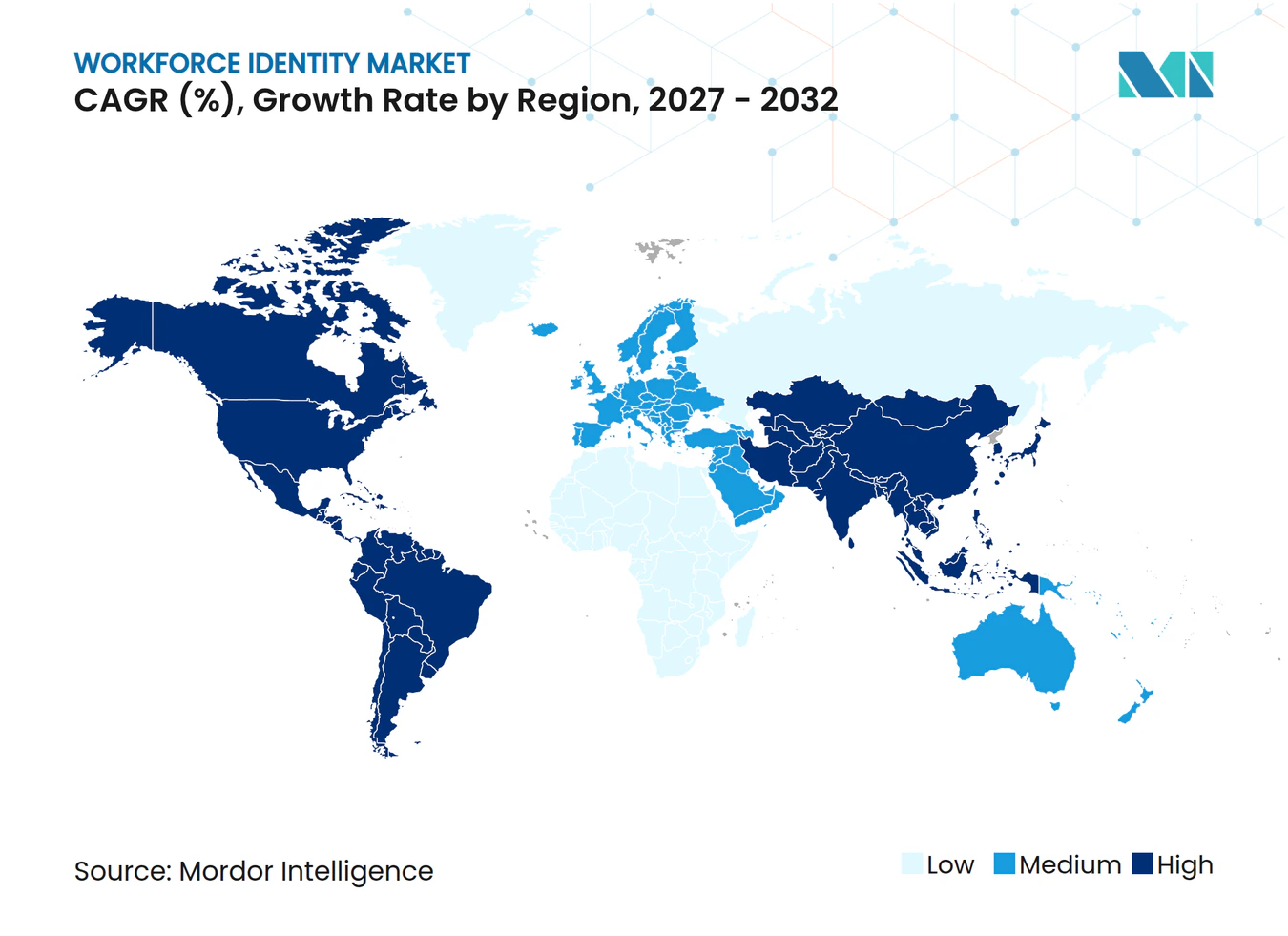
| Fastest Growing Market | Middle East |
| Largest Market | North America |
| Market Concentration | Medium |
Major Players *Disclaimer: Major Players sorted in no particular order Image © Mordor Intelligence. Reuse requires attribution under CC BY 4.0. | |
Workforce Identity Market Analysis by Mordor Intelligence
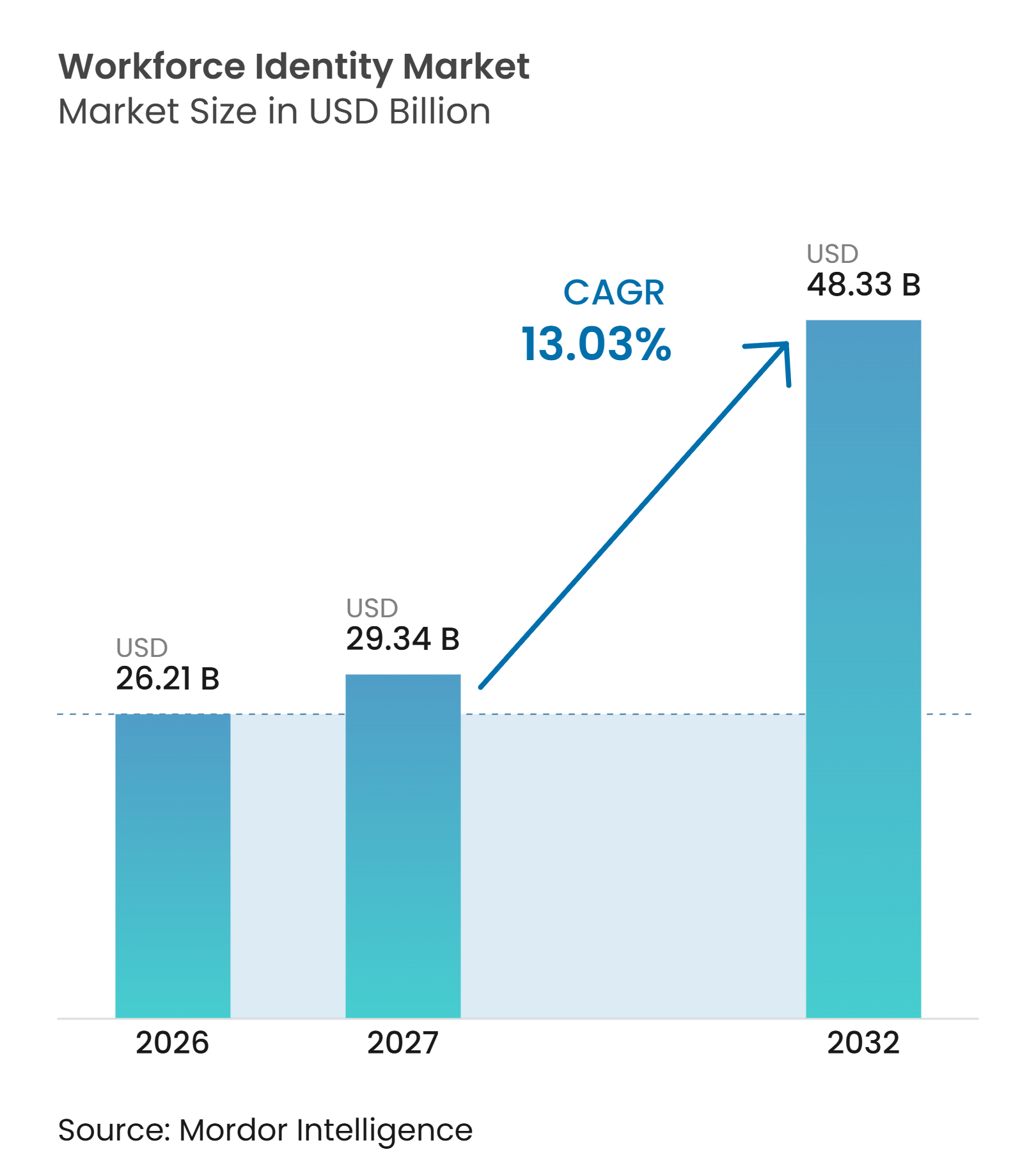
The workforce identity market size is projected to expand from USD 26.21 billion in 2026 to USD 48.33 billion by 2032, registering a CAGR of 13.03% between 2027 and 2032. The workforce identity market is moving from perimeter-led security toward identity-centered controls that work across cloud, on-premises, and edge environments. Regulatory requirements have made auditable identity governance a higher priority for financial services and critical infrastructure operators. This change shifts identity programs from discretionary technology spending toward a core control for access, compliance, and operational resilience. Platform breadth is becoming more important as buyers seek joined-up authentication, governance, privileged access, and threat response capabilities. At the same time, legacy directory environments, data-residency rules, modernization costs, and latency in industrial settings can delay deployment decisions.
Key Report Takeaways
- By offering, solutions held 82.06% share in 2026.
- By capability, workforce authentication and single sign-on held the largest share in 2026, while identity threat detection and response is projected to expand at a 14.78% CAGR through 2032.
- By organization size, large enterprises held 78.82% of the workforce identity market share in 2026, while SMEs are projected to expand at a 14.42% CAGR through 2032.
- By end-user vertical, BFSI accounted for 20.99% of the workforce identity market size in 2026, while IT and telecommunications is projected to expand at a 14.91% CAGR through 2032.
- By geography, North America held 43.51% share in 2026, while the Middle East is the fastest-growing regional segment.
Note: Market numbers in this report are based on Mordor Intelligence's proprietary estimation framework, which combines nine months of actuals with Q4 projections for base year 2026.
Market Trends and Insights
Drivers Impact Analysis of Workforce Identity Market*
| Driver | (~) % Impact on CAGR Forecast | Geographic Relevance | Impact Timeline |
|---|---|---|---|
| Expansion of Zero Trust Access Architectures | +2.8% | Global | Short term (≤ 2 years) |
| Cloud and SaaS Sprawl Across Hybrid Enterprises | +2.3% | Global, particularly North America and Europe | Short term (≤ 2 years) |
| Rising Identity Fraud and Account Takeover Attempts | +2.1% | Global, most acute in North America and Asia-Pacific | Short term (≤ 2 years) |
| Regulatory Pressure for Stronger Access Governance | +1.9% | Europe and North America primarily | Medium term (2-4 years) |
| AI Agent Identity Governance Entering Workforce IAM Budgets | +1.7% | Global, leading in North America and Asia-Pacific | Medium term (2-4 years) |
| Digital Public Identity Rails Extending Into Employer Access | +1.3% | Europe and Middle East | Long term (≥ 4 years) |
| Source: Mordor Intelligence | |||
Expansion of Zero Trust Access Architectures
Zero trust is becoming a procurement requirement rather than a security concept for the workforce identity market. AlgoSec reported that 56% of businesses were fully or partly implementing zero trust in 2025.[1] HPE and Cybersecurity Insiders found that 82% of organizations considered universal zero trust network access essential, while 17% had fully implemented it.[2] This gap supports multi-year buying programs because access decisions must be checked repeatedly against changing risk signals. Open Systems found that only 8-9% of surveyed organizations had a fully integrated zero trust architecture in January 2026. Vendors that connect single sign-on, privileged access, and real-time detection can address fragmented implementation plans.
Cloud and SaaS Sprawl Across Hybrid Enterprises
SaaS adoption has added accounts, permissions, and data-sharing routes faster than many organizations can govern them. This creates a clear need for the workforce identity market because each unmanaged application adds access rights that may not follow standard lifecycle controls. Omada reported in 2025 that nearly 4 in 10 organizations had not deployed SaaS-based identity governance solutions. Organizations with many SaaS applications and multiple identity providers may prefer orchestration tools over a full replacement of existing systems. This approach can apply consistent policies while avoiding a disruptive migration.
Rising Identity Fraud and Account Takeover Attempts
Account takeover has become a major security concern and raises the value of continuous identity monitoring. Sift reported that 83% of organizations experienced at least 1 account takeover incident, while the attack rate reached 2.5% in the second quarter of 2025.[3] TransUnion recorded a 21% increase in digital account takeover volume from the first half of 2024 to the first half of 2025. AuthenticID found that 68% of businesses encountered workforce-related fraud, with employee impersonation the most common type. Credential theft can exploit the space between authentication, governance, and detection systems. Continuous session risk scoring can therefore draw funding from security teams that previously treated endpoint security and identity controls separately.
Regulatory Pressure for Stronger Access Governance
Regulatory obligations have expanded the access-governance requirements facing the workforce identity market. DORA applied from January 17, 2025, and makes identity management, lifecycle controls, and traceable access records relevant to European financial entities. PCI DSS v4.0.1 required multi-factor authentication for cardholder-data access from March 31, 2025. NIST finalized SP 800-63-4 on July 31, 2025, updating assurance guidance for digital identity systems. NIS2 also extends security and access-control obligations across 18 critical sectors. These frameworks can shorten purchasing decisions because organizations must produce evidence of controlled access during reviews.
Restraints Impact Analysis of Workforce Identity Market*
| Restraint | (~) % Impact on CAGR Forecast | Geographic Relevance | Impact Timeline |
|---|---|---|---|
| Integration Complexity With Legacy Directory Environments | -1.4% | Global, most severe in industrial and regulated sectors | Long term (≥ 4 years) |
| High Cost of Enterprise-Scale IAM Modernization | -1.1% | Global, most acute in emerging markets and SMEs | Medium term (2-4 years) |
| Data-Residency Fragmentation in Middle East Deployments | -0.7% | Middle East, spill-over to North Africa | Medium term (2-4 years) |
| Authentication Latency Constraints in Industrial Edge Environments | -0.5% | Industrial regions globally | Short term (≤ 2 years) |
| Source: Mordor Intelligence | |||
Integration Complexity With Legacy Directory Environments
Legacy Active Directory environments remain deeply connected to on-premises applications and can slow modernization across the workforce identity market. Their total cost includes hardware refreshes, identity bridges, virtual private network maintenance, and duplicate access-control layers. Strata Identity estimated that annual legacy identity-provider renewal costs can range from USD 5 million to USD 10 million, before related infrastructure and services costs. A 2025 scientific study found that AI-assisted IAM migration reduced manual effort by 30% and cut costs by USD 160,000 in mid-scale projects, although policy-mapping errors still required human remediation. Complex directory consolidation can extend sales cycles by 12-18 months beyond standard enterprise SaaS evaluations. This delay can limit near-term revenue even when the organization accepts the strategic case for modernization.
High Cost of Enterprise-Scale IAM Modernization
Enterprise identity modernization is a multi-year capital commitment that can lose momentum during procurement. Directory migration services can exceed USD 2 million for large environments. Programs that cross cloud and on-premises systems can reveal undocumented application dependencies and create scope changes. Smaller organizations face a sharper barrier because services are still needed to connect ERP, HR, and communication platforms. Subscription-based identity governance lowers the initial software expense but does not remove integration work. Modular offers that begin with single sign-on or passwordless authentication can reduce the upfront commitment and support staged adoption.
*Our forecasts treat driver/restraint impacts as directional, not additive. The impact forecasts reflect baseline growth, mix effects, and variable interactions.
Workforce Identity Market Segment Analysis
By Offering:
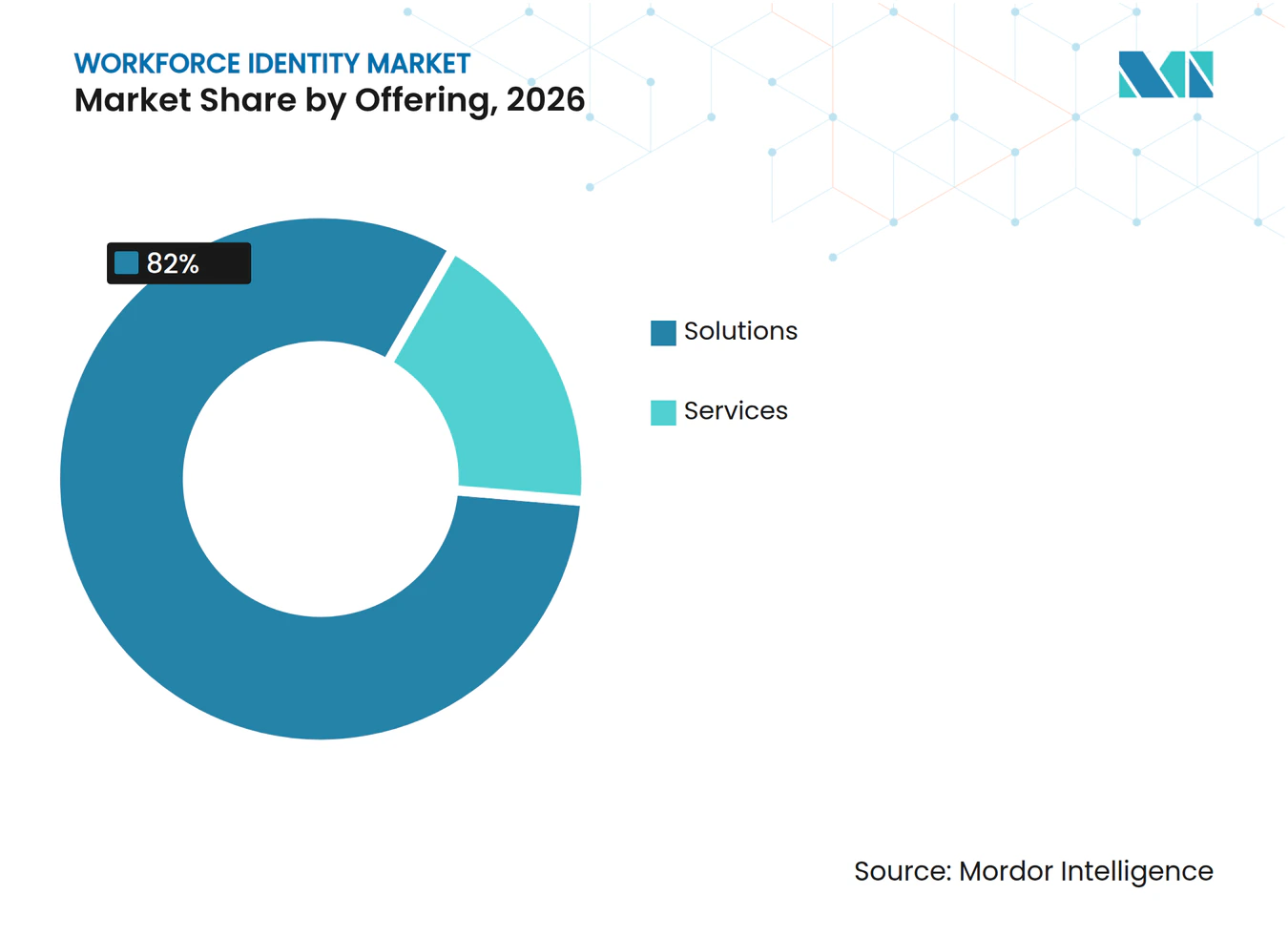
Solutions Lead Workforce Identity DeploymentsSolutions accounted for 82.06% of the workforce identity market share in 2026. This position reflects the preference for software platforms that remain embedded within an organization after implementation work is complete. Workforce identity functions require continuing decisions on authentication, access certification, and privilege escalation. These functions need to operate in real time across a changing application estate. Cloud-native and SaaS delivery have also lowered the upfront commitment associated with older on-premises deployments.
Services remain important for implementation, managed detection, and longer transformation programs. Their role is more complementary when low-code connectors and AI-assisted provisioning reduce the need for external help on routine governance tasks. Buyers still need specialist support to map policies, connect legacy applications, and manage high-risk cutovers. The workforce identity market is therefore likely to retain services revenue alongside the larger solutions base. Vendors with broad administration, authentication, and identity-security capabilities can give customers a more unified operating model.


By Capability:
Identity Threat Detection and Response Gains MomentumIdentity threat detection and response is projected to expand at a 14.78% CAGR through 2032 in the workforce identity market. Workforce authentication and single sign-on held the largest capability share in 2026 because they are used across employees, contractors, and other workforce groups. Strong and auditable authentication is also supported by regulatory requirements. Static access reviews cannot identify a session hijack or privilege escalation while it is happening. This limitation supports closer links among identity threat detection and response, privileged access management, and identity governance.
Identity governance and administration and privileged access management sit in the middle of the capability stack. Privileged access management is gaining attention as secrets management and just-in-time access become more relevant to cloud workloads, developers, and AI agents. Passwordless and biometric authentication are receiving greater enterprise interest as credential theft rises and password-only controls become less suitable. Directory, credential, lifecycle, and provisioning services remain foundational functions. Their lower growth reflects their increasing inclusion in broader platform suites rather than stand-alone purchases.
By Organization Size:
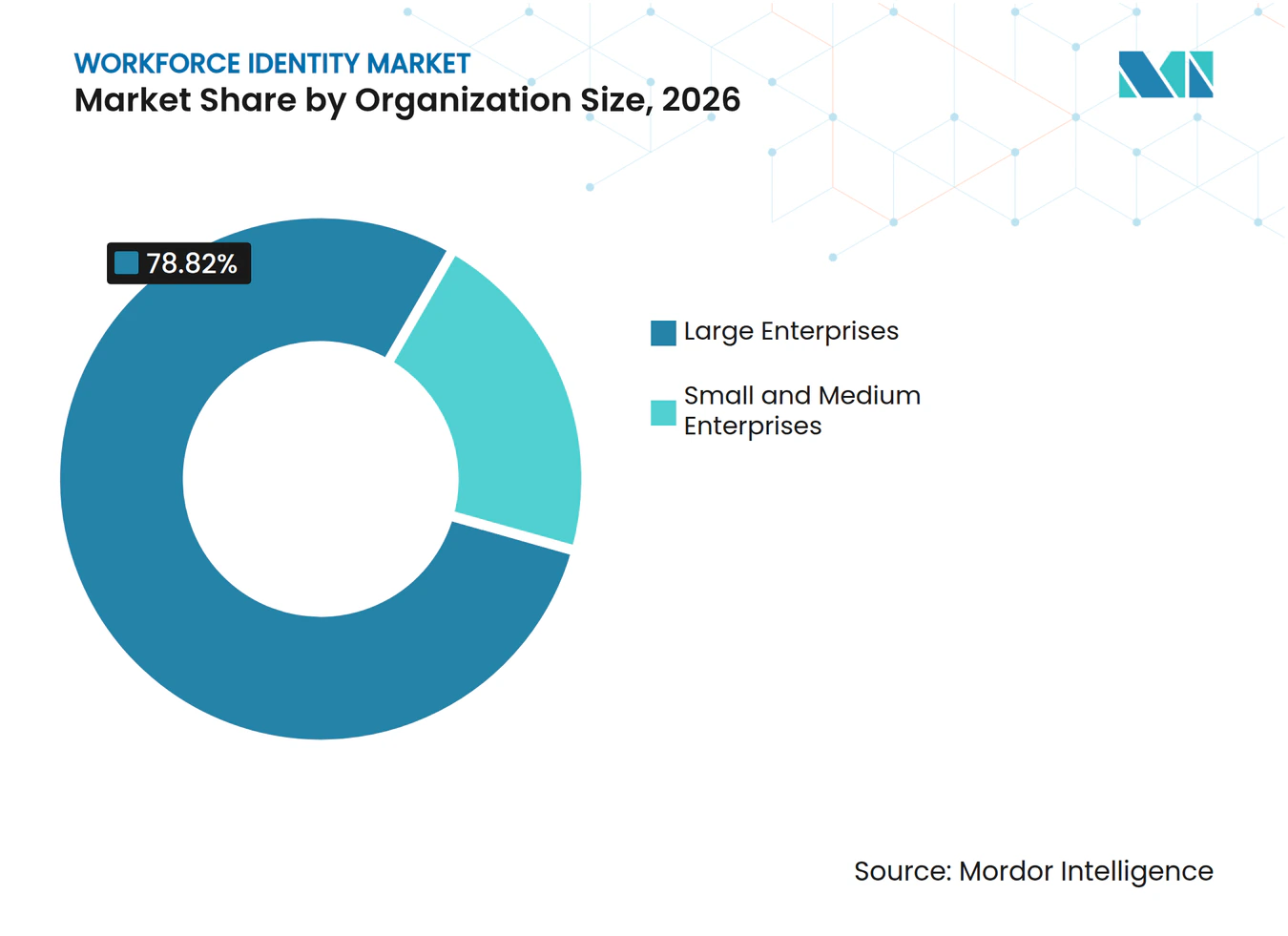
Large Enterprises Lead While SMEs ExpandLarge enterprises commanded 78.82% share in 2026. Their estates can include hundreds of applications, cross-functional provisioning, regulatory audit trails, and human and non-human identities across multiple clouds. These conditions make identity governance a core investment rather than an optional control. Large organizations are also the principal customers for platforms that cover governance, privileged access, threat detection, and authentication. Their need to connect ERP, HR, and operational systems favors broad platforms.
SMEs are projected to expand at a 14.42% CAGR through 2032. Subscription-based IAM has reduced capital barriers and made more functions available through cloud delivery. Supply-chain security obligations and cyber-insurance criteria are also increasing the need for documented access policies. The workforce identity industry is responding with self-service onboarding and modular capability stacks. JumpCloud reported in October 2026 that 59% of organizations using AI agents did not apply the same governance rules used for human users. This gap may be particularly difficult for mid-market organizations without dedicated identity governance teams.

By End-User Vertical:
IT and Telecommunications Sets the Fastest PaceIT and telecommunications is projected to expand at a 14.91% CAGR through 2032. The sector manages developer identities, service accounts, API credentials, CI/CD tokens, cloud workloads, and standard workforce accounts at the same time. These identities and entitlements can change daily. Quarterly access reviews may not keep pace with these changes. This makes continuous policy enforcement more relevant for this part of the workforce identity market.
BFSI represented 20.99% of revenue in 2026. Financial services has long faced demanding controls, and DORA adds a direct operational-resilience requirement for European entities. Healthcare and life sciences face HIPAA obligations in the United States and broader NIS2 duties in Europe. Government and public administration deployments may need to connect enterprise access systems with digital identity wallets, including the EUDI Wallet. Retail, energy, and industrial manufacturing also need access controls, but operational technology can add legacy protocols, air-gapped networks, and real-time availability limits.
Geography Analysis
North America Workforce Identity Market
North America held 43.51% of the workforce identity market size in 2026. The region combines a large base of regulated enterprises, advanced zero trust activity, and a mature ecosystem for identity technology investment. The United States accounts for the largest regional revenue base and hosts vendors including Okta, BeyondTrust, JumpCloud, Saviynt, and SailPoint. Canada has advanced federal cloud adoption and digital identity investment through its Digital Ambition 2022-2026 initiative. Mexico remains at an earlier stage, but nearshore manufacturing and digital banking are adding workforce access-governance needs.
Europe and APAC Workforce Identity Market
Europe is shaped strongly by its regulatory calendar. NIS2 implementation and DORA enforcement have made identity governance a key resilience requirement for financial and critical-infrastructure operators. The European Digital Identity framework requires member states to make certified EUDI Wallets available by the end of 2026, and employer-facing verification workflows may become more relevant as employment credential use cases are tested through the DC4EU pilot. Asia-Pacific includes markets with different conditions, while India’s IT services sector has substantial contractor and offshore-workforce identity needs.
MEA Workforce Identity Market
The Middle East is the fastest-growing regional part of the workforce identity market. Saudi Arabia and the UAE are the main demand centers, supported by sovereign digitization programs and data-residency expectations. Saudi Arabia’s cross-border data-transfer rules entered enforcement in 2025. These requirements can require in-country processing and raise the cost of cross-border deployments. Africa, led by South Africa and Nigeria, remains earlier in adoption, but digital banking and public-sector digitization are broadening formal access-governance needs.
Competitive Landscape
Market Concentration
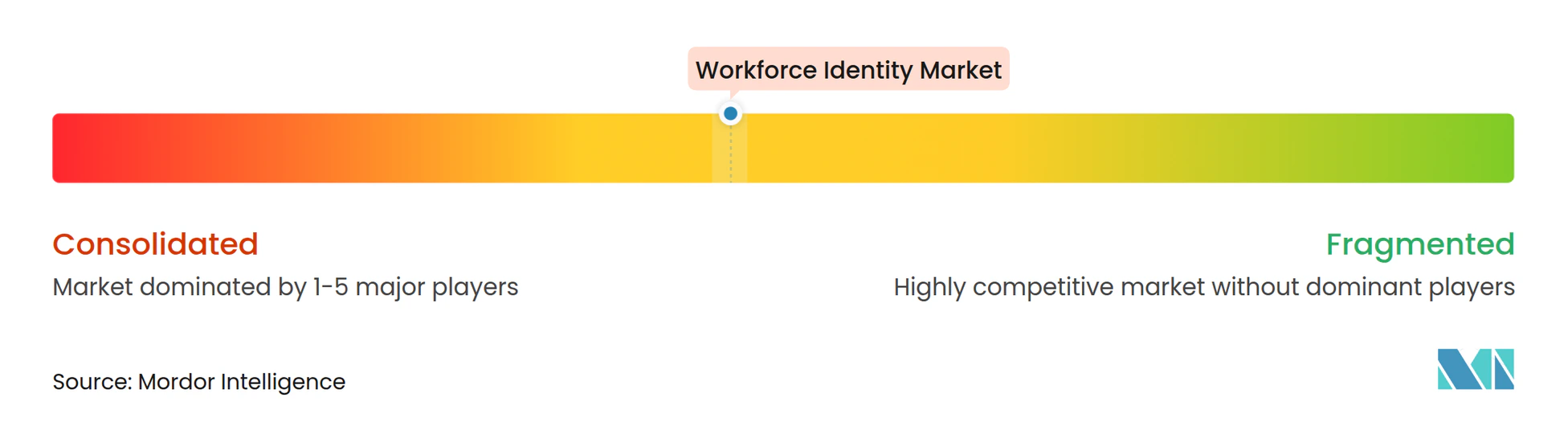
The workforce identity market is moderately consolidated at the top tier and fragmented across the mid-market. Platform vendors are competing on the ability to join IAM, identity governance, privileged access management, and identity threat detection and response within one policy framework. Palo Alto Networks completed the CyberArk acquisition in February 2026 for USD 25 billion and presented the combined identity-security offer as Idira in May 2026. This move combined privileged access, governance, and detection functions with a broader security portfolio, raising the competitive challenge for point products that cannot match a wider platform scope.
Okta, SailPoint, and Idira represent the platform-led part of the workforce identity market. Okta made Okta for AI Agents generally available in April 2026, adding agent identities, human-owner assignment, short-lived tokens, governance workflows, and a kill switch. SailPoint announced IdentityIQ 9.0 in October 2026, adding granular time-based access and a rebuilt application-server foundation for customized on-premises environments. Saviynt exceeded USD 300 million in ARR in July 2026 and launched its Zuma AI identity security platform. These moves show how vendors are extending their platforms toward AI-agent governance and hybrid deployment requirements.
Non-human identity governance remains less mature than workforce controls for people. Service accounts, API tokens, machine identities, and AI agents require lifecycle and access-management approaches that many organizations have not yet standardized. The Coalition for Secure AI released an agentic identity and access control framework in April 2026, while the IETF is developing work on AI identity management. SMEs also remain a target for cloud-native, modular offers. Sovereign-cloud-compatible deployments present a focused opportunity in Middle East regulated sectors where local processing requirements are material.
Workforce Identity Industry Leaders
-
Microsoft Corporation
-
Okta, Inc.
-
Palo Alto Networks
-
Ping Identity Corporation
-
SailPoint Technologies Holdings, Inc.
- *Disclaimer: Major Players sorted in no particular order
Workforce Identity Market Companies Covered in this Report
- Okta, Inc.
- Ping Identity Corporation
- SailPoint Technologies Holdings, Inc.
- Palo Alto Networks
- BeyondTrust Corporation
- One Identity LLC
- Saviynt, Inc.
- JumpCloud, Inc.
- OneLogin, Inc.
- SecureAuth Corporation
- Fischer Identity, Inc.
- Avatier Corporation
- StrongDM, Inc.
- Transmit Security Ltd.
- Descope, Inc.
- Strata Identity, Inc.
- Simeio Solutions, LLC
- Apono, Inc.
- Oasis Security Ltd.
- Authsignal, Inc.
Recent Industry Developments in Workforce Identity Market
- October 2026: SailPoint announced IdentityIQ 9.0 and enterprise-scale enhancements to its SailPoint Human Fabric platform at its Navigate conference. IdentityIQ 9.0 introduces granular, time-based access for roles and entitlements and a rebuilt application server foundation, providing a modernization path for customers with data-residency requirements or highly customized on-premises environments that cannot migrate to cloud-native platforms on standard timelines.
- October 2026: JumpCloud published research revealing that more than half of organizations using AI agents allow those agents to modify systems, permissions, or files, but 59% do not apply the same governance rules as for human users. JumpCloud simultaneously extended its Agentic IAM platform to govern AI agents alongside human employees and devices, including audit trails, human-owner assignment, and just-in-time privileged access for agent workloads.
- September 2026: JumpCloud extended its Agentic IAM capabilities, enabling IT teams to govern AI agents across data, applications, and tasks with verifiable identity, explicit access boundaries, and lifecycle governance, including an AI Gateway that routes unsanctioned Model Context Protocol connections through centralized policy enforcement.
- July 2026: Saviynt, Inc. surpassed USD 300 million in annual recurring revenue (ARR) and launched Zuma, an enterprise AI identity security platform. New customer acquisitions grew over 80% year over year. Saviynt also integrated with Snowflake to govern third-party AI agents accessing business data across platforms.
Global Workforce Identity Market Report Scope
The Workforce Identity Market is Segmented by Offering (Solutions, Services), Capability (Workforce Authentication and Single Sign-On, Identity Governance and Administration, Privileged Access Management, Identity Lifecycle Management and Provisioning, Directory and Credential Services, Identity Threat Detection and Response, and Passwordless and Biometric Authentication), Organization Size (Large Enterprises, Small and Medium Enterprises), End-User Vertical (Banking, Financial Services, and Insurance, Government and Public Administration, Healthcare and Life Sciences, IT and Telecommunications, Retail and E-Commerce, Energy and Utilities, Industrial Manufacturing, and Other End-User Verticals), and Geography (North America, South America, Europe, Asia-Pacific, Middle East, Africa). The Market Forecasts are in Value (USD).
Segmentation Overview
| Solutions |
| Services |
| Workforce Authentication and Single Sign-On |
| Identity Governance and Administration |
| Privileged Access Management |
| Identity Lifecycle Management and Provisioning |
| Directory and Credential Services |
| Identity Threat Detection and Response |
| Passwordless and Biometric Authentication |
| Large Enterprises |
| Small and Medium Enterprises |
| Banking, Financial Services, and Insurance |
| Government and Public Administration |
| Healthcare and Life Sciences |
| IT and Telecommunications |
| Retail and E-Commerce |
| Energy and Utilities |
| Industrial Manufacturing |
| Other End-User Verticals |
| North America | United States |
| Canada | |
| Mexico | |
| South America | Brazil |
| Argentina | |
| Rest of South America | |
| Europe | Germany |
| United Kingdom | |
| France | |
| Italy | |
| Spain | |
| Russia | |
| Rest of Europe | |
| Asia-Pacific | China |
| India | |
| Japan | |
| South Korea | |
| Australia | |
| Rest of Asia-Pacific | |
| Middle East | Saudi Arabia |
| United Arab Emirates | |
| Turkey | |
| Rest of the Middle East | |
| Africa | South Africa |
| Nigeria | |
| Rest of Africa |
| By Offering | Solutions | |
| Services | ||
| By Capability | Workforce Authentication and Single Sign-On | |
| Identity Governance and Administration | ||
| Privileged Access Management | ||
| Identity Lifecycle Management and Provisioning | ||
| Directory and Credential Services | ||
| Identity Threat Detection and Response | ||
| Passwordless and Biometric Authentication | ||
| By Organization Size | Large Enterprises | |
| Small and Medium Enterprises | ||
| By End-User Vertical | Banking, Financial Services, and Insurance | |
| Government and Public Administration | ||
| Healthcare and Life Sciences | ||
| IT and Telecommunications | ||
| Retail and E-Commerce | ||
| Energy and Utilities | ||
| Industrial Manufacturing | ||
| Other End-User Verticals | ||
| By Geography | North America | United States |
| Canada | ||
| Mexico | ||
| South America | Brazil | |
| Argentina | ||
| Rest of South America | ||
| Europe | Germany | |
| United Kingdom | ||
| France | ||
| Italy | ||
| Spain | ||
| Russia | ||
| Rest of Europe | ||
| Asia-Pacific | China | |
| India | ||
| Japan | ||
| South Korea | ||
| Australia | ||
| Rest of Asia-Pacific | ||
| Middle East | Saudi Arabia | |
| United Arab Emirates | ||
| Turkey | ||
| Rest of the Middle East | ||
| Africa | South Africa | |
| Nigeria | ||
| Rest of Africa | ||
Key Questions Answered in the Report
What is the workforce identity sector size?
The sector is projected to expand from USD 26.21 billion in 2026 to USD 48.33 billion by 2032, at a 13.03% CAGR from 2027 to 2032.
What is driving demand for workforce identity platforms?
Zero trust adoption, SaaS sprawl, account takeover risk, and stronger access-governance requirements are increasing demand.
Which workforce identity offering has the largest share?
Solutions held 82.06% share in 2026 because enterprises need continuously operating identity platforms.
Which capability is expanding most quickly?
Identity threat detection and response is projected to expand at a 14.78% CAGR through 2032.
Which organizations are the main buyers of workforce identity platforms?
Large enterprises held 78.82% share in 2026, while SMEs are projected to expand at a 14.42% CAGR through 2032.
Which region leads workforce identity adoption?
North America held 43.51% share in 2026, while the Middle East is the fastest-growing region.