
Identity Lifecycle Management Market Size and Share
Market Overview
| Study Period | 2021 - 2032 |
|---|---|
| Market Size (2027) | USD 7.41 Billion |
| Market Size (2032) | USD 14.02 Billion |
| Growth Rate (2027 - 2032) | 13.91 % |
| Fastest Growing Market | Asia-Pacific |
| Largest Market | North America |
| Market Concentration | Medium |
Major Players *Disclaimer: Major Players sorted in no particular order Image © Mordor Intelligence. Reuse requires attribution under CC BY 4.0. | |
Identity Lifecycle Management Market Analysis by Mordor Intelligence
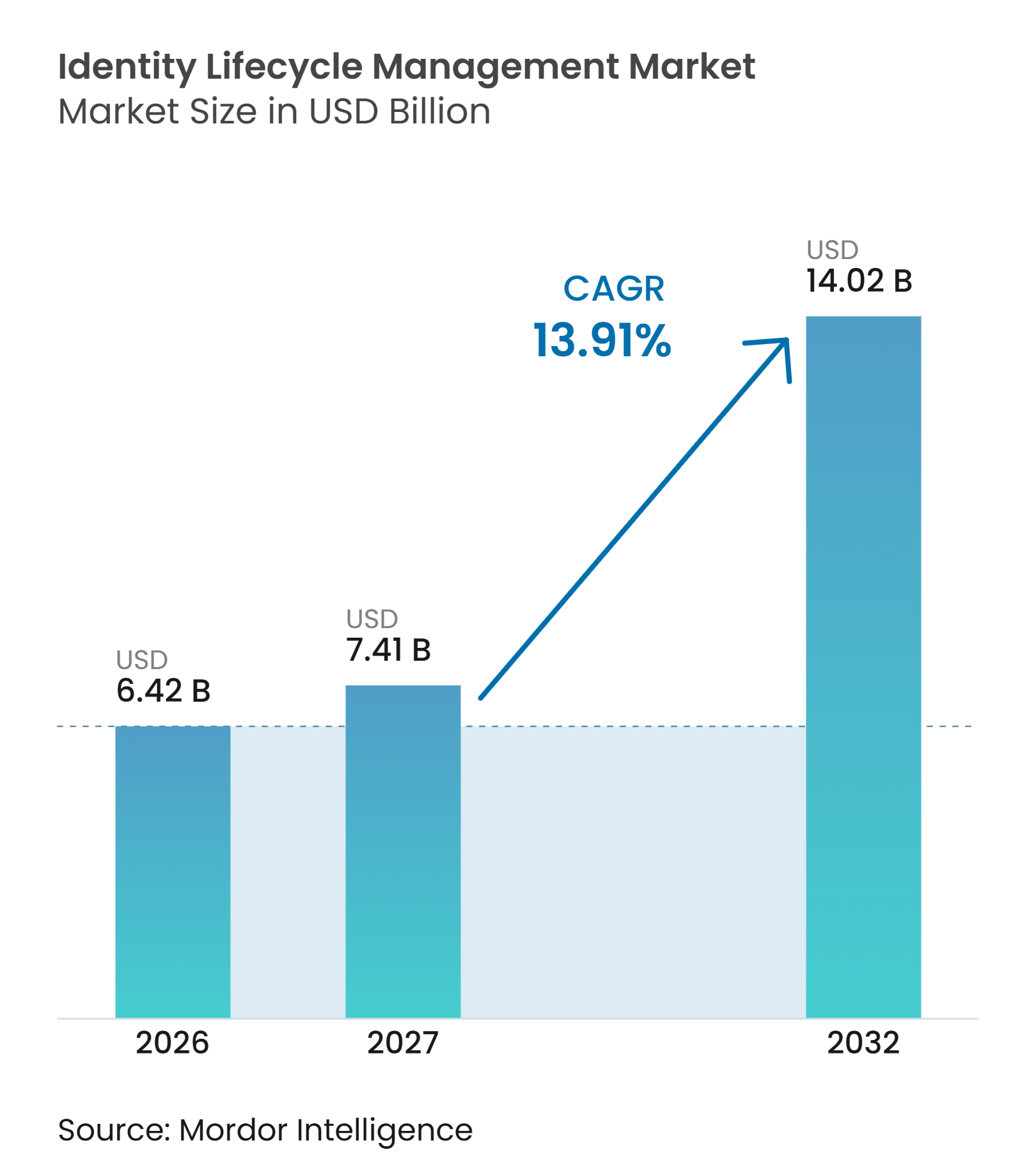
The identity lifecycle management market size is projected to expand from USD 6.42 billion in 2026 to USD 14.02 billion by 2032, registering a CAGR of 13.91% between 2027 and 2032. The identity lifecycle management market is moving beyond employee accounts as service accounts, API keys, machine workloads, and AI agents become important governance concerns that can sit outside the ownership and review models created for a conventional workforce. Organizations increasingly need controls that work continuously within operating processes instead of relying on periodic manual access reviews, especially when access can change quickly as workers move roles, cloud applications are added, and automated systems receive new credentials. This need favors platforms that can connect provisioning, access certification, role analysis, and policy enforcement, while maintaining a record that security teams, auditors, and business owners can understand. Regulatory duties, cloud adoption, and zero-trust programs are raising the priority of these capabilities across regulated organizations, where access governance must align with day-to-day operating requirements rather than be managed as a separate annual exercise. The identity lifecycle management market also faces a practical constraint because qualified specialists remain scarce, which can delay implementation even after budgets are approved and can make simpler deployment approaches more attractive to organizations with limited internal resources.
Key Report Takeaways
- By component, solutions held 74.56% of the identity lifecycle management market share in 2026 and are projected to expand at a 14.62% CAGR through 2032.
- By deployment model, cloud-based delivery is projected to expand at a 14.78% CAGR through 2032.
- By identity type, workforce identities held 40.56% of the identity lifecycle management market share in 2026, while AI-agent identities are projected to expand at a 14.86% CAGR through 2032.
- By organization size, large enterprises accounted for 78.68% of revenue in 2026, while small and medium enterprises are projected to expand at a 14.59% CAGR through 2032.
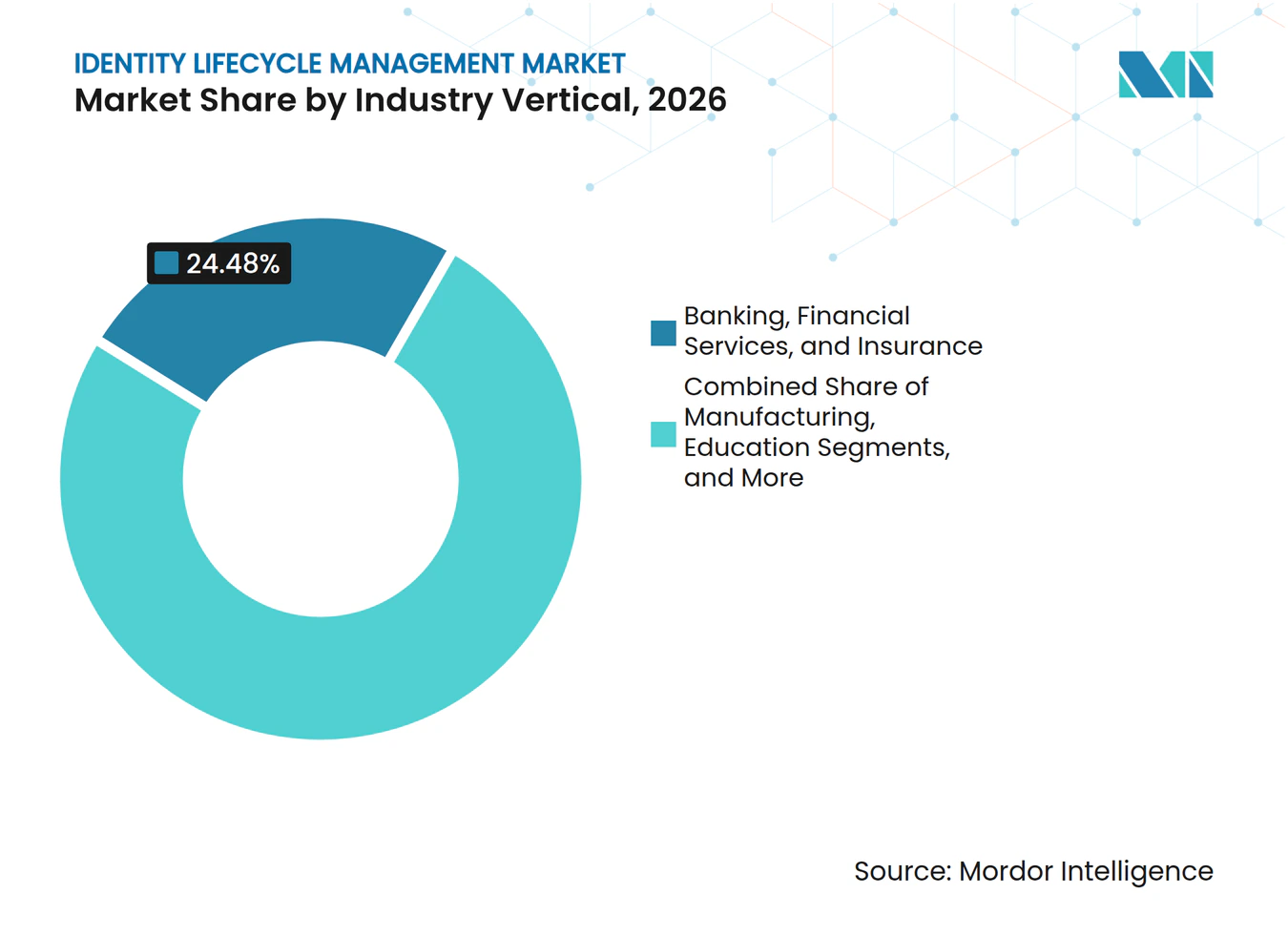
- By industry vertical, banking, financial services, and insurance accounted for 24.48% of revenue in 2026, while IT and telecom is projected to expand at a 14.83% CAGR through 2032.
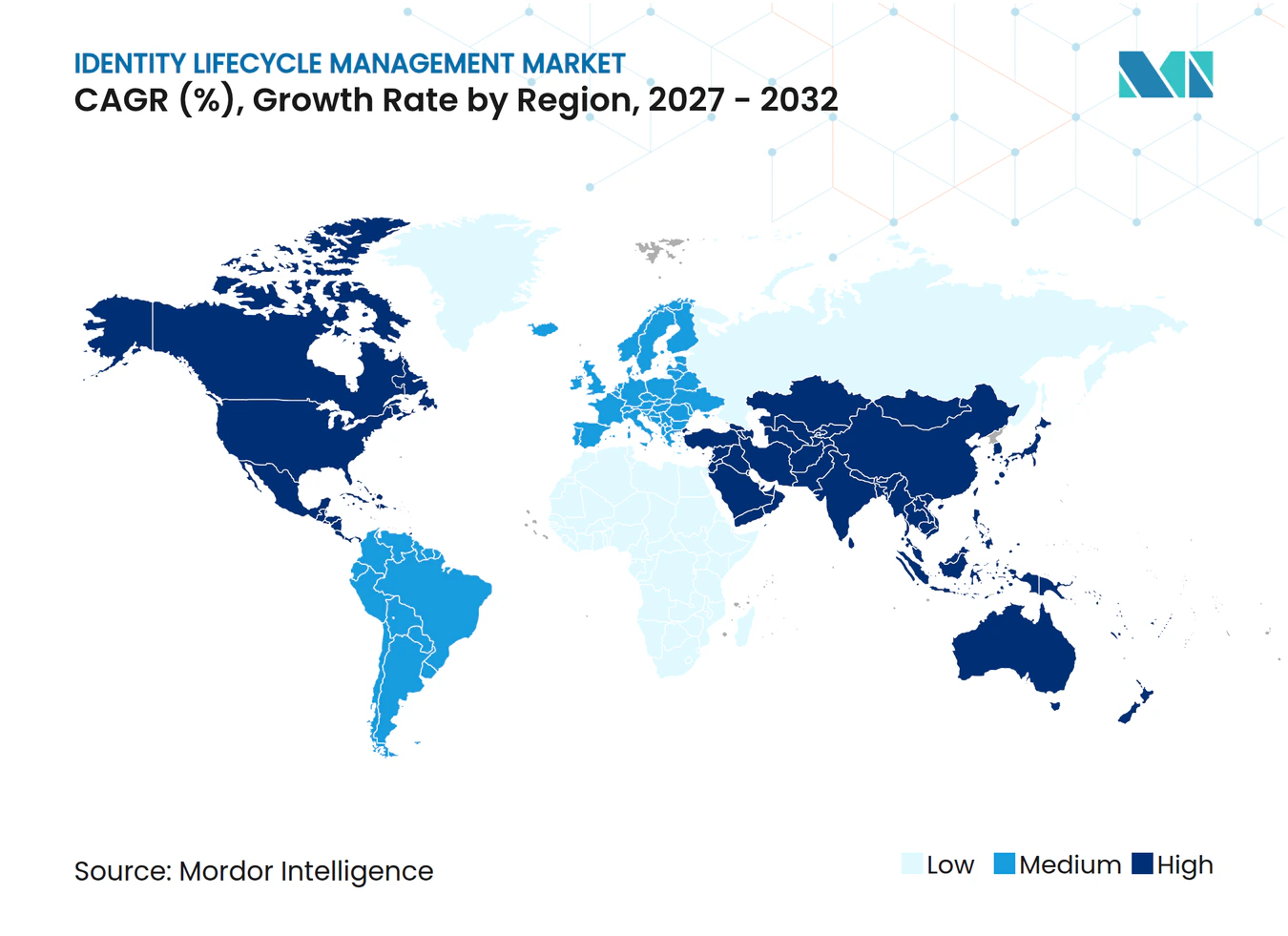
- By geography, North America accounted for 41.67% of revenue in 2026, while Asia-Pacific is projected to expand at a 14.78% CAGR through 2032.
Note: Market numbers in this report are based on Mordor Intelligence's proprietary estimation framework, which combines nine months of actuals with Q4 projections for base year 2026.
Market Trends and Insights
Drivers Impact Analysis of Identity Lifecycle Management Market*
| Driver | (~) % Impact on CAGR Forecast | Geographic Relevance | Impact Timeline |
|---|---|---|---|
| Regulatory Compliance and Audit Automation | +2.8% | Global, highest intensity in Europe and North America | Short term (≤ 2 years) |
| Hybrid and Multi-Cloud Identity Sprawl | +2.3% | Global, Asia-Pacific core, with spillover to the Middle East and Africa | Medium term (2-4 years) |
| Zero-Trust and Least-Privilege Programs | +2.0% | North America and Europe | Medium term (2-4 years) |
| Machine and AI-Agent Identity Governance | +1.8% | Global, led by North America | Long term (≥ 4 years) |
| Identity Lifecycle Automation for Distributed Workforces | +1.5% | Global, with early concentration in North America and Europe | Medium term (2-4 years) |
| Continuous Access Certification and Risk Analytics | +1.0% | North America and Europe | Medium term (2-4 years) |
| Source: Mordor Intelligence | |||
Regulatory Compliance and Audit Automation
Regulatory requirements have made identity lifecycle management a compliance priority for many organizations because access administration is now examined as part of wider operational resilience and cybersecurity programs. The Digital Operational Resilience Act has applied since January 17, 2025, and its requirements for financial entities include regular review of access to critical ICT systems and prompt removal of rights after termination. These duties strengthen the case for automated provisioning and deprovisioning because manual evidence collection and manual removal processes are difficult to apply consistently across large, changing user populations. NIS2 applies to 18 critical-sector verticals and identifies access control and asset management as important cybersecurity measures, widening the group of organizations that must make access practices more formal. ISO/IEC 27001:2022 also keeps access-control requirements central to information security programs, which reinforces the need for policies, records, and clear responsibility over access decisions. The identity lifecycle management market benefits when regulated mid-sized organizations modernize systems that had previously been deferred, particularly where new duties make informal access practices harder to defend during an audit.
Hybrid and Multi-Cloud Identity Sprawl
The identity lifecycle management market is being shaped by enterprise environments that combine cloud platforms, on-premises directories, and large SaaS application portfolios with different data models and access administration practices. A single employee can hold different access entitlements in Active Directory, Entra ID, AWS IAM, and multiple SaaS tenants, making it difficult for a reviewer to understand the person’s effective access without connecting separate records. These parallel records can become inconsistent when access changes are not coordinated, when applications use different identifiers, or when local teams maintain their own approval procedures. Migration projects can add further entitlement debt because permissions created for project teams may remain after a production launch, even after the underlying project responsibilities have ended. Long-standing access can then appear during a certification review without a clear business owner, a documented purpose, or evidence that the entitlement is still necessary. Continuous discovery and event-based deprovisioning help organizations create a more complete and auditable access record while reducing the persistence of permissions that were created for temporary needs.
Zero-Trust and Least-Privilege Programs
Zero-trust programs are increasing the frequency and importance of access certification within the identity lifecycle management market because these programs depend on access decisions that remain valid as people, applications, and risk conditions change. NIST SP 800-207 states that access to resources should be authenticated, authorized, and continuously validated, which moves access review from a periodic reporting obligation toward an operational requirement. This principle places least-privilege controls inside normal operations rather than treating them as an annual audit exercise completed after access has already accumulated. Large organizations can face delays when business units disagree about the access required for specific roles, particularly where the same employee supports several products, projects, or regulated processes. AI-assisted role analysis and policy automation can make those decisions more manageable across a broad workforce by identifying patterns that would be difficult to review manually. Without this preparation, zero-trust programs may stall when access governance needs to be put into practice across business units with different processes and accountability structures.
Machine and AI-Agent Identity Governance
Machine identities include service accounts, API keys, certificates, and autonomous AI agents, which can operate continuously and interact with systems without the visible work patterns associated with employee accounts. These identities have created a security exposure that human-focused lifecycle programs were not designed to manage, especially when the same technical identity is used across several applications or environments. Unregistered AI systems can operate without formal records in enterprise identity directories, leaving permissions, ownership, and potential impact unclear to security and business teams. SailPoint completed its acquisition of Entro Security in June 2026, adding discovery across more than 1,200 credential types, including CI/CD secrets and container registry tokens.[1] ISO/IEC 42001:2023 places lifecycle controls and supplier management within AI management systems, extending governance questions beyond technical credential storage alone. The identity lifecycle management market therefore has a longer-term opportunity in governing credentials tied to machine and AI-agent activity, while helping organizations establish a dependable record of what those identities can access and why.
Restraints Impact Analysis of Identity Lifecycle Management Market*
| Restraint | (~) % Impact on CAGR Forecast | Geographic Relevance | Impact Timeline |
|---|---|---|---|
| Legacy Directory and Mainframe Integration Complexity | -1.6% | Global, most acute in North America and Europe | Medium term (2-4 years) |
| High Implementation and Change-Management Costs | -1.4% | Global, most pronounced among small and medium enterprises | Short term (≤ 2 years) |
| Scarcity of Identity Governance Specialists | -0.9% | Global, with Asia-Pacific and the Middle East and Africa most exposed | Long term (≥ 4 years) |
| Inconsistent Identity Data and Entitlement Ownership | -0.7% | Global | Medium term (2-4 years) |
| Source: Mordor Intelligence | |||
Legacy Directory and Mainframe Integration Complexity
Legacy environments can slow adoption in the identity lifecycle management market because older directory systems and mainframes do not always support modern governance workflows or provide the interfaces needed for current automation tools. Mainframe controls within RACF or ACF2 policies may require middleware or custom scripts for automated provisioning, which adds delivery risk and introduces systems that must be maintained separately. This can make professional services costs equal to or greater than software licensing during a 3-year implementation period, changing the business case that procurement teams initially expected. Financial institutions and government agencies with large mainframe estates may postpone modernization even when senior leaders support the initiative and recognize the compliance implications of old access practices. Prebuilt connectors and managed migration services can reduce the burden for cloud-forward buyers by avoiding some custom work and making deployment more repeatable. Organizations operating core banking workloads on non-modernized infrastructure remain more constrained than organizations with more current environments because the systems that hold the most sensitive access rights can be the hardest to integrate.
High Implementation and Change-Management Costs
Full lifecycle programs require investment in configuration, data mapping, process redesign, training, and organizational change, even where the selected software is delivered as a SaaS service. The work can take longer than planned when organizations cannot identify a clear owner for each entitlement or when different application teams apply different definitions of business need. Informal approval practices across business units add to this challenge because a successful program must convert local knowledge into documented roles, policies, and review procedures. Phased deployment and SaaS delivery can reduce time to value for well-defined initial programs, allowing organizations to begin with a limited group of applications or a priority population. Broad enterprise programs still involve meaningful costs and can delay procurement decisions when leadership cannot confirm the resources needed for data cleanup and continuing administration. This restraint is especially relevant where smaller organizations do not have dedicated identity engineering teams and must balance the program against other cybersecurity priorities.
*Our forecasts treat driver/restraint impacts as directional, not additive. The impact forecasts reflect baseline growth, mix effects, and variable interactions.
Identity Lifecycle Management Market Segment Analysis
By Component:
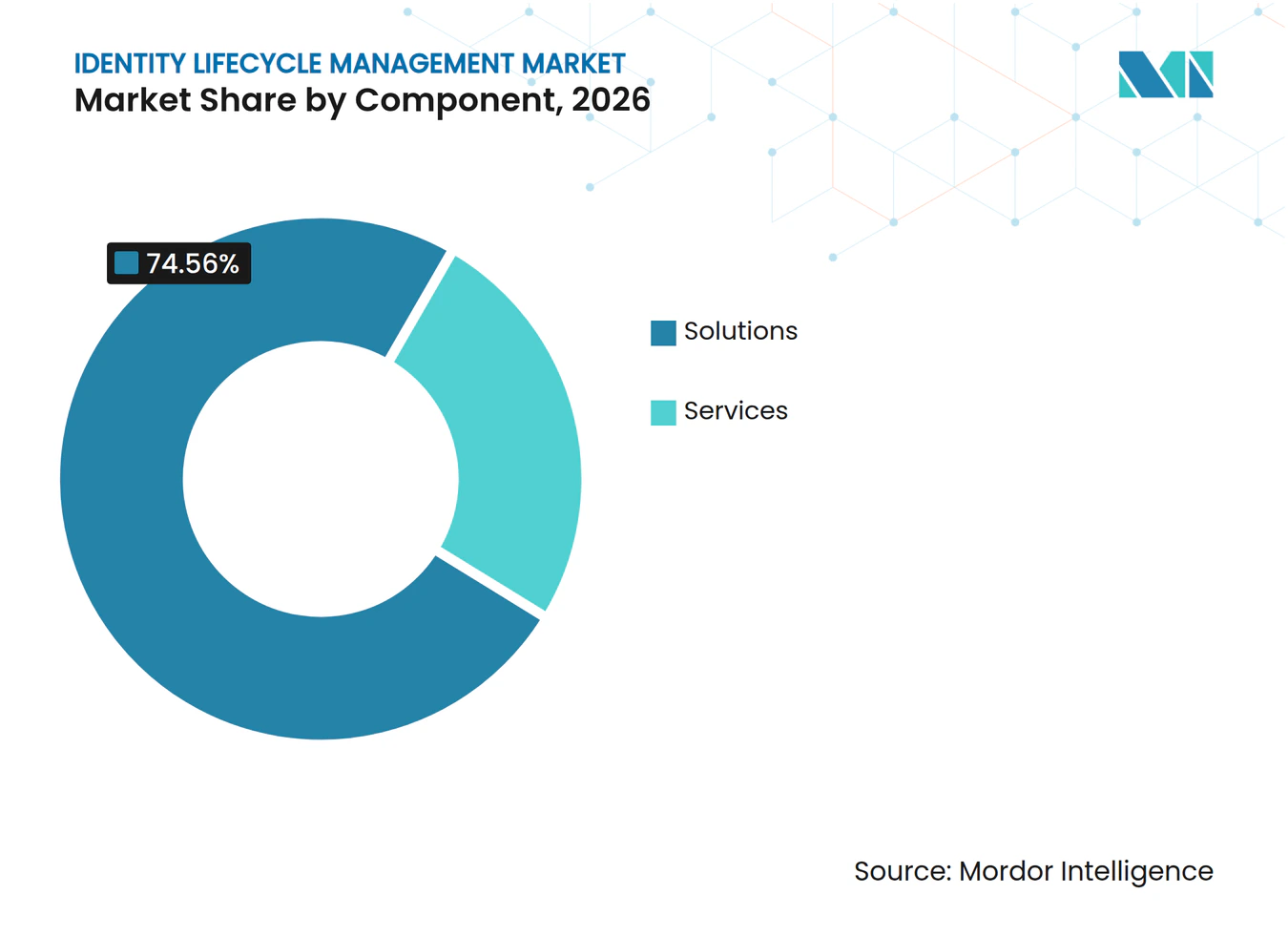
Solutions Anchor Enterprise Identity ProgramsSolutions accounted for 74.56% of the identity lifecycle management market size in 2026. Organizations favor integrated platforms because they unite provisioning, access certification, role analysis, and policy enforcement within 1 governance layer. This approach gives security teams a common view of access assignments that would otherwise be scattered between separate products. Fragmented tooling can recreate the entitlement visibility gaps that a lifecycle program is meant to eliminate. SailPoint introduced its unified Identity Security platform in 2026, combining Agentic Fabric for non-human accounts with Human Fabric for workforce identities. [2]Product breadth and reliable connectors are therefore important selection criteria for buyers that need a consistent control structure across many applications.
Solutions are projected to expand at a 14.62% CAGR between 2027 and 2032. Vendors are adding AI-agent governance and application-level access controls to their core releases because customers need broader coverage from existing platforms. Services remain closely connected to software spending through implementation assistance, managed operations, training, data preparation, and policy design. Their importance rises when hybrid environments add complex integrations and many application owners. Providers that can simplify role mapping, entitlement cleanup, and approval accountability are positioned to support programs that require operational change as well as technology.


By Deployment Model:
Cloud Delivery Reshapes ILM EconomicsCloud-based deployment is projected to expand at a 14.78% CAGR from 2027 to 2032. The SaaS model can scale with the customer environment, update connectors automatically, and remove much of the infrastructure work associated with an on-premises platform. SailPoint reported that SaaS annual recurring revenue increased 39% year over year in fiscal 2025, while its overall annual recurring revenue expanded at a slower pace. The result indicates that regulated enterprise buyers are progressively placing governance workloads in cloud platforms. Cloud-native systems can also provide current audit evidence without relying on batch-based processes that need separate maintenance.
On-premises deployment remains relevant for financial market infrastructure, defense contractors, and operators of critical national infrastructure. These organizations can face data sovereignty requirements that make cloud-only delivery unacceptable for parts of their identity environment. SailPoint released IdentityIQ 9.0 in October 2026 and continued investing in on-premises modernization. JumpCloud launched Agentic IAM on Google Cloud in June 2026, extending governance to autonomous workloads.[3]Hybrid deployment lets organizations shift governance orchestration to the cloud while keeping directory infrastructure on premises. This model allows staged modernization when a complete infrastructure replacement would introduce unnecessary operational risk.
By Identity Type:
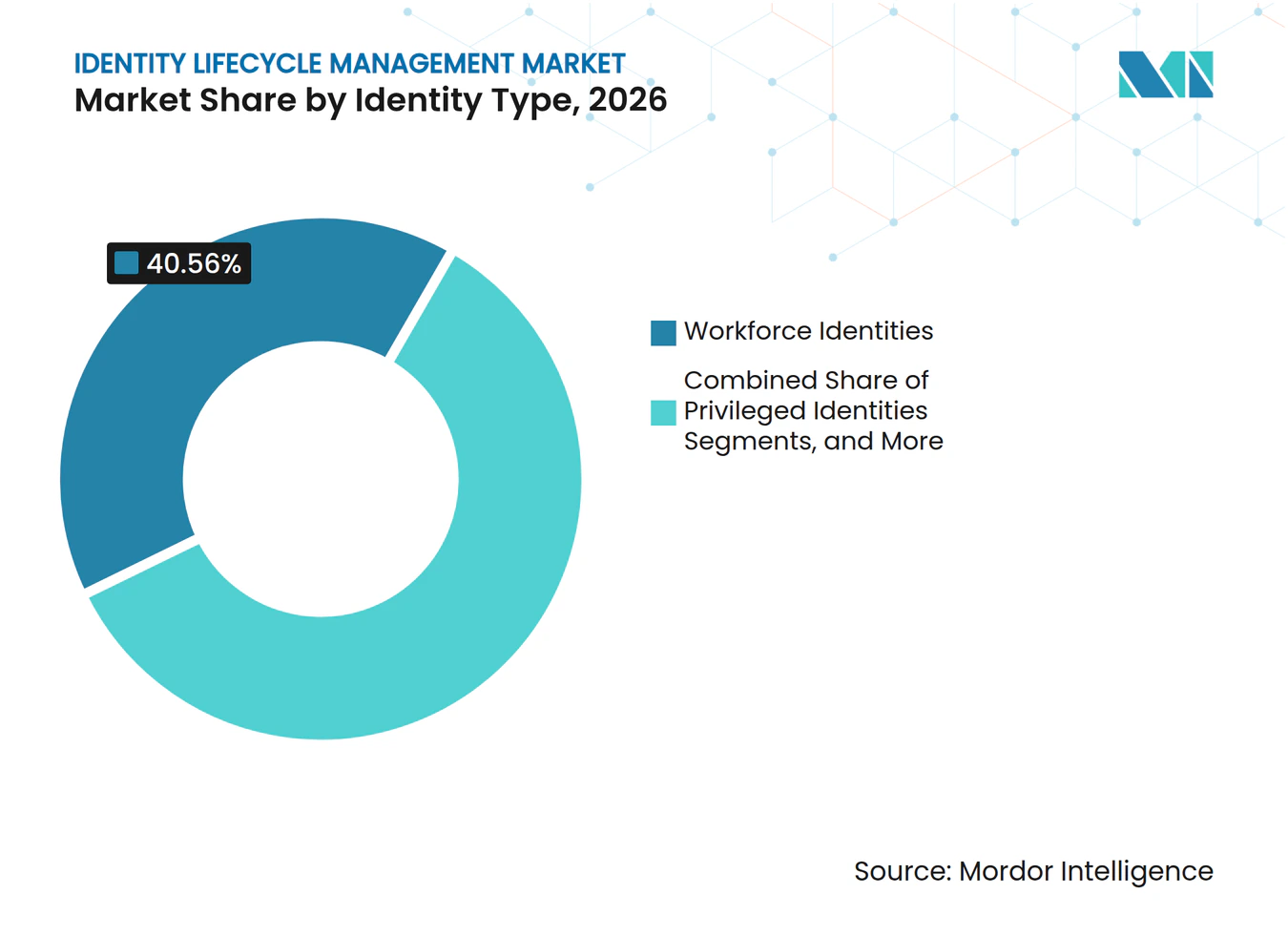
Workforce Governance Anchors the Market, AI Agents Define the Next WaveWorkforce identities held 40.56% of the identity lifecycle management market size in 2026. The segment is centered on the familiar joiner-mover-leaver process that first established the need for enterprise lifecycle management. HR-to-IT provisioning is more standardized for employees because authoritative HR records can trigger routine account and access changes. Connector ecosystems for systems such as Workday and SAP SuccessFactors are already mature in many organizations. Workforce role certification has consequently become a routine operational practice, although contractor and partner access still needs close third-party oversight.
AI-agent identities are projected to expand at a 14.86% CAGR between 2027 and 2032. Autonomous systems can receive permissions comparable to human access rights while operating outside established governance routines. Organizations therefore need clear responsibility for an agent’s actions, permissions, credentials, and business purpose. Machine and workload identities have the highest absolute volume in many large enterprises, but their governance maturity is often lower than for workforce accounts. This gap between identity volume and control maturity creates a substantial modernization requirement for the identity lifecycle management market.


By Organization Size:
Large Enterprises Dominate, SMEs AccelerateLarge enterprises accounted for 78.68% of revenue in the identity lifecycle management market in 2026.
Small and medium enterprises are projected to expand at a 14.59% CAGR between 2027 and 2032. SaaS-native and modular tools have lowered the previous barriers to adoption by reducing the need for an extensive identity engineering team. Lumos raised USD 35 million in a Series B in February 2026 to support its autonomous identity platform, illustrating investment in more accessible governance tools. NIS2 includes important entities across 18 critical sectors, including energy, healthcare, and digital infrastructure. These obligations create new procurement triggers for mid-sized operators that previously did not face the same formal lifecycle governance expectations.
By Industry Vertical:
Banking Leads as Mandates Drive InvestmentBanking, financial services, and insurance accounted for 24.48% of revenue in the identity lifecycle management market in 2026.
IT and telecom is projected to expand at a 14.83% CAGR from 2027 to 2032. The sector has large developer populations with project-based permissions that can change frequently as teams, applications, and responsibilities change. AI-driven automation also increases the number of machine and agent identities that need governance. Government and defense are shaped by NIST SP 800-53 and FedRAMP requirements, while healthcare and life sciences face a proposed HIPAA Security Rule update for multifactor authentication. Retail and e-commerce, energy and utilities, manufacturing, and education represent additional opportunities as cybersecurity and AI rules extend governance responsibilities across more sectors.
Geography Analysis
North America Identity Lifecycle Management Market
North America accounted for 41.67% of the identity lifecycle management market size in 2026. The region has a high concentration of publicly listed and regulated organizations subject to SOX, HIPAA, and FedRAMP requirements, creating an environment where documented and repeatable access controls receive sustained attention. The United States provides most regional revenue and hosts a dense group of specialist identity vendors, enterprise software firms, and organizations with mature cybersecurity procurement practices. SailPoint disclosed in its registration statement that domestic customer concentration exceeded international exposure. Canada is developing demand through identity and access management guidance, while Mexico’s manufacturing expansion supports automation across cross-border supplier ecosystems that need consistent treatment of employee, contractor, and partner access.
Europe Identity Lifecycle Management Market
Europe is a highly compliance-led environment for the identity lifecycle management market. DORA, NIS2, GDPR, and the AI Act create overlapping governance obligations for financial services, critical infrastructure, and AI system providers, which can require organizations to connect compliance evidence with their access management processes. Germany and France remain important national markets because of their regulated industrial and financial sectors and their institutional use of ISO/IEC 27001:2022 practices. Organizations in the region must handle different access review expectations across several rules, rather than responding to a single compliance framework. NIS2 calls for continuing risk-based access controls, while DORA requires semiannual reviews of critical ICT-system access. GDPR also requires access to personal data to be limited, which strengthens the case for automated governance and clearer entitlement ownership across local and enterprise teams.
APAC, Middle East and South America Identity Lifecycle Management Market
Asia-Pacific is projected to expand at a 14.78% CAGR from 2027 to 2032. Cloud adoption, digital-native enterprise expansion, and evolving cybersecurity rules are broadening demand across a region with varied national approaches to technology procurement and regulatory enforcement. South Korea’s CSAP system is supporting public-sector procurement for cloud-delivered identity services, while Japan is increasing investment as financial-sector cybersecurity guidance and manufacturing IoT deployments increase the number of identities requiring oversight. Global vendors are responding through local subsidiary formation and regional delivery capabilities that can support customers with country-specific requirements. The Middle East is advancing through digital transformation programs and national cybersecurity requirements that apply to critical-sector operators. South America is at an earlier stage, but Brazil’s Lei Geral de Proteção de Dados and open-finance requirements are creating initial compliance triggers for lifecycle governance investment.
Competitive Landscape
Market Concentration
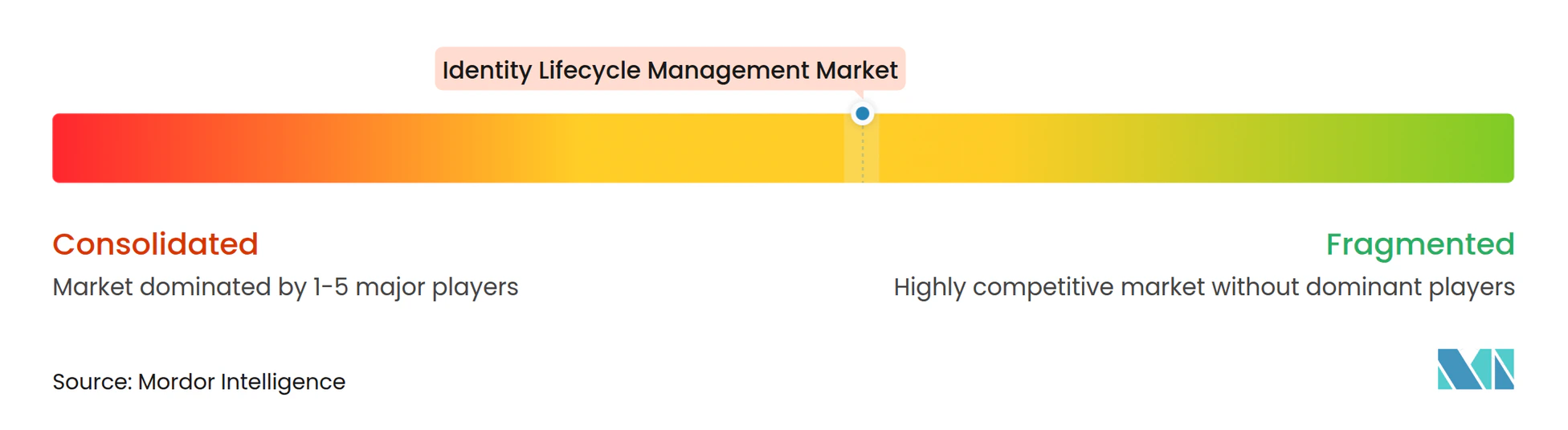
The identity lifecycle management market remains divided between specialist vendors and larger cybersecurity platforms that are adding governance capabilities to complete broader security portfolios. SailPoint and Saviynt remain prominent pure-play providers with product strategies that increasingly address AI agents and non-human identities, while Omada, One Identity, and Ping Identity compete for regulated enterprise customers needing compliance automation. SailPoint returned to the Nasdaq Global Select Market in February 2025, raising USD 1.38 billion at USD 23 per share. Saviynt raised USD 700 million in a KKR-led Series B in December 2025 to accelerate work on AI-agent governance, non-human identity management, and migration tools. The direction of product investment shows that lifecycle governance is increasingly evaluated alongside the management of identities that are not traditional workforce accounts.
Platform consolidation is changing the identity lifecycle management market. ServiceNow completed its acquisition of Veza in March 2026 for USD 1.2 billion in cash. Veza’s Access Graph technology maps effective permissions across human, machine, and AI-agent identities, supplying a detailed view of access relationships that can be used within broader security operations processes. ServiceNow then launched Autonomous Security and Risk in May 2026, integrating Veza’s access graph with Armis asset intelligence. These actions place lifecycle governance closer to security operations and increase competitive pressure on independent vendors whose customers may prefer to consolidate adjacent controls.
AI-native challengers, including C1, Lumos, and Zluri, are targeting mid-market customers with lighter SaaS-first offerings. Their products aim to provide access certification and provisioning without the lengthy deployment effort associated with traditional platforms, a point that is important to buyers without large identity engineering teams. Ping Identity launched Identity for AI in November 2025, covering AI-agent registration, lifecycle management, and just-in-time credential injection through an MCP Gateway. SailPoint also expanded application management in August 2025 through continuous application discovery, zero-touch onboarding, and AI-driven governance workflows. The available information does not provide combined market shares for the top vendors, so a numerical concentration score cannot be supported without estimating a value.
Identity Lifecycle Management Industry Leaders
-
SailPoint Technologies Holdings, Inc.
-
Saviynt, Inc.
-
Okta, Inc.
-
Ping Identity Corporation
-
Omada A/S
- *Disclaimer: Major Players sorted in no particular order
Identity Lifecycle Management Market Companies Covered in this Report
- SailPoint Technologies Holdings, Inc.
- Saviynt, Inc.
- Okta, Inc.
- Ping Identity Corporation
- Omada A/S
- One Identity LLC
- RSA Security LLC
- SecureAuth Corporation
- Hitachi ID Systems, Inc.
- Fischer Identity, Inc.
- EmpowerID, Inc.
- Pathlock, Inc.
- Soffid IAM, S.L.
- Zluri, Inc.
- Lumos Labs, Inc.
- Veza Technologies, Inc.
- ConductorOne, Inc.
- Radiant Logic, Inc.
- Identity Automation, L.P.
- Tools4ever B.V.
- Beta Systems Software AG
Recent Industry Developments in Identity Lifecycle Management Market
- October 2026: SailPoint unveiled Human Fabric enterprise-scale capabilities and released IdentityIQ 9.0 at Navigate 2026, its annual conference. IdentityIQ 9.0 represents a major modernization of the on-premises platform, signaling that SailPoint will continue investing in dual-delivery governance rather than forcing cloud migration, a positioning that directly addresses a pain point among large regulated buyers with non-negotiable on-premises requirements.
- May 2026: ServiceNow launched Autonomous Security and Risk, integrating Veza’s access graph and Armis’s asset intelligence into a single platform for governing AI agents, human identities, and connected enterprise assets. The combined offering embeds identity lifecycle governance directly into security operations, reducing buyer motivation to maintain a standalone ILM toolchain.
- April 2026: ServiceNow completed the acquisition of Armis Security for USD 7.6 billion, adding cyber-asset intelligence across OT, IoT, and physical AI environments to complement Veza’s identity permission mapping within a unified security platform.
- November 2025: Ping Identity launched Identity for AI, covering AI-agent registration, lifecycle management, and just-in-time credential injection via an MCP Gateway, directly closing the governance gap created by agents operating with inherited human-level permissions.
Global Identity Lifecycle Management Market Report Scope
The Identity Lifecycle Management Market is Segmented by Component (Solutions, Services), Deployment Model (Cloud-Based, On-Premises, Hybrid), Identity Type (Workforce Identities, Contractor and Partner Identities, Privileged Identities, Machine and Workload Identities, AI-Agent Identities), Organization Size (Large Enterprises, Small and Medium-Sized Enterprises), Industry Vertical (Banking, Financial Services, and Insurance, Government and Defense, IT and Telecom, Healthcare and Life Sciences, Retail and E-Commerce, Energy and Utilities, Manufacturing, Education, and Other Industry Verticals), and Geography (North America, South America, Europe, Asia-Pacific, Middle East, Africa). The Market Forecasts are in Value (USD).
Segmentation Overview
| Solutions |
| Services |
| Cloud-Based |
| On-Premises |
| Hybrid |
| Workforce Identities |
| Contractor and Partner Identities |
| Privileged Identities |
| Machine and Workload Identities |
| AI-Agent Identities |
| Large Enterprises |
| Small and Medium Enterprises |
| Banking, Financial Services, and Insurance |
| Government and Defense |
| IT and Telecom |
| Healthcare and Life Sciences |
| Retail and E-Commerce |
| Energy and Utilities |
| Manufacturing |
| Education |
| Other Industry Verticals |
| North America | United States |
| Canada | |
| Mexico | |
| South America | Brazil |
| Argentina | |
| Rest of South America | |
| Europe | United Kingdom |
| Germany | |
| France | |
| Italy | |
| Rest of Europe | |
| Asia-Pacific | China |
| India | |
| Japan | |
| South Korea | |
| Rest of Asia-Pacific | |
| Middle East | Saudi Arabia |
| United Arab Emirates | |
| Turkey | |
| Rest of Middle East | |
| Africa | South Africa |
| Nigeria | |
| Rest of Africa |
| By Component | Solutions | |
| Services | ||
| By Deployment Model | Cloud-Based | |
| On-Premises | ||
| Hybrid | ||
| By Identity Type | Workforce Identities | |
| Contractor and Partner Identities | ||
| Privileged Identities | ||
| Machine and Workload Identities | ||
| AI-Agent Identities | ||
| By Organization Size | Large Enterprises | |
| Small and Medium Enterprises | ||
| By Industry Vertical | Banking, Financial Services, and Insurance | |
| Government and Defense | ||
| IT and Telecom | ||
| Healthcare and Life Sciences | ||
| Retail and E-Commerce | ||
| Energy and Utilities | ||
| Manufacturing | ||
| Education | ||
| Other Industry Verticals | ||
| By Geography | North America | United States |
| Canada | ||
| Mexico | ||
| South America | Brazil | |
| Argentina | ||
| Rest of South America | ||
| Europe | United Kingdom | |
| Germany | ||
| France | ||
| Italy | ||
| Rest of Europe | ||
| Asia-Pacific | China | |
| India | ||
| Japan | ||
| South Korea | ||
| Rest of Asia-Pacific | ||
| Middle East | Saudi Arabia | |
| United Arab Emirates | ||
| Turkey | ||
| Rest of Middle East | ||
| Africa | South Africa | |
| Nigeria | ||
| Rest of Africa | ||
Key Questions Answered in the Report
What is the size of the identity lifecycle management market?
The identity lifecycle management market is valued at USD 6.42 billion in 2026 and is projected to reach USD 14.02 billion by 2032 at a 13.91% CAGR. The estimate reflects increasing need for continuous identity controls across workforce, machine, and AI-agent accounts, as organizations replace periodic manual reviews with controls that can respond to operating changes and retain evidence for later review.
What is driving demand for identity lifecycle management platforms?
Compliance requirements, multi-cloud identity sprawl, zero-trust adoption, and governance needs for machine and AI-agent identities are key demand factors. These forces require organizations to maintain more complete records of permissions, ownership, and access decisions across applications, directories, and increasingly automated processes, even when responsibilities are distributed across several business units.
Which component leads identity lifecycle management spending?
Solutions lead with 74.56% of revenue in 2026 and are projected to expand at a 14.62% CAGR through 2032. Integrated platforms are favored because they combine provisioning, certification, role analysis, and policy controls in 1 governance layer instead of requiring security teams to reconcile several independent systems with incomplete entitlement records.
Which deployment model is expanding the fastest?
Cloud-based deployment is projected to expand at a 14.78% CAGR from 2027 to 2032 because SaaS platforms can simplify scaling and connector updates. On-premises and hybrid models remain important where data sovereignty, critical infrastructure, or legacy system requirements limit a cloud-only approach and require a phased modernization process.
Which identity category is expected to expand the fastest?
AI-agent identities are projected to expand at a 14.86% CAGR through 2032 as organizations address governance for autonomous systems and their credentials. These systems can operate with permissions that need clear ownership, traceability, and ongoing review before access can be managed with confidence across the full lifecycle.
Which region is expected to expand the fastest?
Asia-Pacific is projected to expand at a 14.78% CAGR from 2027 to 2032, supported by cloud adoption and evolving cybersecurity requirements. Demand is supported by digital-native enterprise expansion, manufacturing IoT activity, and greater public-sector attention to cloud-delivered identity services in several national markets.