
Cloud Identity Security Market Size and Share
Market Overview
| Study Period | 2021 - 2032 |
|---|---|
| Market Size (2027) | USD 22.88 Billion |
| Market Size (2032) | USD 40.63 Billion |
| Growth Rate (2027 - 2032) | 12.17 % |
| Fastest Growing Market | Asia-Pacific |
| Largest Market | North America |
| Market Concentration | Medium |
Major Players *Disclaimer: Major Players sorted in no particular order Image © Mordor Intelligence. Reuse requires attribution under CC BY 4.0. | |
Cloud Identity Security Market Analysis by Mordor Intelligence
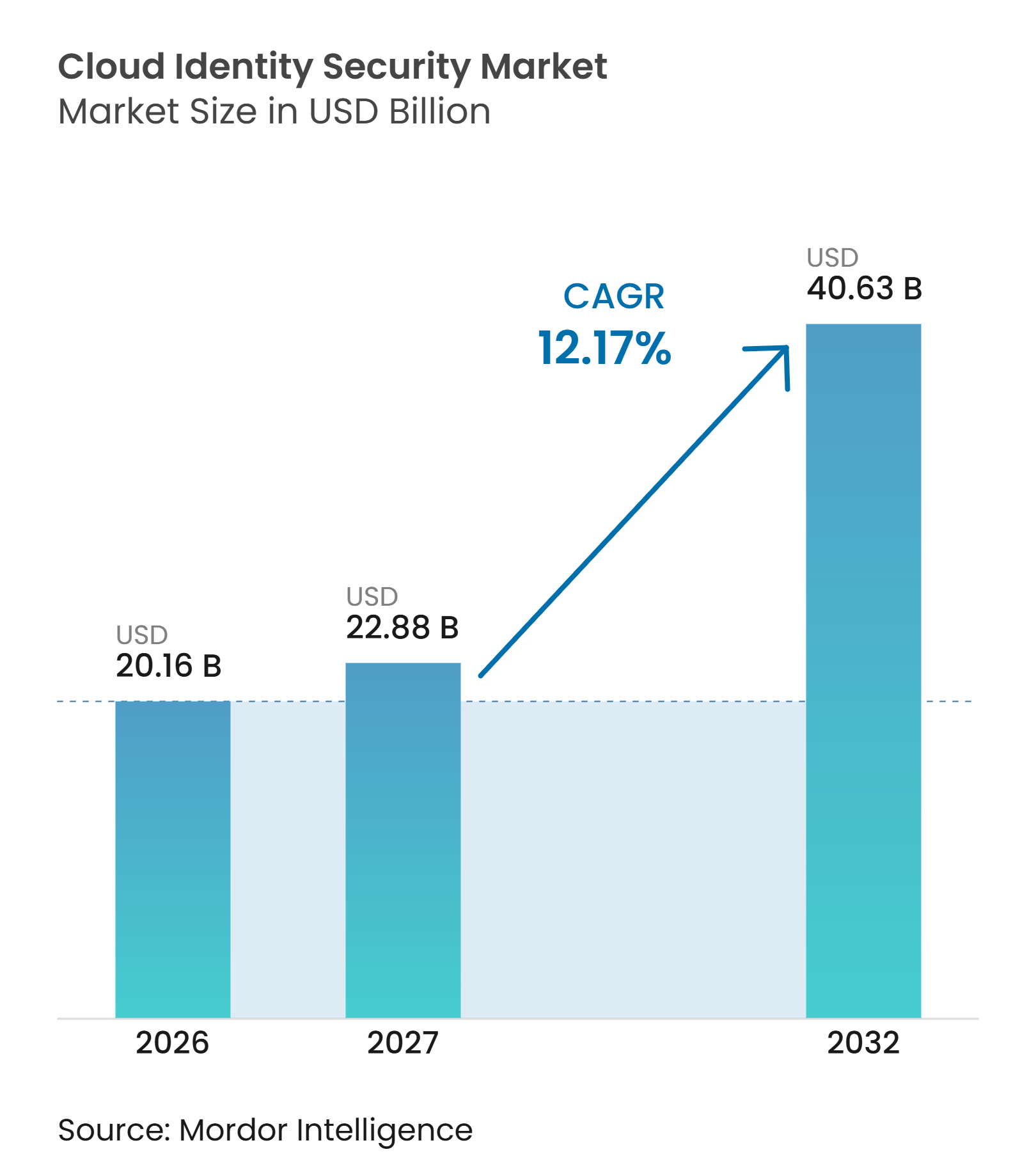
The cloud identity security market size is projected to be USD 20.16 billion in 2026, USD 22.88 billion in 2027, and reach USD 40.63 billion by 2032, growing at a CAGR of 12.17% from 2027 to 2032. Demand is being shaped by identity-centered attacks, expanding machine identity populations, and the broader use of cloud workloads. Buyers are moving beyond login protection toward governance of permissions, sessions, service accounts, and AI agents. Regulatory requirements also make stronger access controls necessary in financial services, healthcare, government, and critical infrastructure. The cloud identity security market is therefore drawing investment in unified platforms, specialist controls for non-human identities, and managed implementation services. Its direction also depends on whether buyers can connect new controls to older directories, applications, and operating processes without delaying priority security work.
Key Report Takeaways
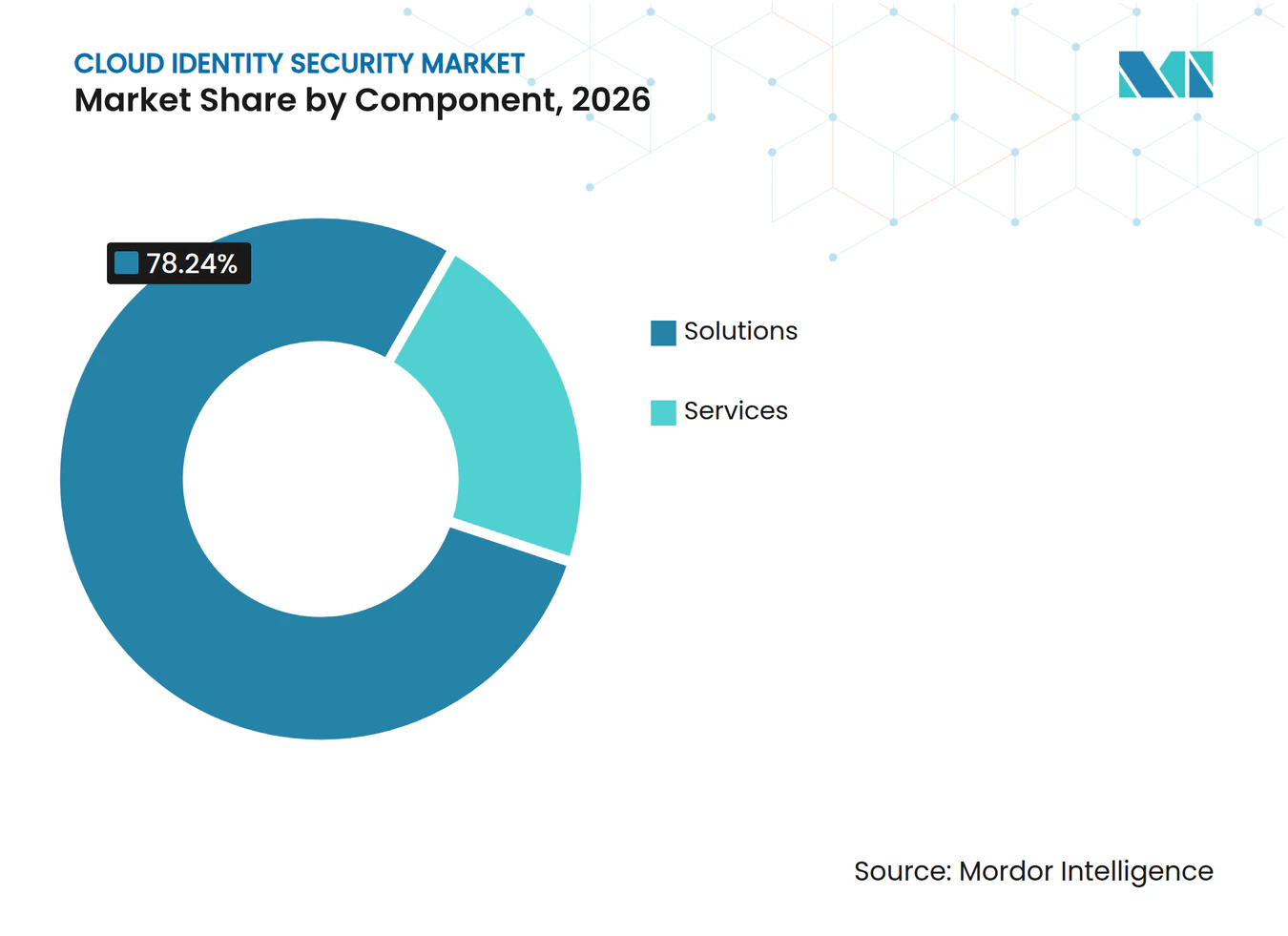
- By component, solutions held 78.24% of the cloud identity security market share in 2026, while services are projected to expand at a 12.27% CAGR through 2032.
- By identity type, workforce identity management held 44.17% of revenue in 2026, while machine and non-human identity management is projected to expand at a 12.52% CAGR through 2032.
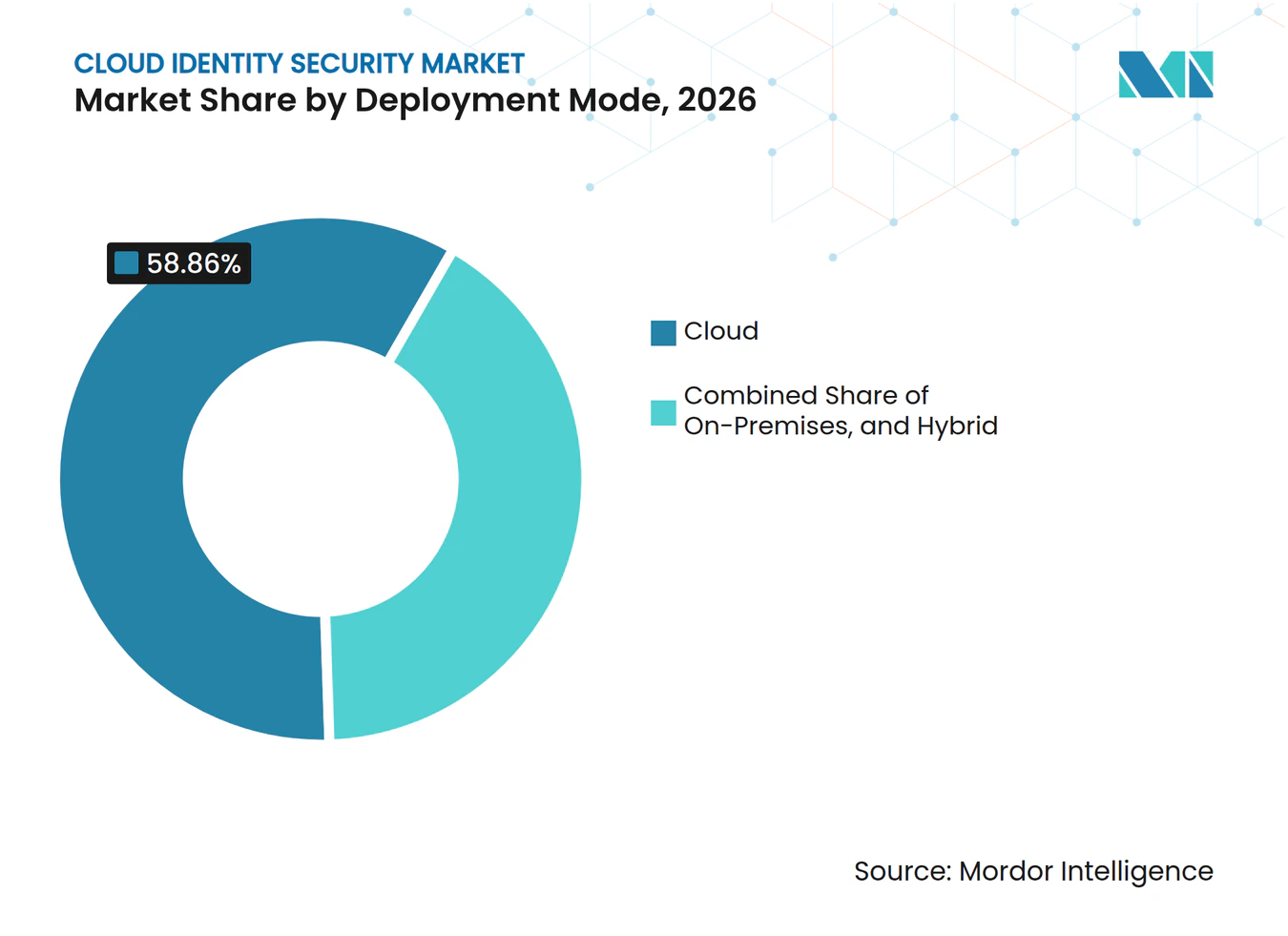
- By deployment mode, cloud deployment accounted for 58.86% of revenue in 2026 and is projected to expand at a 13.02% CAGR through 2032.
- By organization size, large enterprises held 69.36% of revenue in 2026, while SMEs are projected to expand at a 12.43% CAGR through 2032.
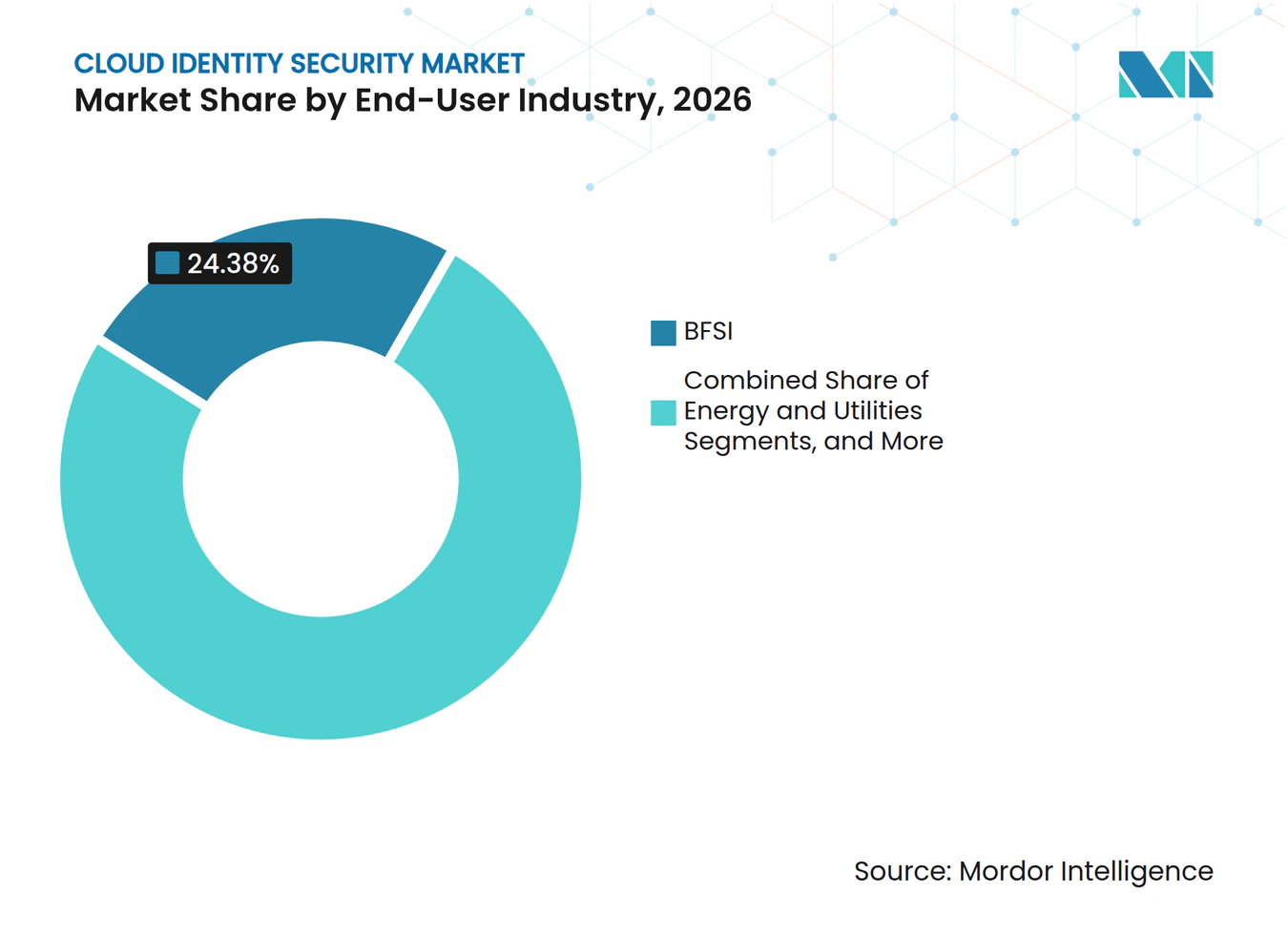
- By end-user industry, BFSI accounted for 24.38% of revenue in 2026, while energy and utilities is projected to expand at a 12.79% CAGR through 2032.
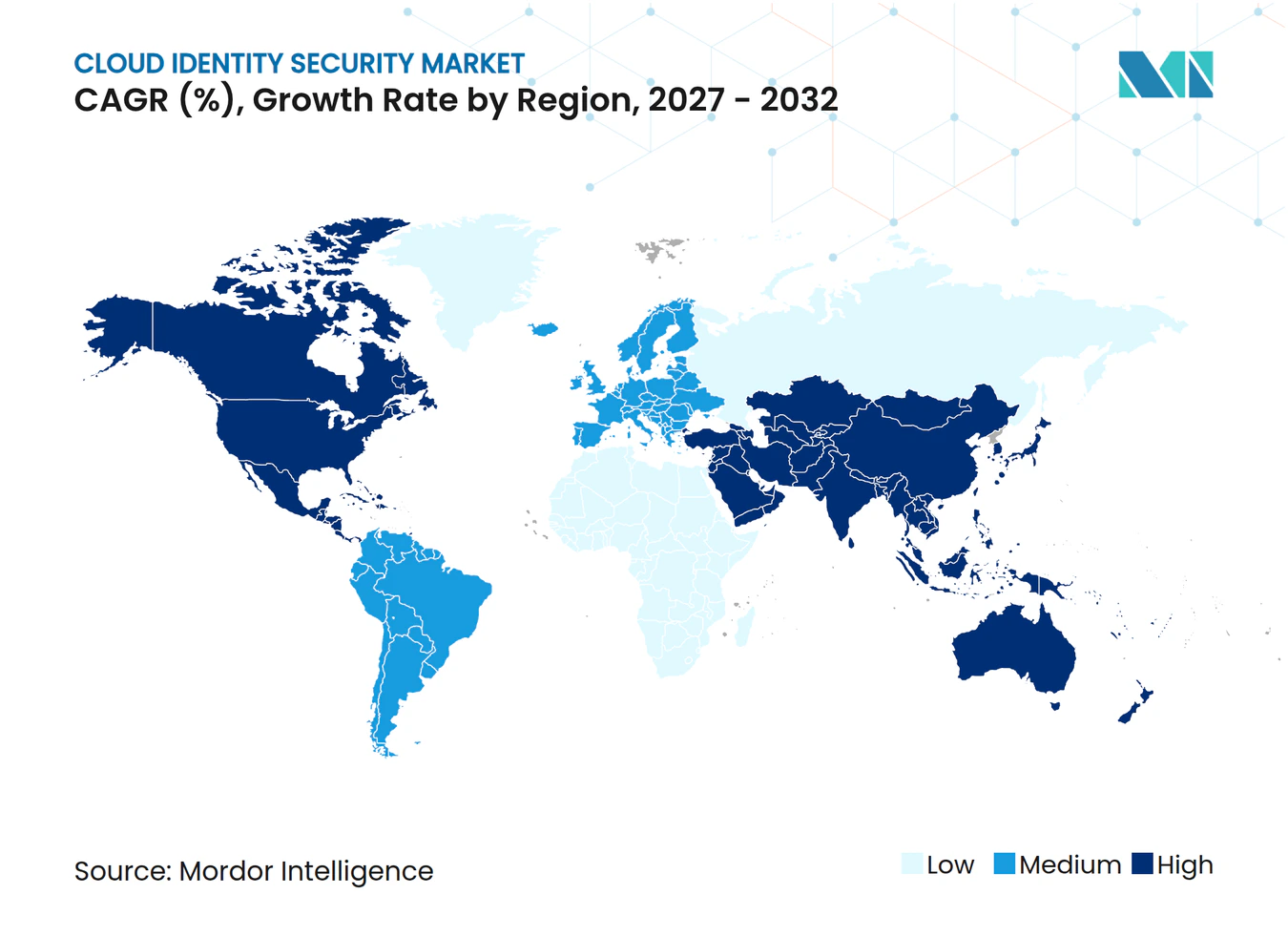
- By geography, North America held 42.58% of revenue in 2026, while Asia-Pacific is projected to expand at a 13.03% CAGR through 2032.
Note: Market numbers in this report are based on Mordor Intelligence's proprietary estimation framework, which combines nine months of actuals with Q4 projections for base year 2026.
Market Trends and Insights
Drivers Impact Analysis of Cloud Identity Security Market*
| Driver | (~) % Impact on CAGR Forecast | Geographic Relevance | Impact Timeline |
|---|---|---|---|
| Rising Identity-Based Attacks and Account Takeover Risk | +3.8% | Global | Short term (≤ 2 years) |
| Agentic AI Workloads Creating Unowned Identity Chains | +2.5% | Global, with early gains in North America and Europe | Medium term (2-4 years) |
| Expansion of Zero-Trust Access Architectures | +2.1% | North America and Europe, with spillover to Asia-Pacific | Medium term (2-4 years) |
| Regulatory Pressure for Stronger Access Governance | +1.7% | Europe, North America, and Asia-Pacific | Medium term (2-4 years) |
| Cloud and SaaS Sprawl Across Hybrid Enterprises | +1.3% | Global | Short term (≤ 2 years) |
| Ephemeral Workload Identity Rotation in Cloud-Native Delivery | +0.5% | North America and Asia-Pacific, with spillover to Europe | Long term (≥ 4 years) |
| Source: Mordor Intelligence | |||
Rising Identity-Based Attacks and Account Takeover Risk
Identity attacks have shifted from isolated credential theft toward multi-step compromises that exploit accounts, browser sessions, and access tokens. RSA reported that 69% of organizations experienced an identity-related breach during the prior 3 years, and 45% of breached organizations reported costs above the IBM benchmark for a typical breach.[1] The same report found that 24% of those organizations incurred more than USD 10 million in costs, which raises the financial case for more complete identity controls. The cloud identity security market benefits as buyers extend protection beyond MFA and single sign-on to monitor access after authentication. This need supports investment in behavioral analytics, continuous session monitoring, and controls for long-lived service credentials. The cloud identity security market also gains where organizations connect incident response to identity policy and access review processes.
Agentic AI Workloads Creating Unowned Identity Chains
AI agents create identities that can act across applications, data stores, and cloud resources without the ownership models used for employees. The Cloud Security Alliance reported that the non-human identity population increased 44% from 2024 to 2025, while 28.65 million hardcoded secrets were added to public GitHub repositories in 2025.[2] The same material identified 1.27 million AI-related secrets among those additions, showing why conventional workforce IAM is insufficient for agentic workloads. The World Economic Forum found that 51% of organizations had no clear ownership of AI identities in 2025. This gap strengthens demand in the cloud identity security market for discovery, ownership assignment, credential rotation, and real-time revocation of machine identities. It also puts the cloud identity security market closer to application development and cloud operations teams that create these credentials.
Expansion of Zero-Trust Access Architectures
Zero trust is pushing organizations to verify access continuously rather than treat authentication as a one-time decision. DXC Technology and Microsoft reported that 83% of organizations using zero trust had reduced security incidents and remediation costs. Identity governance, privileged access controls, and identity threat detection are core parts of this approach because permissions must be evaluated against users, devices, sessions, and resources. ISC2 found that 34% of security teams considered cloud data protection and identity-centered security to be essential capabilities they lacked. The skills gap makes managed services relevant alongside software platforms. A 2025 IEEE review also identified legacy integration and framework gaps as recurring barriers to practical zero-trust adoption.
Regulatory Pressure for Stronger Access Governance
Rules for critical infrastructure and data protection are turning identity practices into auditable operational requirements. Germany's NIS2 transposition took effect in December 2025 and broadened obligations for MFA and access control across affected entities. The April 2026 CISA, Department of Energy, and NIST guidance calls for IT and OT identity separation, documented emergency access processes, and MFA at jump hosts for operational technology environments. NERC CIP-004-7 also requires prompt access revocation and regular access reviews for bulk electric system operators. These requirements shorten procurement cycles in regulated sectors and increase demand for evidence-based access governance in the cloud identity security market. The cloud identity security market is especially relevant when a buyer needs controls that produce consistent records for internal and external review.
Restraints Impact Analysis of Cloud Identity Security Market*
| Restraint | (~) % Impact on CAGR Forecast | Geographic Relevance | Impact Timeline |
|---|---|---|---|
| Integration Complexity With Legacy Directories | -1.8% | Global, most acute in North America and Europe | Medium term (2-4 years) |
| High Cost of Enterprise-Scale IAM Modernization | -1.2% | Global, most constraining for SMEs and emerging-market enterprises | Medium term (2-4 years) |
| Fragmented Ownership of Non-Human Identities | -0.7% | Global | Medium term (2-4 years) |
| Lack of Standardized Assurance for AI-Agent Identities | -0.5% | Global, with highest regulatory pressure in Europe and North America | Long term (≥ 4 years) |
| Source: Mordor Intelligence | |||
Integration Complexity With Legacy Directories
Many enterprises operate cloud identity platforms alongside on-premises directories that contain dormant accounts, customized permissions, and historical exceptions. The 2025 IEEE review identified legacy-system integration and governance gaps as leading barriers to validated zero-trust implementation.[3] Federation projects can reveal excessive privileges, orphaned credentials, and weak trust relationships that were not visible in older environments. These findings lengthen deployment schedules and increase the need for professional services. They can also redirect budgets away from newer capabilities, including non-human identity governance and identity threat detection. For the cloud identity security market, this makes directory assessment and phased migration work central parts of successful adoption.
High Cost of Enterprise-Scale IAM Modernization
Enterprise IAM modernization requires spending on licenses, integration, implementation services, and continued operations. The SANS 2026 survey found that budget constraints were the main obstacle for 38% of organizations considering broader identity security investment. Costs can rise after migration when organizations discover that legacy application permissions were not redesigned for centralized governance. Smaller organizations are affected more sharply because they often lack dedicated identity teams. The cloud identity security market therefore needs flexible subscription models, managed delivery, and simpler integrations to reach smaller buyers. Cost pressure may slow adoption even where regulatory needs are clear.
*Our forecasts treat driver/restraint impacts as directional, not additive. The impact forecasts reflect baseline growth, mix effects, and variable interactions.
Cloud Identity Security Market Segment Analysis
By Component:
Solutions Lead Platform ConsolidationSolutions accounted for 78.24% of 2026 revenue, establishing the largest component position in the cloud identity security market. This category includes identity governance and administration, privileged access management, customer identity and access management, and identity threat detection tools. Enterprises are consolidating these functions because separate tools can create inconsistent policy rules, duplicate identity records, and gaps in access reporting. A unified platform helps security teams trace authorization paths across cloud applications, on-premises systems, infrastructure accounts, and external users. The broad solutions base also reflects continued spending on single sign-on, MFA, lifecycle management, access certification, and privileged session oversight.
Services are projected to expand at a 12.27% CAGR through 2032, the fastest pace within this segmentation. Providers support platform configuration, directory modernization, migration planning, cloud integration, policy design, and recurring governance operations. Multi-cloud environments often need tailored connections across AWS, Microsoft Azure, and Google Cloud even when vendors provide standard connectors. SailPoint's Agentic Fabric, launched in May 2026, demonstrates how suppliers are adding tools to manage AI identities alongside established identity records. Automation can reduce repetitive provisioning work, but complex workflows, regulated applications, and exception handling still require experienced implementation teams.


By Identity Type:
Workforce Identity Remains Largest as Machine Identity AcceleratesWorkforce identity management held 44.17% of 2026 revenue, making it the largest identity-type segment. Its position reflects broad deployment of SSO, adaptive MFA, identity federation, and lifecycle controls for employees. Workforce accounts remain foundational because they connect business applications, infrastructure, data, and administrative privileges across most enterprises. Organizations use these systems to handle onboarding, role changes, leave, account deactivation, and periodic access reviews with greater consistency. They also extend workforce governance practices to contractors and external users when those parties receive internal system access.
Machine and non-human identity management is projected to expand at a 12.52% CAGR through 2032. The Cloud Security Alliance found that non-human identities increased 44% from 2024 to 2025, creating a wider pool of service accounts, API keys, certificates, and agent credentials that require protection. Customer identity continues to support fraud prevention and digital access in BFSI and retail, while privileged identity management focuses on high-risk authorization. CrowdStrike's January 2026 acquisition of SGNL added risk-based authorization capabilities to its security platform. Third-party identity governance is increasingly relevant because the Verizon data cited by the Cloud Security Alliance identifies suppliers and partners as a substantial breach exposure.
By Deployment Mode:
Cloud Deployment Holds Both Scale and MomentumCloud deployment held 58.86% of 2026 revenue and accounted for the largest deployment position. Cloud-native platforms can integrate with major cloud providers and scale as workload identities are created, modified, and removed. They support regular updates and centralized policy administration across distributed applications, cloud accounts, and SaaS services. These features are valuable where organizations release applications frequently or use short-lived workloads that need automatically managed credentials. The cloud identity security market is increasingly aligned with workload portability, cloud service consumption, and the shortened release cycles of modern software delivery.
Cloud deployment is projected to expand at a 13.02% CAGR through 2032, the fastest rate in this segmentation. Microsoft introduced Entra Agent ID in May 2025 to assign directory identities to AI agents created in Copilot Studio and Azure AI Foundry. On-premises deployment remains relevant in defense, government, and financial market infrastructure, where sovereignty, resilience, and segmentation needs can limit full cloud migration. Hybrid models are also relevant in energy and healthcare, where cloud governance can be paired with local privileged access controls at sensitive operational sites. ISC2 reported a cloud skills shortfall among security teams, which can extend implementation work and increase demand for vendor-managed identity services.


By Organization Size:
Large Enterprises Account for Most SpendingLarge enterprises represented 69.36% of 2026 revenue, reflecting their complex application estates and regulatory responsibilities. These organizations commonly operate multiple cloud environments, large employee populations, legacy directories, and extensive partner networks. They can support dedicated identity teams, formal access certification programs, and specialized reviews for privileged or sensitive accounts. Continuous monitoring of privileged sessions and system-to-system access adds to their platform requirements and implementation scope. Large enterprises therefore remain the central purchasers of broad identity platforms in the cloud identity security market.
SMEs are projected to expand at a 12.43% CAGR through 2032. Cloud-native identity-as-a-service can remove infrastructure requirements that previously made advanced IAM difficult for smaller organizations to adopt. Regulated SMEs in BFSI, healthcare, and government contracting still need controls comparable to those used by larger firms, despite having leaner security teams. The SANS survey found that budget constraints were the principal barrier for 38% of organizations considering identity security expansion. Predictable pricing, outsourced management, quick deployment, and clear compliance reporting are therefore important purchase factors for this customer group.
By End-User Industry:
BFSI Is Largest and Energy and Utilities Is FastestBFSI accounted for 24.38% of 2026 revenue, giving it the largest end-user position. Financial institutions manage high-value credentials, sensitive customer records, payment systems, and complex access arrangements involving employees, customers, and partners. These conditions make strong authentication, privileged access controls, transaction-aware monitoring, and continuous session oversight necessary. Customer identity platforms are also relevant as banks and insurers manage digital onboarding, fraud risk, and service access across mobile and online channels. The cloud identity security market serves this sector through tools that join regulatory evidence, access governance, identity protection, and customer experience requirements.
Energy and utilities is projected to expand at a 12.79% CAGR through 2032, the fastest rate by end-user industry. NERC CIP-005-7 requires MFA for interactive remote access to bulk electric system assets. The CISA, Department of Energy, and NIST guidance published in April 2026 also calls for separated IT and OT identity controls and documented emergency access procedures. Healthcare, government, IT and telecommunications support demand through sector-specific rules and sensitive data environments. Retail, manufacturing, education, and transportation are earlier-stage buyers where cloud migration creates initial requirements for centralized identity governance and access management.
Geography Analysis
North America Cloud Identity Security Market
North America held 42.58% of 2026 revenue, making it the largest regional position in the cloud identity security market. The region combines regulated financial services, healthcare providers, critical infrastructure operators, and large enterprises with established security procurement practices. Federal zero-trust direction and NERC CIP requirements create continuing demand for identity governance and privileged access controls. The region also hosts many leading vendors, enabling close product development work with enterprise customers.
Europe and South America Cloud Identity Security Market
Europe remains a substantial revenue base because organizations face extensive data protection and access governance obligations. Germany's NIS2 transposition became effective in December 2025 and widened access-control expectations for affected organizations. The EU AI Act is also directing attention to access controls for AI systems and agent-related governance. Data residency needs encourage European buyers to select providers with regional hosting and consistent compliance controls. South America is smaller in scale, but data protection rules and cloud infrastructure investment are supporting early demand in BFSI and telecommunications.
APAC and MEA Cloud Identity Security Market
Asia-Pacific is projected to expand at a 13.03% CAGR through 2032, making it the fastest-growing regional market. Government-supported digital identity programs, cloud migration, and developing cyber rules are increasing the need for IAM and customer identity functions. Organizations in India, China, and Southeast Asia have strong reasons to invest in customer identity as mobile-first services expand and fraud risks change. The Middle East is also developing demand through national digital infrastructure programs in Saudi Arabia and the UAE. Africa is at an earlier stage, with South Africa, Egypt, and Nigeria advancing adoption through BFSI digitization and mobile financial services. ISA/IEC 62443 and national cybersecurity strategies can encourage more structured identity controls across Middle East and Africa critical infrastructure. The cloud identity security market can benefit as these programs move from foundational cloud use toward more formal control of user, application, and infrastructure access.
Competitive Landscape
Market Concentration
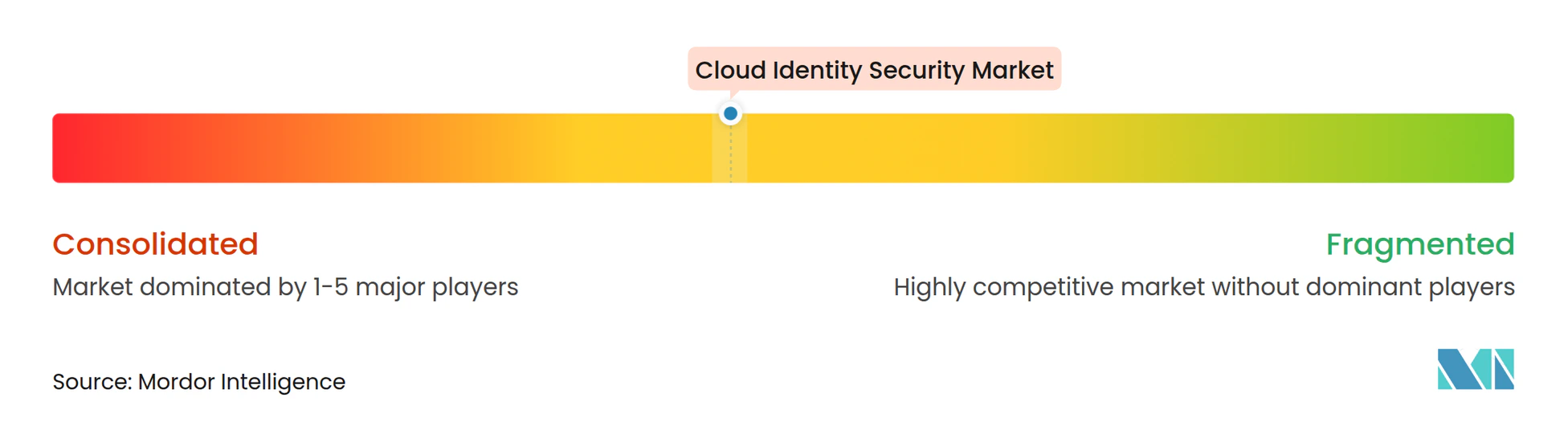
The cloud identity security market is moderately consolidated among large platform providers and fragmented among specialist vendors. Microsoft, Okta, SailPoint, and Palo Alto Networks are prominent competitors across workforce identity, governance, privileged access, and cloud security. Palo Alto Networks completed its acquisition of CyberArk in February 2026, bringing a major privileged access management provider into its platform. This transaction increased pressure on specialist vendors to differentiate through non-human identity controls, runtime authorization, or sector-specific capabilities.
SailPoint launched Agentic Fabric in May 2026 to provide discovery, governance, and real-time authorization for AI identities. In October 2026, the company introduced Autonomous Identity Security Posture Management and autonomous agents for shadow AI discovery, runtime authorization, and controls for AI agents. Microsoft has extended Entra into AI agent workflows through Entra Agent ID, which connects agent identity management with data security and compliance services. These moves show that leading vendors are treating AI identities as part of the wider identity lifecycle rather than as a separate security tool.
Specialist opportunities remain in AI-agent chains that span enterprise applications and third-party SaaS environments. Vendors also have room to address OT identity requirements, where protocol knowledge and compliance with NERC CIP and IEC 62443 are important. Delinea completed the acquisition of StrongDM in January 2026 to extend infrastructure access management across databases, servers, cloud infrastructure, and OT settings. ServiceNow completed its Veza acquisition in March 2026, bringing permissions-graph capabilities into enterprise workflow and AI controls. The cloud identity security market remains competitive because large platforms can bundle identity services, while specialists can focus on difficult areas such as machine credentials, access discovery, and real-time enforcement. These areas give smaller providers a role where broad platforms do not yet provide complete coverage, particularly when customers require connections to varied systems, detailed entitlement analysis, or controls tailored to specific operating environments.
Cloud Identity Security Industry Leaders
-
Microsoft Corporation
-
Okta, Inc.
-
Palo Alto Networks, Inc.
-
Oracle Corporation
-
International Business Machines Corporation
- *Disclaimer: Major Players sorted in no particular order
Cloud Identity Security Market Companies Covered in this Report
- Microsoft Corporation
- Okta, Inc.
- Palo Alto Networks, Inc.
- Oracle Corporation
- International Business Machines Corporation
- Ping Identity Corporation
- SailPoint Technologies Holdings, Inc.
- Saviynt, Inc.
- CyberArk Software Ltd.
- Broadcom Inc.
- Thales Group
- BeyondTrust Corporation
- Delinea, Inc.
- One Identity LLC
- OpenText Corporation
- Akamai Technologies, Inc.
- CrowdStrike Holdings, Inc.
- Zscaler, Inc.
- Aembit, Inc.
Recent Industry Developments in Cloud Identity Security Market
- October 2026: Workday announced a definitive agreement to acquire C1.ai, an agentic identity platform connecting enterprise systems from email and CRM to cloud infrastructure. The platform provides scoped, time-limited access for people and AI agents. The transaction is expected to close in Workday's Q4 fiscal year 2027, ending January 31, 2027. It extends Workday's Agent System of Record from agent registration into end-to-end access governance.
- October 2026: SailPoint launched Autonomous Identity Security Posture Management and 3 classes of Autonomous Agents at Navigate 2026 on October 6, 2026. The release added shadow AI discovery, runtime authorization, and kill-switch controls for AI agents through an expanded Agentic Fabric. It also added just-in-time provisioning for zero standing privilege across humans, service accounts, and AI agents. The release positioned SailPoint to extend its identity controls across the identity types addressed by the cloud identity security market.
- September 2026: Cyera acquired Oasis Security for USD 1 billion. The transaction combined Oasis's non-human identity security governance platform with Cyera's data security posture management offering. It reflected the link between machine credential governance and the protection of sensitive data stores in cloud environments.
- August 2026: Okta completed the acquisition of Permiso Security for USD 200 million. Permiso's cloud identity threat detection and response capabilities were integrated into Okta's platform. The transaction strengthened Okta's visibility of non-human identities across cloud environments and widened the company's threat-detection capability.
Global Cloud Identity Security Market Report Scope
The cloud identity security market encompasses solutions and services that protect digital identities, credentials, and access to cloud-based applications, data, and infrastructure. The report covers market trends, growth drivers, challenges, competitive landscape, and segmentation by component, deployment model, organization size, industry vertical, and geography.
The Cloud Identity Security Market Report is Segmented by Component (Solutions, and Services), Identity Type (Workforce Identity, Customer Identity, Privileged Identity, Machine and Non-Human Identity, and Third-Party Identity), Deployment Mode (Cloud, On-Premises, Hybrid), Organization Size (Large Enterprises, and Small and Medium Enterprises), End-User Industry (BFSI, Government and Public Administration, Healthcare and Life Sciences, IT and Telecommunications, Retail and E-Commerce, Energy and Utilities, and Other End-User Industries), and Geography (North America, South America, Europe, Asia-Pacific, Middle East, and Africa). The Market Forecasts are Provided in Terms of Value (USD).
Segmentation Overview
| Solutions |
| Services |
| Workforce Identity |
| Customer Identity |
| Privileged Identity |
| Machine and Non-Human Identity |
| Third-Party Identity |
| Cloud |
| On-Premises |
| Hybrid |
| Large Enterprises |
| Small and Medium Enterprises |
| BFSI |
| Government and Public Administration |
| Healthcare and Life Sciences |
| IT and Telecommunications |
| Retail and E-Commerce |
| Energy and Utilities |
| Other End-User Industries |
| North America | United States |
| Canada | |
| Mexico | |
| South America | Brazil |
| Argentina | |
| Rest of South America | |
| Europe | Germany |
| United Kingdom | |
| France | |
| Italy | |
| Spain | |
| Russia | |
| Rest of Europe | |
| Asia-Pacific | China |
| India | |
| Japan | |
| South Korea | |
| Australia | |
| Rest of Asia-Pacific | |
| Middle East | Saudi Arabia |
| United Arab Emirates | |
| Turkey | |
| Rest of Middle East | |
| Africa | South Africa |
| Egypt | |
| Nigeria | |
| Rest of Africa |
| By Component | Solutions | |
| Services | ||
| By Identity Type | Workforce Identity | |
| Customer Identity | ||
| Privileged Identity | ||
| Machine and Non-Human Identity | ||
| Third-Party Identity | ||
| By Deployment Mode | Cloud | |
| On-Premises | ||
| Hybrid | ||
| By Organization Size | Large Enterprises | |
| Small and Medium Enterprises | ||
| By End-User Industry | BFSI | |
| Government and Public Administration | ||
| Healthcare and Life Sciences | ||
| IT and Telecommunications | ||
| Retail and E-Commerce | ||
| Energy and Utilities | ||
| Other End-User Industries | ||
| By Geography | North America | United States |
| Canada | ||
| Mexico | ||
| South America | Brazil | |
| Argentina | ||
| Rest of South America | ||
| Europe | Germany | |
| United Kingdom | ||
| France | ||
| Italy | ||
| Spain | ||
| Russia | ||
| Rest of Europe | ||
| Asia-Pacific | China | |
| India | ||
| Japan | ||
| South Korea | ||
| Australia | ||
| Rest of Asia-Pacific | ||
| Middle East | Saudi Arabia | |
| United Arab Emirates | ||
| Turkey | ||
| Rest of Middle East | ||
| Africa | South Africa | |
| Egypt | ||
| Nigeria | ||
| Rest of Africa | ||
Key Questions Answered in the Report
What is the cloud identity security market size?
The cloud identity security market is projected to reach USD 40.63 billion by 2032, from USD 22.88 billion in 2027, at a 12.17% CAGR. The 2026 value is USD 20.16 billion, and the forecast reflects expanding need for governed access across cloud resources.
What is driving demand for cloud identity security?
Identity-related breaches, AI agents, machine credentials, zero-trust programs, and access-governance rules are raising demand for identity controls. Enterprises are giving more attention to sessions, privileged access, service accounts, and permissions that were previously handled in separate systems.
Which component holds the largest position in cloud identity security?
Solutions held 78.24% of revenue in 2026, reflecting demand for identity governance, privileged access management, CIAM, and identity threat detection tools. Services are also important where deployments require directory modernization, cloud integration, and continuing governance support.
Which deployment model is expanding fastest?
Cloud deployment is projected to expand at a 13.02% CAGR through 2032 and held 58.86% of revenue in 2026. It is supported by cloud provider integration, centralized policy administration, and the need to manage workload identities at scale.
Which end-user sector has the fastest expansion outlook?
Energy and utilities is projected to expand at a 12.79% CAGR through 2032 as IT and OT access controls become more important. Requirements for MFA, access reviews, identity separation, and documented emergency access add to the sector's need for identity governance.
Which region has the fastest outlook?
Asia-Pacific is projected to expand at a 13.03% CAGR through 2032, supported by cloud adoption, digital identity programs, and changing cyber rules. Mobile-first services, customer identity needs, and growing cloud workloads give the region a distinct demand profile.