
Identity Risk Assessment Market Size and Share
Market Overview
| Study Period | 2021 - 2032 |
|---|---|
| Market Size (2027) | USD 14.63 Billion |
| Market Size (2032) | USD 29.87 Billion |
| Growth Rate (2027 - 2032) | 15.34 % |
| Fastest Growing Market | Asia-Pacific |
| Largest Market | North America |
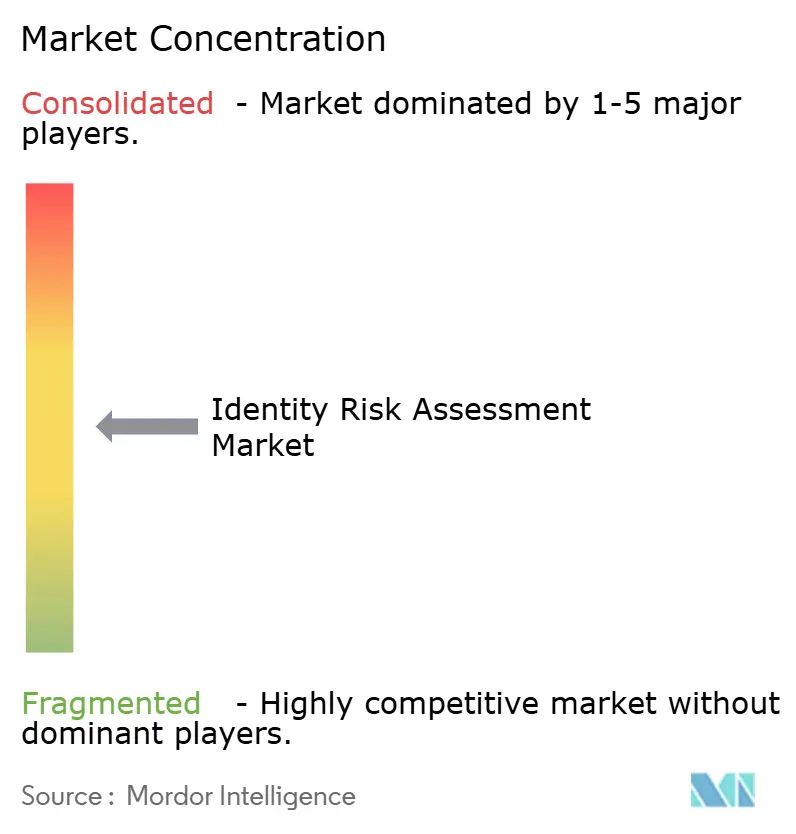
| Market Concentration | Medium |
Major Players *Disclaimer: Major Players sorted in no particular order Image © Mordor Intelligence. Reuse requires attribution under CC BY 4.0. | |
Identity Risk Assessment Market Analysis by Mordor Intelligence
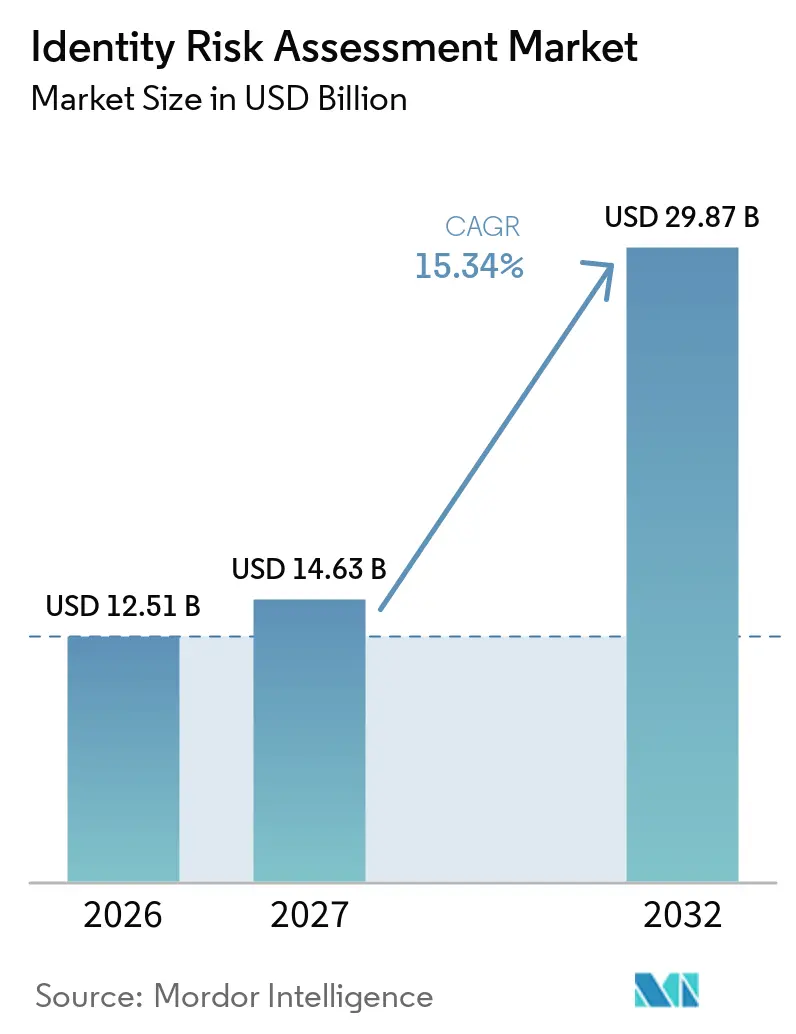
The identity risk assessment market size is projected to be USD 12.51 billion in 2026, USD 14.63 billion in 2027, and reach USD 29.87 billion by 2032, growing at a CAGR of 15.34% from 2027 to 2032. The identity risk assessment market is being shaped by the need to verify people and entities throughout the customer and workforce lifecycle. Artificial intelligence-enabled fraud is making simple, one-time identity checks less effective. Regulatory deadlines are also moving identity controls from discretionary technology projects to required compliance programs. Digital onboarding, instant payments, and embedded finance are raising the need for risk decisions that can work during account opening or transactions. Vendors are responding by combining verification, fraud detection, monitoring, and access controls within broader platforms.
Key Report Takeaways
- By product type, Fraud Detection and Prevention held 26.34% of revenue in the identity risk assessment market in 2026, while Identity Threat Detection and Response is projected to expand at a 17.32% CAGR through 2032.
- By deployment mode, cloud-based deployment accounted for 67.58% of revenue in 2026 and is projected to expand at a 17.81% CAGR through 2032.
- By organization size, large enterprises held 68.54% of revenue in 2026, while SMEs are projected to expand at a 16.72% CAGR through 2032.
- By application, Customer Onboarding and Account Opening accounted for 25.71% of revenue in the identity risk assessment market in 2026, while Payment Authorization and Transaction Monitoring are projected to expand at a 16.72% CAGR through 2032.
- By end user, BFSI accounted for 26.69% of revenue in 2026, while Government and Public Administration is projected to expand at a 19.22% CAGR through 2032.
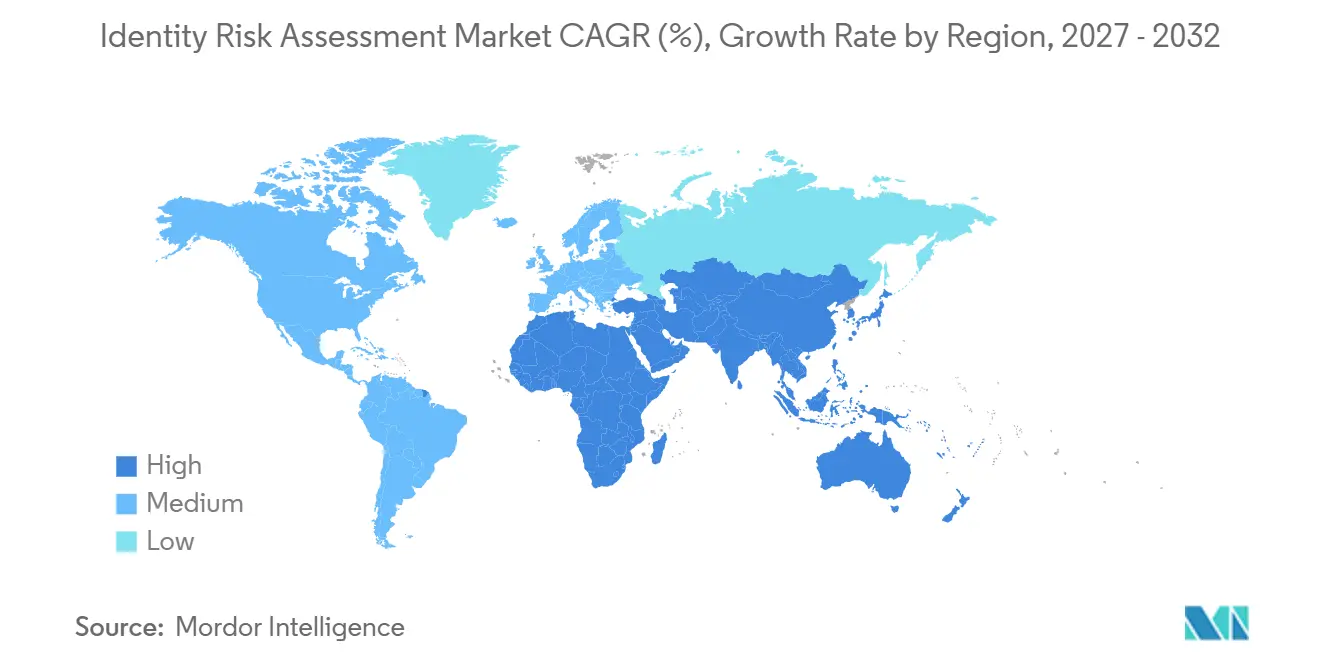
- By geography, North America held 41.64% of the identity risk assessment market revenue in 2026, while Asia-Pacific is projected to expand at a 17.93% CAGR through 2032.
Note: Market numbers in this report are based on Mordor Intelligence's proprietary estimation framework, which combines nine months of actuals with Q4 projections for base year 2026.
Market Trends and Insights
Drivers Impact Analysis of Identity Risk Assessment Market*
| DRIVER | (~) % IMPACT ON CAGR FORECAST | GEOGRAPHIC RELEVANCE | IMPACT TIMELINE |
|---|---|---|---|
| Escalating Synthetic Identity and Deepfake Fraud | +3.8% | Global, with acute concentration in North America, Asia-Pacific core markets, and EU financial services | Short term (≤ 2 years) |
| Stricter KYC, AML, Digital Identity, and Data Protection Requirements | +3.2% | Global, with the greatest effect in the EU, North America, and Asia-Pacific markets with digital identity mandates | Medium term (2-4 years) |
| Digital Onboarding and Remote Customer Acquisition | +2.9% | Global, with the highest velocity in Asia-Pacific fintech, South America neobanking, and EU financial services | Short term (≤ 2 years) |
| Real-Time Payments and Embedded Finance Expansion | +1.5% | Global, with the largest impact in India, the Middle East, the EU, and the United States | Medium term (2-4 years) |
| Cross-Channel Identity Signal Convergence | +1.1% | North America and the EU, with spillover to digital-first Asia-Pacific markets | Medium term (2-4 years) |
| Non-Human Identity and AI-Agent Governance Demand | +1.0% | Global, with the greatest urgency in North American enterprise technology | Long term (≥ 4 years) |
| Source: Mordor Intelligence | |||
Escalating Synthetic Identity and Deepfake Fraud
Artificial intelligence-generated identity attacks are directing product investment across the Identity risk assessment market because a plausible false identity can pass checks designed to detect older document and image attacks. Entrust reported that deepfakes represented 1 in 5 biometric fraud attempts in 2026. The company also recorded a 40% year-over-year increase in injection attacks, where an attacker presents manipulated content to a verification process.[1] Deepfaked selfie attempts rose 58% in 2025. These patterns require controls that assess risk both after onboarding and during an initial identity check, particularly when an account begins to transact or request access. Organizations are therefore moving toward continuous re-scoring at transaction and access events, which extends the role of the Identity risk assessment market beyond account opening.
Stricter KYC, AML, Digital Identity, and Data Protection Requirements
The EU Anti-Money Laundering Regulation applies from July 10, 2027, and replaces separate national transposition requirements with a directly applicable rulebook. The Anti-Money Laundering Authority has operated from Frankfurt since July 1, 2025. EU member states are required to make at least 1 certified EU Digital Identity Wallet available by December 2026. Regulated sectors are required to accept these wallets for authentication by December 2027. The Identity risk assessment market benefits when institutions need controls that align identity proofing, recordkeeping, and ongoing monitoring with a common deadline. Compliance teams must also translate these requirements into working onboarding and authentication processes. These deadlines shorten the period available for vendor selection and integration within the Identity risk assessment market.
Digital Onboarding and Remote Customer Acquisition
Digital onboarding is an important acquisition channel for financial services providers, but it is also an exposed entry point for fraud. Sumsub reported that non-document verification increased 338% year over year and is compliant in more than 20 countries. Database-led checks can reduce friction when assurance requirements are met, which can be important where customers expect an account to be opened promptly. A rejected legitimate applicant can also represent a lost acquisition opportunity. This is increasing demand for tools that select verification methods based on risk, transaction type, and jurisdiction.[2] The Identity risk assessment market is consequently extending beyond document checks toward workflow and orchestration capabilities that manage the sequence of decisions.
Real-Time Payments and Embedded Finance Expansion
Instant payment systems reduce the time available to identify suspicious activity, and they leave less room for an investigation before a transfer is completed. The U.S. FedNow Service increased its transaction limit from USD 1 million to USD 10 million in November 2025. The higher limit extends instant-payment use into corporate treasury activity. Payment providers need identity and fraud signals that operate during the payment flow rather than after settlement. Embedded-finance platforms also need these controls within application programming interfaces, where a separate manual review process may be impractical. The Identity risk assessment market is responding with products that deliver rapid risk scoring and configurable decision rules, including rules that can be adapted for a specific transaction flow.
Restraints Impact Analysis of Identity Risk Assessment Market*
| RESTRAINT | (~) % IMPACT ON CAGR FORECAST | GEOGRAPHIC RELEVANCE | IMPACT TIMELINE |
|---|---|---|---|
| High Integration and Data-Quality Costs for Smaller Buyers | -2.1% | Global, with the greatest effect in SME-heavy markets in South America, Southeast Asia, and Southern Europe | Short term (≤ 2 years) |
| Privacy, Biometric Consent, and Data-Localization Constraints | -1.5% | EU, Southeast Asia, India, and North America | Medium term (2-4 years) |
| False Positives, Customer Friction, and Model-Bias Exposure | -0.9% | Global, with the highest effect in consumer financial services and e-commerce | Short term (≤ 2 years) |
| Fragmented Identity Infrastructure and Shortage of Specialized Talent | -0.6% | Global, with the greatest effect in emerging markets and mid-sized enterprises | Long term (≥ 4 years) |
| Source: Mordor Intelligence | |||
High Integration and Data-Quality Costs for Smaller Buyers
Smaller organizations often face material integration and data-quality barriers when adopting advanced identity controls. Incomplete customer records can increase false positives and manual reviews, even when the verification tool performs as intended. LSEG found that 77% of surveyed financial institutions identified this operational burden as a major challenge. Migration, system configuration, and workflow redesign can require resources that smaller buyers lack. The Identity risk assessment market, therefore, has a practical adoption gap between sophisticated platforms and buyers with limited technical capacity. Consumption-based plans and no-code tools can lower entry barriers, but they do not eliminate the need for reliable data and governance. This constraint slows the adoption of Identity risk assessment among buyers without dedicated compliance or engineering teams.
Privacy, Biometric Consent, and Data-Localization Constraints
Biometric data receives enhanced protection under Article 9 of the General Data Protection Regulation. Organizations using facial recognition or fingerprint data must address explicit consent and data protection assessment requirements. Kenya's data protection authority requires at least 1 serving copy of biometric data to be held in a local data center. The BSI and ANSSI have also stated that service providers in many EU countries cannot access electronic identity-document data without legislative change. The Identity risk assessment market must therefore support different data-handling models across countries instead of relying on a uniform global workflow. These requirements increase the complexity of multinational deployments. They can also limit the reuse of a single identity platform across jurisdictions.
*Our forecasts treat driver/restraint impacts as directional, not additive. The impact forecasts reflect baseline growth, mix effects, and variable interactions.
Identity Risk Assessment Market Segment Analysis
By Product Type:
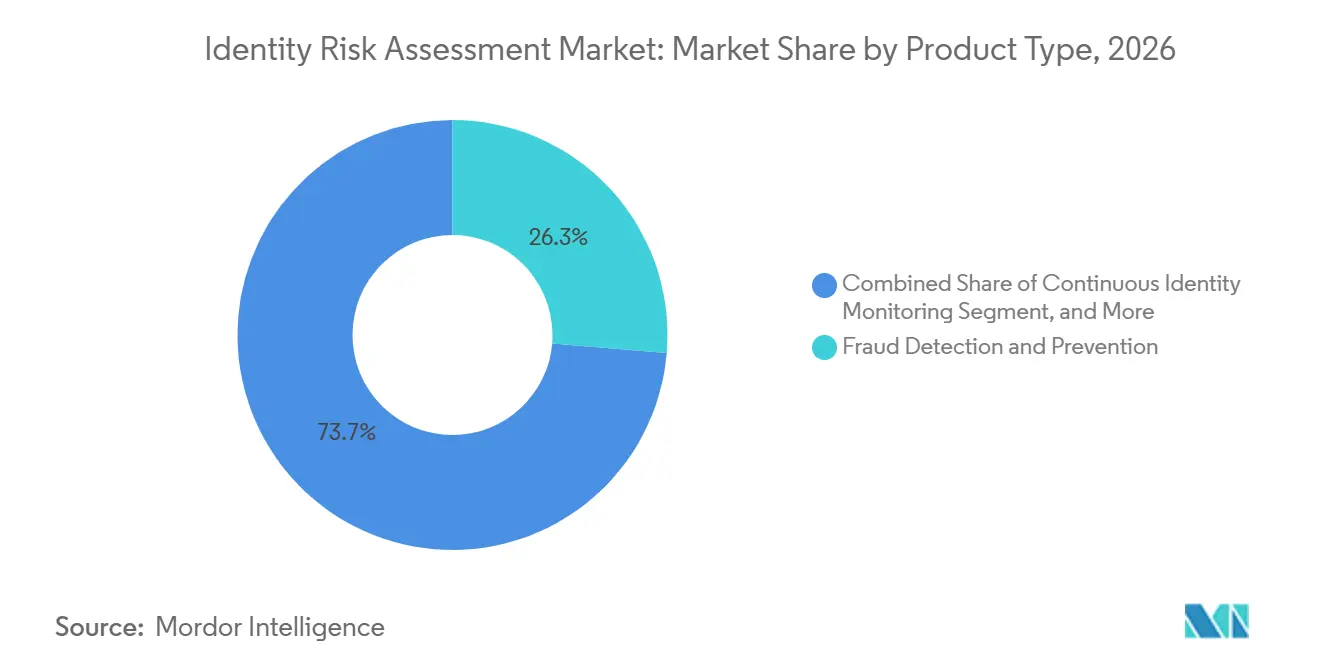
Fraud Detection Supports a Multi-Layered Risk ArchitectureFraud Detection and Prevention held 26.34% of revenue in 2026, the largest share among product types. The identity risk assessment market size for this product reflects the direct financial exposure faced by banks, retailers, and digital platforms, where a successful false application or account takeover can create both financial and compliance costs. Synthetic identities can combine authentic personal information with fabricated details, making conventional rules less reliable. Providers are moving toward trained models that respond to changing attack patterns and compare several signals rather than a single document result. This makes fraud detection a continuing operational capability in the Identity risk assessment market rather than a single decision point.
Identity Threat Detection and Response is projected to expand at a 17.32% CAGR through 2032. Huntress reported that 74% of organizations planned to implement ITDR within 12 months in 2025. Continuous identity monitoring, risk scoring, and orchestration are gaining importance as organizations manage an identity across its lifecycle. The orchestration layer can determine which data source, check, and model applies to a particular event and can route uncertain cases for further review. Verification and proofing tools are increasingly bundled with behavioral analytics and risk scoring. This packaging puts pressure on standalone document-check providers.

By Deployment Mode:
Cloud Delivery Extends Platform ReachCloud-based deployment accounted for 67.58% of revenue in 2026. This share reflects the wider use of application programming interfaces by banks, fintech firms, and embedded-finance providers. Cloud delivery allows customers to deploy services without building all the verification infrastructure internally. It can also scale with changes in onboarding or transaction volume. The model supports faster activation for organizations introducing new digital services and testing new customer journeys.
Cloud-based deployment is projected to expand at a 17.81% CAGR through 2032. On-premises systems still serve government, defense, and air-gapped environments. They also remain relevant where local processing rules apply. A hybrid approach is developing in financial services, with sensitive biometric processing held in private environments while workflow services run in vendor clouds. Security certifications such as ISO/IEC 27001 and SOC 2 Type II are becoming common procurement requirements. These requirements can favor larger providers that have the resources to sustain certification programs and meet buyer review processes.
By Organization Size:
Enterprise Spending Anchors Revenue While SMEs Extend AdoptionLarge enterprises held 68.54% of revenue in 2026. Their share reflects global compliance operations, multi-jurisdiction requirements, and the ability to integrate a broad set of controls with core systems. The Identity risk assessment industry serves these organizations with tools for document verification, liveness detection, screening, monitoring, and response. Large banks also have the budget to combine technology with internal specialist teams. Their requirements are often more complex because risk policies vary across customer groups, products, and jurisdictions in the Identity risk assessment market.
SMEs are projected to expand at a 16.72% CAGR through 2032. Consumption-based pricing can align costs with the number of checks rather than require a large upfront commitment. CFIT found that 85% of UK SMEs would pay for a Digital Company ID service in 2025.[3] Smaller companies can still lack the staff required to set thresholds, investigate exceptions, and monitor model performance. This creates demand for managed services that combine a platform with operational support. The SME opportunity depends on whether vendors can deliver usable controls without enterprise-scale implementation work.
By Application:
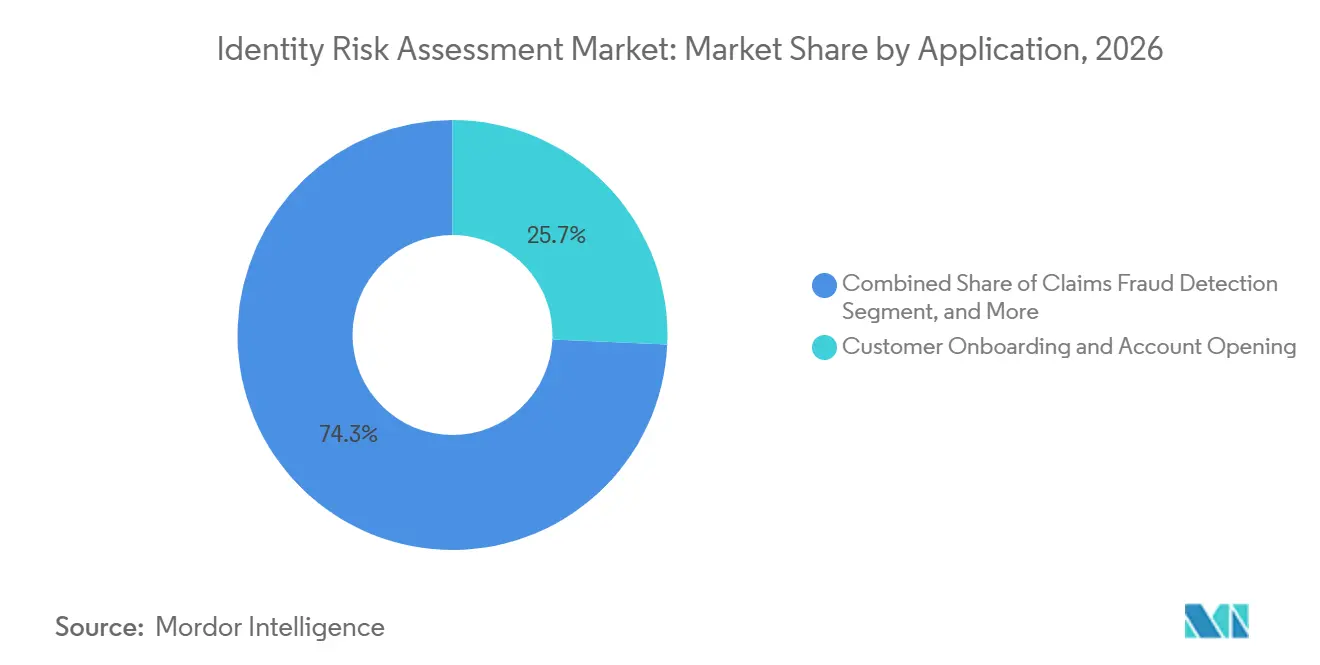
Onboarding Remains the Entry Point for Continuous Risk ManagementCustomer Onboarding and Account Opening accounted for 25.71% of revenue in 2026. The Identity risk assessment market size in this application is supported by customer-identification requirements at the start of a banking or digital-service relationship. Financial institutions must determine whether an applicant is real, eligible, and consistent with available records before providing an account or service. This creates a baseline demand for document, database, and biometric checks. Onboarding remains a core control even as platforms expand into later identity events.
Payment Authorization and Transaction Monitoring is projected to expand at a 16.72% CAGR through 2032. Real-time payment activity requires identity signals at every transaction rather than only at account opening. Behavioral authentication can use device posture, session anomalies, and interaction patterns to reduce repeated challenges for legitimate users. Identity risk scoring also supports credit underwriting by identifying accounts that are fraudulent at inception. Claims fraud detection and marketplace risk management extend the same tools into insurance and platform commerce, broadening the role of identity controls across the customer relationship.
By End User:
BFSI Provides the Largest Base and Government Use AcceleratesBFSI accounted for 26.69% of revenue in 2026. The segment's Identity risk assessment market share is driven by direct fraud exposure, regulatory demands, and high-volume digital customer channels. LexisNexis Risk Solutions stated that every USD 1 lost to fraud costs North American financial institutions USD 5 in total losses in 2025. The same study reported that 44% of institutions relied primarily on manual processes. This gap encourages investment in automation that can assess identity risk before a loss occurs.
Government and Public Administration is projected to expand at a 19.22% CAGR through 2032. Digital public services, biometric border programs, and mobile credentials are supporting this demand. Login.gov introduced passport-based remote identity verification in August 2025, covering 170 million valid U.S. passport holders at launch. Healthcare providers are using identity controls to prevent prescription fraud and to credential clinicians.[4] Retailers, online marketplaces, and telecommunications providers are using similar tools to control false declines, business risk, and SIM-swap fraud.
Geography Analysis
North America Identity Risk Assessment Market
North America held 41.64% of revenue in 2026. This share is supported by a large base of financial institutions and identity technology vendors. Fraud-loss economics are encouraging a move from manual investigation toward real-time intervention. Instant-payment networks also require checks during payment activity. ProSight reported that 87% of surveyed bank respondents said artificial intelligence was accelerating fraud faster than prevention capabilities could respond in 2026, reinforcing demand across the Identity risk assessment market.
Europe Identity Risk Assessment Market
Europe is a highly active regulatory region for the Identity risk assessment market. AMLR and eIDAS 2.0 are creating a synchronized compliance cycle across EU member states. France Identité had enrolled 3.5 million citizens by the end of 2025 and supports digital onboarding across more than 1,800 government services. The BSI and ANSSI have highlighted continued limits on service-provider access to electronic identity-document data.
APAC, South America and MEA Identity Risk Assessment Market
Asia-Pacific is projected to expand at a 17.93% CAGR through 2032. India combines Aadhaar-linked identity infrastructure with a large real-time payments base. Japan's Financial Services Agency tested verifiable credential-based electronic KYC with Mitsubishi UFJ Trust Bank and 34 other organizations in March 2026. The experiment tested interoperability between credentials issued by different organizations. South America, the Middle East, and Africa add demand through payment infrastructure, digital finance programs, and financial inclusion initiatives.
Competitive Landscape
The Identity risk assessment market has a moderately concentrated upper tier and a fragmented group of specialist providers. Large data networks, cybersecurity platforms, and identity intelligence firms compete on data coverage, model performance, and product breadth. Specialist vendors address country-specific, workflow-specific, or industry-specific requirements. The competitive focus is moving from single checks toward linked controls for human, machine, and artificial intelligence agent identities. This favors vendors that can connect verification, monitoring, access controls, and response capabilities.
Palo Alto Networks completed its acquisition of CyberArk for USD 25 billion in February 2026. The company integrated the Identity Security Platform under the Idira brand. CrowdStrike announced an agreement to acquire SGNL for USD 740 million in January 2026, extending just-in-time authorization across cloud identity and software-as-a-service systems. CrowdStrike also expanded its relationship with Microsoft to offer the Falcon platform through Microsoft Marketplace. These moves show that larger security platforms are adding identity capabilities through acquisitions and distribution partnerships.
Open opportunities remain in controls for non-human and artificial intelligence agent identities, SME-focused services, and cross-border orchestration. Consortium fraud-signal sharing can strengthen predictive models when providers have broad verified identity networks. Presentation attack detection and identity assurance standards are becoming important procurement tests. These standards increase the technical demands for entry into the Identity risk assessment market and can further reshape the Identity risk assessment market.
Identity Risk Assessment Industry Leaders
-
LexisNexis Risk Solutions
-
Experian Information Solutions, Inc.
-
Equifax Inc.
-
TransUnion LLC
-
Thales Group
- *Disclaimer: Major Players sorted in no particular order
Identity Risk Assessment Market Companies Covered in this Report
- LexisNexis Risk Solutions
- Experian Information Solutions, Inc.
- Equifax Inc.
- TransUnion LLC
- Thales Group
- Mastercard Incorporated
- GB Group plc
- Entrust Corporation
- Jumio, Inc.
- Trulioo Information Services Inc.
- Mitek Systems, Inc.
- IDEMIA Identity & Security France S.A.S.
- Socure, Inc.
- Alloy, Inc.
- Persona Identities, Inc.
- Sumsub
- Veriff OÜ
- Sift Science, Inc.
- SAS Institute Inc.
- NICE Ltd.
- CyberArk Software Ltd.
- Microsoft Corporation
- Okta, Inc.
- CrowdStrike Holdings, Inc.
- Silverfort, Inc.
Recent Industry Developments in Identity Risk Assessment Market
- October 2026: Equifax launched Signal Score for Email and Signal Score for Device, 2 new AI-powered intelligence solutions designed to help e-commerce retailers, financial institutions, and telecommunications companies detect sophisticated automated fraud networks across digital platforms, delivered via APIs for integration into existing fraud stacks.
- September 2026: LexisNexis Risk Solutions released Emailage Adaptive, a self-calibrating AI fraud detection solution that continuously learns from each organization's unique transaction data and fraud patterns without manual intervention, earning the 2026 Platinum Award for Payments Fraud Prevention Innovation.
- June 2026: Silverfort integrated AI agent identity security controls with Microsoft Copilot Studio, enforcing inline identity security policies at the precise moment a Copilot agent attempts to act and blocking unauthorized access before execution.
- February 2026: Palo Alto Networks completed its acquisition of CyberArk for approximately USD 25 billion, integrating the Identity Security Platform into its ecosystem under the Idira brand as a core element of its platformization strategy covering human, machine, and agentic identities.
Global Identity Risk Assessment Market Report Scope
The identity risk assessment market covers solutions and services used to assess, score, monitor, and mitigate identity-related risk across customers, employees, partners, merchants, machines, and AI agents. It includes identity risk scoring, fraud detection, continuous monitoring, identity threat detection and response, and risk-based decisioning.
The Identity Risk Assessment Market is Segmented by Product Type (Identity Verification and Proofing Solutions, Identity Risk Scoring and Decisioning, Fraud Detection and Prevention, Continuous Identity Monitoring, Identity Threat Detection and Response, and Identity Orchestration and Workflow), Deployment Mode (Cloud-Based, On-Premises, and Hybrid), Organization Size (Large Enterprises, and Small and Medium Enterprises), Application (Customer Onboarding and Account Opening, Payment Authorization and Transaction Monitoring, Authentication and Step-Up Access, Credit Underwriting and Loan Decisioning, Claims Fraud Detection, Merchant and Marketplace Risk Management, and Other Applications), End-User Industry (Banking, Financial Services, and Insurance (BFSI), Government and Public Administration, Healthcare and Life Sciences, Retail and E-Commerce, Telecommunications and Media, Travel and Hospitality, and Other Industry Verticals), and Geography (North America, South America, Europe, Asia-Pacific, Middle East, and Africa). The Market Forecasts are Provided in Terms of Value (USD).
Segmentation Overview
| Identity Verification and Proofing Solutions |
| Identity Risk Scoring and Decisioning |
| Fraud Detection and Prevention |
| Continuous Identity Monitoring |
| Identity Threat Detection and Response |
| Identity Orchestration and Workflow |
| Cloud-Based |
| On-Premises |
| Hybrid |
| Large Enterprises |
| Small and Medium-Sized Enterprises |
| Customer Onboarding and Account Opening |
| Payment Authorization and Transaction Monitoring |
| Authentication and Step-Up Access |
| Credit Underwriting and Loan Decisioning |
| Claims Fraud Detection |
| Merchant and Marketplace Risk Management |
| Other Applications |
| Banking, Financial Services, and Insurance (BFSI) |
| Government and Public Administration |
| Healthcare and Life Sciences |
| Retail and E-Commerce |
| Telecommunications and Media |
| Travel and Hospitality |
| Other Industry Verticals |
| North America | United States |
| Canada | |
| Mexico | |
| South America | Brazil |
| Argentina | |
| Rest of South America | |
| Europe | United Kingdom |
| Germany | |
| France | |
| Italy | |
| Spain | |
| Rest of Europe | |
| Asia-Pacific | China |
| Japan | |
| India | |
| South Korea | |
| Rest of Asia-Pacific | |
| Middle East | Saudi Arabia |
| United Arab Emirates | |
| Rest of Middle East | |
| Africa | South Africa |
| Egypt | |
| Rest of Africa |
| By Product Type | Identity Verification and Proofing Solutions | |
| Identity Risk Scoring and Decisioning | ||
| Fraud Detection and Prevention | ||
| Continuous Identity Monitoring | ||
| Identity Threat Detection and Response | ||
| Identity Orchestration and Workflow | ||
| By Deployment Mode | Cloud-Based | |
| On-Premises | ||
| Hybrid | ||
| By Organization Size | Large Enterprises | |
| Small and Medium-Sized Enterprises | ||
| By Application | Customer Onboarding and Account Opening | |
| Payment Authorization and Transaction Monitoring | ||
| Authentication and Step-Up Access | ||
| Credit Underwriting and Loan Decisioning | ||
| Claims Fraud Detection | ||
| Merchant and Marketplace Risk Management | ||
| Other Applications | ||
| By End User | Banking, Financial Services, and Insurance (BFSI) | |
| Government and Public Administration | ||
| Healthcare and Life Sciences | ||
| Retail and E-Commerce | ||
| Telecommunications and Media | ||
| Travel and Hospitality | ||
| Other Industry Verticals | ||
| By Geography | North America | United States |
| Canada | ||
| Mexico | ||
| South America | Brazil | |
| Argentina | ||
| Rest of South America | ||
| Europe | United Kingdom | |
| Germany | ||
| France | ||
| Italy | ||
| Spain | ||
| Rest of Europe | ||
| Asia-Pacific | China | |
| Japan | ||
| India | ||
| South Korea | ||
| Rest of Asia-Pacific | ||
| Middle East | Saudi Arabia | |
| United Arab Emirates | ||
| Rest of Middle East | ||
| Africa | South Africa | |
| Egypt | ||
| Rest of Africa | ||
Key Questions Answered in the Report
What is the identity risk assessment market size?
The identity risk assessment market size is projected to be USD 12.51 billion in 2026, USD 14.63 billion in 2027, and reach USD 29.87 billion by 2032, growing at a CAGR of 15.34% from 2027 to 2032.
What is driving demand for identity risk assessment tools?
Deepfake attacks, synthetic identity fraud, digital onboarding, real-time payments, and regulatory requirements are increasing demand.
Which product type leads revenue?
Fraud Detection and Prevention leads product-type revenue, with a 26.34% share in 2026.
Which deployment model is most used?
Cloud-based deployment accounts for 67.58% of revenue in 2026 and is projected to expand at a 17.81% CAGR through 2032.
Which end-user group is expanding the fastest?
Government and Public Administration is projected to expand at a 19.22% CAGR through 2032.
Which region is expanding the fastest?
Asia-Pacific is projected to expand at a 17.93% CAGR through 2032, supported by digital identity and payment infrastructure.