
Vision-Guided Assembly Systems Market Size and Share
Market Overview
| Study Period | 2020 - 2031 |
|---|---|
| Market Size (2026) | USD 6.26 Billion |
| Market Size (2031) | USD 11.63 Billion |
| Growth Rate (2026 - 2031) | 13.19 % |
| Fastest Growing Market | Asia-Pacific |
| Largest Market | Asia-Pacific |
| Market Concentration | Medium |
Major Players *Disclaimer: Major Players sorted in no particular order Image © Mordor Intelligence. Reuse requires attribution under CC BY 4.0. | |
Vision-Guided Assembly Systems Market Analysis by Mordor Intelligence
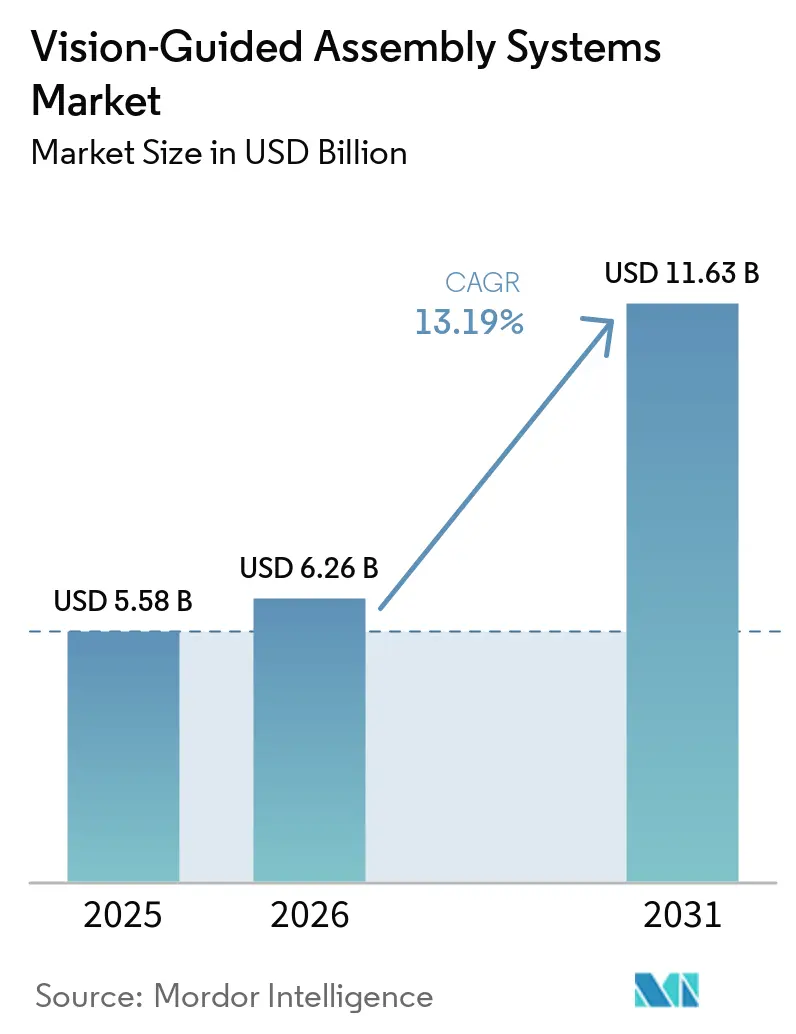
The Vision-guided assembly systems market size was valued at USD 5.58 billion in 2025 and is estimated to grow from USD 6.26 billion in 2026 to reach USD 11.63 billion by 2031, at a CAGR of 13.19% during the forecast period (2026-2031). The Vision-guided assembly systems market is supported by factory investment that combines robotics, sensing, and production software, as manufacturers seek equipment that can make decisions from visual information during assembly and can respond to the practical variation that occurs between parts, processes, and operating conditions on modern production lines. Manufacturers are using these systems to improve traceability and reduce assembly errors in demanding production environments, where the correct placement, orientation, sequence, and condition of each component can affect product quality, regulatory documentation, warranty exposure, and the ability to maintain reliable output over repeated shifts. Investment is shifting toward integrated robot and vision platforms, which can reduce the need to connect products from several suppliers. This favors providers that combine imaging, motion control, software, and implementation support, since buyers increasingly need a system that can recognize parts, guide a robot, record verification data, and remain manageable as applications and production requirements change over time, rather than separate products that require additional work to coordinate across a factory. High acquisition costs and a limited pool of integration specialists remain important barriers for smaller manufacturers, which must assess the expense of equipment, engineering, training, calibration, and later support before committing to a project, while larger organizations can often standardize a system across more sites and gain more value from that shared implementation effort.
Key Report Takeaways
- By component, Robotic and Motion Hardware held 31.23% of the share of the Vision-guided assembly systems market in 2025, while Software is projected to expand at a 14.32% CAGR through 2031.
- By vision technology, 2D Vision Systems held 55.45% of the share of the Vision-guided assembly systems market in 2025, while Multimodal Vision is projected to expand at an 14.11% CAGR through 2031.
- By robot type, Articulated Robots held 39.91% of revenue in 2025, while Mobile Robots and AMRs are projected to expand at a 14.35% CAGR through 2031.
- By application, Pick-and-Place and Component Placement accounted for 25.67% of revenue in 2025, while Kitting and Component Assembly is projected to expand at a 14.51% CAGR through 2031.
- By end-user industry, Automotive and Electric Vehicles held 31.22% of revenue in 2025, while Logistics and Warehousing is projected to expand at a 14.69% CAGR through 2031.
- By geography, Asia-Pacific held 38.71% of revenue in 2025 and is projected to expand at a 14.83% CAGR through 2031.
Note: Market size and forecast figures in this report are generated using Mordor Intelligence’s proprietary estimation framework, updated with the latest available data and insights as of January 2026.
Global Vision-Guided Assembly Systems Market Trends and Insights
Drivers Impact Analysis*
| Driver | (~) % Impact on CAGR Forecast | Geographic Relevance | Impact Timeline |
|---|---|---|---|
| Industrial Automation and Smart Factory Investment | +3.8% | Global, with peak intensity in China, Germany, and the United States | Long term (≥ 4 years) |
| Labor Shortages and Workforce Augmentation | +2.5% | North America, Western Europe, Japan, with spillover to South Korea and India | Medium term (2-4 years) |
| Higher Precision and Zero-Defect Manufacturing Requirements | +2.2% | Global, especially electronics and semiconductors, aerospace and defense, and medical devices | Long term (≥ 4 years) |
| Rising Demand for Flexible High-Mix, Low-Volume Assembly | +1.8% | Asia-Pacific core, with spillover to North America and Europe | Medium term (2-4 years) |
| CAD-Trained AI Reducing Vision-System Commissioning Time | +1.5% | Global, with early adoption in North America and Asia-Pacific | Short term (≤ 2 years) |
| Real-Time Guidance for Moving-Line Assembly | +1.0% | Automotive manufacturing hubs in Germany, the United States, China, and South Korea | Medium term (2-4 years) |
| Source: Mordor Intelligence | |||
Industrial Automation and Smart Factory Investment
Industrial automation investment provides the base for broader use of the Vision-guided assembly systems market. Manufacturers are replacing fixed automation with cells that combine sensors, software, and robotic movement. These cells can respond to changing part positions and changing production conditions. KUKA recorded EUR 213 million in R&D spending during 2025, equivalent to USD 233 million, for AI-supported automation that joins vision perception with robot path planning.[1] The spending shows that vision guidance is becoming a core platform feature for robot suppliers. The Vision-guided assembly systems market therefore benefits when buyers select integrated platforms rather than separate cameras and robot controls.
Integrated offerings may reduce the time required to connect equipment from different suppliers. They also give system providers more control over software, service, and future upgrades. This can place pressure on camera suppliers that sell standalone products. It can also increase the value of firms that provide a complete cell design. VDMA expected Europe’s vision sector to return to expansion in 2026 after a 2% revenue decline in 2025, supported by industrial automation spending and production AI adoption. These conditions support continued investment in the Vision-guided assembly systems market across established manufacturing regions, because factory programs increasingly treat imaging, motion, verification, and production software as connected requirements rather than isolated equipment purchases, and this purchasing approach gives suppliers a reason to develop products that work together through the full assembly process.
Labor Shortages and Workforce Augmentation
Labor shortages are shortening the business case for vision-guided assembly cells. Plants with limited access to skilled assemblers need systems that can sustain more operating hours. Vision guidance can help robots handle tasks where part position and appearance vary. This is especially useful when manual work limits a facility to fewer shifts. The Vision-guided assembly systems market can therefore support capacity expansion without a matching increase in staffing. The driver is strongest in North America, Western Europe, Japan, South Korea, and India, where manufacturers face a persistent need for production labor.
The requirement is not only for additional labor capacity. Manufacturers also need automation that can accommodate frequent changes in product mix. AI-guided robots can use vision and perception software for tasks that would require repeated reprogramming on traditional teach-pendant systems.[2] This is relevant to electronics production, where component variants can change often. It allows staff to focus on process supervision and exception handling. The Vision-guided assembly systems market gains when suppliers make these systems easier for plant teams to configure and maintain. Adoption remains dependent on access to engineers who can validate the resulting processes, select suitable cameras and robot movements, confirm that the visual data is reliable, and maintain the equipment after a production change, which keeps practical commissioning capability important even when software reduces the amount of manual robot teaching.
Higher Precision and Zero-Defect Manufacturing Requirements
Quality requirements are increasing the need for in-process visual verification. Electronics, medical devices, and aerospace production all require repeatable positioning and documented confirmation. Traditional automation may lose precision when equipment wears or process conditions change. Vision guidance can identify these deviations during operation and support corrective motion. A 2025 study reported a machine-vision positioning compensation system that achieved closed-loop positioning accuracy within 0.231 mm.[3] This capability supports demand in the Vision-guided assembly systems market where production errors carry high compliance or warranty costs.
ISO 9001:2015, 21 CFR Part 820, and AS9100 increase the documentation expected from relevant production lines. These requirements make error-proofing more than a simple productivity tool. They place value on systems that can verify a process step and retain records. Electric vehicle battery assembly also requires confirmation of cell placement and torque-related procedures under IEC 62619. Vision systems can address these assembly checks within the production flow. The Vision-guided assembly systems market is therefore tied to both quality assurance needs and throughput requirements, since manufacturers must maintain process records while avoiding interruptions on high-value production lines, and a system that verifies placement or detects an error during operation can address both needs within the same assembly cell.
Rising Demand for Flexible High-Mix, Low-Volume Assembly
A wider range of product variants is reducing the fit of fixed fixtures and lengthy retooling programs. Automotive, consumer electronics, and industrial machinery producers need equipment that can identify different parts within a shared cell. Vision-guided robots can locate a new part without relying only on rigid mechanical positioning. This supports assembly settings where several products move through the same equipment. The Vision-guided assembly systems market has particular relevance for kitting and component assembly, where sequence accuracy is essential. Flexible cells also help manufacturers avoid prolonged downtime when a new stock keeping unit enters production.
CAD-trained models can simplify the initial configuration of a vision system. The input material indicates that vision-guided robots can re-localize parts through learned CAD models in 200-400 milliseconds, avoiding the 2-4-week retooling period linked with conventional automation. Such capabilities reduce the operational burden of frequent changeovers. They also make it practical to automate work that was previously too variable for a fixed cell. Demand for kitting and component assembly is projected to expand at a 14.51% CAGR through 2031. The Vision-guided assembly systems market is positioned to benefit as plants seek reliable handling of mixed component sets, especially when teams need equipment that can recognize, sequence, and confirm different parts without rebuilding the physical layout for each new variant, while still maintaining consistent process verification during frequent changeovers.
Restraints Impact Analysis*
| Restraint | (~) % Impact on CAGR Forecast | Geographic Relevance | Impact Timeline |
|---|---|---|---|
| High Initial Capital and Integration Costs | -2.8% | Global, most acute in South America and Southeast Asia | Long term (≥ 4 years) |
| Shortage of Vision-Systems Integration Talent | -2.0% | North America, Europe, and emerging Asia-Pacific markets | Medium term (2-4 years) |
| Brownfield Interface and Calibration Complexity | -1.5% | Established manufacturing regions in Europe, Japan, and North America | Medium term (2-4 years) |
| Limited Interoperability Across Robot, Camera, and Controller Ecosystems | -1.0% | Global | Short term (≤ 2 years) |
| Source: Mordor Intelligence | |||
High Initial Capital and Integration Costs
High upfront spending remains a key adoption barrier in the Vision-guided assembly systems market. A complete deployment can include cameras, robotic equipment, engineering work, software, and operator training. Smaller manufacturers may have limited ability to spread these costs across several facilities. Their procurement teams must also account for recalibration and software maintenance after installation. The problem is more acute in South America and Southeast Asia, where capital budgets can be constrained. This can limit use in consumer goods and food and beverage facilities even when the process is suitable.
Large manufacturers can standardize systems across multiple plants and improve the financial case. Smaller firms often evaluate a single cell without that scale advantage. Cognex stated that its OneVision framework can reduce multi-site scaling costs by up to 50%. However, enterprise software evaluation still requires internal engineering capacity. Incomplete total-cost-of-ownership planning can leave first-time buyers exposed to unexpected service needs. The Vision-guided assembly systems market will depend on simpler deployment models to reach a wider group of manufacturers, including approaches that make costs more predictable, limit the amount of bespoke engineering, and help purchasing teams understand the ongoing requirements for system maintenance, calibration, and software support before a project begins.
Shortage of Vision-Systems Integration Talent
Vision-guided cells require expertise in optics, embedded software, robot movement, and manufacturing processes. This combination is not readily available in many production locations. The shortage can slow project commissioning and increase dependence on external integrators. It can also make maintenance more difficult after the original project team leaves. The Vision-guided assembly systems market needs products that reduce the number of specialist decisions required at installation. No-code interfaces, AI-supported calibration, and CAD-trained models are designed to meet this need.
Inbolt launched Robot Programming at Automate 2026 in Chicago to build robot assembly applications directly from CAD models. The company stated that the software had been deployed across more than 200 robots in over 100 factories, with reported reductions in downtime and faster cycle times. Products of this type can shorten manual teaching work. They can also help standardize deployment across sites with different technical resources. Poor post-maintenance calibration remains a risk when operators lack training. Suppliers are responding by including vision health monitoring and process controls within project delivery, so users can identify gradual calibration problems, maintain reliable image quality after service work, and use more consistent procedures across different facilities without relying solely on a small group of experienced integration specialists.
*Our forecasts treat driver/restraint impacts as directional, not additive. The impact forecasts reflect baseline growth, mix effects, and variable interactions.
Segment Analysis
By Component, Software Demand Accelerates Despite Hardware’s Revenue Lead
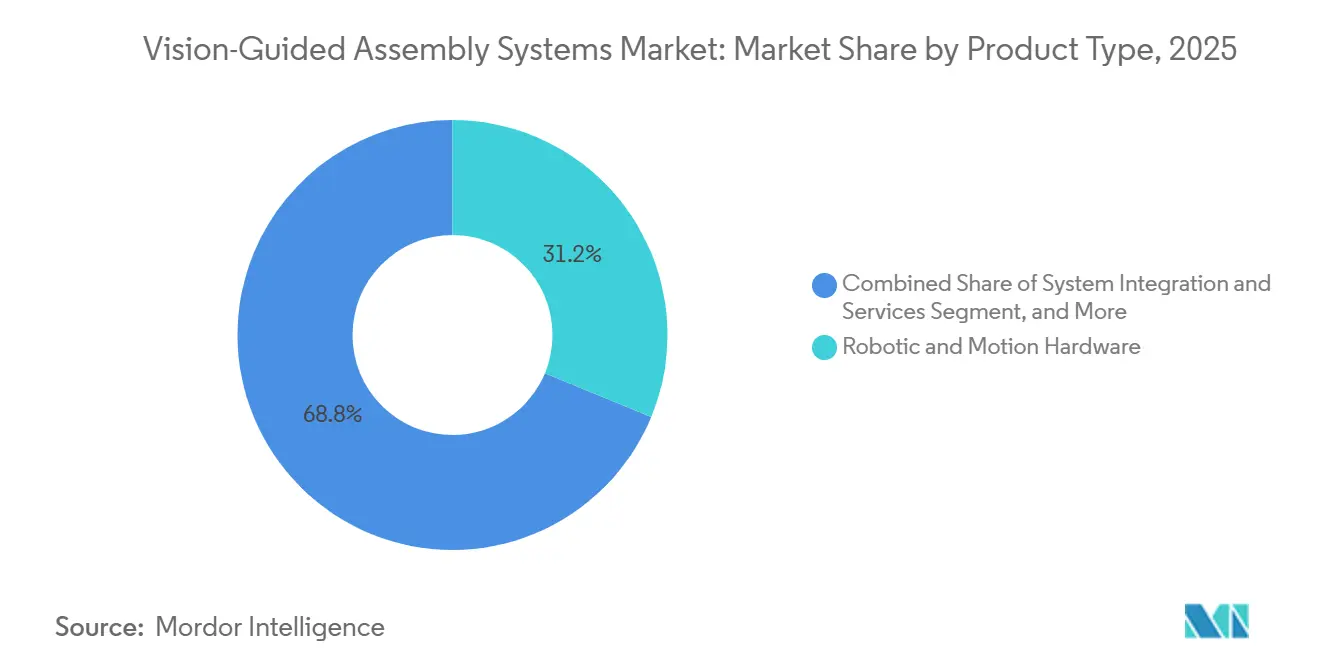
Robotic and Motion Hardware held 31.23% of the share of the Vision-guided assembly systems market in 2025. The result reflects the high capital cost of robot arms and associated motion equipment. This hardware provides the mechanical basis for positioning, handling, and tool movement. Vision Hardware formed the next major revenue pool through cameras, lenses, lighting, and embedded computing. Higher sensor resolution and multi-camera cell designs support demand in electronics assembly. End-of-Arm Tooling adds value where grippers and process tools must work with visual guidance. System Integration and Services also remain important because enterprise installations need support after the first deployment.
Software is projected to expand at a 14.32% CAGR through 2031. The Vision-guided assembly systems market size for software is supported by cloud-to-edge platforms that separate application development from hardware replacement cycles. These tools allow centrally trained AI models to be deployed on production-edge devices. Cognex made OneVision generally available in May 2026 after building a base of more than 100 enterprise customers. Cognex cited Schneider Electric as a customer that doubled yield and reduced false rejects after a multi-site implementation. Software governance requirements linked with IEC 62443 can further increase the role of software in system purchasing. The Vision-guided assembly systems industry is moving toward recurring software and support revenue alongside equipment sales, because central model training, edge deployment, cybersecurity governance, and continuing performance management remain relevant after a robot or camera has been installed, giving customers a reason to evaluate software capability as part of the full system decision.

By Vision Technology, 2D Vision Retains Scale While Multimodal Systems Address Complex Work
2D Vision Systems held 55.45% of the share of the Vision-guided assembly systems market in 2025. Their position is supported by extensive application libraries and favorable cost-per-pixel performance. They are well suited to flat parts and high-throughput inspection tasks. 2D tools also support established processes where object presentation is controlled. 3D Vision Systems serve bin picking, press-fit verification, and automotive body assembly. These applications require depth information and precise Z-axis positioning. A 2026 Scientific Reports study reported 0.54 mm positioning accuracy and a 98.7% success rate across 1,200 vision-guided pick-and-place trials.
Multimodal Vision is projected to expand at an 14.11% CAGR through 2031. It combines RGB imaging with depth data and can include thermal or polarimetric signals. This approach addresses scene variation that a single imaging method may not resolve. It can be useful when parts have uncertain orientation or surface conditions. The Vision-guided assembly systems market needs this capability for unstructured and high-mix production work. Mech-Mind Robotics reported a 22.1% global share of AI and 3D vision-guided robot components by 2025 revenue, while its shipment share exceeded 27%. The company’s position shows the commercial importance of combined 3D vision and AI architectures, particularly for applications where depth information, part recognition, and process decisions must work together, and where a conventional camera installation cannot provide a sufficiently clear view of varied or uncertain production conditions.
By Robot Type, Articulated Robots Lead Production Lines While AMRs Extend Automation
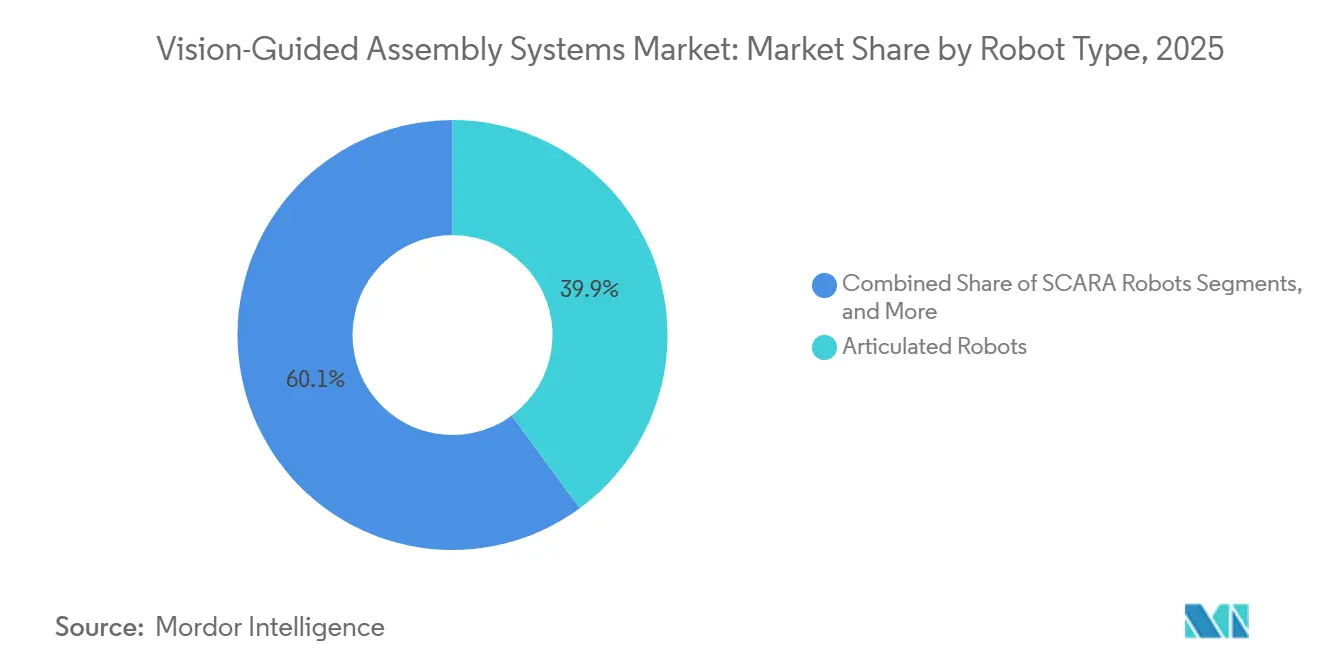
Articulated Robots held 39.91% of robot type revenue in 2025. The category benefits from broad reach, payload flexibility, and established use in structured assembly stations. Automotive, aerospace, and electronics plants use articulated systems for repeated tasks across defined work areas. SCARA Robots and Cartesian and Gantry Robots support high-speed planar processes where repeatability is more important than spatial flexibility. Collaborative Robots are used in final assembly cells that require shared workspaces. Their force-torque sensing can complement vision-guided insertion and fastening. Other Robot Types, including delta and parallel-link designs, address specialized high-speed pick-and-place work.
Mobile Robots and AMRs are projected to expand at a 14.35% CAGR through 2031. The Vision-guided assembly systems market is extending from fixed workstations to material movement within active plants. ForwardX reported that more than 270 of 435 planned AMRs were operating at Chery’s Dalian facility in March 2026. The units operated across welding and final assembly workshops that produced 800-1,000 vehicles each day. ABB also introduced the Flexley Stack F712 autonomous forklift as part of its visual SLAM AMR portfolio. ISO 3691-4 continues to shape the safety and certification requirements for industrial trucks, including AMRs, which means developers must consider reliable perception, safe vehicle movement, and appropriate operating controls as part of deployment planning rather than treat vision-based navigation as a separate feature added after the vehicle design is complete.
By Application, Pick-and-Place Holds Volume While Kitting Handles Product Variety
Pick-and-Place and Component Placement accounted for 25.67% of the share of the Vision-guided assembly systems market in 2025. The application is used in electronics PCB population, automotive sub-assembly, and consumer goods packaging. Its breadth makes it a core source of equipment volume. Vision guidance can identify parts before pickup and confirm orientation before placement. Part Alignment and Orientation, Insertion and Press-Fit, and Fastening and Joining form the next group of applications. These processes can use visual feedback with force correction to reduce blind insertion errors. Adhesive and Sealant Dispensing is gaining relevance in electric vehicle battery sealing because bead placement can affect thermal management and safety.
Kitting and Component Assembly is projected to expand at a 14.51% CAGR through 2031. The task requires a system to identify, sequence, and confirm varied components before robot presentation. Fixed-fixture automation is less suitable when part combinations change frequently. The Vision-guided assembly systems market can provide a more adaptable method for these workflows. Research presented through the AAAI 2026 RoCo Challenge found that a Specialist-plus-Generalist dual-model framework performed better than single-model approaches in long-horizon, multi-task robotic assembly. This work is relevant to software design for complex kitting processes. Assembly Verification and Error Proofing also contributes demand because manufacturers need documented evidence that assembly steps were completed, and this requirement can make visual confirmation relevant even where a task is already largely automated, since the value lies in showing that the correct part, position, and process sequence were achieved.
By End-User Industry, Automotive Leads Demand While Logistics Expands Quickly
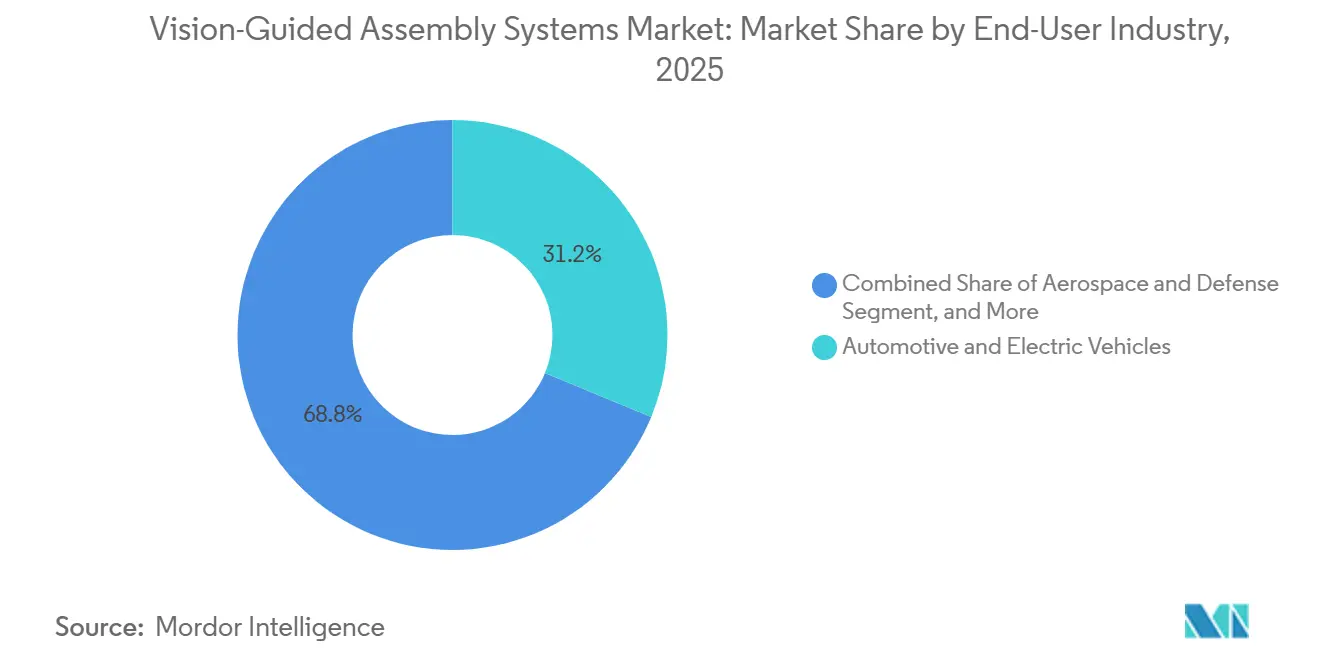
Automotive and Electric Vehicles held 31.22% of the share of the Vision-guided assembly systems market in 2025. Automotive plants have a high density of stations that require precise component location and process confirmation. Electric vehicle battery and powertrain work adds further accuracy requirements. Electronics and Semiconductors remain technically demanding because packaging lines require sub-5-micron defect detection. Aerospace and Defense and Medical Devices use documented assembly records to support AS9100 and 21 CFR Part 820 requirements. Consumer Goods and Appliances and Industrial Machinery provide additional deployment opportunities. Food and Beverages can adopt hygienic IP67-rated vision hardware where washdown conditions previously limited installations.
Logistics and Warehousing is projected to expand at a 14.69% CAGR through 2031. E-commerce order variety, continuous throughput needs, and labor shortages are supporting deployment in distribution operations. Vision software can support both item recognition and AMR navigation within the same facility. This can connect two system functions that were historically purchased separately. The Vision-guided assembly systems market has an opportunity where robotic picking and material movement are deployed together. The input material also identifies financing activity in assembly robotics during 2025 that focused on embodied intelligence and high-frequency operating environments. This supports attention on logistics use cases that require reliable perception across repeated movements, where the same visual system may have to identify items, guide robot travel, and work around changing facility conditions, making software reliability and repeatable operation central to the value of a combined robotics deployment.
Geography Analysis
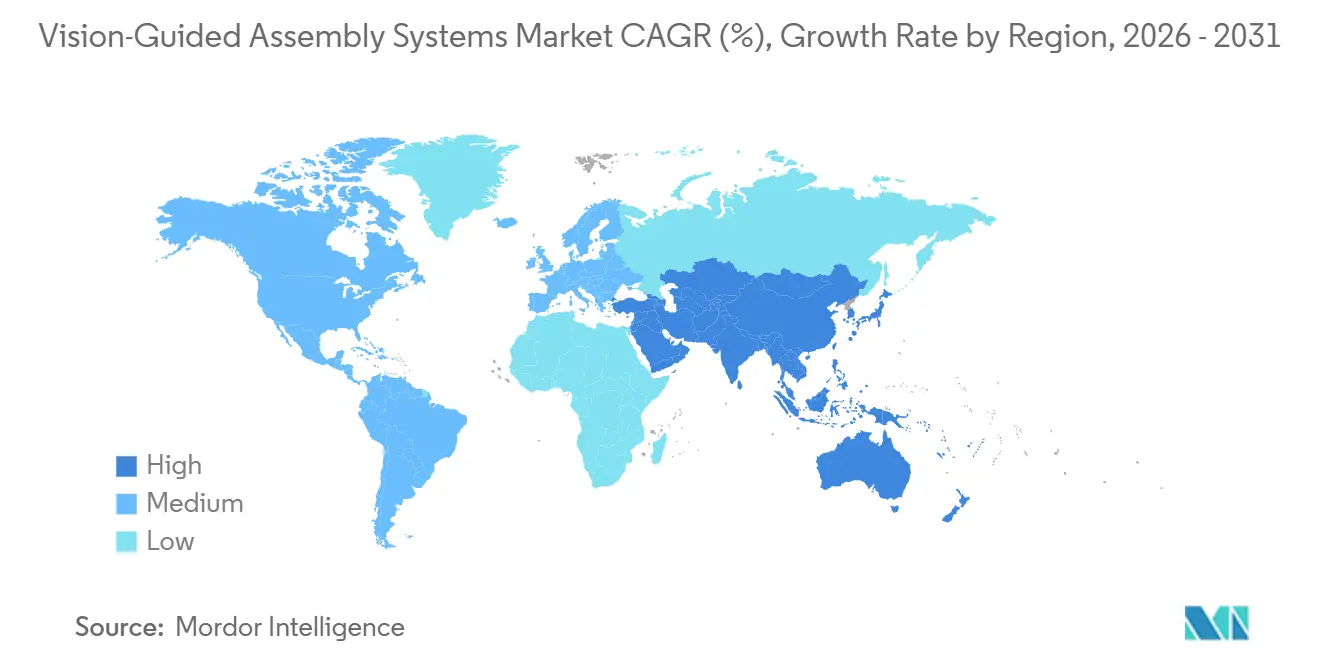
Asia-Pacific held 38.71% of the share of the Vision-guided assembly systems market in 2025 and is projected to expand at a 14.83% CAGR through 2031. China, Japan, South Korea, and the ASEAN corridor concentrate major electronics, semiconductor, and automotive production. This manufacturing base supports demand for both fixed assembly cells and flexible material handling. China is also developing domestic capability in force control and autonomous path planning. The region’s scale gives local suppliers opportunities to compete with established international automation providers, because customers can combine a large manufacturing base with suppliers that understand local production needs, while established companies must continue adapting their products and commercial support to regional requirements for electronics, batteries, and automotive assembly.
Japan remains important because of its robotics manufacturing base and dense automotive sector. Mitsubishi Electric and Sony Semiconductor Solutions announced Advanced Vision Solutions Co., Ltd. in July 2026, with Mitsubishi Electric holding 60% and Sony holding 40%. The venture is intended to develop AI-based vision sensors that process data directly on image sensors for factory automation. Such products can reduce data movement between sensing and control functions. This supports the Vision-guided assembly systems market in applications that need rapid local processing. Asia-Pacific remains the leading regional demand center because it combines end-user scale with active automation investment, and its electronics, semiconductor, and automotive facilities create demand for a wide range of equipment, from precise fixed assembly cells to vision-supported material movement within complex production and distribution environments.
North America and Europe form the next major demand block, supported by reshoring, AI chipset availability, and investment in automotive, aerospace, and semiconductor production. VDMA projected a 3% expansion for Europe’s vision sector in 2026 after the 2% decline recorded in 2025. KUKA reported 4% revenue expansion in 2025 and China revenue above EUR 1 billion, equivalent to USD 1.09 billion, for the first time. South America, the Middle East, and Africa remain earlier-stage markets with adoption shaped by individual projects. Brazil, Saudi Arabia, the UAE, and South Africa are focal points because automotive, electronics, and diversification programs support manufacturing automation, although deployment in these locations is still shaped by individual projects and the availability of capital, technical expertise, and local integration capacity for new robotics and vision installations.
Competitive Landscape
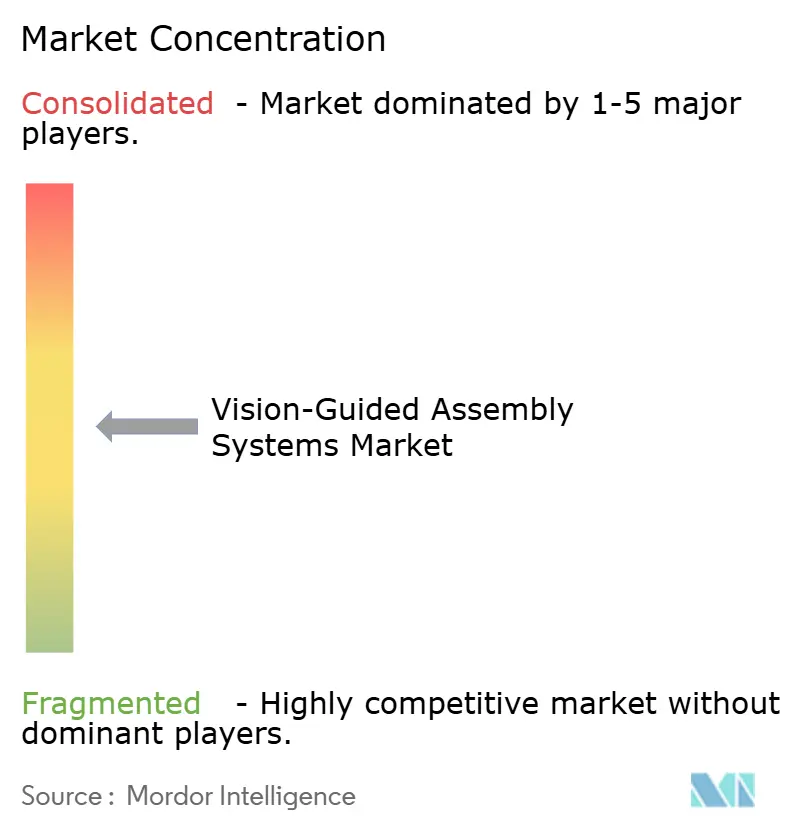
The Vision-guided assembly systems market is moderately concentrated. Industrial automation groups and specialist machine vision suppliers occupy related but distinct positions. Cognex and Keyence compete in embedded vision hardware and machine vision software. Robotics suppliers such as ABB, FANUC, and KUKA integrate vision within broader robot and software portfolios. This gives buyers a choice between a specialist component approach and a more integrated automation platform. The competitive balance depends on application needs, system integration capacity, and the value placed on software support, because buyers must decide whether an established specialist product can fit their existing equipment or whether a broader automation provider offers a more practical route to a unified robot, vision, and service environment.
Cognex made OneVision generally available in May 2026, directing its offering toward centrally managed AI model deployment across manufacturing sites. The platform strategy seeks to add recurring software value alongside hardware sales. ABB invested in LandingAI in September 2025 to integrate generative visual AI with its robotic software suite. ABB also launched OmniCore EyeMotion during 2025, stating that it can reduce commissioning time by up to 90% compared with custom vision integration. KUKA presented its AMP software platform in March 2026 as part of its Automation 2.0 strategy. These moves show that major suppliers are competing on easier deployment and software integration, with the aim of reducing the specialist effort needed to build and manage an application, while also expanding their role beyond equipment supply into model deployment, commissioning, maintenance, and ongoing performance management for customer production sites.
The Vision-guided assembly systems market has room for providers of low-code commissioning tools for mid-sized manufacturers, where internal teams may understand their assembly process but may not have specialists in robot programming, optics, and AI model configuration, making simpler interfaces and guided setup an important competitive requirement. Demand also exists for moving-line guidance that combines fast imaging with real-time path correction. Multimodal systems that combine depth, tactile, and force-torque signals offer another area of development for complex assembly. Inbolt and Mech-Mind Robotics represent companies seeking to compete through AI-first approaches. Mech-Mind Robotics listed on the Hong Kong Stock Exchange in September 2026, with a reported market capitalization of HKD 12.71 billion, equivalent to USD 1.63 billion. Market concentration score: 3 out of 10, because the reported 22.1% share for a leading specialized supplier indicates no dominant player and a dispersed competitive field.
Vision-Guided Assembly Systems Industry Leaders
-
Cognex Corporation
-
Keyence Corporation
-
OMRON Corporation
-
ABB Ltd.
-
FANUC CORPORATION
- *Disclaimer: Major Players sorted in no particular order
Recent Industry Developments
- July 2026: Mitsubishi Electric and Sony Semiconductor Solutions announced the formation of Advanced Vision Solutions Co., Ltd. The joint venture is owned 60% by Mitsubishi Electric and 40% by Sony, and it will develop AI-based vision sensors that analyze data directly on image sensors for factory automation applications.
- June 2026: Inbolt SAS launched Robot Programming at Automate 2026 in Chicago. The product enables robot assembly applications built directly from CAD models, with demonstrations alongside NVIDIA and Universal Robots and a FANUC CRX cobot performing bolt tightening on a moving engine block.
- May 2026: Cognex announced general availability of OneVision with more than 100 enterprise customers globally. Schneider Electric and 3M were cited as customers reporting doubled yield and faster deployment, respectively. Cognex also launched the In-Sight 3900 Vision System powered by Qualcomm Dragonwing platforms on May 5, 2026.
- April 2026: Cognex launched the In-Sight 6900 Vision Controller powered by NVIDIA Jetson. The controller provides up to 157 TOPS of AI performance and supports Few Sample Classification with 10-20 training images.
Global Vision-Guided Assembly Systems Market Report Scope
The vision-guided assembly systems market comprises the sale and deployment of integrated hardware, software, and services that use machine-vision technologies, including cameras, sensors, lighting, image-processing systems, and artificial intelligence, to guide, monitor, and control automated or semi-automated assembly operations.
The Vision-Guided Assembly Systems Market Report is Segmented by Component (Vision Hardware, Robotic and Motion Hardware, End-of-Arm Tooling, Software, and System Integration and Services), Vision Technology (2D Vision Systems, 3D Vision Systems, and Multimodal Vision), Robot Type (Articulated Robots, SCARA Robots, Cartesian and Gantry Robots, Collaborative Robots, Mobile Robots and AMRs, and Other Robot Types), Application (Pick-and-Place and Component Placement, Part Alignment and Orientation, Insertion and Press-Fit, Fastening and Joining, Adhesive/Sealant Dispensing, Kitting and Component Assembly, Assembly Verification and Error Proofing, and Other Applications), End-User Industry (Automotive and Electric Vehicles, Electronics and Semiconductors, Aerospace and Defense, Medical Devices and Pharmaceuticals, Consumer Goods and Appliances, Industrial Machinery, Food and Beverages, Logistics and Warehousing, and Other End-User Industries), and Geography (North America, South America, Europe, Asia-Pacific, and Middle East and Africa). The Market Forecasts are Provided in Terms of Value (USD).
| Vision Hardware |
| Robotic and Motion Hardware |
| End-of-Arm Tooling |
| Software |
| System Integration and Services |
| 2D Vision Systems |
| 3D Vision Systems |
| Multimodal Vision |
| Articulated Robots |
| SCARA Robots |
| Cartesian and Gantry Robots |
| Collaborative Robots |
| Mobile Robots and AMRs |
| Other Robot Types |
| Pick-and-Place and Component Placement |
| Part Alignment and Orientation |
| Insertion and Press-Fit |
| Fastening and Joining |
| Adhesive / Sealant Dispensing |
| Kitting and Component Assembly |
| Assembly Verification and Error Proofing |
| Other Applications |
| Automotive and Electric Vehicles |
| Electronics and Semiconductors |
| Aerospace and Defense |
| Medical Devices and Pharmaceuticals |
| Consumer Goods and Appliances |
| Industrial Machinery |
| Food and Beverages |
| Logistics and Warehousing |
| Other End-User Industries |
| North America | United States | |
| Canada | ||
| Mexico | ||
| South America | Brazil | |
| Argentina | ||
| Rest of South America | ||
| Europe | Germany | |
| United Kingdom | ||
| France | ||
| Italy | ||
| Spain | ||
| Rest of Europe | ||
| Asia-Pacific | China | |
| Japan | ||
| India | ||
| South Korea | ||
| ASEAN | ||
| Rest of Asia-Pacific | ||
| Middle East and Africa | Middle East | Saudi Arabia |
| United Arab Emirates | ||
| Rest of the Middle East | ||
| Africa | South Africa | |
| Rest of Africa | ||
| By Component | Vision Hardware | ||
| Robotic and Motion Hardware | |||
| End-of-Arm Tooling | |||
| Software | |||
| System Integration and Services | |||
| By Vision Technology | 2D Vision Systems | ||
| 3D Vision Systems | |||
| Multimodal Vision | |||
| By Robot Type | Articulated Robots | ||
| SCARA Robots | |||
| Cartesian and Gantry Robots | |||
| Collaborative Robots | |||
| Mobile Robots and AMRs | |||
| Other Robot Types | |||
| By Application | Pick-and-Place and Component Placement | ||
| Part Alignment and Orientation | |||
| Insertion and Press-Fit | |||
| Fastening and Joining | |||
| Adhesive / Sealant Dispensing | |||
| Kitting and Component Assembly | |||
| Assembly Verification and Error Proofing | |||
| Other Applications | |||
| By End-User Industry | Automotive and Electric Vehicles | ||
| Electronics and Semiconductors | |||
| Aerospace and Defense | |||
| Medical Devices and Pharmaceuticals | |||
| Consumer Goods and Appliances | |||
| Industrial Machinery | |||
| Food and Beverages | |||
| Logistics and Warehousing | |||
| Other End-User Industries | |||
| By Geography | North America | United States | |
| Canada | |||
| Mexico | |||
| South America | Brazil | ||
| Argentina | |||
| Rest of South America | |||
| Europe | Germany | ||
| United Kingdom | |||
| France | |||
| Italy | |||
| Spain | |||
| Rest of Europe | |||
| Asia-Pacific | China | ||
| Japan | |||
| India | |||
| South Korea | |||
| ASEAN | |||
| Rest of Asia-Pacific | |||
| Middle East and Africa | Middle East | Saudi Arabia | |
| United Arab Emirates | |||
| Rest of the Middle East | |||
| Africa | South Africa | ||
| Rest of Africa | |||
Key Questions Answered in the Report
What is the size of the Vision-guided Assembly Systems market?
The market was valued at USD 5.58 billion in 2025, is estimated at USD 6.26 billion in 2026, and is forecast to reach USD 11.63 billion by 2031 at a 13.19% CAGR, supported by wider factory investment in integrated robotic, visual, and software-enabled assembly systems.
Which component leads spending on these systems?
Robotic and Motion Hardware led with 31.23% revenue share in 2025, while Software is projected to expand at a 14.32% CAGR through 2031.
Which vision technology is expanding fastest?
Multimodal Vision is projected to expand at a 14.11% CAGR through 2031, while 2D Vision Systems held 55.45% share in 2025.
Why are manufacturers adopting vision-guided assembly systems?
Manufacturers use them to improve traceability, support error-proofing, and manage changing part positions in high-mix assembly work.
Which end-user sector leads demand?
Automotive and Electric Vehicles led with 31.22% revenue share in 2025 because battery and powertrain assembly require accurate positioning and verification.
Which region has the strongest demand?
Asia-Pacific held 38.71% share in 2025 and is projected to expand at a 14.83% CAGR through 2031, supported by electronics, semiconductor, and automotive production.