
Vision-Guided Painting Robots Market Size and Share
Market Overview
| Study Period | 2020 - 2031 |
|---|---|
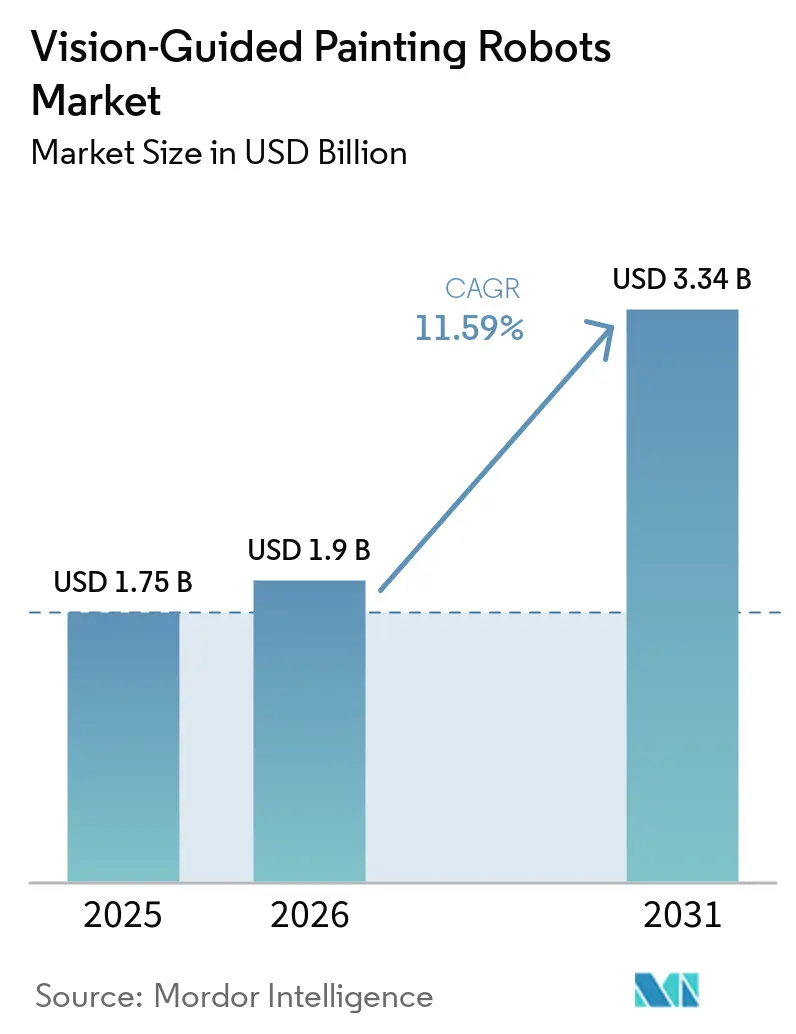
| Market Size (2026) | USD 1.9 Billion |
| Market Size (2031) | USD 3.34 Billion |
| Growth Rate (2026 - 2031) | 11.59 % |
| Fastest Growing Market | Asia-Pacific |
| Largest Market | Asia-Pacific |
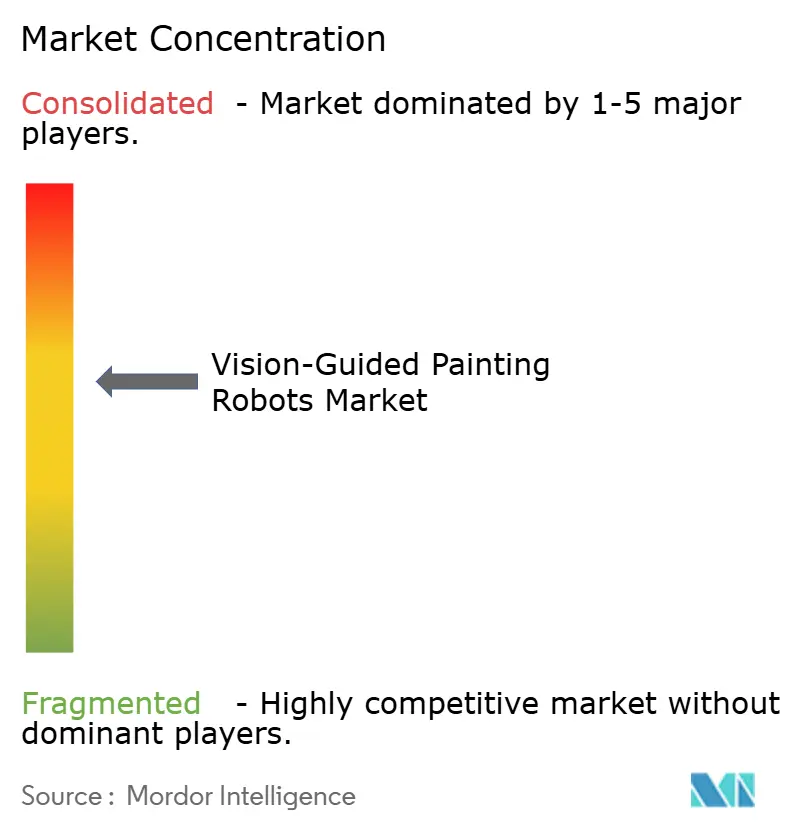
| Market Concentration | Medium |
Major Players *Disclaimer: Major Players sorted in no particular order Image © Mordor Intelligence. Reuse requires attribution under CC BY 4.0. | |
Vision-Guided Painting Robots Market Analysis by Mordor Intelligence
The Vision-guided painting robots market size was valued at USD 1.75 billion in 2025 and estimated to expand from USD 1.95 billion in 2026 to reach USD 3.34 billion by 2031, at a CAGR of 11.59% during the forecast period (2026-2031). The Vision-guided painting robots market is supported by manufacturers that need repeatable coating quality, lower material waste, safer paint-booth operations, and better control of process variation across repeated production cycles. Electric vehicle production is increasing the number of difficult-to-reach surfaces that must be coated consistently, including reinforced structures, battery housings, and reconfigured body openings. This favors systems that combine multi-axis motion with part recognition, surface mapping, and adaptive spray paths, rather than relying only on a fixed program and standard part placement. Suppliers are also competing through certified hazardous-area products, process software, service coverage, and application tools that can reduce overspray and support inline personalization. The Vision-guided painting robots market, therefore, offers opportunities in new electric vehicle facilities, established paint-shop upgrades, and lower-volume applications where simplified collaborative systems can improve access to automation.
Key Report Takeaways
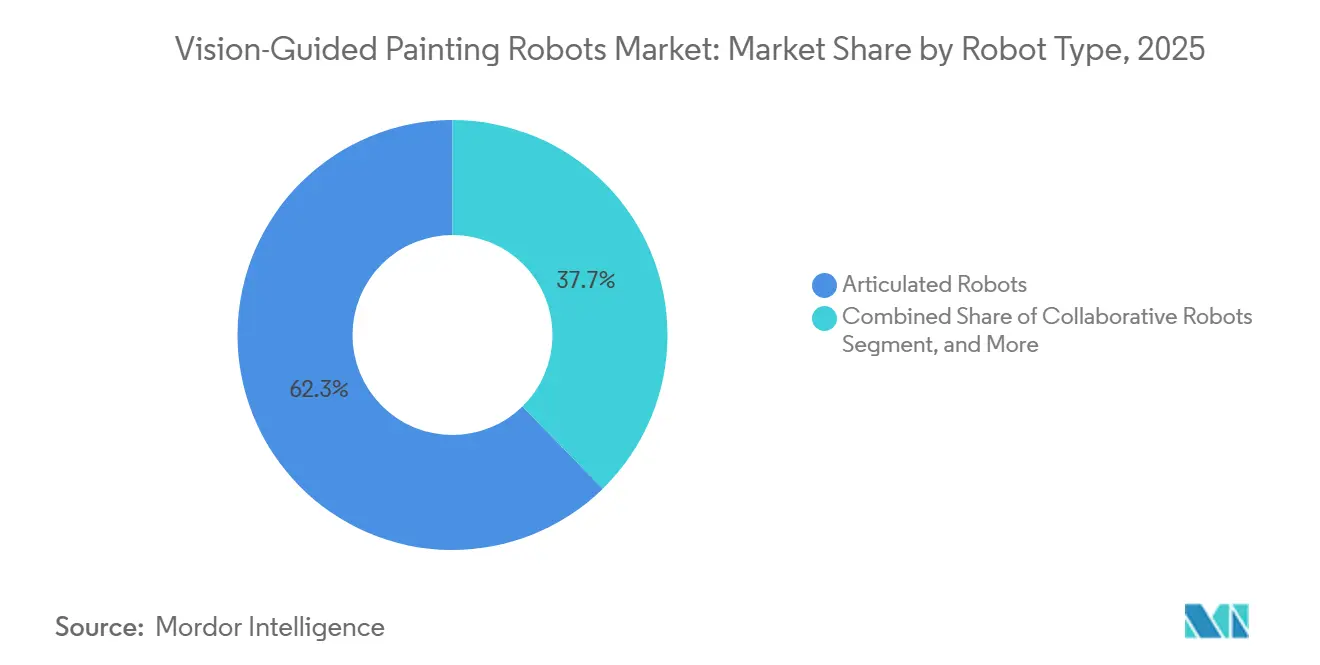
- By robot type, articulated robots held 62.33% of the Vision-guided painting robots market in 2025, while collaborative robots are projected to expand at a 15.67% CAGR through 2031.
- By vision technology, 2D vision systems held 52.67% share in 2025, while multimodal vision is projected to expand at a 16.89% CAGR through 2031.
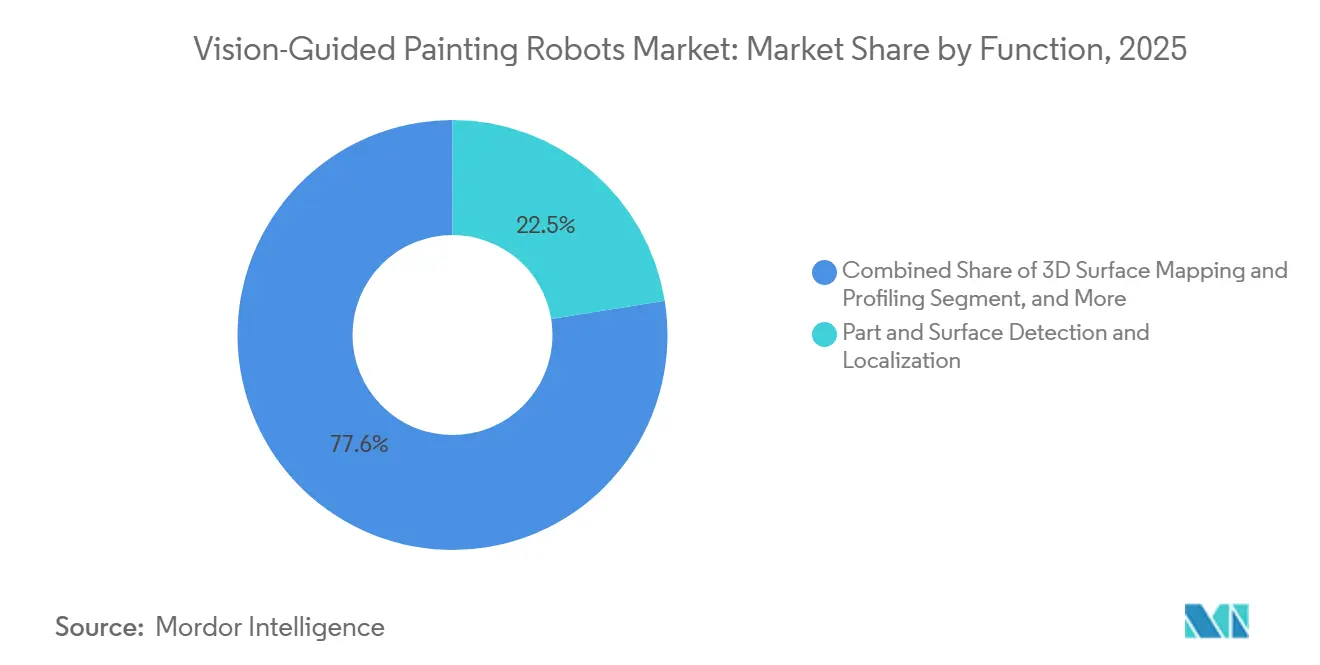
- By function, part and surface detection and localization held 22.45% share in 2025, while adaptive paint-path generation is projected to expand at a 14.31% CAGR through 2031.
- By paint and coating process, liquid spray painting held 56.11% share in 2025, while electrostatic painting and coating are projected to expand at a 13.57% CAGR through 2031.
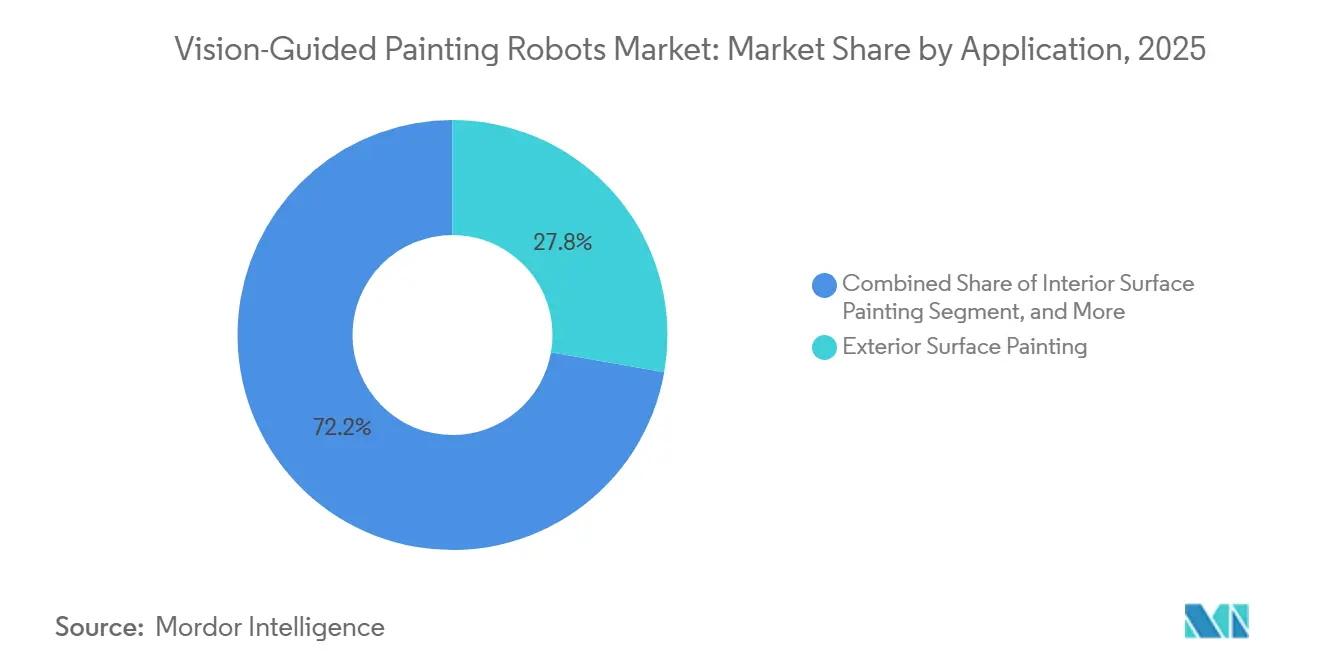
- By application, exterior surface painting held 27.77% share in 2025, while complex-geometry and contoured surface painting are projected to expand at a 14.55% CAGR through 2031.
- By end-user industry, automotive and electric vehicles held 42.22% share in 2025, while electrical and electronics is projected to expand at a 14.81% CAGR through 2031.
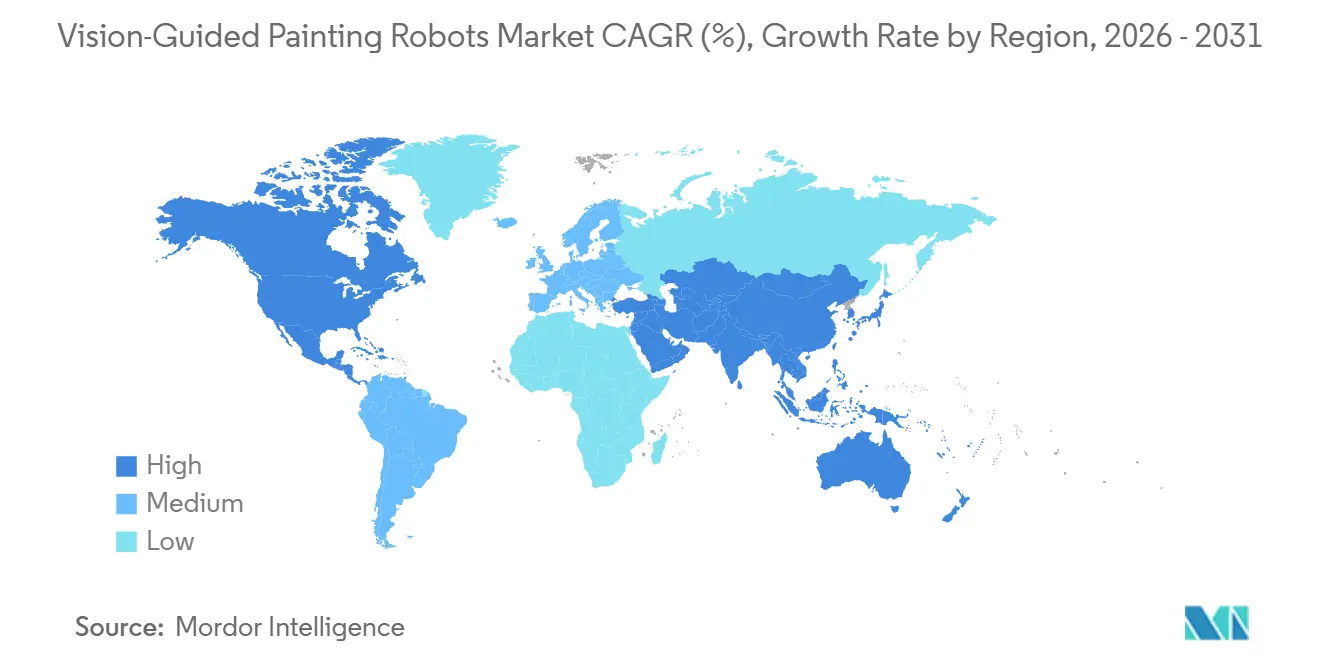
- By geography, Asia-Pacific held 37.51% share in 2025 and is projected to expand at a 14.11% CAGR through 2031.
Note: Market size and forecast figures in this report are generated using Mordor Intelligence’s proprietary estimation framework, updated with the latest available data and insights as of January 2026.
Market Trends and Insights
Drivers Impact Analysis of Vision-Guided Painting Robots Market*
| Driver | (~) % Impact on CAGR Forecast | Geographic Relevance | Impact Timeline |
|---|---|---|---|
| Increasing Automation in High-Volume Manufacturing | +2.8% | Global, highest density in China, Germany, and Japan | Short term (≤ 2 years) |
| Consistent Coating Quality and Lower Overspray | +2.2% | Global, particularly North America and Europe | Medium term (2-4 years) |
| Electric Vehicle and Battery Manufacturing Expansion | +1.9% | China, Germany, India, and South Korea | Medium term (2-4 years) |
| Stricter Worker Safety and VOC Requirements | +1.4% | Global, accelerated in India, the EU, and China | Short term (≤ 2 years) |
| Vision-Based Adaptive Spraying for Complex Geometries | +0.9% | Automotive and aerospace in North America and Europe | Medium term (2-4 years) |
| Lower-Cost Robotic Cells for Small and Mid-Sized Manufacturers | +0.6% | North America, Europe, and ASEAN | Long term (≥ 4 years) |
| Source: Mordor Intelligence | |||
Increasing Automation in High-Volume Manufacturing
High-volume manufacturing requires stable coating cycles across multiple shifts and production days, especially where the cost of an inconsistent finish can include rework, material loss, and disruption to scheduled output. The International Federation of Robotics reported 542,000 industrial robot installations worldwide in 2024, the second-highest annual total recorded. Asia accounted for 74% of those installations, and the operating stock reached 4,664,000 units, underscoring the scale of the installed industrial base that supports suppliers of robotic application equipment.[1]International Federation of Robotics, “Global Robot Demand in Factories Doubles Over 10 Years,” International Federation of Robotics, ifr.org. Electronics accounted for 24% of global installations in 2024, while automotive accounted for 23%, which broadens the base for automated coating equipment beyond the sector historically associated with paint robots. ABB installed 47 paint robots and its AI-enabled Digital Painting Suite at Audi FAW’s Changchun electric vehicle plant in 2025. The Vision-guided painting robots market benefits when new factories specify vision, analytics, multi-axis equipment, and coordinated process control as one integrated production system.
Consistent Coating Quality and Lower Overspray
Premium vehicle and electronics producers require consistent coatings on visible and complex surfaces, where even small variations in the finish can affect acceptance rates and create additional work for operators. ABB stated that its PixelPaint system uses a 1,000-nozzle head with 3D vision guidance and achieves 100% paint-to-surface transfer with zero overspray. The system was deployed at Mercedes-Benz’s Sindelfingen plant, Stellantis’ Melfi plant, and Mahindra and Mahindra’s electric vehicle facility in 2025. These deployments allow dual-tone finishes to be applied in line without masking work, which removes a manual step from premium-finish programs. ABB reported that 42 IRB 5500-family robots began operating at Mahindra and Mahindra’s facility with RB1000i-S atomizers. The Vision-guided painting robots market gains where finishing quality, paint savings, and product personalization must be delivered at production speed without adding a separate coating pass.
Electric Vehicle and Battery Manufacturing Expansion
Battery-electric vehicle structures have reinforced rocker panels, underfloor battery trays, and reconfigured door openings that increase the difficulty of applying a consistent coating. These features can require applicators to reach angles that standard six-axis systems do not readily cover, which makes seven-axis configurations and vision-guided adaptive paths more relevant. Dürr delivered its 19,000th Ecopaint-family robot to BYD’s first European plant in Szeged during May 2025. The project included more than 120 painting and handling robots for interior and exterior electric vehicle body coating. Dürr announced its modular EcoProBooth installation for CEER, Saudi Arabia’s first automotive brand, in January 2026. The Vision-guided painting robots market is positioned to benefit as electric vehicle plants seek flexible equipment to support new body designs, additional coating steps, and future model changes.
Stricter Worker Safety and VOC Requirements
Paint booths expose workers and equipment to volatile organic compounds, isocyanate particulates, and explosive aerosols, which creates a clear need for equipment designed for hazardous conditions. The ATEX Directive and the IECEx scheme require certified explosion-protection ratings for electrical equipment used in classified paint-booth zones. FANUC introduced the CRX-10iA/L Paint in Europe during March 2025 as an ATEX-certified explosion-proof collaborative paint robot. The product supports liquid painting, powder coating, and gel coating in Zone 1 and Zone 2 environments. Certified systems reduce the technical burden of building a compliant robotic cell, particularly where existing processes must be updated to meet operating requirements. The Vision-guided painting robots market benefits as safety and emissions requirements strengthen the case for enclosed, monitored, and automated painting operations.
Restraints Impact Analysis of Vision-Guided Painting Robots Market*
| Restraint | (~) % Impact on CAGR Forecast | Geographic Relevance | Impact Timeline |
|---|---|---|---|
| High Capital and Integration Costs | -2.1% | Global, most constraining for SMEs in ASEAN and South America | Medium term (2-4 years) |
| Shortage of Robotics and Paint-Process Programming Skills | -1.4% | Global, acute in Europe and South America | Long term (≥ 4 years) |
| Vision-System Reliability Under Paint-Booth Contamination | -0.9% | Global | Medium term (2-4 years) |
| Limited Training Data for Novel Parts and Low-Volume Production | -0.5% | Aerospace, consumer appliances, and marine | Long term (≥ 4 years) |
| Source: Mordor Intelligence | |||
High Capital and Integration Costs
A complete vision-guided painting cell requires spending on robots, application equipment, safety hardware, controls, and commissioning. The cost is more difficult to justify for small and mid-sized manufacturers with low volumes or uneven orders. Existing facilities can also use conveyors, ovens, and inspection equipment from several generations of suppliers. That diversity increases the work needed to connect a new robotic cell to the production line. The Vision-guided painting robots market may see delayed purchases when buyers need to align capital budgets with facility upgrades. Lower-cost turnkey cells may widen access, but buyers still weigh local service support and long-term maintenance capability.
Shortage of Robotics and Paint-Process Programming Skills
Vision-guided painting needs skills in robot programming, camera calibration, coating behavior, and booth safety. The International Federation of Robotics identified sustained demand for robotics programming roles in European and North American manufacturing. Training programs have not fully adapted to vision calibration and adaptive path teaching for paint processes. Longer integration periods can move investment decisions into later budget cycles. Hirebotics introduced its Beacon no-code interface with the Cobot Painter in June 2026, allowing an operator to guide a robot once and repeat the path.[2]Hirebotics, “Hirebotics Launches Industry’s First No-Code, Explosion-Proof Cobot Solution for Painting,” Hirebotics, hirebotics.com. The approach can reduce programming effort for simpler tasks, although full automotive body-painting programs remain more demanding.
*Our forecasts treat driver/restraint impacts as directional, not additive. The impact forecasts reflect baseline growth, mix effects, and variable interactions.
Vision-Guided Painting Robots Market Segment Analysis
By Robot Type:
Articulated Arms Lead Volume, While Cobots Improve AccessArticulated robots held 62.33% of the Vision-guided painting robots market share in 2025. Their six-axis and seven-axis configurations provide the reach and wrist movement needed for door recesses, underbody panels, engine-bay surfaces, and other areas with restricted access. Their established position also reflects the need for stable, repeatable motion on high-volume automotive lines. Dürr presented the EcoRP4 in May 2026, featuring an asymmetric process arm that shifts the applicator center by more than 200 mm from the main axis. This geometry improves access to door rebates and interior zones that earlier designs could not reliably serve. The unit supports floor, tower, and linear-rail mounting, which gives plant designers options for new and existing lines. Articulated platforms can also support multiple applicator configurations within an integrated paint-shop layout.
Collaborative robots are projected to expand at a 15.67% CAGR through 2031. Their force-sensing design can support deployment in existing manual paint booths without dedicated guarding for suitable tasks. FANUC introduced the CRX-10iA/L Paint at Global Industrie in Lyon during March 2025. Hirebotics paired this hardware with its no-code Beacon platform for metal fabricators in June 2026. Explosion-proof cobots with integrated vision can lower the minimum production volume needed to support automation. Cartesian and gantry robots remain relevant for oversized aerospace and construction components, while SCARA robots support compact, high-speed electronics applications. ISO 10218-1 and ISO/TS 15066 safety frameworks continue to guide specifications for collaborative work cells.



By Vision Technology:
2D Systems Lead Installations, While Multimodal Vision Advances2D vision systems held 52.67% share of the Vision-guided painting robots market in 2025. Their leading position reflects lower cost, fast processing, and suitability for flat or near-flat automotive surfaces. Many installed production lines use 2D cameras because they were designed around established reference geometry and stable part presentation. These systems can have difficulty with reflective, wet metal surfaces, overlapping transparent layers, and curved-edge detection on contoured panels. Such limits become more relevant as manufacturers introduce more varied vehicle and product designs. 3D vision systems provide structured surface mapping where depth information is needed without the full overhead of a multimodal system. They therefore occupy a useful middle position between baseline cameras and integrated sensor-fusion systems.
Multimodal vision is projected to expand at a 16.89% CAGR through 2031. It combines 2D camera data, structured-light depth sensing, and AI-based scene interpretation into a single perception system. This arrangement can create real-time workpiece models and spray paths without relying solely on programmed reference geometry. An IEEE IROS 2025 study found that contrastive multimodal fusion outperformed standalone 2D systems for color-sensitive robotic manipulation accuracy. ABB used 3D vision systems across 42 IRB 5500 robots at Mahindra and Mahindra’s electric vehicle facility. This capability is relevant for aerospace, marine, and specialized production, where batch sizes can make extensive manual programming impractical. Safety requirements near personnel can also encourage multi-layer sensing in collaborative cells.
By Function:
Detection Supports Adoption, While Adaptive Paths Add CapabilityPart and surface detection and localization accounted for 22.45% of the market in 2025. This function is a baseline requirement because the robot must identify part position before it begins a coating cycle. It can verify loading position, surface orientation, and the relationship between the part and the programmed spray zone. This reduces errors caused by dimensional variation, weld distortion, or a misplaced part on a fixture. Real-time path correction, 3D surface mapping, and spray-distance optimization build on this base capability. Together, these functions form a connected control stack that separates closed-loop systems from baseline configurations. Their value is strongest where part handling or geometry changes can otherwise introduce coating variation.
Adaptive paint-path generation is projected to expand at a 14.31% CAGR through 2031. A real-time 3D scan can be used to create a spray trajectory for a part with varying geometry. PaintNet research using 3D point-cloud inputs demonstrated near-complete coverage of unseen free-form surfaces in industrial spray-painting scenarios. A 2026 IEEE ISEAE paper reported that DeepLabv3+ vision could recognize aerospace electronic workpieces and generate adaptive trajectories for diverse small-batch parts. IEEE.ORG Paint coverage and thickness feedback can allow the system to adjust application parameters during a cycle. This reduces the need to treat dimensional variation as an exception that requires manual rework. The Vision-guided painting robots market allows suppliers to offer these functions in stages as customers expand automation investment.
By Paint and Coating Process:
Liquid Spray Leads Demand, While Electrostatic GainsLiquid spray painting held 56.11% of the Vision-guided painting robots market share in 2025. It remains widely used because it can be applied to steel, aluminum, plastics, and composites across many manufacturing settings. This broad compatibility supports its role in automotive, general industry, and consumer durable production. Dürr stated that its EcoBell4 Pro atomizer can achieve up to 90% application efficiency and use 30% less shaping air. Higher transfer efficiency can narrow the material-waste advantage historically associated with electrostatic methods on metallic substrates. Powder coating remains popular in industrial machinery because it offers a zero-VOC profile and corrosion resistance. Vision-guided powder systems are also gaining attention in furniture and metal fabrication, where texture consistency can be measured and controlled.
Electrostatic painting and coating is projected to expand at a 13.57% CAGR through 2031. Surface-charge application reduces rebound and overspray compared with conventional air spray. This can help paint-intensive manufacturers manage material use and emission-control obligations. Battery-tray sections and structural aluminum extrusions can benefit from electrostatic application when paired with a spray path that adapts to the part's shape. Sealant and adhesive application is also becoming more relevant as electric vehicle designs incorporate battery modules that require structural bonding. These operations can take place in explosion-rated settings where certified equipment is important. ISO 8501 surface-preparation requirements and hazardous-area rules reinforce the position of process-certified robotic systems in regulated facilities.
By Application:
Exterior Painting Leads, While Complex Surfaces Gain PriorityExterior surface painting accounted for 27.77% of the market in 2025. It remains the most visible coating step for automotive and consumer durable producers, where finish consistency directly affects product appearance. Robots can switch between single-tone and dual-tone programs without the masking used in manual or conventional finishing work. ABB’s PixelPaint was selected for the DS Automobiles DS N°8 at Stellantis’ Melfi plant in 2025. The installation applies duo-tone finishes at automotive production speed without masking tape. This supports a clearer operating case for premium finish variants and personalized vehicle designs. Exterior processes also remain an important entry point for manufacturers expanding their automated coating capabilities.
Complex geometry and contoured surface painting are projected to expand at a 14.55% CAGR through 2031. Battery-electric vehicle bodies, aerostructure parts, and electronics enclosures require coating on increasingly varied surfaces. Seven-axis articulated systems can reach interior areas such as door panels, dashboards, and underbody cavities. Mobile and gantry-mounted systems extend application to large aerospace, marine, and construction equipment. The 2026 IEEE ISEAE research described adaptive spray trajectories for high-precision aerospace electronics parts in low-volume settings. Kawasaki and NVIDIA announced a July 2026 collaboration that includes autonomous motion planning for painting at Kawasaki’s Sakaide Works. These cases show the importance of combining part recognition with motion planning, where a fixed spray path is insufficient.
By End-User Industry:
Automotive and EVs Lead, While Electronics AcceleratesAutomotive and electric vehicles held 42.22% of end-user demand in 2025. Vehicle producers use vision-guided systems to coat battery-integrated structures and aluminum-intensive bodies that require adaptable paths. Dürr’s CEER project uses modular EcoProBooth flexible cells, EcoBell4 Pro atomizers, EcoPaintJet Pro applicators, and DXQ manufacturing execution tools. The facility is expected to begin production in the fourth quarter of 2026. The project reflects the role of flexible equipment in plants built around electric-vehicle models rather than in older paint-line layouts. Marine, aerospace, consumer appliances, furniture, and construction equipment also require repeatable coating quality and compliance. The Vision-guided painting robots market has demand in these fields where manual application is less consistent.
The electrical and electronics sector is projected to expand at a 14.81% CAGR through 2031. Demand includes consumer-electronics enclosures, server chassis, electric vehicle battery module housings, and printed circuit board conformal coatings. Complex molded shapes and fine film-thickness requirements can make basic teach pendant programming less suitable for these applications. The IFR reported that electronics accounted for 24% of global robot installations in 2024 and was the only major customer segment to gain share, while automotive declined. Aerospace and defense producers also face traceability requirements under standards such as MIL-PRF-85285. Vision-based thickness feedback can support the documentation expected in these settings. These needs make precision and repeatability as important as production volume for the Vision-guided painting robots industry.
Geography Analysis
APAC Vision-Guided Painting Robots Market
Asia-Pacific accounted for 37.51% of the Vision-guided painting robots market in 2025 and is projected to grow at a 14.11% CAGR through 2031. China recorded 295,000 industrial robot installations in 2024, equal to 54% of global deployments. Domestic manufacturers held 57% of China’s robot market in 2024, compared with 28% a decade earlier. India installed a record 9,100 industrial robots in 2024, up 7%, with automotive accounting for 45% of demand. Suzuki deployed 120 robots at its Kosai paint facility in 2025 and reported more than 50% automation with a 30% reduction in direct labor.
North America and Europe Vision-Guided Painting Robots Market
North America is supported by automotive production in the United States and Mexico, as well as by the reshoring of electronics and defense components. The United States recorded 34,200 robot installations in 2024. Hirebotics launched a no-code, explosion-proof cobot painting solution in June 2026 for high-mix, low-volume metal fabricators. Europe recorded 85,000 robot installations in 2024, down 8%, while Germany recorded 26,982 installations, down 5%. Dürr contracted with Volkswagen Autoeuropa in June 2026 to build a CO₂-efficient paint shop in Palmela, Portugal, with high-transfer-efficiency atomizers and a shared DXQ SCADA environment across 3 facilities.[3]Dürr AG, “Dürr Implementing a CO₂-Efficient Paint Shop With Cross-Plant System Integration,” Dürr, durr.com. Europe retains demand for certified systems due to ATEX and industrial emissions requirements.
MEA and South America Vision-Guided Painting Robots Market
South America remains an early-stage opportunity anchored by Brazil’s automotive base and Argentina’s metal fabrication sector. Access to financing and integration skills remain key limitations to adoption in this region. The Middle East is developing as a greenfield location for advanced paint automation. Dürr installed its modular paint-shop concept for CEER at King Abdullah Economic City in Saudi Arabia in January 2026. Dürr had established Dürr Systems Arabia LLC in Jeddah in the autumn of 2024 to support regional service continuity. Africa remains at an earlier stage, with South Africa’s automotive clusters providing the main demand base and certified systems meeting requirements referenced in Gulf project specifications.

Competitive Landscape
The Vision-guided painting robots market is moderately concentrated at the original equipment manufacturer level. ABB, FANUC, YASKAWA, KUKA, Dürr, Kawasaki, and Stäubli serve premium automotive programs through hazardous-area portfolios, process integration, and global service networks. CMA Robotics, Epistolio, Gaiotto Automation, and Krautzberger compete in furniture and metal fabrication applications where specialized process expertise matters. Siasun and Techman Robot use lower-cost and native-vision cobot approaches in the broader general-industry tier. FANUC began mass production of its P-55/15-21A mid-size paint robot in March 2026. The robot combines a reach above 2 m, a 15 kg payload, battery-free encoders, and a single-cabinet R-50iA controller.[4]FANUC Corporation, “New Innovative Mid-Size Paint Robot P-55,” FANUC, fanuc.co.jp.
Dürr’s EcoRP4 reflects competition around arm geometry and application access. The company stated that its simplified pinion drive and asymmetric arm improve reach while supporting floor, tower, and rail mounting. ABB competes through digital paint tools and PixelPaint installations that combine robot control, vision, and high-transfer application. FANUC has focused on hazardous-area collaborative robots and lower-complexity deployment through its partnership with Hirebotics. Techman Robot’s native-vision cobots can reduce the need for a separate vision-integration step in electronics and consumer-appliance applications. The Vision-guided painting robots market rewards suppliers that can combine application performance with implementation support.
Regulations, including IEC 60079, ISO 10218-1 and ISO 10218-2, and ATEX, create a meaningful barrier to entry in hazardous paint environments. These requirements favor established suppliers with products that are already certified for hazardous zones. Software also remains a competitive area, particularly where customers seek coordinated operation across multiple robot platforms. Dürr’s DXQ and ABB RobotStudio provide proprietary software environments that address part of this need. Their approach also limits the ability to operate every supplier’s equipment from a single common layer. This structure leaves room for specialized and lower-cost suppliers in general-industry applications, while premium contracts remain concentrated among established providers.
Vision-Guided Painting Robots Industry Leaders
ABB Ltd.
FANUC CORPORATION
YASKAWA ELECTRIC CORPORATION
KUKA AG
Kawasaki Heavy Industries, Ltd.
- *Disclaimer: Major Players sorted in no particular order
Vision-Guided Painting Robots Market Companies Covered in this Report
- ABB Ltd.
- FANUC CORPORATION
- YASKAWA ELECTRIC CORPORATION
- KUKA AG
- Kawasaki Heavy Industries, Ltd.
- Dürr AG
- CMA Robotics S.p.A.
- Stäubli International AG
- Epistolio S.r.l.
- Krautzberger GmbH
- Gaiotto Automation S.p.A.
- Comau S.p.A.
- Seiko Epson Corporation
- Omron Corporation
- Nachi-Fujikoshi Corporation
- Teradyne, Inc.
- Siasun Robot and Automation Co., Ltd.
- Mitsubishi Electric Corporation
- Denso Corporation
- Rockwell Automation, Inc.
- Bosch Rexroth AG
- Techman Robot, Inc.

Recent Industry Developments in Vision-Guided Painting Robots Market
- August 2026: ABB launched a fully automated AI-enabled paint booth at its USD 150 million Shanghai Robotics Super Factory. The 15-robot line doubles production capacity, improves painting efficiency by 20%, reduces operating costs by 36%, lowers paint waste and hazardous-waste recycling by 60%, and removes more than 98% of VOCs through high-temperature oxidation.
- July 2026: Kawasaki Heavy Industries and NVIDIA announced a collaboration to develop a next-generation digital shipyard at Kawasaki’s Sakaide Works in Japan. The work integrates NVIDIA Cosmos and Omniverse physical-AI and digital-twin technologies for autonomous robot motion planning in welding, painting, and inspection tasks.
- July 2026: Gifu Shatai Kogyo, a Toyota commercial-vehicle body manufacturer in Kakamigahara, Japan, launched the country’s first fully robot-based cargo-room interior painting line for commercial vehicles. The line reduced direct operator burden and environmental load.
- June 2026: Dürr contracted with Volkswagen Autoeuropa in Palmela, Portugal, to build a CO₂-efficient turnkey paint shop. The project integrates EcoBell4 Pro HTE atomizers and a cross-plant DXQ SCADA environment across 3 paint facilities, with completion targeted for mid-2027.


Global Vision-Guided Painting Robots Market Report Scope
The Vision-Guided Painting Robots Market comprises robotic systems that use integrated machine vision technologies to identify, locate, map, and assess workpieces or surfaces, and to dynamically guide automated painting and coating operations. The market includes robotic platforms such as articulated robots, collaborative robots, Cartesian/gantry robots, SCARA robots, and other specialized configurations equipped with 2D, 3D, or multimodal vision systems. It covers vision-enabled functions including part and surface detection and localization, three-dimensional surface mapping and profiling, adaptive paint-path generation, real-time trajectory correction, spray distance and angle optimization, and paint coverage or thickness feedback.
The Vision-Guided Painting Robots Market Report is Segmented by Robot Type (Articulated Robots, Collaborative Robots, Cartesian/Gantry Robots, SCARA Robots, and Other Robot Types), Vision Technology (2D Vision Systems, 3D Vision Systems, and Multimodal Vision Systems), Function (Part/Surface Detection and Localization, 3D Surface Mapping and Profiling, Adaptive Paint-Path Generation, Real-Time Path/Trajectory Correction, Spray Distance and Angle Optimization, Paint Coverage/Thickness Feedback, and Other Functions), Paint/Coating Process (Liquid Spray Painting, Powder Coating, Electrostatic Painting/Coating, Sealant and Adhesive Application, and Specialty/Decorative Coating), Application (Interior Surface Painting, Exterior Surface Painting, Complex-Geometry/Contoured Surface Painting, Small-Part/Precision Painting, Large-Component Painting, and Other Applications), End-User Industry (Automotive and Electric Vehicles, Aerospace and Defense, Industrial Machinery and Metal Fabrication, Electrical and Electronics, Consumer Appliances, Furniture and Wood Products, Construction Equipment and Infrastructure, Marine and Shipbuilding, and Other End-User Industries), and Geography (North America, South America, Europe, Asia-Pacific, and Middle East and Africa). The Market Forecasts are Provided in Terms of Value (USD).
| Articulated Robots |
| Collaborative Robots |
| Cartesian / Gantry Robots |
| SCARA Robots |
| Other Robot Types |
| 2D Vision Systems |
| 3D Vision Systems |
| Multimodal Vision Systems |
| Part and Surface Detection and Localization |
| 3D Surface Mapping and Profiling |
| Adaptive Paint-Path Generation |
| Real-Time Path / Trajectory Correction |
| Spray Distance and Angle Optimization |
| Paint Coverage / Thickness Feedback |
| Other Functions |
| Liquid Spray Painting |
| Powder Coating |
| Electrostatic Painting / Coating |
| Sealant and Adhesive Application |
| Specialty / Decorative Coating |
| Interior Surface Painting |
| Exterior Surface Painting |
| Complex-Geometry / Contoured Surface Painting |
| Small-Part / Precision Painting |
| Large-Component Painting |
| Other Applications |
| Automotive and Electric Vehicles |
| Aerospace and Defense |
| Industrial Machinery and Metal Fabrication |
| Electrical and Electronics |
| Consumer Appliances |
| Furniture and Wood Products |
| Construction Equipment and Infrastructure |
| Marine and Shipbuilding |
| Other End-User Industries |
| North America | United States | |
| Canada | ||
| Mexico | ||
| South America | Brazil | |
| Argentina | ||
| Rest of South America | ||
| Europe | Germany | |
| United Kingdom | ||
| France | ||
| Italy | ||
| Spain | ||
| Rest of Europe | ||
| Asia-Pacific | China | |
| Japan | ||
| India | ||
| South Korea | ||
| ASEAN | ||
| Rest of Asia-Pacific | ||
| Middle East and Africa | Middle East | Saudi Arabia |
| United Arab Emirates | ||
| Rest of the Middle East | ||
| Africa | South Africa | |
| Nigeria | ||
| Rest of Africa | ||
| By Robot Type | Articulated Robots | ||
| Collaborative Robots | |||
| Cartesian / Gantry Robots | |||
| SCARA Robots | |||
| Other Robot Types | |||
| By Vision Technology | 2D Vision Systems | ||
| 3D Vision Systems | |||
| Multimodal Vision Systems | |||
| By Function | Part and Surface Detection and Localization | ||
| 3D Surface Mapping and Profiling | |||
| Adaptive Paint-Path Generation | |||
| Real-Time Path / Trajectory Correction | |||
| Spray Distance and Angle Optimization | |||
| Paint Coverage / Thickness Feedback | |||
| Other Functions | |||
| By Paint / Coating Process | Liquid Spray Painting | ||
| Powder Coating | |||
| Electrostatic Painting / Coating | |||
| Sealant and Adhesive Application | |||
| Specialty / Decorative Coating | |||
| By Application | Interior Surface Painting | ||
| Exterior Surface Painting | |||
| Complex-Geometry / Contoured Surface Painting | |||
| Small-Part / Precision Painting | |||
| Large-Component Painting | |||
| Other Applications | |||
| By End-User Industry | Automotive and Electric Vehicles | ||
| Aerospace and Defense | |||
| Industrial Machinery and Metal Fabrication | |||
| Electrical and Electronics | |||
| Consumer Appliances | |||
| Furniture and Wood Products | |||
| Construction Equipment and Infrastructure | |||
| Marine and Shipbuilding | |||
| Other End-User Industries | |||
| By Geography | North America | United States | |
| Canada | |||
| Mexico | |||
| South America | Brazil | ||
| Argentina | |||
| Rest of South America | |||
| Europe | Germany | ||
| United Kingdom | |||
| France | |||
| Italy | |||
| Spain | |||
| Rest of Europe | |||
| Asia-Pacific | China | ||
| Japan | |||
| India | |||
| South Korea | |||
| ASEAN | |||
| Rest of Asia-Pacific | |||
| Middle East and Africa | Middle East | Saudi Arabia | |
| United Arab Emirates | |||
| Rest of the Middle East | |||
| Africa | South Africa | ||
| Nigeria | |||
| Rest of Africa | |||


Key Questions Answered in the Report
What is the size of the vision-guided painting robots market?
The Vision-guided painting robots market size is estimated at USD 1.95 billion in 2026 and is forecast to reach USD 3.34 billion by 2031, at an 11.59% CAGR. The Vision-guided painting robots market is supported by higher demand for repeatable, monitored, and lower-waste coating processes.
Which robot type leads vision-guided painting deployments?
Articulated robots led with 62.33% share in 2025 because their motion range supports complex interior and exterior surfaces. This capability keeps them central to the Vision-guided painting robots market for high-volume paint applications.
Why are collaborative paint robots gaining adoption?
Collaborative robots are projected to expand at a 15.67% CAGR through 2031 because they can support automation in existing paint booths for suitable lower-volume work. The Vision-guided painting robots market also benefits from simplified deployment and no-code operating tools.
Which coating process is expanding fastest?
Electrostatic painting and coating is projected to expand at a 13.57% CAGR through 2031, supported by lower rebound and overspray. It is increasingly relevant to the Vision-guided painting robots market where material efficiency and emission control are priorities.
Which end-user sector is expanding fastest?
Electrical and electronics is projected to expand at a 14.81% CAGR through 2031, supported by demand for enclosures, server chassis, battery housings, and conformal coatings. These applications expand the Vision-guided painting robots market beyond conventional automotive lines.
Which region has the strongest outlook for vision-guided painting robots?
Asia-Pacific held 37.51% share in 2025 and is projected to expand at a 14.11% CAGR through 2031, supported by China, India, Japan, and regional electric vehicle production. Its large robot installation base also supports demand for integrated painting systems and related service capacity across key manufacturing centers.
Page last updated on:





