
Vision-Guided Bin Picking Systems Market Size and Share
Market Overview
| Study Period | 2020 - 2031 |
|---|---|
| Market Size (2026) | USD 511.06 Million |
| Market Size (2031) | USD 844.36 Million |
| Growth Rate (2026 - 2031) | 10.56 % |
| Fastest Growing Market | Europe, Middle East, and Africa |
| Largest Market | Asia-Pacific |
| Market Concentration | Medium |
Major Players *Disclaimer: Major Players sorted in no particular order Image © Mordor Intelligence. Reuse requires attribution under CC BY 4.0. | |
Vision-Guided Bin Picking Systems Market Analysis by Mordor Intelligence
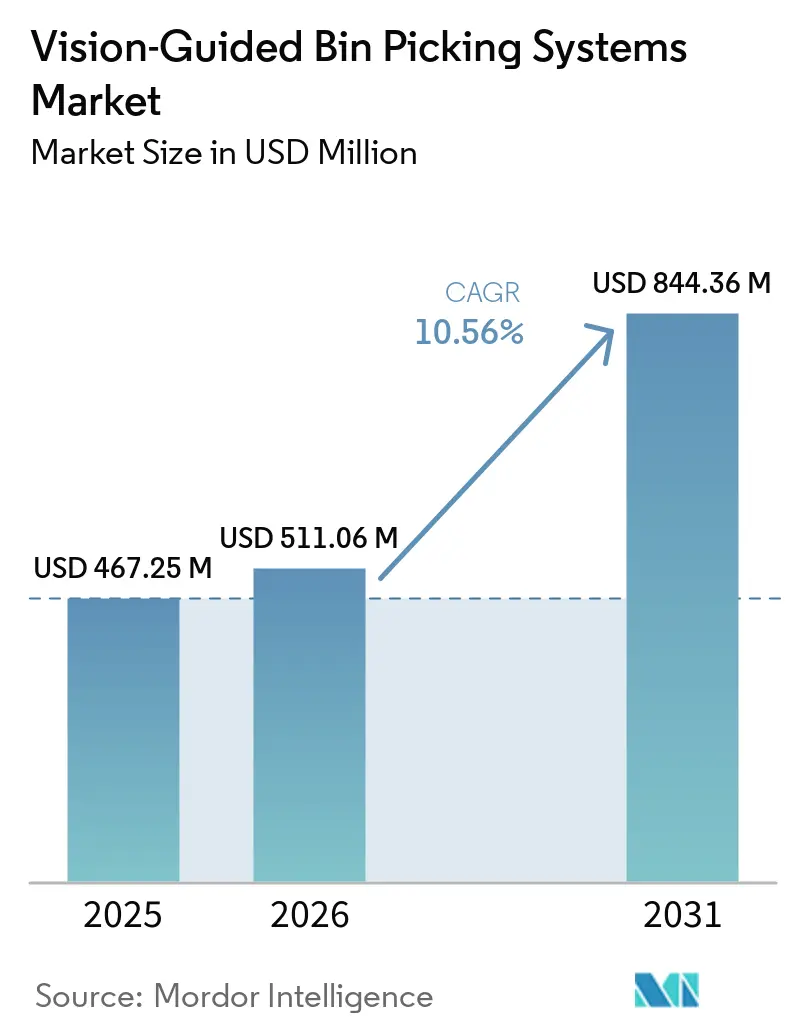
The vision-guided bin picking systems market size was valued at USD 467.25 million in 2025 and estimated to expand from USD 511.06 million in 2026 to reach USD 844.36 million by 2031, at a CAGR of 10.56% during the forecast period (2026-2031). Manufacturers are using these systems to sustain output when production and material-handling roles remain difficult to fill. The value case centers on stable throughput with less reliance on adding headcount. Suppliers are also shifting their offers toward software that can be updated as parts and tasks change. This shift can shorten deployment work for mid-sized factories and make automation practical in more high-mix settings. Competition now depends increasingly on grasp-planning capability, integration speed, and the ability to support diverse robot fleets.
Key Report Takeaways
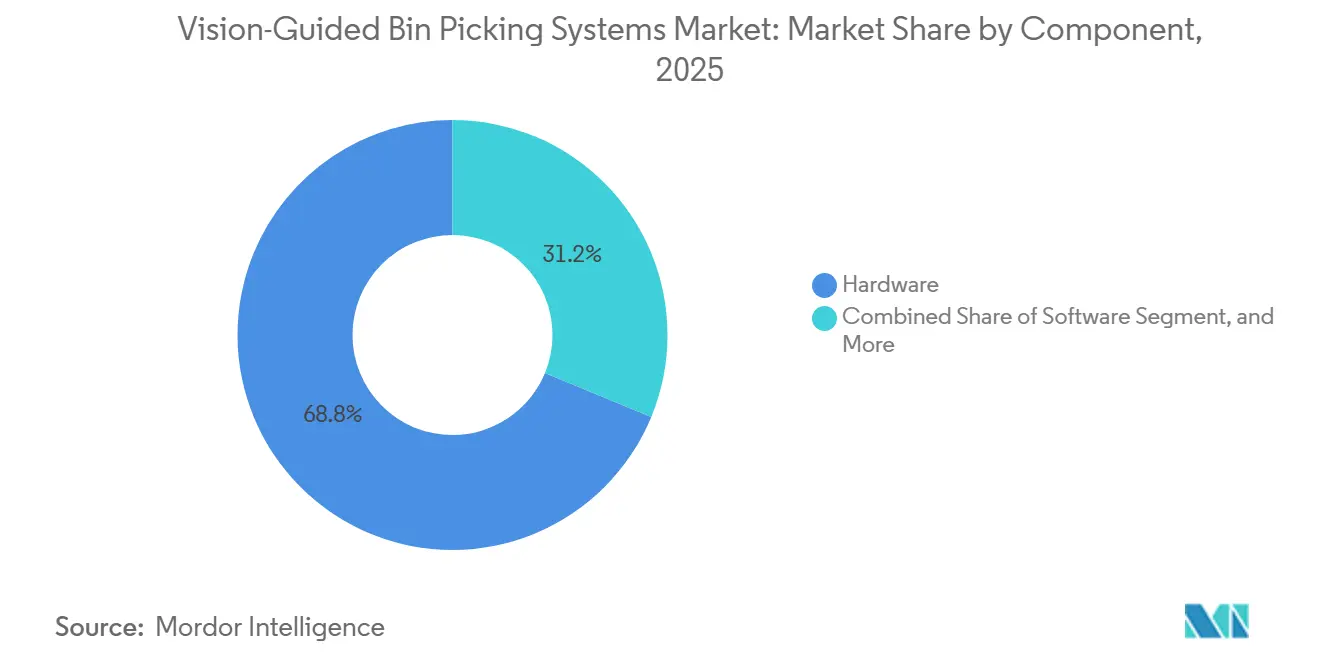
- By component, hardware held 68.78% of the vision-guided bin picking systems market share in 2025, while software is projected to expand at a 11.78% CAGR through 2031.
- By vision technology, 3D stereo vision held a 31.23% revenue share in 2025, while time-of-flight is projected to expand at a 11.89% CAGR through 2031.
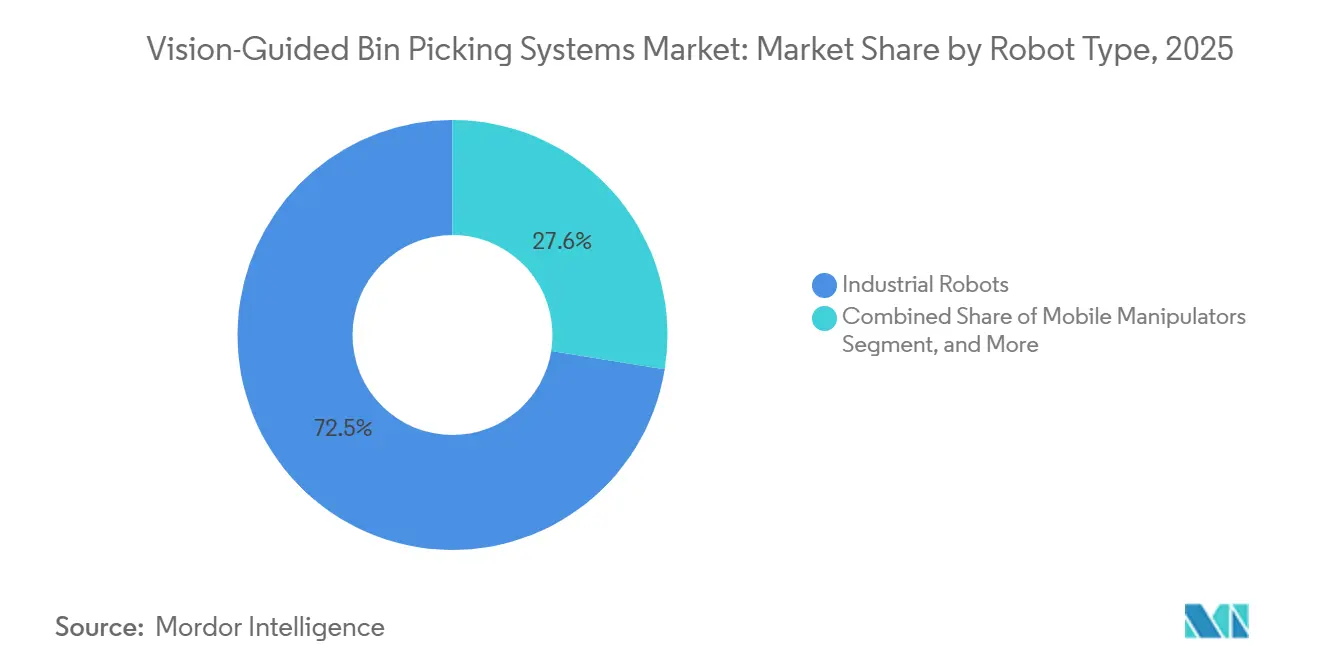
- By robot type, industrial robots held a 72.45% revenue share in 2025, while mobile manipulators are projected to expand at a 11.43% CAGR through 2031.
- By end-user industry, automotive and automotive components held a 28.91% revenue share in 2025, while logistics and e-commerce is projected to expand at a 11.51% CAGR through 2031.
- By geography, Asia-Pacific held a 37.89% revenue share in 2025, while Middle East and Africa is projected to expand at a 11.21% CAGR through 2031.
Note: Market size and forecast figures in this report are generated using Mordor Intelligence’s proprietary estimation framework, updated with the latest available data and insights as of January 2026.
Global Vision-Guided Bin Picking Systems Market Trends and Insights
Drivers Impact Analysis*
| Driver | (~) % Impact on CAGR Forecast | Geographic Relevance | Impact Timeline |
|---|---|---|---|
| Manufacturing Labor Shortages and Rising Labor Costs | +2.5% | Global, early saturation in North America and Europe | Short Term (≤ 2 Years) |
| Higher 3D Perception Accuracy and AI Grasp Planning | +2.2% | Global, led by Asia-Pacific, with spillover to North America and Europe | Medium Term (2-4 Years) |
| Flexible Automation for High-Mix Production | +1.5% | North America and Europe, with spillover to South Korea and Japan | Medium Term (2-4 Years) |
| Expansion of E-Commerce Fulfillment Automation | +1.3% | Asia-Pacific and North America, with spillover to Middle East and Africa | Short Term (≤ 2 Years) |
| Safer Handling of Heavy, Sharp, and Contaminated Parts | +0.8% | Global, concentrated in Europe and Japan | Medium Term (2-4 Years) |
| Synthetic-Data Training Reducing New-Part Commissioning Time | +0.7% | Global, strongest pull in Asia-Pacific and North America | Long Term (≥ 4 Years) |
| Source: Mordor Intelligence | |||
Manufacturing Labor Shortages and Rising Labor Costs
Manufacturing labor scarcity remains an immediate demand factor for the vision-guided bin picking systems market. Plants need reliable ways to maintain handling capacity when skilled operators are difficult to recruit and retain. The vision-guided bin picking systems market therefore addresses an operating constraint as well as a production task. Vision-guided cells can take over repetitive bulk picking tasks that are hard to staff consistently. They also allow available personnel to move into quality review, cell supervision, and exception handling. This makes adoption relevant even for facilities that are only partly automated. It gives the vision-guided bin picking systems market a role in phased automation programs. The International Federation of Robotics identified workforce shortages and reshoring as major automation investment factors in North America and Asia during 2026.[1]International Federation of Robotics, “IFR Executive Roundtable Market Presentation,” International Federation of Robotics, ifr.org
Higher 3D Perception Accuracy and AI Grasp Planning
Better 3D perception and grasp planning are making more difficult parts suitable for automated picking. Reflective stampings, dark brackets, and tangled fasteners have historically required extra programming and testing. GraspGen-X presented a cross-embodiment approach to 6-DOF grasping that used 350 million synthetic grasps across parallel-jaw and three-finger grippers.[2]C. Han et al., “GraspGen-X, Cross-Embodiment 6-DOF Diffusion-Based Grasping,” Proceedings of CVPR 2026, openaccess.thecvf.com A 2025 peer-reviewed review described grasp prediction as a rapidly changing part of the bin-picking workflow, alongside localization and pose estimation. These advances can reduce the effort needed to introduce a new part. For the vision-guided bin picking systems market, this changes the cost of serving varied product portfolios. They also make shorter runs and broader part mixes more viable for the vision-guided bin picking systems market.
Flexible Automation for High-Mix Production
High-mix, low-volume production is becoming an important deployment setting for the vision-guided bin picking systems market. Manufacturers face shorter batches and more frequent changes in part geometry and production sequences. Research completed by FZI in 2025 found that combining language and vision models could help robots adapt to these changes with less manual reprogramming.[3]FZI Forschungszentrum Informatik, “Flexible Industrial Robots Thanks to Generative AI,” FZI Forschungszentrum Informatik, fzi.de Techman Robot Korea and Tesollo showed a shape-adaptive gripper and collaborative robot vision cell for high-mix work in March 2026. ABB also launched PickMaster Lite in May 2026 with stated reductions of 30% in engineering work and 25% in commissioning time. Faster reconfiguration lowers the production volume needed to support an automation investment. This broadens the vision-guided bin picking systems market beyond long, stable production runs.
Expansion of E-Commerce Fulfillment Automation
E-commerce fulfillment is a fast-moving demand channel for the vision-guided bin picking systems market. Rising SKU counts and irregular product shapes limit the usefulness of fixed-fixture sortation equipment. Locus Robotics launched Locus Array in April 2026 as a system that combines AI vision, a mobile platform, and a picking arm for picking, putaway, induction, and slotting. Amazon stated that it planned to invest more than EUR 10 billion, (USD 11 billion), in European fulfillment center expansion and modernization, including AI-guided robotics. Logistics users are increasingly shaping requirements for AI grasp planning rather than simply adopting systems designed for automotive plants. European deployments also need to account for machinery safety requirements under Regulation (EU) 2023/1230. These obligations affect how the vision-guided bin picking systems market is served in fulfillment settings.
Restraints Impact Analysis*
| Restraint | (~) % Impact on CAGR Forecast | Geographic Relevance | Impact Timeline |
|---|---|---|---|
| High Upfront Integration and Commissioning Costs | -1.8% | Global, strongest drag in South America, Middle East and Africa, and Southeast Asia | Short Term (≤ 2 Years) |
| Occlusion, Reflectivity, and Part-Surface Variability | -1.2% | Global, concentrated in European automotive and Japanese precision manufacturing | Medium Term (2-4 Years) |
| Sparse Edge-Case Data for Rare Part Poses | -0.7% | Global, most acute in high-mix job-shop environments | Long Term (≥ 4 Years) |
| Supplier Qualification and Cybersecurity Friction in Connected Cells | -0.5% | Europe and North America, emerging in Asia-Pacific | Medium Term (2-4 Years) |
| Source: Mordor Intelligence | |||
High Upfront Integration and Commissioning Costs
Integration and commissioning costs remain a major barrier for small and medium-sized manufacturers. A complete cell requires more than a robot and vision sensor. It can include mechanical design, safety equipment, gripper engineering, software licenses, interfaces, and training. ABB stated in March 2026 that virtual commissioning through RobotStudio HyperReality could reduce setup and commissioning costs by up to 40%. This supports the case for reducing physical prototyping before installation. Robotics-as-a-Service and modular software are beginning to improve access, but they have not removed the near-term cost hurdle.
Occlusion, Reflectivity, and Part-Surface Variability
Cluttered bins still create perception problems for many commercial systems. Polished, coated, and textureless parts can affect structured-light sensing and weaken 3D point clouds. Deep bins and densely packed components can also obscure the surfaces needed for dependable pose estimation. A 2025 study reported a 90% grasp success rate in highly cluttered scenes using synthetic-data-trained deep learning. Mech-Mind demonstrated ±0.2 mm positioning accuracy for dark and reflective sheet metal at Automate 2026. Automotive users require much higher reliability for unattended production, so performance across actual part finishes and operating conditions remains important.
*Our forecasts treat driver/restraint impacts as directional, not additive. The impact forecasts reflect baseline growth, mix effects, and variable interactions.
Segment Analysis
By Component: Hardware Holds Value While Software Revenue Accelerates
Hardware held 68.78% of the vision-guided bin picking systems market share in 2025. The segment includes 3D cameras, structured-light sensors, time-of-flight sensors, robot arms, grippers, and on-cell computing equipment. Its large position reflects the initial capital required to build a functional cell. This equipment base remains central to the vision-guided bin picking systems market. It also reflects replacement cycles that can keep early hardware choices in place for several years. Falling prices for robot arms and 3D cameras are extending access to mid-sized manufacturers. The supplied range indicated annual price reductions of 5-8% for these hardware categories.
Software is projected to expand at a 11.78% CAGR from 2026 to 2031, the fastest rate within the component split. The vision-guided bin picking systems market size for software benefits from a move away from one-time licenses toward subscription-based grasp-planning platforms. Services provide maintenance, remote diagnostics, and application engineering as the installed base expands. ABB’s PickMaster suite, Photoneo’s Bin Picking Studio, and Mech-Mind’s Mech-Vision platform support recurring software and service revenue. Photoneo stated that Bin Picking Studio supported more than 275 robot models across more than 11 brands as of September 2026. This model can make supplier revenue less dependent on individual hardware procurement cycles.



By Vision Technology: 3D Stereo Vision Leads While Time-of-Flight Advances
3D stereo vision held a 31.23% revenue share in 2025. The technology benefits from established industrial use and broad availability from suppliers such as Roboception, Basler, and SICK. Integrators also understand its connection with major robot controllers. Structured-light 3D vision remained the second-largest technology type. It offers sub-millimeter precision for metal parts and electronics connectors. This makes it a common option in automotive stamping and connector handling applications.
Time-of-flight is projected to expand at a 11.89% CAGR from 2026 to 2031. Its progress is tied to lower fabrication costs and resilience to ambient light in less controlled facilities. These qualities are relevant for food and beverage and logistics work outside dedicated cells. Laser triangulation serves narrower, high-precision needs in semiconductor and aerospace component handling. Photoneo introduced a blue-laser sensor family at Automatica 2025 for dark, reflective, and transparent objects. The company stated that parallel dual-laser scanning halved data acquisition time compared with a single-laser configuration.
By Robot Type: Industrial Robots Lead While Mobile Manipulators Expand
Industrial robots accounted for a 72.45% revenue share in 2025. They remain the standard platform for high-volume, fixed-cell work in automotive and electronics facilities. ABB, FANUC, Yaskawa, and KUKA continue to be important suppliers of these cells. Integrator proposals routinely specify grasp-planning cycle times below 200 milliseconds. This performance benchmark was not commercially achievable before 2024. It supports the vision-guided bin picking systems market where cycle time remains a procurement criterion. The installed base and established controller ecosystems support industrial robots in the vision-guided bin picking systems market. They also give established suppliers a practical route to sell vision upgrades into existing cells.
Mobile manipulators are projected to expand at a 11.43% CAGR from 2026 to 2031. They combine autonomous navigation with a picking arm, allowing work across multiple stations without fixed-cell infrastructure. This is useful for logistics operators that change warehouse layouts during seasonal peaks. Locus Array illustrates this design through its combination of mobile robotics, vision, and an integrated arm. Collaborative robots serve a separate need in pharmaceutical and food settings where human co-location and lower force limits matter. The IFR reported that general-industry robot demand was exceeding automotive demand in 2026, which supports mobile configurations in new settings. This shift expands the vision-guided bin picking systems market into less conventional applications.
By End-User Industry: Automotive Leads While Logistics and E-Commerce Accelerate
Automotive and automotive components held a 28.91% revenue share in 2025. The sector has long invested in high-throughput robotic cells and formal supplier qualification. Stamped metal parts, fasteners, and bulk sub-assemblies are well suited to vision-guided picking. Established procurement cycles also support continuing capital allocation. Electronics and semiconductors formed the second-largest end-user group. Compact and irregular PCB components and expanded chip-packaging capacity in East Asia support demand in this area.
Logistics and e-commerce is projected to expand at a 11.51% CAGR from 2026 to 2031. The segment faces rising SKU variety, same-day delivery expectations, and the limits of manual piece picking. Machinery and industrial equipment contribute through machine tending and component feeding. Food and beverage applications seek to reduce direct contact with contamination-risk products. Pharmaceuticals and healthcare remain less served because handling precision and contamination controls raise procurement requirements. Logistics operators are now creating practical requirements for AI grasp planning that can also influence automotive deployments.
Geography Analysis
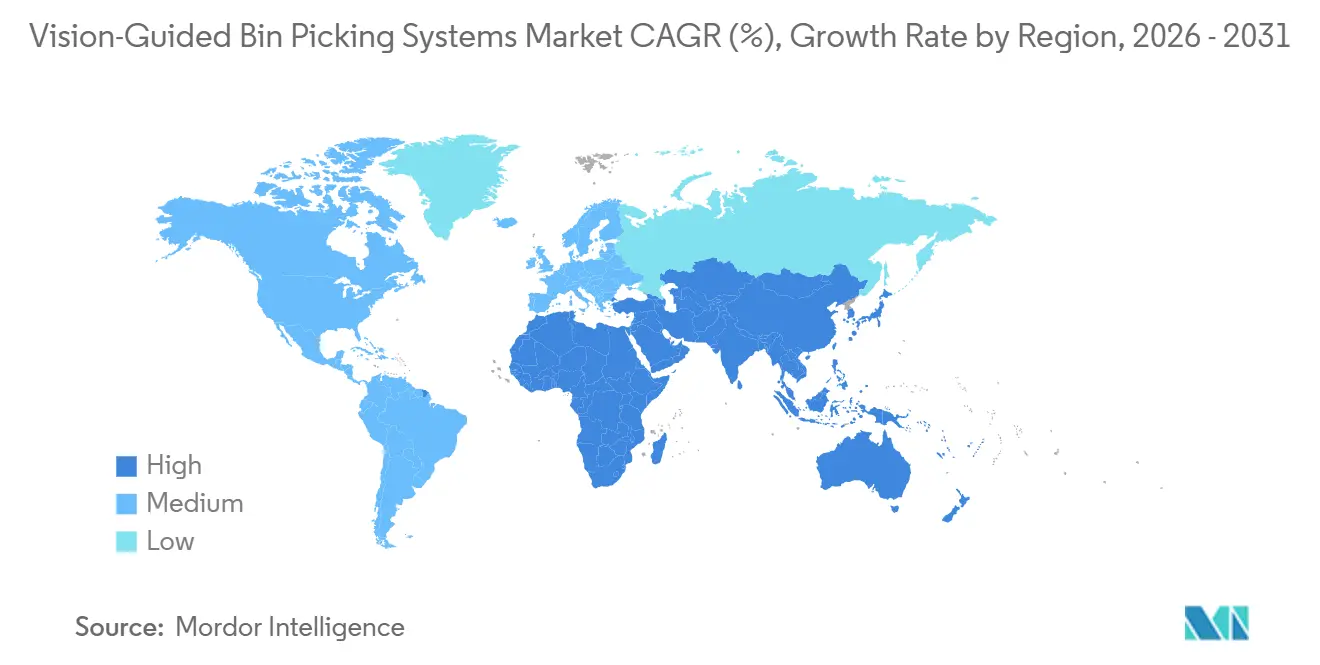
Asia-Pacific held a 37.89% revenue share in 2025. Its position reflects a large concentration of automotive, electronics, and consumer-goods manufacturing. The IFR reported 542,000 global industrial robot installations in 2024, with Asia accounting for 74% of installations. Preliminary 2025 data released by the IFR indicated 621,000 global installations and a 79% Asian share. China installed 295,045 robots in 2024, while South Korea had a robot density of 1,220 units per 10,000 manufacturing workers. India is also gaining attention as a manufacturing location that complements China as electronics assembly expands.
North America and Europe form the second tier of the vision-guided bin picking systems market. North America recorded strong robot installation turnover in the first quarter of 2026, supported by reshoring in electronics and pharmaceutical manufacturing. The United States had a robot density of 307 units per 10,000 manufacturing workers. Europe saw a preliminary 14% decline in installations during 2025 amid cautious investment and weaker automotive activity. Germany’s robot density of 449 units per 10,000 manufacturing workers points to a mature installed base. This favors software retrofits and sensor upgrades over entirely new equipment in many European plants. South America remains an emerging adoption area, with Brazil’s automotive sector serving as the main demand base while infrastructure and import duties limit wider uptake.
Middle East and Africa is projected to expand at a 11.21% CAGR from 2026 to 2031. Its smaller installed base is being supported by industrial diversification programs and new logistics facilities. Saudi Arabia’s Vision 2030 and the UAE’s National In-Country Value policies direct investment toward manufacturing, logistics, and food processing. The Dubai Robotics and Automation Program and fulfillment expansion in Riyadh, Jeddah, and Johannesburg are adding local demand. South African automotive assembly supports a smaller but rising share of regional activity. The vision-guided bin picking systems market size in logistics could benefit as digital commerce use increases across the Arabian Gulf.

Competitive Landscape
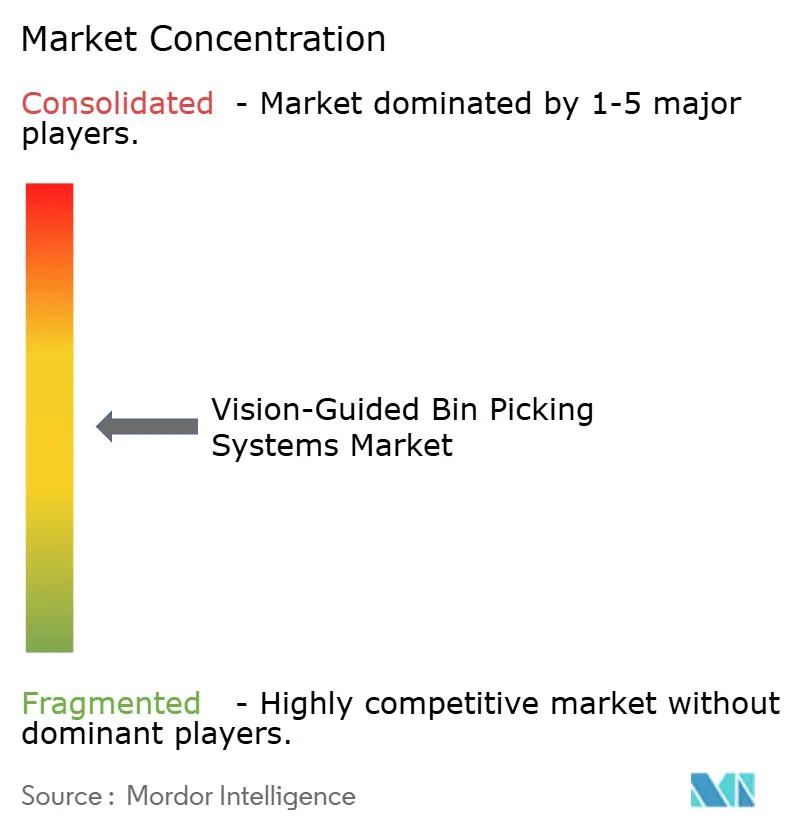
The vision-guided bin picking systems market is moderately consolidated. Large robotics original equipment manufacturers hold meaningful revenue through combined hardware, vision, and software offers linked to their controller ecosystems. ABB, FANUC, Yaskawa, and KUKA compete with specialist providers including Photoneo, Mech-Mind, and Cognex. Specialist providers emphasize compatibility across robot brands and AI grasp-planning performance. The principal point of competition is reducing the time required to deploy a system for a new part type. ABB launched PickMaster Lite in May 2026 and stated that it reduced engineering work by 30% and commissioning time by 25%.
Mech-Mind introduced Mech-Station InstaPick and InstaDepal at Automate 2026 for loading, unloading, depalletizing, and palletizing. Zebra Technologies acquired Photoneo in December 2024, combining its scanning and workflow infrastructure with Photoneo’s Bin Picking Studio and MotionCam-3D portfolio. KUKA achieved IEC 62443-4-2 Security Level 2 certification for iiQKA.OS2 and the KR C5 controller platform in July 2026. The certification aligns with rising procurement scrutiny for connected robot cells. These moves show how software usability, cyber security, and integrated product portfolios are shaping vendor selection.
Pharmaceutical and food-grade applications remain less developed because security and handling compliance require capabilities beyond robotics hardware alone. Small and medium-sized manufacturers in South America and Southeast Asia also face limits under prevailing pricing models. Robotics-as-a-Service from Universal Robots and modular systems from Solomon Technology and Stäubli are opening potential entry routes. Mobile manipulation combined with bin picking remains a field without a widely deployed, fully integrated, commercially proven offer from a single supplier. Mitsubishi Electric and OMRON are positioned to address this need through motion-control and sensing platforms. ABB’s March 2026 NVIDIA partnership for RobotStudio HyperReality also highlights virtual commissioning and synthetic-data training as differentiators.
Vision-Guided Bin Picking Systems Industry Leaders
FANUC Corporation
ABB Ltd.
Cognex Corporation
KUKA AG
OMRON Corporation
- *Disclaimer: Major Players sorted in no particular order

Recent Industry Developments
- September 2026: Photoneo released Bin Picking Studio 1.12 and Locator Studio 1.5, introducing in-app scan-based 3D model creation that eliminates the need for CAD files, adding on-demand AI-based object classification with color-group routing, and expanding the supported robot database to 275+ models across 11+ brands. The release materially reduces deployment prerequisites for system integrators working in high-mix environments and extends bin picking applicability to facilities without dedicated CAD engineering resources.
- July 2026: KUKA became the first robotics manufacturer to achieve Security Level 2 certification under IEC 62443-4-2 for its iiQKA.OS2 operating system and KR C5 controller platform, simultaneously satisfying the requirements of Regulation (EU) 2024/2847 Cyber Resilience Act and EN ISO 10218-1:2025. This milestone establishes a new cybersecurity compliance benchmark for connected robot cells and is expected to influence procurement qualification criteria across EU and North American manufacturing clients.
- May 2026: ABB Robotics launched PickMaster Lite, a streamlined version of its PickMaster software suite, reducing engineering workload by 30% and commissioning time by 25% compared with conventional pick-and-place software or PLC-based systems. The platform targets packaging OEMs and system integrators deploying vision-guided picking applications and supports ABB's strategy of expanding addressable market reach into mid-tier automation buyers.
- April 2026: Locus Robotics globally launched Locus Array, a fully autonomous fulfillment system combining AI-powered vision, a mobile robotic platform, and an integrated picking arm capable of executing picking, putaway, induction, drop-off, and slotting without manual intervention. Early-access deployments were already underway in North America, with global scale-out across Europe and Asia-Pacific planned on the back of Locus Robotics' existing 17,000-robot fleet across 360+ sites.


Global Vision-Guided Bin Picking Systems Market Report Scope
The Vision-Guided Bin Picking Systems Market refers to the industry focused on robotic automation solutions that use machine vision, 2D/3D cameras, artificial intelligence, sensors, and advanced software algorithms to identify, locate, and accurately pick randomly oriented parts from bins, containers, or bulk storage environments.
The Vision-Guided Bin Picking Systems Market Report is Segmented by Component (Hardware, Software, and Services), Vision Technology (3D Stereo Vision, Structured-Light 3D Vision, Time-of-Flight (ToF), Laser Triangulation, and Other Vision Technologies), Robot Type (Industrial Robots, Collaborative Robots, and Mobile Manipulators), End-User Industry (Automotive and Automotive Components, Electronics and Semiconductors, Machinery and Industrial Equipment, Logistics and E-commerce, Food and Beverage, Pharmaceuticals and Healthcare, and Other End-User Industries), and Geography (North America, South America, Europe, Asia-Pacific, and Middle East and Africa). The Market Forecasts are Provided in Terms of Value (USD).
| Hardware |
| Software |
| Services |
| 3D Stereo Vision |
| Structured-Light 3D Vision |
| Time-of-Flight (ToF) |
| Laser Triangulation |
| Other Vision Technologies |
| Industrial Robots |
| Collaborative Robots |
| Mobile Manipulators |
| Automotive and Automotive Components |
| Electronics and Semiconductors |
| Machinery and Industrial Equipment |
| Logistics and E-commerce |
| Food and Beverage |
| Pharmaceuticals and Healthcare |
| Other End-User Industries |
| North America | United States | |
| Canada | ||
| Mexico | ||
| South America | Brazil | |
| Argentina | ||
| Rest of South America | ||
| Europe | Germany | |
| United Kingdom | ||
| France | ||
| Italy | ||
| Spain | ||
| Rest of Europe | ||
| Asia-Pacific | China | |
| Japan | ||
| India | ||
| South Korea | ||
| ASEAN | ||
| Rest of Asia-Pacific | ||
| Middle East and Africa | Middle East | Saudi Arabia |
| United Arab Emirates | ||
| Rest of the Middle East | ||
| Africa | Egypt | |
| South Africa | ||
| Rest of Africa | ||
| By Component | Hardware | ||
| Software | |||
| Services | |||
| By Vision Technology | 3D Stereo Vision | ||
| Structured-Light 3D Vision | |||
| Time-of-Flight (ToF) | |||
| Laser Triangulation | |||
| Other Vision Technologies | |||
| By Robot Type | Industrial Robots | ||
| Collaborative Robots | |||
| Mobile Manipulators | |||
| By End-User Industry | Automotive and Automotive Components | ||
| Electronics and Semiconductors | |||
| Machinery and Industrial Equipment | |||
| Logistics and E-commerce | |||
| Food and Beverage | |||
| Pharmaceuticals and Healthcare | |||
| Other End-User Industries | |||
| By Geography | North America | United States | |
| Canada | |||
| Mexico | |||
| South America | Brazil | ||
| Argentina | |||
| Rest of South America | |||
| Europe | Germany | ||
| United Kingdom | |||
| France | |||
| Italy | |||
| Spain | |||
| Rest of Europe | |||
| Asia-Pacific | China | ||
| Japan | |||
| India | |||
| South Korea | |||
| ASEAN | |||
| Rest of Asia-Pacific | |||
| Middle East and Africa | Middle East | Saudi Arabia | |
| United Arab Emirates | |||
| Rest of the Middle East | |||
| Africa | Egypt | ||
| South Africa | |||
| Rest of Africa | |||


Key Questions Answered in the Report
What Is the 2026 Size Estimate for Vision-Guided Bin Picking Systems?
The 2026 estimate is USD 511.06 Million and is projected to reach USD 844.36 Million by 2031, at a CAGR of 10.56%.
Which Component Leads Vision-Guided Bin Picking Systems?
Hardware led the component split with a 68.78% share in 2025, covering cameras, sensors, robot arms, grippers, and computing equipment.
Why Are Manufacturers Adopting Vision-Guided Bin Picking Systems?
Manufacturers use these systems to sustain material-handling throughput when staffing is difficult and to move available workers toward quality and exception-handling roles.
Which Robot Type Is Expanding Fastest for Bin Picking?
Mobile manipulators are projected to expand at an 11.43% CAGR through 2031 because they can serve several stations without fixed-cell infrastructure.
Which End-User Application Is Advancing Fastest?
Logistics and e-commerce is projected to expand at an 11.51% CAGR through 2031 as SKU variety and delivery expectations increase.
Which Region Is Advancing Fastest?
Middle East and Africa is projected to expand at an 11.21% CAGR through 2031, supported by industrial diversification and fulfillment infrastructure investment.
Page last updated on:





