
Vision-Guided Welding Robots Market Size and Share
Market Overview
| Study Period | 2020 - 2031 |
|---|---|
| Market Size (2026) | USD 4.39 Billion |
| Market Size (2031) | USD 7.13 Billion |
| Growth Rate (2026 - 2031) | 10.19 % |
| Fastest Growing Market | Asia-Pacific |
| Largest Market | Asia-Pacific |
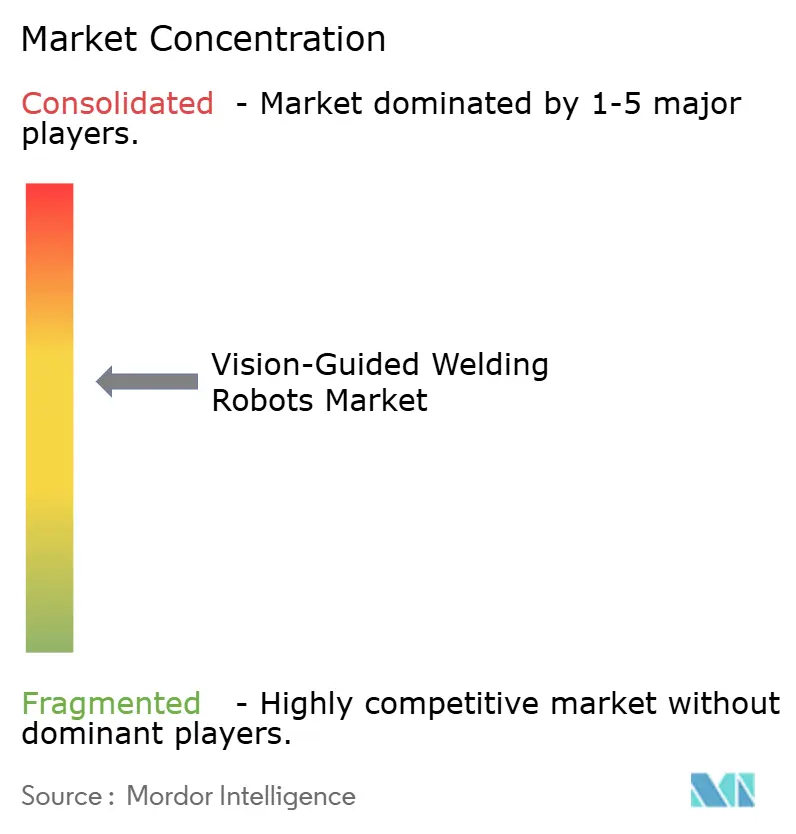
| Market Concentration | Medium |
Major Players *Disclaimer: Major Players sorted in no particular order Image © Mordor Intelligence. Reuse requires attribution under CC BY 4.0. | |
Vision-Guided Welding Robots Market Analysis by Mordor Intelligence
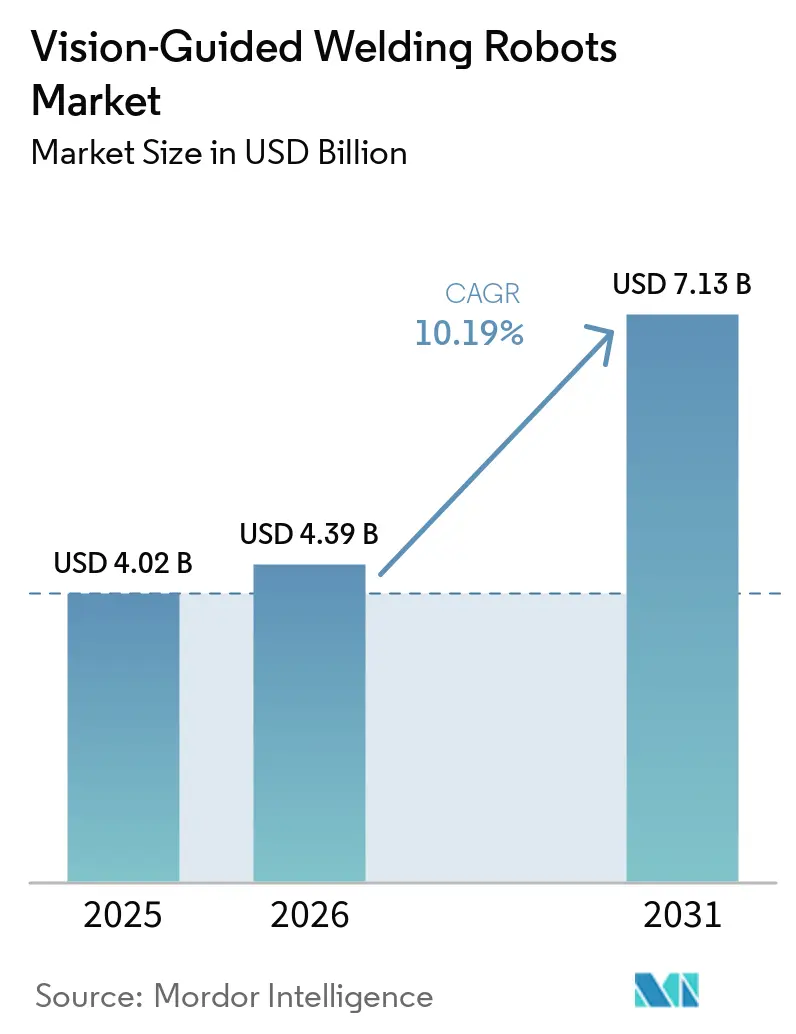
The Vision-guided welding robots market size is projected to expand from USD 4.02 billion in 2025 to USD 4.39 billion in 2026, and to USD 7.13 billion by 2031, registering a CAGR of 10.19% between 2026 and 2031. Shortages of qualified welders are shaping demand, with more demanding joining work in electric vehicles and wider use of embedded vision hardware. Manufacturers are treating automation as a way to maintain production capacity when skilled labor is unavailable. Integrated systems can also support consistent seam placement, inspection, and production records across changing part designs. Large robot suppliers are combining robots, sensors, software, and application cells into more complete offerings, while specialist suppliers focus on autonomous pipe welding and precision vision applications.
Key Report Takeaways
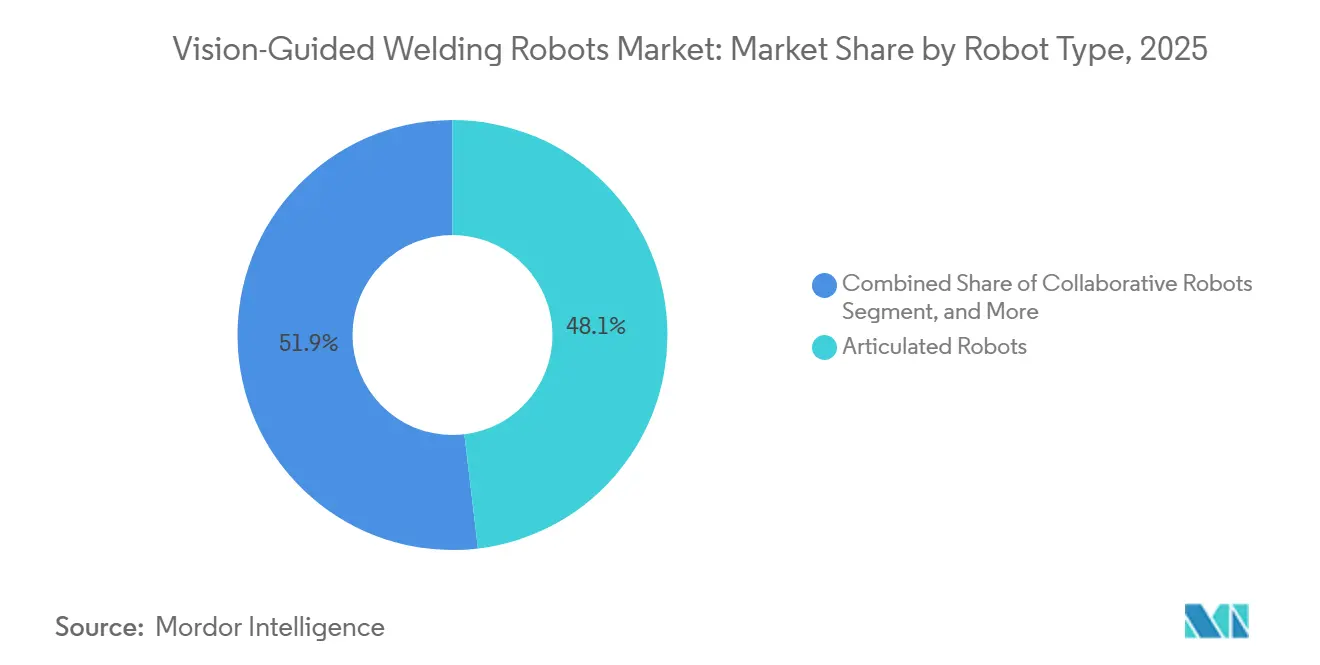
- By robot type, articulated robots held 48.11% of the Vision-guided welding robots market in 2025, while mobile and autonomous welding robots are projected to expand at a 17.32% CAGR through 2031.
- By vision technology, 2D vision systems held 53.45% of the Vision-guided welding robots market in 2025, while multimodal vision systems are projected to expand at a 14.65% CAGR through 2031.
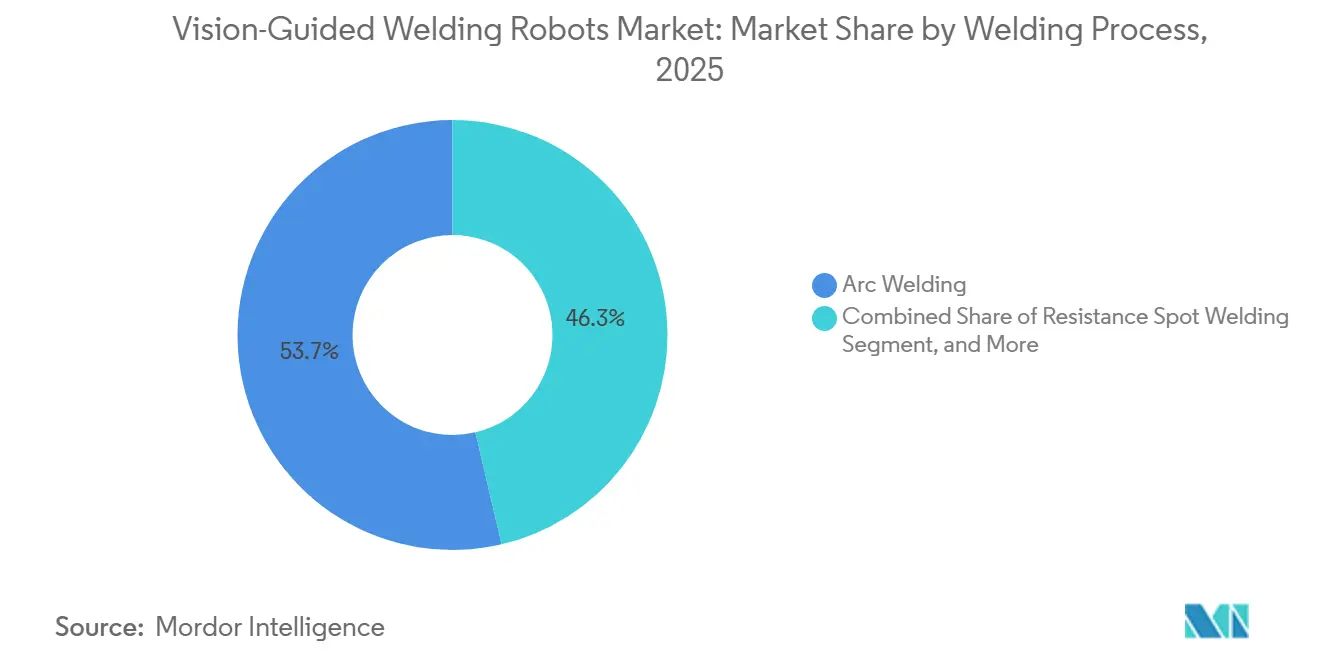
- By welding process, arc welding held 53.67% of the Vision-guided welding robots market in 2025, while laser welding is projected to expand at a 14.24% CAGR through 2031.
- By payload capacity, the 20-50 kg segment held 38.88% of the market in 2025, while the up to 10 kg segment is projected to expand at a 13.57% CAGR through 2031.
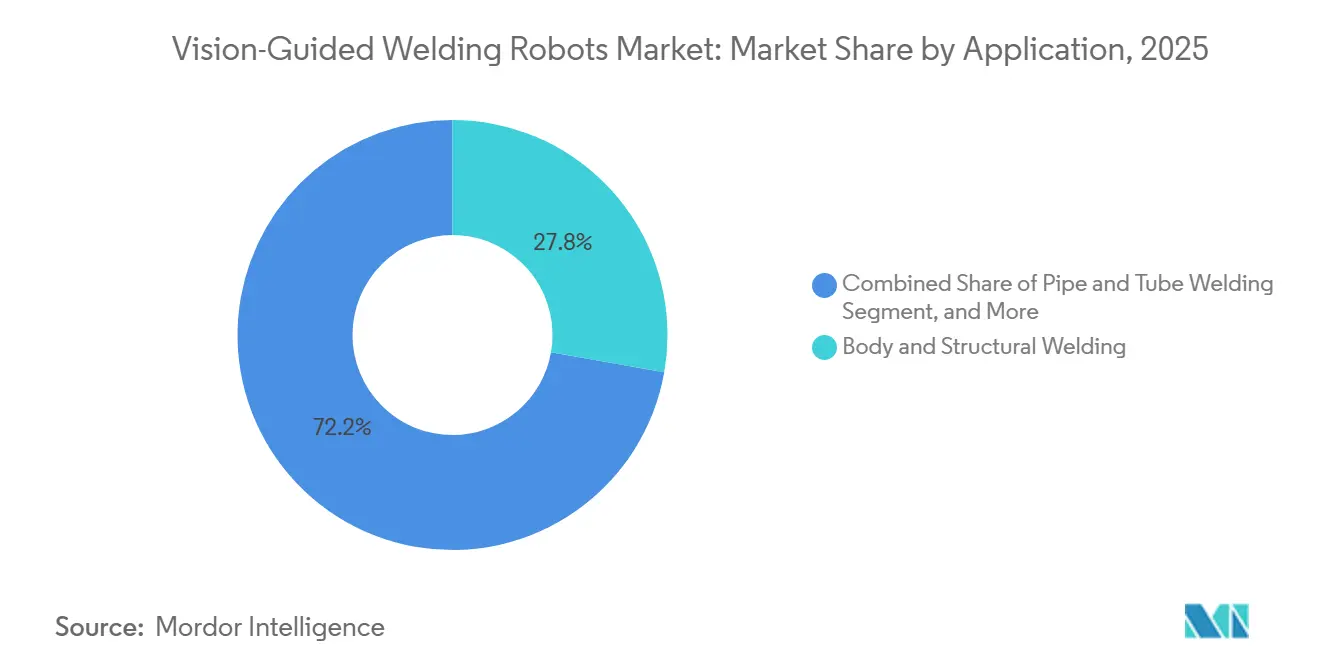
- By application, body and structural welding held 27.77% of the market in 2025, while precision and micro-welding is projected to expand at a 15.51% CAGR through 2031.
- By end-user industry, automotive and transportation held 42.22% of the market in 2025, while electrical and electronics is projected to expand at a 12.67% CAGR through 2031.
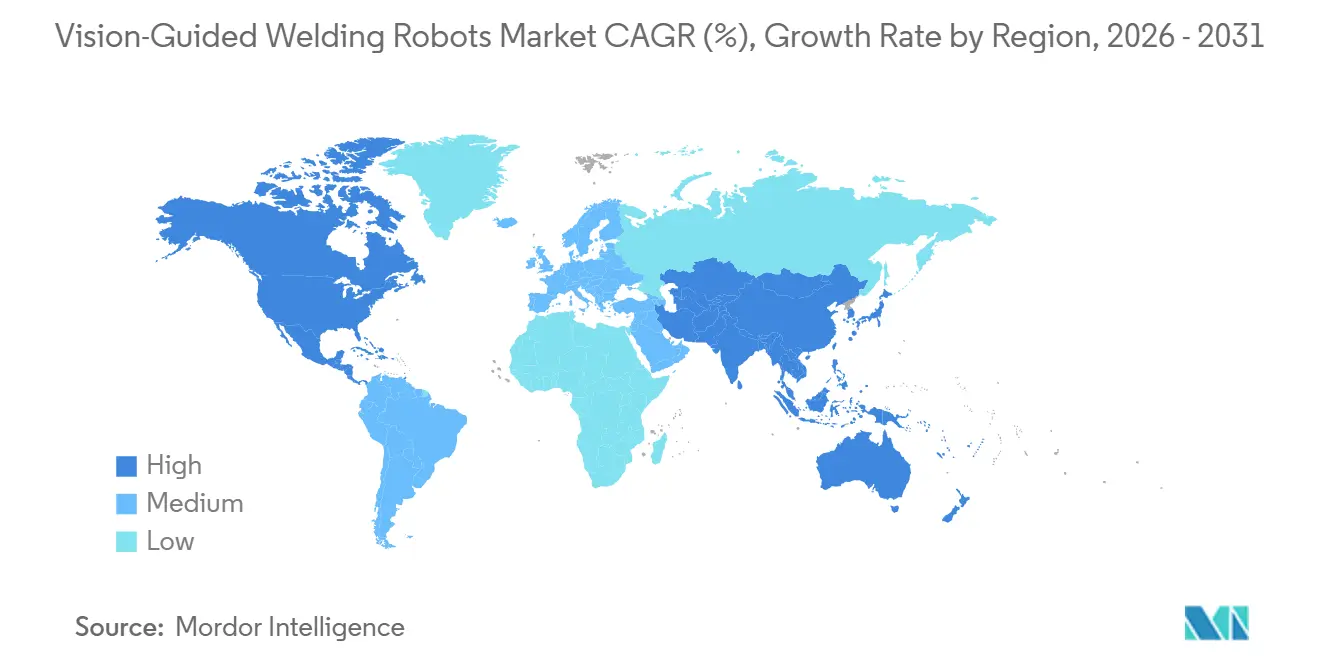
- By geography, Asia-Pacific held 38.71% of the market in 2025 and is projected to expand at a 13.27% CAGR through 2031.
Note: Market size and forecast figures in this report are generated using Mordor Intelligence’s proprietary estimation framework, updated with the latest available data and insights as of January 2026.
Global Vision-Guided Welding Robots Market Trends and Insights
Drivers Impact Analysis*
| Driver | (~) % Impact on CAGR Forecast | Geographic Relevance | Impact Timeline |
|---|---|---|---|
| Skilled Welder Shortages and Throughput Pressure | +3.2% | Global, most acute in North America, Europe, and Japan | Long term (≥ 4 years) |
| EV Battery Enclosure and Lightweight-Material Welding | +2.0% | Asia-Pacific core, with spillover to North America and Europe | Medium term (2-4 years) |
| Industry 4.0 Traceability and Closed-Loop Quality Control | +1.4% | Global, led by Germany, Japan, South Korea, and the United States | Long term (≥ 4 years) |
| Falling Vision-Sensor and Edge-Compute Costs | +0.9% | Global, with early gains in Asia-Pacific and North America | Short term (≤ 2 years) |
| Vision-Guided Automation for High-Mix, Low-Volume Fabrication | +0.7% | North America and Europe | Medium term (2-4 years) |
| Autonomous Welding of Large and Unstructured Workpieces | +0.5% | Global, concentrated in the Middle East and Africa, Europe, and North America | Long term (≥ 4 years) |
| Source: Mordor Intelligence | |||
Skilled Welder Shortages and Throughput Pressure
The shortage of skilled welders makes automated welding a capacity issue rather than solely an efficiency decision. A substantial portion of the US welding workforce is nearing retirement, while the industry requires a significant influx of new professionals to maintain capacity. The active US welder workforce is aging, even as infrastructure, vehicle, and fabrication activities continue to require welding capacity. Manufacturers can use vision-guided cells to reduce dependence on manual path teaching and maintain repeatable work across shifts. The vision-guided welding robots market therefore benefits when factories need reliable output but cannot recruit enough certified welders.
EV Battery Enclosure and Lightweight-Material Welding
Electric vehicle battery enclosures require accurate control of heat input, joint position, and sealing performance. Aluminum battery components can be up to 50% lighter than comparable steel components, but they require careful welding due to aluminum's thermal behavior.[1]Novelis, “EV Battery Components,” Novelis, novelis.com. Vision-guided laser and resistance welding can support seam positioning where battery designs and material combinations change across vehicle programs. Fiber laser systems can reduce heat input compared with traditional MIG welding in aluminum battery enclosure work. Cell-to-pack battery designs also reduce the value of fixed tooling because seam paths can vary across model lines. These requirements support the Vision-guided welding robots market, where precision joining, porosity control, and enclosure sealing are production priorities.
Industry 4.0 Traceability and Closed-Loop Quality Control
Automotive Tier 1 suppliers and aerospace manufacturers increasingly require traceable records for individual welds. ISO/DTR 23247-101:2026 describes a digital twin framework for robotic multilayer and multipass gas-shielded metal arc welding. Vision-integrated cells can capture seam information, process data, and produce quality results while the weld is being produced. A recent study described a physics-informed robotic welding framework that integrates industrial-camera and X-ray monitoring with time-ahead prediction capabilities. The framework enables manufacturers to identify potential welding instability before it occurs, supporting more proactive process control during welding operations. The study reported high accuracy in forecasting welding instability shortly before it developed. The Vision-guided welding robots market benefits from demand among customers who require defect prevention, consistent weld quality, and comprehensive audit records, rather than relying solely on post-failure inspection.
Falling Vision-Sensor and Edge-Compute Costs
Lower-cost sensors and edge processors make vision functions more accessible to smaller welding operations. On-device processing can support seam tracking and defect classification without depending on a remote computing connection. A recent sensor study demonstrated a multi-layer, multi-pass weld inspection system using line-scanner and infrared-camera inputs. The study reported a strong mean average precision for surface-defect classification using industrial sensors. Compact vision hardware also reduces the need for separate computing racks beside a welding cell. The Vision-guided welding robots market can reach more batch sizes and production settings as the cost of sensing and processing becomes less restrictive.
Restraints Impact Analysis*
| Restraint | (~) % Impact on CAGR Forecast | Geographic Relevance | Impact Timeline |
|---|---|---|---|
| High Cell Investment and Integration Costs | -1.3% | Global, most acute in South America, Southeast Asia, and the Middle East and Africa | Long term (≥ 4 years) |
| Shortage of Robot-Programming and Welding-Integration Skills | -0.9% | Global, most acute in North America and Europe | Medium term (2-4 years) |
| Optical Interference From Arc Glare, Spatter, Smoke, and Reflective Metals | -0.5% | Global, concentrated in heavy fabrication segments | Medium term (2-4 years) |
| Inconsistent Fit-Up and Limited Training Data for Adaptive Welding Models | -0.3% | Global, most acute in high-mix, low-volume, and small and medium-sized enterprise settings | Long term (≥ 4 years) |
| Source: Mordor Intelligence | |||
High Cell Investment and Integration Costs
A vision-guided welding cell may require investment in the robot, fixturing, sensors, calibration, engineering, safety interlocks, and training. Turnkey articulated robot cells with integrated vision systems can involve substantial upfront costs. These costs can extend payback periods for lower-throughput welding operations. Integration also requires compatibility among robot software, sensor interfaces, welding power sources, and PLC safety systems. Smaller fabricators often lack dedicated automation teams to manage this work. The Vision-guided welding robots market faces slower adoption outside high-volume plants until modular cells and flexible financing reduce these barriers.
Shortage of Robot-Programming and Welding-Integration Skills
Vision-guided robots shift labor needs toward a combination of welding knowledge, robot programming, and vision diagnostics. This combination remains difficult for manufacturers to recruit and retain. IFR preliminary data showed that Europe installed 14% fewer industrial robots in 2025, while global installations rose 15% to 621,000 units. Manufacturers may postpone projects when they cannot staff commissioning work or operate a new cell at the intended rate. Drag-to-teach interfaces, no-code recipe tools, and updated parameter libraries can reduce some of the burden. The Vision-guided welding robots market still requires engineering depth for high-mix work, where part variation demands real-time adaptation.
*Our forecasts treat driver/restraint impacts as directional, not additive. The impact forecasts reflect baseline growth, mix effects, and variable interactions.
Segment Analysis
By Robot Type: Articulated Robots Lead, While Autonomous Systems Advance
Articulated robots held 48.11% of the Vision-guided welding robots market share in 2025. Their six-axis movement, payload range, and long use in automotive body-in-white and structural fabrication support this position. Manufacturers that already use articulated cells can often expand the same layout during replacement cycles. This installed base reduces the need to redesign fixtures, safety areas, and material handling around a new robot type. Collaborative robots are the next large conventional category in many applications. They are used where redeployment across part families is more valuable than maximum throughput.
Mobile and autonomous welding robots are projected to expand at a 17.32% CAGR through 2031. They move the robot to large, heavy, or complex workpieces that cannot enter a fixed cell. This approach is relevant in shipbuilding, energy infrastructure, and large structural fabrication. FANUC launched the CRX-3iA in May 2026 as an 11-kg collaborative robot for structural and shipbuilding applications. One operator can carry the product between weld seams. Mobile systems must also meet the requirements of ISO 10218-1 when robotic arms operate near people.



By Vision Technology: 2D Systems Retain Scale, While Multimodal Systems Expand
2D vision systems held 53.45% of the market in 2025. Their cost, simpler operation, and established role in controlled lighting conditions support continued use. High-volume automotive body shops use 2D systems in which panel geometry is predictable, and camera contrast can be managed. These systems are well-suited to resistance spot welding and many arc welding lines. The Vision-guided welding robots market size for 2D systems remains tied to standardized production environments. 3D systems are gaining use where joint geometry, material interfaces, and surface reflectivity make 2D contrast less reliable.
Multimodal vision systems are projected to expand at a 14.65% CAGR through 2031. These systems combine sensing methods for applications where a single camera or sensor cannot provide sufficient control. Battery welding, titanium aerospace joining, and electronics assembly are key uses. Cognex launched the In-Sight 3900 high-performance AI vision system in May 2026 for high-speed edge inspection. The system supports the edge-processing infrastructure needed for real-time production inspection. The shift toward multimodal systems reflects the need to track seam geometry, weld-pool conditions, and spatter simultaneously.
By Welding Process: Arc Welding Has Breadth, While Laser Welding Adds Precision
Arc welding held 53.67% of the market in 2025. It is used across structural welding, pipe fabrication, and general manufacturing. Deposition rate and access to the joint are often more important than minimizing the heat-affected zone in these settings. Resistance spot welding is the second-largest process in automotive body assembly. Vision-guided corrections can address variation between stamped panels. TIG and plasma welding remain important in aerospace, medical device, and food-grade manufacturing, where appearance and contamination control are critical.
Laser welding is projected to expand at a 14.24% CAGR through 2031. Electric vehicle battery enclosures, semiconductor packaging, and consumer electronics all require precise weld geometries at production speeds. A 2025 study described laser micro-welding that enabled weld geometries as small as 50 micrometers for advanced packaging. Small seam offsets can affect battery busbars and electronic connectors where current paths are tightly defined. Falling fiber-laser costs improve the case for adding vision guidance to existing laser installations. The Vision-guided welding robots market, therefore, gains from applications where traditional welding generates excessive heat or lacks sufficient positional control.
By Payload Capacity: Mid-Range Systems Lead, While Light Systems Gain Use
The 20-50 kg payload segment held 38.88% of the market in 2025. It serves articulated robots used in automotive structural welding, metal fabrication, and pipe assembly. Torch weight, cable management, and process tooling can place these applications within the mid-range capacity band. The 10-20 kg range is used for general arc welding, cobots, and medium-sized structural work. Systems above 50 kg support gantry and heavy-industry robots in shipbuilding, boiler fabrication, and large construction weldments. Vision integration varies by payload: heavy systems often use fixed 3D sensors, whereas lighter robots can carry compact sensors with the torch.
The up to 10 kg payload segment is projected to expand at a 13.57% CAGR through 2031. Lightweight cobots support precision electronics and micro-welding work that requires compact torch and camera assemblies. Intuitive curved-path programming has also reduced the need for specialist knowledge in some light-payload applications. The electrical and electronics sector is projected to expand at a 12.67% CAGR through 2031. Dense board assemblies, battery interconnects, and precision enclosures require compact equipment capable of accommodating small parts. Larger industrial platforms can face collision limits in these layouts. The Vision-guided welding robots market benefits from the need for more tightly controlled joining in small-format products.
By Application: Structural Welding Leads, While Micro-Welding Moves Faster
Body and structural welding held 27.77% of the market in 2025. Automotive and general fabrication sites produce high volumes of weld joints in this application. Component and subassembly welding serves aerospace brackets, HVAC assemblies, and electronics enclosures. These products often have more part variation and more frequent fixture changes. Pipe and tube welding uses specialized systems that combine vision seam tracking with root-to-cap work. Sheet metal and heavy fabrication require real-time adjustment when burn-through risk or large-scale structures make fixed programming inadequate.
Precision and micro-welding are projected to expand at a 15.51% CAGR through 2031. Demand comes from battery cell interconnects, medical device assembly, and semiconductor packaging. These applications require narrow joints, controlled heat input, and production records. A 2026 Journal of Intelligent Manufacturing study described a hybrid method for in-line laser weld inspection using laser line-scanning data and 3D anomaly detection. Medical-device requirements also increase the need for documented in-process inspection. The Vision-guided welding robots market provides the sensing and control functions needed for these precise production settings.
By End-User Industry: Automotive Holds Scale, While Electronics Gains Momentum
Automotive and transportation held 42.22% of the Vision-guided welding robots market share in 2025. The segment reflects more than 30 years of investment in robotic welding across body-in-white, chassis, and powertrain work. Electric vehicle architectures refresh this installed base with different joining needs. Battery enclosures may require laser welding, while multi-material body panels may require resistance spot welding. Metals and machinery are the second-largest end-user group. It includes general fabrication, agricultural equipment, and heavy machinery, where vision can reduce the need for dedicated tooling.
The electrical and electronics sector is projected to expand at a 12.67% CAGR through 2031. IFR data showed that electrical and electronics companies installed 161,000 industrial robots worldwide in 2025, an increase of 25%. Automotive installed 139,000 units that year, an increase of 10%. China installed 83,000 industrial robots in the electrical and electronics industry in 2024. Electronics production requires precision, thermal control, and joint miniaturization beyond the needs of many body-shop applications.
Geography Analysis
Asia-Pacific accounted for the largest share of the regional total and is projected to grow rapidly through the forecast period. China accounted for more than half of the global operational industrial robot fleet and saw increased robot installations. Electrical and electronics-led robot installations in China, ahead of automotive. Japan supports demand for high-specification systems through its automotive and electronics production base. South Korea has the highest robot density globally and uses vision-integrated spot welding in semiconductor and automotive supply chains.
India recorded an increase in industrial robot installations and ranked among the leading countries globally, making it an important regional opportunity through the forecast period. The country’s expanding automotive, electronics, metal fabrication, and general manufacturing industries are expected to support further adoption of industrial robots, including vision-guided welding systems. Asia accounted for the majority of global robot installations, with regional installations increasing as manufacturers expanded automation to address labor constraints, improve production consistency, and support high-volume manufacturing operations.[2]International Federation of Robotics, “What’s Next in Automation,” International Federation of Robotics, ifr.org. China, Japan, South Korea, and India continue to drive regional demand through their established manufacturing bases and growing investments in advanced automation technologies.
Canada and Mexico support North American demand through automotive supply chains. Mexico recorded a decline in industrial robot installations, reflecting near-term uncertainty. Europe remains centered on Germany, Italy, and Sweden for automotive body-in-white welding. European industrial robot installations declined, although Germany retained demand for high-specification cells. South America has a demand for agricultural equipment and oil and gas applications. The Middle East and Africa have demand in Saudi Arabia, the United Arab Emirates, and South Africa, with autonomous systems suited to energy, infrastructure, mining equipment, and large structural work.

Competitive Landscape
The Vision-guided welding robots market is moderately consolidated among major robot suppliers, components, and specialized applications. ABB, FANUC, Yaskawa, and KUKA have substantial positions in articulated welding systems for automotive and heavy fabrication. Smaller specialists compete in autonomous pipe welding, cobot welding, and precision vision. Large suppliers increasingly package robot hardware, vision sensors, application cells, and software into a single offer. This approach can simplify procurement and reduce a buyer’s dependence on separate integrators. It also gives vendors a larger role in services, upgrades, and lifecycle support.
ABB has used its OmniVance Collaborative Arc Welding Cell and Easy Teach Device to address the needs of high-mix, low-volume users with limited programming expertise. KUKA launched the LBR iisy cobot on the iiQKA.OS2 platform in July 2026 for scalable automation across collaborative and industrial settings.[3]KUKA, “KUKA Launches LBR iisy on iiQKA.OS2,” KUKA, kuka.com. Cognex launched the In-Sight 3900 in May 2026 for high-speed, high-accuracy edge inspection. These moves show how suppliers are lowering programming effort, expanding platform flexibility, and shifting more inspection work closer to the production process. The competitive position of large suppliers rests on installed robot fleets, application knowledge, and system integration capabilities.
Novarc introduced NovAI Autonomy and NovHub in June 2026 to provide real-time machine vision, adaptive control, and cross-robot data management for ABB and Yaskawa robots. Lincoln Electric acquired Inrotech A/S in 2024, adding autonomous pipe and structural welding capability to its automation portfolio. Regional integrators can still compete where customers need packaged cells, lower initial investment, and local service. The Vision-guided welding robots market offers room for these providers, as small and medium-sized fabricators often need flexible commercial models. Robot-as-a-service and modular cell formats can be important where capital spending remains difficult. The resulting competition is strongest where suppliers can reduce obstacles to programming, integration, and financing.
Vision-Guided Welding Robots Industry Leaders
FANUC Corporation
Yaskawa Electric Corporation
ABB Ltd.
KUKA AG
OTC DAIHEN Inc.
- *Disclaimer: Major Players sorted in no particular order

Recent Industry Developments
- July 2026: KUKA AG launched the LBR iisy cobot on the iiQKA.OS2 unified platform, enabling scalable automation entry from collaborative to industrial environments across applications including arc welding, with seamless expansion across multiple robots and production lines without reprogramming.
- June 2026: Novarc Technologies unveiled NovAI Autonomy and the NovHub enterprise welding intelligence platform at Automate 2026 in Chicago, expanding robot compatibility to ABB and Yaskawa systems and demonstrating the first Physical AI welding system capable of real-time, vision-based adaptive control across multiple third-party robot brands.
- June 2026: Novarc Technologies and Yaskawa America signed a Memorandum of Understanding to advance AI-powered autonomous welding automation, combining Novarc's NovAI physical AI platform with Yaskawa's Motoman Robotics robot portfolio for commercial deployment.
- May 2026: Cognex Corporation launched the In-Sight 3900, a high-performance AI vision system for high-speed, high-accuracy edge inspection in welding cell quality-control applications.


Global Vision-Guided Welding Robots Market Report Scope
The Vision-Guided Welding Robots Market comprises robotic welding systems that use machine vision technologies to detect, locate, track, measure, and inspect workpieces and weld joints, enabling robots to automatically adjust welding paths, positions, parameters, or operations based on real-time or pre-programmed visual information. These systems combine industrial robots, welding equipment, vision sensors, controllers, and vision-processing software to automate welding operations and improve positioning accuracy, consistency, productivity, and quality across manufacturing and fabrication environments.
The Vision-Guided Welding Robots Market Report is Segmented by Robot Type (Articulated Robots, Collaborative Robots, Cartesian/Gantry Robots, SCARA Robots, Mobile/Autonomous Welding Robots, and Other Robot Types), Vision Technology (2D Vision Systems, 3D Vision Systems, and Multimodal Vision Systems), Welding Process (Arc Welding, Resistance Spot Welding, Laser Welding, TIG and Plasma Welding, and Other Welding Processes), Payload Capacity (Up to 10 kg, 10–20 kg, 20–50 kg, and Above 50 kg), Application (Body and Structural Welding, Component and Subassembly Welding, Pipe and Tube Welding, Sheet Metal Welding, Heavy Fabrication Welding, Precision/Micro-Welding, and Other Applications), End-User Industry (Automotive and Transportation, Metals and Machinery, Electrical and Electronics, Aerospace and Defense, Shipbuilding, Energy, and Infrastructure, Contract Manufacturing and Job Shops, and Other End-User Industries), and Geography (North America, South America, Europe, Asia-Pacific, and Middle East and Africa). The Market Forecasts are Provided in Terms of Value (USD).
| Articulated Robots |
| Collaborative Robots |
| Cartesian / Gantry Robots |
| SCARA Robots |
| Mobile / Autonomous Welding Robots |
| Other Robot Types |
| 2D Vision Systems |
| 3D Vision Systems |
| Multimodal Vision Systems |
| Arc Welding |
| Resistance Spot Welding |
| Laser Welding |
| TIG and Plasma Welding |
| Other Welding Processes |
| Up to 10 kg |
| 10–20 kg |
| 20–50 kg |
| Above 50 kg |
| Body and Structural Welding |
| Component and Subassembly Welding |
| Pipe and Tube Welding |
| Sheet Metal Welding |
| Heavy Fabrication Welding |
| Precision / Micro-Welding |
| Other Applications |
| Automotive and Transportation |
| Metals and Machinery |
| Electrical and Electronics |
| Aerospace and Defense |
| Shipbuilding, Energy, and Infrastructure |
| Contract Manufacturing and Job Shops |
| Other End-User Industries |
| North America | United States | |
| Canada | ||
| Mexico | ||
| South America | Brazil | |
| Argentina | ||
| Rest of South America | ||
| Europe | Germany | |
| United Kingdom | ||
| France | ||
| Italy | ||
| Spain | ||
| Rest of Europe | ||
| Asia-Pacific | China | |
| Japan | ||
| India | ||
| South Korea | ||
| ASEAN | ||
| Rest of Asia-Pacific | ||
| Middle East and Africa | Middle East | Saudi Arabia |
| United Arab Emirates | ||
| Rest of the Middle East | ||
| Africa | South Africa | |
| Nigeria | ||
| Rest of Africa | ||
| By Robot Type | Articulated Robots | ||
| Collaborative Robots | |||
| Cartesian / Gantry Robots | |||
| SCARA Robots | |||
| Mobile / Autonomous Welding Robots | |||
| Other Robot Types | |||
| By Vision Technology | 2D Vision Systems | ||
| 3D Vision Systems | |||
| Multimodal Vision Systems | |||
| By Welding Process | Arc Welding | ||
| Resistance Spot Welding | |||
| Laser Welding | |||
| TIG and Plasma Welding | |||
| Other Welding Processes | |||
| By Payload Capacity | Up to 10 kg | ||
| 10–20 kg | |||
| 20–50 kg | |||
| Above 50 kg | |||
| By Application | Body and Structural Welding | ||
| Component and Subassembly Welding | |||
| Pipe and Tube Welding | |||
| Sheet Metal Welding | |||
| Heavy Fabrication Welding | |||
| Precision / Micro-Welding | |||
| Other Applications | |||
| By End-User Industry | Automotive and Transportation | ||
| Metals and Machinery | |||
| Electrical and Electronics | |||
| Aerospace and Defense | |||
| Shipbuilding, Energy, and Infrastructure | |||
| Contract Manufacturing and Job Shops | |||
| Other End-User Industries | |||
| By Geography | North America | United States | |
| Canada | |||
| Mexico | |||
| South America | Brazil | ||
| Argentina | |||
| Rest of South America | |||
| Europe | Germany | ||
| United Kingdom | |||
| France | |||
| Italy | |||
| Spain | |||
| Rest of Europe | |||
| Asia-Pacific | China | ||
| Japan | |||
| India | |||
| South Korea | |||
| ASEAN | |||
| Rest of Asia-Pacific | |||
| Middle East and Africa | Middle East | Saudi Arabia | |
| United Arab Emirates | |||
| Rest of the Middle East | |||
| Africa | South Africa | ||
| Nigeria | |||
| Rest of Africa | |||


Key Questions Answered in the Report
What is the Vision-guided welding robots market size?
The market was valued at USD 4.39 billion in 2026 and is projected to reach USD 7.13 billion by 2031 at a 10.19% CAGR.
What is driving demand for vision-guided welding robots?
Skilled-welder shortages, electric vehicle battery welding, quality traceability, and more accessible vision hardware are supporting demand.
Which robot type has the largest share?
Articulated robots held 48.11% of revenue in 2025 because they are widely used in automotive and structural fabrication cells.
Which welding process is expanding fastest?
Laser welding is projected to expand at a 14.24% CAGR through 2031, supported by battery enclosures and electronics applications.
Which region leads adoption?
Asia-Pacific held 38.71% of revenue in 2025 and is projected to expand at a 13.27% CAGR through 2031.
What limits wider deployment of vision-guided welding robots?
High investment and integration costs, as well as shortages of programming and welding-integration skills, continue to slow adoption.
Page last updated on:


 Your data is secure and never sold or shared.


