
Virtual Reality In Gaming Market Size and Share
Market Overview
| Study Period | 2020 - 2031 |
|---|---|
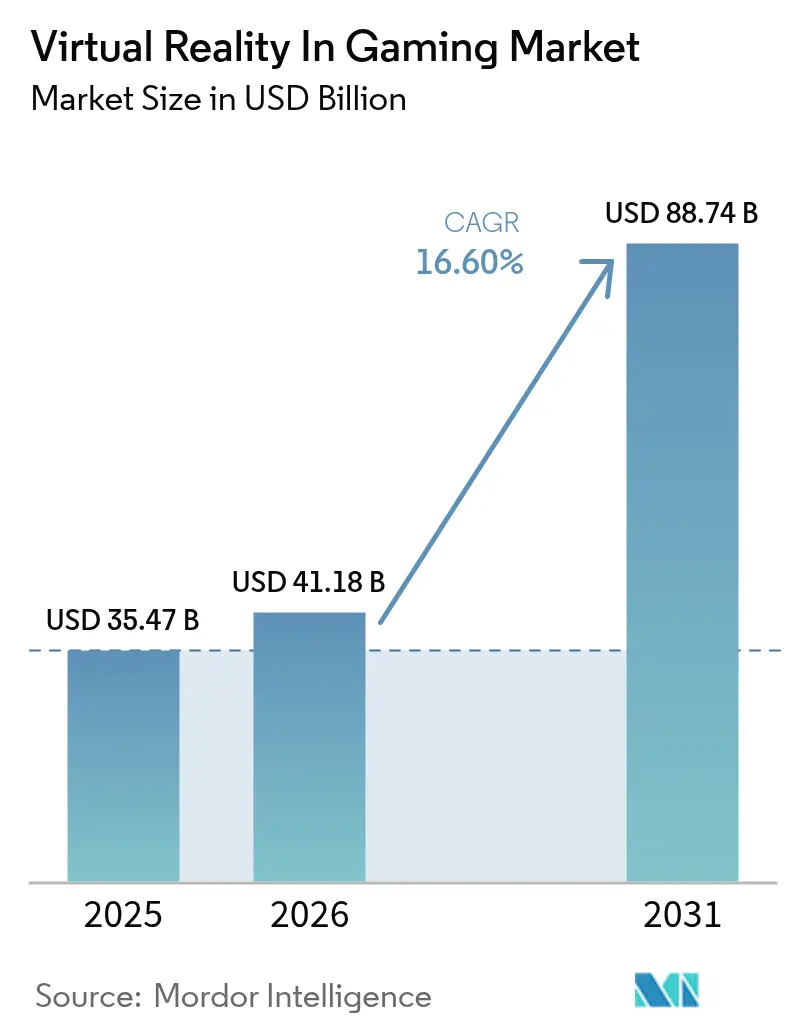
| Market Size (2026) | USD 41.18 Billion |
| Market Size (2031) | USD 88.74 Billion |
| Growth Rate (2026 - 2031) | 16.60 % |
| Fastest Growing Market | Asia Pacific |
| Largest Market | Asia Pacific |
| Market Concentration | High |
Major Players *Disclaimer: Major Players sorted in no particular order Image © Mordor Intelligence. Reuse requires attribution under CC BY 4.0. | |
Virtual Reality In Gaming Market Analysis by Mordor Intelligence
The Virtual Reality in Gaming market size was valued at USD 35.47 billion in 2025 and is estimated to grow from USD 41.18 billion in 2026 to reach USD 88.74 billion by 2031, at a CAGR of 16.6% during the forecast period (2026-2031). Surging telco-subsidized 5G edge-rendering bundles that push latency below 50 milliseconds, the entry of sub-USD 400 eye-tracking stand-alone headsets, and a pipeline of AAA franchises that now launch day-and-date in VR have all moved the category from experimental to mainstream. Location-based entertainment operators opened nearly thirty new venues across Asia-Pacific in 2025, confirming that commercial arcades are no longer niche pilots but scalable revenue engines. Cloud-streamed services such as NVIDIA GeForce NOW have shown that console-grade graphics can reach lightweight goggles over 5G, eroding the visual gap between tethered and mobile devices. Meanwhile, Meta’s focus on subscription platforms like Supernatural demonstrates that recurring software revenue, rather than one-time hardware sales, is becoming the dominant value driver.
Key Report Takeaways
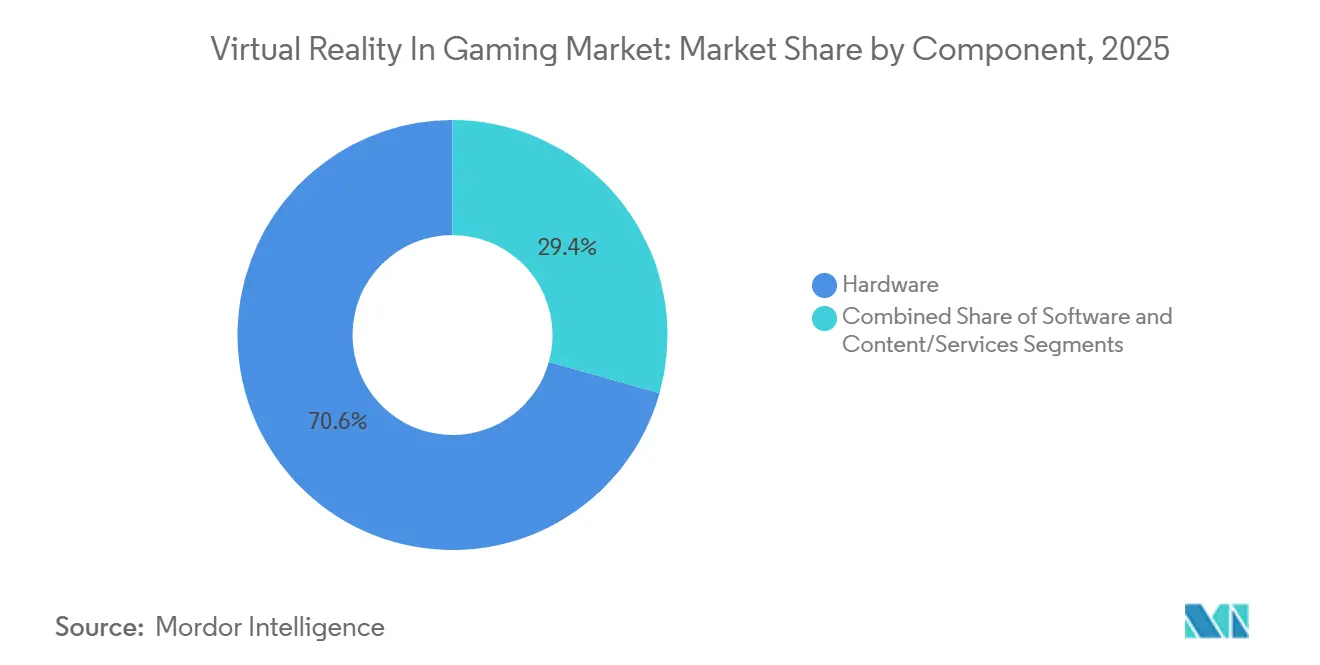
- By component, hardware led with 70.64% share of Virtual Reality in Gaming market size in 2025, while content and services posted the fastest trajectory at a 16.72% CAGR through 2031.
- By device type, stand-alone headsets captured 56.82% of Virtual Reality in Gaming market share in 2025, whereas cloud and streaming VR is set to expand at a 17.09% CAGR between 2026 and 2031.
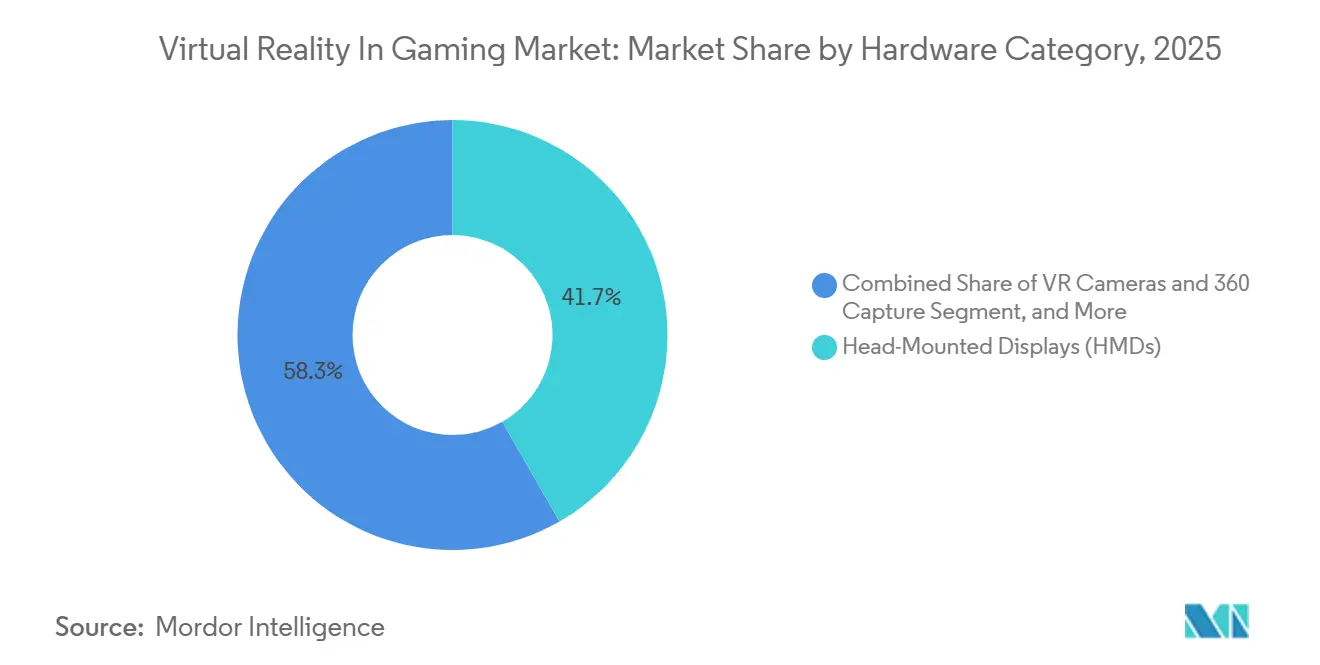
- By hardware category, head-mounted displays held 41.72% of the Virtual Reality in Gaming market size in 2025, yet VR cameras and 360-degree capture equipment is on course for a 16.88% CAGR to 2031.
- By game genre, action and shooter titles commanded 50.74% revenue in 2025, but sports and fitness is forecast to record the highest growth at a 16.64% CAGR to 2031.
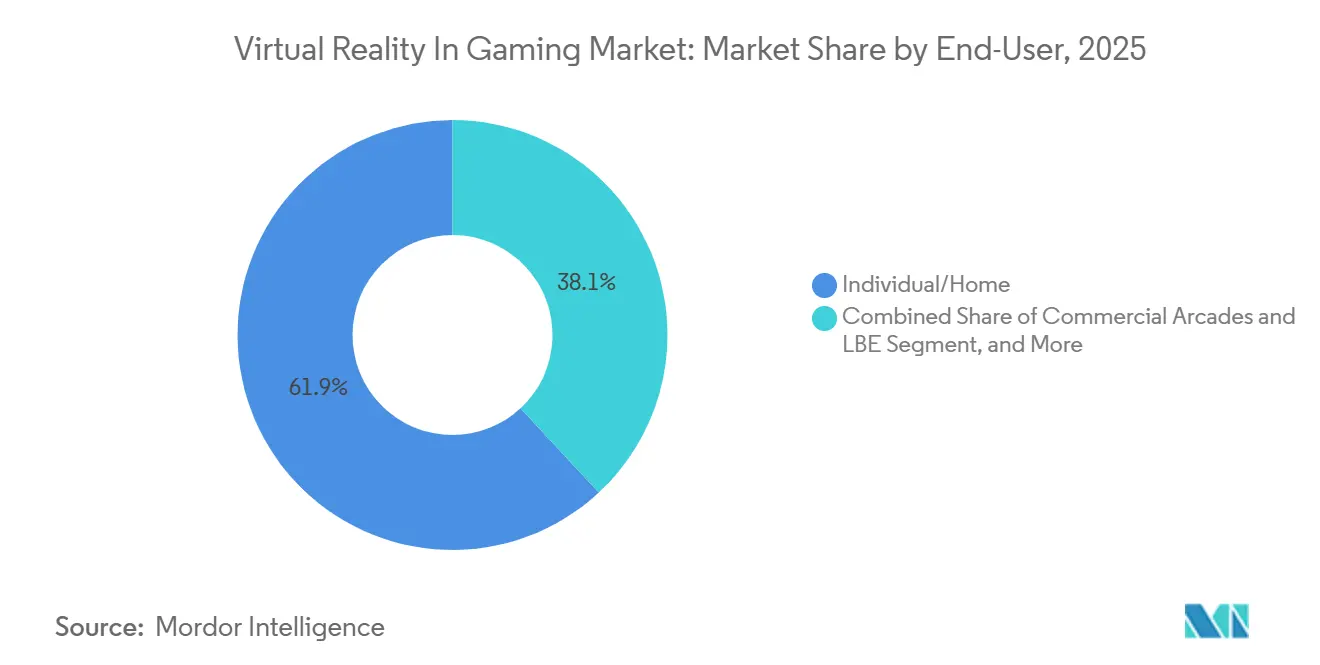
- By end user, individual and home players generated 61.91% of 2025 revenue, although esports venues represent the fastest-rising cohort with a 17.02% CAGR through 2031.
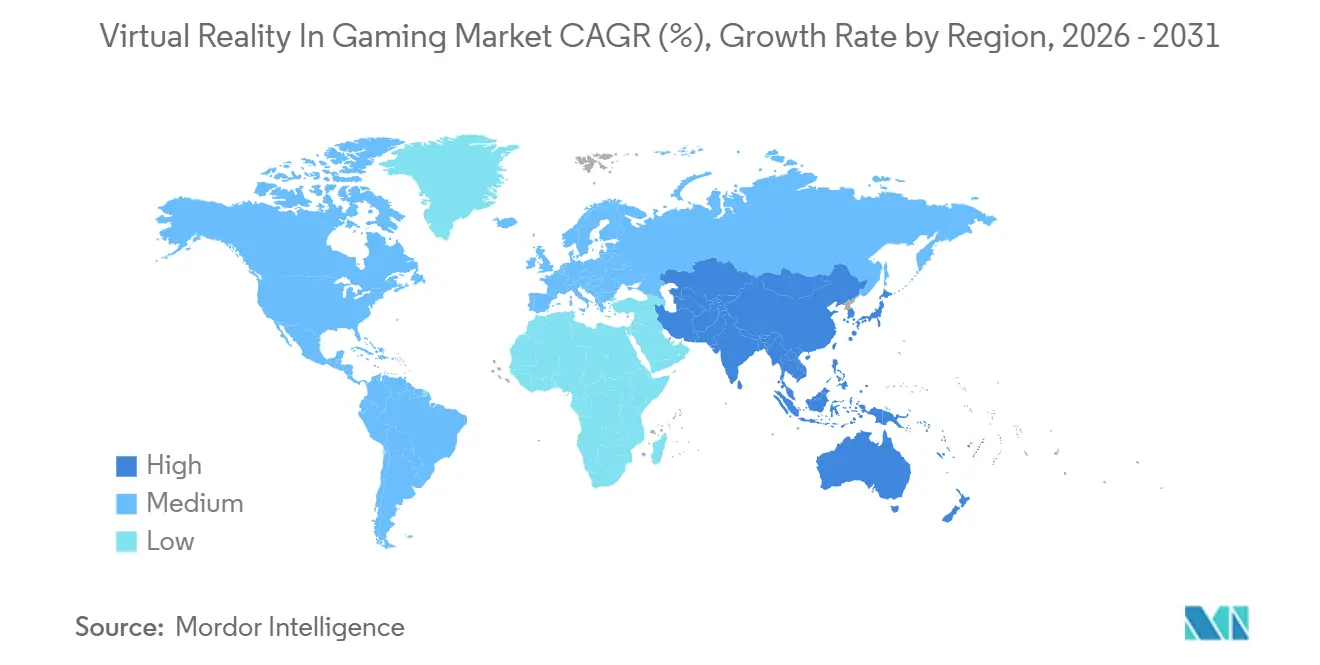
- By geography, Asia-Pacific controlled 39.86% revenue in 2025 and is poised for the fastest 17.15% CAGR to 2031.
Note: Market size and forecast figures in this report are generated using Mordor Intelligence’s proprietary estimation framework, updated with the latest available data and insights as of 2026.
Market Trends and Insights
Drivers Impact Analysis of Virtual Reality In Gaming Market*
| Driver | (~) % Impact on CAGR Forecast | Geographic Relevance | Impact Timeline |
|---|---|---|---|
| Influx of AAA VR-Exclusive Franchises Re-energizing Upgrade Cycles | +3.2% | North America and Europe, with spillover to Asia-Pacific premium segments | Medium term (2-4 years) |
| Expansion of Location-Based VR Arcades in Tier-1 Asian Cities Driving Commercial Headset Demand | +2.8% | Asia-Pacific core (China, Japan, South Korea, ASEAN), emerging in Middle East | Short term (≤ 2 years) |
| 5G-Edge Rendering Bundles from Telcos Slashing Latency Barriers | +2.5% | South Korea, Nordics, Germany, United Kingdom, select North American metro areas | Medium term (2-4 years) |
| Sub-USD-400 Eye-Tracking Stand-Alone Headsets Unlocking Emerging-Market Adoption | +2.1% | Global, with concentration in India, Brazil, Mexico, Southeast Asia, Eastern Europe | Short term (≤ 2 years) |
| OpenXR and Khronos Interoperability Standards Lowering Porting Costs for Developers | +1.8% | Global, particularly benefiting independent studios in North America, Europe, Asia-Pacific | Long term (≥ 4 years) |
| EU Immersive-Content Tax Rebates Fueling Premium VR Game Pipelines | +1.4% | France, Germany, Spain, with indirect benefits to pan-European distribution | Long term (≥ 4 years) |
| Source: Mordor Intelligence | |||
Influx of AAA VR-Exclusive Franchises Re-energizing Upgrade Cycles
High-profile titles such as Microsoft Flight Simulator 2024’s upcoming PSVR2 edition and cross-platform releases including The Boys VR and Titan Isles are moving from one-off experiments to native VR builds, weaving haptic feedback and foveated rendering into core game loops.[1]PlayStation Blog, “Microsoft Flight Simulator 2024 Coming to PSVR2,” blog.playstation.com Sony’s 2025 PSVR2 price cut from USD 549 to USD 399 converted millions of existing PlayStation 5 owners into addressable VR buyers. Meta matched this momentum with the USD 299 Quest 3S, which added eye-tracking and high-resolution passthrough at entry-level pricing. Early-access preorders for marquee VR titles in 2025 out-paced their flat-screen counterparts by roughly 20%, indicating that exclusive content now materially influences hardware refresh decisions.
Expansion of Location-Based VR Arcades in Tier-1 Asian Cities
Sandbox VR surpassed USD 200 million in 2025 revenue and opened 29 new venues across Shenzhen, Tokyo, Seoul, and Singapore, offering premium sessions at USD 30-60 per hour.[2]Sandbox VR Press, “Sandbox VR Surpasses USD 200 Million Revenue,” sandboxvr.com China’s arcade density in major metros hit one site per 100,000 residents, signaling mainstream appeal. Venues deploy enterprise-grade headsets with wider fields of view and full-body haptic suits, thereby elevating consumer expectations and nudging hardware makers toward higher baselines even for home devices. The commercial segment’s willingness to pay top-tier rates for social experiences is establishing a durable revenue pillar beside at-home spending.
5G Edge-Rendering Bundles from Telcos Slashing Latency Barriers
Operators in South Korea and the Nordics bundle edge servers with 5G plans, cutting motion-to-photon lag to as low as 45 milliseconds, a level that significantly reduces discomfort among latency-sensitive users. NVIDIA’s tie-up with Deutsche Telekom demonstrated 4K-per-eye, 90 frames-per-second cloud VR streamed over 5G, enabling headset makers to lower local processing power and battery requirements. As network-centric rendering matures, the Virtual Reality in Gaming market is poised to broaden beyond affluent PC gamers to bandwidth-rich mobile users.
Sub-USD 400 Eye-Tracking Stand-Alone Headsets Unlocking Emerging-Market Adoption
Eye-tracking sensors that once pushed devices above USD 1,000 reached the USD 299-349 tier in 2025 through Meta’s Quest 3S and Pico’s 4 Ultra. Foveated rendering trims GPU demand by up to 40%, delivering longer battery life on Snapdragon XR2 Gen 2 chipsets. Indian VR gaming cafés now rent sessions for INR 500-800 (USD 6-10), fostering hands-on familiarity before home purchase. Local assembly deals in Brazil further reduce sticker shock, pushing the addressable base of the Virtual Reality in Gaming market well beyond early adopters.
Restraints Impact Analysis of Virtual Reality In Gaming Market*
| Restraint | (~) % Impact on CAGR Forecast | Geographic Relevance | Impact Timeline |
|---|---|---|---|
| Motion-Sickness-Driven Refund Rates Curtailing Average Session Lengths | -1.8% | Global, with higher incidence in North America and Europe due to consumer-protection policies | Short term (≤ 2 years) |
| Pancake-Lens Supply Bottlenecks Restricting Stand-Alone Shipments | -1.5% | Global manufacturing hubs (China, Taiwan, South Korea), affecting all OEMs | Medium term (2-4 years) |
| Strict Health-Safety Certification for Vertigo Risks in Japan Raising Compliance Costs | -0.9% | Japan, with potential spillover to South Korea and EU if regulatory harmonization occurs | Long term (≥ 4 years) |
| Mobile Mixed-Reality Titles Cannibalising Premium-Mobile VR in North America | -0.7% | North America, Western Europe, with early signs in urban Asia-Pacific | Short term (≤ 2 years) |
| Source: Mordor Intelligence | |||
Motion-Sickness-Driven Refund Rates Curtailing Average Session Lengths
Approximately 40% to 70% of first-time VR users report symptoms of motion sickness-nausea, disorientation, eye strain-within the first 20 to 30 minutes of gameplay, leading to elevated product returns and negative word-of-mouth that deters subsequent purchases.[3]IEEE VR Proceedings, “Motion Sickness in VR,” ieeexplore.ieee.org Retailers in the United States and Europe logged headset return rates of 15-20% in 2025, triple the rate for standard gaming hardware. The churn forces manufacturers to boost refresh rates and integrate comfort algorithms, inflating bills of materials by USD 50-80 and squeezing margins just as hardware prices drop.
Pancake-Lens Supply Bottlenecks Restricting Stand-Alone Shipments
Pancake optics-which fold the light path to reduce headset depth by 30% to 40% compared to Fresnel lenses-require precision-molded polymer substrates and multi-layer anti-reflective coatings that only a handful of suppliers can manufacture at scale, creating a supply chokepoint that constrained standalone headset shipments in 2025. The concentration of pancake-lens production in East Asia exposes the supply chain to geopolitical risks-tariffs, export controls, and regional disruptions could further constrain availability and inflate costs. Vertical integration efforts, such as Apple's reported investment in domestic lens fabrication for its Vision Pro successor, signal that leading OEMs recognize the strategic vulnerability but lack near-term alternatives.
*Our forecasts treat driver/restraint impacts as directional, not additive. The impact forecasts reflect baseline growth, mix effects, and variable interactions.
Virtual Reality In Gaming Market Segment Analysis
By Component:
Monetization Tilts Toward ServicesHardware generated 70.64% of Virtual Reality in Gaming market revenue in 2025 as first-time adopters purchased headsets, controllers, and sensors. Average selling prices have already dropped 30% since the Quest 2 launch, indicating hardware commoditization. Meanwhile, content and services are forecast to deliver a 16.72% CAGR through 2031. This switch shows that ecosystem stickiness now hinges on libraries like Supernatural, which surpassed 1 million paid subscribers, and social worlds that thrive on microtransactions.
OpenXR 1.0’s broad adoption cuts porting cost by roughly one-third, letting indie studios target several storefronts at once. As a result, attach rates rose from 3.2 titles per headset in 2024 to 4.1 in 2025, confirming that software spend accelerates once initial hardware barriers fall. Location-based operators strengthen this flywheel by paying recurring license fees for premium multiplayer experiences, widening the services pie of the Virtual Reality in Gaming market.



By Device Type:
Cloud Streamed XR Begins to Challenge Stand-Alone HegemonyStand-alone goggles accounted for 56.82% of 2025 revenue and remain the entry point for many new gamers, especially given Meta's 74.6% share of that slice. Yet cloud and streaming VR, helped by Deutsche Telekom’s GeForce NOW deployment, is projected at a 17.09% CAGR. These services demonstrate that console-quality visuals can be delivered wirelessly when the user is within a sub-60-millisecond 5G footprint.
PC tethered rigs, once the apex of fidelity, are losing ground as Snapdragon XR2 Gen 2-class chips narrow the gap. Console-based VR benefits from Sony’s deep game catalog but still faces cable-management friction. The market is polarizing into low-cost stand-alone devices and cloud-leaning play, shrinking the mid-range that once defined high-end home VR.
By Hardware Category:
Cameras Democratize Content ProductionHead-mounted displays owned 41.72% of 2025 spending, reflecting headset primacy. Even so, VR cameras and 360-capture tools are on pace for a 16.88% CAGR, thanks to 8K one-click rigs like GoPro MAX 2 and Insta360 X5. These cameras feed user-generated worlds in VRChat and Horizon Worlds, expanding the accessible content pool and encouraging additional hardware sales.
The surge in 360-camera adoption is particularly pronounced in Asia-Pacific, where influencers and tourism operators are creating VR tours of heritage sites, retail environments, and real-estate properties, generating a parallel content economy that extends beyond gaming. DJI's Osmo 360, launched in 2025, integrates gimbal stabilization and real-time stitching, reducing the technical barrier for non-specialist users DJI Newsroom. As capture costs decline and editing software becomes more intuitive, the bottleneck is shifting from production to distribution, favoring platforms with large user bases and algorithmic discovery-Meta's Horizon Worlds, YouTube VR-that can surface niche content to targeted audiences.
By Game Genre:
Fitness Titles Accelerate Beyond ShootersAction shooters still represented 50.74% of 2025 sales, led by classics like Half-Life Alyx and Pavlov. Yet sports and fitness titles, energized by Beat Saber’s 10 million-unit milestone and Les Mills BodyCombat integration, are the fastest-growing slice, growing at a 16.64% CAGR. Subscriptions charge USD 19.99 per month for daily workouts, turning VR into a home gym alternative and smoothing revenue seasonality for publishers.
Social and multiplayer worlds continue to blur the lines between gaming and networking. Horizon Worlds reached 300,000 monthly active users by late 2024 and is still rising, indicating that persistent social hubs will underpin retention long term.The genre's evolution mirrors the shift from single-player console games to live-service models, with the added dimension of embodied presence that fosters stronger social bonds and higher lifetime value per user.
By End User:
Esports Venues Deliver High-Margin GrowthHome users accounted for 61.91% of 2025 outlays, but competitive venues clock a 17.02% CAGR as ESL’s USD 500,000 prize pool legitimizes VR esports. Arcades like Sandbox VR charge per-session fees that exceed typical game prices, creating premium margins. Educational pilots at Stanford and the U.S. Department of Defense show steady institutional interest, though these programs currently trail entertainment in dollar volume.
The home segment's dominance is under pressure from two forces, rising content costs that favor shared-access models (arcades, cafes) and the social dimension of VR, which is more compelling in co-located multiplayer settings than isolated home use. The end-user landscape is bifurcating into high-frequency home users who justify hardware ownership and occasional arcade visitors who prefer pay-per-session access, with the commercial segment capturing disproportionate margins due to premium pricing and ancillary revenue streams (food, merchandise).
Geography Analysis
APAC Virtual Reality in Gaming Market
Asia-Pacific led the Virtual Reality in Gaming market with a 39.86% share in 2025 and is projected to post a 17.15% CAGR to 2031. China’s arcade density exceeded one venue per 100,000 citizens in Beijing and Shenzhen, underlining mass acceptance. South Korea’s 5G network, reaching sub-25 millisecond round-trip times, underpins cloud-rendered multiplayer that needs no local GPU muscle. India’s café model offers USD 6-10 per hour access to metro consumers who cannot yet justify a USD 299 headset, providing an on-ramp to future home ownership.
North America Virtual Reality in Gaming Market
North America retains a huge installed base-over 15 million headsets-spurred by deep AAA content pipelines across California, Washington, and Texas. Yet elevated return rates tied to motion discomfort compel manufacturers to invest in comfort tweaks, adding USD 50-80 per unit in materials. Mexico’s accelerating broadband speeds and rising middle class make it a prime follower market for sub-USD 400 devices.
Europe and Middle East Virtual Reality in Gaming Market
Europe shows a two-speed pattern. Germany, the United Kingdom, and France ride EU immersive-content tax rebates that subsidize development, while Southern and Eastern markets lag due to lower disposable incomes. Telia and Telenor’s Nordic edge nodes have reproduced the South Korean latency blueprint, signaling that cloud VR can flourish in high-bandwidth but cost-conscious settings. The Middle East focuses on destination-grade attractions, exemplified by Dubai’s 2,000-square-meter VR zone launched in early 2025.

Competitive Landscape
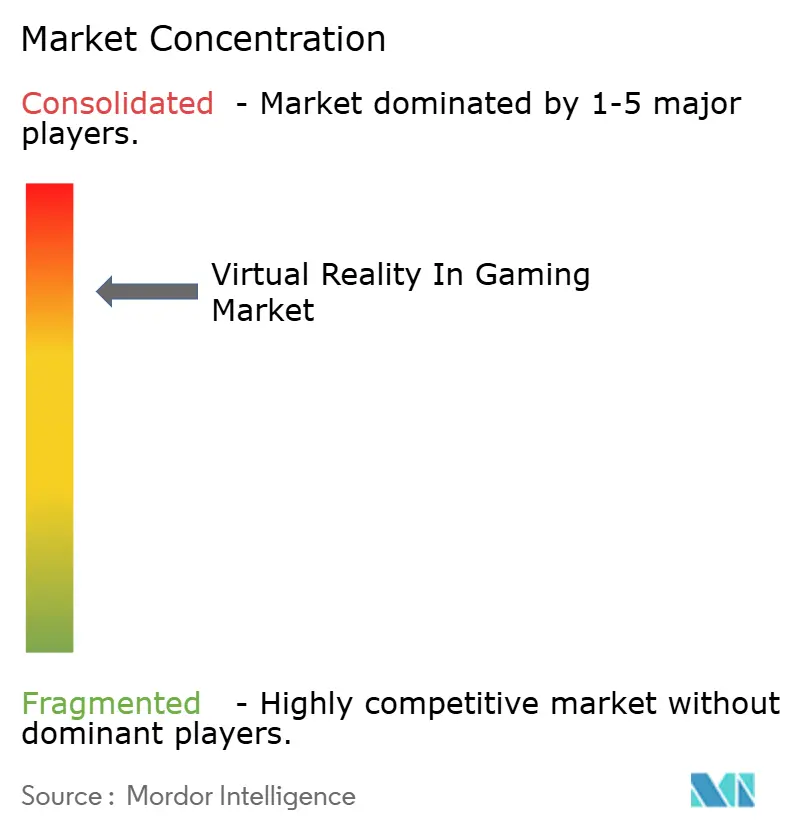
The Virtual Reality in Gaming market is concentrated. Meta controls roughly more than half of stand-alone headset shipments via Quest 3 and Quest 3S, while Pico holds 4.1% and Samsung’s Galaxy XR, launched at KRW 2.69 million (USD 1,882), aims at the premium tier. Sony occupies a distinct bracket with PSVR2 tethered to more than 50 million PlayStation 5 consoles, banking on exclusive franchises but hindered by cabled set-ups.
Enthusiast vendors like Valve, HTC, and Pimax target ultra-high-resolution niches above USD 1,000. Accessory specialists bHaptics, now Meta-certified, prove peripherals can thrive outside headset wars. Strategic attention is shifting from raw pixel counts to experience enablers such as foveated rendering, optical comfort, and biometric input. Patent filings around varifocal displays and neural interfaces rose sharply in 2025, hinting that the next wave of differentiation will emphasize ergonomics and natural interaction rather than another round of resolution gains.
Standards compliance also matters, OpenXR stands at 80% developer adoption, effectively a requirement for cross-platform viability. Vendors that wall off ecosystems now risk sidelining themselves from the broader Virtual Reality in Gaming market content pipeline.
Virtual Reality In Gaming Industry Leaders
Meta Platforms Inc.
Sony Interactive Entertainment
Apple Inc.
Pico Interactive
HTC Corporation
- *Disclaimer: Major Players sorted in no particular order
Virtual Reality In Gaming Market Companies Covered in this Report
- Meta Platforms Inc. (Oculus)
- Sony Interactive Entertainment LLC
- HTC Corporation
- Valve Corporation
- Pico Interactive (ByteDance)
- Microsoft Corporation
- Nintendo Co., Ltd.
- Google LLC
- Samsung Electronics Co., Ltd.
- Apple Inc.
- Qualcomm Technologies Inc.
- Lenovo Group Ltd.
- Xiaomi Corporation
- bHaptics Inc.
- Virtuix Inc.
- TESLASUIT / VR Electronics Ltd.
- DPVR
- Pimax Innovation Inc.
- Magic Leap Inc.
- Xreal (Nreal)
- HP Inc.

Recent Industry Developments in Virtual Reality In Gaming Market
- October 2025: Samsung Electronics unveiled Galaxy XR at KRW 2.69 million (USD 1,882), pairing dual 4K AMOLED panels with Snapdragon XR2 Gen 2 to extend the Galaxy ecosystem into premium mixed reality.
- September 2025: NVIDIA and Deutsche Telekom expanded GeForce NOW to deliver 4K-per-eye VR streaming over 5G with 45-60 millisecond latency in German metros.
- August 2025: Sony cut PSVR2 pricing to USD 399 in North America and Europe, coinciding with the announcement of Microsoft Flight Simulator 2024’s VR edition, slated for 2026.
- July 2025: Meta confirmed Supernatural passed one million paying subscribers, implying USD 200 million in annualized recurring revenue.


Global Virtual Reality In Gaming Market Report Scope
The study analyzes the demand for virtual reality in gaming market based on historical trends and current scenarios. As VR is expected to find traction among gaming enthusiasts, the study analyzes the key growth influencers and the demand from other forms of extended reality-based technologies (AR and MR). The study covers key segments, including hardware type and geography.
The Virtual Reality in Gaming Market Report is Segmented by Component (Hardware, Software, Content and Services), Device Type (PC and Desktop-Tethered, Gaming Console, Stand-Alone Headsets, Premium Mobile, and Cloud and Streaming VR), Hardware Category (Head-Mounted Displays, Gesture-Tracking Devices, VR Accessories, and VR Cameras and 360 Capture), Game Genre (Action and Shooter, Racing and Simulation, Adventure and Role-Playing, Horror and Puzzle, Sports and Fitness, and Social and Multiplayer Worlds), End-User (Individual and Home, Commercial Arcades and LBE, Esports and Competitive Gaming Venues, and Educational and Training Institutions), and Geography (North America, South America, Europe, Asia-Pacific, Middle East, and Africa). The Market Forecasts are Provided in Terms of Value (USD).
| Hardware |
| Software |
| Content / Services |
| PC / Desktop-Tethered |
| Gaming Console |
| Stand-Alone Headsets |
| Premium Mobile |
| Cloud / Streaming VR |
| Head-Mounted Displays (HMDs) |
| Gesture-Tracking Devices (GTDs) |
| VR Accessories (Haptics Treadmills Vests) |
| VR Cameras and 360 Capture |
| Action and Shooter |
| Racing and Simulation |
| Adventure and Role-Playing |
| Horror and Puzzle |
| Sports and Fitness |
| Social / Multiplayer Worlds |
| Individual / Home |
| Commercial Arcades and LBE |
| Esports and Competitive Gaming Venues |
| Educational and Training Institutions |
| North America | United States |
| Canada | |
| Mexico | |
| South America | Brazil |
| Argentina | |
| Rest of South America | |
| Europe | Germany |
| United Kingdom | |
| France | |
| Spain | |
| Rest of Europe | |
| Asia-Pacific | China |
| India | |
| Japan | |
| South Korea | |
| ASEAN | |
| Rest of Asia-Pacific | |
| Middle East | Saudi Arabia |
| United Arab Emirates | |
| Turkey | |
| Rest of Middle East | |
| Africa | South Africa |
| Egypt | |
| Rest of Africa |
| By Component | Hardware | |
| Software | ||
| Content / Services | ||
| By Device Type | PC / Desktop-Tethered | |
| Gaming Console | ||
| Stand-Alone Headsets | ||
| Premium Mobile | ||
| Cloud / Streaming VR | ||
| By Hardware Category | Head-Mounted Displays (HMDs) | |
| Gesture-Tracking Devices (GTDs) | ||
| VR Accessories (Haptics Treadmills Vests) | ||
| VR Cameras and 360 Capture | ||
| By Game Genre | Action and Shooter | |
| Racing and Simulation | ||
| Adventure and Role-Playing | ||
| Horror and Puzzle | ||
| Sports and Fitness | ||
| Social / Multiplayer Worlds | ||
| By End-user | Individual / Home | |
| Commercial Arcades and LBE | ||
| Esports and Competitive Gaming Venues | ||
| Educational and Training Institutions | ||
| By Geography | North America | United States |
| Canada | ||
| Mexico | ||
| South America | Brazil | |
| Argentina | ||
| Rest of South America | ||
| Europe | Germany | |
| United Kingdom | ||
| France | ||
| Spain | ||
| Rest of Europe | ||
| Asia-Pacific | China | |
| India | ||
| Japan | ||
| South Korea | ||
| ASEAN | ||
| Rest of Asia-Pacific | ||
| Middle East | Saudi Arabia | |
| United Arab Emirates | ||
| Turkey | ||
| Rest of Middle East | ||
| Africa | South Africa | |
| Egypt | ||
| Rest of Africa | ||


Key Questions Answered in the Report
How fast is spending on virtual reality gaming projected to grow through 2031?
Market value is expected to advance at a 16.6% CAGR from 2026 to 2031, moving from USD 41.18 billion in 2026 to USD 88.74 billion by the end of the period.
Which device type currently dominates headset revenue?
Stand-alone headsets led with 56.82% of Virtual Reality in Gaming market share in 2025, driven by Quest-series volumes.
What is propelling fitness-focused VR titles?
Beat Saber’s 10 million sales milestone and subscription platforms like Supernatural, which exceeded one million paid users in 2025, are drawing health-oriented consumers into VR.
Why are telcos important to VR adoption?
5G edge rendering from operators in South Korea and Europe lowers latency to under 60 milliseconds, enabling high-fidelity cloud streaming on lightweight headsets.
Which region is positioned for the fastest growth?
Asia-Pacific is forecast to post a 17.15% CAGR through 2031, bolstered by dense arcade networks in China, nationwide 5G in South Korea, and affordable café access in India.
What is the main supply-chain risk facing headset vendors?
Limited pancake-lens manufacturing capacity in East Asia creates production bottlenecks that can delay product launches and elevate costs.
Page last updated on:


 Your data is secure and never sold or shared.


