
Market Overview
| Study Period | 2020 - 2031 |
|---|---|
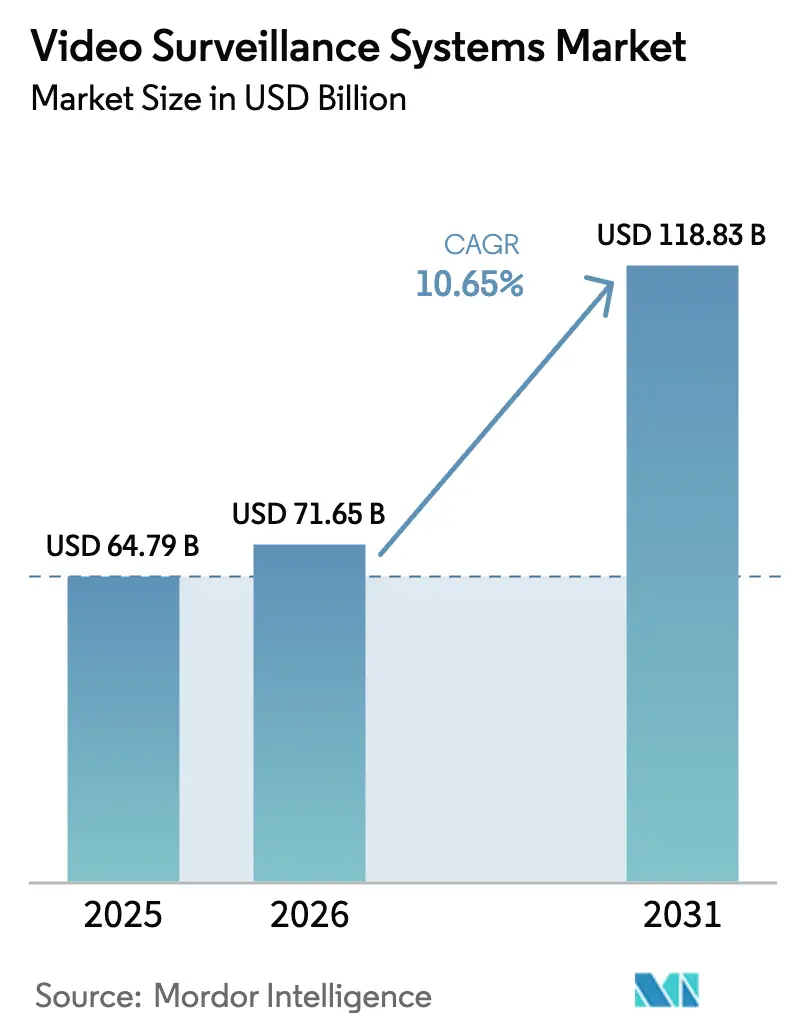
| Market Size (2026) | USD 71.65 Billion |
| Market Size (2031) | USD 118.83 Billion |
| Growth Rate (2026 - 2031) | 10.65 % |
| Fastest Growing Market | Middle East |
| Largest Market | Asia Pacific |
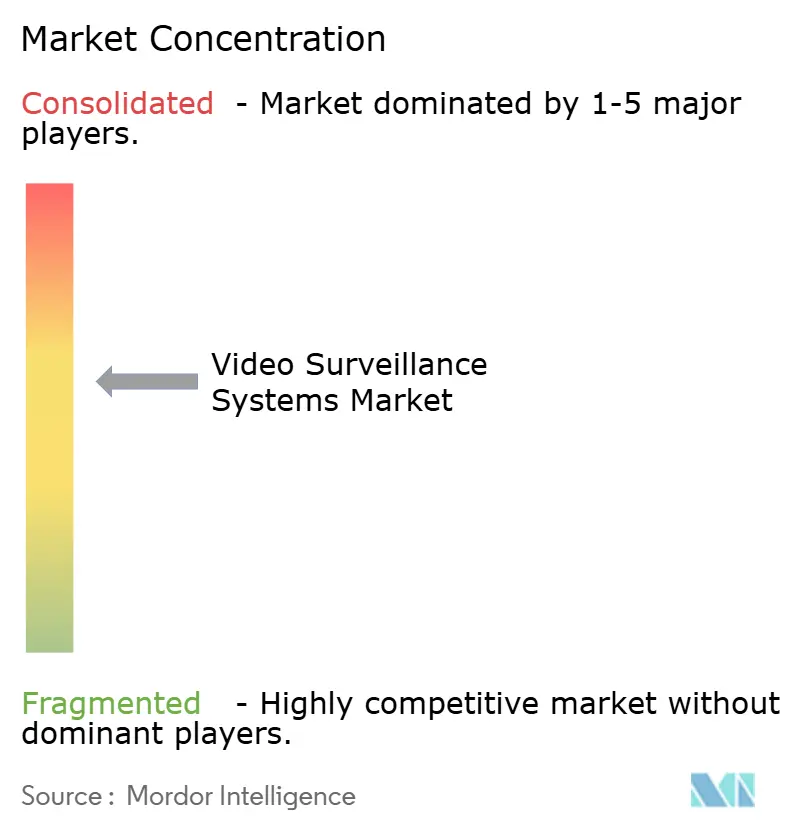
| Market Concentration | Medium |
Major Players *Disclaimer: Major Players sorted in no particular order Image © Mordor Intelligence. Reuse requires attribution under CC BY 4.0. | |
Video Surveillance Systems Market Analysis by Mordor Intelligence
The Video Surveillance Systems Market size is projected to expand from USD 64.79 billion in 2025 and USD 71.65 billion in 2026 to USD 118.83 billion by 2031, registering a CAGR of 10.65% between 2026 to 2031. Mandatory migration from analog to IP, rapid 5G roll-outs, and camera-level artificial intelligence are shifting value from passive recording to real-time insight platforms. European municipalities are swapping legacy CCTV for encrypted IP networks that meet cybersecurity directives, while Asian transportation hubs rely on 5G backhaul to stream ultra-high-definition video with sub-20-millisecond latency. Edge analytics processors now cut cloud transmission costs by 40%-60% and reduce decision latency below 200 milliseconds, unlocking industrial automation and safe-city use cases. National safe-city grants across the Middle East and ESG-linked insurance discounts are accelerating refresh cycles, although chiplet shortages for AI system-on-chips and rising GDPR-compliance storage fees create uneven adoption patterns.
Key Report Takeaways
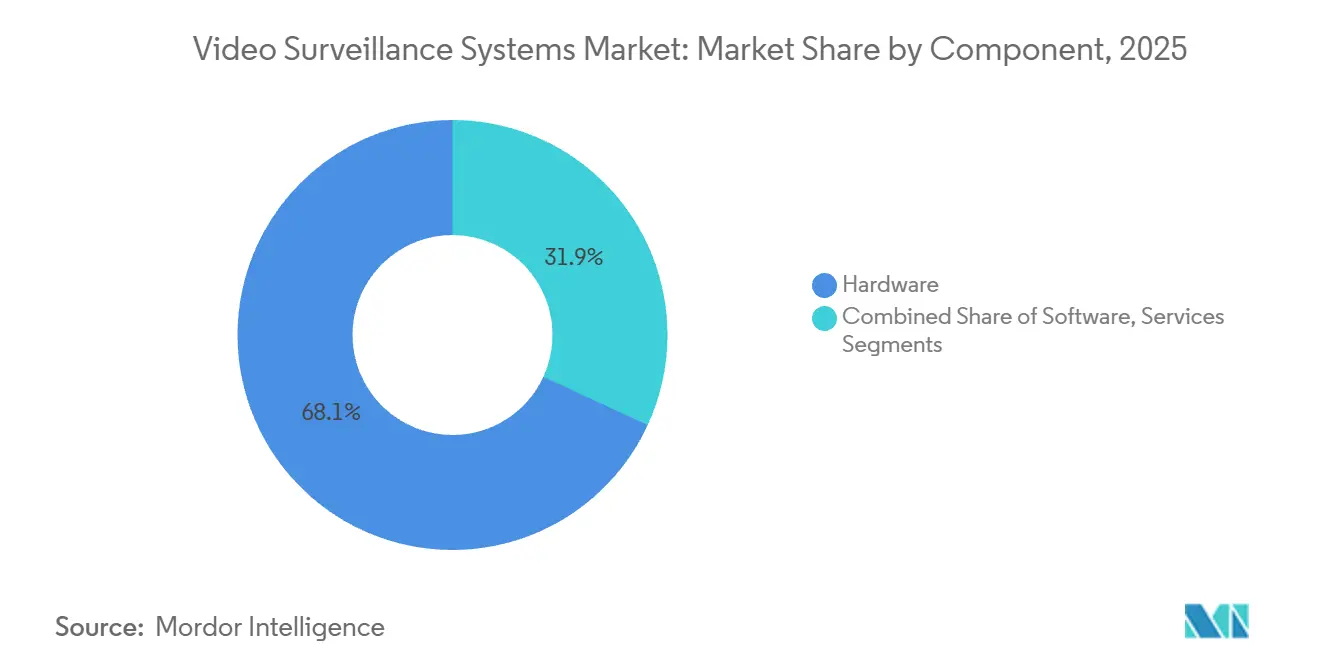
- By component, hardware led with a 68.13% share in 2025, whereas services are forecast to expand at an 11.14% CAGR through 2031.
- By system type, IP architectures commanded 74.26% of the 2025 base, while wireless 4G/5G is poised for a 12.78% CAGR.
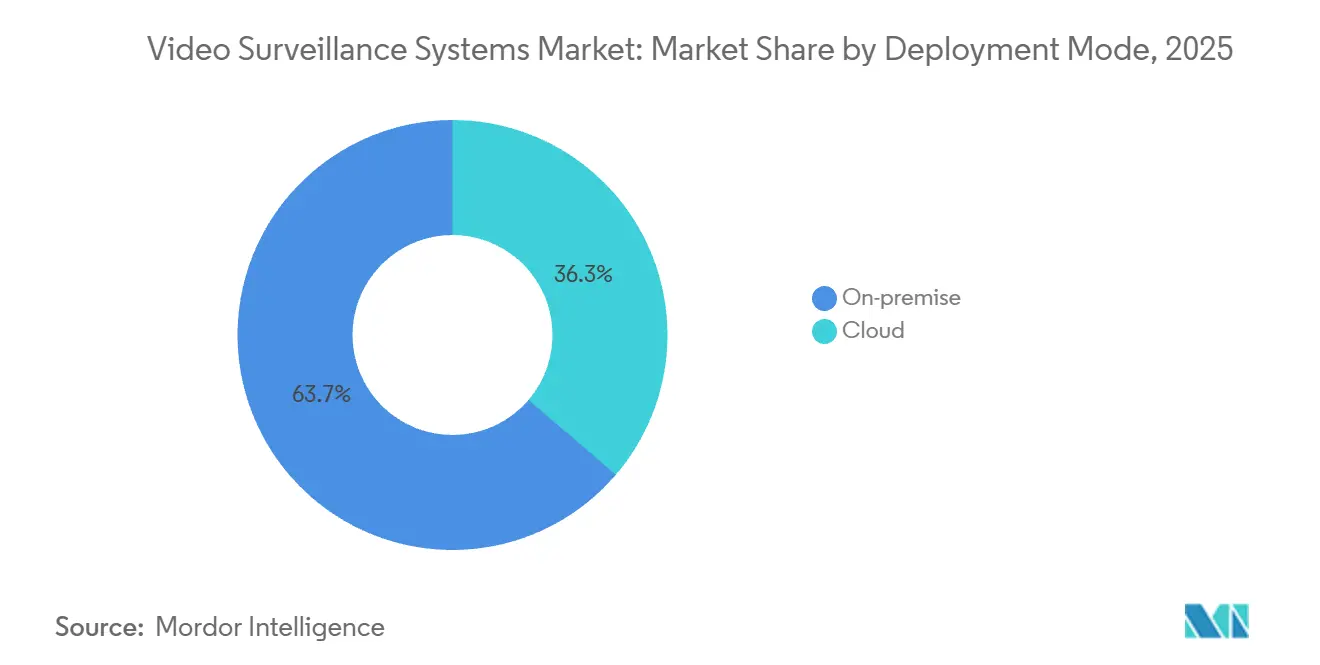
- By deployment mode, on-premise held 63.74% of 2025 installations; cloud models are set to grow at 12.51% as hybrid approaches satisfy data-sovereignty mandates.
- By connectivity, power-over-ethernet captured 51.31% of 2025 installations, yet cellular 5G new radio is forecast to expand at an 11.31% CAGR.
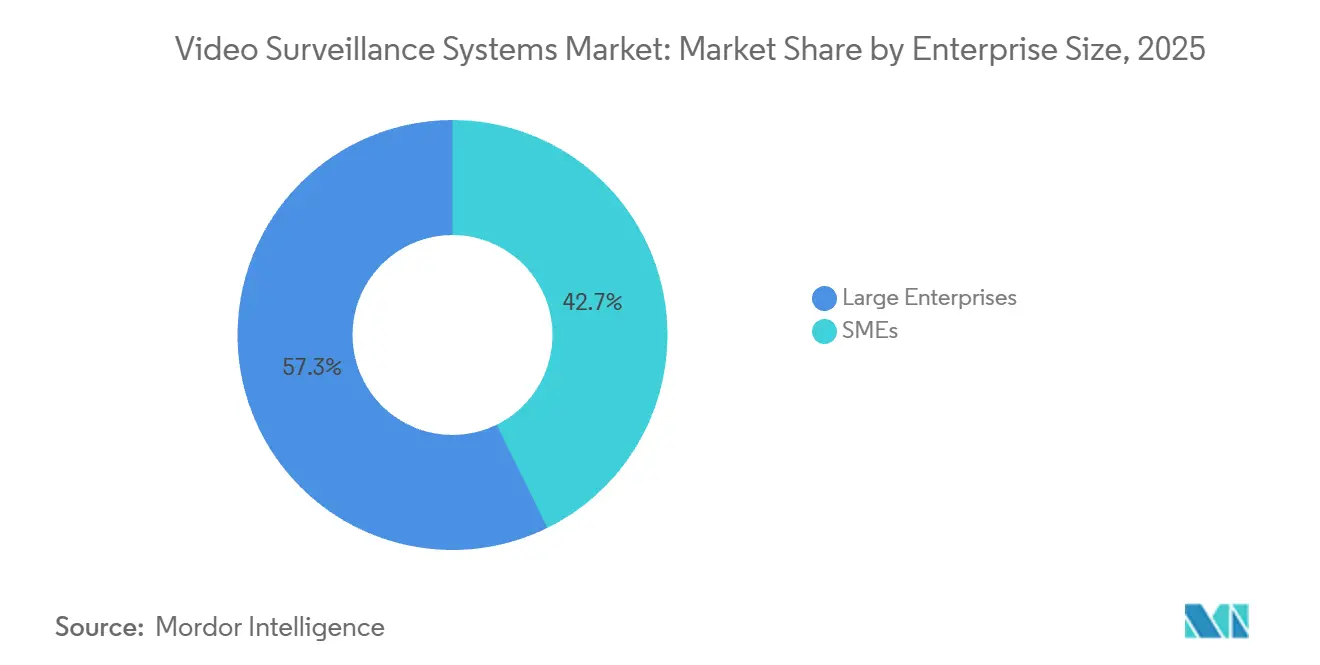
- By enterprise size, large organizations accounted for 57.28% of 2025 spending, but SMEs will advance at 12.76% on cloud video surveillance as a service uptake.
- By application, city surveillance controlled 32.53% of demand in 2025, while industrial manufacturing is the fastest-growing segment at 12.56% CAGR.
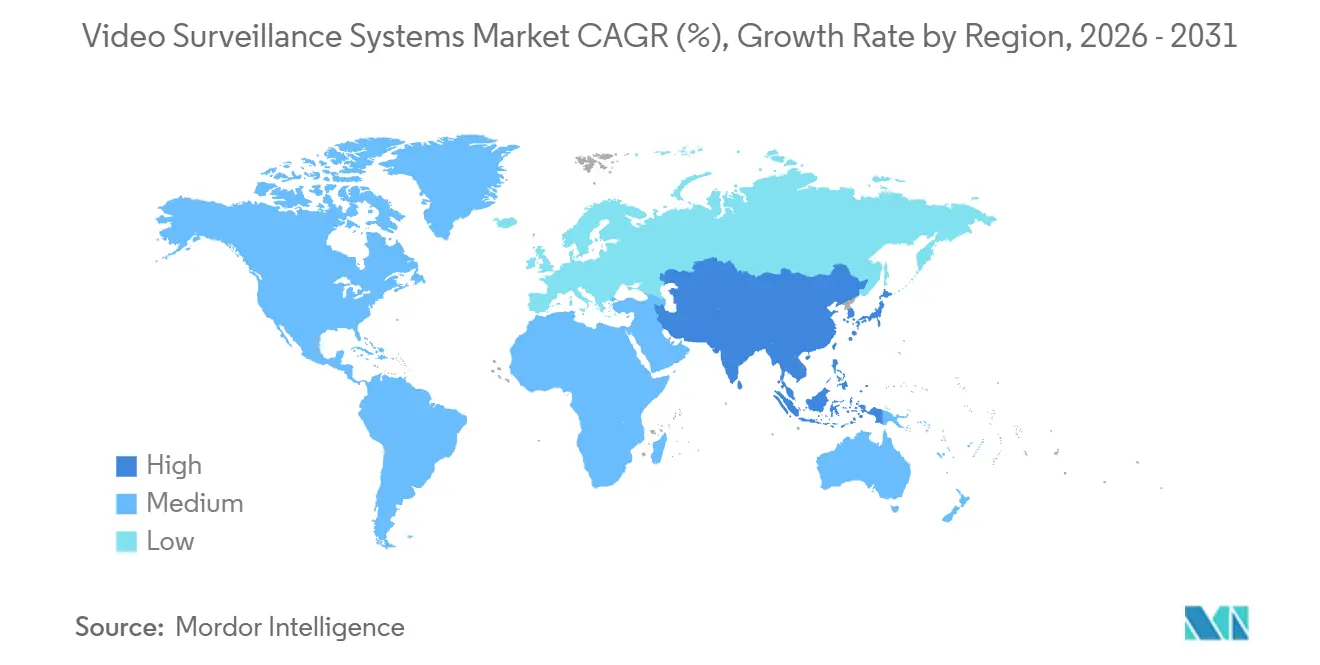
- By geography, Asia-Pacific generated 43.61% of 2025 revenue; the Middle East is the fastest-growing geography at 12.19% CAGR.
Note: Market size and forecast figures in this report are generated using Mordor Intelligence’s proprietary estimation framework, updated with the latest available data and insights as of January 2026.
Market Trends and Insights
Drivers Impact Analysis of Video Surveillance Systems Market*
| Driver | (~) % Impact on CAGR Forecast | Geographic Relevance | Impact Timeline |
|---|---|---|---|
| Rapid AI-Powered Edge Analytics Integration | +2.3% | North America, Europe, developed Asia-Pacific | Medium term (2-4 years) |
| Mandatory Migration from Analog to IP | +1.8% | Germany, France, Netherlands, Nordics | Short term (≤ 2 years) |
| Tier-3 and Tier-4 Data Center Surveillance | +1.2% | United States, Canada, selected Asia-Pacific hubs | Medium term (2-4 years) |
| 5G-Enabled Ultra-HD Streaming at Hubs | +1.9% | China, Japan, South Korea, Singapore | Short term (≤ 2 years) |
| National Safe-City Grants | +1.6% | Saudi Arabia, United Arab Emirates, Qatar | Medium term (2-4 years) |
| ESG-Linked Insurance Discounts | +1.0% | North America, Europe | Long term (≥ 4 years) |
| Source: Mordor Intelligence | |||
Rapid AI-Powered Edge Analytics Integration
Edge cameras equipped with neural processing units now execute 30 trillion operations per second, enabling real-time object identification without backhauling raw video to data centers. Bandwidth use falls by as much as 70%, trimming cloud storage costs by USD 0.12 per camera per day and supporting autonomous decision loops under 200 milliseconds. Retailers deploy these units to curb inventory shrinkage, while manufacturers flag worker-safety violations at the point of capture. The architecture simultaneously lowers latency for airport perimeter security and facilitates solar-powered surveillance in remote energy sites, broadening addressable use cases.
Mandatory Migration from Analog to IP in European Smart Cities
European cybersecurity directives require municipalities to encrypt video streams, implement granular access controls, and automate retention policies.[1]Federal Office for Information Security, “Cybersecurity in Video Surveillance,” bsi.bund.de Cities such as Munich and Hamburg replaced 40,000 analog units with IP cameras certified to IEC 62443 before the December 2025 deadline, reducing maintenance outlays by 32%. Amsterdam integrated edge-analytics cameras into bicycle-traffic management, showing how public-safety budgets deliver mobility dividends. Updated guidance from the UK Information Commissioner obliges local authorities to complete data-protection impact assessments, anchoring compliance rigor in future tenders.
Tier-3 and Tier-4 Data Center Surveillance Build-Outs Across North America
Hyperscale and colocation operators spread into secondary U.S. markets for cost and power advantages, each new campus exceeding 50 MW capacity. Facilities require 180-day footage retention to satisfy SOC 2 Type II and ISO 27001 audits, lifting demand for 4K IP cameras and cabinet-level monitoring. Digital Realty’s Phoenix site commissioned 420 cameras in 2024, while Equinix’s Toronto campus added thermal units to track cooling-system health. Uptime Institute now mandates video verification of maintenance drills, embedding surveillance into resiliency frameworks.
5G-Enabled Ultra-HD Streaming Demand in Asian Transportation Hubs
Stand-alone 5G networks deliver uplink speeds above 100 Mbps and latency below 20 milliseconds, permitting 4K and 8K video feeds from mobile surveillance units. Beijing Daxing Airport streams 3,000 camera feeds for 100 million annual passengers, while Changi Airport leverages 5G slices to steer autonomous baggage tractors with 99.99% reliability. Hong Kong MTR replaced wired systems across 93 stations and cut installation time by 70%. Guaranteed 10-millisecond latency enables track-intrusion detection and crowd-management analytics for peak-hour safety.
Restraints Impact Analysis of Video Surveillance Systems Market*
| Restraint | (~) % Impact on CAGR Forecast | Geographic Relevance | Impact Timeline |
|---|---|---|---|
| GDPR-Driven Multi-Terabyte Retention Costs | -1.4% | Europe, expanding to GDPR-inspired markets | Short term (≤ 2 years) |
| U.S. NDAA and FCC Blacklist Restrictions | -1.8% | North America, Australia, Japan | Medium term (2-4 years) |
| Acute AI Chiplet Shortages | -1.2% | Global, most acute in Taiwan-fab dependent regions | Short term (≤ 2 years) |
| Rising Cyber-Insurability Thresholds | -0.9% | North America, Europe | Medium term (2-4 years) |
| Source: Mordor Intelligence | |||
GDPR-Driven Multi-Terabyte Data Retention Costs
Retention periods extending to 180 days inflate monthly storage expenses to USD 15,000–25,000 for enterprises running 1,000 cameras.[2] UK Information Commissioner’s Office, “Guidance on Video Surveillance,” ico.org.uk Encrypted storage adds 20% compute overhead and complicates cross-border data transfers, while legal reviews and data-protection-officer fees consume up to 12% of surveillance budgets for German and French SMEs. Cloud providers must draft standard contractual clauses and perform transfer-impact assessments, lengthening sales cycles by 8 weeks and tilting smaller firms toward edge-only upgrades rather than full overhauls.
U.S. NDAA and FCC Black-List Sourcing Restrictions
Section 889 of the NDAA and the FCC Covered List prohibit federal agencies and contractors from buying Hikvision and Dahua products, removing 38% of global camera supply from eligible U.S. bids. Substitutes from Axis and Hanwha cost 20%-35% more, raising project capex and squeezing integrator margins. Australia and Japan adopted similar bans in 2025, forcing vendors to manage parallel product lines. U.S. military facilities must replace non-compliant cameras by 2027, a USD 1.2 billion program that strains approved-vendor capacity and inflates lead times.
*Our forecasts treat driver/restraint impacts as directional, not additive. The impact forecasts reflect baseline growth, mix effects, and variable interactions.
Video Surveillance Systems Market Segment Analysis
By Component:
Services Gain as Hardware CommoditizesHardware commanded 68.13% of 2025 spending, but service revenue is forecast to expand at an 11.14% CAGR as cameras, storage, and recorders become interchangeable and enterprises outsource management. Video surveillance as a service bundles devices, cloud storage, and AI analytics into a single subscription, appealing to cost-sensitive SMEs. Verkada charges USD 300–500 per camera annually for its plug-and-play package. Meanwhile, Genetec’s hybrid model lets banks keep sensitive footage on-premises while running analytics in the cloud, satisfying sovereignty requirements without incurring capital expense spikes.
Second-generation edge-storage appliances cache footage locally and upload only event metadata, slicing egress costs by up to 75%. Component makers promote drives optimized for 24/7 write loads and AI indexing. As a result, services captured 31.87% of 2025 revenue and are projected to overtake hardware by 2030 if current adoption persists. Vendors are layering predictive maintenance, incident-response automation, and privacy masking into subscription tiers, expanding the addressable spend beyond physical security budgets.



By System Type:
Wireless Architectures Challenge Wired DominanceIP networks held a 74.26% share in 2025, anchored by Ethernet infrastructure in retail and municipal deployments. However, wireless 4G/5G systems are forecast for 12.78% CAGR as mobile operators bundle connectivity and cloud storage, slashing installation timelines by 70%. Verizon’s private 5G service supports 300 cameras per campus with 15-millisecond latency guarantees.[3]Verizon Private 5G Solutions, verizon.com AT&T’s edge-compute offload cuts round-trip delays by 40%, enabling real-time alerts for intrusions.
Analog deployments fell to 14% market share in 2025 but persist in legacy factories where coaxial cabling remains viable. Hybrid encoder boxes that bridge analog cameras to IP backbones account for 8% but will decline as analog devices reach end-of-life. As sensor costs drop and wireless uplink charges fall, fully untethered architectures are likely to erode wired incumbency across construction, disaster-recovery, and temporary-event use cases.
By Deployment Mode:
Cloud Gains Despite Data-Sovereignty ConcernsOn-premise solutions held 63.74% of 2025 deployments because financial and healthcare operators prefer local control. Yet cloud architectures are expected to expand at a 12.51% CAGR as hybrid models reconcile sovereignty needs with cost efficiency. Public-cloud usage represented 18% of the cloud segment, favored by retailers that prioritize scalability over data isolation. Private-cloud instances held 22%, providing dedicated hardware for regulated workloads.
Hybrid approaches dominated 2025 enterprise bids, allowing critical footage to remain onsite while archives migrate to object stores that cost USD 0.05 per gigabyte per month. This pattern aligns storage costs with retention policies, enabling automated tiering as footage ages. Vendors now offer single-pane dashboards that manage edge devices and cloud clusters, accelerating operational consolidation across geographically dispersed portfolios.
By Connectivity:
Cellular 5G NR Disrupts Wired IncumbencyPower-over-Ethernet retained 51.31% of connections in 2025, leveraging IEEE 802.3bt’s 90-watt budget to drive pan-tilt-zoom units with integrated heaters. Nonetheless, cellular 5G NR connections are forecast for 11.31% CAGR as network slicing guarantees dedicated uplink throughput for security traffic. T-Mobile’s private network supports 200 cameras per logistics hub with 99.9% availability. Qualcomm’s QCS8250 chip merges 5G modem, AI accelerator, and ISP in one die, cutting power use 30% and enabling solar operation.
Wi-Fi 6/6E carved out 28% share in 2025, ideal for indoor sites with dense access-point coverage. Yet its 50-meter range ceiling limits outdoor reach, positioning cellular as the technology of choice for remote oil, gas, and border facilities. The GSMA IoT SAFE framework embeds SIM-based authentication and encryption, easing cyber insurance compliance.
By Enterprise Size:
SMEs Embrace Cloud to Bypass Capital ConstraintsLarge enterprises captured 57.28% of 2025 revenue and maintain security operations centers with analysts monitoring multi-site feeds. However, SMEs are projected to grow at 12.76% CAGR as cloud platforms remove upfront hardware outlays. Rhombus Systems offers USD 20-30 per-camera monthly plans with 30-day retention, enabling firms with fewer than 100 employees to adopt enterprise-grade surveillance.
Cyber insurers now grant 10%-15% premium discounts to policyholders running encrypted, multi-factor-authenticated cloud video, nudging cash-constrained businesses toward subscription bundles. As plug-and-play cellular cameras require no wiring, SMEs in retail and hospitality deploy within hours, expanding addressable demand in previously unserved micro-business segments.
By Application:
Industrial Manufacturing Leverages AI for Operational GainsCity surveillance secured 32.53% of 2025 demand, funded by crime-reduction grants and urban-mobility programs. Industrial manufacturing, though, is forecast to outpace all other segments at 12.56% CAGR as cameras feed robotic process automation and predictive maintenance engines. Siemens’ Industrial Edge integrates vision data with PLCs to adjust parameters in real time, cutting defects and downtime.
Factory deployments now track worker PPE compliance, detect product anomalies at 60 frames per second, and predict equipment failures hours in advance. The video surveillance systems market share for industrial sites reached 18% in 2025 and is expected to rise five points by 2031. Integrations with ERP and MES platforms further embed surveillance into operational intelligence, broadening spend beyond security budgets.
Geography Analysis
APAC Video Surveillance Systems Market
Asia-Pacific remains the revenue cornerstone, accounting for 43.61% of 2025 revenue, with China’s public-safety projects and India’s municipal tenders underpinning volume demand. National policies that favor domestic manufacturers and integrate cloud giants like Alibaba create vertically integrated ecosystems. Simultaneously, stringent cyber requirements in Japan and South Korea elevate the status of premium Western vendors for critical infrastructure deployments.
North America Video Surveillance Systems Market
North America demonstrates high replacement velocity rather than first-time adoption. Federal agencies must strip banned Chinese equipment by 2027 and channel orders to Axis, Hanwha, and Motorola. Hyperscale data center surveillance drives follow-on demand as SOC 2 audits tighten. Canada’s safe-city grants catalyze provincial spending, while Mexican manufacturing hubs upgrade to cloud-managed cameras to meet export-plant compliance requirements.
Europe Video Surveillance Systems Market
Europe’s trajectory centers on compliance-driven modernization. Cities retrofit analog assets to IP with encryption and automated retention to meet GDPR mandates. Nordic nations are pioneering edge analytics for traffic management, using video to optimize pedestrian and cyclist flows. However, high retention costs and privacy litigation create friction that lengthens procurement cycles.
Middle East Video Surveillance Systems Market
The Middle East, the fastest-growing geography at a 12.19% CAGR through 2031, executes mega-city builds with large unit counts. NEOM plans 500,000 cameras integrated into autonomous-vehicle grids, while Dubai Police attributes a 22% response-time drop to its AI-enabled network. Government mandates and sovereign-wealth financing ensure sustained capex despite macro volatility.
LATAM and Africa Video Surveillance Systems Market
Latin America and Africa exhibit fragmented, project-based growth. Brazil deploys city-wide analytics for crime monitoring, whereas South Africa’s private-security sector adopts cloud video as a differentiator. Lagos State leverages trust-fund mechanisms to finance camera grids for traffic and crime, portending broader sub-Saharan uptake.

Regulatory Landscape
Regulation and standards increasingly shape product eligibility, AI feature design, and deployment architecture in global video surveillance. In the European Union, GDPR continues to govern video processing and pushes buyers toward encryption, access controls, and formal Data Protection Impact Assessments for systematic monitoring, while the EU Artificial Intelligence Act (Regulation (EU) 2024/1689) adds AI-specific obligations for surveillance use cases, including transparency-related requirements that take effect on 2 August 2026 and influence labeling, user disclosure, and documentation in tenders.
In North America, sourcing restrictions remain a defining constraint for public sector and government-adjacent projects. US federal procurement rules under Section 889 of the 2019 NDAA restrict acquisition of video surveillance and telecommunications equipment from named Chinese vendors and affiliates, and the FCC Covered List reinforces supply-chain scrutiny for communications-linked deployments. Standards continue to evolve in parallel, with IEC 62676-4:2025 guiding application planning and lifecycle practices, and EN IEC 62676-6:2026 introducing performance testing and grading specifications for real-time intelligent video content analysis devices, supporting more measurable AI-analytics evaluation in procurement.
Value Chain Analysis
The value chain spans image sensors and optics, camera modules and housings (including thermal/multispectral variants), edge compute silicon, connectivity chipsets (PoE, Wi-Fi, cellular), storage media, and firmware that feed into VMS, analytics engines, and VSaaS platforms. System OEMs and ODMs assemble cameras and recorders, while cloud and software vendors provide device management, retention, and AI inference layers that increasingly monetize through subscriptions. Channel delivery remains integrator-led for enterprise, critical infrastructure, and municipal deployments, with distributors and telecom operators playing larger roles where wireless 4G/5G surveillance bundles connectivity and cloud storage.
Supply and compliance constraints are reshaping upstream choices and downstream go-to-market. Diversification away from China-linked components, driven by national security mandates and procurement eligibility, has been associated with a 15%-20% increase in procurement costs reported by CP PLUS (Aditya Infotech Ltd.) in 2026, pressuring BOM optimization and raising the value of standardized, interoperable designs. At the software layer, the ecosystem is adding specialized video AI models and on-premise or air-gapped options for high-security environments, with differentiation shifting toward edge analytics performance, secure lifecycle management, and integration with customer IT governance rather than camera hardware alone.
Competitive Landscape
Hikvision, Dahua, Axis Communications, Hanwha Vision, and Bosch together shipped 48% of 2025 units. Chinese vendors dominate low-price segments through vertically integrated supply chains but face procurement bans in North America, Australia, and Japan. Western players differentiate via open standards and ONVIF compliance, enabling multi-vendor analytics overlays.
Software and cloud layers remain fragmented, with more than 200 vendors. Genetec, Milestone, and Verkada rely on subscription revenue and maintain 65%–75% gross margins. Smaller disruptors bundle hardware, storage, and analytics into per-camera subscriptions, removing integrator complexity and capturing SME budgets.
Technology differentiation focuses on on-camera AI silicon. Axis’ ARTPEC-9 executes 40 TOPS and encodes 8K video, while Huawei’s Ascend 310B emphasizes performance-per-watt for solar deployments. Federated-learning patents enable distributed training without centralizing video, cutting bandwidth 90% and aligning with European data-minimization rules.
Video Surveillance Systems Industry Leaders
Hangzhou Hikvision Digital Technology Co. Ltd
Zhejiang Dahua Technology Co. Ltd
Axis Communications AB
Bosch Security & Safety Systems
Hanwha Vision (Samsung)
- *Disclaimer: Major Players sorted in no particular order
Video Surveillance Systems Market Companies Covered in this Report
- Hangzhou Hikvision Digital Technology Co. Ltd
- Zhejiang Dahua Technology Co. Ltd
- Axis Communications AB
- Bosch Security and Safety Systems
- Hanwha Vision
- Panasonic Connect Co. Ltd
- Honeywell Security Group
- Motorola Solutions (Avigilon)
- FLIR Systems (Teledyne)
- Pelco (Schneider Electric)
- Vivotek Inc.
- CP Plus (Aditya Infotech)
- Uniview
- Genetec Inc.
- Milestone Systems A/S
- Qognify
- Infinova Corporation
- Sony Semiconductor Solutions
- Verkada Inc.
- Cloudflare (Area 1 Video)

Market Opportunities and Future Outlook
Opportunities are widening where buyers need measurable AI outcomes, auditable cybersecurity, and interoperable architectures rather than standalone recording. In July 2026, Verkada announced collaboration with NVIDIA to integrate foundation-model and data-factory capabilities across its connected device base, reinforcing a route for vendors that can operationalize privacy-aware model training, inference, and fleet management at scale. Alongside this, investment activity into AI video platforms points to white space in agentic analytics, natural-language investigation, and automation layers that sit above existing camera fleets, supported by funding events such as Coram raising Series B capital in June 2026 and AIsphere securing a large round led by Alibaba in July 2026.
Standards and compliance are also opening upgrade cycles and new procurement criteria, particularly for cloud and hybrid deployments. IEC 62676-2-11:2024 strengthens requirements for VMS and VSaaS interoperability and secure third-party access, aligning with enterprise demand for vendor-neutral integrations and multi-site governance. In Europe, the EU AI Act application milestone on 2 August 2026 and ongoing GDPR enforcement elevate demand for capabilities such as transparency controls, privacy masking, retention automation, and documented risk management, creating room for suppliers that package compliance-ready analytics and hybrid architectures for municipalities, transportation hubs, and regulated enterprises.
Recent Industry Developments in Video Surveillance Systems Market
- June 2026: Hikvision published its 2026 Cybersecurity White Paper outlining an updated security framework for AIoT deployments and describing enhancements to protection models for AI-enabled systems. The publication supports procurement conversations where buyers require evidence of secure development lifecycle practices and product hardening for networked IP camera fleets.
- October 2025: Motorola Solutions acquired Ava Security for USD 445 million to deepen its cloud video and analytics capabilities. The deal strengthens Motorola's position in VSaaS-style offerings and adds competitive pressure on incumbents that rely on on-premise VMS deployments without a unified cloud management layer.
- November 2024: Axis Communications announced the ARTPEC-9 system-on-chip, positioning higher on-camera AI performance and improved cloud-based video and analytics support for future product generations. This silicon step-up underpins the shift toward edge inference and reduces reliance on constant cloud backhaul for real-time detection use cases.


Video Surveillance Systems Market Report Scope and Research Methodology
Market Definition and Coverage
This market covers video surveillance systems used to capture, store, manage, and monitor video for security and safety in residential, commercial, industrial, and public settings. It includes the main equipment, software layers, and related services that are purchased to run a complete video surveillance setup.
Scope exclusions: Consumer baby monitors, dash cams, and standalone body-worn police cameras are excluded from this sizing.
Segments Covered in This Report
- By Component
- Hardware
- Cameras
- Analog
- IP
- Thermal / Multispectral
- Storage
- DVR/NVR
- SAN / Edge-Storage
- Cameras
- Software
- Video Management Software
- Video Analytics
- Services (VSaaS)
- Hosted
- Managed
- Hybrid
- Hardware
- By System Type
- Analog
- IP
- Hybrid
- Wireless 4G/5G
- By Deployment Mode
- On-premise
- Cloud
- Public
- Private
- By Connectivity
- Wired (PoE)
- Wireless (Wi-Fi 6/6E)
- Cellular (5G NR)
- By Enterprise Size
- Large Enterprises
- SMEs
- By Application
- City Surveillance and Safe-City
- Commercial
- Retail and Malls
- BFSI and Fin-Tech
- Critical Infrastructure
- Energy and Utilities
- Transportation (Airports, Rail, Ports)
- Industrial Manufacturing
- Residential and Smart-Home
- Defense and Homeland Security
- By Geography
- North America
- United States
- Canada
- Mexico
- South America
- Brazil
- Rest of South America
- Europe
- Germany
- United Kingdom
- France
- Italy
- Spain
- Nordics
- Rest of Europe
- Middle East
- Saudi Arabia
- United Arab Emirates
- Rest of Middle East
- Africa
- South Africa
- Nigeria
- Rest of Africa
- Asia-Pacific
- China
- Japan
- South Korea
- India
- Singapore
- Australia
- Rest of Asia-Pacific
- North America
Data Sources, Market Sizing, and Validation
Desk Research
Desk research was used to set the model structure and to anchor the output to indicators that can be checked and revisited. The base work draws heavily on public sources such as UN Comtrade trade flows for cameras and recorders, World Bank and IMF macro series, and official telecom regulators for broadband and 4G/5G coverage trends that shape connected deployments.
We also reviewed sources such as US Census construction spending series, public procurement portals for city surveillance tenders, and peer reviewed engineering journals on imaging and video analytics adoption. Company annual reports, earnings notes, and investor decks were reviewed to understand revenue mixes across hardware, software, and services. Where needed, subscription databases for company financials, patent lookups, and shipment level import-export records were used to cross-check timelines and fill gaps. These sources are illustrative, and other public references were also used for data collection, validation, and clarification.
Primary Interviews and Surveys
Primary work focused on confirming what gets counted as a billable video surveillance system in real purchase cycles and how pricing changes by project type. We spoke with a mix of manufacturers, channel partners, installers, and large end users across APAC, EMEA, and the Americas, so the assumptions could be checked against actual deployment patterns and service attachment rates.
Distribution of primary research fieldwork respondents
| Company type | Respondent position | Region |
|---|---|---|
| Top tier: 25% | CXOs: 12% | APAC: 51% |
| Mid tier: 61% | Functional/Unit leaders: 35% | EMEA: 30% |
| Smaller Players: 14% | Managers: 53% | Americas: 19% |
Market-Sizing & Forecasting
Sizing is built using a top-down demand reconstruction, where camera and recorder demand is approximated from construction activity, installed base replacement cycles, and public safety and infrastructure spend signals. That demand is then converted into value using typical system mixes and average selling prices. After the first cut, we corroborate it with selective bottom-up checks, such as sampled supplier and channel revenue splits, a few country level roll-ups, and ASP x unit sanity checks for cameras, storage, and software licensing.
Key inputs used in the model include the share shift from analog to IP, cloud and VSaaS adoption rates, the ratio of cameras per site by end-use setting, storage depth (days retained) that drives recorder and cloud capacity needs, and service attachment for installation and maintenance. Once the main clause is reached after these inputs are applied, the market total becomes traceable to clear volume and price drivers. Forecasting is run with scenario analysis supported by light multivariate regression, using macro growth, construction outlook, and connectivity trends as drivers, and then tuned based on what interviewees expect for refresh cycles and price erosion in key hardware categories. If a country has limited public indicators, a proxy is used from a similar market and adjusted through expert checks before being accepted.
Data Validation & Update Cycle
Validation is done through several passes to avoid relying on a single dataset or one assumption. Outputs are compared against independent signals such as trade movements, reported revenue direction from public filings, and the installed base growth implied by construction and public project pipelines.
Outliers are flagged when growth or pricing moves outside realistic ranges, and the assumptions are revisited until the pattern matches what is being seen across multiple geographies. Before sign-off, another analyst reviews the model logic and key drivers, and any large variance triggers re-contact with interviewees for clarification. The report is refreshed annually, and interim updates are made when material events occur, followed by a final freshness check right before delivery so clients receive the latest view.
Mordor Intelligence's Video Surveillance Systems Market Size Measured Against Other Published Estimates
Published market values for video surveillance systems can differ more than expected because each publisher draws the line differently on what counts as part of a system and how recurring services are treated. Differences also come from the base year chosen, the currency conversion timing, and whether the estimate leans conservative or aggressive on cloud adoption and refresh cycles.
Body-worn cameras sold as standalone products sit outside Mordor Intelligence's scope, and this single exclusion can move totals because some estimates group them with broader surveillance spend. Another common gap driver is how cloud video storage and managed monitoring are counted, where some sources include broader physical security services or double count integration revenue across channels. In addition, assumptions on analog to IP migration speed and ASP decline for cameras can vary widely when they are not validated with channel checks and end-user procurement feedback.
Benchmark comparison
| Source | Market Size | Gaps in Research Methodology |
|---|---|---|
| Mordor Intelligence | USD 71.65 B (2026) | |
| Industry Publisher A | USD 57.68 B (2024) | Uses an earlier base year and a platform and services split that may not fully capture the same hardware plus recurring service bundle, and it can differ on what is treated as system revenue versus adjacent security spend. |
| Industry Publisher B | USD 69.97 B (2026) | Applies a factory gate revenue view that can suppress totals in markets with higher downstream integration and service billing, and it can vary on how cloud and managed offerings are recognized across deployment types. |
The table indicates that most of the spread is explained by what is included as a complete system and how service revenue is recognized across the value chain. By keeping inputs tied to visible demand signals and then re-checking key assumptions with interviews, the resulting market size stays easier to reproduce and easier to explain when compared across years and regions.


Key Questions Answered in the Report
How large is the video surveillance systems market in 2026?
The video surveillance systems market size reached USD 71.65 billion in 2026 and is forecast to hit USD 118.83 billion by 2031.
Which component segment is growing fastest?
Services, particularly video surveillance as a service, are expected to grow at 11.14% CAGR as enterprises shift from capex to opex models.
Why are SMEs adopting cloud video platforms?
Subscription bundles eliminate upfront hardware costs, meet cyber-insurance requirements, and scale with business growth.
Which region will record the highest growth through 2031?
The Middle East is projected to lead with a 12.19% CAGR, propelled by Saudi Arabia’s Vision 2030 and UAE government mandates.
How do 5G networks impact surveillance deployments?
5G reduces latency below 20 milliseconds, enabling real-time 4K/8K streaming and rapid deployment where wired infrastructure is impractical.
What is the main regulatory restraint in North America?
U.S. NDAA and FCC sourcing restrictions ban certain Chinese equipment, raising costs and tightening vendor supply for federal projects.
Page last updated on:


 Your data is secure and never sold or shared.


