
Vehicle Emission Standards and Impact Analysis Market Size and Share
Market Overview
| Study Period | 2019 - 2031 |
|---|---|
| Market Size (2026) | USD 7.02 Billion |
| Market Size (2031) | USD 10.04 Billion |
| Growth Rate (2026 - 2031) | 7.43 % |
| Fastest Growing Market | Asia Pacific |
| Largest Market | Europe |
| Market Concentration | Medium |
Major Players *Disclaimer: Major Players sorted in no particular order Image © Mordor Intelligence. Reuse requires attribution under CC BY 4.0. | |
Vehicle Emission Standards and Impact Analysis Market Analysis by Mordor Intelligence
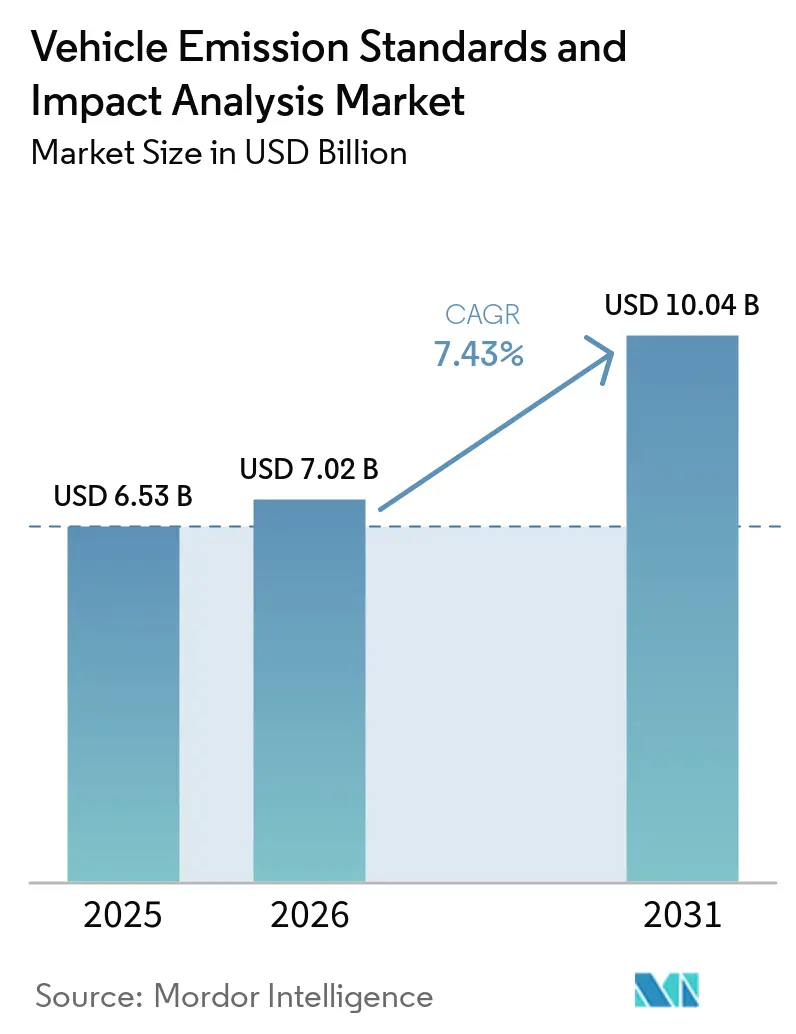
The vehicle emission standards and impact analysis market size was valued at USD 6.53 billion in 2025, is estimated at USD 7.02 billion in 2026, and is projected to reach USD 10.04 billion by 2031, growing at a CAGR of 7.43% from 2026 to 2031. Tightening emission regulations, accelerated electrification, and AI-enabled real-world analytics are expanding laboratory workloads, while rising capital requirements are reshaping competitive dynamics. Europe held a dominant share of the Vehicle Emission Standards and Impact Analysis market. This was largely propelled by the impending Euro 7 regulations, specifically the new brake and tire particulate limits. Meanwhile, the Asia-Pacific region is witnessing the swiftest growth, bolstered by China's National VII draft and India's Bharat Stage VI Phase 2 mandates. Additionally, the rising adoption of portable emissions measurement systems, coupled with cloud-based data platforms and city-level low-emission zones, underscores a robust long-term demand for compliance verification.
Key Report Takeaways
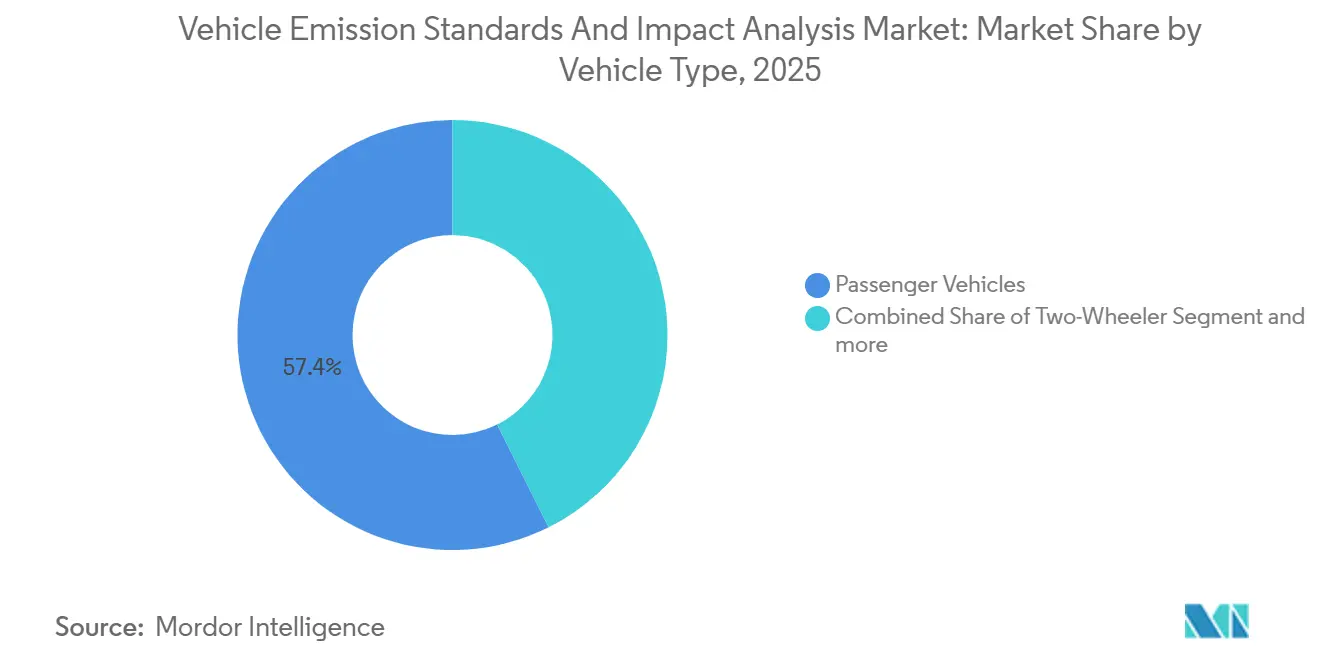
- By vehicle type, passenger cars led with 57.42% of the Vehicle Emission Standards and Impact Analysis market share in 2025, while three-wheelers are forecast to expand at a 7.97% CAGR through 2031.
- By propulsion, internal combustion engine vehicles accounted for 73.47% of the Vehicle Emission Standards and Impact Analysis market in 2025, whereas battery electric vehicles advanced at an 8.48% CAGR.
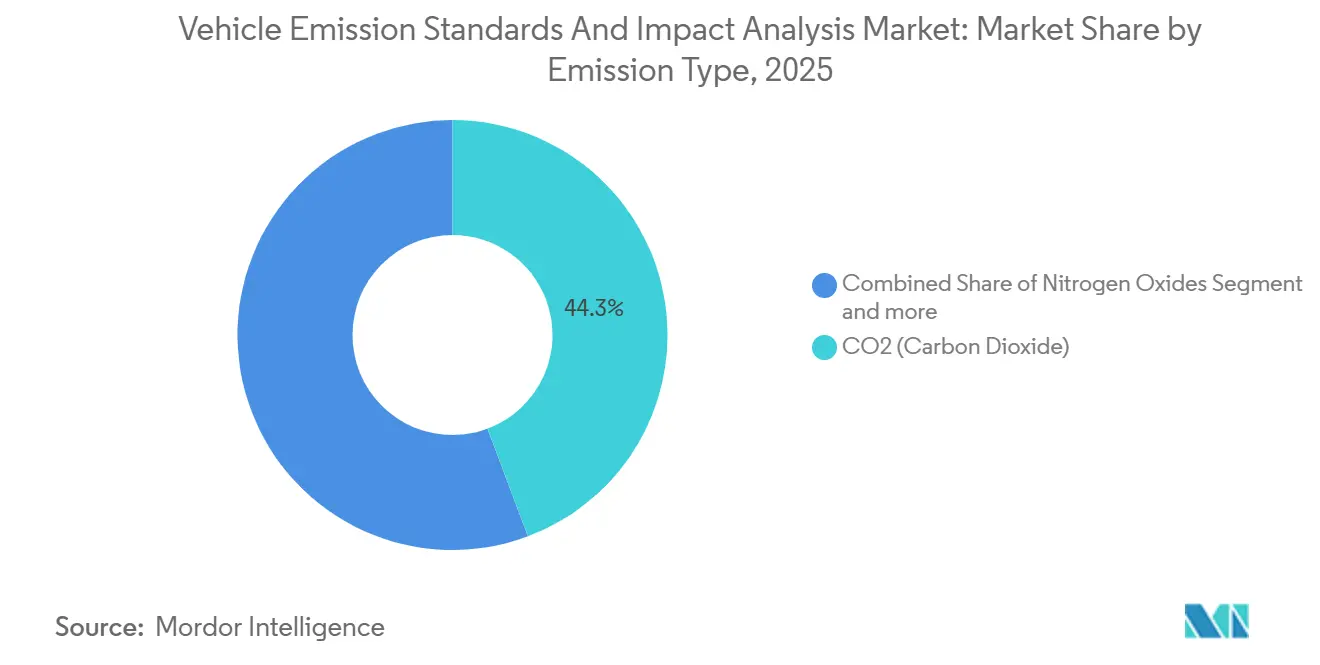
- By emission class, carbon dioxide testing accounted for 44.29% of revenue in 2025, yet hydrocarbon testing is set to grow at a 9.35% CAGR over 2026-2031.
- By end user, original equipment manufacturers captured 46.37% of spending in 2025; independent laboratories are rising at an 8.83% CAGR as outsourcing of real-world testing accelerates.
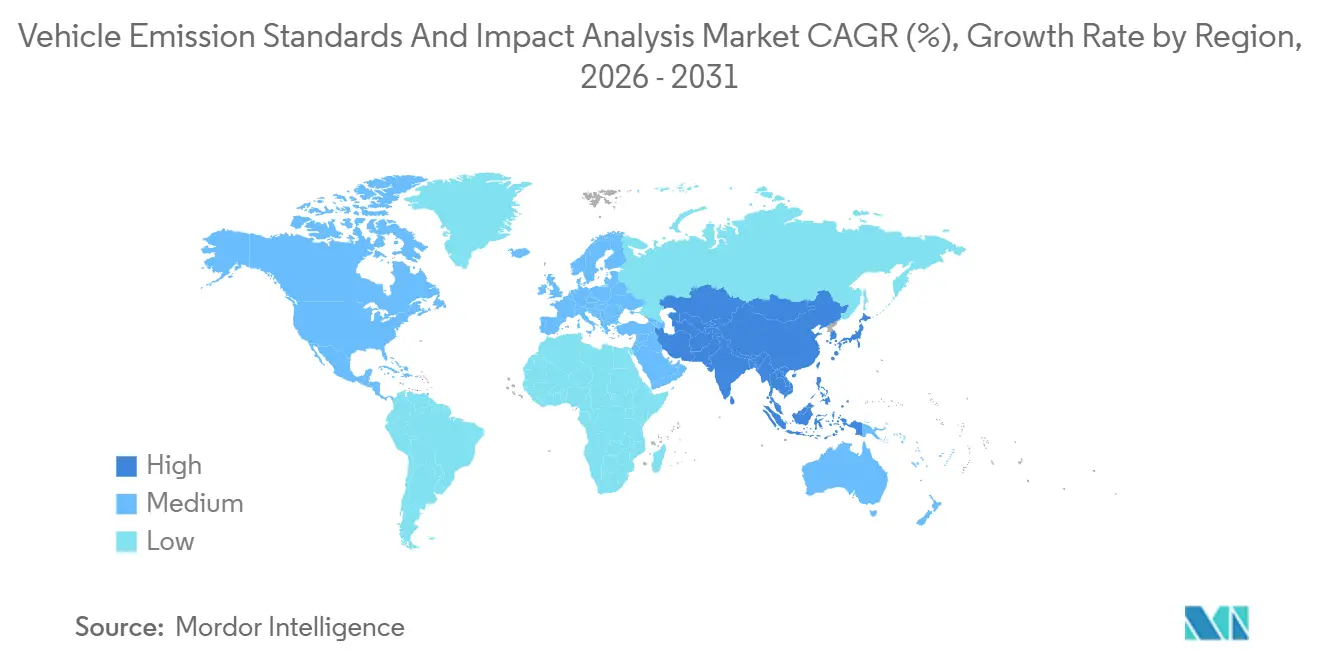
- By geography, Europe held 34.28% of the Vehicle Emission Standards and Impact Analysis market share in 2025, while Asia-Pacific is projected to record the quickest 9.28% CAGR to 2031.
Note: Market size and forecast figures in this report are generated using Mordor Intelligence’s proprietary estimation framework, updated with the latest available data and insights as of January 2026.
Market Trends and Insights
Drivers Impact Analysis of Vehicle Emission Standards and Impact Analysis Market*
| Driver | (~) % Impact on CAGR Forecast | Geographic Relevance | Impact Timeline |
|---|---|---|---|
| Stricter Global Emission Standards | +1.8% | Europe, China, North America | Medium term (2-4 years) |
| Electric & Hybrid Vehicle Surge | +1.2% | Asia-Pacific, North America | Long term (≥ 4 years) |
| Government Incentives | +0.9% | North America, Europe, Asia-Pacific | Short term (≤ 2 years) |
| Outsourcing of TIC Services | +0.7% | Global manufacturing hubs | Medium term (2-4 years) |
| AI-Driven Remote Sensing | +0.6% | Initially developed markets | Long term (≥ 4 years) |
| Expansion of Low-Emission Zones | +0.5% | Europe core cities | Medium term (2-4 years) |
| Source: Mordor Intelligence | |||
Stricter Global Emission Standards Drive Market Transformation
Euro 7 retains the tailpipe limits of Euro 6 but introduces new measures: a particle number measurement for smaller particles, a brake particulate ceiling, and thresholds for tire wear [1]. These measures will take effect first for new vehicle types, followed by all new registrations. China's National VII draft lowers nitrogen oxide limits and sets caps on ammonia emissions. The final version is anticipated soon, with a phased enforcement extending over time. California's Low-NOx regulation initially tightens limits on heavy-duty engines, with even stricter standards planned later. This move is projected to significantly reduce statewide NOx emissions. Manufacturers face challenges as they navigate divergent cycles—WLTP, FTP-75, and CLTC—which lead to duplicate validations. This not only inflates testing expenses but also bolsters the Vehicle Emission Standards and Impact Analysis market.
Surge in EV and HEV Production Reshapes Testing Protocols
Battery-electric models, due to their heavier curb mass, produce higher tire particulate emissions than their internal-combustion counterparts, prompting the introduction of new non-exhaust metrics. In response to Euro 7 regulations, which mandate brake particulate checks even for regenerative systems, laboratories are now incorporating PN10 counters and brake dynamometers in accordance with UN GTR 22 standards. Hybrids introduce complexities: their power-split operation, cold-start spikes, and fluctuations in battery state of charge necessitate a dual-cycle evaluation, often doubling test hours. Highlighting the industry's shift towards BEV and HEV protocols, AVL allocated a portion of its revenue to expand its electrification benches[2].
AI Integration Transforms Emissions Monitoring Capabilities
Roadside sensors using infrared and ultraviolet spectroscopy identify high-emission vehicles without halting traffic. These sensors support enforcement efforts in numerous low-emission zones throughout Europe. In the U.S., the Environmental Protection Agency incorporates these data feeds into its inspection initiatives. Meanwhile, HORIBA's MEXA-ONE platform transmits PEMS data to an AI engine, which detects anomalies in real-time, reducing report cycles significantly. As automakers increasingly prioritize predictive diagnostics over mere compliance, early adopters of these technologies are securing lucrative contracts.
Low-Emission Zones Expansion Creates Testing Demand
London has expanded its zone to encompass all boroughs, imposing a daily charge on vehicles that don't comply. This move has hastened the scrappage of pre-Euro 6 diesel vehicles and increased the volume of retests. Paris has prohibited certain vehicles and is gearing up for even stricter measures. Following suit are Milan, Barcelona, and Delhi, all of which are pushing for regular certifications for used vehicles. These cities are linking their plate databases to specific emission classes. Laboratories that can provide certificates with a quick turnaround are carving out a significant advantage in the Vehicle Emission Standards and Impact Analysis market[3].
Restraints Impact Analysis of Vehicle Emission Standards and Impact Analysis Market*
| Restraint | (~) % Impact on CAGR Forecast | Geographic Relevance | Impact Timeline |
|---|---|---|---|
| High Capital Cost of Equipment | -0.8% | Emerging markets hardest hit | Short term (≤ 2 years) |
| Complexity of Real-World Measurements | -0.6% | Global | Medium term (2-4 years) |
| Fragmented Data-Access Rules | -0.4% | EU, North America | Medium term (2-4 years) |
| Duplicate Tests from Non-Harmonized Rules | -0.3% | Multinational OEMs | Long term (≥ 4 years) |
| Source: Mordor Intelligence | |||
High Capital Investment Requirements Limit Market Entry
Though a single particle-number PEMS kit commands a hefty price, the cost of a 4-wheel-drive climate chassis dynamometer is even steeper. Such a considerable outlay extends the payback period, particularly in areas with lower volumes. This financial burden is further exacerbated by the need for regular maintenance and calibration of these advanced testing systems, which increases operational costs. While DEKRA has set aside considerable resources for capital ventures, numerous local labs, without similar financial backing, grapple with limitations in their regional capacity, hindering their ability to meet growing demand for emissions testing services.
Complexity of Capturing Real-World Emissions
Calibration drift and ambient fluctuations can cause PEMS NOx readings to deviate from laboratory baselines. To maintain accuracy and reliability, operators must conduct regular zero checks and span-gas routines. Furthermore, boundary violations, such as extreme altitude or temperature, necessitate reruns, adding significant analysis hours per vehicle. These added requirements strain operational efficiency and tighten margins, highlighting the need for standardized protocols to streamline processes and minimize variability.
*Our forecasts treat driver/restraint impacts as directional, not additive. The impact forecasts reflect baseline growth, mix effects, and variable interactions.
Vehicle Emission Standards and Impact Analysis Market Segment Analysis
By Vehicle Type:
Three-Wheelers Accelerate Amid ElectrificationThree-wheelers will command the fastest 7.97% CAGR as India and Southeast Asia electrify auto-rickshaw fleets, even though passenger cars retained 57.42% of the Vehicle Emission Standards and Impact Analysis market in 2025. Electric three-wheeler registrations in India have surpassed a significant threshold, prompting heightened scrutiny and new battery safety and regenerative braking tests. At the same time, Euro 7's tire restrictions imposed challenges on SUVs, escalating non-exhaust compliance costs for this leading car category. Laboratories spanning the car, commercial, and two- to three-wheeler sectors have strategically diversified to better navigate volume fluctuations.
Regulatory rhythms dictate growth trajectories. As Thailand and Indonesia move closer to Euro 4-equivalent standards, they're steering three-wheeler OEMs towards accredited hubs like ARAI and ICAT. Commercial trucks are preparing for stricter emission standards, underscoring a robust demand for heavy-duty PEMS. While two-wheeler volumes wane as battery scooters sidestep tailpipe tests, traditional petrol fleets still require regular checks for urban entry. This dynamic landscape, with its vehicle-type diversification, sees the Vehicle Emission Standards and Impact Analysis market balancing established passenger car revenues with burgeoning niches.

By Propulsion Type:
Battery Electric Vehicles Demand New Test CyclesBattery-electric platforms post an 8.48% CAGR, the fastest among propulsion lines, yet internal combustion engines maintain a 73.47% revenue share in 2025. Euro 7 sets a stringent brake dust limit. As a result, electric regenerative systems now rely on tailored algorithms to mimic the wear of low-use pads. Furthermore, the increased curb weight of electric vehicles has led to higher tire particulate levels. In response, laboratories are channeling investments into gravimetric analyzers, capable of detecting ultra-fine particles.
Evaluating hybrid stands is the priciest endeavor. Without a unified testing cycle, OEMs are compelled to assess hybrids in both combustion and electric modes. This dual testing not only doubles bench occupancy but also amplifies the market size for propulsion testing, particularly in the realm of Vehicle Emission Standards and Impact Analysis. While internal combustion validation has matured, it remains lucrative. This is largely due to EU and Chinese regulations, which emphasize particle counting and ammonia slip checks. Laboratories that cross-subsidize legacy benches with premium BEV/HEV packages optimize asset utilization.
By Emission Type:
Hydrocarbon Testing Gains TractionHydrocarbon protocols grew at a 9.35% CAGR as CARB’s Methods 1001-1004 tightened cold-start and evaporative requirements, even though carbon dioxide held 44.29% revenue leadership in 2025. Advanced flame-ionization detectors are now parsing methane and non-methane fractions down to ppm levels. Euro has broadened PN particle counts, while China has introduced ammonia caps for the first time, expanding the “other” category.
Demand is split along jurisdictional lines. Europe’s emphasis on ultrafine particles is advantageous for labs equipped with high-resolution counters; the United States is prioritizing hydrocarbons; and China has a pressing need for ammonia analyzers. A lab adept in multi-gas and multi-phase analysis is reaping the benefits, securing bookings across regions and establishing a strong foothold in the Vehicle Emission Standards and Impact Analysis market.
By End-Users:
OEMs Lead Spending, Independent Labs Scale FastFrom 2026 to 2031, independent testing laboratories are expected to grow at an 8.83% CAGR, driven by automakers outsourcing Real Driving Emissions validation to providers with extensive PEMS fleets and regional networks. In 2025, original equipment manufacturers (OEMs) held 46.37% of the Vehicle Emission Standards and Impact Analysis market, reflecting their strong in-house capabilities for early-stage development and type-approval. Outsourcing is rising as operating a 15-unit PEMS fleet costs USD 1-2 million, while independents spread these costs across multiple clients, improving capital efficiency.
Government regulatory agencies procure surveillance services but rely on accredited independents to avoid conflicts of interest. DEKRA’s Michigan Automotive Testing Laboratory, launched in May 2025, combines electric-vehicle, electromagnetic-compatibility, and cybersecurity validation, attracting OEM contracts. SGS’s Manchester laboratory, operational since January 2026, focuses on EV charger and accessory certification, tapping into aftermarket revenue. As regulations shift to lifetime monitoring, the Vehicle Emission Standards and Impact Analysis market increasingly favors recurring service agreements, positioning large independents for long-term growth.
Geography Analysis
Europe Vehicle Emission Standards and Impact Analysis Market
Europe’s 34.28% slice stems from Euro 7 and more than 320 low-emission zones. London’s network alone covers 1,500 km² and requires periodic recertification of aging fleets. Investment clusters in Germany, the U.K., France, Italy, Spain, and the Netherlands are scaling PN10 counters and battery chambers, while Eastern Europe imports services, extending queue times but raising utilization at Western hubs.
APAC Vehicle Emission Standards and Impact Analysis Market
Asia-Pacific leads growth at 9.28% CAGR thanks to China’s National VII draft and India’s Bharat Stage VI Phase 2 rules. China's Automotive Technology and Research Center is upgrading its facilities to monitor ammonia slip and 10 nm particle counts. In India, battery-safety laboratories are being expanded specifically for electric three-wheelers. Meanwhile, Japan's JARI is leading the way with hydrogen fuel cell cycles. Countries like Indonesia, Korea, and others in the Asia-Pacific region are falling behind in PEMS density. This gap has led to cross-border outsourcing, which, while inflating costs, is hastening the penetration of regional Vehicle Emission Standards and Impact Analysis.
The Americas and MEA Vehicle Emission Standards and Impact Analysis Market
In North America, there's a heavy reliance on CARB Low-NOx and the U.S. EPA for the green light on next-generation equipment. HORIBA’s IRLAM™ has clinched certification, solidifying its position with heavy-duty bookings. DEKRA has set its sights on Detroit's OEM clusters with a lab in Michigan. South America is eyeing a move to a Euro 6-like Proconve L7 standard. Meanwhile, the Middle East is turning to Turkey for validation, especially as Gulf states import vehicles that meet Euro specifications. In Africa, demand is budding but remains sluggish until broader regulatory alignment occurs.
Mordor Intelligence provides coverage of the vehicle emission standards and impact analysis market across other key regional markets, including Europe, each with their regulatory frameworks and demand patterns. Detailed country-level analysis extends to Japan and China incorporating local coverage and market participation, as required.
Competitive Landscape
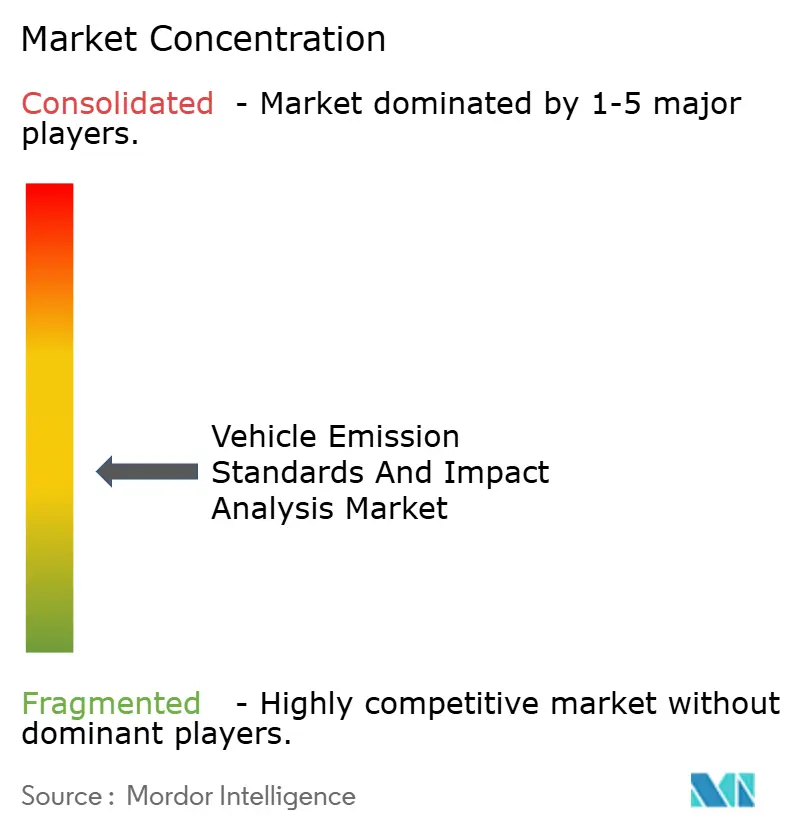
The vehicle emission standards and impact analysis market is moderately fragmented. Global TIC giants—SGS, Bureau Veritas, DEKRA, TÜV SÜD, TÜV Rheinland, and Intertek—face competition from specialized firms such as HORIBA, AVL, and Ricardo. In 2025, DEKRA underscored its commitment to electrification services by investing EUR 10 million in Arnhem, inaugurating a multi-million-dollar site in Michigan, and establishing a battery center at Lausitzring. Meanwhile, in January 2026, SGS unveiled a UKAS-accredited laboratory in Manchester, focusing on certifying EV chargers and accessories, marking a strategic pivot towards power-electronics validation.
Suppliers distinguish themselves through technological prowess. HORIBA’s MEXA-ONE and IRLAM™ platforms, which integrate AI with PEMS for predictive diagnostics, have received EPA endorsement. AVL, having clinched an EPA chassis dynamometer contract, allocates a significant portion of its revenue to R&D, particularly for e-drive benches. Ricardo’s Vehicle Emissions Research Center operates multiple OBS-ONE units, providing insights that influence Euro 7 policy-making. While ammonia slip metrics and hybrid real-world analytics present emerging opportunities—having been recognized by China VII—they remain relatively underserved. The competitive landscape thus juxtaposes the advantages of scale with the intricacies of niche technological expertise.
While recent consolidations have been sparse, there's a noticeable trend toward joint ventures. These collaborations strategically align global accreditation with localized route networks, empowering multinationals to navigate regional demands and establish a presence in the Vehicle Emission Standards and Impact Analysis market.
Vehicle Emission Standards and Impact Analysis Industry Leaders
-
SGS SA
-
Bureau Veritas
-
DEKRA SE
-
TÜV SÜD
-
TÜV Rheinland
- *Disclaimer: Major Players sorted in no particular order
Vehicle Emission Standards and Impact Analysis Market Companies Covered in this Report
- SGS SA
- Bureau Veritas
- DEKRA SE
- TUV SUD
- TUV Rheinland
- Applus+
- HORIBA Ltd.
- AVL List GmbH
- Intertek Group plc
- Opus Group AB
- MTS Systems Corp.
- Ricardo plc
- IAV GmbH
- Automotive Research Association of India (ARAI)
Recent Industry Developments in Vehicle Emission Standards and Impact Analysis Market
- April 2026: The UK Department for Transport (DfT) is soliciting feedback on its proposal to elevate the minimum emission standard for new vehicles to Euro 7. Euro 7, the EU's most recent emission benchmark, is set to be enforced on new light-duty vehicle models starting 29 November 2026, and on new heavy-duty models from 29 May 2028. Notably, the UK played a pivotal role in shaping this standard in collaboration with the United Nations Economic Commission for Europe (UNECE).
- May 2026: The U.S. Environmental Protection Agency (EPA) proposed a deregulatory action to delay compliance deadlines for light- and medium-duty vehicle emission standards by two years, until model year (MY) 2029, following the shift away from electric vehicles (EVs).
- April 2025: The European Commission proposed mandatory hot-idle particle-number tests during periodic inspections and required remote sensing to flag high emitters.
Global Vehicle Emission Standards and Impact Analysis Market Report Scope
The vehicle emission standards and impact analysis market report is segmented by vehicle type, propulsion type, emission type, end-user, and geography. By vehicle type, the market is segmented into (two-wheeler, three-wheeler, passenger cars and commercial vehicles), propulsion type, the market is segmented into (ICE, hybrid electric vehicles, and battery electric vehicles), emission type, the market is segmenetd into (CO₂, NOₓ, PM, HC, and others), end-users, the market is segmented into (government agencies, OEMs, and independent testing labs), and geography, the market is segmented into (North America, South America, Europe, Asia-Pacific, Middle East and Africa). The market forecasts are provided in terms of value (USD).
Segmentation Overview
| Two-Wheeler | |
| Three-Wheeler | |
| Passenger Cars | Hatchbacks |
| Sedans | |
| SUV & MUVs | |
| Commercial Vehicles | Light Commercial Vehicles |
| Medium & Heavy Commercial Vehicles | |
| Buses & Coaches |
| Internal-Combustion Engine Vehicles |
| Hybrid Electric Vehicles |
| Battery Electric Vehicles |
| CO2 (Carbon Dioxide) |
| NOx (Nitrogen Oxides) |
| PM (Particulate Matter) |
| HC (Hydrocarbons) |
| Others (CO, etc.) |
| Government Regulating Agencies |
| OEMs |
| Independent Testing Labs |
| North America | United States |
| Canada | |
| Rest of North America | |
| South America | Brazil |
| Argentina | |
| Rest of South America | |
| Europe | Germany |
| United Kingdom | |
| Spain | |
| Italy | |
| France | |
| Netherlands | |
| Rest of Europe | |
| Asia-Pacific | India |
| China | |
| Japan | |
| South Korea | |
| Indonesia | |
| Rest of Asia-Pacific | |
| Middle East and Africa | United Arab Emirates |
| Saudi Arabia | |
| Turkey | |
| Egypt | |
| South Africa | |
| Rest of Middle East & Africa |
| By Vehicle Type | Two-Wheeler | |
| Three-Wheeler | ||
| Passenger Cars | Hatchbacks | |
| Sedans | ||
| SUV & MUVs | ||
| Commercial Vehicles | Light Commercial Vehicles | |
| Medium & Heavy Commercial Vehicles | ||
| Buses & Coaches | ||
| By Propulsion Type | Internal-Combustion Engine Vehicles | |
| Hybrid Electric Vehicles | ||
| Battery Electric Vehicles | ||
| By Emission Type | CO2 (Carbon Dioxide) | |
| NOx (Nitrogen Oxides) | ||
| PM (Particulate Matter) | ||
| HC (Hydrocarbons) | ||
| Others (CO, etc.) | ||
| By End-Users | Government Regulating Agencies | |
| OEMs | ||
| Independent Testing Labs | ||
| By Geography | North America | United States |
| Canada | ||
| Rest of North America | ||
| South America | Brazil | |
| Argentina | ||
| Rest of South America | ||
| Europe | Germany | |
| United Kingdom | ||
| Spain | ||
| Italy | ||
| France | ||
| Netherlands | ||
| Rest of Europe | ||
| Asia-Pacific | India | |
| China | ||
| Japan | ||
| South Korea | ||
| Indonesia | ||
| Rest of Asia-Pacific | ||
| Middle East and Africa | United Arab Emirates | |
| Saudi Arabia | ||
| Turkey | ||
| Egypt | ||
| South Africa | ||
| Rest of Middle East & Africa | ||
Key Questions Answered in the Report
How large will compliance testing spending be by 2031?
The vehicle emission standards and impact analysis market size is projected to reach USD 10.04 billion by 2031, growing at a 7.43% CAGR from 2026.
Which region offers the quickest growth?
Asia-Pacific leads with a 9.28% CAGR, driven by China’s pending National VII and India’s Bharat Stage VI Phase 2 requirements.
Which vehicle segment is the next high-growth pocket?
Battery electric and hybrid vehicles create the fastest-rising demand because Euro 7 mandates new brake dust and battery durability tests.
Why are independent labs winning more contracts?
Outsourcing trims OEM fixed costs and lets independent labs amortise expensive PEMS and PN10 equipment across several clients, boosting their share.