
Japan Vehicle Emission Standards and Impact Analysis Market Size and Share
Market Overview
| Study Period | 2019 - 2031 |
|---|---|
| Forecast Data Period | 2026 - 2031 |
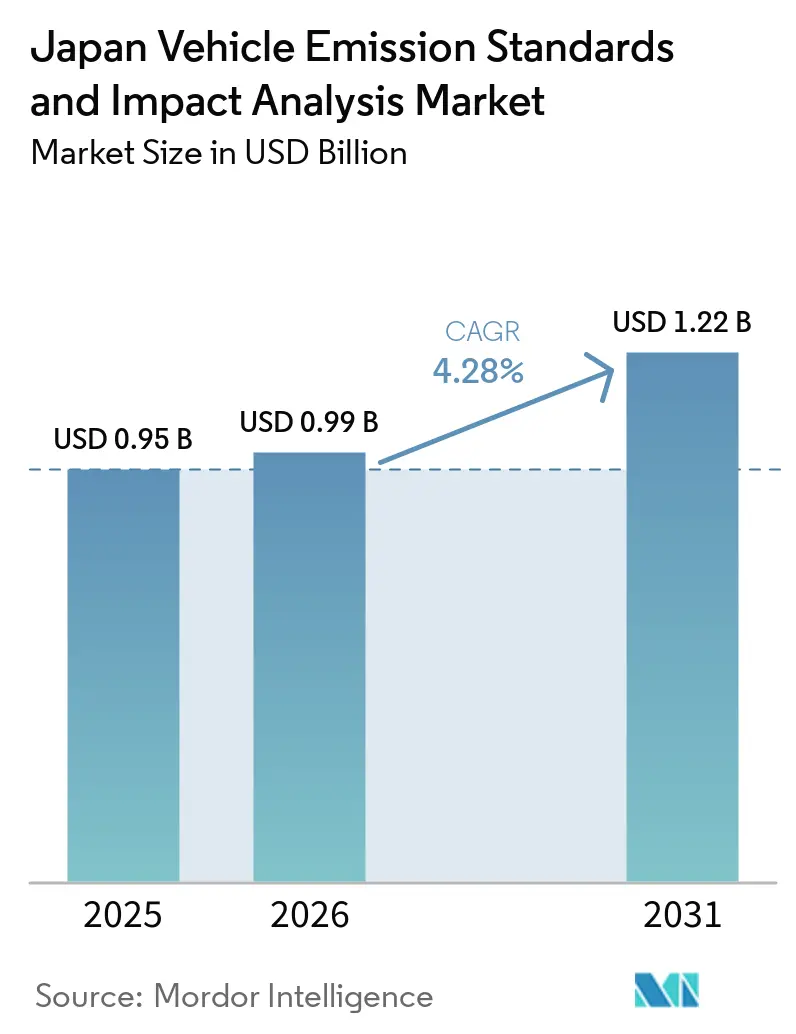
| Base Year Market Size (2025) | USD 0.95 Billion |
| Market Size (2026) | USD 0.99 Billion |
| Market Size (2031) | USD 1.22 Billion |
| Growth Rate (2026 - 2031) | 4.28 % |
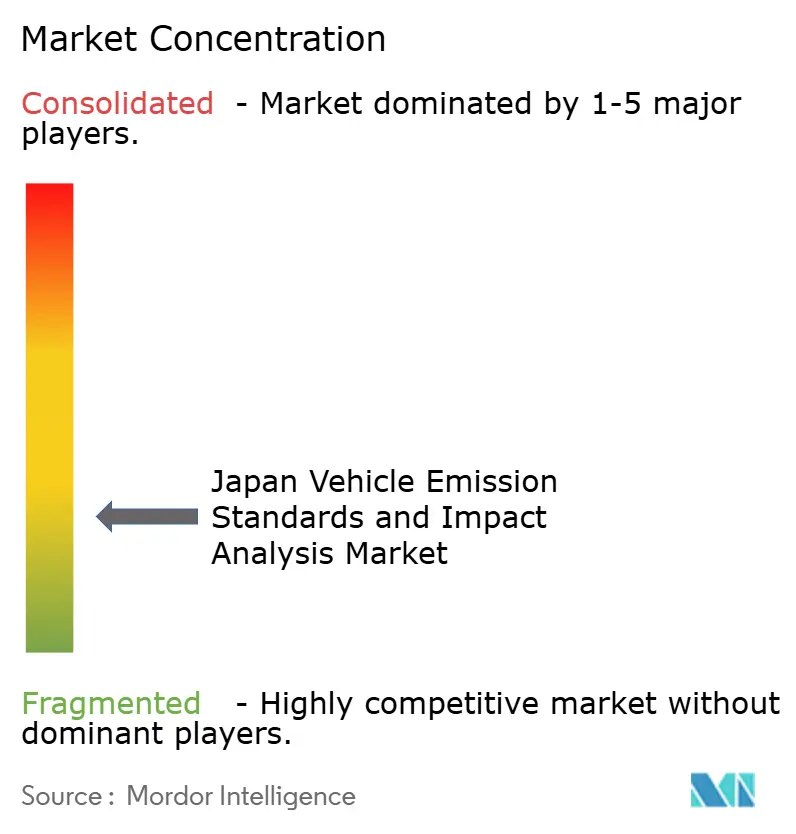
| Market Concentration | Low |
Major Players *Disclaimer: Major Players sorted in no particular order Image © Mordor Intelligence. Reuse requires attribution under CC BY 4.0. | |
Japan Vehicle Emission Standards and Impact Analysis Market Analysis by Mordor Intelligence
The Japan vehicle emission standards and impact analysis market size was valued at USD 0.95 billion in 2025, is estimated at USD 0.99 billion in 2026, and is projected to reach USD 1.22 billion by 2031, growing at a CAGR of 4.28% over 2026-2031. As real-driving-emissions rules mandate passenger-car manufacturers to validate compliance both on the road and in laboratories, independent testing laboratories are witnessing a surge in demand. This uptick is further fueling sales of portable emission measurement systems and cloud-connected on-board diagnostics. In anticipation of the introduction of particle-number caps for heavy-duty vehicles, market leaders are ramping up their capacities. Concurrently, low-emission zone trials in Tokyo and Osaka are nudging fleet operators to obtain timely certifications. Corporate demand for ESG disclosures is driving up volumes of CO₂ tests. At the same time, newly instituted particulate-number regulations are amplifying the demand for NOₓ and PM testing. The competitive landscape is increasingly focused on comprehensive compliance services that seamlessly integrate instrumentation, data analytics, and documentation tailored to specific jurisdictions.
Key Report Takeaways
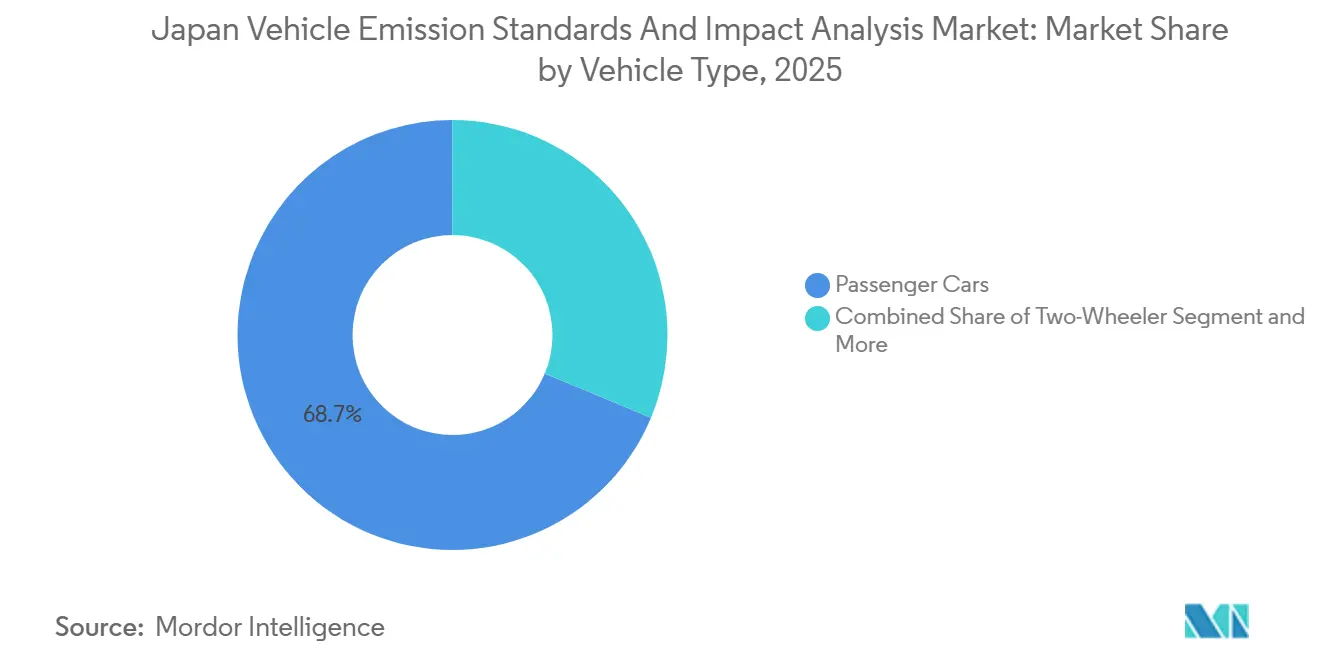
- By vehicle type, passenger cars led with a 68.72% revenue share of the Japan vehicle emission standards and impact analysis market in 2025, and the segment is projected to advance at a 6.29% CAGR through 2031.
- By propulsion type, internal-combustion-engine platforms accounted for 87.47% of the Japanese vehicle emission standards and impact analysis market size in 2025. In contrast, battery-electric testing is the fastest-growing propulsion category, with a 6.28% CAGR over 2026-2031.
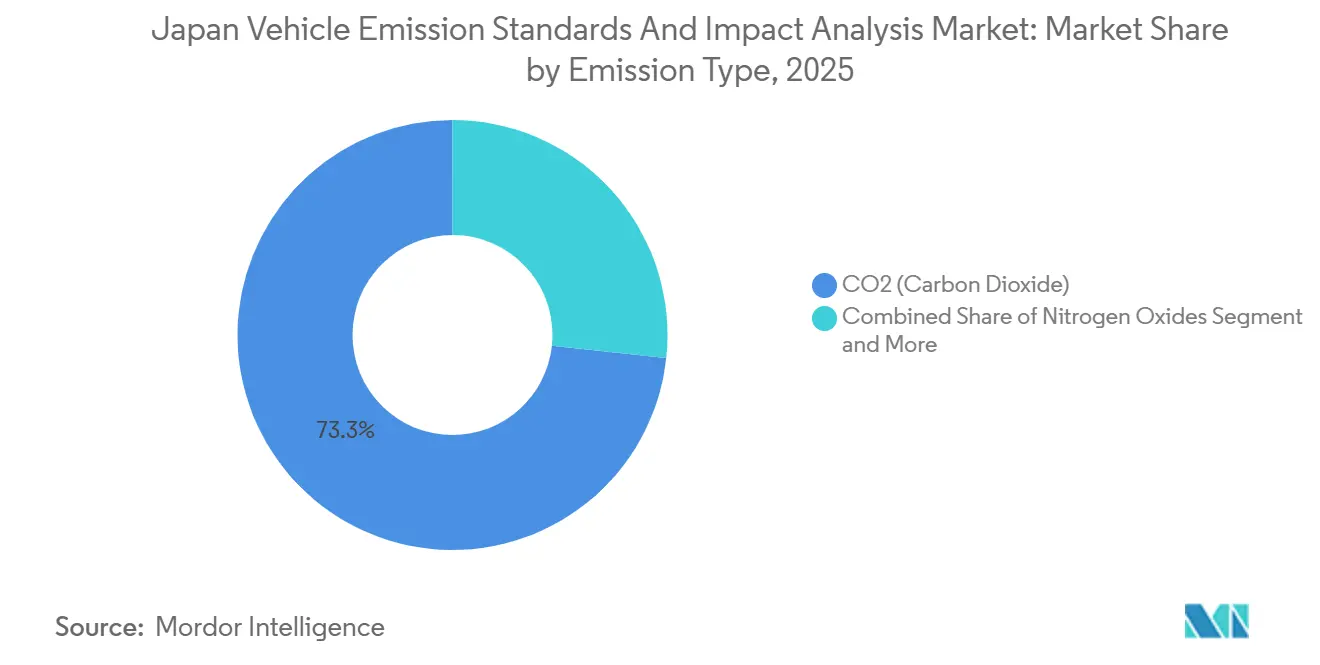
- By emission type, CO₂ testing captured a 73.29% share of market revenue in 2025, while nitrogen oxides testing registered the highest CAGR at a 6.35% during the forecast period.
- By end user, original-equipment manufacturers accounted for 54.37% of spending in 2025, but independent testing laboratories are the fastest-growing group, with a 6.63% CAGR projected through 2031.
Note: Market size and forecast figures in this report are generated using Mordor Intelligence’s proprietary estimation framework, updated with the latest available data and insights as of January 2026.
Worldwide, activity is shaped by contributions from multiple countries and regions, with Japan representing one among them. The global report on vehicle emission standards and impact analysis market by Mordor Intelligence reflects how these countries and regional layers combine into a single system.
Japan Vehicle Emission Standards and Impact Analysis Market Trends and Insights
Drivers Impact Analysis*
| Driver | (~) % Impact on CAGR Forecast | Geographic Relevance | Impact Timeline |
|---|---|---|---|
| Tightening 2030 PNLT Limits for HDVs | +1.2% | Kanto and Chubu regions | Medium term (2-4 years) |
| 100% ZEV Target for Light Vehicles by 2035 | +0.9% | Tokyo, Osaka, Nagoya metros | Long term (≥ 4 years) |
| Adoption of RDE and PEMS Testing | +0.8% | Nationwide pilot prefectures | Short term (≤ 2 years) |
| Prefecture Low-Emission Zones | +0.5% | Tokyo, Osaka, Kyoto, others | Medium term (2-4 years) |
| Remote OBD and Telematics Compliance | +0.4% | Urban corridors | Short term (≤ 2 years) |
| Fleet CO₂ Data Monetization | +0.3% | Corporate hubs in Kanto | Medium term (2-4 years) |
| Source: Mordor Intelligence | |||
Tightening 2030 Post-New-Long-Term Limits for Heavy-Duty Vehicles
Japan is poised to implement particle-number limits and real-driving-emission checks for trucks and buses, mirroring existing regulations for diesel cars. These measures aim to reduce environmental impact, improve air quality, and ensure compliance with global emission standards. The introduction of these regulations is expected to drive advancements in emission-control technologies and encourage manufacturers to further innovate. The market's reaction is clear: medium-duty trucks that meet NOx/PM standards are commanding price premiums, highlighting robust demand for rigorous testing, environmentally compliant vehicles, and advanced emission-control technologies. Additionally, these developments reflect a growing emphasis on sustainability and stricter regulatory frameworks within the automotive market.
100% Zero-Emission Vehicle Target for Light-Duty Vehicles by 2035
Corporates are required to validate plug-in hybrid and battery-electric models across various prefecture schemes, aligning with the national goal that includes hybrids. These validation processes ensure compliance with regional regulations and support the broader adoption of environmentally friendly vehicles. In Tokyo, a mandate for large fleets necessitates a certain percentage of non-gasoline passenger cars, underscoring the demand for bundled multi-jurisdiction test contracts. This requirement drives the need for comprehensive testing frameworks that cater to diverse regulatory environments.
Adoption of Real-Driving-Emissions and PEMS Testing
As of February 2026, the new rule eliminates tolerance margins between laboratory and road test results. This regulatory change significantly impacts the automotive testing landscape, underscoring the need for precise, reliable testing systems. Systems like HORIBA's OBS-ONE PEMS have become indispensable for OEM validations, ensuring compliance with increasingly stringent standards. These systems play a critical role in bridging the gap between lab and real-world testing conditions. Additionally, they are crucial for Tier 2 suppliers without in-house testing facilities, enabling them to meet regulatory requirements effectively and maintain competitiveness in the market [1]“OBS-ONE Portable Emissions Measurement,”, Horiba Ltd., horiba.com.
Prefecture-Level Low-Emission Zones Pilot Programs
In earlier cycles, the 8-prefecture NOx/PM Law, which bans older diesel registrations, spurred a surge in new truck registrations. This regulation has also driven consistent demand for retrofit validation, as businesses and vehicle owners seek to comply with the law to continue operating in the affected regions. Additionally, the law has encouraged the adoption of cleaner technologies and the modernization of vehicle fleets, thereby improving air quality and aligning with broader environmental goals [2]“Road Vehicle Act Amendments 2026,”, Ministry of Land, Infrastructure, Transport and Tourism, mlit.go.jp.
Restraints Impact Analysis*
| Restraint | (~) % Impact on CAGR Forecast | Geographic Relevance | Impact Timeline |
|---|---|---|---|
| Flat Domestic Vehicle Sales | -0.7% | Rural regions | Long term (≥ 4 years) |
| High Capex for Next-Gen Benches | -0.5% | Nationwide | Medium term (2-4 years) |
| Technician Shortage | -0.4% | Kyushu and Tohoku | Medium term (2-4 years) |
| Telematics Data-Privacy Costs | -0.2% | Corporate-dense Kanto | Short term (≤ 2 years) |
| Source: Mordor Intelligence | |||
Flat Domestic Vehicle Sales Volume Growth
As cities prioritize transit-oriented development and populations age, new-model certifications encounter constraints. These constraints arise due to the evolving needs of urban planning and the growing emphasis on sustainable infrastructure. Changes to inspection rules have redistributed tests without boosting their total count. This redistribution reflects a shift in focus toward compliance with updated standards rather than increasing testing frequency. Consequently, market growth now leans more on regulatory intricacies than on the mere number of units, highlighting the critical role of policy frameworks in shaping industry dynamics.
High Capital Expenditure for Next-Generation Emission Test Benches
HORIBA invested heavily in upgrading its plant, spotlighting the hefty price tag of Euro-7-ready facilities. These enhancements underscore the daunting financial and technological hurdles the industry grapples with to align with the rigorous Euro-7 standards. Designed to curb vehicle emissions, the Euro-7 regulations mandate sophisticated testing and compliance infrastructure, resulting in a significant capital outlay. This financial strain is nudging smaller laboratories towards outsourcing or even contemplating a market exit, as they struggle to compete with larger entities that can shoulder these higher costs. Moreover, this pivot towards outsourcing is paving the way for third-party service providers that specialize in emissions testing and compliance solutions.
*Our forecasts treat driver/restraint impacts as directional, not additive. The impact forecasts reflect baseline growth, mix effects, and variable interactions.
Segment Analysis
By Vehicle Type: Passenger Cars Drive Market Expansion
Passenger cars accounted for 68.72% of Japan's vehicle emissions in 2025. They will outpace the total market at a 6.29% CAGR through 2031, as every hybrid and battery-electric trim level must prove parity with legacy internal-combustion baselines. Electrified variants of SUVs and multi-utility vehicles boost revenue with their high-margin certification packages. In contrast, sedans and hatchbacks are experiencing more measured, compliance-driven spending. While two-wheelers currently occupy a niche status, the anticipated adoption of relevant standards suggests a promising growth trajectory, especially once the validated PEMS protocol addresses existing vibration challenges.
Commercial segments are broadening their revenue streams. In major cities, bans on older diesel vehicles in low-emission zones are driving a surge in demand for retrofit validation. Furthermore, with trucks facing stricter particle-number limits, an additional certification layer is on the horizon. Municipal bus operators are mandated to achieve higher low-pollution fleet ratios, leading to a bottleneck of electric-bus tests at independent laboratories.



By Propulsion Type: ICE Dominance Amid Electric Transition
In 2025, internal-combustion engines dominated Japan's vehicle emission standards market, accounting for 87.47% of the market, driven by a substantial stock of gasoline- and diesel-powered vehicles. The introduction of real-driving-emissions parity rules has eliminated previous compliance leniencies, resulting in increased test counts for each model. This shift highlights the growing regulatory focus on ensuring that real-world emissions closely align with laboratory test results, pushing manufacturers to adopt stricter testing protocols.
Battery-electric vehicles are emerging as the fastest-growing propulsion category, boasting a 6.28% CAGR. This surge comes as 2026 regulations expand focus to include counts of brake-dust and tire-wear particles. These new standards aim to address non-exhaust emissions, which are becoming a significant contributor to particulate pollution. Furthermore, laboratory enhancements now feature sub-23 nm particle-number counters and rigs for testing battery thermal runaway scenarios, reflecting the industry's commitment to improving safety and environmental performance.
By Emission Type: CO₂ Testing Leads, NOx Growth Accelerates
CO₂ (Carbon Dioxide) compliance accounted for 73.29% of testing revenues in 2025 as life-cycle greenhouse gas assessments became mainstream. Labs run extended drive cycles and fuel-upstream simulations to generate corporate ESG metrics. Particulate matter and hydrocarbon checks remain core for both diesel and gasoline models, with steady, if slower, expansion.
NOₓ (Nitrogen Oxides) testing is the breakout category, projected to rise at a 6.35% CAGR through 2031, fueled by heightened RDE enforcement. Portable analyzers now follow vehicles on urban and alpine routes to catch spikes beyond lab settings. Comprehensive pollutant coverage increases operational complexity but enables integrated providers to bundle multi-gas packages and deepen their footprints in the Japanese vehicle emission standards and impact analysis market.
By End-Users: OEMs Lead, Independent Labs Surge
OEM in-house centers retained 54.37% of the revenue share in 2025, reflecting their obligation for type approval and development testing. However, independent laboratories are growing at an 8.63% CAGR as regulations diversify. They win contracts for specialty RDE, fuel-cell stack, and telematics compliance work that internal teams find uneconomical.
Government agencies broadened surveillance programs after the Volkswagen scandal, commissioning market surveillance retests and defeat device hunts. Fleet operators increasingly contract CO₂ data analytics to monetize emission credits, widening the client mix. The mix shift supports capacity expansion across global networks such as SGS and Intertek, which integrate equipment sourcing, regulatory consulting, and certification for Japanese vehicle emission standards and impact analysis.
Geography Analysis
Japan's vehicle emission standards and impact analysis market is primarily concentrated in eight key prefectures: Tokyo, Kanagawa, Osaka, Hyogo, Aichi, Mie, Chiba, and Saitama. In Tokyo, regulations require a segment of vehicles in large fleets to meet low-pollution standards, thereby boosting demand for testing and compliance services. Kanagawa employs a tiered labeling approach, mandating separate certificates for its various grades, thereby adding complexity to compliance processes and increasing administrative requirements for manufacturers and fleet operators.
In both Osaka and Hyogo, truck purchasers are opting to pay a premium for vehicles that meet compliance standards, driving a rise in retrofit validations and demand for aftermarket solutions, including emission control technologies. Due to their proximity to automaker plants, Aichi and Mie are seeing heightened pre-production testing activity as manufacturers aim to streamline processes, ensure compliance early in the production cycle, and reduce potential delays in market entry.
Conversely, rural prefectures, grappling with dwindling populations and limited resources, are opting for remote OBD data streams rather than establishing new laboratories. This choice, in turn, moderates the pace of nationwide expansion and shifts the focus toward digital solutions for emissions monitoring, which could redefine the testing and compliance landscape in the long term.
Mordor Intelligence provides coverage of the vehicle emission standards and impact analysis market across other key regional markets, including Europe, each with their regulatory frameworks and demand patterns. Detailed country-level analysis extends to China incorporating local coverage and market participation, as required.
Competitive Landscape
Japan's vehicle emission standards market exhibits moderate fragmentation. HORIBA and Shimadzu lead in instrumentation, while the Japan Automobile Research Institute and the Japan Automobile Transport Technology Association dominate government contracts.
Companies such as SGS, Intertek, and AVL are seizing the growing demand for Euro-7-ready capacities. In a strategic expansion, HORIBA plans to invest in Fukuchiyama, zeroing in on integrated test-cell and analyzer projects. This move is poised to bolster HORIBA's market stance, amplifying its ability to offer holistic solutions.
Concurrently, Shimadzu is broadening its portfolio with the Autograph AGS-V line, which caters to electric-vehicle structural testing. This strategic addition not only meets the surging demand for electric vehicle testing but also fortifies Shimadzu's market position [3]“Annual Report 2025,”, Shimadzu Corporation, shimadzu.co.jp. Tsuzuki Denki leads the charge in OBD telematics pilots, yet faces potential hurdles from escalating privacy compliance costs, which could marginalize all but the most financially robust vendors.
Japan Vehicle Emission Standards and Impact Analysis Industry Leaders
HORIBA Ltd.
Shimadzu Corporation
SGS Japan Inc.
Intertek Group plc
Applus+ IDIADA Japan
- *Disclaimer: Major Players sorted in no particular order

Recent Industry Developments
- March 2026: Starting in April 2026, 300 to 400 Japanese companies that emit over 100,000 metric tons (Scope 1) must report their emissions. By September 2027, they must calculate their climate impact and set reduction goals. Emissions trading will begin the following year under the GX-ETS framework, supporting Japan's 2050 net-zero target.
- January 2026: Mitsubishi Fuso and Foxconn announced plans to establish a new bus OEM in Japan to focus on zero-emission buses. Mitsubishi Fuso Truck and Bus Corporation (MFTBC), a Daimler Truck subsidiary, announced a collaboration with Hon Hai Technology Group (Foxconn) to form an independent bus company that will align with Japan's vehicle emission standards.


Japan Vehicle Emission Standards and Impact Analysis Market Report Scope
The Japan vehicle emission standards and impact analysis market report is segmented by vehicle type, propulsion type, emission type, and end-users. By vehicle type, the market is segmented into (two-wheeler, three-wheeler, passenger cars, and commercial vehicles); by propulsion type, the market is segmented into (ICE, hybrid electric vehicles, and battery electric vehicles); by emission type, the market is segmented into (CO₂, NOₓ, PM, HC, and others); and by end-users, the market is segmented into (government agencies, OEMs, and independent testing labs). The market forecasts are provided in terms of value (USD).
| Two-Wheeler | |
| Three-Wheeler | |
| Passenger Cars | Hatchbacks |
| Sedans | |
| Sports Utility Vehicles | |
| Multi-Purpose Vehicles | |
| Commercial Vehicles | Light Commercial Vehicles |
| Medium and Heavy Commercial Vehicles | |
| Buses and Coaches |
| Internal-Combustion Engine Vehicles |
| Hybrid Electric Vehicles |
| Battery Electric Vehicles |
| CO₂ (Carbon Dioxide) |
| NOₓ (Nitrogen Oxides) |
| PM (Particulate Matter) |
| HC (Hydrocarbons) |
| Others (CO, SO₂‚ etc.) |
| Government Regulating Agencies |
| Original Equipment Manufacturers |
| Independent Testing Labs |
| By Vehicle Type | Two-Wheeler | |
| Three-Wheeler | ||
| Passenger Cars | Hatchbacks | |
| Sedans | ||
| Sports Utility Vehicles | ||
| Multi-Purpose Vehicles | ||
| Commercial Vehicles | Light Commercial Vehicles | |
| Medium and Heavy Commercial Vehicles | ||
| Buses and Coaches | ||
| By Propulsion Type | Internal-Combustion Engine Vehicles | |
| Hybrid Electric Vehicles | ||
| Battery Electric Vehicles | ||
| By Emission Type | CO₂ (Carbon Dioxide) | |
| NOₓ (Nitrogen Oxides) | ||
| PM (Particulate Matter) | ||
| HC (Hydrocarbons) | ||
| Others (CO, SO₂‚ etc.) | ||
| By End-Users | Government Regulating Agencies | |
| Original Equipment Manufacturers | ||
| Independent Testing Labs | ||


Key Questions Answered in the Report
What is the Japan vehicle emission standards and impact analysis market size forecast for 2031?
The Japan vehicle emission standards and impact analysis market is projected to reach USD 1.22 billion by 2031, reflecting a 4.28% CAGR from 2026 to 2031.
Which vehicle segment leads certification demand?
Passenger cars held 68.72% Japan vehicle emission standards and impact analysis market share in 2025 and are expected to continue leading through 2031.
Why are independent laboratories gaining market share?
Automakers outsource real-driving-emissions and telematics compliance to avoid high capital expenditure, giving independent labs a 6.63% CAGR growth path.
Why is NOx testing gaining importance in Japan?
Stricter PNLT standards and nationwide adoption of Real Driving Emissions testing are lifting NOx workloads at an 8.35% CAGR through 2030.
How are independent laboratories positioned in this market?
They are the fastest-growing end-user group, expanding at an 6.63% CAGR as OEMs outsource specialized RDE and EV energy-consumption validations.
Page last updated on:


 Your data is secure and never sold or shared.


