
United States Optoelectronics Market Size and Share
| Study Period | 2019 - 2030 |
| Forecast Data Period | 2025 - 2030 |
| Historical Data Period | 2019 - 2023 |
| Market Size (2025) | USD 9.03 Billion |
| Market Size (2030) | USD 11.36 Billion |
| CAGR (2025 - 2030) | 4.70% |
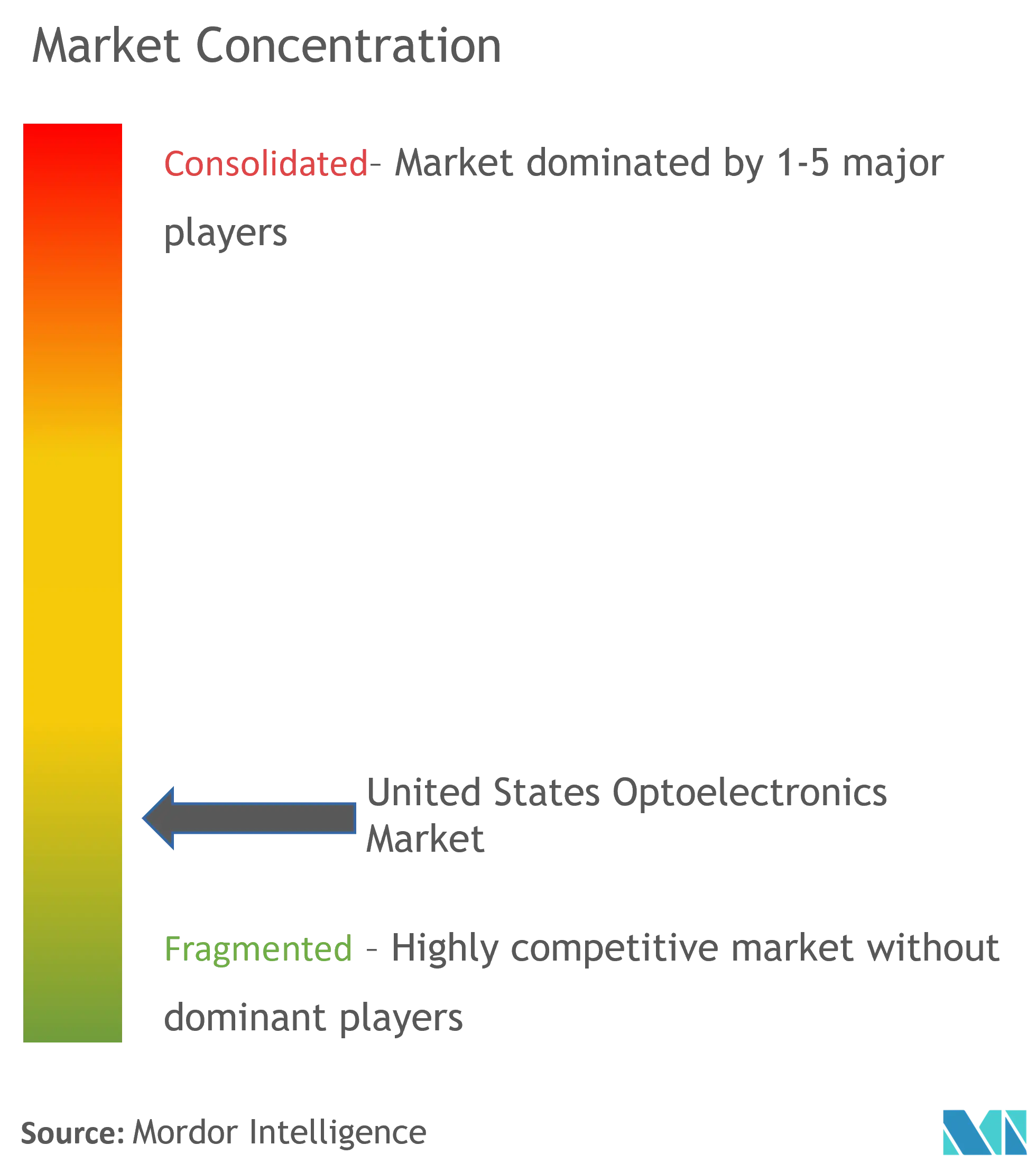
| Market Concentration | Low |
Major Players *Disclaimer: Major Players sorted in no particular order |
United States Optoelectronics Market Analysis by Mordor Intelligence
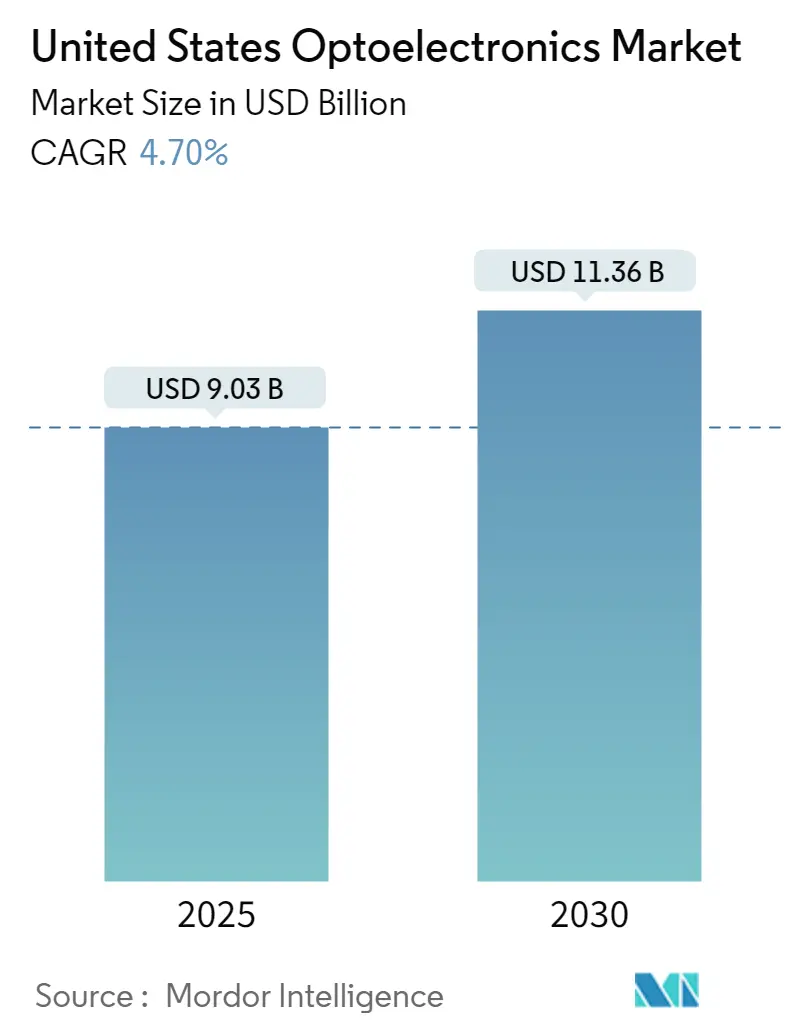
The United States Optoelectronics Market size is estimated at USD 9.03 billion in 2025, and is expected to reach USD 11.36 billion by 2030, at a CAGR of 4.7% during the forecast period (2025-2030).
- Optoelectronics (or optronics) is a branch of electronics that focuses on the study and application of devices and systems that detect, control, and emit light. This field encompasses a variety of light forms, including visible light, infrared, ultraviolet, and even gamma rays and X-rays. Optoelectronic devices function as transducers, converting electrical signals into optical signals and vice versa. They are primarily based on the quantum mechanical effects of light interacting with electronic materials, particularly semiconductors.
- Optoelectronics provide electrical isolation, allowing two systems that operate at different voltages to interface. This helps in limiting data transmission issues caused by induced noise, crosstalk, and signal degradation due to worn runs. Optoelectronics provide a high bandwidth for communications, which is advantageous in various applications like telecommunications and data transmission. Optoelectronic devices consume less power, making them energy-efficient and suitable for applications where power consumption is a concern.
- Optoelectronics devices also prevent dangerous voltages from passing between electronic circuits, enhancing safety in various applications in files such as communications, energy conversion, and sensing. Moreover, optoelectronic devices can be physically separated by a distance and still pass data, making them suitable for applications where physical space is a constraint.
- The transition from traditional incandescent light sources to LEDs has revolutionized the lighting industry in the United States. LEDs are more energy-efficient, longer-lasting, and environmentally friendly, leading to substantial cost savings for consumers and businesses alike. The rising growth in the use of LED lamps in buildings for lighting also provides enormous possibilities for optoelectronics.
- As per the US Department of Energy, LED lights are expected to gain popularity drastically between 2020 and 2035 in the United States. By 2025, LED lights should be installed in 73% of residential lighting and become the most common light source in all sectors. This will create massive growth opportunities for the market to grow and improve throughout the forecast period, driving the market significantly.
- Further, according to the US Department of Energy, the residential sector will see the most LED light installations in the forecasted period, recording 3,800 million units in 2025 and 6,210 million units by 2035.
- The increasing popularity of wearable health technology, like heart rate monitors and blood glucose sensors, drives the demand for optoelectronic sensors in the United States. These devices utilize light-based technologies to monitor various health parameters in real-time.
- However, high manufacturing and fabrication costs, as well as challenges with energy loss and heating of optoelectronic devices, are likely to act as restraining factors in the growth of the studied market.
- Further, the increased inflation and interest rates reduced consumer spending and hampered the demand for semiconductors and electronics, leading to slow growth in the studied market. Further, the United States and China trade war disturbed the global semiconductor supply chain. Additionally, owing to strict export and import controls on semiconductor manufacturing equipment in China by the United States, the production of the consumer electronics sector is compromised.
United States Optoelectronics Market Trends and Insights
The Image Sensors Segment Anticipated to Drive Demand
- Image sensors are a crucial component in optoelectronics that allows cameras and imaging devices to convert photons into electrical signals that can be interpreted and processed. The first digital cameras used charge-coupled devices (CCDs) to facilitate the movement of electrical charge through the device for modulation. However, modern cameras predominantly use complementary metal-oxide-semiconductor (CMOS) sensors due to their low power consumption, high integration, and compatibility with standard CMOS fabrication processes.
- With the upsurge in the demand for high-definition image-capturing devices in various industries, CMOS technology has experienced a high adoption rate. CMOS technology provides a faster shutter speed while delivering high-quality images. Moreover, advancements in artificial intelligence (AI) and machine learning have enabled smarter image-processing algorithms. These algorithms enhance image quality and enable features such as facial recognition, object detection, and augmented reality (AR), creating new opportunities for image sensors in various.
- The proliferation of smartphones and consumer electronics is a significant driver of the image sensor market in the United States. Smartphones have become ubiquitous, and the demand for high-quality cameras in these devices has surged. With consumers increasingly relying on their smartphones for photography and videography, manufacturers are continually upgrading camera systems to include advanced image sensors.
- Additionally, the rise of social media platforms, where visual content is extremely important, has heightened consumer expectations for camera performance. This trend has led to increased investment in high-resolution image sensors with features such as optical zoom, low-light performance, and image stabilization.
- The automotive industry's shift towards advanced driver-assistance systems (ADAS) and autonomous vehicles is another critical driver of the image sensor market. Image sensors play a vital role in enhancing vehicle safety and functionality through applications such as rearview cameras, lane departure warnings, and parking assistance systems.
- As automakers incorporate more sophisticated sensor technologies to support features like 360-degree visibility and pedestrian detection, the demand for high-performance image sensors is expected to grow. The ongoing development of fully autonomous vehicles will further accelerate this trend, creating new opportunities for image sensor manufacturers.
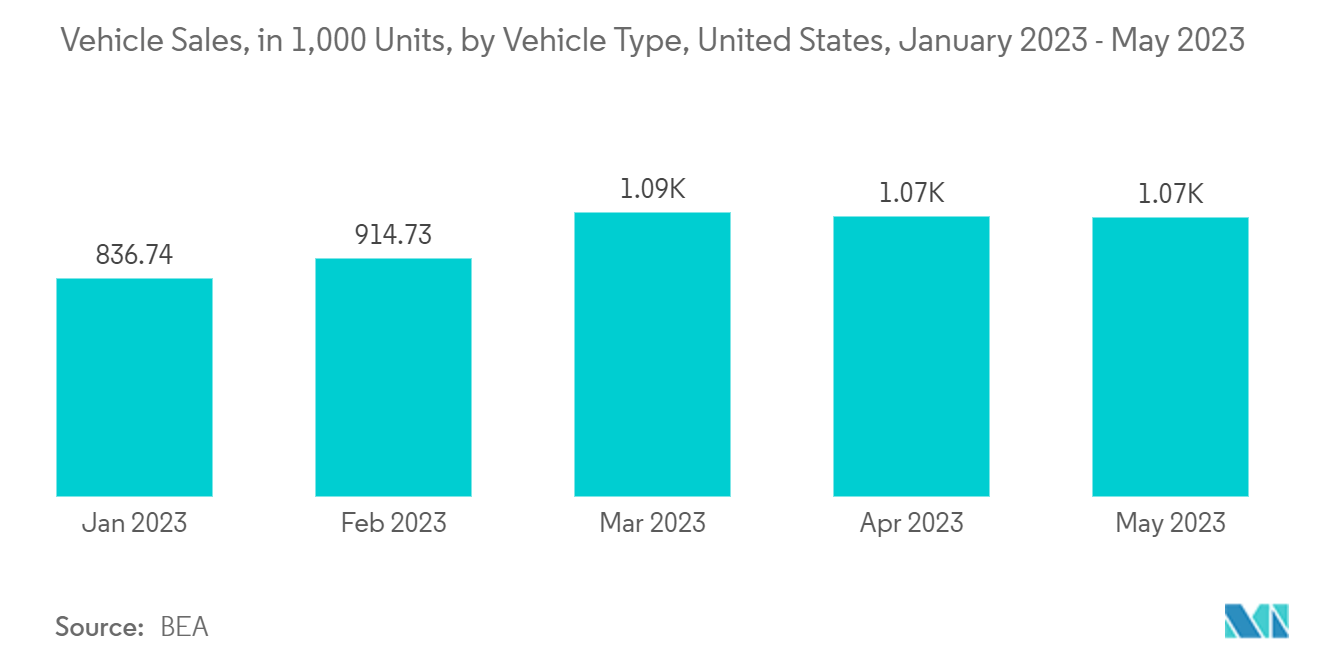
- The United States is one of the largest automotive markets in the world. Being home to prominent automotive industry leaders, such as General Motors, Ford, and Chryslers, vehicle production in North America is growing significantly. With the increasing usage of cars in the United States, the demand for smart parking is also growing, propelling the demand for compact camera modules for application in parking surround view. According to BEA, at just under 1.07 million unit sales, light trucks remained the most significant US auto market segment in May 2023, down from over 1.07 unit sales in April 2023 and increasing by approximately 23.06% year-on-year.
The Information Technology Sector to Hold a Major Market Share
- One of the primary applications of optoelectronics is in fiber-optic communication. Fiber-optic cables transmit data as light pulses generated by lasers or light-emitting diodes (LEDs). This technology allows for much higher bandwidth than traditional copper cables, enabling faster internet speeds and greater data capacity. Fiber optics are essential for backbone networks, connecting cities and countries, and for last-mile connections to homes and businesses.
- Optoelectronic components, such as photodetectors and optical amplifiers, are also vital in communications systems. Photodetectors convert incoming light signals back into electrical signals, while optical amplifiers boost the strength of these signals over long distances, ensuring minimal loss of data integrity. Technologies like wavelength-division multiplexing (WDM) utilize optoelectronic principles to send multiple data streams simultaneously over a single fiber, significantly increasing network efficiency.
- Additionally, the demand for compact and energy-efficient optical transceivers has been on the rise in recent years. This increase in demand can be attributed to several factors, including the growing installation of optical transceivers for data center aggregation and backplane applications, as well as the need for high-speed data transmission. Such trends are anticipated to offer lucrative opportunities for the growth of the market.
- In addition to communication, optoelectronics is crucial in data centers, where it supports high-speed data processing and storage systems. Laser-based interconnects and optical switches enhance the speed and efficiency of data transfer within and between servers, improving overall performance and reducing energy consumption.
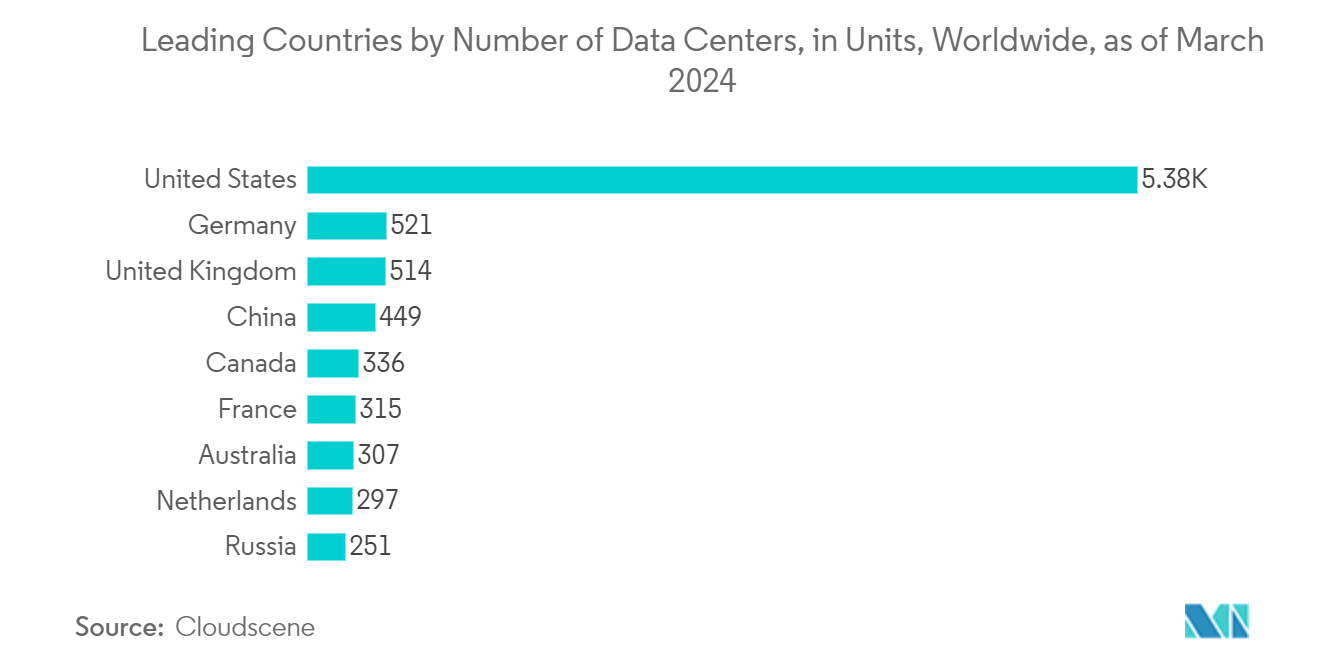
- As data demands increase, the transition to optical interconnects becomes more common, offering a scalable solution for future growth. According to Cloudscene, as of March 2024, there were a reported 5,381 data centers in the United States, the most of any country worldwide. The robust data center ecosystem in the United States is likely to significantly drive the growth of the studied market.
- Moreover, optoelectronics is integral to emerging technologies like the Internet of Things and 5G networks. In IoT, optoelectronic sensors and devices facilitate real-time data collection and transmission, enhancing connectivity and automation in a diverse range of applications, like from smart homes, industrial systems, etc. For 5G, optoelectronic components enable higher frequencies and faster data rates, supporting the growing need for mobile connectivity in the United States.
Competitive Landscape
The United States optoelectronics market is a fragmented market with the presence of various players like Panasonic Corporation, Samsung Electronics, Omnivision Technologies Inc., Sony Corporation, Osram Licht AG, Koninklijke Philips N.V., Vishay Intertechnology, Inc., Texas Instruments Inc., LITE-ON Technology Corporation, Rohm Co., Ltd (ROHM SEMICONDUCTOR), Mitsubishi Electric Corporation, Broadcom Inc., Sharp Corporation, SK Hynix Inc., etc. The companies in the market are innovating advanced products that cater to the complex and evolving requirements of consumers.
- In November 2023, Sony Semiconductor Solutions Corporation (SSS) unveiled its latest innovation, the IMX992 short-wavelength infrared (SWIR) image sensor. It features a 5.32 effective megapixels. As per the company, its SSS's pioneering Cu-Cu connection technology enables it to achieve a robust pixel size of just 3.45 μm, the smallest in the SWIR sensor realm. Moreover, the sensor's pixel structure has been optimized to enhance light capture efficiency. It also features an optimized pixel structure for efficiently capturing light. It enables high-definition imaging across a broad spectrum ranging from visible to invisible short-wavelength infrared regions (wavelength: 0.4 to 1.7 μm).
- In September 2023, Texas Instruments Incorporated introduced its new opto-emulator portfolio of signal isolation semiconductors. TI's first opto-emulators are engineered to enhance signal integrity, reduce power consumption, and prolong the lifespan of high-voltage systems in industrial and automotive settings. These opto-emulators, a debut from TI, boast pin-to-pin compatibility with the industry's prevalent optocouplers. This compatibility ensures a smooth transition into current designs while harnessing the distinct advantages of silicon dioxide (SiO2) isolation technology.
United States Optoelectronics Industry Leaders
-
SK Hynix Inc.
-
Samsung Electronics
-
Sony Corporation
-
LITE-ON Technology Corporation
-
Broadcom Inc.
- *Disclaimer: Major Players sorted in no particular order
Recent Industry Developments
- January 2024 - AMS Osram AG introduced a line of low-power LEDs, named SYNIOS P1515 side lookers, designed to streamline design processes, enhance implementation, and facilitate the creation of uniform lighting in extended automotive light bars and rear lighting applications. As per the company, by opting for these side-looker LEDs over traditional top-looker ones, automakers can achieve a consistent appearance spanning the vehicle's width. Furthermore, utilizing the same LED count as a top looker setup, these side lookers allow for significantly slimmer and more straightforward optical assemblies in rear combination lamps and turn indicators.
- December 2023 - Marktech Optoelectronics, Inc., a privately-held designer and manufacturer of standard and custom optoelectronics, including visible, UV, near-infrared, and short-wavelength infrared emitters, detectors, InPepi wafers, and other compound semiconductors, announced the release of their enhanced sharpness 25 and 50 microngreen dot point source LEDs (MTSP-1358 and MTSP-1360) for reflex sights, riflescopes, camera viewfinders, sports optics, and other aiming applications. In addition, Marktech expanded its offering of red dot LEDs with additional micron sizes and package types. Marktech claimed that it can assemble the red dot or reticle die into several standard & custom packages, and chip-on-board (COB), rigid PCB, and flexible circuit assemblies.
United States Optoelectronics Market Report Scope
Optoelectronics involves the study and application of electronic systems that manipulate (find, detect, and control) light, often seen as a subset of photonics. Light, in this context, encompasses not just visible light but also other forms of radiation, including gamma rays, X-rays, ultraviolet, and infrared. Optoelectronic devices serve as transducers, converting electrical signals to optical and vice versa.
To evaluate the market revenue for the United States optoelectronics market, we have tracked the sales of optoelectronics sold in the United States through various types of optoelectronic devices employed for a diverse range of applications. The study also tracks the key market parameters, underlying growth influencers, and major vendors operating in the industry, which supports the market estimations and growth rates over the forecast period. The study further analyses the overall impact of COVID-19 aftereffects and other macroeconomic factors on the market. The report’s scope encompasses market sizing and forecasts for the various market segments.
The United States optoelectronics market is segmented by device type (LED, laser diode, image sensors, optocouplers, photovoltaic cells, and other device types) and end user (automotive, aerospace and defense, consumer electronics, information technology, healthcare, residential and commercial, industrial, and other end users). The Market size and forecasts are provided in terms of value (USD) for all the above segments.
| LED |
| Laser Diode |
| Image Sensors |
| Optocouplers |
| Photovoltaic cells |
| Others |
| Automotive |
| Aerospace & Defense |
| Consumer Electronics |
| Information Technology |
| Healthcare |
| Residential and Commercial |
| Industrial |
| Others |
| By Device Type | LED |
| Laser Diode | |
| Image Sensors | |
| Optocouplers | |
| Photovoltaic cells | |
| Others | |
| By End-User Industry | Automotive |
| Aerospace & Defense | |
| Consumer Electronics | |
| Information Technology | |
| Healthcare | |
| Residential and Commercial | |
| Industrial | |
| Others |
Key Questions Answered in the Report
How big is the United States Optoelectronics Market?
The United States Optoelectronics Market size is expected to reach USD 9.03 billion in 2025 and grow at a CAGR of 4.70% to reach USD 11.36 billion by 2030.
What is the current United States Optoelectronics Market size?
In 2025, the United States Optoelectronics Market size is expected to reach USD 9.03 billion.
Who are the key players in United States Optoelectronics Market?
SK Hynix Inc., Samsung Electronics, Sony Corporation, LITE-ON Technology Corporation and Broadcom Inc. are the major companies operating in the United States Optoelectronics Market.
What years does this United States Optoelectronics Market cover, and what was the market size in 2024?
In 2024, the United States Optoelectronics Market size was estimated at USD 8.61 billion. The report covers the United States Optoelectronics Market historical market size for years: 2019, 2020, 2021, 2022, 2023 and 2024. The report also forecasts the United States Optoelectronics Market size for years: 2025, 2026, 2027, 2028, 2029 and 2030.
United States Optoelectronics Market Report
Statistics for the 2025 United States Optoelectronics market share, size and revenue growth rate, created by Mordor Intelligence™ Industry Reports. United States Optoelectronics analysis includes a market forecast outlook for 2025 to 2030 and historical overview. Get a sample of this industry analysis as a free report PDF download.