
United States Commercial Bathroom Products Market Size and Share
Market Overview
| Study Period | 2021 - 2031 |
|---|---|
| Forecast Data Period | 2026 - 2031 |
| Base Year Market Size (2025) | USD 5.42 Billion |
| Market Size (2026) | USD 5.64 Billion |
| Market Size (2031) | USD 6.80 Billion |
| Growth Rate (2026 - 2031) | 3.81 % |
| Market Concentration | Medium |
Major Players *Disclaimer: Major Players sorted in no particular order Image © Mordor Intelligence. Reuse requires attribution under CC BY 4.0. | |
United States Commercial Bathroom Products Market Analysis by Mordor Intelligence
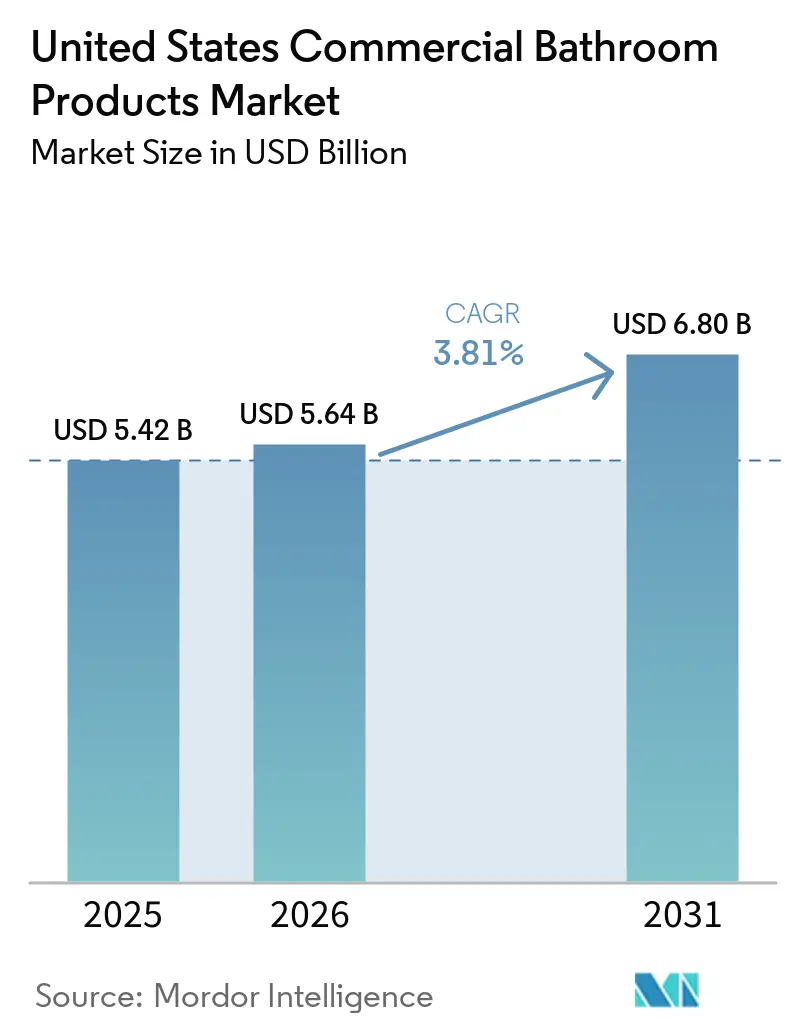
The United States commercial bathroom products market size was valued at USD 5.42 billion in 2025 and estimated to grow from USD 5.64 billion in 2026 to reach USD 6.80 billion by 2031, at a CAGR of 3.82% during the forecast period (2026-2031). Nonresidential construction is expanding on the back of data center megaprojects and healthcare facilities, which improves procurement visibility for high-spec fixtures in large campuses. Post-pandemic hygiene expectations, together with EPA WaterSense Version 2.0 and LEED v5, are elevating low-flow and touchless products from optional upgrades to standard specifications across many commercial projects [1]U.S. Environmental Protection Agency, “WaterSense Specifications and Product Certification,” U.S. Environmental Protection Agency, epa.gov. Procurement cycles are also being reshaped by IoT-enabled monitoring that shortens maintenance response times in airports, hospitals, and schools while enabling predictive schedules. At the same time, 50% tariffs on certain imported metals enacted in 2025 have kept input prices volatile, which tightens bid margins and requires careful pass-through pricing in the United States commercial bathroom products market. Persistent labor shortages create installation bottlenecks that give an advantage to prefabrication, standardized assemblies, and sensor platforms that reduce field workload.
Key Report Takeaways
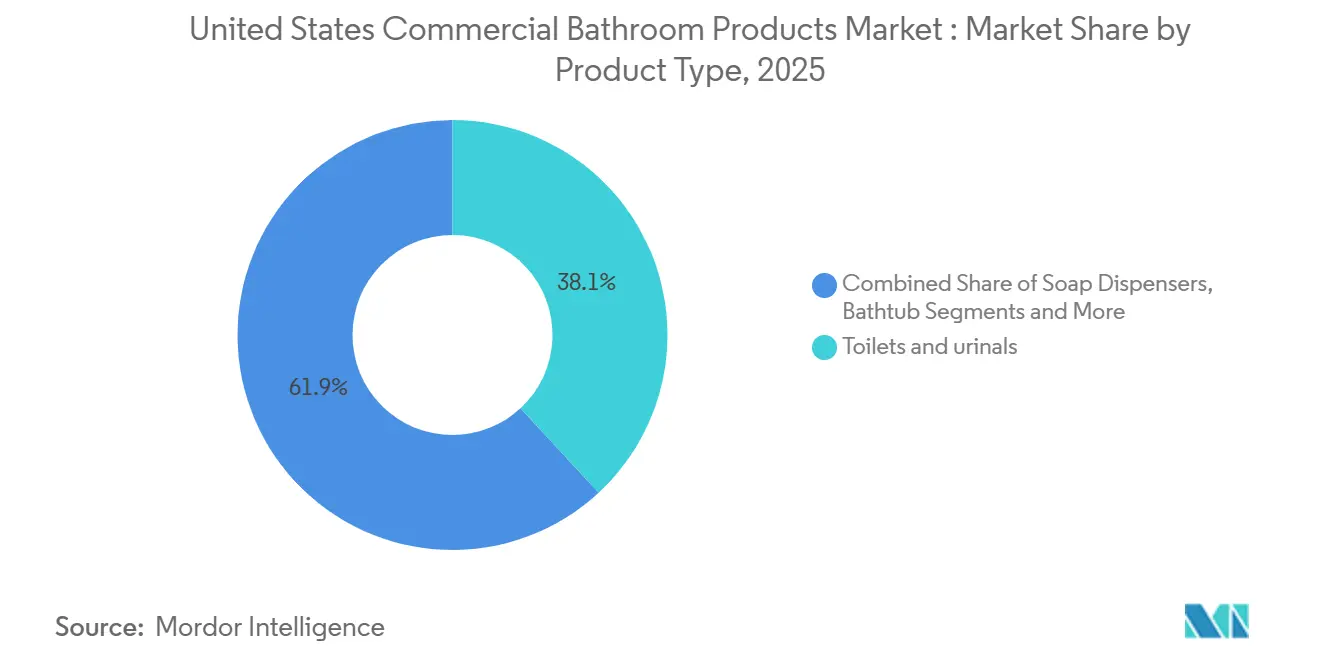
- By product type, toilets and urinals led with 38.16% revenue share in 2025 in the United States commercial bathroom products market, while soap dispensers are projected to record the fastest growth at a 5.0% CAGR through 2031.
- By price, the standard or economy tier accounted for 35.25% in 2025 in the United States commercial bathroom products market, while premium fixtures are set to grow at a 5.0% CAGR through 2031.
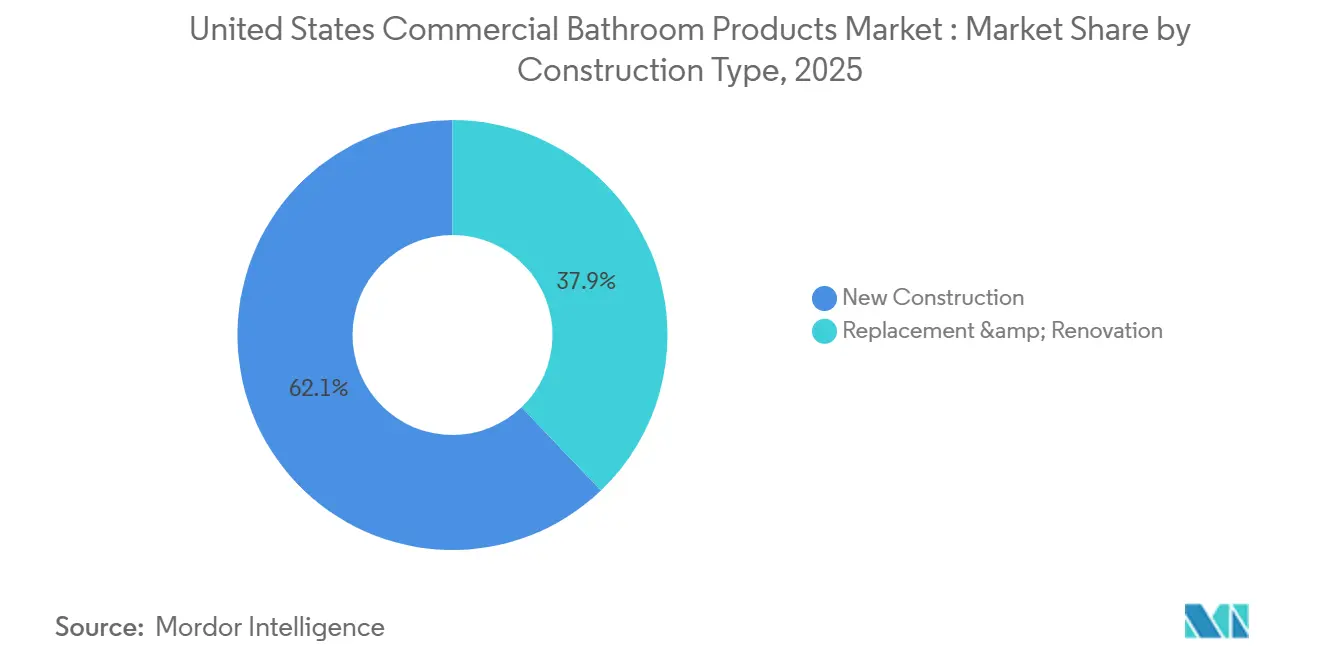
- By Construction Type, new construction commanded 62.13% of demand in 2025 in the United States commercial bathroom products market, while replacement & renovation is expected to expand at a 4.8% CAGR through 2031.
- By end-user, hospitality commanded 24.91% of demand in 2025 in the United States commercial bathroom products market, while retail is expected to expand at a 5.3% CAGR through 2031.
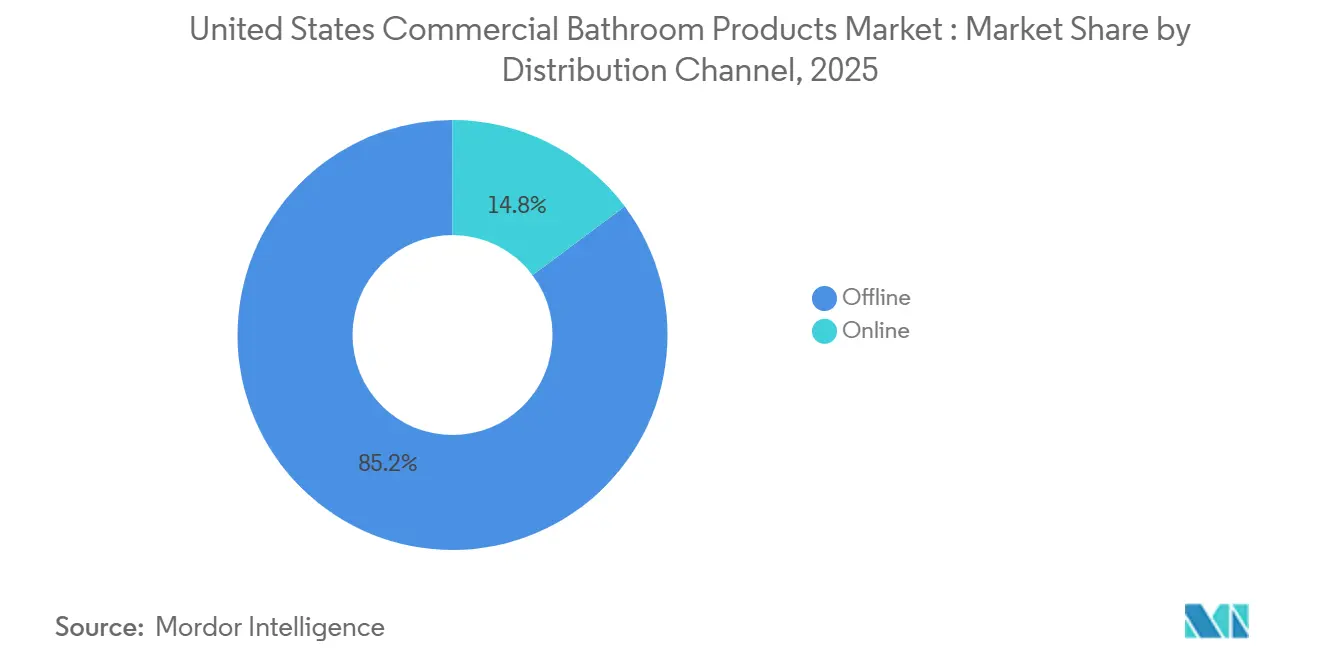
- By distribution channel, offline sales held 85.21% in 2025 in the United States commercial bathroom products market, while online channels are poised for a 10.2% CAGR through 2031.
- By geography, the Northeast accounted for 32.25% in 2025 in the United States commercial bathroom products market, and the Southwest is projected to be the fastest-growing region at a 4.8% CAGR from 2026 to 2031.
Note: Market size and forecast figures in this report are generated using Mordor Intelligence’s proprietary estimation framework, updated with the latest available data and insights as of January 2026.
United States Commercial Bathroom Products Market Trends and Insights
Drivers Impact Analysis*
| Driver | (~) % Impact on CAGR Forecast | Geographic Relevance | Impact Timeline |
|---|---|---|---|
| Construction spending in nonresidential end-markets sustains fixture demand | +1.2% | National, with early gains in Southeast healthcare, Southwest data centers, and Northeast adaptive reuse | Medium term (2-4 years) |
| Codes, WaterSense, and LEED push low-flow and efficient fixtures in commercial projects | +0.9% | National under EPA, accelerated in CA, NY, OR, WA | Long term (≥ 4 years) |
| End-user hygiene expectations drive touchless faucets, flushometers, and dispensers retrofits | +0.8% | National, with intensity in airports, healthcare, and K-12 schools | Medium term (2-4 years) |
| Facility ESG targets and utility incentives accelerate high-efficiency replacements | +0.6% | National, led by portfolios pursuing LEED/WELL in urban markets | Long term (≥ 4 years) |
| IoT-connected smart restrooms enable predictive maintenance and lower lifecycle costs | +0.4% | National, the earliest adoption in large-format facilities | Medium term (2-4 years) |
| Legionella and ASHRAE-188 compliance elevates TMVs, automated flushing, and water safety | +0.5% | National in healthcare, strict in NY, NJ, CA, MI, IL, VA | Short term (≤ 2 years) |
| Source: Mordor Intelligence | |||


Construction Spending in Nonresidential End Markets
Nonresidential construction starts reached USD 80.3 billion in January 2026, the highest January on record and a 53.3% year-over-year increase, supported by USD 26.3 billion in megaprojects of USD 1 billion or more. The surge was led by offices that include data centers, which hit a single-month starts peak, and by hospitals and clinics that advanced alongside demographic demand for care. Forecasts indicate that data center investment will continue to grow while traditional office activity remains constrained by elevated vacancy and hybrid work dynamics through 2027 [2]American Institute of Architects, “AIA Consensus Construction Forecast,” American Institute of Architects, aia.org. Healthcare construction is expected to remain resilient, and medical outpatient building occupancy reached 92.7% as landlords gained pricing power, which sustains bid pipelines for healthcare-grade fixtures and water safety systems. These patterns shape procurement in the United States commercial bathroom products market as data centers favor standardized, repeatable bathroom modules to compress schedules, while healthcare and education prioritize ADA accessibility and Legionella risk mitigation through thermostatic mixing valves and automated flushing [3]Centers for Medicare & Medicaid Services, “Water Management Program Expectations Referencing ASHRAE 188,” Centers for Medicare & Medicaid Services, cms.gov.
Codes, WaterSense, and LEED Drive Efficient Fixtures
EPA finalized the Draft Version 2.0 WaterSense specification for private lavatory faucets in December 2024, tightening the maximum flow to 1.2 gpm, with an effective date about 12 months from publication. States including California, Colorado, New York, Oregon, Washington, Hawaii, and Maine already enforce 1.2 gpm, together covering 24.2% of the United States population, which codifies a retrofit opportunity in regions still using higher-flow products. For public lavatory faucets, EPA’s June 2024 notice proposed a 0.4 gpm to 0.35 gpm ceiling, building on product data that show a large installed base already operating at low flows. LEED v5 transitions water reductions from optional credits to baseline requirements, with submetering and performance tracking expected to push owners toward 1.28 gpf toilets and 0.35–0.4 gpm public faucets to satisfy compliance thresholds. The prior LEED v4.1 framework recorded an 11% water-use reduction across certified buildings, and the tighter v5 standard raises the bar for the United States commercial bathroom products market.
End-User Hygiene Expectations Accelerate Touchless Retrofits
Touchless operation has moved from preference to expectation in high-traffic settings such as airports, hospitals, and schools, which accelerates retrofits that replace manual faucets and flush valves with sensors that reduce contact points and water run time. Facility managers increasingly integrate soap and towel dispensers with restroom monitoring platforms to reduce in-use stockouts and to maintain consistent service levels during peak traffic. IoT sensors linked to a CMMS enable condition-based cleaning that focuses labor where usage thresholds are exceeded, which cuts emergency callouts and improves restroom uptime in labor-constrained operations. Post-pandemic guidance from health authorities favors touchpoint minimization in public assembly spaces, and water-contact materials compliant with NSF/ANSI 61 remain standard across new commercial installations. Together, these shifts are pushing sensor-equipped faucets, flushometers, and dispensers deeper into the specification lists that drive the United States commercial bathroom products market.
IoT-Connected Smart Restrooms Lower Lifecycle Cost
IoT restroom systems monitor consumables, occupancy, temperature, humidity, and leaks, and they connect through LoRaWAN, BLE, or WiFi gateways to cloud platforms that trigger automated work orders. Facilities that link sensors to a CMMS can maintain more than 99% supply availability and can target janitorial work to restrooms that cross usage or threshold alerts, which reduces waste and improves service consistency. Automated work-order creation removes manual steps, which accelerates response times and reduces the number of patrons affected by service issues during peak periods. TOTO’s ECOPOWER faucets and valves generate micro-hydroelectric power with each use and connect to the KOLO Smart Monitoring System, which gives managers live visibility into usage heatmaps and maintenance history. Zurn’s AquaSense system reports water consumption, cycle counts, battery status, and flush-to-wash ratios to benchmark hygiene program performance across locations, which underscores a shift to data-driven restroom operations in the United States commercial bathroom products market. Facilities that deploy these platforms report fast payback periods that are reinforced by lower supply waste, fewer emergency interventions, and longer fixture uptime.
Restraints Impact Analysis*
| Restraint | (~) % Impact on CAGR Forecast | Geographic Relevance | Impact Timeline |
|---|---|---|---|
| Skilled labor shortages and contractor capacity constraints delay installations | -1.1% | National, acute in high-growth metros and large data center programs | Short term (≤ 2 years) |
| Raw material price volatility for copper, brass, and steel pressures margins | -0.9% | National, amplified by 2025 import tariffs | Short term (≤ 2 years) |
| Ultra-low-flow drainline carry issues increase callbacks and design complexity | -0.3% | Retrofit-heavy regions with older building stock | Medium term (2-4 years) |
| Code fragmentation across IPC, UPC, and local amendments raises costs | -0.2% | National, with pain points for multi-state contractors and distributors | Long term (≥ 4 years) |
| Source: Mordor Intelligence | |||
Skilled Labor Shortages and Contractor Capacity Constraints Delay Installations
The construction sector needs an estimated 349,000 net new workers in 2026 to meet demand, and that requirement grows further in 2027, which constrains capacity for plumbing and mechanical installations [4]Associated Builders and Contractors, “2026 Construction Workforce Forecast,” Associated Builders and Contractors, abc.org. Contractors report persistent staffing challenges and schedule delays, and many firms cite worker shortages among both their own staff and their subcontractors. Foreign-born workers account for a meaningful share of the construction labor force, and enforcement actions can tighten local availability, which introduces project-level risks when schedules hinge on specialized trades. Extended timelines have become common as labor availability tightens, and builders report longer build cycles as permitting, procurement, and installation windows lengthen. These conditions favor prefabrication, standardized bathroom pods, and digital coordination that reduce the number of field hours per installed fixture in the United States commercial bathroom products market.
Raw Material Price Volatility Pressures Margins and Bid Discipline
The producer price index for materials and services used in nonresidential construction increased 3.3% from December 2024 to December 2025 as aluminum mill shapes rose 30.5%, steel mill products rose 17%, and copper and brass mill shapes rose 11.8% in the wake of 2025 import tariffs. Copper wire and cable prices jumped 22.3% year over year in December 2025, signaling broad inflation pressures on copper-intensive plumbing components. The cumulative increase in nonresidential input prices since 2020 has outpaced bid-price growth, which squeezes contractor margins and raises the risk of budget overruns if contracts lack escalation clauses. Elevated tariffs and price uncertainty complicate forward bids and encourage owners to evaluate alternatives and lifecycle cost tradeoffs as they specify premium water-saving fixtures. These pressures have reinforced the case for standardized SKUs and value engineering that preserve performance while reducing exposure to high-volatility alloys in the United States commercial bathroom products market.
*Our forecasts treat driver/restraint impacts as directional, not additive. The impact forecasts reflect baseline growth, mix effects, and variable interactions.
Segment Analysis
By Product Type: Fixture Volume Supports Replacement Demand
Toilets and urinals held 38.2% of the United States commercial bathroom products market share in 2025, making them the largest product category. Their position reflects the extensive installed base of flushometer-valve fixtures in commercial buildings. The Environmental Protection Agency stated that nearly 27 million flushometer-valve toilets were installed in U.S. commercial buildings, including 7 million units using 3.0 to 7.0 gallons per flush. Replacing these older units with products that meet the federal 1.6-gallon-per-flush standard could save 39 billion gallons of water annually.
This replacement need gives the United States commercial bathroom products market a recurring source of demand that is less dependent on new construction. Faucets and lavatory sinks remained the second-largest product group and are commonly specified with toilet packages. At the same time, shower systems, partitions, grab bars, and mirrors were linked to hospitality and health care fit-outs. Soap dispensers are forecast to grow at the fastest 5.0% CAGR from 2026 to 2031 as buyers move toward sensor-activated and connected models. Refillable bulk-fill formats coordinated faucet and dispenser specifications, and broader lavatory upgrades can support demand while helping facilities meet sustainability and water-efficiency goals.


By Price Tier: Standard Products Lead While Premium Demand Rises
The standard and economy tiers held 35.3% of the United States commercial bathroom products market in 2025. Health care, education, and government buyers favor value-engineered fixtures with reliable availability, code compliance, and predictable lifecycle costs. Standard and mid-range products supply much of the market's unit volume in data center campuses, warehouses, and multi-tenant office conversions. Branded touchless faucets and dual-flush toilets with WaterSense certification sit between budget requirements and efficiency needs.
Premium products are forecast to grow at the fastest 5.0% CAGR through 2031 in the United States commercial bathroom products market. Hospitality renovations and coordinated fixture suites in upscale interiors are supporting demand for this tier. Architects increasingly specify touchless faucets, soap dispensers, and hand dryers with matching finishes for retail lobbies and corporate reception spaces. Property renovations associated with refinancing, ownership changes, and brand updates can favor suppliers that offer complete product ranges.
By Construction Type: New Construction Leads as Renovation Gains Pace
New construction accounted for 62.1% of the United States commercial bathroom products market share in 2025. Health care, hospitality, and data center projects required complete restroom packages. The American Institute of Architects forecast commercial construction spending to grow 4.8% in 2026, led by data centers and selected hotel projects. Hotel construction was forecast to increase 4.6% in 2026 and 5.2% in 2027, while health facility construction was projected to grow 2.6% and 4.4%, respectively.
Replacement and renovation are forecast to grow at the fastest 4.8% CAGR through 2031 in the United States commercial bathroom products market. Higher interest rates, economic uncertainty, and skilled-labor constraints are encouraging owners to improve existing properties, while adaptive reuse projects require broader plumbing changes. Data centers add procurement volume but use fewer bathroom products per square foot than hospitality and mixed-use developments. Quick-install systems, including above-floor macerating products and pre-assembled modular lavatory units, can help suppliers address renovation needs with less disruption.
By End-User: Hospitality Leads While Retail Upgrades Restroom Standards
Hospitality held 24.9% of the United States commercial bathroom products market share in 2025, making it the largest end-user category. Hotel brand conversions and renovation activity supported the procurement of fixtures that meet brand standards and refresh guest-facing spaces. Health care and education formed the next-largest buyer group, requiring sensor faucets, touchless dispensers, and compliant grab bars. Offices, warehouses, food service sites, and data center campuses represented the remaining demand, with low-maintenance restroom procurement concentrated in Northern Virginia, Phoenix, and the Dallas-Fort Worth corridor.
Retail is forecast to grow at the fastest 5.3% CAGR from 2026 to 2031 in the United States commercial bathroom products market. Growth comes from experiential retail upgrades rather than broad new construction. Fitness studios, food halls, entertainment venues, and health-and-wellness retailers often require touchless fixtures, premium finishes, and more fixtures per square foot. Retail development in Dallas, Houston, Austin, Phoenix, and Las Vegas aligns with the Southwest's position as the fastest-growing regional area in the United States commercial bathroom products market.
By Distribution Channel: Offline Channels Retain Large-Project Demand
Offline channels held 85.2% of the United States commercial bathroom products market share in 2025. Commercial projects rely on mechanical contractors, plumbing distributors, and architecture firms to manage specifications, showrooms, account relationships, and logistics. Project staging, jobsite delivery, specification support, and return management reduce procurement risk where product errors can lead to costly rework. These services keep offline distributors central to institutional and hospitality projects.
Online channels are forecast to record the fastest 10.2% CAGR through 2031 in the United States commercial bathroom products market. Small facility operators, boutique hospitality owners, and independent contractors use digital channels for faster ordering, price visibility, shorter lead times, and detailed product information. Digital purchasing is most relevant for smaller orders, including those from independent restaurants, boutique hotels, and municipal satellite offices. Connected fixture systems could create a mixed model in which hardware moves through distribution while monitoring subscriptions are sold directly, affecting distributor economics later in the forecast period.
Geography Analysis
The Northeast held 32.25% in 2025, supported by dense urban infrastructure, older building stock, and water-safety requirements that enforce frequent testing and documented water management plans. New York City will escalate Legionella sampling from quarterly to monthly in May 2026, which encourages systematic upgrades in cooling towers and domestic hot water controls in adjacent restrooms. Healthcare and education pipelines remain steady in major metros, and higher compliance standards favor touchless fixtures and thermostatic mixing valves that improve control and documentation. Harsh winters and legacy drainline constraints can complicate ultra-low-flow retrofits, which leads many owners to pair high-efficiency toilets with pressure-assist and piping improvements during renovations.
The Southeast accounts for a significant share anchored by population growth, tourism infrastructure, and healthcare expansions in markets such as Florida and Georgia. Airports, hotels, and theme parks pursue touchless retrofits and smart restroom monitoring to improve uptime during peak seasons, which supports premium categories. Multi-site operators benefit from more uniform model code use across many Southeastern states, which helps standardize specifications and consolidate SKUs for distribution. Industrial growth and military-related institutional work add a steady B2B pull for core fixtures, valves, and accessories across high-traffic restrooms.
The Southwest is projected to be the fastest-growing region at a 4.8% CAGR from 2026 to 2031, as data center and in-migration-driven development expand the installed base for connected, low-flow fixtures. Code adoption in leading metros supports current technologies, and plumbing right-sizing efforts help align low-flow performance with modern building use patterns. On the West Coast, California’s 1.2 gpm private faucet standard and strong water efficiency codes continue to push premium specifications, and portfolios that pursue LEED and similar frameworks sustain momentum for low-flow and connected products. Across these regions, migration patterns and high-compliance markets shape a two-speed profile in the United States commercial bathroom products market, where water efficiency, hygiene, and monitoring lead growth.
Competitive Landscape
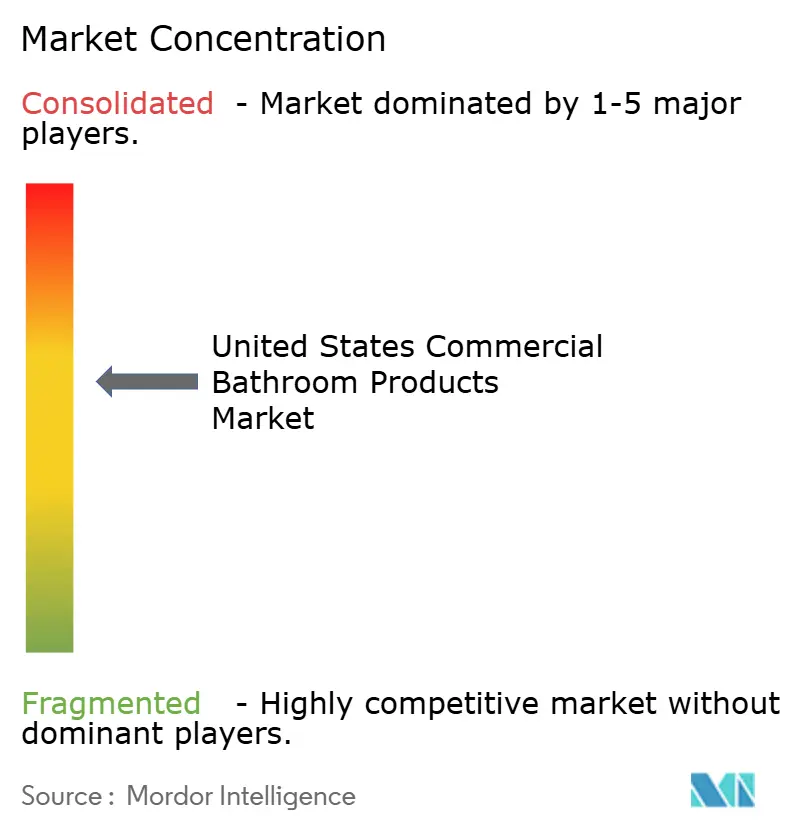
The United States commercial bathroom products market is moderately concentrated, with the top five manufacturers holding 60–65% combined share, led by Kohler, American Standard, TOTO USA, Sloan Valve, and Zurn Elkay. Diversified portfolios help large brands win one-stop specifications across faucets, toilets, urinals, sinks, and coordinated systems. Category specialists use focused innovation in flushometers, sensor calibration, and hand-hygiene systems to defend niche leadership. Spec wins form upstream during design development when reps provide BIM content, submittal data, and AIA-accredited education that ties product choices to code and certification outcomes. In a labor-constrained market, manufacturers that support prefabrication, standardized assemblies, and rapid submittal support create switching costs that favor incumbents.
Two technology vectors stand out. First, connected fixtures that integrate with restroom monitoring platforms are shifting plumbing from mechanical-only to software-visible systems that improve operations and reporting. Second, water-safety solutions that bundle thermostatic mixing, automated flushing, and temperature monitoring align with ASHRAE-188-informed programs in healthcare and high-risk occupancies. Input price volatility and tariffs are compressing margins, which makes supply chain agility and careful alloy selection a competitive advantage for fixture makers and distributors. Players who help owners navigate rebate programs and document performance under WaterSense and LEED maintain a consultative edge across the specification cycle.
Recent moves reinforce these themes. Sloan introduced a 0.75 gpf pressure-assisted toilet designed for high efficiency with strong drainline performance, expanding options for new light-commercial installations. TOTO connected ECOPOWER faucets and flush valves to the KOLO Smart Monitoring System to deliver usage and maintenance analytics without external power, which reduces battery servicing in high-use locations. Zurn’s AquaSense suite exposes telemetry on water consumption and hygiene indicators, making performance visible for hospitals and schools with reporting needs. American Standard expanded a plumber rebate program that supports WaterSense-labeled installations and strengthens trade relationships, which aligns incentives across the channel. These strategic steps deepen ties to code compliance, ESG reporting, and operational savings that are shaping the United States commercial bathroom products market.
United States Commercial Bathroom Products Industry Leaders
Kohler Co.
American Standard (LIXIL)
Sloan Valve Company
Zurn Elkay Water Solutions
TOTO USA
- *Disclaimer: Major Players sorted in no particular order

Recent Industry Developments
- April 2026: Topeka, Kansas, adopted the 2024 editions of the Uniform Plumbing Code and Uniform Mechanical Code, reducing needed local amendments and aligning city practice with current model standards.
- November 2025: LIXIL’s American Standard brand announced an enhanced Plumber Rebate Program to support WaterSense-labeled product installations across commercial and residential settings.
- December 2024: EPA finalized WaterSense Version 2.0 for private lavatory faucets, lowering the maximum allowable flow to 1.2 gpm with an effective date about 12 months from publication.
- August 2024: Sloan Valve Company introduced a 0.75 gpf pressure-assisted toilet using Flushmate’s 503UH system, achieving long drainline carry performance for light-commercial applications.


United States Commercial Bathroom Products Market Report Scope
Bathroom products are ceramic plumbing fixtures such as sinks, lavatories, or toilet bowls. It is an essential element in enhancing the splendor of the bathroom. Bathroom products are available in different sizes and styles and offer various features.
The United States Commercial Bathroom Products Market Report is Segmented by Product Type (Toilets & Urinals, Soap Dispensers, Faucets & Shower Systems, Sinks/Washbasins, Bathtubs, Others), Price Tier (Standard/Economy, Mid-Range, and Premium), Construction Type (New Construction and Replacement & Renovation), End-User (Hospitals, Offices, Hospitality, Retail, Educational Institutes, and Others (Airports, Public Places, Sports Venues, etc.)), Distribution Channel (Online and Offline), and Geography (Northeast, Southeast, Midwest, Southwest, West). The Market Forecasts are Provided in Terms of Value (USD).
| Toilets & urinals |
| Soap Dispensers |
| Faucets & shower systems |
| Sinks / washbasins |
| Bathtub |
| Others |
| Standard / economy |
| Mid-Range |
| Premium |
| New Construction |
| Replacement & Renovation |
| Hospitals |
| Offices |
| Hospitality |
| Retail |
| Educational Institutes |
| Others (Airports, Public Places, Sports Venues, etc.) |
| Online |
| Offline |
| Northeast |
| Southeast |
| Midwest |
| Southwest |
| West |
| By Product Type | Toilets & urinals |
| Soap Dispensers | |
| Faucets & shower systems | |
| Sinks / washbasins | |
| Bathtub | |
| Others | |
| By Price Tier | Standard / economy |
| Mid-Range | |
| Premium | |
| By Construction Type | New Construction |
| Replacement & Renovation | |
| By End-User | Hospitals |
| Offices | |
| Hospitality | |
| Retail | |
| Educational Institutes | |
| Others (Airports, Public Places, Sports Venues, etc.) | |
| By Distribution Channel | Online |
| Offline | |
| By Geography | Northeast |
| Southeast | |
| Midwest | |
| Southwest | |
| West |


Key Questions Answered in the Report
What is the current size and growth outlook for the United States commercial bathroom products market?
The market was USD 5.42 billion in 2025 and is expected to rise from USD 5.64 billion in 2026 to USD 6.8 billion by 2031 at a 3.81% CAGR.
Which product categories are leading, and which are growing fastest in the United States commercial bathroom products market?
Toilets and urinals led with 38.16% of 2025 revenue, while soap dispensers are projected to grow the fastest at a 5.0% CAGR through 2031.
How do regulations like WaterSense and LEED v5 affect specifications?
EPA WaterSense Version 2.0 tightens faucet flows to 1.2 gpm, and LEED v5 elevates water reductions to baseline requirements, which shifts specifications toward sub-1.28 gpf toilets and 0.35–0.4 gpm public faucets.
What end-users are driving demand in the United States commercial bathroom products market?
Hospitality accounted for 24.91% of demand in 2025, driven by hotel brand-conversion activity, property improvement plan cycles, and the sector's premium specification standards for guest-facing restrooms.
Which regions offer the strongest opportunities ahead?
The Southwest is projected as the fastest-growing region at a 4.8% CAGR to 2031, while the Northeast held the largest 2025 share at 32.25%.
How are IoT and smart restrooms changing operations?
Connected faucets, valves, and dispensers with restroom monitoring platforms drive faster response times, better stock availability, and lower maintenance costs with quick paybacks.
Page last updated on:





