
Market Overview
| Study Period | 2020 - 2031 |
|---|---|
| Market Size (2026) | USD 8.96 Billion |
| Market Size (2031) | USD 11.83 Billion |
| Growth Rate (2026 - 2031) | 6.54 % |
| Fastest Growing Market | Asia Pacific |
| Largest Market | North America |
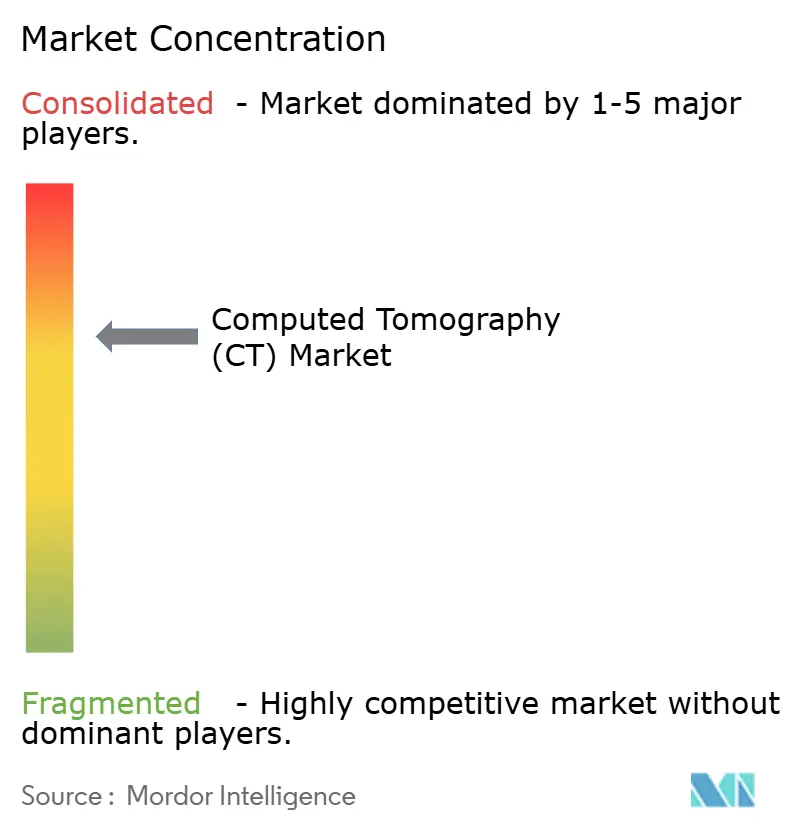
| Market Concentration | Medium |
Major Players *Disclaimer: Major Players sorted in no particular order Image © Mordor Intelligence. Reuse requires attribution under CC BY 4.0. | |
Computed Tomography (CT) Market Analysis by Mordor Intelligence
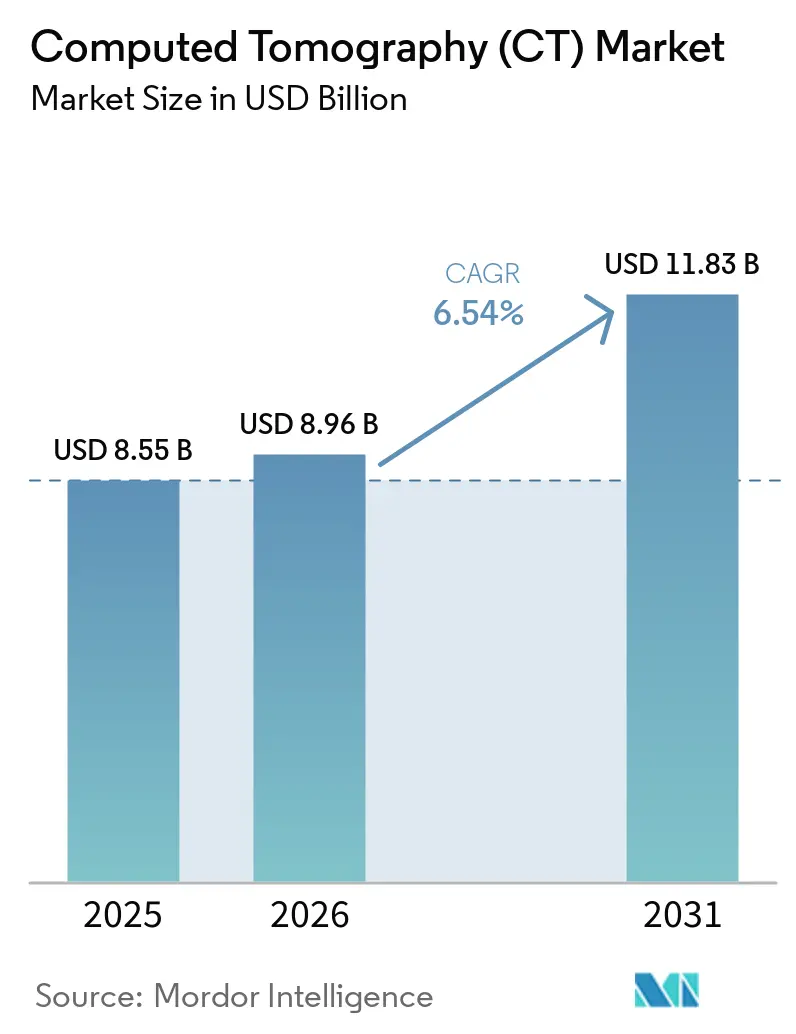
The Computed Tomography Market size was valued at USD 8.55 billion in 2025 and is estimated to grow from USD 8.96 billion in 2026 to reach USD 11.83 billion by 2031, at a CAGR of 6.54% during the forecast period (2026-2031).
Photon-counting detectors, AI-enabled workflow automation, and service-driven financing models are shortening replacement cycles and widening global access. Vendors are commercializing scanners that deliver sub-millisievert protocols, and regulators have cleared more than 240 radiology AI algorithms since 2024, cutting median read times for chest CT by roughly one-fifth.[1] Hospitals are shifting from capital expenditure to outcome-based leases, pushing services revenue ahead of hardware growth. High-slice and spectral systems are becoming standard in tertiary centers, while portable CT fills critical-care gaps. In parallel, mid-income countries are funding large procurement programs, creating fresh demand for high-slice platforms from local and multinational suppliers.
Key Report Takeaways
- By component, hardware led with 63.52% share in 2025, while services are forecast to expand at a 9.35% CAGR through 2031.
- By slice count, mid-slice scanners accounted for 44.11% of computed tomography market share in 2025, whereas high-slice systems are projected to advance at a 10.46% CAGR to 2031.
- By technology, dual-energy and spectral CT platforms held 31.34% of computed tomography market size in 2025, but photon-counting CT is expected to climb at a 10.32% CAGR through 2031.
- By modality, stationary units made up 81.54% of shipments in 2025, yet portable CT is the fastest-growing modality at a 10.93% CAGR.
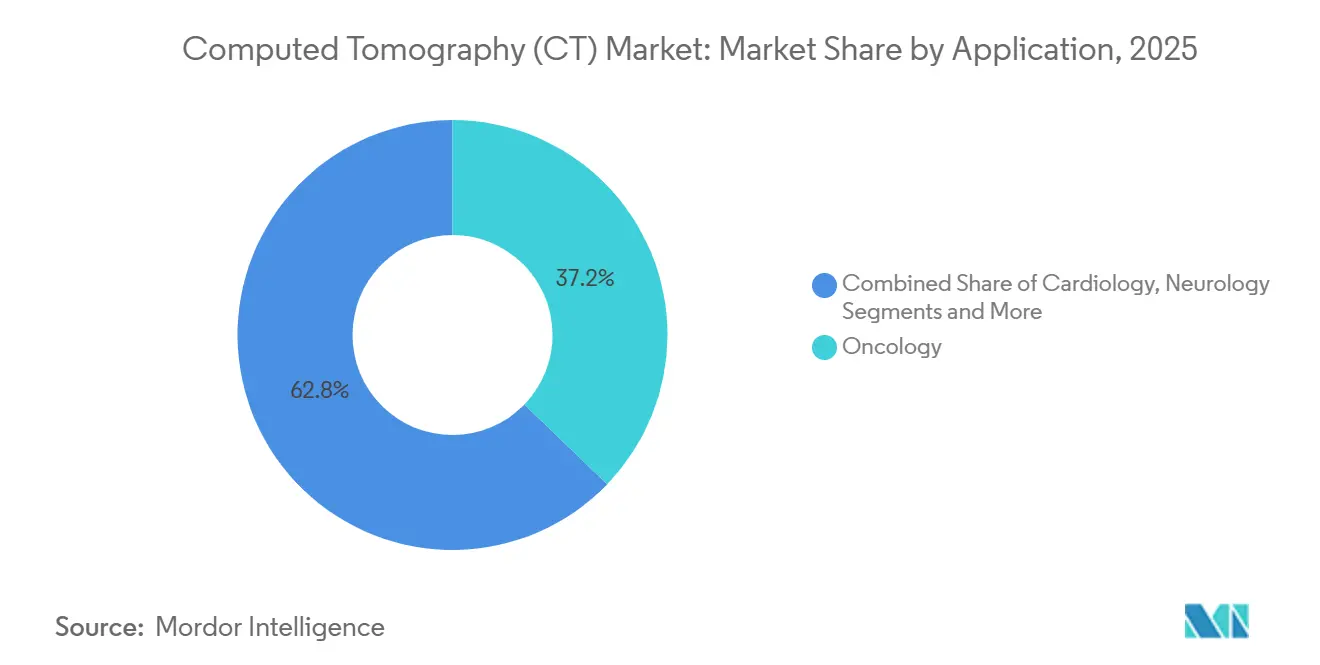
- By application, oncology contributed 37.22% share in 2025, whereas cardiology imaging is poised to register an 8.63% CAGR to 2031.
- By end user, hospitals installed 56.71% of scanners in 2025, while ambulatory surgical and specialty centers are projected to grow at an 8.82% CAGR over the forecast horizon.
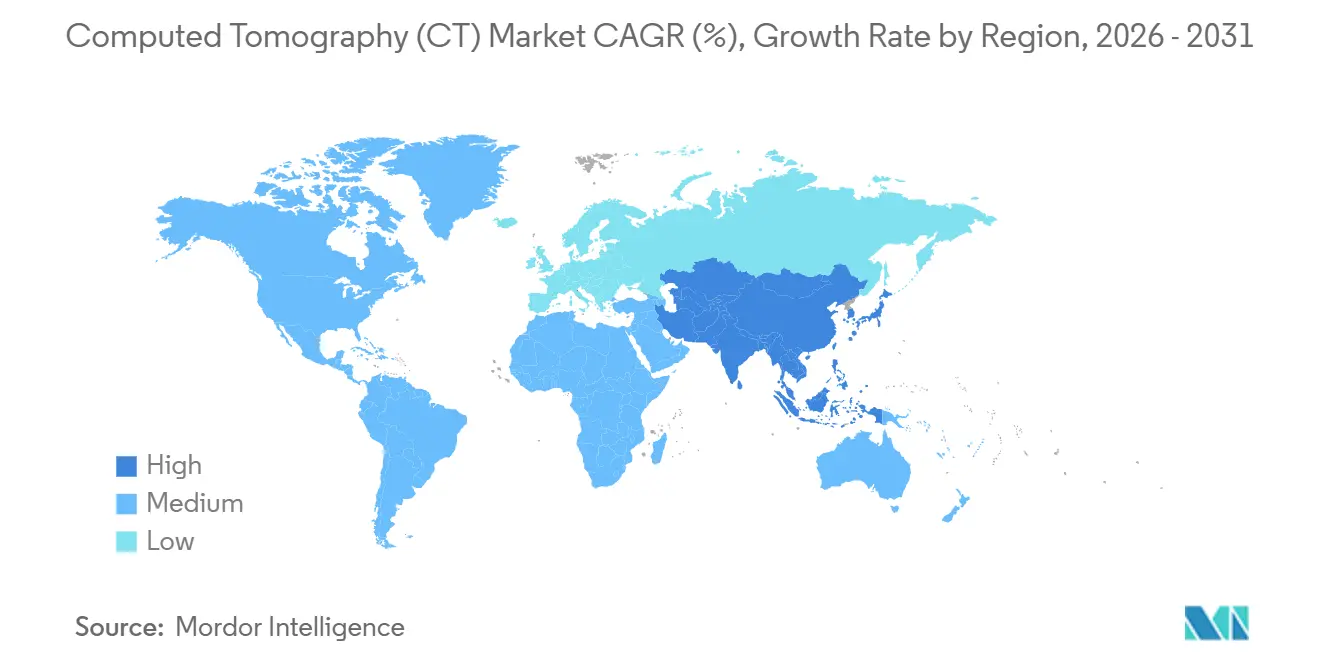
- By geography, North America retained 36.16% revenue share in 2025, while Asia-Pacific is forecast to expand at an 8.04% CAGR through 2031.
Note: Market size and forecast figures in this report are generated using Mordor Intelligence’s proprietary estimation framework, updated with the latest available data and insights as of 2026.
Market Trends and Insights
Drivers Impact Analysis of Computed Tomography (CT) Market*
| Driver | (~) % Impact on CAGR Forecast | Geographic Relevance | Impact Timeline |
|---|---|---|---|
| Technological Advances in Detector Design & Iterative Reconstruction | +1.2% | Global, early adoption in North America and Western Europe | Medium term (2-4 years) |
| Rising Global Burden of Oncology & Cardiovascular Diseases | +1.5% | Global, aging populations in North America, Europe, East Asia | Long term (≥ 4 years) |
| Expansion of High-Slice & Spectral CT in Emerging Economies | +1.1% | China, India, Middle East, Africa | Medium term (2-4 years) |
| AI-Enabled Workflow Automation | +0.9% | North America, EU, urban APAC | Short term (≤ 2 years) |
| Photon-Counting CT Launches | +0.8% | North America, Western Europe, APAC diffusion | Medium term (2-4 years) |
| Pay-Per-Scan & Leasing Models | +0.7% | Global, strongest in North America and Latin America | Short term (≤ 2 years) |
| Source: Mordor Intelligence | |||
Technological Advances in Detector Design & Iterative Reconstruction
Iterative reconstruction and new detector materials let clinicians achieve sub-millisievert studies while preserving diagnostic quality, cutting dose by up to 60%. Silicon photomultipliers boost photon-detection efficiency, and 0.25 mm elements now resolve coronary stents previously invisible on legacy systems.[2]
Rising Global Burden of Oncology & Cardiovascular Diseases
Cancer and cardiovascular disease caused 31 million deaths in 2024, more than half of global mortality, driving sustained CT demand for screening, staging, and perfusion studies. In oncology, the National Comprehensive Cancer Network revised its lung-cancer screening guidelines in 2024 to recommend annual low-dose CT for adults aged 50 to 80 with a 20 pack-year smoking history, expanding the eligible U.S. population from 8 million to 14.5 million individuals
Expansion of High-Slice & Spectral CT in Emerging Economies
Government programs in China and India mandate installation of 64-slice or higher systems, while Saudi Arabia and Brazil channel infrastructure budgets toward dual-energy platforms.[3] India's Pradhan Mantri Ayushman Bharat Health Infrastructure Mission, launched in 2021 and expanded in 2024, earmarked USD 3.2 billion to establish 17,000 health and wellness centers equipped with diagnostic imaging, including CT, by 2027. These programs favor dual-energy CT.
AI-Enabled Workflow Automation
FDA-cleared triage and segmentation algorithms now flag critical findings within seconds and trim reading time 20%-30%, easing radiologist shortages in rural regions. AI algorithms that triage urgent findings—such as intracranial hemorrhage, pulmonary embolism, and aortic dissection—are compressing time-to-diagnosis and enabling radiologists to prioritize critical cases. Aidoc's FDA-cleared suite of seven CT algorithms, deployed in over 1,000 hospitals by mid-2025, flags abnormal scans within seconds and routes them to on-call radiologists via mobile alerts
Restraints Impact Analysis of Computed Tomography (CT) Market*
| Restraint | (~) % Impact on CAGR Forecast | Geographic Relevance | Impact Timeline |
|---|---|---|---|
| High Capital & Lifecycle Costs of Premium CT Systems | -0.8% | Global, acute in emerging markets | Long term (≥ 4 years) |
| Radiation-Dose Safety Concerns & Tightening Regulations | -0.5% | North America, EU, expanding to APAC | Medium term (2-4 years) |
| Competition From MRI & Ultrasound | -0.4% | North America, Western Europe | Long term (≥ 4 years) |
| Rare-Earth Supply Constraints | -0.3% | Global, impact on high-slice systems | Short term (≤ 2 years) |
| Source: Mordor Intelligence | |||
High Capital & Lifecycle Costs of Premium CT Systems
Photon-counting or dual-energy scanners list between USD 1.8 million and USD 3.5 million, and tube replacements can exceed USD 250,000, steering price-sensitive buyers toward mid-slice or refurbished units.
Radiation-Dose Safety Concerns & Tightening Regulations
Cumulative radiation exposure from medical imaging remains a public-health concern, particularly for pediatric and young-adult populations. EU MDR 2017/745 now obligates dose-tracking software, and the FDA is drafting mandatory thresholds, raising compliance costs and reducing discretionary scans
*Our forecasts treat driver/restraint impacts as directional, not additive. The impact forecasts reflect baseline growth, mix effects, and variable interactions.
Computed Tomography (CT) Market Segment Analysis
By Component:
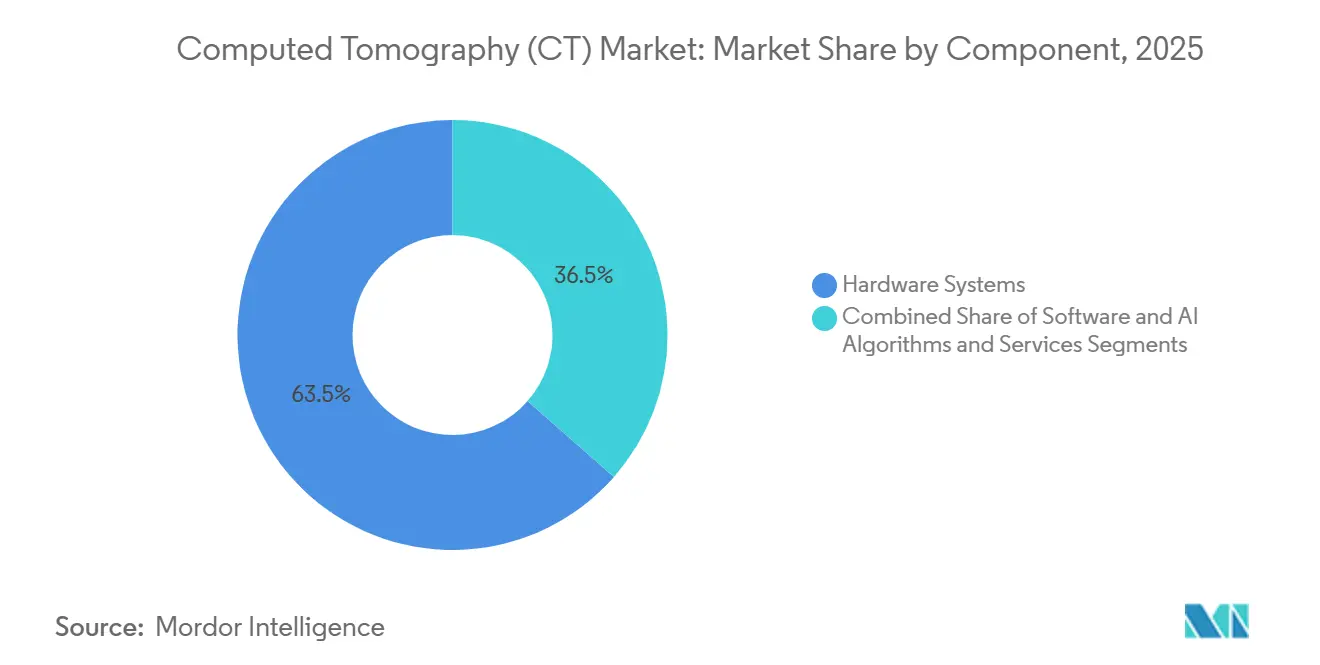
Services Gain as Hardware CommoditizesHardware represented 63.52% of computed tomography market revenue in 2025, but services are set to outpace with a 9.35% CAGR, reflecting hospitals’ preference for uptime guarantees and software subscriptions. Maintenance contracts deliver 35%-45% gross margins, compared with 20%-25% on hardware. Predictive maintenance programs cut downtime by 30%, reinforcing the annuity stream.
Services now absorb rising demand for iterative reconstruction upgrades, cybersecurity patches, and regulatory audits. Combined, these factors underline why vendors treat services as the anchor of the computed tomography market.

By Slice Count:
High-Slice Systems Lead Replacement WaveMid-slice platforms held 44.11% of computed tomography market share in 2025, but high-slice models will grow 10.46% annually as oncology and trauma protocols demand sub-millimeter resolution. High-slice scanners complete whole-body trauma scans in under 10 seconds, crucial for unstable patients.
Low-slice units are declining except in biopsy suites and dental practices, while cone-beam CT is carving out a niche in orthopedics thanks to compact footprints and lower cost. The computed tomography market size for high-slice platforms is projected to rise sharply once photon-counting becomes mainstream.
By Technology:
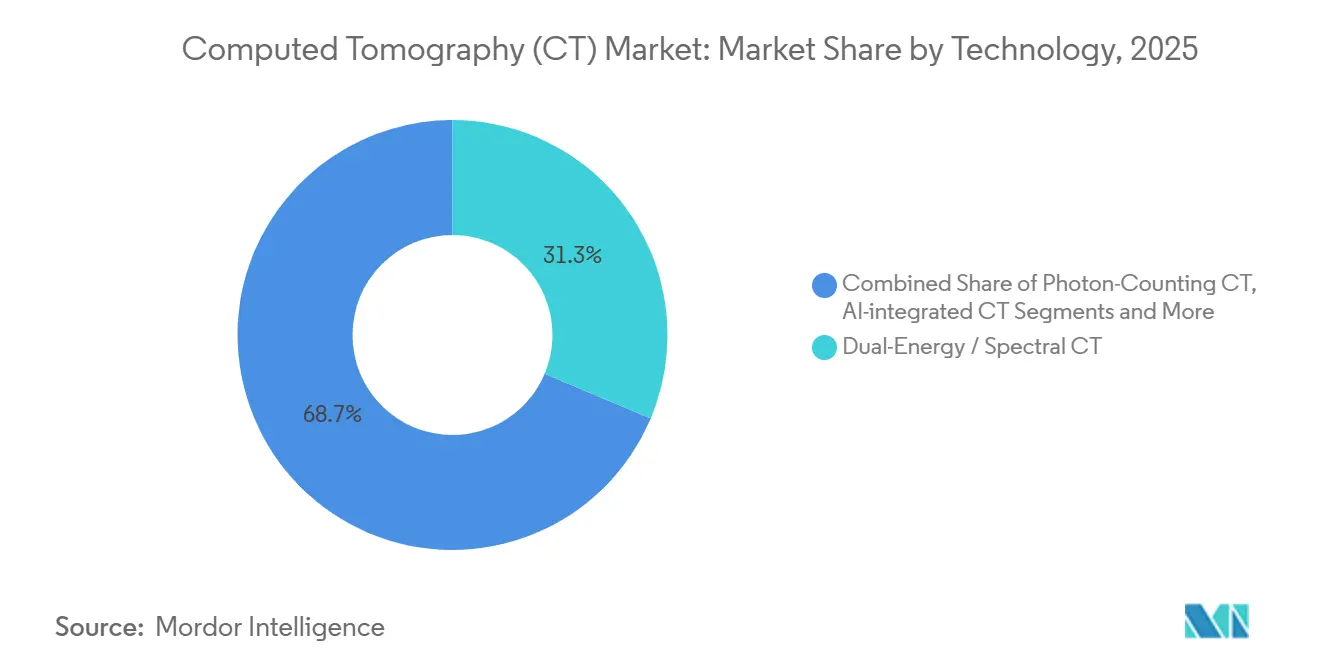
Photon-Counting Disrupts Dual-EnergyDual-energy and spectral scanners accounted for 31.34% of 2025 revenue, but photon-counting CT is projected to climb at a 10.32% CAGR to 2031, eroding legacy architectures. Photon-counting tallies individual photons, delivers intrinsic spectral data, and lowers iodine dose by 40%.
Iterative reconstruction is now table stakes, baked into nearly every new model, while AI-integrated control loops adjust tube current in real time. Hospitals weigh photon-counting benefits against reimbursement gaps, yet early adopters report sharper images at lower dose, accelerating fleet renewal. As spectral precision becomes routine, photon-counting platforms will reshape the computed tomography market share landscape.
By Modality:
Portable CT Accelerates in Critical CareStationary systems dominated shipments with an 81.54% share in 2025, but portable CT is advancing at a 10.93% CAGR as intensive-care and emergency units demand bedside imaging. Portable scanners eliminate risky patient transfers and cut time-to-diagnosis for intracranial hemorrhage by nearly 50 minutes.
COVID-19 protocols validated the point-of-care model, prompting hospitals to retain mobile fleets for infection control and critical-care efficiency. Hybrid PET-CT and SPECT-CT remain niche yet indispensable in oncology and cardiology, respectively. While stationary units stay the workhorse for routine studies, portable growth will lift computed tomography market size across critical-care corridors.
By Application:
Cardiology Closes Gap on OncologyOncology led with 37.22% of 2025 volume, yet cardiology imaging is set to expand at an 8.63% CAGR as coronary CT angiography replaces invasive catheterization for stable chest pain. Spectral protocols quantify myocardial perfusion, reducing the need for separate nuclear studies.
Stroke guidelines now call for CT angiography and perfusion imaging for suspected large-vessel occlusion, bolstering neuro applications. Musculoskeletal trauma relies on 3-D reconstructions for surgical planning, while vascular studies remain emergency staples. Cardiology’s rapid rise is narrowing the computed tomography market share gap with oncology
By End User:
Ambulatory Centers Capture GrowthHospitals installed 56.71% of scanners in 2025, but ambulatory surgical and specialty centers are forecast to grow at an 8.82% CAGR as procedures migrate to outpatient settings. Pay-per-scan contracts let these centers access high-slice technology without major capital outlays.
Diagnostic imaging centers leverage economies of scale and higher reimbursement for freestanding facilities, while hospital budgets face pressure from value-based care. In regions where freestanding imaging is restricted, hospitals retain dominance, yet outpatient momentum is unmistakable. Ambulatory expansion will underpin future computed tomography market size gains, especially in North America and Western Europe.
Geography Analysis
North America Computed Tomography (CT) Market
North America contributed 36.16% of computed tomography market revenue in 2025, supported by favorable reimbursement and the continent’s dense imaging network. The average installed scanner age reached 9.2 years in 2024, indicating pending replacement demand.
APAC Computed Tomography (CT) Market
Asia-Pacific is the growth engine, expanding at an 8.04% CAGR as China’s health commission directs USD 12 billion toward 3,000 county-hospital installations and India’s Ayushman Bharat boosts diagnostic coverage. Local vendors United Imaging and Mindray undercut Western prices by up to 40%, accelerating penetration.
Europe, LATAM and Middle East Computed Tomography (CT) Market
Europe shows moderate growth as MDR dose rules raise compliance costs. Germany earmarked EUR 1.2 billion for upgrades tied to dose-reduction targets, and the UK allocated GBP 400 million to cut imaging backlogs. Latin America and the Middle East showcase faster upticks from infrastructure drives in Saudi Arabia and Brazil, though currency risk tempers some procurements.
Regulatory Landscape
Computed tomography systems sit under mature medical-device frameworks, but recent updates increasingly scrutinize software performance and radiation management. In the United States, CT remains regulated as a Class II device (21 CFR 892.1750) and is subject to Electronic Product Radiation Control provisions, while FDA radiology AI clearances have accelerated, reinforcing premarket expectations for algorithm validation when AI is embedded into reconstruction and workflow. Across other major markets, regulators have added device-specific proof points that affect registration dossiers and lifecycle compliance. In China, NMPA CMDE issued 2026 actions that formalize performance validation, dose management, and software verification for X-ray CT equipment, and added mandatory reliability evaluation requirements for CT tube assemblies, including a declared reliability index in submissions. In Europe, MDR 2017/745 continues to drive dose-tracking and technical documentation rigor, alongside 2026 amendments such as Commission Delegated Regulation (EU) 2026/1451, which adjusts aspects of clinical investigation exemptions for certain devices and influences evidence planning for established platform updates.
Value Chain Analysis
The CT value chain starts with upstream inputs such as X-ray tubes, detector materials and assemblies, high-voltage generators, motion and gantry subsystems, and increasingly, embedded software and AI modules that drive reconstruction and workflow. OEMs such as Siemens Healthineers, GE HealthCare, Philips, Canon Medical Systems, and regional suppliers including Neusoft and other Chinese manufacturers integrate these components into scanner platforms, then route systems through direct enterprise sales and distributor channels, with installation, applications training, and multi-year service contracts forming a large downstream layer. Hospitals and imaging networks also increasingly procure through leasing and pay-per-scan structures, shifting value toward uptime guarantees, upgrades, cybersecurity, and regulatory documentation support. Supply and compliance constraints shape sourcing and manufacturing strategies for critical components, particularly CT tubes and electronics. Trade and tariff friction has pushed some vendors toward regionalization and localization of supply in key manufacturing hubs, while China initiated an anti-dumping investigation into imported CT X-ray tubes from the United States and India, adding uncertainty for tube supply and pricing in one of the largest procurement markets. In parallel, regulatory requirements such as EU MDR 2017/745 documentation and US performance standards for radiation-emitting products (21 CFR 1020.33) increase the burden on suppliers and OEMs to provide traceability, verification data, and post-market support, reinforcing the role of services partners and in-house field engineering networks.
Competitive Landscape
The computed tomography market remains moderately concentrated. Siemens leads photon-counting, GE excels in AI reconstruction, Philips bundles multiyear service contracts, and Canon targets cardiac imaging. Chinese firms United Imaging and Mindray grow in emerging markets through aggressive pricing and local service.
Portable CT is dominated by Samsung NeuroLogica and GE, while dental and orthopedic cone-beam niches attract CurveBeam AI and Planmed. Patent filings are brisk, with 1,240 CT-related grants in 2024, 42% belonging to Siemens, GE, and Philips. Regulatory barriers around FDA and CE clearances shield incumbents, but financing models and AI differentiation keep the field highly dynamic.
Computed Tomography (CT) Industry Leaders
-
Canon Medical Systems Corporation
-
GE Healthcare
-
Koninklijke Philips NV
-
Siemens Healthineers
-
United Health Imaging
- *Disclaimer: Major Players sorted in no particular order
Computed Tomography (CT) Market Companies Covered in this Report
- Canon
- Carestream Health
- CurveBeam AI
- FUJIFILM
- GE Healthcare
- Koning
- Koninklijke Philips
- MARS BioImaging
- Mindray Medical
- MinFound Medical
- Neusoft
- Planmed
- Samsung NeuroLogica
- Shenzhen Anke Hi-Tech
- Shimadzu
- Siemens Healthineers
- United Imaging Healthcare
- Xoran Technologies
Market Opportunities and Future Outlook
A primary opportunity sits in accelerated platform refresh cycles driven by photon-counting, spectral imaging, and AI-assisted reconstruction, anchored by regulatory and commercial milestones. Philips obtained FDA 510(k) clearance for its Spectral CT Verida system and for its Rembra CT platform in 2026, enabling broader adoption of advanced protocols with lower dose. GE HealthCare expanded its AI-reconstruction stack with True Definition DL and advanced photon-counting capabilities, supporting higher-resolution workflows in clinically important areas. A second opportunity exists in integrated software, workflow automation, and service-led financing as providers seek throughput gains and predictable operating costs. The EU AI Act, effective August 2026, classifies most clinical imaging AI as high-risk, elevating demand for compliant AI embedded in scanners and enterprise imaging stacks. On the supply side, capacity investments support faster delivery, evidenced by Siemens Healthineers breaking ground in July 2026 on a 4,500-square-meter facility in Kemnath, Germany for medical imaging and radiotherapy components, and Canon expanding deep-learning motion correction and higher-matrix reconstruction across Aquilion units in July 2026.
Recent Industry Developments in Computed Tomography (CT) Market
- July 2026: Canon Medical Systems introduced CLEAR Motion deep learning motion correction and Precise IQ Engine (PIQE) 1024 Matrix Deep Learning Reconstruction across its Aquilion CT portfolio. The upgrade targets sharper imaging in motion-prone exams and helps differentiate performance through software-enabled improvements without a full hardware refresh.
- April 2026: GE HealthCare received US FDA 510(k) clearance for True Definition DL, a deep-learning-based CT reconstruction method for high-contrast lung and bone imaging. The clearance broadens the company’s AI reconstruction stack and supports hospital interest in faster workflows and image-quality gains via software.
- November 2024: Philips launched the AI-enabled CT 5300 in North America, expanding its AI-enabled CT portfolio and enabling workflow automation and higher throughput in mid-to-high tier hospitals.
Computed Tomography (CT) Market Report Scope and Research Methodology
Market Definition and Coverage
For this study, the global CT market is defined as revenues earned from computed tomography hardware systems, related software and AI algorithms, and CT services used for medical imaging across healthcare settings worldwide.
Scope exclusions: Industrial CT and non-medical inspection uses are excluded, and procedure reimbursement values are not counted as market revenue.
Segments Covered in This Report
- By Component
- Hardware Systems
- Software & AI Algorithms
- Services (Installation, Maintenance, Up-grades)
- By Slice Count
- Low-slice (Less than 16) CT
- Mid-slice (16–64) CT
- High-slice ( More than 64) CT
- Cone Beam CT
- By Technology
- Dual-Energy / Spectral CT
- Photon-Counting CT
- Iterative Reconstruction CT
- AI-integrated CT
- By Modality
- Stationary CT
- Portable CT
- Hybrid PET-CT / SPECT-CT
- By Application
- Oncology
- Cardiology
- Neurology
- Musculoskeletal & Trauma
- Vascular & Others
- By End User
- Hospitals
- Diagnostic Imaging Centers
- Ambulatory Surgical & Specialty Centers
- By Geography
- North America
- United States
- Canada
- Mexico
- Europe
- Germany
- France
- United Kingdom
- Italy
- Spain
- Rest of Europe
- Asia-Pacific
- China
- Japan
- India
- South Korea
- Australia
- Rest of Asia-Pacific
- Middle East & Africa
- GCC
- South Africa
- Rest of Middle East & Africa
- South America
- Brazil
- Argentina
- Rest of South America
- North America
Data Sources, Market Sizing, and Validation
Desk Research
Desk research helps us build the factual base for the CT demand pool and the supply footprint before assumptions are set. We rely on public sources such as the World Health Organization, the OECD, the World Bank, and national health ministries for healthcare capacity and imaging access signals. We also use regulator and standards bodies (such as the US FDA databases and IEC publications) to understand technology approvals, safety updates, and typical device classification.
On the market-side, we review annual reports, investor presentations, and press releases to map product launches, service mix, and geographic exposure, which then guides how the model is split and checked. Where needed, paid subscriptions for company financials and intelligence, patent databases, and global tenders help confirm installed base expansion, new platform cycles, and large public procurements. The desk sources listed here are illustrative only, since many other public references were also used for collection, cross-checking, and clarification.
Primary Interviews and Surveys
Primary work is used to pressure-test the desk inputs and close gaps that are hard to verify from public documents, especially around replacement cycles, service attach rates, and pricing movement by slice class. We speak with OEM-facing channel participants, hospital and imaging center buyers, and clinical users across APAC, EMEA, and the Americas, so assumptions can be checked against how purchasing and utilization are actually changing.
Distribution of primary research fieldwork respondents
| Company type | Respondent position | Region |
|---|---|---|
| Top tier: 28% | CXOs: 14% | APAC: 51% |
| Mid tier: 56% | Functional/Unit leaders: 29% | EMEA: 30% |
| Smaller Players: 16% | Managers: 57% | Americas: 19% |
Market-Sizing & Forecasting
Sizing starts with a top-down build where imaging equipment demand is reconstructed from healthcare delivery signals and CT adoption intensity by care setting, and then translated into revenue through typical replacement and upgrade cycles. To keep it practical, we anchor the model on repeatable inputs, such as estimated CT scanner installed base by region, annual replacement rates, mix shift toward mid and high slice systems, service contract penetration, and average pricing spread between hardware, software, and services.
Once the first cut is ready, we apply selective bottom-up checks, such as sampled ASP times shipment proxies for key system classes, and a supplier-side roll up for services where public disclosures allow it. If a country has limited visibility, we handle gaps by using proxy indicators like hospital bed expansion, diagnostic center growth, and import patterns for imaging equipment, followed by expert confirmation.
For forecasting, we mainly use scenario analysis supported by short trend models on the key drivers, so a base case can be compared with faster upgrade and slower capex cycles. The final curve is adjusted only after primary feedback aligns on the direction of price movement, utilization recovery, and procurement timing.
Data Validation & Update Cycle
Validation is done through cross-checks that look for mismatches between modeled revenue and independent market signals, such as regional imaging capacity additions, known platform refresh timing, and service revenue expansion trends. When a variance is unusually high, assumptions are revisited, and follow-up calls are triggered to confirm whether the issue is scope, timing, or pricing.
Before sign-off, the model is reviewed in steps. One analyst checks the build, another checks the logic and variance notes, and then the final numbers are reconciled back to the defined market scope. Reports are refreshed annually, and interim updates are made when major events materially change supply, pricing, or purchasing behavior. Before delivery, a final data pass is completed so clients receive the most current view available at the time.
Mordor Intelligence's Global Ct Market Market Sizing Compared With Other Published Estimates
Published CT market estimates often differ because they do not always count the same revenue lines, and they use different base years and exchange-rate timing. The spread can look large even when the underlying growth story is similar, so scope choices and the way pricing is handled matter alongside the forecast period.
Key gap drivers for CT are usually whether service revenue and software and AI algorithm revenue are included alongside scanner hardware, how slice mix upgrades are priced over time, and whether hybrid systems are counted inside CT or pushed into a separate nuclear imaging bucket. Refresh cadence also affects the reported total because tender timing and large hospital purchasing cycles can shift the current-year number.
Benchmark comparison
| Source | Market Size | Gaps in Research Methodology |
|---|---|---|
| Mordor Intelligence | USD 8.55 B (2025) | |
| Global Consultancy A | USD 7.65 B (2025) | Often presented as a CT scanners only view, which can undercount software, AI algorithm revenue, and ongoing service contracts tied to the installed base, and it may treat hybrid systems differently. |
| Industry Research Group B | USD 6.30 B (2024) | Uses an earlier base year and can blend conservative pricing assumptions with a narrower channel view, which may miss upgrade-driven ASP lift and higher service attach in mature hospital accounts. |
The table mainly shows that scope choices, especially whether services plus software are counted, explain a big part of the gap, and year timing adds a second layer of difference. By keeping hardware, software and AI algorithms, and services inside one tracked revenue pool and reconciling the result with installed base and replacement-cycle checks, the final 2025 total stays more traceable to real purchase behavior, which is the approach applied by Mordor Intelligence.
Key Questions Answered in the Report
How large will the computed tomography market be by 2031?
It is projected to reach USD 12.59 billion in 2031, expanding at a 6.48% CAGR over 2026-2031.
Which component is growing fastest within the computed tomography space?
Services, including maintenance and software subscriptions, are forecast to climb at a 9.35% CAGR as hospitals favor outcome-based contracts.
Why is Asia-Pacific the quickest-growing region for computed tomography?
Government hospital build-outs in China and India, coupled with competitively priced high-slice systems from local vendors, drive an 8.04% CAGR.
What technology trend is accelerating scanner replacement cycles?
Photon-counting CT delivers multi-energy data at lower dose, prompting many hospitals to plan fleet upgrades before the usual 15-year cycle.
How are financing models changing CT adoption?
Pay-per-scan and leasing contracts spread costs over the scanner’s life, cutting first-year expenses by up to 80% and enabling access for smaller facilities.