
Market Overview
| Study Period | 2021 - 2031 |
|---|---|
| Forecast Data Period | 2026 - 2031 |
| Historical Data Period | 2021 - 2024 |
| Base Year Market Size (2025) | USD 78.62 Million |
| Market Size (2026) | USD 83.38 Million |
| Market Size (2031) | USD 111.93 Million |
| Growth Rate (2026 - 2031) | 6.06 % |
Major Players *Disclaimer: Major Players sorted in no particular order Image © Mordor Intelligence. Reuse requires attribution under CC BY 4.0. | |
United Kingdom Combined Heat And Power (CHP) Market Analysis by Mordor Intelligence
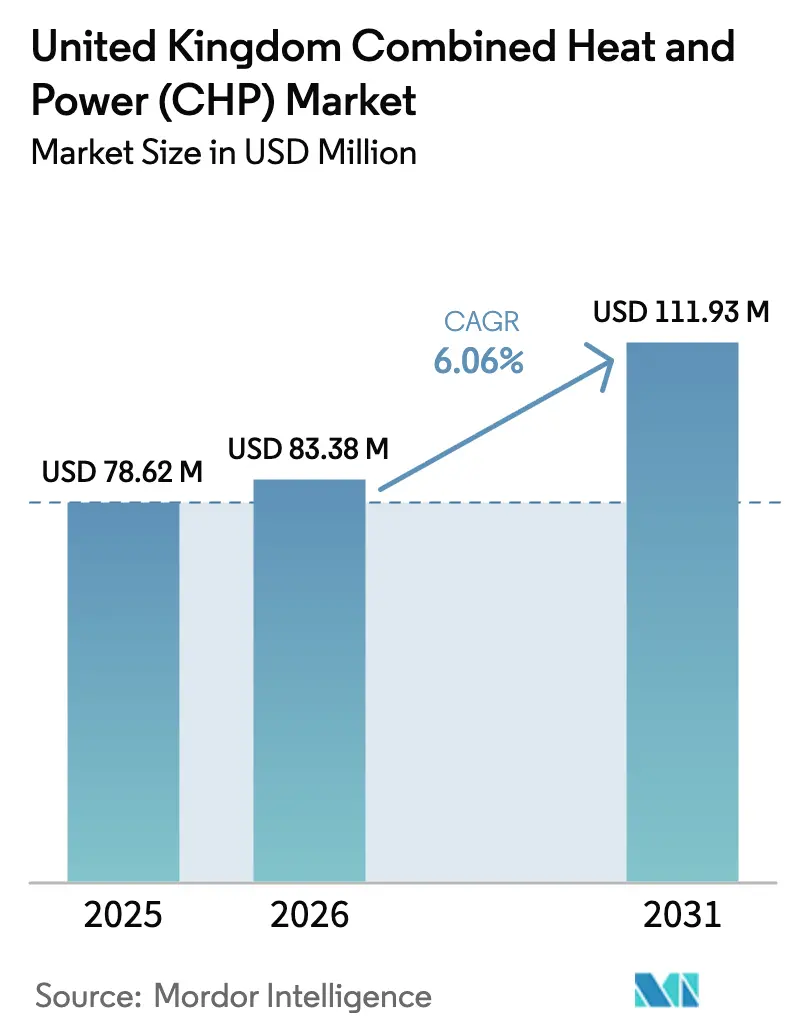
The United Kingdom Combined Heat And Power Market size is expected to grow from USD 78.62 million in 2025 to USD 83.38 million in 2026 and is forecast to reach USD 111.93 million by 2031 at 6.06% CAGR over 2026-2031.
The UK Combined Heat and Power (CHP) market is experiencing significant transformation driven by evolving energy infrastructure needs and sustainability goals. The sector has seen substantial investments in new projects, exemplified by VH Global's £78 million funding announcement in September 2021 for innovative power generation equipment projects in Nottinghamshire and County Durham. These projects, featuring gas-fired engine technology with carbon capture and reuse systems, demonstrate the industry's commitment to clean, net-zero, flexible, and dependable electricity solutions. The construction activity around CHP installations has shown remarkable resilience, with the Office of National Statistics reporting that new orders for construction in the private commercial sector increased to 114 in 2021, representing a 32% growth compared to pre-pandemic levels.
Technological advancements in CHP systems have led to improved efficiency and environmental performance across various applications. The industry has witnessed a notable shift towards more sophisticated systems, particularly in the commercial and industrial sectors, where combined cycle gas turbine CHP systems have demonstrated superior efficiency levels. These systems have shown the capability to convert fuel to 40% electricity or more, marking a significant improvement in energy conversion efficiency. The integration of advanced control systems and smart technologies has further enhanced the operational capabilities of CHP installations, enabling better load management and optimization of energy production.
The market has seen a growing emphasis on renewable and low-carbon CHP solutions, particularly in the industrial and commercial sectors. In March 2022, MPC Energy Solutions completed the acquisition of the Neol CHP plant in Caguas, with an energy production capacity of approximately 26,000 MWh per year. This trend is further supported by the government's Heat Networks Investment Project (HNIP), which has provided significant funding for district heating projects. For instance, Cory received £12.1 million in funding through HNIP in May 2021 for a major district heating project, demonstrating the government's commitment to supporting sustainable energy solutions.
The industry landscape is being reshaped by strategic partnerships and innovative business models. Gas distribution company SGN and UK renewable energy solutions provider Vital Energi announced a 50:50 joint venture in July 2021, creating an Energy Services Company (ESCO) aimed at providing affordable and low-carbon infrastructure. This trend towards collaboration is enabling more comprehensive energy solutions, with companies combining their expertise to deliver more efficient and sustainable cogeneration systems. The sector has also witnessed increased activity in the biogas CHP segment, with several projects focusing on utilizing organic waste for energy generation, particularly in agricultural and industrial applications.
Note: Market size and forecast figures in this report are generated using Mordor Intelligence’s proprietary estimation framework, updated with the latest available data and insights as of 2026.
United Kingdom Combined Heat And Power (CHP) Market Trends and Insights
Growing Commercial and Industrial Applications
The expanding commercial and industrial infrastructure in the United Kingdom has emerged as a significant driver for the Combined Heat and Power (CHP) market. According to the Office of National Statistics, the construction sector witnessed remarkable growth, with new orders for construction in the private commercial sector reaching USD 17,960 million in 2022, representing a 35% increase compared to 2020. This surge in construction activity has created substantial opportunities for CHP system installations across various commercial establishments, including hotels, supermarkets, office buildings, sports centers, hospitals, and data centers. The versatility of CHP systems in meeting diverse energy requirements has made them particularly attractive for commercial applications, where they provide both energy independence and security.
The commercial sector's energy consumption patterns have significantly influenced CHP system adoption, particularly in supermarkets where refrigeration, lighting, and HVAC systems account for the majority of energy usage, with refrigeration alone responsible for approximately one-third of total consumption. These facilities require specialized CHP configurations to address varying load demands during operational and non-operational hours, leading to the development of more sophisticated internal combustion engine CHPs with higher electrical efficiency. Additionally, the emergence of fuel cell-based CHP systems, driven by falling costs and improved efficiency, has further expanded the technology's commercial applications, particularly in facilities requiring consistent power supply like hospitals and data centers. The integration of heat recovery systems within these facilities enhances power plant efficiency and contributes to overall energy conservation systems.
Understand The Key Trends Shaping This Market
Download Sample
Government Support and Policy Framework
The United Kingdom's robust policy framework and financial incentive programs have significantly propelled the CHP market forward. The Contract for Difference (CFD) Scheme, a government mechanism supporting low-carbon electricity generation, has been instrumental in incentivizing investments in high upfront cost installations of renewable power systems, including renewable CHP systems. This scheme provides crucial protection to project developers from volatile market prices, thereby reducing investment risks and encouraging broader adoption of CHP technology. Furthermore, the Enhanced Capital Allowances (ECA) program allows businesses to write off 100% of their investment in energy-saving technologies, including CHP systems, against taxable profits during the investment period, making the technology financially more attractive to commercial and industrial users.
The government's commitment to supporting CHP adoption is further evidenced by specialized initiatives targeting specific sectors. For instance, the Heat Networks Investment Project (HNIP) has provided substantial funding for district heating projects incorporating CHP systems. A notable example is the GBP 12.1 million funding received by Cory in 2023 for a major district heating project, comprising a GBP 1.6 million commercialization grant and GBP 10.5 million construction loan. Additionally, the introduction of super deduction and special rate first-year allowances for companies subject to corporation tax has created additional financial incentives for CHP installations, particularly benefiting industrial users investing in new plant and machinery. The role of distributed generation and distributed energy resources is increasingly recognized in these policy frameworks, promoting a decentralized approach to energy production.
Environmental Regulations and Emission Reduction Targets
The United Kingdom's stringent environmental regulations and ambitious emission reduction targets have become a crucial driver for the CHP market. Natural gas-based CHP systems have gained particular prominence as they produce the lowest carbon dioxide emissions among all fossil fuel-based technologies, aligning perfectly with the nation's greenhouse gas reduction objectives. According to the Department for Business, Energy, and Industrial Strategy, CHP units utilizing natural gas not only achieve significant reductions in nitrogen oxide emissions but also operate with virtually no sulfur or contaminant emissions, making them an environmentally superior choice for power generation.
The transition toward more sustainable energy solutions has been further accelerated by the development of advanced CHP technologies. The emergence of hydrogen-based fuel cell CHP systems represents a significant advancement in ultra-low emission technology, producing only water vapor as a byproduct. This technological evolution has particularly impacted the transportation sector, where hydrogen-powered fuel cell electric vehicles (FCEVs) are classified as ultra-low emission vehicles (ULEVs). The government's commitment to environmental sustainability is reflected in its announcement of more than GBP 200 million in funding for a three-year comparative demonstration program to evaluate zero-emission solutions for heavy goods vehicles (HGVs), with a clear mandate to ban the sale of fossil-fuel-powered trucks weighing 26 tonnes or less from 2035. Additionally, the focus on waste heat recovery in CHP systems contributes to reducing overall emissions and enhancing system efficiency.
Segment Analysis
Industrial Segment in UK CHP Market
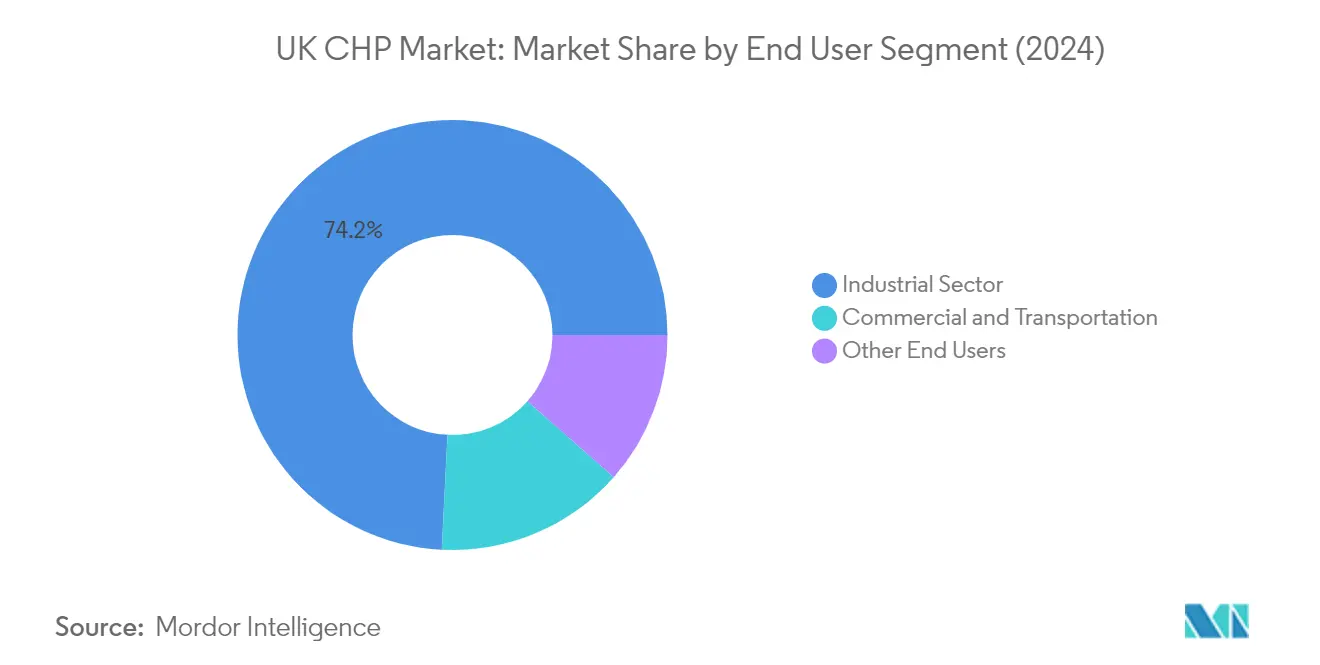
The industrial sector dominates the UK Combined Heat and Power (CHP) market, holding approximately 73.35% market share in 2025. This significant market position is driven by extensive industrial cogeneration adoption across oil and gas terminals, refineries, chemical industries, food and beverage manufacturing, paper publishing, printing, sewage treatments, and iron and steel industries. The sector's dominance is further reinforced by government initiatives like Enhanced Capital Allowances (ECA) that allow businesses to write off 100% of their investment in energy-saving technologies against taxable profits. Additionally, the introduction of super deduction and special rate first-year allowances for companies subject to corporation tax has strengthened the industrial sector's position in the CHP market. The integration of industrial energy systems is pivotal in maintaining this growth trajectory.
Commercial and Transportation Segment in UK CHP Market
The commercial and transportation sector represents the fastest-growing segment in the UK CHP market for the period 2026-2031. This growth is primarily driven by increasing adoption in hotels, supermarkets, office buildings, sports centers, hospitals, data centers, and shopping centers. The sector's expansion is supported by the development of fuel cell-based CHP systems, which are becoming increasingly popular due to falling costs and rising efficiency. The growth is further accelerated by significant construction projects in the pipeline worth about GBP 2.5 billion in various parts of the United Kingdom, particularly in the hotel sector. The healthcare sector is also contributing to this growth, with the government's New Hospital Programme announcing the development of 40 new hospitals by 2030, creating substantial opportunities for commercial cogeneration system installations.
Remaining Segments in End User Segmentation
The other end-user segments, including agriculture, community heating, and leisure facilities, play a vital role in the UK CHP market despite having a smaller market share. The agricultural sector utilizes CHP technologies for crop processing, dairy and animal farms, horticulture, and water heating applications, particularly through biogas plants that convert organic materials into energy. Community heating projects are gaining traction through government initiatives and funding programs, while leisure facilities are increasingly adopting CHP systems to support amenities such as swimming pools, gyms, and indoor sports courts. These segments collectively contribute to the market's diversity and demonstrate the versatility of CHP applications across different sectors, including residential cogeneration.
Segment Analysis: Type
Gas Turbine Segment in UK CHP Market
The gas turbine segment holds approximately 5% market share in the UK Combined Heat and Power (CHP) market in 2024, making it a significant technology choice among the primary turbine types. Gas turbine CHP systems are particularly well-suited for large-scale and industrial CHP applications with greater than 1 MW capacity, offering advantages like low maintenance requirements and high-quality waste heat generation. The segment's strength is further reinforced by its economic benefits, as gas turbines represent one of the lowest costs per MW capacity in large-scale CHP systems. Major companies like General Electric Energy, Siemens Energy AG, and Caterpillar Inc. are actively providing gas turbine CHP systems in the United Kingdom, contributing to the segment's market position. The use of combined cooling heat and power systems enhances the efficiency of these applications.
Steam Turbine Segment in UK CHP Market
The steam turbine segment is projected to experience notable growth during the forecast period 2024-2029, driven by its versatility in fuel usage and widespread adoption in industrial applications. Steam turbines offer unique advantages as they can operate with various fuels, from clean natural gas to solid waste, including all types of wood, coal, wood waste, and agricultural byproducts. This segment's growth is particularly supported by its increasing adoption in medium and large-scale industrial and institutional applications where inexpensive fuels such as coal, biomass, solid waste, refinery residual oil, and refinery gases are available. The segment's expansion is further bolstered by its primary focus on heat generation, making it especially attractive for industrial plants and commercial buildings with high thermal loads, such as hospitals and district heating systems. The integration of trigeneration systems further enhances the segment's appeal.
Remaining Segments in Type Segmentation
The other types segment, which includes reciprocating engines and organic Rankine cycle CHP systems, plays a crucial role in the UK CHP market. Reciprocating engine CHP systems are particularly valued for their high electrical efficiencies and reliability, making them suitable for distributed generation applications across industrial, commercial, and institutional facilities. Meanwhile, organic Rankine cycle CHP systems are gaining traction due to their ability to efficiently convert medium-grade waste heat into useful energy, particularly beneficial in renewable energy applications. These technologies complement the traditional turbine-based systems by offering solutions for specific applications and contributing to the market's technological diversity, forming part of the total energy systems approach.
Regulatory Landscape
The United Kingdom CHP regulatory framework is anchored by the Combined Heat and Power Quality Assurance (CHPQA) programme administered by the Department for Energy Security and Net Zero (DESNZ). CHPQA certification determines whether a scheme is classed as Good Quality CHP, which in turn affects eligibility for a Secretary of State Exemption Certificate used to access Climate Change Levy (CCL) exemption for qualifying electricity output.
Policy and market access for supported low-carbon generation also interact with CHPQA rules, including the CHPQA Standard and related guidance used when CHP is referenced in schemes seeking support under mechanisms such as the Contracts for Difference (CfD) and Renewables Obligation (RO). In parallel, the Energy Act 2023 introduced powers supporting heat network zoning, shaping the deployment environment for CHP integrated with district heat networks and raising the importance of compliance and performance evidence in heat-led CHP business cases.
Value Chain Analysis
The UK CHP value chain begins with fuel supply, predominantly natural gas, alongside renewable fuels in biogas and waste-derived applications, and it extends through equipment manufacturing, including gas engine and turbine OEMs and fuel cell technology providers. Delivery is led by developers and energy service companies (ESCOs), with EPC and MEP contractors, as well as specialist packagers that integrate prime movers, heat recovery, switchgear, controls, and grid connection. Edina, for instance, operates in the UK as an official distributor for MWM gas engines and provides design, installation, and maintenance services, illustrating how integrated suppliers combine equipment channel access with lifecycle delivery.
Certification and metering act as mid-stream enablers, since CHPQA assessment underpins access to incentives and exemptions. Downstream, site owners and operators in industrial facilities, hospitals, water and wastewater, commercial buildings, and district heat networks procure CHP for on-site resilience and heat utilization, while surplus electricity export is managed via suppliers or aggregators alongside distribution network interfaces. Operations and maintenance, remote monitoring, and major-overhaul service networks represent a material share of lifetime value, and performance verification needed to maintain Good Quality status shapes operating regimes and retrofit decisions.
Competitive Landscape
Top Companies in UK Combined Heat and Power Market
The UK combined heat and power market features prominent players, including Caterpillar Inc., Centrica PLC, General Electric Company, Mitsubishi Power, Siemens Energy AG, Ramboll Ltd, and HELEC Ltd. These companies are increasingly focusing on product innovations, particularly in areas of energy efficiency systems and enhanced efficiency systems. Strategic partnerships and collaborations, especially in renewable energy integration and smart grid solutions, have become crucial for market expansion. Companies are demonstrating operational agility through modular CHP solutions and rapid deployment capabilities, while also investing in digitalization and remote monitoring capabilities. Geographic expansion strategies are primarily centered around strengthening presence in industrial clusters and urban development zones, with companies also emphasizing after-sales service networks and technical support infrastructure.
Market Structure Shows Mixed Global-Local Dynamic
The UK CHP market exhibits a unique structure where global conglomerates operate alongside specialized local players, creating a dynamic competitive environment. Global players like GE and Siemens leverage their extensive technological capabilities and international experience to serve large-scale industrial power generation applications, while local specialists such as HELEC Ltd focus on customized solutions for specific market segments. The market demonstrates moderate consolidation, with larger players maintaining their positions through established relationships with industrial clients and utilities, while smaller players carve out niches in specific applications or regional markets.
Recent market activities indicate an increasing trend toward strategic acquisitions and partnerships, particularly in the renewable energy and sustainable solutions segment. Companies are forming joint ventures to combine complementary capabilities, as evidenced by collaborations between gas distribution companies and renewable energy solution providers. The acquisition landscape shows particular interest in biomass cogeneration facilities and renewable energy developments, indicating a strategic shift toward sustainable energy solutions and decarbonization efforts.
Innovation and Sustainability Drive Future Success
For established players to maintain and expand their market share, developing integrated solutions that combine traditional cogeneration capabilities with renewable energy sources has become crucial. Companies need to focus on enhancing their digital capabilities, particularly in areas of predictive maintenance and smart grid integration. The ability to offer flexible financing options and turnkey solutions, combined with strong local service networks, will be essential for maintaining competitive advantage. Additionally, developing expertise in sector-specific applications, particularly in emerging areas like data centers and sustainable urban development, will be crucial for market leadership.
New entrants and challenger companies can gain ground by focusing on specialized market segments and developing innovative business models that address specific customer pain points. Success factors include the ability to offer modular, scalable solutions that can be easily integrated with existing infrastructure, and developing strong partnerships with local utilities and energy service companies. The regulatory environment, particularly regarding carbon emissions and renewable energy integration, will continue to shape market opportunities, while the increasing focus on energy security and grid resilience creates new opportunities for innovative solutions. Companies must also address the growing end-user demand for sustainable solutions while managing technology obsolescence risks.
United Kingdom Combined Heat And Power (CHP) Industry Leaders
General Electric Company
Caterpillar Inc.
Siemens Energy AG
Ramboll Group
Centrica PLC
- *Disclaimer: Major Players sorted in no particular order
_Market.webp)


Market Opportunities and Future Outlook
Replacement and upgrade cycles in heat-led public and utility estates are creating near-term demand for higher-efficiency, digitally monitored CHP packages. A recent example is Severn Trent Water awarding multi-million-pound contracts in April 2026 for replacement CHP units in its Bioresources operations, reinforcing demand for engineered retrofits and long-term service frameworks in water and wastewater. Hospitals and other critical facilities are also investing in CHP as part of broader energy infrastructure programs, supporting opportunities for turnkey suppliers that can handle installation, compliance documentation, and ongoing availability guarantees.
Low-carbon and fuel-flexible CHP technologies are another opportunity area, particularly where decarbonization pathways and high-availability power needs intersect in campuses and data-center-adjacent microgrids. In May 2026, Durham University spinout H2CHP raised funding, including Innovate UK support, to develop fuel-flexible linear generators for applications such as data centers and microgrids, indicating progress in next-generation CHP-capable assets toward commercialization. In district energy and institutional settings, the Energy Act 2023 heat network zoning powers, together with continued CHPQA-linked incentives, keep attention on high-efficiency schemes that can document qualifying performance and integrate with heat network buildouts.
Recent Industry Developments
- July 2026: The John Innes Centre initiated procurement for the design, supply, installation, and ongoing service of a CHP system for the new NBI Energy Centre at Norwich Research Park under its Next Generation Infrastructure (NGI) Programme. The tender signals continued institutional investment in heat-led onsite generation tied to new-build energy centers, supporting opportunities for turnkey CHP suppliers and long-term service providers.
- May 2026: Durham University spinout H2CHP secured a GBP 1.5 million funding package, including support through Innovate UK and venture investors, to develop fuel-flexible linear electric generators for uses that include data centers, ports, and microgrids. The raise underlines momentum behind CHP-adjacent, dispatchable low-carbon generation architectures that can broaden the technology mix beyond conventional gas engines.
- April 2026: Severn Trent Water awarded GBP 16.554 million in contracts to Clarke Energy Limited and Veolia Energy & Utility Services UK Limited for the purchase and installation of replacement CHP units for its Bioresources area, with contract operations effective from late April 2026. This utility-scale award reinforces the scale of CHP replacement demand in wastewater and anaerobic digestion-linked operations and supports the use of framework contracting for multi-site deployments.


Research Methodology Framework and Report Scope
Market Definition and Coverage
For this study, the market covers revenue generated in the United Kingdom from combined heat and power (CHP) systems that produce electricity and useful heat from the same fuel input, across new installations and replacement activity.
Scope exclusions: We exclude upstream fuel supply, routine building boiler-only spend, and standalone power-only generation assets that do not deliver recoverable heat.
Segmentation Overview
- End User
- Industrial Sector
- Commercial and Transportation Sector
- Other End Users (Agriculture, Community Heating, Leisure, etc.)
- Type
- Gas Turbine
- Steam Turbine
- Other Types (Reciprocating Engine and Organic Rankine Cycle CHP)
Data Sources, Market Sizing, and Validation
Desk Research
Desk research was used to set the operating context for UK CHP demand and to anchor our model inputs to public, repeatable indicators. We typically start with official UK energy statistics, such as Department for Energy Security and Net Zero publications, and then cross-check scheme counts, qualifying capacity, and output trends with publicly released CHP programme data.
To keep assumptions realistic, we also refer to sources such as Ofgem and National Grid ESO publications for system-level signals, HM Revenue and Customs trade data where equipment flows are relevant, and peer reviewed journals for performance ranges and fuel efficiency benchmarks. Company annual reports, investor decks, and reputable press coverage were used to confirm installation pipelines and product positioning, and then a paid subscription for company financials and a patent database were used selectively to validate supplier exposure and technology shifts. The sources listed here are illustrative and not exhaustive, and other public references were also used for data collection, validation, and research clarification.
Primary Interviews and Surveys
Primary work focused on validating what is actually being installed and replaced in the UK, and how project economics are being priced and approved. We spoke with a mix of OEM-facing channels, project developers, EPC participants, and end users in industrial and commercial settings, and these discussions helped confirm average unit sizing, typical configuration choices, and the pace from quoting to commissioning.
Because secondary sources can lag real project decisions, interviews were also used to pressure-test assumptions on service attachment rates, lead times, and how carbon policy signals are changing payback thresholds. The updated assumptions were then fed back into the market model.
Distribution of primary research fieldwork respondents
| Company type | Respondent position |
|---|---|
| Top tier: 26% | CXOs: 14% |
| Mid tier: 58% | Functional/Unit leaders: 38% |
| Smaller Players: 16% | Managers: 48% |
Market-Sizing & Forecasting
Market sizing was built using a top-down approach, where UK CHP demand is reconstructed from qualifying capacity trends, scheme counts, utilization patterns, and the mix of technology types reported across the installed base. Once the demand pool was formed, revenue was estimated by applying indicative pricing bands to typical unit sizes and configurations, then adjusting for project mix between industrial sites, commercial buildings, and community heat networks.
To keep the totals grounded, selective bottom-up approximations were used as checks, such as rolling up a sample of supplier revenue exposure to the UK, triangulating quoted price ranges from channel feedback, and testing implied volumes against commissioning activity. Key inputs used in the model include average installed capacity per site (MW), technology split between gas turbines, steam turbines, and reciprocating engines, typical run-hour assumptions, replacement cycles for packaged units, and the observed gap between quoted and commissioned projects.
For forecasting, scenario analysis was applied so the model can flex with the pace of industrial decarbonization, grid electricity price expectations, and policy support for high-efficiency CHP and heat networks. Where bottom-up signals were incomplete, gaps were handled by using conservative adoption curves that were validated in interviews, and then cross-checked against the capacity-based demand reconstruction so the final path stays consistent.
Data Validation & Update Cycle
Validation is handled through cross-checks between the model outputs and independent signals, such as changes in qualifying capacity, announced project activity, and observed shifts in fuel and technology preference. When a variance looks large, assumptions are revisited in steps, starting with unit sizing and pricing, followed by utilization and replacement timing, and then the end-user mix.
Before sign-off, results go through an analyst review that focuses on internal consistency across years, segment logic, and whether any single assumption is driving too much of the movement. The report is refreshed annually, and interim updates are triggered when material events occur, such as a major policy change or a step-change in equipment pricing. Prior to delivery, we do a final pass to ensure the market view reflects the latest available public data and confirmed primary feedback.
Mordor Intelligence's United Kingdom Combined Heat and Power Market Market Sizing Compared With Other Published Estimates
Published UK CHP market values can look far apart, even when similar terms are used, because timing, unit economics, and what is counted as market revenue are handled differently by different providers. Our sizing work is kept traceable back to capacity and project activity signals, then converted into revenue using clear pricing steps.
When price bands and the mix of packaged units versus larger schemes change within a year, totals can shift noticeably, so the model is rechecked around exchange-rate timing and refreshed assumptions during updates in Mordor Intelligence.
Benchmark comparison
| Source | Market Size | Gaps in Research Methodology |
|---|---|---|
| Mordor Intelligence | USD 78.62 M (2025) | |
| Global Consultancy A | USD 69.80 B (2024) | This figure is presented at a much broader value basis, which likely folds in power generation value or wider energy spend, and it also uses an earlier year with unclear pricing update timing. |
| Industry Publisher B | USD 69.80 B (2023) | This estimate appears to use a different revenue boundary and a longer-range forecast setup, and the price-per-unit progression is not clearly tied to UK commissioning and replacement activity. |
The table shows that the spread is mainly explained by what is counted as market revenue and how quickly price and project-mix assumptions are refreshed. By tying the size to observed capacity and installation signals, then applying transparent pricing steps with review triggers, the resulting number stays easier to audit and repeat year over year.


Key Questions Answered in the Report
How big is the UK Combined Heat And Power (CHP) Market?
The UK Combined Heat And Power (CHP) Market size is expected to reach USD 83.38 million in 2026 and grow at a CAGR of 6.06% to reach USD 111.93 million by 2031.
What is the current UK Combined Heat And Power (CHP) Market size?
In 2026, the UK Combined Heat And Power (CHP) Market size is expected to reach USD 83.38 million.
Who are the key players in UK Combined Heat And Power (CHP) Market?
General Electric Company, Caterpillar Inc., Siemens Energy AG, Ramboll Group and Centrica PLC are the major companies operating in the UK Combined Heat And Power (CHP) Market.
What years does this UK Combined Heat And Power (CHP) Market cover, and what was the market size in 2025?
In 2025, the UK Combined Heat And Power (CHP) Market size was estimated at USD 83.38 million. The report covers the UK Combined Heat And Power (CHP) Market historical market size for years: 2020, 2021, 2022, 2023 and 2024. The report also forecasts the UK Combined Heat And Power (CHP) Market size for years: 2026, 2027, 2028, 2029, 2030 and 2031.
Page last updated on:


 Your data is secure and never sold or shared.


