
Residential Combined Heat And Power Market Size and Share
Market Overview
| Study Period | 2021 - 2031 |
|---|---|
| Forecast Data Period | 2026 - 2031 |
| Historical Data Period | 2021 - 2024 |
| Growth Rate | 4.18 % |
| Fastest Growing Market | North America |
| Largest Market | North America |
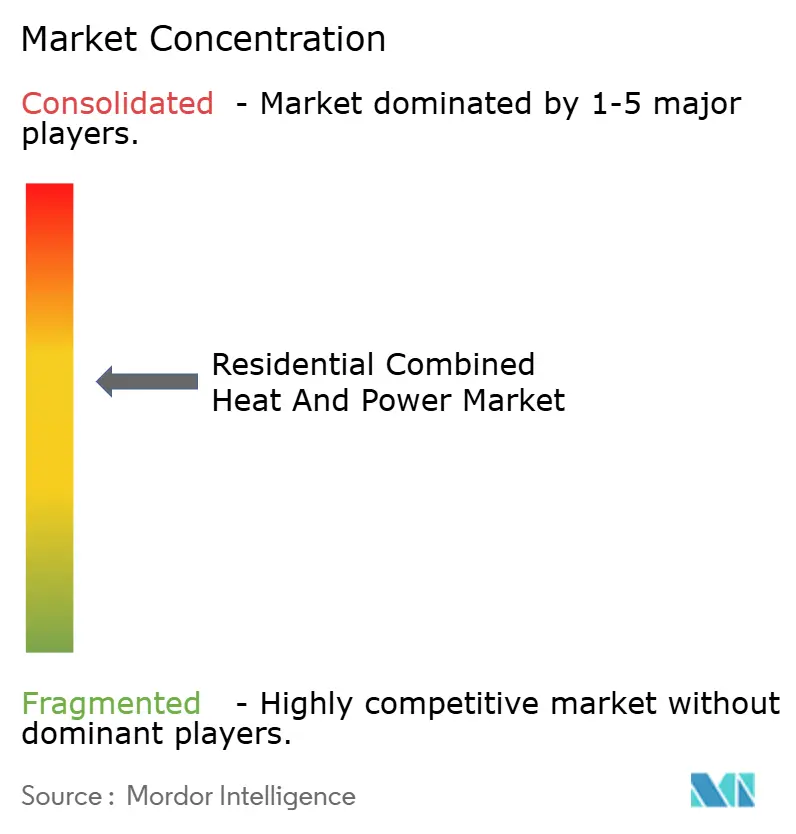
| Market Concentration | Medium |
Major Players *Disclaimer: Major Players sorted in no particular order Image © Mordor Intelligence. Reuse requires attribution under CC BY 4.0. | |
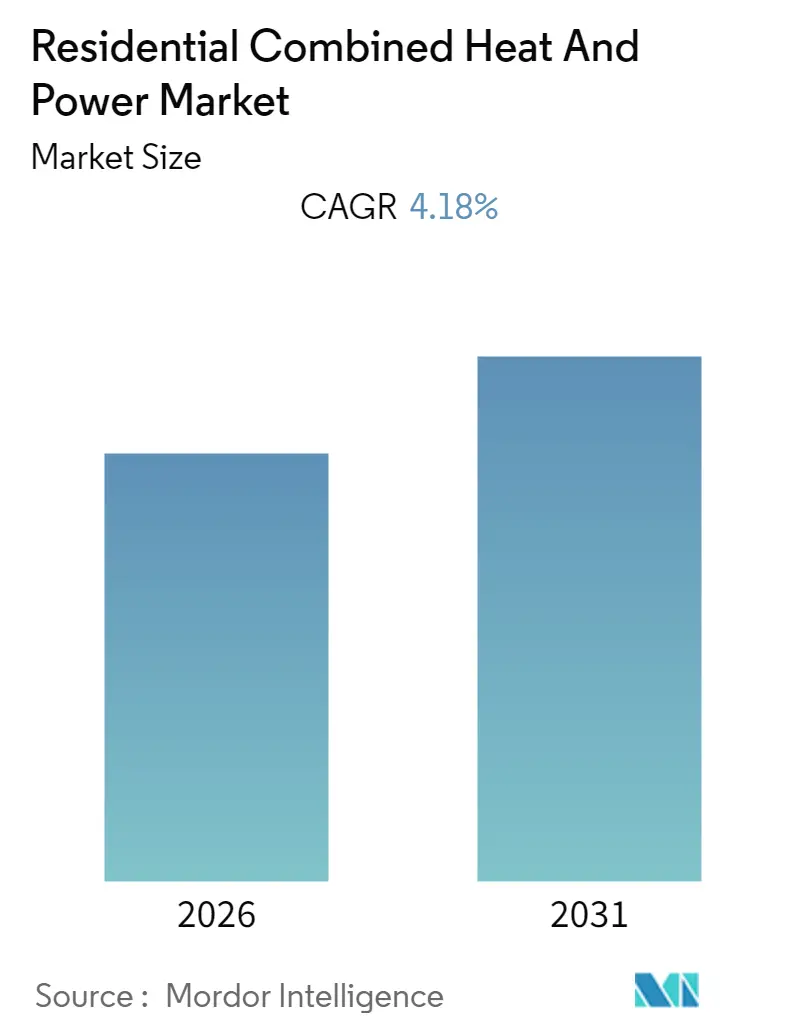
Residential Combined Heat And Power Market Analysis by Mordor Intelligence
The Residential Combined Heat And Power Market size is expected to register a CAGR of 4.18% during the forecast period.
The Residential Combined Heat and Power Market is expected to register a CAGR of greater than 4% during the forecast period.
- Engine-based CHP is expected to dominate the market in the forecast period, owing to various factors such as an increase in power generation from low greenhouse gas-emitting systems due to rising concerns over greenhouse gas emissions, and economic aspects.
- The increasing demand for clean and efficient electrical energy to sustain global development requires consistent investments in the development of combined heat and power systems. This has helped the market for combined heat and power systems to grow in recent years and is expected to do so in the forecast period.
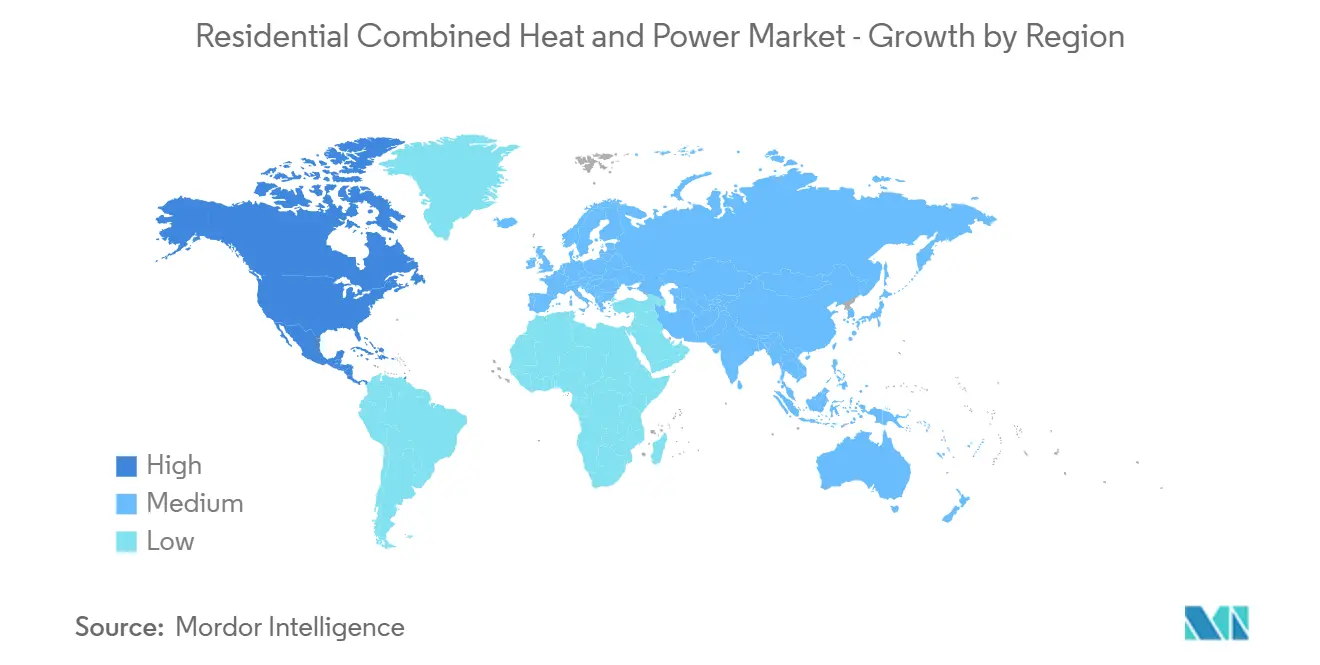
- North America is expected to lead the market, with the majority of the demand coming from countries such as Canada and the USA, owing to factors like a strong natural gas distribution network in the mentioned countries, an increase in the number of gas-based power generation plants, and rising demand for clean and stable energy for both electricity generation and heat generation.
Note: Market size and forecast figures in this report are generated using Mordor Intelligence’s proprietary estimation framework, updated with the latest available data and insights as of 2026.
Market Trends and Insights
Engine Based to Dominate the Market
- The Engine based residential combined heat and power systems are expected to dominate the market in terms of market share, due to the factors like ease of use, no loss in transmission and its relatively matured technology compared to fuel cell based combined heat and power systems.
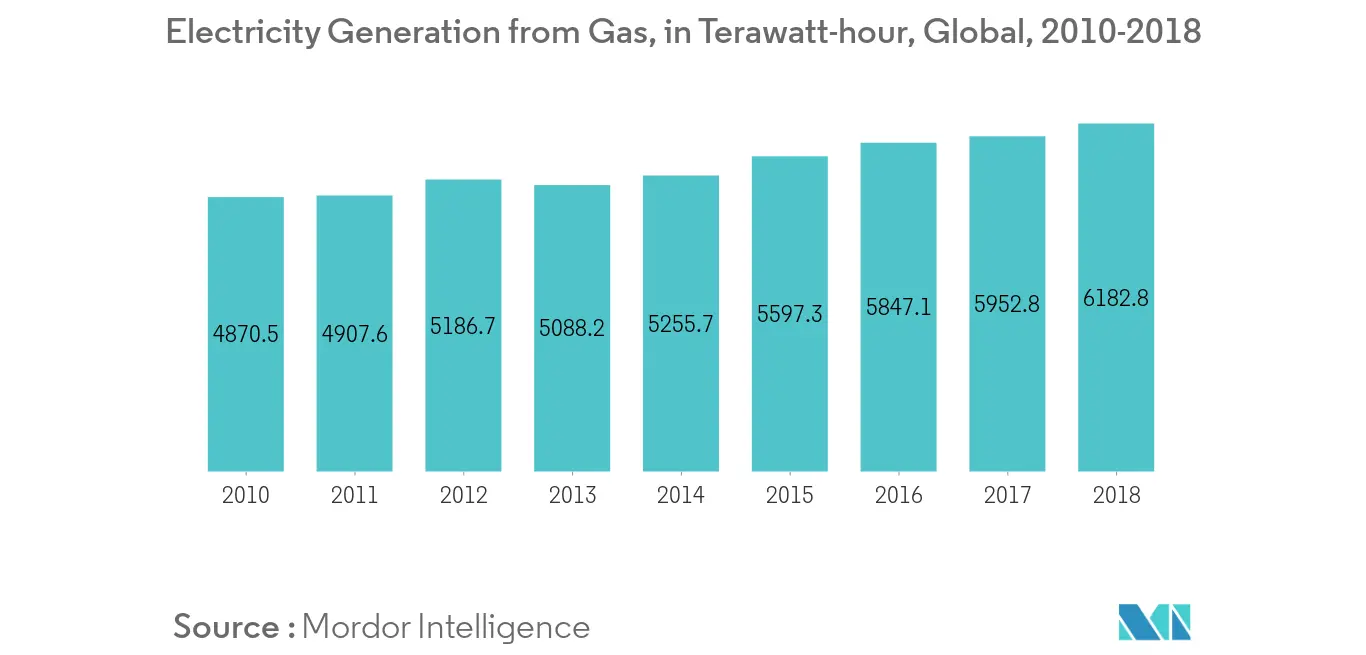
- The increase in the production of natural gas has shifted the global focus on the development of gas-fired CHP systems. The greenhouse gases emitted from gas-fired CHP are comparatively lower than that emitted from coal-fired power plants. Moreover, the demand for peak power is increasing globally, which can be most effectively met by gas-based power generation.
- For residential buildings the on-site electricity generation from engine based CHP have proved to save up to 40% of primary energy when compared to conventional electricity supply from central grids.
- The electricity consumption rose more than primary energy consumption, with increases at 4% and 2.3%, respectively. The electricity demand increased more than overall energy growth because more people got access to electricity.
- Therefore, factors such as increased demand of heat and electricity, economical superiority of CHP over conventional electricity supply, reduction in transportation and distribution losses, and increased concerns over greenhouse gas emissions from coal based power plants, are expected to help drive the market in forecast period.
North America to Dominate the Market
- North America has dominated the combined heat and power market in 2018 and is expected to continue its dominance in the coming years as well. A reliable and resilient grid is critical to the economic growth and energy security of countries like the United States. As the country's grid interconnects a growing number of renewable energy sources, such as wind and solar, the intermittent nature of power generation from these sources is creating challenges for power system operations. Electric utilities and other system operators are facing an increasing and immediate need for additional power to keep the electric grid stable and secure.
- Due to aging transmission and distribution network of the USA, Canada, and China, CHP is seen as an attractive option for heat and electricity generation, due to the requirement of no transmission network and low carbon emission, which, in turn, is expected to support the significant growth of the market in North American region.
- As of August 2018, there were 81.3 GWs of CHP installed at more than 4,400 sites around the United States and its territories. There were 111 new CHP installations in the country, representing 554 megawatts of new capacity in 2017. The states with the most new CHP installations were New York (53), New Jersey (10), California (5), and Pennsylvania (5).
- Therefore, the aforementioned factors are expected to drive the market in forecast period, similar to the trend witnessed in recent years.
Regulatory Landscape
Residential CHP policy signals are increasingly framed around building decarbonization and heat-electrification measures rather than stand-alone CHP mandates. In the United Kingdom, the Clean Heat Market Mechanism (CHMM) sets manufacturer obligations that rise in Year 2 (starting 1 April 2026) to 8% of relevant boiler sales, with compliance tied to Microgeneration Certification Scheme (MCS) certification, while the Boiler Upgrade Scheme (BUS) was amended in 2026 to extend support to 2030 and broaden eligible technologies (including air-to-air heat pumps) with modified EPC-related eligibility requirements.
In the European Union, the Energy Performance of Buildings Directive recast (EU) 2024/1275 requires member states to transpose provisions by 29 May 2026, tightening the framework that governs heating system choices and building renovation trajectories. High-efficiency cogeneration remains recognized under the EU energy-efficiency framework, including requirements for member-state assessment of cogeneration potential and for high-efficiency cogeneration to demonstrate primary energy savings and meet applicable carbon-related criteria, which raises the compliance bar for residential CHP offerings in building upgrades.
Value Chain Analysis
The residential CHP value chain starts with upstream raw materials and critical components, such as steel housings, electronic controls and power electronics, generators, and heat exchangers, and for fuel-cell systems, stacks and catalysts. Midstream work includes OEM design and assembly of engine-based micro-CHP units and fuel-cell micro-CHP systems, certification and controls integration, and packaging with balance-of-plant, followed by systems integration for household electrical and thermal interfaces.
Downstream, go-to-market channels include OEM-direct sales, regional distributors, and HVAC installers and energy-service partners that handle siting, installation, commissioning, and ongoing maintenance, with permitting and interconnection support depending on local rules. Partnerships and integrator models are used to expand route-to-market and installation capability, including EC Power Inc. finalizing a distribution agreement (April 2025) for its XRGI25 CHP system and Global Clean Energy, Inc. launching a cogeneration division (May 2025) with agreements covering small CHP units and SOFC stack integration for North American deployments.
Competitive Landscape
The residential combined heat and power market is consolidated, with major players holding a big share of the market. Some of the major companies are BDR Thermea Group B.V., Yanmar Holdings Co. Ltd, Vaillant Group, Centrica PLC, and Clarke Energyamong others.
Residential Combined Heat And Power Industry Leaders
-
BDR Thermea Group B.V.
-
Yanmar Holdings Co. Ltd
-
Centrica PLC
-
Clarke Energy
-
Vaillant Group Ltd
- *Disclaimer: Major Players sorted in no particular order
Residential Combined Heat And Power Market Companies Covered in this Report
- BDR Thermea Group
- Yanmar Holdings Co. Ltd
- Vaillant Group
- Centrica Plc
- Clarke Energy A Kohler Company
- Cummins Inc.
- Aisin Group
- Capstone Turbine Corporation
- Remeha
Read Analysis of Residential Combined Heat And Power Companies
Market Opportunities and Future Outlook
Policy-driven home electrification programs are expanding the addressable customer base for whole-home energy upgrades and create space for hybrid configurations where residential CHP is paired with building efficiency, thermal storage, and controls. New York's Clean Heat planning cycle provides a near-term program anchor, with incentives for projects in small residential one- to four-family homes beginning in 2026, and NYSERDA introducing a Heat Pump Ready Specification in early 2026 that can shape how contractors scope weatherization, controls, and heating equipment packages.
At the same time, government funding and rebate platforms are influencing residential purchase decisions and contractor workflows, which CHP suppliers can align with resilient on-site power and heat use cases in gas-networked homes. The UK has committed GBP 6 billion in public funding from 2025 to 2028 for home decarbonization and extended the Boiler Upgrade Scheme support horizon (via amendments extending the scheme to 2030), while California launched Phase I of the Home Electrification and Appliance Rebates (HEEHRA) program in October 2024 and is developing Phase II through the California Energy Commission. In practice, these program structures increase the value of certified installation networks, compliant product documentation, and bundled offers that fit within incentive rules and building upgrade specifications.
Recent Industry Developments in Residential Combined Heat And Power Market
- June 2026: Yanmar unified Controlled Air, Yanmar Energy Systems, and TEDOM under Yanmar Energy Systems North America, Inc. (YESNA) in Branford, Connecticut. The consolidation centralizes sales, engineering, and service capabilities for cogeneration and on-site energy systems across North America. A unified operating structure can streamline channel management and lifecycle support, which are critical for residential and small-scale CHP deployments that depend on installer and service coverage.
- April 2026: Centrica partnered with Delta Electronics to launch a scalable off-grid power solution built around solid oxide fuel cells for energy-intensive users such as data centers. The collaboration expands commercialization pathways for fuel-cell-based on-site generation and associated power electronics integration. Although oriented to larger behind-the-meter loads, it reflects supplier investment and supply-chain attention toward high-efficiency fuel-cell platforms that also inform micro-CHP technology development.
- July 2024: Yanmar announced a demonstration of hydrogen-blended cogeneration, advancing fuel-flexible CHP operation for decarbonization pathways. The initiative highlights ongoing R&D and validation activity around using hydrogen blends in CHP systems rather than relying only on conventional natural gas. Demonstrations of this type support product positioning in regions pursuing low-carbon gaseous fuels and can influence future certification and installer readiness.
Residential Combined Heat And Power Market Report Scope and Research Methodology
Market Definition and Coverage
For this study, the residential combined heat and power market covers small-scale CHP systems installed at homes that produce electricity and usable heat from a single fuel source. The market value counted is the equipment sold for residential use across major regions.
Scope exclusions: utility-scale CHP, industrial and commercial CHP, district heating plants, and standalone boilers or generators not configured as CHP are excluded.
Segments Covered in This Report
- Type
- Fuel Cell Based
- Engine Based
- Geography
- North America
- Europe
- Asia-Pacific
- South America
- Middle-East and Africa
Data Sources, Market Sizing, and Validation
Desk Research
Desk work was used to map the home energy demand environment and anchor assumptions that are hard to infer from company claims alone. We relied on public energy and policy datasets such as the International Energy Agency, the US Energy Information Administration, Eurostat, and country energy ministries and regulators, along with standards and technical references from bodies such as ISO and IEC.
To translate that context into sizing inputs, we also reviewed company annual reports, investor presentations, product specification sheets, and reputable press coverage on residential micro-CHP rollouts and subsidies. Patent databases were checked to understand technology direction (fuel cell versus engine based), and an import and export shipment-level database was used selectively to sanity check cross-border equipment flows where disclosure was thin. These source examples are not exhaustive, and many other public references were used for data collection, validation, and clarification during the work.
Primary Interviews and Surveys
Primary calls and structured surveys were used to validate adoption patterns, typical system sizing for homes, and pricing ranges by technology and region, especially where public datasets lag the market. Interviews covered manufacturers, distributors and installers, utilities and energy service players, and subject experts across APAC, EMEA, and the Americas, so penetration, replacement cycles, and incentives could be cross-checked from more than one viewpoint.
Distribution of primary research fieldwork respondents
| Company type | Respondent position | Region |
|---|---|---|
| Top tier: 32% | CXOs: 12% | APAC: 44% |
| Mid tier: 47% | Functional/Unit leaders: 30% | EMEA: 32% |
| Smaller Players: 21% | Managers: 58% | Americas: 24% |
Market-Sizing & Forecasting
Sizing starts with a top-down build that reconstructs the addressable residential demand pool from housing stock, heating demand indicators, and policy-linked microgeneration adoption. That pool is then filtered by practical CHP suitability for the home segment. The totals are corroborated through selective bottom-up checks using sampled unit shipments and installed base signals, combined with ASP bands by technology. When these checks point to gaps, we adjust the assumptions.
Inputs that most often move the model include residential new-build and retrofit activity, household gas network access, average heat load profiles and seasonal usage, incentive coverage for microgeneration, and the fuel mix trend that affects technology choice between engine systems and fuel cell systems. For pricing, we use observed ASP ranges by capacity class, and we apply learning-rate style declines only when it is supported by repeated primary feedback and public product updates. Forecasting is run using scenario analysis, where policy continuity, energy price direction, and installation capacity constraints are translated into high, base, and low adoption paths, and the final view is kept close to the base case that experts consider workable.
Where bottom-up signals are incomplete in a country, we bridge the gap by using comparable-market penetration ratios. We only carry those ratios forward when installers and distributors confirm the direction in follow-up discussions.
Data Validation & Update Cycle
Outputs are checked against independent signals such as implied unit volumes, housing activity, and reported microgeneration program uptake. Any large variances are flagged for rework. Before sign-off, the model goes through multi-step analyst review, and respondents are re-contacted when an input swings the result beyond an expected range (for example, a sudden incentive change or an outlier ASP shift).
The report is refreshed annually, and interim updates are made when material events occur, such as major policy revisions or supply constraints that affect residential installations. Right before delivery, we do a final pass to ensure the latest public statistics and validated assumptions are reflected in the numbers.
Mordor Intelligence's Global Residential Combined Heat and Power Market Size Compared Against Other Published Estimates
Published market sizes for residential CHP do not always line up because the boundary of what is counted can change, and the year and currency timing can also shift the headline number. In this topic, the biggest swings usually come from whether a source treats micro-CHP as only home installations or quietly blends in light commercial systems, and whether the value is equipment-only or includes installation and long-term service.
Observed installation momentum in incentive-led countries, along with cross-checked unit shipment signals and typical ASP bands, are the evidence points that keep Mordor Intelligence's estimate tied to residential-only equipment revenues instead of broader distributed generation spend. Differences in how fuel cell systems are priced versus engine systems, how fast ASPs are assumed to fall, and how quickly policy changes are reflected in the model also explain why two publishers can land far apart even when they use similar growth language.
Benchmark comparison
| Source | Market Size | Gaps in Research Methodology |
|---|---|---|
| Mordor Intelligence | USD 3.08 B (2025) | |
| Industry Publisher A | USD 9.10 B (2025) | This estimate appears to use a wider value boundary that can inflate totals, especially if installation, service, or adjacent small commercial systems are included alongside residential equipment. |
| Trade Research Group B | USD 2.68 B (2024) | This figure is scoped to residential micro-CHP and is stated for a different base year, and it can land lower if it narrows technology coverage or uses conservative ASP progression between years. |
The table shows that most of the spread is explained by scope and value-chain choices, followed by base-year timing and pricing assumptions. By keeping the counting rules clear, and then checking the result against adoption and shipment signals, we end up with a market value that is easier to trace back to real residential demand drivers.
Key Questions Answered in the Report
What is the current Residential Combined Heat and Power Market size in 2026?
The Residential Combined Heat & Power System Market is projected to register a CAGR of 4.18% during the forecast period (2026-2031).
Who are the key players in Residential Combined Heat and Power Market?
BDR Thermea Group B.V., Yanmar Holdings Co. Ltd, Centrica PLC, Clarke Energy and Vaillant Group Ltd are the major companies operating in the Residential Combined Heat & Power System Market.
Which is the fastest growing region in Residential Combined Heat and Power Market?
North America is estimated to grow at the highest CAGR over the forecast period (2026-2031).
Which region has the biggest share in Residential Combined Heat and Power Market?
In 2025, the North America accounts for the largest market share in Residential Combined Heat & Power System Market.
What years does this Residential Combined Heat and Power Market cover?
The report covers the Residential Combined Heat & Power System Market historical market size for years: 2020, 2021, 2022, 2023 and 2024. The report also forecasts the Residential Combined Heat & Power System Market size for years: 2026, 2027, 2028, 2029, 2030 and 2031.