
Ultraviolet Disinfection Equipment Market Size and Share
Market Overview
| Study Period | 2021 - 2031 |
|---|---|
| Market Size (2026) | USD 7.22 Billion |
| Market Size (2031) | USD 13.56 Billion |
| Growth Rate (2026 - 2031) | 13.45 % |
| Fastest Growing Market | Asia Pacific |
| Largest Market | Asia Pacific |
| Market Concentration | Medium |
Major Players *Disclaimer: Major Players sorted in no particular order Image © Mordor Intelligence. Reuse requires attribution under CC BY 4.0. | |
Ultraviolet Disinfection Equipment Market Analysis by Mordor Intelligence
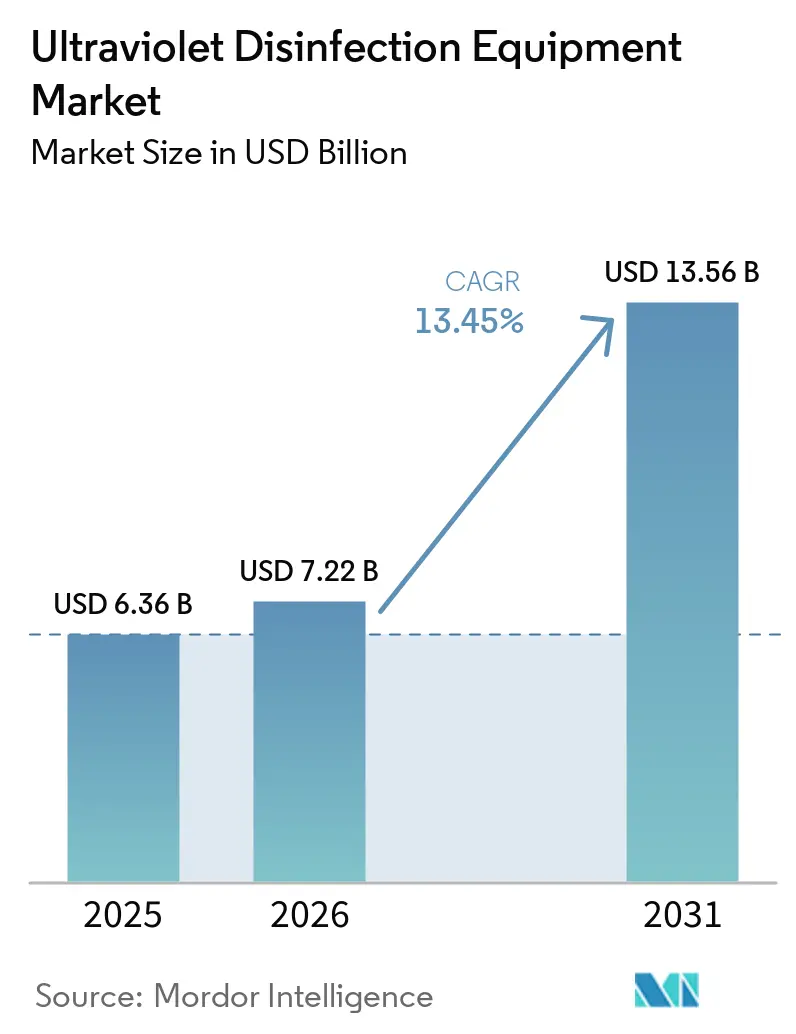
The Ultraviolet disinfection equipment market size is expected to grow from USD 6.36 billion in 2025 to USD 7.22 billion in 2026 and is forecast to reach USD 13.56 billion by 2031 at 13.45% CAGR over 2026-2031. Heightened global concerns about chemical-free disinfection, tightening PFAS and DBP standards, and rapid UV-C LED cost declines are reinforcing long-run demand. Far-UVC research is widening the technology’s addressable space, while vertical integration across the semiconductor supply chain is emerging as a decisive competitive edge. Meanwhile, service-based revenue models are gaining traction as utilities and hospitals prioritize predictable lifecycle costs. These simultaneous shifts point to a structurally larger addressable pool for the Ultraviolet disinfection equipment market across municipal utilities, healthcare facilities, and commercial real estate.
Key Report Takeaways
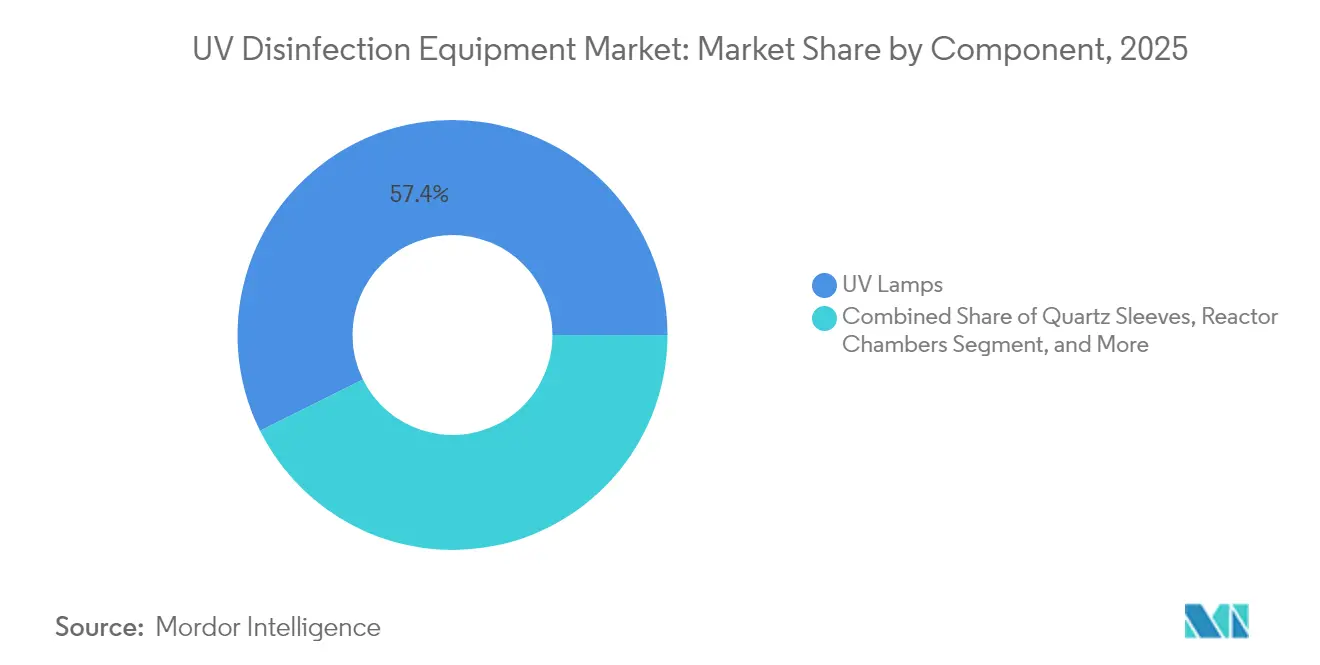
- By component, UV Lamps retained 57.35% of the Ultraviolet disinfection equipment market share in 2025; UV-C LED systems deliver the fastest growth at an 17.65% CAGR through 2031.
- By power rating, medium-power units (10-999 kW) led with 48.20% revenue share in 2025, while low-power units (<10 kW) are expanding at a 14.35% CAGR to 2031.
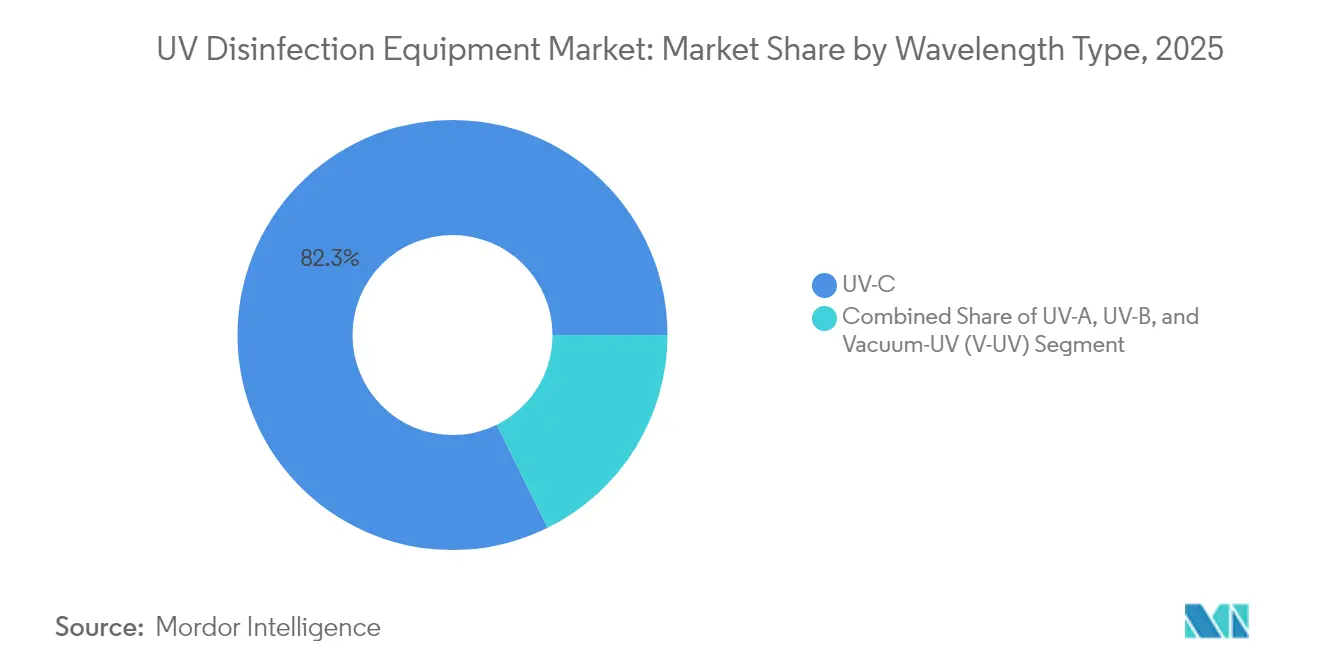
- By wavelength, UV-C held 82.30% share of the Ultraviolet disinfection equipment market size in 2025; vacuum-UV solutions are projected to compound at 18.55% to 2031.
- By mobility, fixed installations commanded 65.10% of 2025 revenue, whereas portable towers post the highest CAGR at 15.05% through 2031.
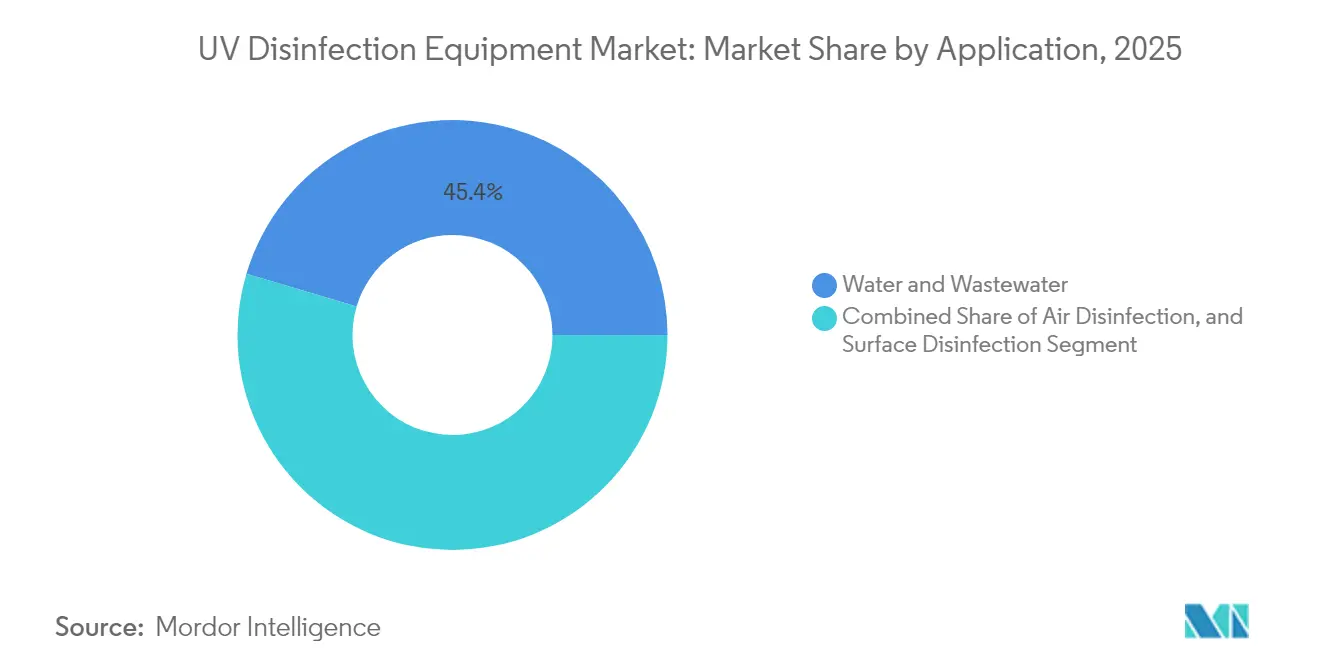
- By application, water and wastewater solutions represented 45.40% of the Ultraviolet disinfection equipment market in 2025; air disinfection systems are poised for a 14.7% CAGR.
- By end-user, municipal utilities generated 37.40% of 2025 revenue; healthcare institutions are the fastest riser at 15.05% CAGR across 2026-2031.
- By geography, Asia Pacific accounted for a 33.60% share of the Ultraviolet disinfection equipment market in 2025, and it is set to expand at a 14.05% CAGR during the forecast horizon.
Note: Market size and forecast figures in this report are generated using Mordor Intelligence’s proprietary estimation framework, updated with the latest available data and insights as of 2026.
Market Trends and Insights
Drivers Impact Analysis of Ultraviolet Disinfection Equipment Market*
| Driver | (~) % Impact on CAGR Forecast | Geographic Relevance | Impact Timeline |
|---|---|---|---|
| PFAS & DBP regulations in municipal water | +4.8% | North America & EU | Medium term (2-4 years) |
| UV-C LED retrofits in commercial HVAC | +3.4% | North America & Asia Pacific | Short term (≤ 2 years) |
| Zero-chemical mandates in food & beverage | +2.7% | Global | Medium term (2-4 years) |
| Water-reuse projects in GCC economies | +2.1% | Middle East | Long term (≥ 4 years) |
| Infection-control spending in Western Europe | +1.4% | Europe | Short term (≤ 2 years) |
| Source: Mordor Intelligence | |||
Stricter PFAS & DBP Regulations Accelerating UV Adoption in Municipal Drinking-Water
New PFAS limits finalized by the United States Environmental Protection Agency and parallel European moves are forcing utilities to seek advanced oxidation processes that do not increase chemical residuals. UV-based AOP trains deliver up to 99% PFAS removal and concurrently suppress chlorine demand, lowering trihalomethane formation by 37% at the Sweeney Water Treatment Plant. These dual-compliance benefits, together with falling LED prices, are scaling procurement pipelines.
Rapid Uptake of UV-C LED Retrofit Modules in Commercial HVAC
Demand-controlled ventilation strategies now pair instant-on UV-C LEDs with smart building systems. Coil efficiency gains of 10-20%, documented payback periods under 24 months, and 90% airborne pathogen reductions are propelling adoption in the United States and Japan.[1]Building owners value low lifecycle costs and easier maintenance versus mercury lamps.
Rising Zero-Chemical Mandates by Food & Beverage Majors
Global food processors targeting residue-free operations before 2028 are deploying UV-C for surface, air, and process-water treatment. Three-log pathogen reductions and two-day shelf-life extensions were recorded in ready-to-eat lines without moisture or chemicals that support microbial regrowth.[2]This driver adds direct equipment demand and recurring service opportunities.
Hospital Infection-Control Spending Surge in Western Europe
Western European hospitals face antibiotic resistance pressures and staffing constraints. UV-C room devices reduce healthcare-associated infections by up to 30% and cut cleaning labor, generating annual savings of roughly EUR 605 per bed. Procurement frameworks now include UV as standard for isolation wards, driving steady equipment replacement cycles.
Restraints Impact Analysis of Ultraviolet Disinfection Equipment Market*
| Restraint | (~) % Impact on CAGR Forecast | Geographic Relevance | Impact Timeline |
|---|---|---|---|
| High USD/mW Cost of Deep-UV LEDs vs. Low-Pressure Mercury Lamps | -2.7% | Global | Medium term (2-4 years) |
| Shadowing & Turbidity Challenges in Industrial Wastewater | -2.1% | Global, with higher impact in Asia Pacific | Short term (≤ 2 years) |
| Minamata-Driven Phase-out Complexity for Legacy Hg-Lamp Stock | -1.8% | Global | Medium term (2-4 years) |
| Fragmented Certification Standards in ASEAN | -1.2% | Asia Pacific | Long term (≥ 4 years) |
| Source: Mordor Intelligence | |||
High USD/mW Cost of Deep-UV LEDs vs. Low-Pressure Mercury Lamps
Average wall-plug efficiency for deep-UV LEDs trails mercury sources, inflating capital outlays for high-flow installations. The differential exceeds 300% in some municipal projects, delaying large-scale LED rollouts. Annual efficiency gains near 20% and escalating mercury restrictions are narrowing the gap, yet economic parity is unlikely before 2027, constraining the Ultraviolet disinfection equipment market in cost-sensitive segments.
Shadowing and Turbidity Challenges in Industrial Wastewater
High suspended solids and color frequently shield microbes from UV exposure, reducing log inactivation rates by 30-50% in industrial streams versus municipal water.[4]Extensive pre-treatment or oversized reactors raise costs, limiting uptake in textiles and petrochemicals where conditions fluctuate widely.
*Our forecasts treat driver/restraint impacts as directional, not additive. The impact forecasts reflect baseline growth, mix effects, and variable interactions.
Ultraviolet Disinfection Equipment Market Segment Analysis
By Component:
UV-C LEDs Disrupting Traditional Lamp DominanceThe Ultraviolet disinfection equipment market share for component UV Lamps secured 57.35% of revenue. Solid-state UV-C LED systems, however, are compounding at 17.65% and eroding lamp dominance by removing mercury, shortening warm-up time, and integrating seamlessly with IoT-enabled controls. The Ultraviolet disinfection equipment market share of LED units is on course to exceed 25% by 2031 as cost curves improve. Auxiliary sensors are rising in importance, providing real-time irradiance verification that satisfies tightening audit trails. Reactor chambers now leverage optimized hydraulics and advanced quartz coatings to mitigate shadowing, while smart ballasts enable predictive maintenance that lowers lifecycle costs by 25%.
Complementing these shifts, vertically integrated suppliers bundle LED engines, drivers, and monitoring software into single-OEM packages, making procurement easier for smaller utilities. Capital allocations are also moving from upfront equipment to multiyear service agreements that combine hardware refresh, sensor calibration, and analytics under one fee. This favours manufacturers with field-service networks and cloud support platforms.

By Power Rating:
Low-Power Systems Gaining MomentumMedium-power assemblies (10-999 kW) generated the bulk of installations in 2025 at48.20% share, but low-power systems beneath 10 kW are expanding rapidly with a 14.35% CAGR in residences, dental clinics, and point-of-use devices. Instant-on LEDs suit intermittent duty cycles, lowering energy use and room-by-room disinfection deployments. Meanwhile, high-power reactors above 1 MW remain indispensable for mega-plants yet face limited green-field prospects in saturated OECD markets. In developing economies, urban growth still supports steady medium-power demand, though decentralised treatment pilots are starting to divert incremental capital toward clustered low-power nodes.
Technology roadmaps reveal that next-generation LED chips can achieve 180 mW optical power at reduced cost, letting manufacturers reconfigure smaller arrays into flexible cartridge formats. Such cartridges simplify field replacement and slash downtime, an attractive proposition for hospitality chains and small hospitals. As a result, service models charging per-operating-hour rather than per-unit are expected to accelerate low-power unit penetration during 2026-2031.
By Wavelength Type:
Vacuum-UV Emerging as Disruptive TechnologyUV-C wavelengths currently underpin 82.30% of revenue due to decades of empirical performance data and established validated log-credit tables. Yet vacuum-UV systems, emitting below 200 nm, exhibit superior oxidation of recalcitrant organics and are posting the fastest CAGR at 18.55%. Academic studies show enhanced breakdown of micropollutants, encouraging utilities in Japan and Germany to pilot combined UV-C + V-UV reactors for integrated pathogen and chemical control. Far-UVC (200-230 nm) devices add another frontier by inactivating viruses in occupied spaces without damaging human tissue; controlled trials record 98.4% airborne pathogen reduction.
Manufacturers are redesigning reactor geometries to exploit multipass exposure and minimize ozone production. Meanwhile, niche UV-A and UV-B products continue serving photocatalysis and curing lines where disinfection is secondary. This diversified wavelength toolkit strengthens the Ultraviolet disinfection equipment market, letting suppliers match specific contaminants and regulatory endpoints in one modular platform.
By Mobility:
Portable Systems Addressing Flexibility DemandsFixed reactors integrated into pipes, basins, and air-handling units represented 65.10% of 2025 revenue, reflecting the embedded base in municipal and industrial plants. Portable towers, robots, and cart systems, however, enjoy a 15.05% CAGR as hospitals, airlines, and event venues deploy them for spot treatment. Instant-feedback sensors show users dose delivery, building trust and supporting compliance documentation. The Ultraviolet disinfection equipment market size for mobile units reached USD 1.28 billion in 2025 and is poised to double by 2031.
In-duct retrofits offer a hybrid pathway by mounting UV arrays in existing HVAC plenums without major teardown. Retail chains have begun specifying retrofits in lease contracts to standardize indoor-air quality across portfolios. Robotics researchers are exploring autonomous navigation and real-time mapping to extend UV coverage into cluttered spaces, aligning with workforce-shortage trends and infection-control mandates
By Application:
Air Disinfection Experiencing Rapid GrowthWater and wastewater treatment remained the core application, capturing 45.40% of 2025 turnover. Persistent regulatory obligations for cryptosporidium removal and PFAS compliance make UV indispensable. Nonetheless, air disinfection units are scaling quickest at 14.7% CAGR, driven by workplace wellness programs, school air-quality grants, and mass-transit upgrades. UV-C LED arrays embedded in supply ducts cut pathogen counts without adding pressure drop, a critical differentiator in energy-constrained retrofits.
Surface disinfection equipment is gaining prominence in electronics assembly, where chemical residues can damage sensitive components. Food processors employ conveyor-mounted UV tunnels to extend shelf life and limit recall risk. Industrial process-water use cases remain robust in pharmaceuticals and microelectronics, which require ultrapure water free of biofilm. Collectively, cross-application synergies reinforce platform vendors that can offer unified control dashboards and standardized spare parts.
By End-user:
Healthcare Institutions Leading AdoptionMunicipal utilities held 37.40% of spending in 2025, reflecting large-scale fixed assets and regulatory drivers. Hospitals, clinics, and long-term-care facilities clock a 15.05% CAGR as infection-control budgets rise. Peer-reviewed studies measuring 30% HAI reduction and rapid payback invigorate procurement pipelines. Industrial manufacturers adopt UV to support zero-chemical targets, while commercial office owners integrate UV into wellness certifications to attract tenants. Residential and aquaculture niches, though smaller, benefit from compact LED modules that simplify installation and monitoring.
Hospitals are integrating UV into both room disinfection robots and in-line water systems feeding ice machines and endoscopy devices. Insurance carriers in Europe now credit UV deployment in premium calculations, providing an indirect financial incentive. Meanwhile, fish hatcheries report higher survival rates when UV is used to control waterborne pathogens, a promising extension segment.
Geography Analysis
APAC Ultraviolet Disinfection Equipment Market
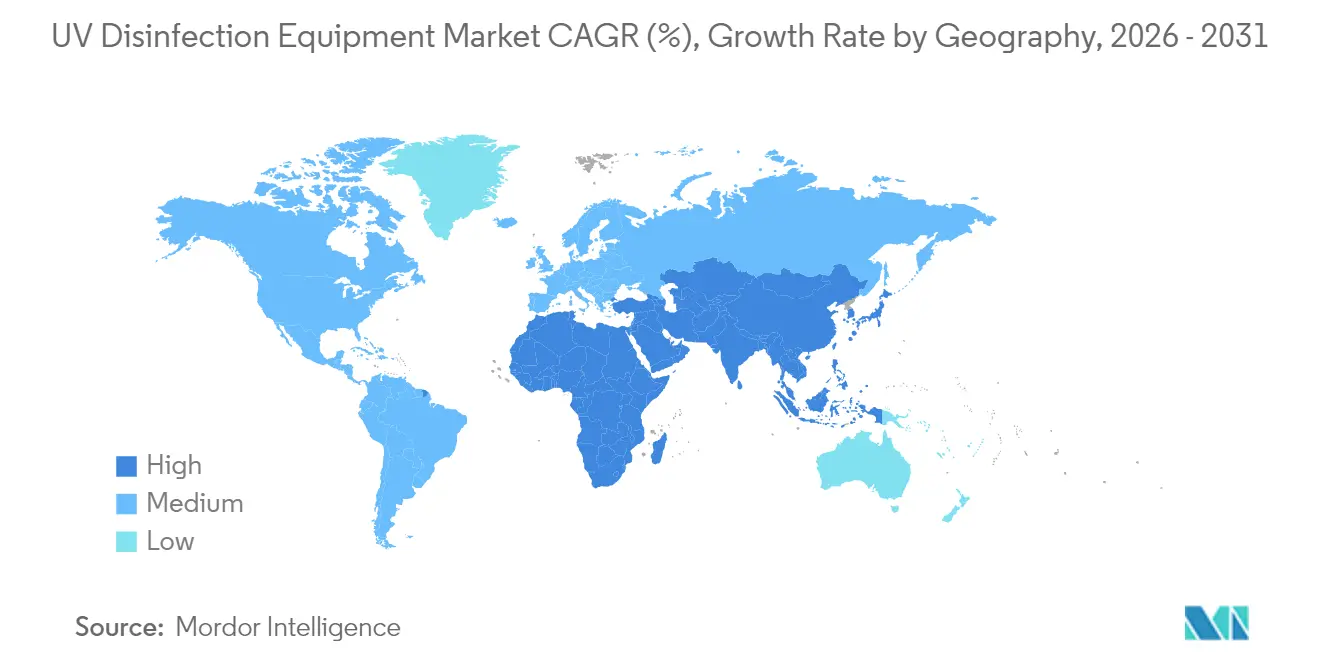
Asia Pacific commanded a 33.60% revenue share in 2025, the highest among all regions, and is projected to grow at an 14.05% CAGR through 2031. China’s 14th Five-Year Plan emphasizes UV investments in tier-two municipalities, and Japan’s leadership in deep-UV semiconductors compresses regional LED costs. India and Australia, facing chronic water scarcity, are scaling potable-reuse projects that embed UV as the primary disinfection barrier. Southeast Asian nations, led by Indonesia and Vietnam, are expanding seafood exports, driving aquaculture UV demand. Collectively, these factors reinforce a broad installation base and spur local manufacturing clusters, ensuring the Ultraviolet disinfection equipment market maintains regional momentum.
North America Ultraviolet Disinfection Equipment Market
North America remains a technologically advanced arena with steady replacement demand. The EPA’s PFAS rule is a critical catalyst, propelling utilities toward UV-AOP combinations. Hospitals in the United States document 30% HAI reductions post-UV deployment, underpinning incremental procurement. Office developers include UV-ready HVAC specifications to meet WELL and LEED standards. Canada’s regulatory harmonization with U.S. PFAS limits will further stimulate cross-border equipment sales. Ongoing infrastructure grants channel public spending to mid-sized municipalities, sustaining medium-power reactor orders.
EMEA Ultraviolet Disinfection Equipment Market
Europe shows mature penetration but continues to innovate. The revised EU Drinking Water Directive introduces emerging contaminant monitoring, pushing utilities to adopt multi-barrier trains featuring UV. Water-scarce Mediterranean states invest in reuse plants, while Scandinavia pilots Far-UVC systems in public transport. Western European hospitals allocate larger infection-control budgets, and Germany’s industrial sector leverages UV to align with stringent green-chemistry rules. The Middle East and Africa, although smaller, outperform on growth rates due to GCC diversification programs that bundle UV into desalination and district-cooling assets.
Regulatory Landscape
Regulation for ultraviolet disinfection equipment is split by intended-use claims and the end-user setting. In the United States, the EPA treats UV products that claim to kill, repel, or suppress microorganisms as pesticide devices under FIFRA, focusing on establishment registration and controls on labeling and marketing claims rather than pre-market registration. This pushes vendors in air and surface disinfection to build compliance programs around claim substantiation, compliant labels, and traceable manufacturing in EPA-registered establishments.
For healthcare-oriented equipment, the U.S. FDA regulates ultraviolet radiation chamber disinfection devices as Class II medical devices under 21 CFR 880.6600 (product code SCS) with special controls and premarket pathways such as De Novo and 510(k). FDA activity provides recent anchors for this category, including an August 2024 De Novo classification for Chronos and a December 2025 510(k) clearance for UV Smart D60. The combination of EPA claim enforcement and FDA medical device controls raises the importance of integrated dose monitoring, audit trails, and quality system readiness in supplier selection.
Value Chain Analysis
The value chain starts with UV source technologies, including low and medium-pressure mercury lamps, excimer sources such as 222 nm, and UV-C LEDs, alongside upstream materials like quartz sleeves, high-purity substrates, and epitaxy wafers for LEDs. Power and control electronics, such as drivers, ballasts, sensors, and embedded controls, also sit early in the stack. LED-centric supply is concentrated in East Asia, and 2025 conditions highlighted bottlenecks in high-purity aluminum nitride substrates and gallium nitride epitaxy wafers, stretching lead times for premium UV-LED modules into the 16-26 week range.
System OEMs and integrators then package these sources into validated reactors, in-duct retrofits, and mobile devices, with validation software and irradiance monitoring increasingly bundled to meet buyer documentation needs. Downstream, distribution and deployment split between municipal and industrial water and wastewater integrators, building and HVAC channels, and healthcare procurement frameworks, while aftersales service and proprietary spares form a critical annuity layer even when consumables are excluded from market revenue. Strategic partnerships between semiconductor providers and water-sterilization equipment makers point to tighter component-to-system development, for example, Nichia and MIURA collaborated (announced October 2025) on mercury-free UV-LED water sterilization equipment, increasing treatment capacity from 10 m3/h to 25 m3/h. Legacy lamp ecosystems still run alongside this transition, supported by established lamp suppliers and regional distribution hubs, while OEMs with field service networks use maintenance contracts and calibration programs to deepen installed-base lock-in.
Competitive Landscape
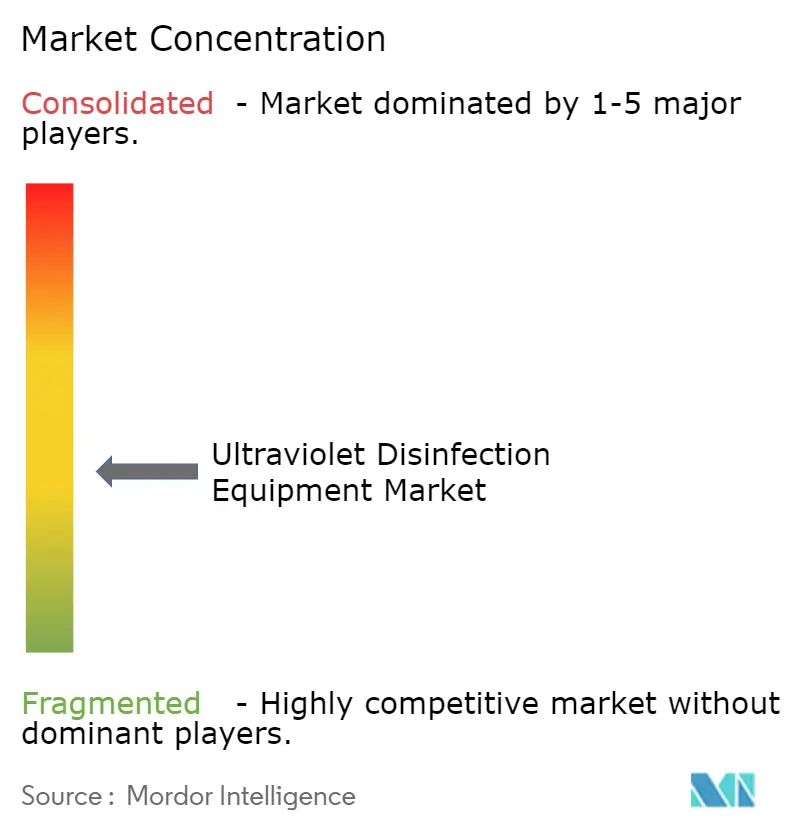
The Ultraviolet disinfection equipment market comprises diversified water-technology conglomerates and specialized LED innovators. The top five suppliers collectively hold roughly 45% of global revenue, pointing to moderate concentration. Strategic pivots toward service-centric models are evident as utilities and hospitals request performance guarantees and remote-monitoring dashboards. Xylem’s 2024 acquisition of Evoqua Water Technologies broadened its UV portfolio across municipal and industrial verticals, leveraging cross-selling opportunities. De Nora’s registered Sentinel platform integrates electronic ballasts that trim energy use, and the company reports an 18.8% EBITDA margin in its water segment.
LED-focused entrants such as AquiSense and Silanna UV exploit rising mercury restrictions and semiconductor know-how to undercut lamp incumbents on maintenance costs. AquiSense secured a Series A round to expand full-spectrum products. Vertically integrated LED makers de-risk chip supply and compress lead times, attracting OEM partnerships. Far-UVC pioneers like Uviquity are courting HVAC integrators to bring continuous air disinfection to high-occupancy space.
Innovation themes now center on improving wall-plug efficiency, integrating AI for dose control, and combining UV with membrane or electrodialysis units for multi-contaminant removal. Partnerships between equipment makers and cloud-analytics startups aim to deliver predictive maintenance and regulatory reporting dashboards, thereby locking in annuity-style revenue. Suppliers that pair hardware with data services are expected to capture disproportionate share growth during the forecast window.
Ultraviolet Disinfection Equipment Industry Leaders
-
Xylem Inc.
-
Trojan Technologies
-
Halma PLC
-
Severn Trent Services
-
Nichia Corporation
- *Disclaimer: Major Players sorted in no particular order
Ultraviolet Disinfection Equipment Market Companies Covered in this Report
- Xylem Inc.
- Trojan Technologies (Danaher)
- Halma plc (Aquionics, Hanovia)
- Evoqua Water Technologies LLC
- Signify N.V. (Philips UV-C)
- AquiSense Technologies
- Atlantic Ultraviolet Corp.
- American Ultraviolet
- Advanced UV Inc.
- Severn Trent Services
- Ultraaqua A/S
- Lumalier Corporation
- Nichia Corporation
- Heraeus Noblelight GmbH
- UV-technik Speziallampen GmbH
- Australian Ultra Violet Services Pty Ltd
- Hitech Ultraviolet Pvt Ltd
- UV Pure Technologies Inc.
- Aquafine (Watts Water)
- Excelitas Technologies (LumenDynamics)
- Light Progress Srl
Read Analysis of Ultraviolet Disinfection Equipment Companies
Market Opportunities and Future Outlook
A major whitespace sits in accelerating replacement and retrofit cycles tied to tightening chemical-byproduct and material policies. The EU RoHS framework still permits time-limited exemptions for mercury-containing UV lamps, but the expiry date is June 30, 2027 unless extended, which gives procurement teams a concrete timetable to qualify mercury-free alternatives across new builds and replacement programs. This creates room for UV-C LED-based platforms that can drop into existing hydraulics and HVAC footprints, particularly when paired with sensors and control units that provide irradiance verification and digital compliance records.
Another opportunity is standardization and utility-grade validation that broadens procurement confidence beyond pilots. Germany published DIN 19294-2:2026-04 and DIN 19294-4:2026-04 in April 2026, updating technical rules for medium-pressure UV applications, while safety certification frameworks such as ANSI/CAN/UL 8802:2023 provide a cross-border anchor for equipment safety requirements. On the demand side, municipal buyers are already awarding multi-site UV service work, as seen in February 2026 UK procurement covering multiple sites running Xylem and Trojan technology, reinforcing the pull for vendors that combine hardware with long-term maintenance, dose assurance, and reporting capabilities.
Recent Industry Developments in Ultraviolet Disinfection Equipment Market
- April 2026: The City of Wilsonville adopted Resolution No. 3259 authorizing a goods and services contract with Trojan Technologies to procure ultraviolet disinfection equipment for a Wastewater Treatment Plant Backup UV System Replacement project. The action highlights continued investment in redundancy and retrofit upgrades at existing plants, supporting demand for established UV platforms and OEM-supplied systems integration.
- February 2026: A UK government tender awarded UV disinfection maintenance services spanning 12 sites using Xylem technology and 3 sites using Trojan technology equipment. Multi-site maintenance awards reinforce the shift toward lifecycle service contracts and the importance of installed-base support capabilities in vendor selection.
- March 2024: The City of Toronto authorized a non-competitive contract with Trojan Technologies Group ULC for proprietary parts and maintenance services at the Ashbridges Bay Treatment Plant through March 31, 2027, totaling CAD 1,111,867. Long-dated, proprietary service arrangements underscore OEM lock-in dynamics and recurring aftermarket demand tied to municipal compliance and uptime requirements.
Ultraviolet Disinfection Equipment Market Report Scope and Research Methodology
Market Definition and Coverage
This market covers revenue generated from ultraviolet disinfection equipment sold for inactivating microorganisms in water, air, and on hard surfaces, using germicidal UV-C or vacuum-UV light in engineered systems such as reactors, ducts, and portable units.
Scope exclusions: We exclude consumables and aftersales items such as replacement lamps, gaskets, and maintenance services from the market value.
Segments Covered in This Report
- By Component
- UV Lamps
- Quartz Sleeves
- Reactor Chambers
- Ballasts and Control Units
- Auxiliary Sensors
- By Power Rating
- Low-Power ( Less than 10 kW)
- Medium-Power (10-999 kW)
- High-Power (1 MW and Above)
- By Wavelength Type
- UV-A
- UV-B
- UV-C
- Vacuum-UV (V-UV)
- By Mobility
- Fixed Systems
- Portable/Mobile Towers
- In-duct Retrofits
- By Application
- Water and Wastewater
- Drinking-Water Plants
- Industrial Process Water
- Municipal Wastewater
- Air Disinfection
- Hospital Rooms and Operating Theatres
- Commercial HVAC and AHU
- Transportation (Aircraft, Rail)
- Surface Disinfection
- Food and Beverage Processing Lines
- Pharmaceutical Cleanrooms
- Consumer Electronics Assembly
- Water and Wastewater
- By End-user
- Municipal Utilities
- Residential
- Commercial Facilities
- Industrial Manufacturing
- Healthcare Institutions
- Aquaculture and Marine
- By Geography
- North America
- United States
- Canada
- Mexico
- Europe
- Germany
- United Kingdom
- France
- Italy
- Spain
- Rest of Europe
- Asia-Pacific
- China
- Japan
- South Korea
- India
- South East Asia
- Rest of Asia-Pacific
- South America
- Brazil
- Rest of South America
- Middle East and Africa
- Middle East
- United Arab Emirates
- Saudi Arabia
- Rest of Middle East
- Africa
- South Africa
- Rest of Africa
- Middle East
- North America
Data Sources, Market Sizing, and Validation
Desk Research
Desk work starts by mapping where UV disinfection equipment demand comes from, and then linking it to measurable activity in water, air, and surface treatment. We rely on public sources such as the US EPA drinking water and wastewater guidance, USGS water-use series, WHO and CDC infection prevention publications, and UNEP materials on mercury and lamp transitions, which help anchor technology shifts.
To make the dataset usable, we also review customs and trade statistics, selected patent filings for UV-C and UV-LED designs, peer-reviewed journals on UV dose and reactor performance, and public association resources tied to water and building systems. Company annual reports, investor presentations, and reputable press are used to cross-check shipments, installed-base discussion, and regional momentum, and then company financials and intelligence subscriptions, plus patent and import-export shipment-level databases, are referenced selectively to validate coverage. These desk sources are illustrative only, and many other public and paid references were also used for data collection and clarification.
Primary Interviews and Surveys
Primary inputs were used to confirm what buyers consider a complete UV system, versus what they treat as parts or consumables, and to validate typical pricing ranges by system size and use case. We spoke with a mix of equipment manufacturers, channel partners, utilities and facility operators, and engineering and procurement teams across APAC, EMEA, and the Americas, and then re-checked assumptions when responses did not align with desk indicators.
Distribution of primary research fieldwork respondents
| Company type | Respondent position | Region |
|---|---|---|
| Top tier: 37% | CXOs: 13% | APAC: 52% |
| Mid tier: 47% | Functional/Unit leaders: 35% | EMEA: 29% |
| Smaller Players: 16% | Managers: 52% | Americas: 19% |
Market-Sizing & Forecasting
Sizing is built using top-down and bottom-up checks, so the final number stays realistic and explainable. The top-down approach reconstructs demand from end-market activity like municipal and industrial water treatment additions, new building airflow and filtration upgrades, and healthcare hygiene spend, and then applies UV adoption and replacement patterns to reach equipment demand. After that, results are corroborated with selective bottom-up approximations such as sampled system ASP multiplied by likely unit volumes for key applications, plus channel checks to verify what portion of sales is equipment versus service.
Key model inputs include UV technology mix shifts (lamp versus UV-LED), typical reactor sizing by flow rate for water applications, equipment utilization and replacement timing, regulatory and compliance pull for disinfection upgrades, and regional construction and infrastructure cycles that influence new installations. Where direct volume signals are thin, gaps are handled by using comparable application benchmarks and conservative penetration bands that are confirmed in interviews. Forecasts are produced using scenario analysis supported by simple multivariate relationships between installations, retrofit activity, and expected price progression, and then the output is reviewed against interview consensus before finalizing.
Data Validation & Update Cycle
Model outputs are checked against independent signals such as public infrastructure spending direction, trade flow movements for relevant equipment categories, and the timing of technology transitions that can change ASPs. When a country or application shows an outlier pattern, we revisit the underlying assumptions, re-check unit economics, and re-contact sources if needed before sign-off.
Each report goes through multi-step internal review so definitions, math, and year alignment are consistent across chapters. The dataset is refreshed annually, and interim updates are made when material events occur that can move demand or pricing. Before delivery, a final analyst pass is completed so clients receive the latest updated view.
Mordor Intelligence's Ultraviolet Disinfection Equipment Market Size Compared Against Other Published Estimates
Published market values for ultraviolet disinfection equipment can look far apart, even when the topic name is similar, because the counted revenue items and end uses are not always the same. Differences also come from how pricing is treated over time, how quickly assumptions are refreshed, and whether the market is tied back to real install activity.
The largest gap drivers in this market usually come from whether studies include only complete UV systems or also count recurring lamp replacements and service work, and from whether they mainly focus on water treatment versus also counting air and surface systems. Currency timing, base-year choice, and optimistic versus conservative adoption curves can further spread the numbers, especially when UV-LED mix assumptions shift quickly and are not rechecked.
Benchmark comparison
| Source | Market Size | Gaps in Research Methodology |
|---|---|---|
| Mordor Intelligence | USD 6.36 B (2025) | |
| Global Consultancy A | USD 4.35 B (2025) | More tightly centered on municipal and industrial water treatment equipment, with limited inclusion of air and surface disinfection systems, which lowers the demand pool and the installed-base driven replacements. |
| Industry Publisher B | USD 4.82 B (2025) | Likely broader technology labeling and product-type mixing, which can blend equipment-only revenue with parts and related categories, and it may apply different price progression and regional weighting assumptions. |
The table shows that scope choices, more than the math itself, usually explain most of the spread in 2025 values. By counting only newly manufactured UV disinfection systems across water, air, and surface uses while keeping consumables and maintenance out of revenue, the estimate is kept consistent, a modeling choice applied by Mordor Intelligence.
Key Questions Answered in the Report
What is the projected growth rate of the Ultraviolet disinfection equipment market?
The market is forecast to grow at a 13.45% CAGR, climbing from USD 6.36 billion in 2025 to USD 7.22 billion in 2026 and USD 13.56 billion by 2031.
Which component segment is expanding the fastest?
UV-C LED systems exhibit the highest growth, advancing at an 17.65% CAGR due to mercury-free operation and falling semiconductor costs.
How are new PFAS regulations influencing equipment demand?
Stringent PFAS limits are pushing utilities toward UV-based advanced oxidation processes capable of 99% PFAS removal and lower DBP formation, accelerating municipal investment pipelines.
Why are hospitals investing heavily in UV systems?
Peer-reviewed studies show UV-C devices can cut healthcare-associated infections by up to 30% and save roughly EUR 605 per bed each year, making them financially compelling.
What role does Far-UVC play in future market expansion?
Far-UVC wavelengths (200-230 nm) can disinfect occupied spaces safely, with trials demonstrating 98.4% airborne pathogen reduction, opening new opportunities in transportation and commercial buildings.
Which region will contribute the largest incremental revenue by 2031?
Asia Pacific is projected to add the most absolute revenue, supported by urban water infrastructure upgrades, semiconductor manufacturing leadership, and escalating water-reuse investments.