
Ultrasound Probe Disinfection Market Size and Share
Market Overview
| Study Period | 2020 - 2031 |
|---|---|
| Market Size (2026) | USD 0.82 Billion |
| Market Size (2031) | USD 1.44 Billion |
| Growth Rate (2026 - 2031) | 11.93 % |
| Fastest Growing Market | Asia-Pacific |
| Largest Market | North America |
| Market Concentration | Medium |
Major Players *Disclaimer: Major Players sorted in no particular order Image © Mordor Intelligence. Reuse requires attribution under CC BY 4.0. | |
Ultrasound Probe Disinfection Market Analysis by Mordor Intelligence
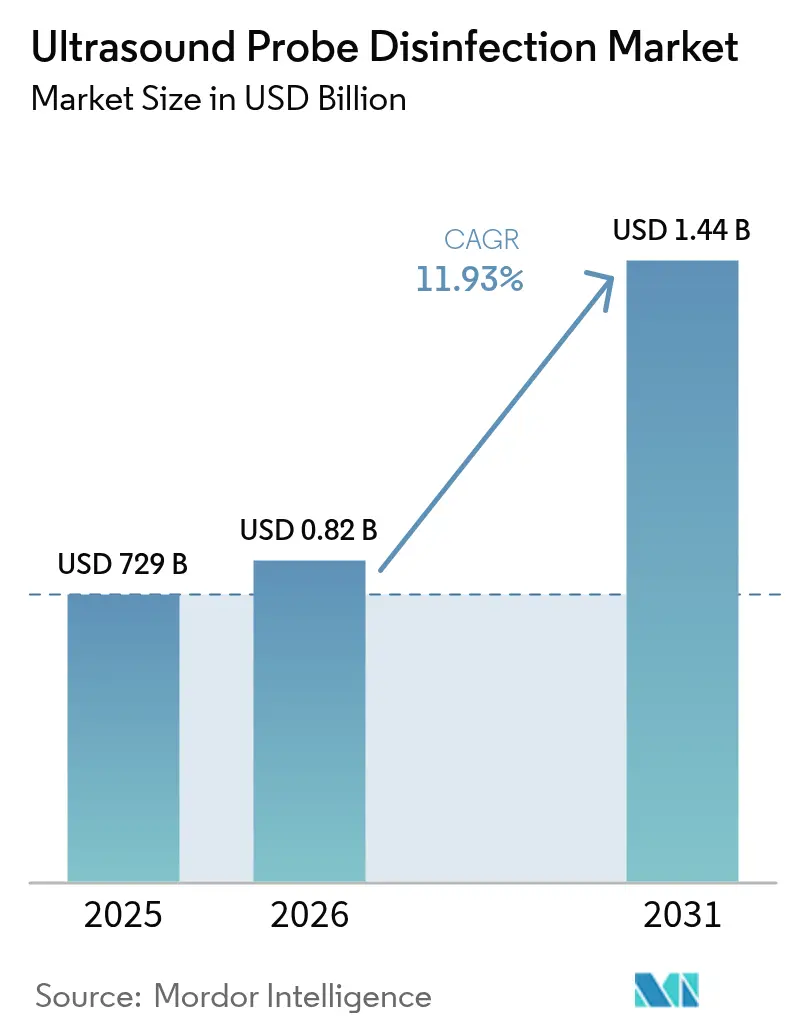
Ultrasound probe disinfection market size in 2026 is estimated at USD 820 million, growing from 2025 value of USD 729 million with 2031 projections showing USD 1.44 billion, growing at 11.93% CAGR over 2026-2031. Accelerated adoption stems from the relentless rise in ultrasound procedures, stringent global mandates for high-level probe reprocessing, and quick, automated systems that document each cycle for auditors. Hospitals are prioritizing chemical-free cabinets that complete cycles in under two minutes, while ambulatory centers choose compact devices that pair with handheld scanners for point-of-care use. Vendors are embedding RFID logs to simplify audits, and competitive pressure is intensifying as core patents expire and mid-tier suppliers launch lower-priced units. Health systems view these upgrades as risk-mitigation investments that can curb costly HAI-related penalties.
Key Report Takeaways
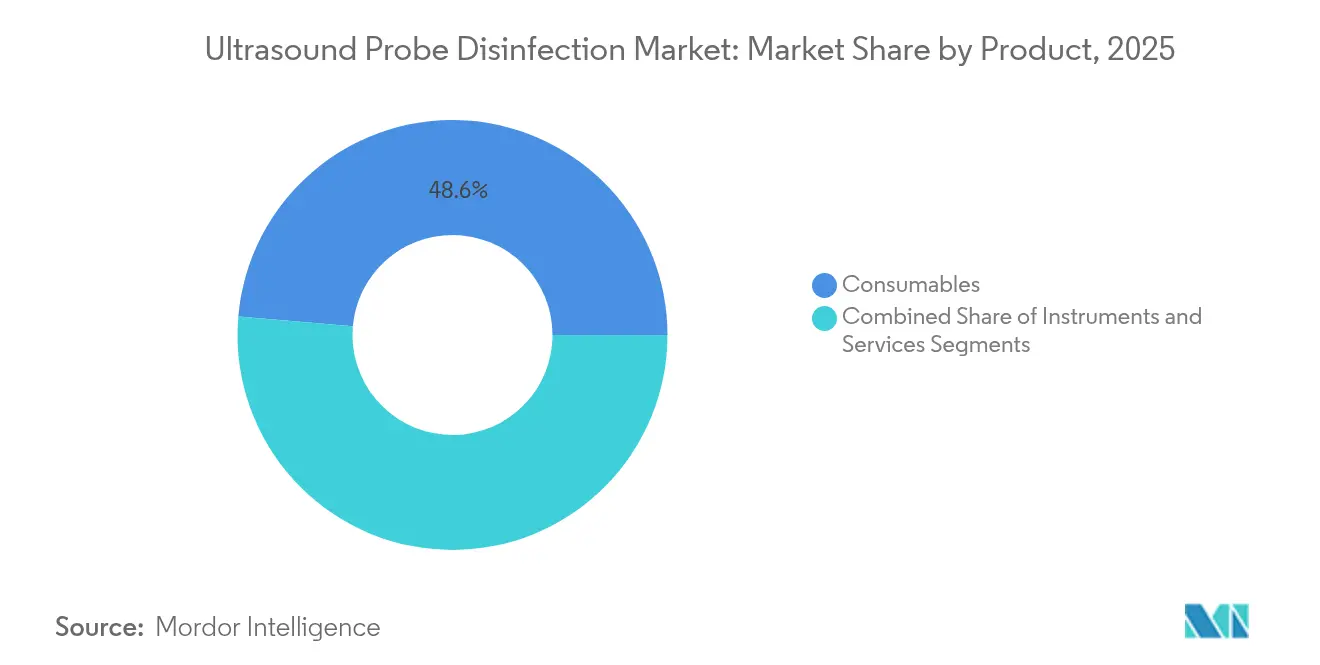
- By product category, consumables led with 48.62% revenue share in 2025, while services are projected to expand at a 13.76% CAGR through 2031.
- By process, high-level disinfection captured 60.05% of the ultrasound probe disinfection market share in 2025, and it remains the fastest-growing process at a 12.98% CAGR.
- By technology, hydrogen-peroxide mist accounted for 43.70% share of the ultrasound probe disinfection market size in 2025; UV-C systems are advancing at a 14.55% CAGR.
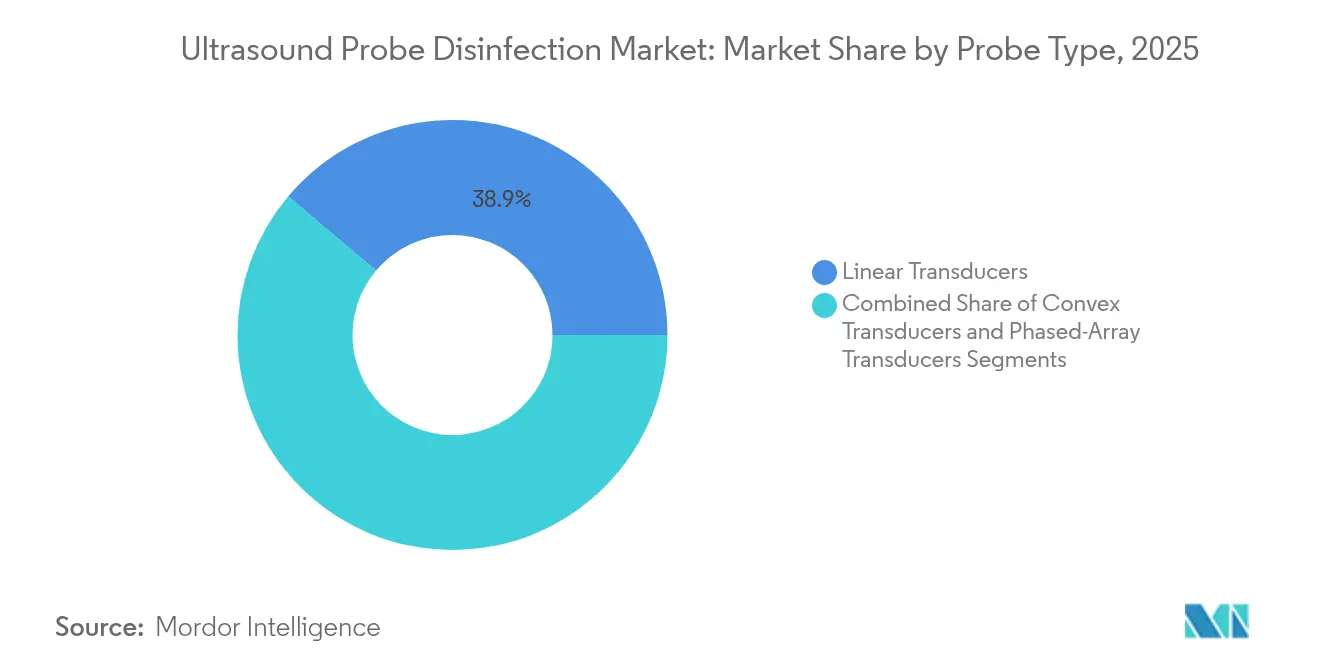
- By probe type, linear transducers held 38.85% share of the ultrasound probe disinfection market size in 2025, whereas phased-array probes record the quickest 12.74% CAGR.
- By end user, hospitals and diagnostic laboratories captured 66.60% of the ultrasound probe disinfection market share in 2025, while ambulatory care centers are poised to grow at a 13.25% CAGR to 2031.
- By geography, North America contributed 36.45% share of the ultrasound probe disinfection market size in 2025, whereas Asia Pacific is forecast to expand at 14.22% annually through 2031.
Note: Market size and forecast figures in this report are generated using Mordor Intelligence’s proprietary estimation framework, updated with the latest available data and insights as of 2026.
Market Trends and Insights
Drivers Impact Analysis of Ultrasound Probe Disinfection Market*
| Driver | (~) % Impact on CAGR Forecast | Geographic Relevance | Impact Timeline |
|---|---|---|---|
| Rising ultrasound imaging procedure volumes | +2.8% | Global; strongest in North America and APAC | Medium term (2-4 years) |
| Escalating incidence & penalties for HAIs | +2.1% | North America, EU; extending to APAC | Short term (≤ 2 years) |
| Regulatory mandates for high-level disinfection | +1.9% | Global, led by FDA, Health Canada, CE regions | Long term (≥ 4 years) |
| Rapid adoption of automated HLD systems & UV-C cabinets | +2.3% | North America, EU; emerging MEA | Medium term (2-4 years) |
| Expiry of core HLD device patents | +1.5% | Developed markets first | Short term (≤ 2 years) |
| Integration of RFID/IoT traceability | +1.7% | North America, EU; gradual APAC | Long term (≥ 4 years) |
| Source: Mordor Intelligence | |||
Rising Ultrasound Imaging Procedure Volumes
Global ultrasound utilization continues to soar as physicians broaden applications across emergency, critical-care, and musculoskeletal disciplines. Point-of-care adoption allows clinicians to scan at the bedside, compressing diagnostic timelines and lifting procedural counts. In low- and middle-income countries, 80% of providers surveyed rated ultrasound access as essential to improving care quality.[1]Amy Sarah Ginsburg, “A Survey of Barriers and Facilitators to Ultrasound Use in Low- and Middle-Income Countries,” Scientific Reports, nature.comPortable, battery-powered scanners expand outreach clinics but introduce mobile disinfection challenges, thereby magnifying demand for quick-cycling, countertop units. Health ministries are bundling probe reprocessors into national imaging upgrades to guarantee infection control parity with advanced economies. As procedure volumes climb, every incremental scan increases the risk of cross-contamination, reinforcing the ultrasound probe disinfection market’s growth trajectory.
Escalating Incidence & Penalties For Hospital-Acquired Infections (HAIs)
Governments and private insurers impose financial penalties on facilities that exceed HAI benchmarks, and contaminated probes remain a documented vector. A multicenter study showed over 90% of transvaginal probes harbored pathogens after low-level wipes, evidencing shortfalls in legacy cleaning workflows. The CDC’s 2025 health alert on gel-borne Paraburkholderia fungorum infections renewed scrutiny of sonography suites.[2]Centers for Disease Control and Prevention, “Alert: Use Only Sterile Ultrasound Gel for Percutaneous Procedures,” cdc.gov Hospitals now calculate potential fines plus reputational damage when budgeting for automated cabinets. Cost analyses reveal damaged transesophageal probes can add USD 1,800–USD 9,000 in repair charges, often precipitated by improper manual cleaning. Consequently, facilities fast-track investments that standardize disinfection cycles and log proof of compliance.
Regulatory Mandates For High-Level Disinfection Of Semi-Critical Probes
The FDA classifies endocavitary probes as semi-critical devices that demand high-level disinfection, and recent guidance explicitly calls for validated protocols.[3]U.S. Food and Drug Administration, “Marketing Clearance of Diagnostic Ultrasound Systems and Transducers—Guidance for Industry and Food and Drug Administration Staff,” fda.gov Professional societies such as AIUM and ACEP codify similar requirements, extending them to sterile gel use during invasive scans.[4]American Institute of Ultrasound in Medicine, “Guidelines for Cleaning and Preparing External- and Internal-Use Ultrasound Transducers and Equipment Between Patients as Well as Safe Handling and Use of Ultrasound Coupling Gel,” aium.orgEuropean CE authorities mirror these stipulations, forming a harmonized compliance baseline that multinational hospital chains must observe. Accrediting bodies now audit probe logs during site visits, and non-conformance can stall reimbursement. As regulators converge, the ultrasound probe disinfection market gains a predictable, policy-driven demand floor that persists beyond cyclical capital budgets.
Rapid Adoption Of Automated HLD Systems & UV-C Cabinets
Automation removes operator variability, shortens cycle time, and feeds electronic health records with time-stamped logs. Comparative trials found UV-C devices could finish a cycle in 7.9 minutes versus 49 minutes for chemical baths, while halving residual contamination sites. Germitec’s Chronos won FDA de novo clearance in 2024 as the first chemical-free UV-C cabinet for probes, completing cycles in 90 seconds and eliminating bacteria, fungi, and spores. Healthcare executives struggling with staffing shortages value these unattended systems that keep ultrasound rooms turning over safely during peak hours. RFID tagging of each probe feeds centralized dashboards that flag missed cycles, cutting administrative burden and enhancing audit readiness.
Restraints Impact Analysis of Ultrasound Probe Disinfection Market*
| Restraint | (~) % Impact on CAGR Forecast | Geographic Relevance | Impact Timeline |
|---|---|---|---|
| High capital cost of automated reprocessors | -1.8% | Global; acute in emerging markets | Medium term (2-4 years) |
| Low awareness & training gaps | -1.3% | APAC, MEA, Latin America | Long term (≥ 4 years) |
| Hydrogen-peroxide supply-chain constraints | -0.9% | Emerging APAC, MEA, Latin America | Short term (≤ 2 years) |
| Threat of single-use sterile probe covers | -1.1% | Global; higher in developed markets | Medium term (2-4 years) |
| Source: Mordor Intelligence | |||
High Capital Cost Of Automated Reprocessors
Automated cabinets can exceed USD 25,000 each, a hurdle for rural hospitals and budget-constrained clinics. Nanosonics noted that tight capital budgets slowed new placements early in fiscal 2024, although second-half orders rebounded 14% as purchasing cycles normalized. Total cost of ownership extends to consumable cartridges and annual service contracts, stretching limited budgets. Facilities in markets where infection-prevention investments lack direct reimbursement must reconcile the up-front outlay with longer-term savings from fewer HAIs and lower labor costs. Until financing programs or pay-for-prevention incentives mature, adoption may lag in cash-strapped settings, tempering the ultrasound probe disinfection market’s upside.
Low Awareness & Training Gaps In Low- And Mid-Income Facilities
Clinicians in low-resource regions often receive ultrasound proficiency training but little instruction on probe reprocessing. Surveys cite education deficits and equipment competition as key barriers to safe ultrasound roll-out. Programs in Haiti and Kenya demonstrate that targeted training raises diagnostic accuracy yet rarely covers disinfection protocols. Without standardized curricula and competency checks, inconsistent cleaning persists, dampening demand for advanced cabinets. Donor-funded imaging projects increasingly bundle reprocessors, but power and maintenance constraints still challenge consistent use.
*Our forecasts treat driver/restraint impacts as directional, not additive. The impact forecasts reflect baseline growth, mix effects, and variable interactions.
Ultrasound Probe Disinfection Market Segment Analysis
By Product:
Services Drive Comprehensive SolutionsConsumables controlled 48.62% of 2025 revenue as facilities restock disinfectant cartridges, probe covers, and filters daily. Services, however, are projected to pace the ultrasound probe disinfection market at a 13.76% CAGR through 2031 as hospitals outsource maintenance, calibration, and compliance audits. The shift mirrors broader healthcare moves toward outcome-based contracting, where vendors guarantee uptime and accreditation readiness rather than selling stand-alone kits.
Some health systems bundle training, software updates, and remote diagnostics into multiyear service plans that spread cost and free internal staff. Nanosonics added 2,340 units in fiscal 2024, reaching 34,790 global installations, which feed a recurring revenue stream of consumables and digital monitoring fees. Providers value rapid support that avoids exam cancellations, reinforcing service uptake across the ultrasound probe disinfection industry.



By Process:
High-Level Disinfection Dominates StandardsHigh-level disinfection accounted for 60.05% share of the ultrasound probe disinfection market size in 2025 and will outpace other processes at a 12.98% CAGR as regulators tighten rules on semi-critical devices. Spaulding classification places endocavitary probes squarely in the high-level category, and compliance audits increasingly flag any deviation.
Intermediate and low-level wipes remain permissible for surface scans on intact skin, but many hospitals standardize on high-level cycles to simplify staff training and limit error. Automated logs that record temperature, concentration, and exposure times help clinicians demonstrate adherence to FDA and CE guidance. Over the forecast horizon, multi-tiered protocols may give way to single high-level standards that protect all patients equally, driving steady gains for the segment.
By Technology:
UV-C Light Emerges As Chemical-Free AlternativeHydrogen-peroxide mist retained 43.70% share in 2025, reflecting a decade of clinical familiarity and broad regulatory clearance. UV-C systems are projected to grow 14.55% annually, propelled by chemical-free cycles that remove staff exposure risks and ventilation requirements. Germitec’s Chronos cabinet completes a high-level cycle in 90 seconds without consumables, appealing to high-volume emergency rooms.
Ozone and chlorine-dioxide foams occupy niche roles where facility design limits liquid use, and updated ANSI/AAMI standards now recognize chlorine-dioxide as a valid high-level option. Procurement teams evaluate each platform’s through-put, cost per cycle, and environmental footprint, shaping a competitive field that will diversify the ultrasound probe disinfection market.
By Probe Type:
Phased-Array Applications Expand Specialty CareLinear probes captured 38.85% of the ultrasound probe disinfection market share in 2025 thanks to broad usage in vascular, musculoskeletal, and abdominal imaging. Phased-array probes will grow fastest at 12.74% as cardiology, critical-care, and anesthesiology expand bedside echocardiography routines.
Convex probes remain vital in obstetrics and general surgery, but rising adoption of portable cardiac ultrasound boosts demand for fast-cycle cabinets sized for phased-array heads. Each probe geometry presents unique crevices that complicate manual cleaning, reinforcing hospitals’ preference for validated automated units. Specialty growth broadens the ultrasound probe disinfection industry’s customer base beyond radiology departments.
By End User:
Ambulatory Care Centers Drive Decentralized GrowthHospitals and diagnostic labs held 66.60% of 2025 demand, benefiting from bundled imaging budgets and dedicated infection-control teams. Ambulatory care centers will expand 13.25% yearly as outpatient surgery, urgent-care, and imaging chains decentralize scanning services. Portable handheld scanners paired with compact UV-C cabinets allow centers to meet the same accreditation standards as tertiary hospitals.
Research and academic institutes pilot experimental probes and disinfection protocols, accelerating commercial adoption once efficacy is proved. Their willingness to beta-test IoT dashboards and AI-driven cycle-quality analytics shapes next-gen feature roadmaps. Decentralization thus multiplies sites needing compliant reprocessing, sustaining the ultrasound probe disinfection market well beyond core hospital campuses.
Geography Analysis
North America Ultrasound Probe Disinfection Market
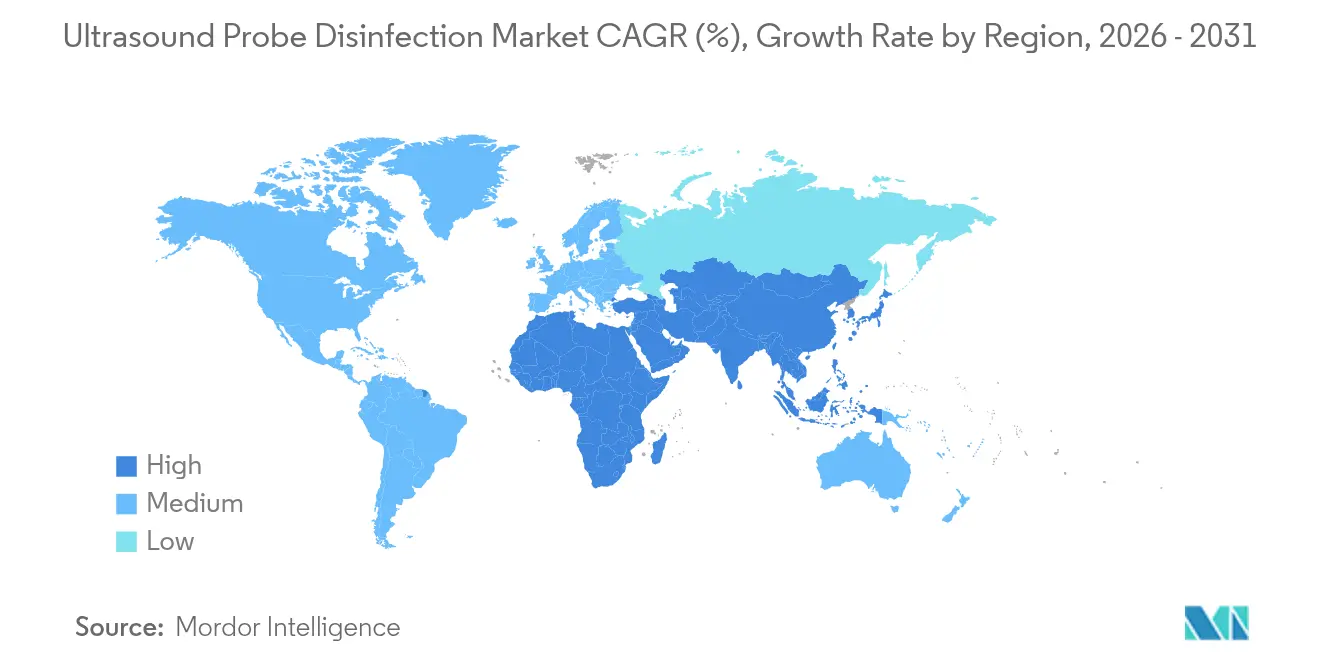
North America led the ultrasound probe disinfection market with 36.45% of global revenue in 2025, underpinned by FDA mandates, insurer penalties for HAIs, and capital budgets that prioritize automated HLD cabinets. Hospitals routinely integrate RFID-enabled reprocessors with electronic health records, streamlining Joint Commission audits and reinforcing best-practice diffusion across the region. The mature reimbursement climate offsets high device costs, allowing health systems to adopt premium chemical-free units rapidly.
Europe Ultrasound Probe Disinfection Market
Europe remains a substantial contributor, leveraging CE harmonization to expedite technology circulation across member states. Environmental regulations encourage migration to UV-C systems that avoid chemical disposal, and procurement frameworks increasingly weigh life-cycle sustainability metrics. Cross-border hospital groups standardize preferred vendor lists, giving compliant suppliers pan-regional scale. Meanwhile, national infection-prevention action plans push smaller clinics to match the standards of flagship university hospitals, enriching the total addressable market.
APAC, MEA and LATAM Ultrasound Probe Disinfection Market
Asia Pacific is forecast to post a 14.22% CAGR as China, India, and Southeast Asian nations pour funds into imaging capacity and infection-control modernization. Government insurance schemes finance rural ultrasound deployment, frequently stipulating high-level disinfection capabilities to curb cross-infection risks. Domestic manufacturers in China and South Korea introduce cost-effective peroxide cabinets, raising competitive stakes. Emerging regions in MEA and Latin America continue to upgrade basic disinfection infrastructure, but financing gaps and supply-chain volatility temper near-term momentum.

Regulatory Landscape
Regulation centers on mandated high-level disinfection (HLD) for semi-critical ultrasound probes (notably endocavitary and other internal-use transducers) and on validated, device-specific instructions for cleaning and disinfection. In the United States, FDA guidance for diagnostic ultrasound systems and transducers requires manufacturers to provide detailed reprocessing instructions. Professional guidance such as the AIUM 2025 update reinforces HLD between each patient use for internal transducers, typically alongside single-use protective barriers.
Outside the United States, requirements are increasingly formalized through national standards and medical-device frameworks. In Canada, healthcare facilities commonly align with CSA Z314 reprocessing standards and provincial requirements (for example, CPSBC guidance for ultrasound probe reprocessing). In the European Union, products intended for cleaning and disinfection of medical devices fall under EU MDR (EU) 2017/745. Australia tightens product compliance by requiring instrument-grade disinfectants to be listed on the Australian Register of Therapeutic Goods (ARTG) and to meet TGA disinfectant standards (including TGO 104). National infection-prevention guidance from the Australian Commission on Safety and Quality in Health Care supports standardized, auditable reprocessing.
Value Chain Analysis
The value chain begins with chemistry and component inputs, including high-level disinfectants such as hydrogen peroxide and chlorine-dioxide formulations, filters, packaging, and electronics for cabinets. It then moves to manufacturing of reprocessors and consumables, followed by validation and compatibility work with ultrasound probe OEMs. OEM endorsement and written compatibility with specific reprocessing methods remain key gate points, because providers must follow manufacturer instructions to avoid probe damage and to remain compliant with HLD requirements for semi-critical devices.
Commercialization is largely split between direct sales to hospitals and diagnostic laboratories, distributor-led sales to ambulatory care centers, and bundled offerings that pair devices with consumables, service contracts, and compliance software. Systems such as Nanosonics trophon (hydrogen peroxide mist), Germitec Chronos/AE1 (UV-C), CIVCO offerings, and Tristel ULT (chlorine-dioxide foam) show how hardware, chemistry, and workflow tools come together as a single reprocessing solution. Downstream, audit readiness and accreditation pressure have raised the value of digital traceability, including RFID-logged cycles and portals such as Tristel 3T, supported by training and preventive maintenance that reduce cycle failures and workflow variability.
Competitive Landscape
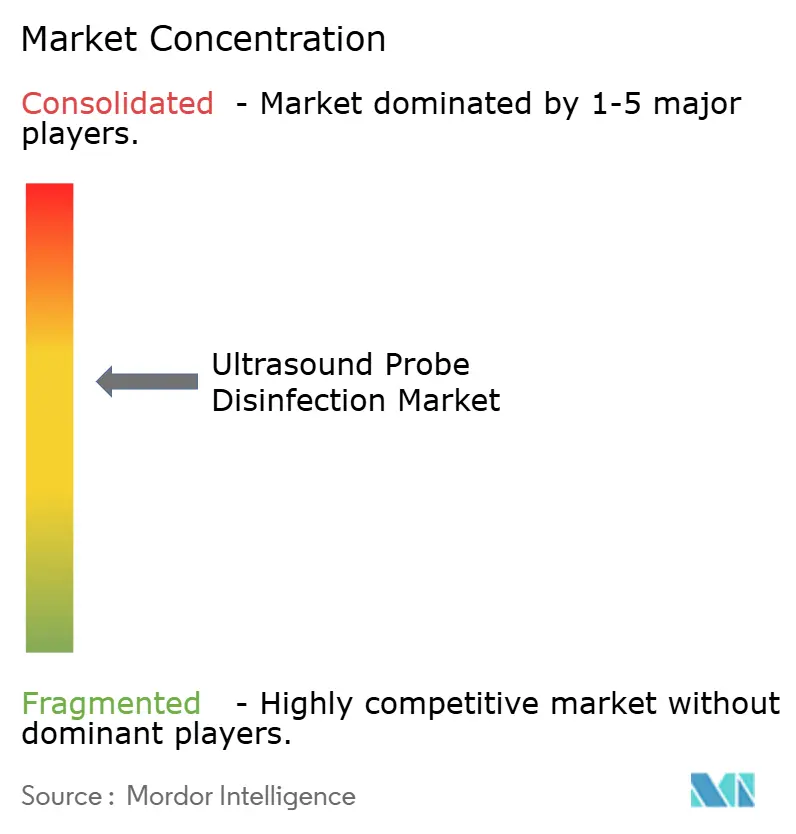
The ultrasound probe disinfection market is moderately fragmented. Nanosonics anchors the field with its trophon platform and logged USD 170 million revenue in fiscal 2024, supported by 34,790 installed units that protect an estimated 27 million patients each year. Competitors such as Germitec and CS Medical emphasize chemical-free UV-C and fully enclosed peroxide baths, respectively, seeking differentiation through cycle speed, footprint, and user-interface design.
Patent cliffs are lowering entry barriers, enabling mid-tier suppliers to deliver peroxide mist or ozone cabinets at disruptive price points. To defend share, incumbents bundle cloud dashboards, preventive maintenance, and staff training into subscription plans that embed switching costs. Strategic partnerships also unfold: ultrasound OEMs integrate reprocessors into equipment leases, and distributors sign exclusive regional agreements to secure service revenue.
M&A activity signals consolidation. Medline’s planned purchase of Ecolab’s global surgical solutions unit will add reprocessing accessories to its vast distribution network, potentially reshaping competitive dynamics. Vendors investing in IoT telemetry and AI-driven cycle validation are poised to command premium segments, while budget buyers weigh open-architecture cabinets that accept third-party consumables. Overall, competition pivots on regulatory compliance, documented efficacy, and lifetime cost rather than headline unit price.
Ultrasound Probe Disinfection Industry Leaders
CIVCO Medical Solutions
Tristel plc
Ecolab
Germitec
CS Medical LLC
- *Disclaimer: Major Players sorted in no particular order
Ultrasound Probe Disinfection Market Companies Covered in this Report
- Nanosonics
- CIVCO Medical solutions
- Tristel
- Germitec
- Ecolab
- Advanced Sterilization Products (ASP)
- CS Medical LLC
- Metrex Research
- Soluscope
- Virox Technologies
- Parker Laboratories
- Cantel Medical
- Steris plc
- Whiteley Corporation
- Borer Chemie
- Lanxess AG
- TSO3 Inc.
- BluLine Solutions
- Cleanis SAS

Market Opportunities and Future Outlook
A major whitespace is digitized compliance that links probe reprocessing records to patient and imaging workflows, since documentation is increasingly audited and manual logs are error-prone. This is visible in vendor roadmaps and adoption activity, including Nanosonics introducing trophon3 with a 4-minute automated HLD cycle in the United States and Canada in August 2025, then expanding connectivity features in October 2025 to integrate disinfection records with hospital systems such as RIS and PACS. The same direction supports software subscriptions, middleware integration, and service-led contracts that help sites standardize policies across radiology, emergency, and point-of-care ultrasound.
Technology diversification also creates opportunity where chemical handling, ventilation constraints, and turnaround time limit throughput, particularly in high-volume and decentralized settings. Clinical validation is advancing for chemical-free approaches, including a June 2026 hospital-based non-inferiority study reporting UV-C LED automated disinfection as non-inferior to manual chlorine-dioxide disinfection for transabdominal and transvaginal probes, which supports procurement consideration beyond traditional manual chemical workflows. Regionally, standard-setting activity also supports adoption pathways: in February 2026, the Australasian Society for Ultrasound in Medicine published updated reprocessing guidelines aligned with ARTG-listed disinfectant requirements, supporting validated instruments, compatible consumables, and training packages in markets formalizing ultrasound transducer reprocessing practices.
Recent Industry Developments in Ultrasound Probe Disinfection Market
- June 2026: Tristel plc highlighted its FDA-cleared Tristel ULT for ultrasound probe disinfection at APIC 2026 in Nashville and introduced the Tristel 3T Pro digital compliance platform. The focus on digital documentation supports hospitals that need auditable proof of each cycle and strengthens differentiation beyond chemistry alone.
- June 2025: CIVCO Medical Solutions opened a new 96,000-square-foot production facility in Coralville, Iowa, reported as a USD 15 million build. Added capacity and modernized manufacturing infrastructure support higher output and faster fulfillment for probe-care and reprocessing-related product lines as customers expand installed bases.
- September 2024: Ecolab reported that its Soluscope automated reprocessing portfolio and a manufacturing site achieved certification under the European Union Medical Device Regulation (EU MDR). MDR certification improves EU market access and helps standardize compliance credentials for automated reprocessing solutions used in regulated clinical environments.


Ultrasound Probe Disinfection Market Report Scope and Research Methodology
Market Definition and Coverage
For this report, the market is defined as the revenues earned from products and services used to disinfect ultrasound probes between patient uses, across care settings where diagnostic and interventional ultrasound is performed.
Scope exclusions: We exclude general environmental surface disinfectants and room cleaning solutions that are not intended for ultrasound probe reprocessing workflows.
Segments Covered in This Report
- By Product
- Instruments
- Consumables
- Services
- By Process
- Intermediate / Low-level Disinfection
- High-level Disinfection
- By Technology
- Hydrogen-Peroxide Mist
- UV-C Light
- Ozone-based
- Chlorine-Dioxide & Other Chemicals
- By Probe Type
- Linear Transducers
- Convex Transducers
- Phased-Array Transducers
- By End User
- Hospitals & Diagnostic Laboratories
- Ambulatory Care Centers
- Research & Academic Institutes
- By Geography
- North America
- United States
- Canada
- Mexico
- Europe
- Germany
- United Kingdom
- France
- Italy
- Spain
- Rest of Europe
- Asia-Pacific
- China
- Japan
- India
- Australia
- South Korea
- Rest of Asia-Pacific
- Middle East and Africa
- GCC
- South Africa
- Rest of Middle East and Africa
- South America
- Brazil
- Argentina
- Rest of South America
- North America
Data Sources, Market Sizing, and Validation
Desk Research
Desk work started by mapping the infection prevention and medical device reprocessing context so the product boundary stays consistent across countries and care settings. We referenced public sources such as the US FDA guidance and safety communications on ultrasound probe reprocessing, the US CDC infection control resources, and AAMI and ISO standards related to cleaning and disinfection practices.
To size the demand pool in a realistic way, we reviewed ultrasound procedure and utilization signals from sources such as OECD health statistics, WHO health system indicators, and selected national health agencies where modality use is published. We paired these with company annual reports, investor presentations, and reputable healthcare press to understand product launch timing, installed base direction, and pricing commentary. In addition, our internal paid subscriptions were used selectively for company financials and patent databases to understand innovation intensity and to pressure-test product mix shifts. The sources listed above are illustrative and not exhaustive, and many other references were consulted for data collection, validation, and clarification.
Primary Interviews and Surveys
Primary interviews and surveys were used to verify how disinfection is actually performed by probe type and setting, and to confirm where spending sits across instruments, consumables, and services. We spoke with a mix of hospital sterile processing leaders, infection control staff, imaging department managers, ambulatory center operators, and supply chain stakeholders across APAC, EMEA, and the Americas to close data gaps and to align assumptions on replacement cycles and average selling prices.
Distribution of primary research fieldwork respondents
| Company type | Respondent position | Region |
|---|---|---|
| Top tier: 26% | CXOs: 12% | APAC: 44% |
| Mid tier: 60% | Functional/Unit leaders: 34% | EMEA: 31% |
| Smaller Players: 14% | Managers: 54% | Americas: 25% |
Market-Sizing & Forecasting
Sizing was built using a top-down and bottom-up structure, where the main totals come from an identified ultrasound usage pool and the disinfection intensity required per procedure and per probe type. We translated procedure volumes and modality utilization signals into disinfection cycles, and then linked those cycles to likely purchasing of high-level and intermediate or low-level solutions, along with associated equipment and service needs.
To keep the model realistic, key inputs included the share of exams that use endocavitary and transesophageal probes, the mix between high-level versus intermediate or low-level disinfection protocols, typical consumable use per cycle, equipment replacement timing, and regional price ranges checked in interviews. Forecasts were run using scenario analysis, with variables like procedure growth, compliance tightening, and adoption of automated systems adjusted by geography and end user feedback. Where direct bottom-up rollups were incomplete, we used sampled price times volume checks and channel discussions to fill gaps, and then totals were adjusted only when multiple signals pointed in the same direction.
Data Validation & Update Cycle
Validation was done by triangulating outputs across independent signals, including ultrasound utilization direction, infection prevention enforcement intensity, and the implied spend per disinfection cycle by setting. Large variances were flagged and reviewed, and then assumptions were rechecked with selected interviewees when a change in product mix or pricing looked out of line.
Before sign-off, the model and its assumptions go through step-by-step analyst reviews so arithmetic, unit logic, and regional conversions stay consistent. Reports are refreshed annually, and interim updates are made when material events occur, such as major regulatory actions, product recalls, or step changes in pricing. Right before delivery, a final pass is completed so clients receive the latest updated view.
Mordor Intelligence's Ultrasound Probe Disinfection Market Size Versus Other Published Estimates
Published market values for ultrasound probe disinfection can look far apart because each publisher draws product coverage differently and uses its own assumptions on disinfection method mix and pricing progression. Differences also show up when some figures are reported for a different base year, or when currency conversion timing and regional weighting are handled in a simpler way.
The table shows a noticeable spread versus the USD 0.82 B (2026) value, and within Mordor Intelligence's scope the total is limited to dedicated ultrasound probe disinfection instruments, related consumables, and services, rather than including broader hospital disinfectants or general medical device cleaning revenue. The gap can also come from how high-level disinfection adoption is estimated for endocavitary and transesophageal probes, since small changes in compliance assumptions can lift or lower the implied consumables run-rate.
Benchmark comparison
| Source | Market Size | Gaps in Research Methodology |
|---|---|---|
| Mordor Intelligence | USD 0.82 B (2026) | |
| Industry Association A | USD 0.67 B (2026) | Applies a narrower interpretation focused on high-level disinfection only, and assumes slower adoption of automated systems in outpatient settings, which reduces instrument and service spend. |
| Global Consultancy B | USD 0.95 B (2026) | Uses a broader scope that can blend in adjacent device reprocessing and general disinfectant categories, and applies more aggressive average selling price uplift assumptions across regions. |
Overall, the comparison points to scope control and a few high-impact assumptions as the main reasons for variation. By tying demand to disinfection cycles, probe-type mix, and realistic pricing ranges confirmed in interviews, our estimate stays traceable to repeatable steps and clear inclusion rules, which helps users interpret the market in a consistent way.


Key Questions Answered in the Report
What is the current size of the ultrasound probe disinfection market?
The ultrasound probe disinfection market size stands at USD 820 million in 2026 and is projected to reach USD 1.44 billion by 2031.
Which process segment leads the market?
High-level disinfection captures 60.05% of 2025 revenue and remains the fastest-growing process at a 12.98% CAGR.
Why are UV-C cabinets gaining popularity?
UV-C systems deliver chemical-free, 90-second cycles that reduce staff exposure and simplify ventilation requirements, driving a forecast 14.55% CAGR.
Which region is growing quickest?
Asia Pacific posts the highest regional CAGR at 14.22% thanks to infrastructure expansion and stricter infection-control mandates.
How does RFID traceability benefit hospitals?
RFID-enabled cabinets auto-record each cycle, achieving 99.70% counting accuracy and streamlining accreditation audits.
What factor most restrains adoption in emerging markets?
High up-front capital costs for automated reprocessors limit uptake in budget-constrained facilities despite long-term infection-prevention savings.
Page last updated on:





