
Market Overview
| Study Period | 2020 - 2031 |
|---|---|
| Forecast Data Period | 2026 - 2031 |
| Base Year Market Size (2025) | 13.14 Million tons |
| Market Volume (2026) | 13.65 Million tons |
| Market Volume (2031) | 16.52 Million tons |
| Growth Rate (2026 - 2031) | 3.88 % |
| Market Concentration | Medium |
Major Players *Disclaimer: Major Players sorted in no particular order Image © Mordor Intelligence. Reuse requires attribution under CC BY 4.0. | |
UAE Silica Sand Market Analysis by Mordor Intelligence
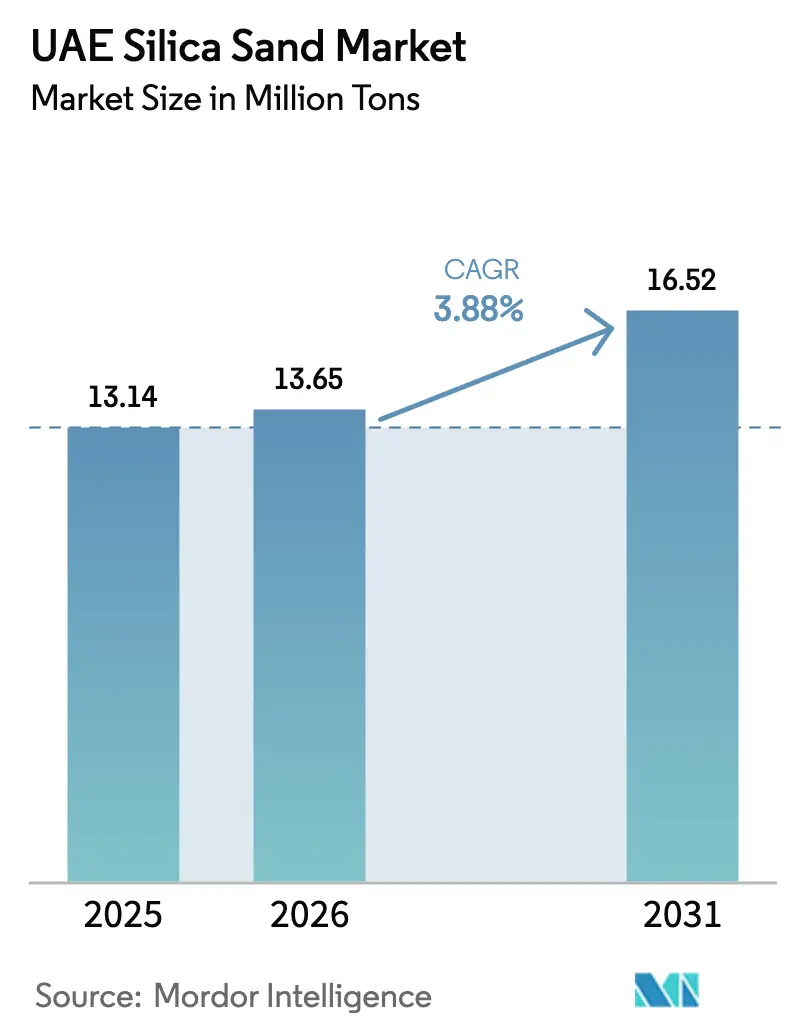
The UAE silica sand Market size is expected to grow from 13.14 million tons in 2025 to 13.65 million tons in 2026 and is forecast to reach 16.52 million tons by 2031 at 3.88% CAGR over 2026-2031. The demand trajectory is shifting away from bulk marine reclamation toward niche, specification-driven uses in unconventional oil and gas, solar-grade glass, and high-performance construction materials, underpinned by ADNOC’s USD 1.7 billion unconventional drilling program and Dubai’s 2040 Urban Master Plan. Record glass output from Dubai Investments, new solar glass capacity in Ras Al Khaimah, and a steady construction pipeline worth USD 130.8 billion by 2029 provide a durable demand base, while circular-economy mandates and tighter dredging rules reshape raw-material sourcing. Competitive intensity is moderate: three primary quarry operators supply most of the industrial-grade feedstock; however, emirate-level procurement policies, such as Emaar’s 99.5% local sourcing preference, drive high entry barriers. Environmental regulation is tightening under Federal Decree-Law 11/2024, creating compliance costs but also favoring players with low-carbon operations.
Key Report Takeaways
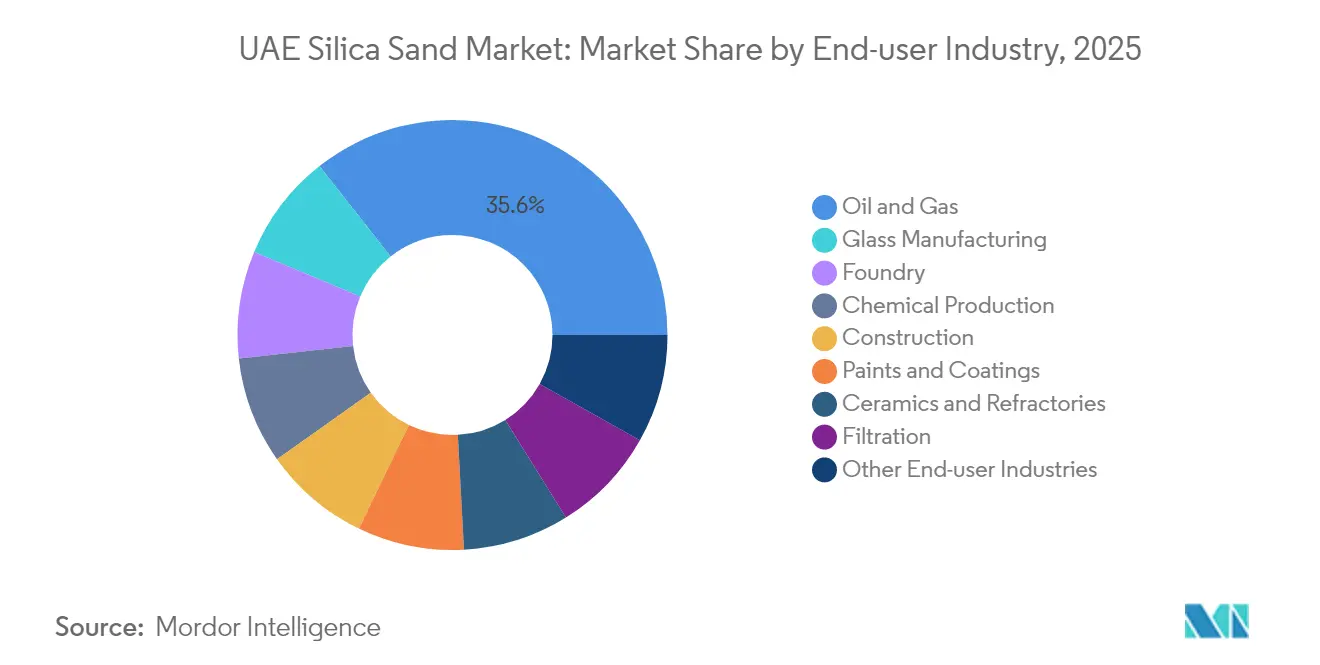
- By end-user industry, Oil and Gas held 35.62% of the UAE Silica Sand market share in 2025, supported by 144 unconventional wells scheduled for completion by Q4 2025, while Paints and Coatings is expected to expand at a 5.04% CAGR between 2026-2031, the highest among all segments.
Note: Market size and forecast figures in this report are generated using Mordor Intelligence’s proprietary estimation framework, updated with the latest available data and insights as of 2026.
UAE Silica Sand Market Trends and Insights
Drivers Impact Analysis*
| Drivers | (~) % Impact on CAGR Forecast | Geographic Relevance | Impact Timeline |
|---|---|---|---|
| Land reclamation and mega tourism projects | +0.8% | Dubai, Abu Dhabi | Medium term (2-4 years) |
| Solar-grade glass demand for PV expansion | +1.2% | Ras Al Khaimah, Dubai, Abu Dhabi | Long term ( ≥ 4 years) |
| 3D printing in construction | +0.3% | Dubai, Sharjah | Long term ( ≥ 4 years) |
| Rising frac-sand demand in oil and gas | +1.1% | Abu Dhabi onshore fields, Al Dhafra, Jebel Ali logistics hubs | Short term (≤ 2 years) |
| Infrastructure pipeline beyond Expo City | +0.9% | Dubai, Abu Dhabi, Northern Emirates | Medium term (2-4 years) |
| Source: Mordor Intelligence | |||
Land Reclamation and Mega Tourism Projects
Palm Jebel Ali’s relaunch repositions coastal engineering toward precision sand placement and beach profiling rather than indiscriminate offshore dredging, a shift codified in the Dubai 2040 Urban Master Plan[1]. Nakheel’s AED 810 million contract, awarded to Jan De Nul in August 2024, covers 13.4 km² of reclaimed land but postpones additional offshore works until strategic environmental assessments conclude. The new approach reflects concerns over marine ecosystem stress following the development of 119 km² of reclaimed land between 2000 and 2021, with 70% of this area located in Dubai. As a result, the UAE Silica Sand market is seeing reduced low-grade bulk volumes but higher demand for processed sand that meets grain-size and environmental discharge criteria under the Dubai Environment and Climate Change Authority (DECCA) regime.
Solar-Grade Glass Demand for PV Expansion
The AED 350 million solar glass plant, inaugurated by Glass Technology FZ-LLC in April 2025, adds glass capacity sufficient for 5.5 million solar modules annually and plans to install a second furnace to double its output. The Ras Al Khaimah cluster, joined by Guardian Glass and Emirates Float Glass, consumes low-iron silica that must meet high solar transmittance standards. Dubai Investments recorded 14.8 million m² of flat glass output in 2024 and reached full utilization at its 12.6 million m² Emirates Float Glass facility. This specialized pull lifts the UAE Silica Sand market toward higher-purity product segments.
Rising Frac-Sand Demand in Oil and Gas
ADNOC’s unconventional drive, executed through the Turnwell Industries joint venture with SLB and Patterson-UTI, allocates USD 1.7 billion to drill 144 tight-reservoir wells by Q4 2025, each requiring high roundness 20/40-100 mesh frac sand. Abu Dhabi aims to produce 1 billion cubic feet per day from unconventional resources by 2030, redirecting silica demand away from low-value concrete sand to engineered proppants that can withstand high closure stresses. Regional suppliers in Saudi Arabia and Oman currently fill specification gaps, but domestic beneficiation opportunities are on the rise.
Infrastructure Pipeline Beyond Expo City
Dubai’s 2040 Urban Master Plan outlines a national housing budget of AED 65 billion, along with metro extensions and deep tunnel drainage, which will anchor multi-year demand for concrete aggregates, masonry sand, and specialty glass. The construction sector was valued at USD 107.2 billion in 2024 and is expected to reach USD 130.8 billion by 2029, bolstered by mega-schemes such as ADNOC’s USD 45 billion Al Ruwais refinery expansion, awarded in June 2024.
Restraints Impact Analysis*
| Restraints | (~) % Impact on CAGR Forecast | Geographic Relevance | Impact Timeline |
|---|---|---|---|
| Substitute aggregates and plastics | -0.6% | Abu Dhabi, Dubai, nationwide | Medium term (2-4 years) |
| Tighter dredging and environmental rules | -0.9% | Dubai coastal zones, nationwide | Short term (≤ 2 years) |
| Sand-free building materials (polymers) | -0.4% | Dubai, Abu Dhabi | Long term ( ≥ 4 years) |
| Source: Mordor Intelligence | |||
Substitute Aggregates and Plastics
MOCCAE Resolution 21/2019 permits contractors to fulfill up to 40% of road-paving and earth-filling material needs with recycled aggregates, undercutting virgin sand demand. Although Abu Dhabi generated 3.7 million tons of construction and demolition waste in 2019, uptake in circular sand remains below potential. The Circular Economy Policy 2021-2031 builds upon this mandate by layering 22 policies, incentivizing the use of lower-carbon and lower-cost secondary materials. Academic trials on the Dibba-Masafi roadway achieved a 70% cost savings and 87% landfill diversion through the use of recycled asphalt blends.
Tighter Dredging and Environmental Rules
Federal Decree-Law 11/2024 introduces mandatory greenhouse-gas measurement, reporting, and verification for all UAE entities, effective May 2025, with fines of up to AED 2 million for non-compliance[2]. Dubai’s Law 11/2024 established DECCA, centralizing environmental permitting and imposing a moratorium on offshore reclamation pending strategic assessments. Cabinet Resolution 67/2024 sets a 0.5 million tons CO₂-equivalent threshold for mandatory reporting and creates a National Carbon Credit Registry, adding compliance costs to sand extraction and processing.
*Our forecasts treat driver/restraint impacts as directional, not additive. The impact forecasts reflect baseline growth, mix effects, and variable interactions.
Segment Analysis
By End-User Industry: Oil and Gas Dominance Meets Paints and Coatings Acceleration
Oil and Gas captured 35.62% of UAE Silica Sand market share in 2025 on the back of ADNOC’s unconventional drilling program. This segment alone is projected to consume 650,000 tons of specialized proppant sand annually by 2027, reflecting the uptake of multi-stage hydraulic fracturing. Paints and coatings, although a smaller volume user, will expand at a 5.04% CAGR through 2031, driven by Industrial Decarbonization Roadmap incentives for low-VOC, silica-enhanced coatings that improve UV resistance and durability.
Construction remains one of the largest volume consumers in the UAE Silica Sand market, supported by a USD 65 billion housing fund and megaprojects such as the Blue Line metro extension. However, recycled aggregates now meet as much as 15% of base-course requirements, capping virgin volume growth. Glass Manufacturing contributes consistent demand, with Emirates Float Glass producing 12.6 million m² in 2024 and Glass Technology’s solar line adding significant additional pull from 2025 onward.

Geography Analysis
Dubai and Abu Dhabi account for 85% of the construction contract value and therefore anchor volume demand in the UAE silica sand market. Dubai’s transition from mass reclamation to densification shifts sand requirements toward higher-specification construction and glass products, evident from 91 km of Palm Jebel Ali beachfront profiling and record float-glass output. Abu Dhabi’s industrial nodes—KEZAD, Al Ruwais, and Al Taweelah—drive foundry, filtration, and refractories consumption; EGA’s 2.69 million tons of aluminium output in 2024 alone sustains hundreds of thousands of tons of foundry sand per year.
Ras Al Khaimah hosts a burgeoning glass cluster that demands low-iron silica for photovoltaic applications, while Fujairah remains the primary quarrying hub with an annual capacity of 20 million tons. Northern Emirates leverage Jebel Ali Port and Al Maktoum Airport to import specialty frac sand and high-purity silica when domestic supply falls short. New federal MRV rules create a uniform compliance landscape, although emirate-specific authorities, such as DECCA in Dubai or Abu Dhabi’s Department of Energy, retain local permitting oversight.
Value Chain Analysis
The UAE silica sand value chain begins with quarrying and extraction, concentrated in the Northern Emirates, particularly Fujairah and Ras Al Khaimah, where mineral deposits and processing infrastructure support ongoing supply. Feedstock is then converted through crushing, screening, washing, and purification/beneficiation to meet tighter size distribution and purity needs across industrial applications, including low-iron silica for glass and controlled mesh products for oil and gas proppants. Vertically integrated mine-to-market operators, such as Adwan Chemical Industries Co. Ltd, tend to have an advantage in quality consistency and cost control.
Distribution uses road haulage to domestic users (construction materials, ready-mix, foundries, filtration media, and glass producers) alongside port-enabled routes for imports and exports. Sharjah trading channels and Fujairah port access help move quarry output to downstream plants and regional customers, and specialty grades can be sourced via UAE gateways when local purification capacity or quality specifications do not fully match demand. Downstream requirements are increasingly driven by large, specification-led buyers in glass manufacturing and oil and gas, where procurement incorporates environmental and quality documentation, pushing suppliers to scale processing capability and maintain traceable supply chains.
Competitive Landscape
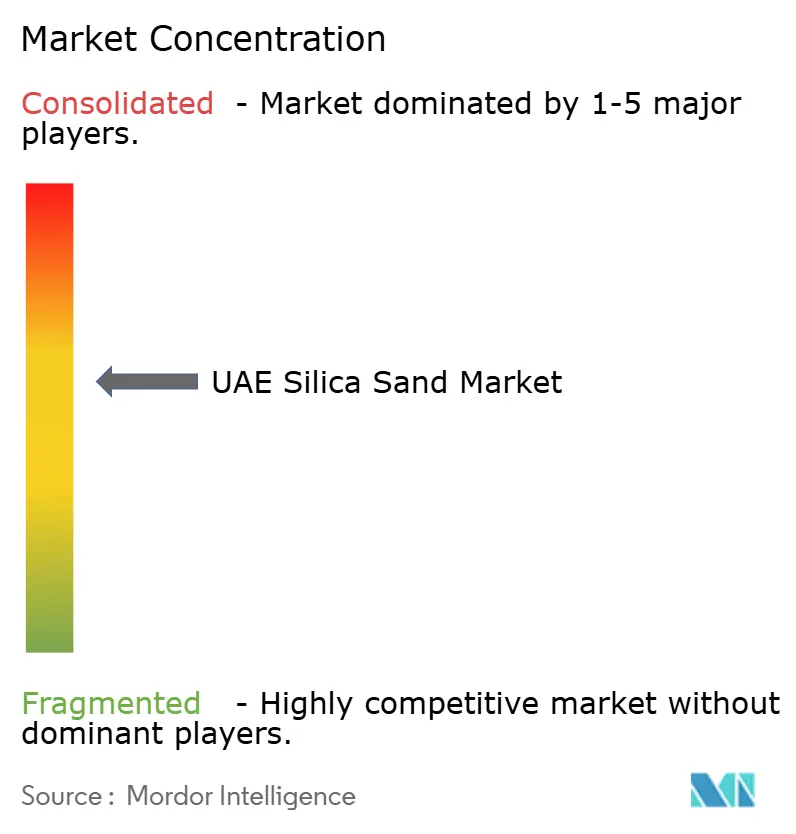
The UAE Silica Sand market is moderately concentrated, with the top five companies supplying the bulk of industrial-grade feedstock. Procurement power, however, lies with mega-developers and state-linked entities such as Emaar, Nakheel, ADNOC, and DEWA, all of which require vendors to comply with ISO 14001, ISO 50001, and ICV standards. Vertical integration is gaining momentum: Dubai Investments operates the only ICV-certified float glass line, while EGA’s first commercial alumina deal with The Alumina Industrial Company secures a local refractories supply, aligning with the Operation 300bn goals. Low-carbon logistics and digital MRV readiness are becoming decisive advantages: EGA’s LNG-fueled bauxite shipments have cut shipping emissions by 28% and set a benchmark that other silica carriers may soon emulate.
UAE Silica Sand Industry Leaders
-
Adwan Chemical Industries Co. Ltd
-
Silica International (RAK)
-
National Ready Mix Concrete Co. LLC
-
Gulf Minerals
-
Delmon
- *Disclaimer: Major Players sorted in no particular order
Market Opportunities and Future Outlook
A clear whitespace in the UAE silica sand market is the domestic upgrading of locally available sand into higher-purity, tighter-specification products that currently face quality gaps, especially for glassmaking and engineered oil and gas applications. The April 2025 commissioning of a solar glass plant in Ras Al Khaimah, along with high flat-glass utilization in Dubai, supports the demand for low-iron, consistent silica inputs and strengthens the case for beneficiation investments, including washing, flotation, and impurity removal, near the Fujairah and Ras Al Khaimah quarrying hubs.
There is also an opportunity to localize supply of technical and laboratory-grade standard sands used in cement and construction quality control, reducing lead times and inventory risk for contractors and testing labs. At the same time, the move toward stricter environmental measurement and reporting, under Federal Decree-Law 11/2024 effective from May 2025, creates room for suppliers that can show compliant, lower-carbon operations and documented material provenance. This becomes more relevant where state-linked or large developer procurement programs require auditable quality and sustainability systems.
Recent Industry Developments
- July 2026: Alliance Silica announced ex-stock SNL France EN 196-1 Standard Sand to support cement laboratories, research facilities, and quality control departments across the United Arab Emirates and the wider GCC region. The announcement expands standardized silica sand availability in UAE and GCC markets, improving QA/QC capabilities and reducing import lead times, which supports regional supply security.
- July 2026: Alliance Silica the Dubai-based company announced the availability of ex-stock SNL France EN 196-1 Standard Sand to support cement laboratories, research facilities, and quality control departments across the United Arab Emirates and the wider GCC region. This action enhances access to certified sand standards, reducing procurement bottlenecks and reinforcing regional supply resilience for construction and testing sectors.
- April 2026: IMARC Group published GCC Silica Sand Market by End Use and Country (2026-2034) report highlighting UAE growth sectors. The report positions the UAE as a key growth market for construction, glass, and oil and gas inputs, pointing to rising feedstock demand across the region. It also supports planning by mapping demand drivers and cross-sector linkages affecting silica sand utilization in the UAE.
Research Methodology Framework and Report Scope
Market Definition and Coverage
For this study, the UAE silica sand market covers silica sand volumes supplied and consumed within the UAE across industrial and construction use, measured in tons for the study period.
Scope exclusions: This sizing does not count other silica forms (such as silica flour, fumed silica, or silica gel) and it excludes finished products like glass, cement, and chemicals.
Segmentation Overview
- By End-user Industry
- Glass Manufacturing
- Foundry
- Chemical Production
- Construction
- Paints and Coatings
- Ceramics and Refractories
- Filtration
- Oil and Gas
- Other End-user Industries
Data Sources, Market Sizing, and Validation
Desk Research
Desk research was used to set the fact base on demand drivers and trade flows before any modeling assumptions were finalized. We relied on public statistical series and official trade data, including UN Comtrade via WITS for HS 250510 movements, the UAE Federal Competitiveness and Statistics Centre for construction and industry indicators, and UAE Ministry of Energy and Infrastructure releases on project activity and permitting trends.
We also reviewed technical and standards-oriented sources, including ASTM references for sand specifications used in glass and foundry, and peer-reviewed papers that explain how grain size and purity affect industrial yields. To cross-check volumes and cost signals, general secondary inputs were added from company filings, investor presentations, association websites, and reputed regional press, followed by selective use of paid subscriptions for company financials and shipment-level import export intelligence. This list is illustrative only, and we used additional public and paid sources to collect data, validate numbers, and clarify open questions.
Primary Interviews and Surveys
Primary interviews and structured surveys were used to confirm how silica sand moves from quarrying and processing into end users, and how buyers define usable grades for their applications. We spoke with producers, distributors, and large industrial buyers across the UAE, then used their inputs to validate utilization, product mix, pricing bands, and the share of domestic supply versus imports in specific use cases.
Distribution of primary research fieldwork respondents
| Company type | Respondent position |
|---|---|
| Top tier: 34% | CXOs: 13% |
| Mid tier: 47% | Functional/Unit leaders: 31% |
| Smaller Players: 19% | Managers: 56% |
Market-Sizing & Forecasting
Sizing starts with a top-down build that reconstructs UAE demand using end-use activity indicators and trade signals, which are then translated into silica sand tonnage through usage factors agreed in interviews. In practice, the model is anchored on variables such as construction project activity, glass and foundry output proxies, oil and gas completion intensity where relevant, the share of applications needing washed or higher-purity material, and import export trends for silica sands and quartz sands.
After the macro demand pool is built, selective bottom-up approximations are used to keep the totals realistic, including supplier capacity and utilization checks, distributor channel checks, and sampled price per ton ranges applied to plausible volumes to test for outliers. When coverage gaps appear, such as informal supply routes or short-term project spikes, we adjust using conservative ranges and then confirm directionally with additional calls.
For forecasting, scenario analysis is used because demand is closely tied to project pipelines and industrial expansions that can shift timing. The forward view is shaped by expected construction scheduling, capacity additions in glass and related manufacturing, logistics constraints, and policy or permitting changes, and the final trajectory is accepted only after key assumptions are aligned with primary inputs.
Data Validation & Update Cycle
Validation is done through triangulation across three layers, desk indicators, primary confirmations, and internal model consistency checks. We compare outputs to independent signals like trade quantities, known project timelines, and reported operating patterns, and we review any sharp jumps to confirm they reflect a real event rather than a data artifact.
Before sign-off, the model is reviewed in multiple steps by another analyst, followed by a final variance check against prior editions and adjacent materials where substitution is plausible. Reports are refreshed annually, and interim updates are triggered when material changes occur, such as large capacity additions, trade disruptions, or major regulatory shifts. Right before delivery, a quick re-check is performed so clients get the most current view available.
Mordor Intelligence's UAE Silica Sand Market Size Compared Against Other Published Estimates
Published market sizes for UAE silica sand can look different even when the topic sounds the same, because the unit of measurement, grade boundaries, and what is counted as silica sand versus adjacent silica products are not always aligned. Differences also come from how firms treat imports and re-exports, and whether they report volume or value for the same demand base.
Trade quantities for HS 250510, quarry and processing capacity checks, and end-user specification feedback are the evidence points that keep Mordor Intelligence focused on a tonnage-based demand pool for UAE silica sand, rather than mixing in broader silica materials or downstream products. When price is used for sanity checks, it is applied to tested volume bands and not treated as the primary sizing unit, which reduces overstatement when grades and purity levels vary.
Benchmark comparison
| Source | Market Size | Gaps in Research Methodology |
|---|---|---|
| Mordor Intelligence | USD 13.14 M (2025) | |
| Trade Data Source A | USD 4.33 M (2023) | This figure reflects export trade value for HS 250510 and not total domestic market consumption, so it excludes locally consumed volumes and can be distorted by re-export patterns and declared customs values. |
| Industry Brief B | USD 350.00 M (2024) | This estimate is value-based and typically blends multiple silica categories and end uses into one headline number, which can inflate the total if higher-priced processed silica products or broader construction aggregates are included. |
The spread in published numbers mainly comes down to unit choice and what each publisher decides to include as silica sand. By keeping the scope tight to UAE silica sand volumes and then checking the totals against trade, capacity, and buyer specification realities, the resulting estimate stays easier to trace, explain, and repeat in future updates.
Key Questions Answered in the Report
What is the 2026 volume of the UAE Silica Sand market?
The market is estimated at 13.65 million tons in 2026.
How fast will UAE silica demand grow through 2031?
Volume is forecast to rise at a 3.88% CAGR, reaching 16.52 million tons by 2031.
Which segment uses the most silica sand in the UAE?
Oil and Gas leads with a 35.62% market share in 2025, driven by rising frac-sand needs.
Why is solar-grade silica demand increasing?
New solar glass capacity in Ras Al Khaimah and a record float-glass output in Dubai are driving the uptake of low-iron silica.
How do recycling mandates affect silica sand suppliers?
MOCCAE Resolution 21/2019 allows 40% recycled aggregates in road projects, reducing demand for virgin construction-grade sand.
What regulation poses the biggest compliance risk?
Federal Decree-Law 11/2024 enforces mandatory GHG MRV, with fines up to AED 2 million for non-compliance.