
Two-Factor Authentication (2FA) Market Size and Share
Market Overview
| Study Period | 2021 - 2032 |
|---|---|
| Market Size (2027) | USD 6.09 Billion |
| Market Size (2032) | USD 11.18 Billion |
| Growth Rate (2027 - 2032) | 12.92 % |
| Fastest Growing Market | Asia-Pacific |
| Largest Market | North America |
| Market Concentration | Low |
Major Players *Disclaimer: Major Players sorted in no particular order Image © Mordor Intelligence. Reuse requires attribution under CC BY 4.0. | |
Two-Factor Authentication (2FA) Market Analysis by Mordor Intelligence
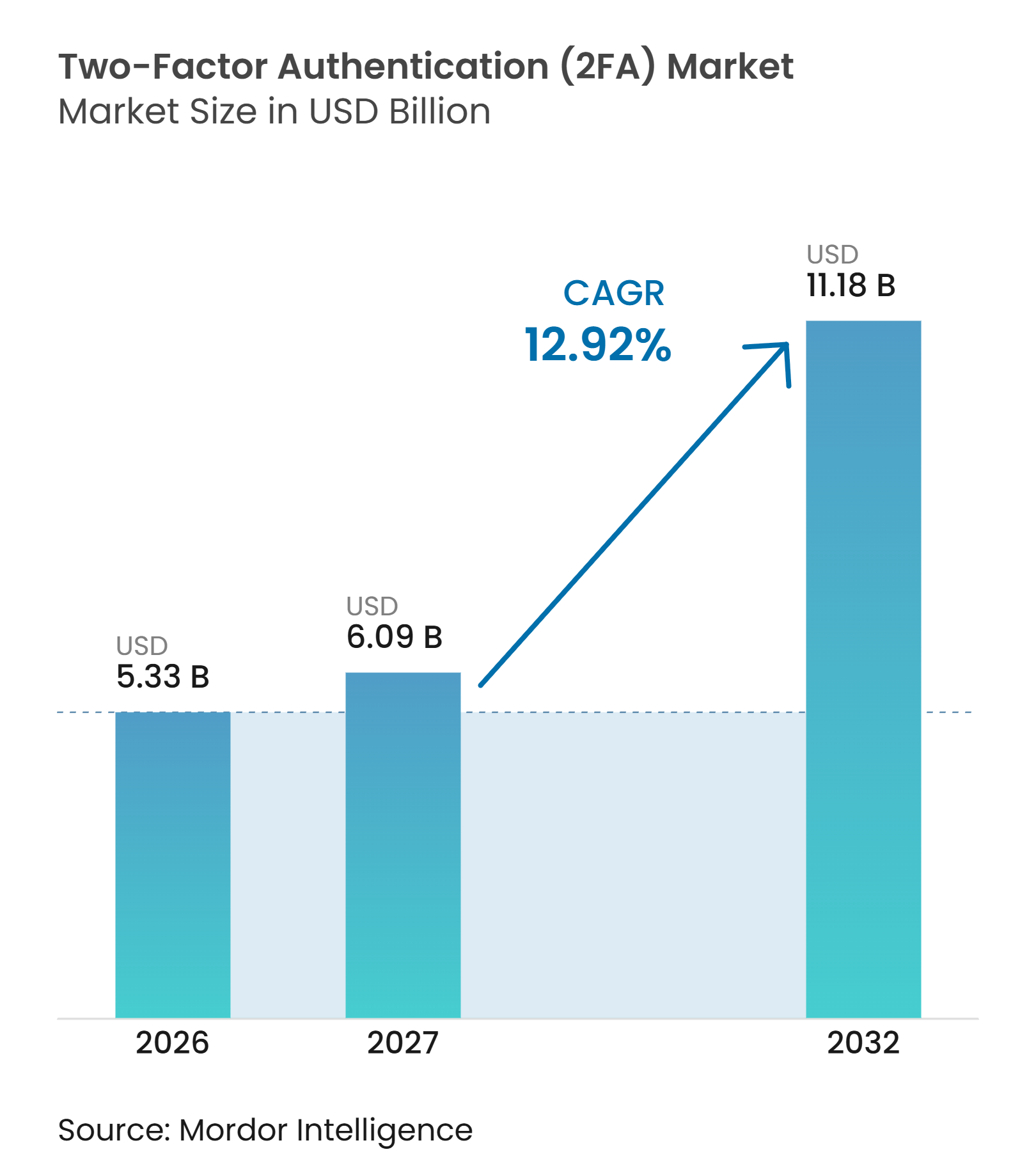
The Two-Factor Authentication (2FA) Market size was valued at USD 5.33 billion in 2026 and is forecast to reach USD 11.18 billion by 2032, expanding at a CAGR of 12.92% during 2027-2032. Demand is moving beyond basic compliance because phishing campaigns, identity-based attacks, and remote access have made stronger second-factor controls a routine security requirement. AI-enabled social engineering has widened the range of organizations exposed to account takeover, including smaller businesses that were once less attractive targets. Enterprises are also moving from one-time passwords toward cryptographic passkeys, which can support larger authentication projects and more demanding assurance requirements. Platform vendors are increasing competitive pressure by including phishing-resistant multi-factor authentication within broader productivity and security suites. This favors suppliers that can support hardware-backed credentials, legacy applications, regulated workflows, and recovery processes without adding unnecessary user friction.
Key Report Takeaways
- By authentication method, SMS and Voice OTP held 21.87% of the share of the Two-Factor Authentication (2FA) Market in 2026, while FIDO2 and WebAuthn Passkey are projected to expand at a 13.24% CAGR through 2032.
- By component, software accounted for 62.84% of the Two-Factor Authentication (2FA) Market in 2026, while hardware is projected to expand at a 13.36% CAGR through 2032.
- By deployment model, cloud-based deployment accounted for 57.66% of the Two-Factor Authentication (2FA) Market in 2026 and is projected to expand at a 13.28% CAGR through 2032.
- By organization size, large enterprises held 50.77% of the share of the Two-Factor Authentication (2FA) Market in 2026, while SMEs are projected to expand at a 13.56% CAGR through 2032.
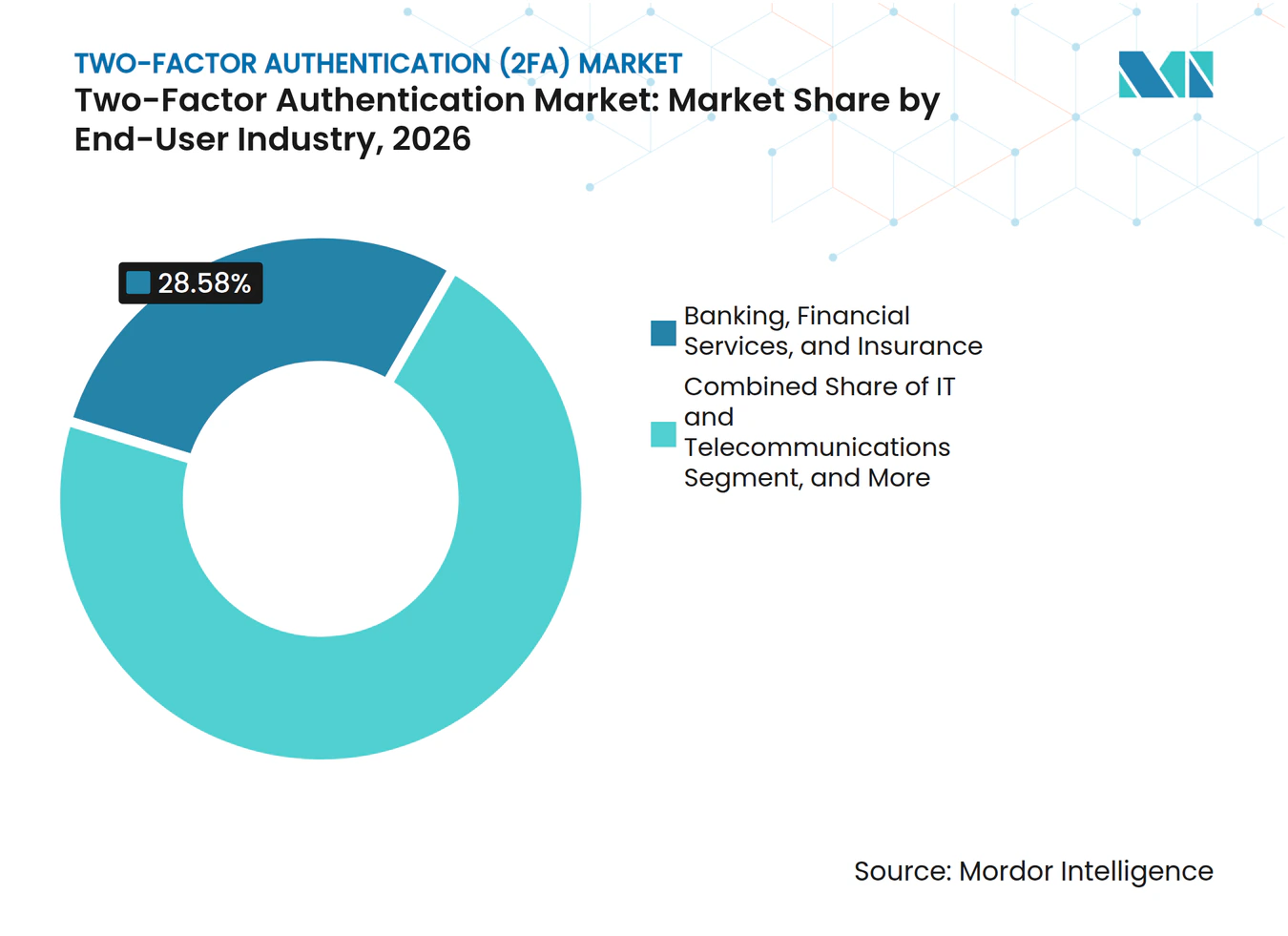
- By end-user industry, BFSI accounted for 28.58% of the share of the Two-Factor Authentication (2FA) Market in 2026, while healthcare and life sciences is projected to expand at a 13.84% CAGR through 2032.
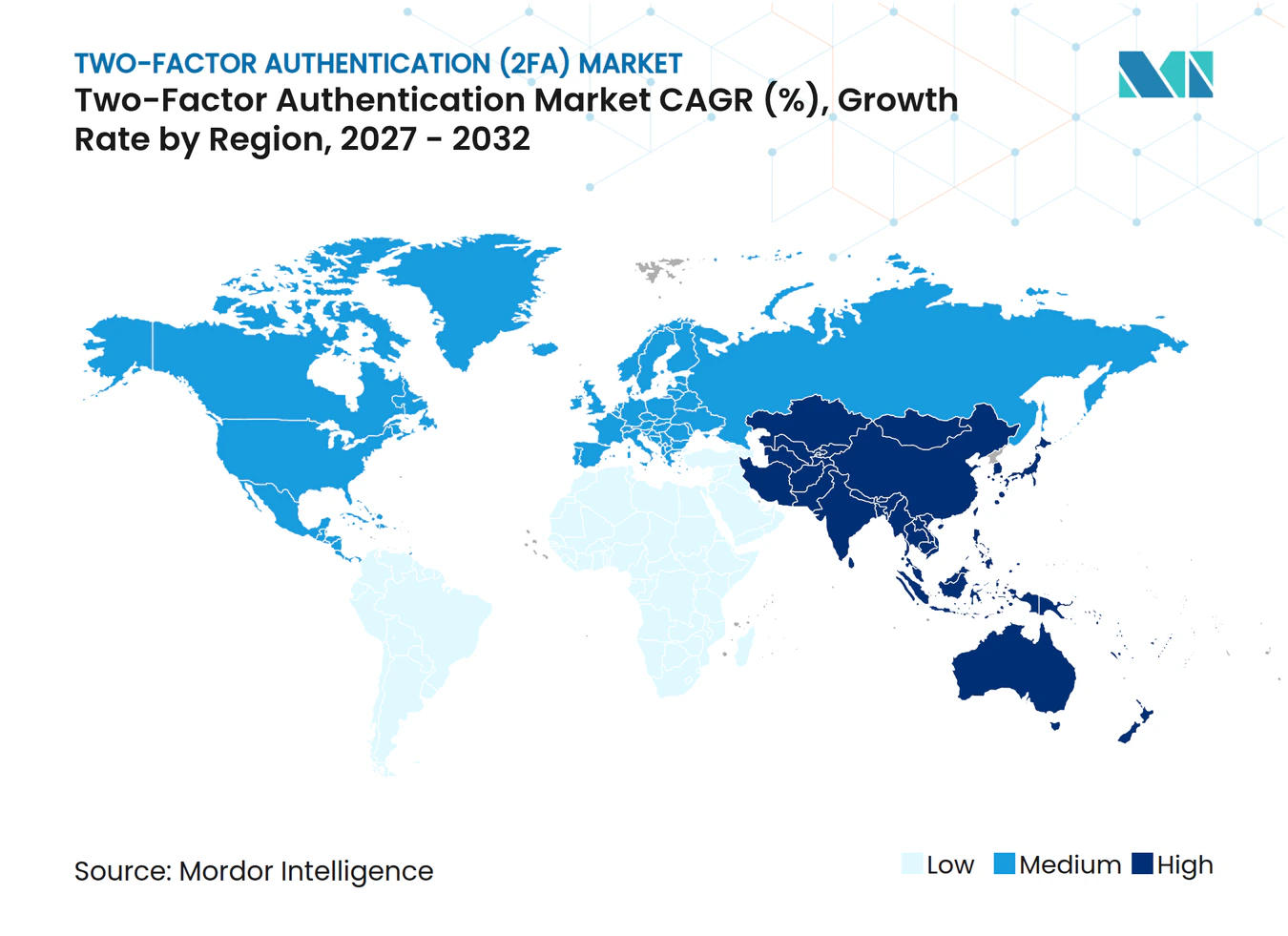
- By geography, North America held 37.24% of the share of the Two-Factor Authentication (2FA) Market in 2026, while Asia-Pacific is projected to expand at a 13.58% CAGR through 2032.
Note: Market numbers in this report are based on Mordor Intelligence's proprietary estimation framework, which combines nine months of actuals with Q4 projections for base year 2026.
Global Two-Factor Authentication (2FA) Market Trends and Insights
Drivers Impact Analysis*
| Driver | (~) % Impact on CAGR Forecast | Geographic Relevance | Impact Timeline |
|---|---|---|---|
| Rising Identity-Based Cyberattacks and Account Takeovers | +3.50% | Global | Short term (≤ 2 years) |
| Mandatory Authentication and Data-Security Requirements | +3.00% | North America and Europe, early gains in Asia-Pacific | Medium term (2-4 years) |
| Cloud, SaaS, Hybrid Work, and BYOD Access Expansion | +2.50% | Global | Short term (≤ 2 years) |
| Digital Banking and Online Transaction Growth | +1.80% | Asia-Pacific core, spill-over to Middle East and Africa and South America | Medium term (2-4 years) |
| Passkey Migration Creating a Higher-Assurance Upgrade Cycle | +1.20% | North America and Europe | Medium term (2-4 years) |
| Recovery-Flow and Help-Desk Exposure Increasing Demand for Resilient 2FA | +0.80% | Global | Short term (≤ 2 years) |
| Source: Mordor Intelligence | |||
Rising Identity-Based Cyberattacks and Account Takeovers
Identity compromise has become a central security concern because attackers can use stolen credentials and social engineering to bypass many conventional controls. Microsoft and Europol disrupted Tycoon 2FA in March 2026 after the phishing-as-a-service platform delivered more than 30 million fraudulent emails to over 500,000 organizations each month.[1] The disruption showed how phishing infrastructure can operate at a global scale while targeting authentication steps directly. The Two-Factor Authentication (2FA) Market benefits when organizations reassess whether a basic OTP provides enough protection against modern identity attacks. Passwordless credentials, number matching, and hardware-backed factors address attack paths that depend on intercepting or replaying a shared secret. Demand is extending to mid-market organizations because automated attack tools have reduced the cost of targeting a larger number of accounts.
Mandatory Authentication and Data-Security Requirements
Regulatory requirements are making multi-factor authentication a formal control for more organizations and access scenarios. PCI DSS v4.0.1 requires multi-factor authentication for all access to the cardholder data environment, including non-console access, as of March 31, 2025. NIST SP 800-63B-4 identifies phishing-resistant authentication as the preferred option for higher-assurance uses, thereby supporting the procurement of FIDO2 credentials and security keys [2]. These requirements matter beyond their direct legal scope because security teams and auditors often use recognized frameworks as benchmarks. Financial services, healthcare, critical infrastructure, and government contractors, therefore, face related expectations even where a rule is not directly binding. This wider use of security benchmarks supports demand for authentication products that can document assurance, policy enforcement, and audit activity.
Cloud, SaaS, Hybrid Work, and BYOD Access Expansion
Cloud applications and hybrid work have placed identity at the center of access control because users now connect from many devices and networks. Each additional SaaS application creates another sign-in point that must be governed consistently. A 2025 systematic review found that OTP remains the primary authentication method in 33% of the reviewed industry tools, despite the availability of stronger cryptographic options [3]. The Two-Factor Authentication Market is supported by organizations that need a single policy layer across cloud services, managed devices, personal devices, and remote users. Cloud-delivered authentication can reduce provisioning delays and make it easier to update controls as threats change. It also allows organizations with smaller IT teams to adopt managed authentication services rather than maintain extensive on-premises infrastructure.
Digital Banking and Online Transaction Growth
Digital banking requires dependable transaction authentication because customer accounts and payment journeys are regular targets for fraud. The expansion of mobile payments has increased the importance of confirming user identity without creating a difficult sign-in or approval process. The Two-Factor Authentication (2FA) Market has an important role in this setting because banks need to balance strong controls with high transaction volumes. Biometric factors, device binding, and passkeys can reduce reliance on reusable OTP codes for appropriate use cases. In India, financial market participants face requirements for stronger authentication on trading and mutual-fund transactions, which supports a broader shift toward upgraded controls. Authentication suppliers that can work with mobile devices, local identity infrastructure, and financial service workflows are better placed to serve these requirements.
Restraints Impact Analysis*
| Restraint | (~) % Impact on CAGR Forecast | Geographic Relevance | Impact Timeline |
|---|---|---|---|
| Deployment Complexity Across Legacy and Modern Applications | -2.10% | Global | Long term (≥ 4 years) |
| Implementation, Support, and Authenticator Procurement Costs | -1.80% | South America, Middle East and Africa, and SME-dominated markets globally | Medium term (2-4 years) |
| User Friction, Enrollment Drop-Off, and Recovery Burden | -1.40% | Global | Short term (≤ 2 years) |
| SMS and Voice Channel Vulnerability Eroding Trust in Traditional 2FA | -0.90% | Global | Short term (≤ 2 years) |
| Source: Mordor Intelligence | |||
Deployment Complexity Across Legacy and Modern Applications
Legacy infrastructure can slow implementation because authentication must work across systems built in different technology periods. Mainframes, RADIUS environments, older enterprise resource planning systems, and on-premises directories often need tailored integration work. RSA added passwordless capabilities for RADIUS environments in 2025, including code-matching intended to reduce the risk of prompt-bombing. The Two-Factor Authentication (2FA) Market faces a longer sales and deployment cycle, where buyers must connect several identity providers and acquire business systems. Identity federation adds complexity because changes to an authentication layer can affect trust relationships across multiple applications. Federal and regulated deployments may require additional validation, including compliance with FIPS 140-2, before a solution can be approved.
Implementation, Support, and Authenticator Procurement Costs
Cost remains a practical barrier for organizations with limited security budgets and small IT teams. Hardware-key programs require device purchasing, distribution, replacement planning, and help-desk support. Subscription-based authentication services can also be costly for businesses with many short-term workers, partners, or contractors. The Two-Factor Authentication (2FA) Market must therefore offer deployment models that match each organization’s user turnover and assurance needs. These costs are more difficult for SMEs and public-sector buyers who operate within fixed budget cycles. Managed services and cloud delivery can reduce some infrastructure costs, but they do not remove the need for enrollment, user support, and recovery planning.
*Our forecasts treat driver/restraint impacts as directional, not additive. The impact forecasts reflect baseline growth, mix effects, and variable interactions.
Segment Analysis
By Authentication Method: Passkey Adoption Advances Against the Legacy OTP Installed Base
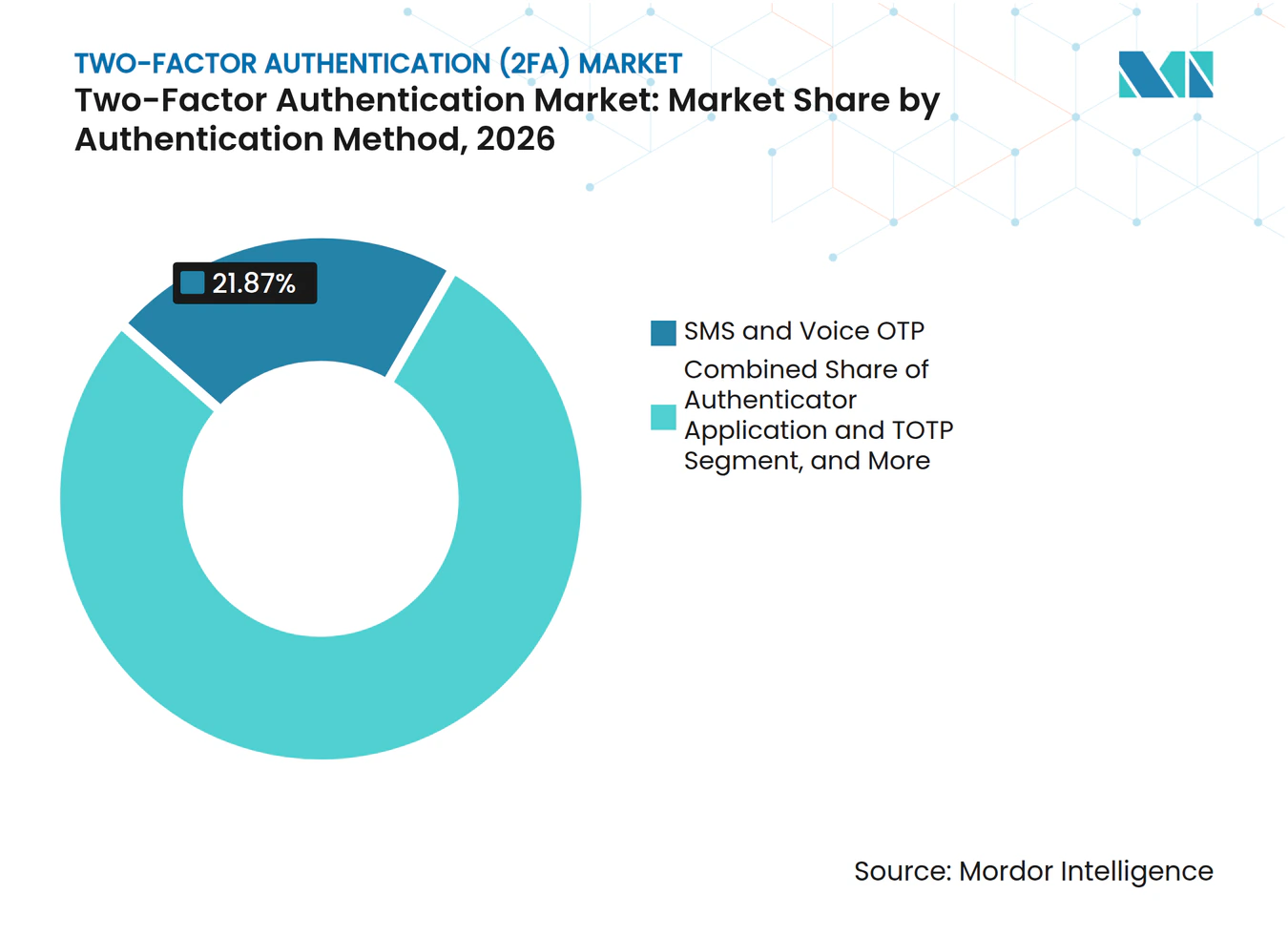
SMS and Voice OTP held 21.87% of the share of the Two-Factor Authentication (2FA) Market in 2026 because mobile networks provide a familiar channel across enterprise and consumer use cases. The installed base remains large because SMS and voice are easy for users to understand and work on many mobile devices. However, the GSMA notes that SS7 was not designed with authentication or encryption protections, leaving pathways for interception, call rerouting, and location tracking. ITU-T Recommendation Q.3066 provides principles for detecting and mitigating signaling attacks in telecommunication networks. Email OTP and authenticator applications occupy the middle of the method mix, with TOTP remaining useful where push infrastructure is unavailable. These methods continue to serve organizations that require broad compatibility across diverse device environments.
FIDO2 and WebAuthn Passkey are projected to expand at a 13.24% CAGR through 2032, making it the fastest-growing authentication-method segment. The FIDO Alliance reported 5 billion passkeys in active use in May 2026 and stated that 68% of surveyed organizations had deployed or were deploying passkeys for workforce sign-ins. The October 2026 Passkey Index reported that passkeys accounted for 36% of successful sign-ins across participating services, up from 26% in 2025. This adoption supports a transition away from methods that depend on a code being sent, copied, or manually entered. It also places greater importance on how a service manages device registration and account recovery when a user changes a device. Hardware security keys and smart cards remain important in government, defense, and regulated financial services where validated hardware and PIV-related requirements restrict alternatives. Push notification, number matching, and biometric second factors also support mobile-first banking and healthcare settings where proximity-based verification can reduce friction. The Two-Factor Authentication (2FA) Market is gradually shifting toward methods that make phishing-resistant authentication more practical without excluding older applications that still need compatible options.



By Component: Software Leads While Hardware Gains From Higher-Assurance Needs
Software held 62.84% of the share of the Two-Factor Authentication (2FA) Market in 2026, reflecting the move from discrete token deployments to integrated identity platforms. These platforms bring authentication, access policies, risk signals, device trust, and audit capabilities into a common operating layer. Buyers can use this approach to manage several authentication methods without running a separate system for each method. Software also supports cloud delivery, which can simplify updates and allow policy changes to be made centrally. The component is relevant to organizations that want to connect authentication with governance and threat detection. Services remain important because deployment, integration, support, and training work are often required when organizations add 2FA to legacy systems.
Hardware is projected to expand at a 13.36% CAGR through 2032, supported by the move to phishing-resistant credentials in high-assurance settings. Hardware keys provide a dedicated factor that can be resistant to remote credential theft when deployed with suitable policies. Token introduced BioKey in June 2025, a FIDO-certified security key with an integrated fingerprint sensor and secure element for enterprise authentication. Hardware procurement is particularly relevant in financial services, government, defense, and healthcare environments that require stronger authentication assurance. The physical nature of these credentials can also support security teams that want a clear separation between a user’s device and the second authentication factor. FIDO certification and FIPS 140-2 validation can act as qualification thresholds for suppliers in regulated programs. These requirements narrow the pool of products that may be considered for some deployments. The Two-Factor Authentication (2FA) Market size for hardware benefits when buyers must satisfy these requirements and cannot rely only on software-based OTP controls.
By Deployment Model: Cloud-Based Delivery Combines Scale With Ongoing Local Demand
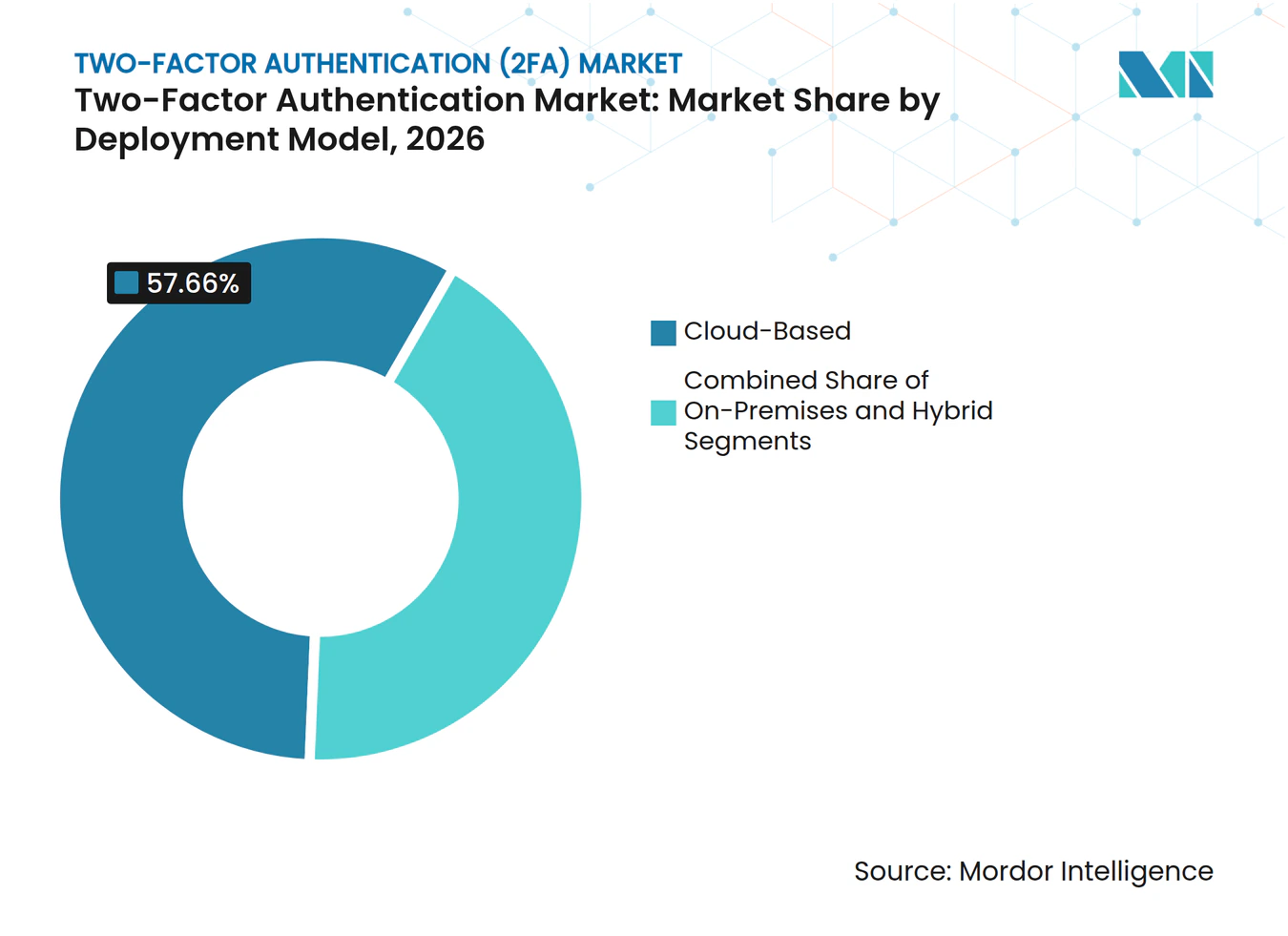
Cloud-based deployment accounted for 57.66% of the Two-Factor Authentication Market in 2026 and is projected to expand at a 13.28% CAGR through 2032. This alignment of scale and expansion reflects the need for authentication that can serve distributed users, cloud applications, and changing device patterns. Cloud delivery reduces the time needed to provision authentication services and enables threat detection updates to be applied continuously. It can also align spending with active users, which is helpful where workforce size changes over time. Managed authentication services are relevant for mid-market organizations that do not want to build a dedicated identity operations team. The cloud model also supports consistent policies across remote work, SaaS applications, and bring-your-own-device access.
On-premises deployment retains a role where data residency, air-gapped operations, or critical legacy systems limit cloud connectivity. Government agencies, defense contractors, and financial institutions can maintain local authentication servers as a primary trust anchor. These organizations may use cloud services selectively for remote access or customer-facing services while keeping sensitive controls inside their own environment. Hybrid delivery connects both approaches and lets organizations modernize in stages. It is particularly useful when an enterprise cannot retire existing infrastructure immediately or must support several application generations. A phased approach also gives security teams time to test policy changes before extending them across sensitive systems. This is important because a failed authentication integration could interrupt access to operationally important applications. The Two-Factor Authentication Market, therefore, includes both cloud-first purchases and complex programs that combine local and hosted controls.

By Organization Size: Large Enterprises Lead While SMEs Adopt Cloud Services
Large enterprises held 50.77% of the share of the Two-Factor Authentication Market in 2026 because they have large identity populations, complex application estates, and extensive compliance obligations. Their exposure to regulatory review and high-value account compromise supports spending on stronger authentication controls. Large organizations often need to protect employees, contractors, privileged users, and customers across many applications. This requirement can favor platforms that provide centralized policy administration, audit records, and connections to multiple identity providers. Public sector and government agencies have separate procurement characteristics because their budgets and contracts are tied to formal assurance requirements. Longer procurement cycles can delay purchases, but defined standards can also create predictable upgrade schedules for qualified vendors.
SMEs are projected to expand at a 13.56% CAGR through 2032 as cloud-based services make strong authentication more accessible for organizations with smaller IT teams. Subscription delivery can remove the need to operate on-premises authentication infrastructure. SMEs still need systems that can be deployed with limited internal expertise and provide reliable support when users lose devices or need account recovery. Cybersecurity insurance requirements can also make MFA a practical investment topic for business owners and security managers. The onboarding process is especially important because smaller organizations may not have a dedicated identity administrator. Suppliers that offer simple enrollment, predictable pricing, and manageable administration can reduce the gap between an SME’s willingness to improve security and its ability to implement the controls. Clear recovery procedures can also limit the operational burden when employees change phones or leave the organization. The Two-Factor Authentication Market is supported by this move from specialist enterprise projects toward repeatable cloud-based adoption among smaller businesses.
By End-User Industry: BFSI Sets the Compliance Baseline While Healthcare and Life Sciences Expands Fastest
BFSI accounted for 28.58% of the Two-Factor Authentication Market in 2026, driven by the sector’s need to protect high-value accounts and regulated payment activity. PCI DSS requirements, PSD2 strong customer authentication requirements, and U.S. banking supervision all reinforce the use of stronger access controls. Financial institutions need authentication across employee systems, consumer banking, payment approval, and privileged administrative activity. This can require several methods because the assurance level and user experience differ between a customer making a payment and an employee accessing a sensitive system. Hardware keys, passkeys, device-bound factors, and biometrics can be used where institutions move beyond conventional OTP methods. Government and defense, together with IT and telecommunications, also require broad authentication coverage because they protect extensive user populations and critical systems.
Healthcare and life sciences are projected to expand at a 13.84% CAGR through 2032, making it the fastest-growing end-user segment. Digital clinical workflows, telemedicine, e-prescribing, and access to electronic protected health information increase the number of identities that must be verified. Healthcare users often operate at shared workstations and in time-sensitive settings, so the authentication process must protect access without causing needless delays. Biometric and proximity-based methods can be relevant in these settings because they may reduce the need for repeated code entry. The segment also needs strong recovery controls because help desks can be targeted through social engineering when users cannot access clinical systems. Authentication projects must therefore account for the way clinicians move between devices, applications, and locations during a shift. A solution that works well for office workers may not meet the practical needs of care teams managing urgent tasks. The Two-Factor Authentication Market opportunity in healthcare depends on suppliers that can meet assurance needs while fitting real clinical workflows.
Geography Analysis
North America held 37.24% of the share of the Two-Factor Authentication (2FA) Market in 2026, supported by mature cloud infrastructure, large enterprise security budgets, and formal payment-security requirements. The United States is central to regional demand because it has substantial IAM spending and a concentration of platform and specialist suppliers. PCI DSS v4.0.1 has supported stronger authentication requirements for relevant cardholder data environment access since March 2025. Canada and Mexico are also influenced by cross-border commercial relationships and widely used U.S. security frameworks. These conditions support continued purchasing of authentication platforms, passkeys, security keys, and managed services.
Europe remains a major regional market because organizations must respond to GDPR accountability expectations, PSD2 strong customer authentication, and the expanded security scope of NIS2. The region’s rules affect companies outside Europe when they serve EU customers or process related data. Germany and the United Kingdom support enterprise demand through their large industrial and financial services bases. European buyers often require technology that can support formal audit, identity governance, and privacy-related controls. North America and Europe are also important early markets for FIDO2 adoption because enterprises in these regions often seek phishing-resistant workforce authentication. The Two-Factor Authentication (2FA) Market in these regions is shaped by compliance requirements and by the need to integrate modern controls with long-established enterprise systems.
Asia-Pacific is projected to expand at a 13.58% CAGR through 2032, supported by digital identity programs, mobile payments, and financial service modernization. India’s financial services environment is a significant source of demand for stronger authentication across trading and mutual-fund transactions. Japan’s My Number system, South Korea’s FinTech Act, and passkey activity in Singapore and Australia support compliance-led and technology-led adoption. China creates demand for high-volume transaction authentication through digital identity infrastructure and cross-border e-commerce requirements. South America is led by Brazil, where Pix creates many authenticated payment sessions that banks can progressively upgrade beyond SMS OTP. The Middle East and Africa is supported by digital transformation programs in the United Arab Emirates and Saudi Arabia, where mobile-first authentication can be more practical than hardware tokens for broad user groups.
Competitive Landscape
Market Concentration
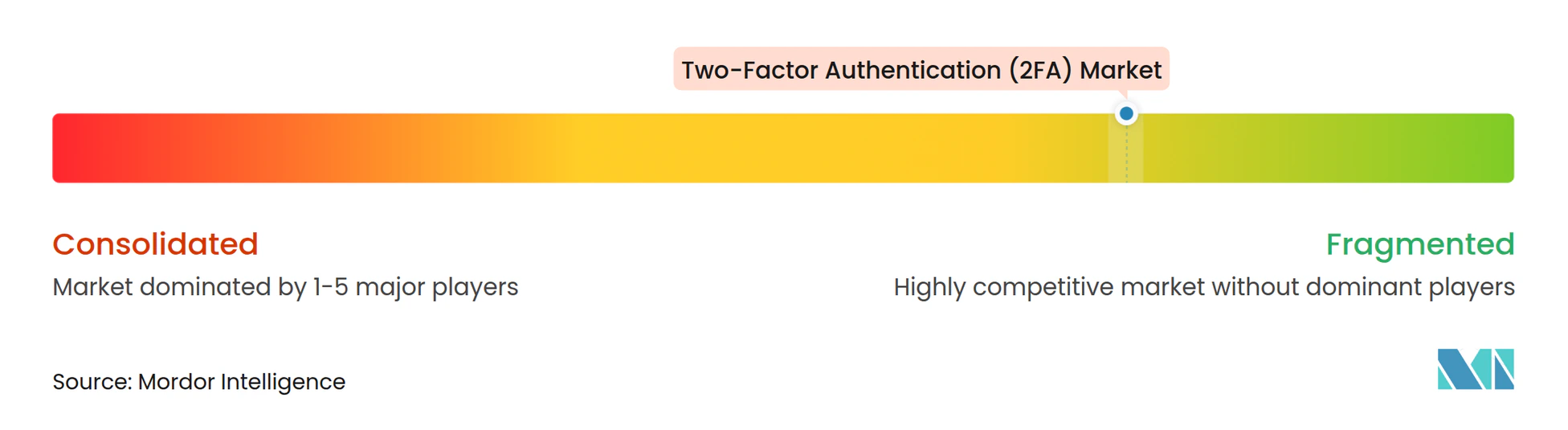
The Two-Factor Authentication (2FA) Market is moderately fragmented, with platform suppliers, specialist identity providers, and hardware token manufacturers serving distinct assurance and deployment needs. Microsoft, Okta, and Cisco, through Duo, have structural advantages because authentication can be included within wider productivity or security suites. This bundling can reduce the pricing power of point-solution providers. Specialist suppliers respond by focusing on hardware-backed credentials, legacy-system support, regulated workflows, and stronger recovery controls. Buyers may select a broad platform for standard workforce access while using a specialist product for higher-risk groups or complex applications. Competition, therefore, depends on product coverage, integration capability, assurance, and the ability to manage user enrollment at scale.
RSA expanded its partnership with Microsoft in March 2026 to integrate RSA ID Plus with Microsoft 365 E7 and The Frontier Suite for passwordless workforce authentication across hybrid, legacy, operational technology, and non-Microsoft environments. RSA also introduced Help Desk Live Verify in 2025 to address social engineering risks during account recovery and help desk interactions. Okta announced its identity security fabric for AI agents, service accounts, and API tokens in September 2025, extending authentication governance to non-human identities. These moves show that competition is extending beyond traditional workforce sign-in to recovery processes, machine identities, and complex technology environments. They also show why specialist providers can partner with large platforms where they fill coverage gaps.
Hardware suppliers are addressing provisioning challenges that once limited security-key programs to narrow high-security use cases. Yubico expanded enrollment services in March 2026 for Microsoft Entra ID and PingID environments, including options designed to support in-field enrollment. The FIDO Alliance reported that 200 organizations had signed the FIDO Passkey Pledge in May 2026, indicating continued supplier and service-provider support for passkey adoption. A continuing opportunity lies in connecting certificate-based smart-card programs and legacy hardware with cloud-based identity orchestration. Federal and defense buyers remain relevant because their assurance requirements can favor FIDO2 and FIPS-aligned products. The Two-Factor Authentication (2FA) Market will continue to reward suppliers that combine strong authentication with straightforward enrollment, interoperable deployment, and credible support for legacy environments.
Two-Factor Authentication (2FA) Industry Leaders
-
Yubico AB
-
RSA Security LLC
-
Microsoft Corporation
-
Okta, Inc.
-
Cisco Systems, Inc.
- *Disclaimer: Major Players sorted in no particular order
Recent Industry Developments
- October 2026: The FIDO Alliance published the Passkey Index 2026 reporting 36% of successful sign-ins now use a passkey, up from 26% in 2025, passkey success rates of 93% versus 78% for traditional MFA, and 42% of eligible accounts enrolled. Two-thirds of participants plan to offer passwordless accounts within 12 months.
- March 2026: Microsoft and Europol disrupted Tycoon 2FA, seizing 330 active domains under a U.S. federal court order, with coordinated law enforcement action across 6 countries. The platform had delivered over 30 million fraudulent emails to 500,000+ organizations monthly and was linked to 96,000 distinct phishing victims globally.
- March 2026: RSA Security announced an expanded partnership with Microsoft at RSAC Conference 2026, integrating RSA ID Plus with Microsoft’s 365 E7, The Frontier Suite, to deliver AI-powered passwordless workforce authentication. The partnership extends phishing-resistant coverage to legacy, OT, and non-Microsoft environments beyond native Entra ID reach.
- March 2026: Yubico expanded YubiKey as a Service enrollment capabilities at RSAC 2026, adding in-field enrollment support for Microsoft Entra ID and PingID environments through a new YubiKey as a Service Enroll app with limited early access for Android. The capability enables enterprises to customize Entra ID and PingOne PingID registration and account-recovery experiences at a deployment scale.
Global Two-Factor Authentication (2FA) Market Report Scope
The Two-Factor Authentication Market comprises security solutions that require users to verify their identity using two distinct factors, typically something they know (password/PIN) combined with something they have (OTP via SMS, authenticator app, or hardware token) or something they are (biometric) before granting access to systems, applications, or transactions.
The Two-Factor Authentication Market Report is Segmented by Authentication Method (SMS/Voice OTP, Email OTP, Authenticator App/TOTP, Push Notification, Hardware Security Key, Biometric Second Factor, and FIDO2/WebAuthn Passkey), Component (Hardware, Software, and Services), Deployment Model (Cloud-Based, On-Premises, and Hybrid), Organization Size (Large Enterprises, SMEs, and Public Sector), End-User Industry (BFSI, Government and Defense, IT and Telecom, Healthcare, Retail, and Education), and Geography (North America, South America, Europe, Asia-Pacific, and Middle East and Africa). The Market Forecasts are Provided in Terms of Value (USD).
| SMS and Voice OTP |
| Email OTP |
| Authenticator Application and TOTP |
| Push Notification and Number Matching |
| Hardware Security Key and Smart Card |
| Biometric Second Factor |
| FIDO2 and WebAuthn Passkey |
| Hardware |
| Software |
| Services |
| Cloud-Based |
| On-Premises |
| Hybrid |
| Large Enterprises |
| Small and Medium-Sized Enterprises |
| Public Sector and Government Agencies |
| Banking, Financial Services, and Insurance |
| Government and Defense |
| IT and Telecommunications |
| Healthcare and Life Sciences |
| Retail and E-Commerce |
| Education |
| Other End-User Industry |
| North America | United States |
| Canada | |
| Mexico | |
| South America | Brazil |
| Argentina | |
| Rest of South America | |
| Europe | United Kingdom |
| Germany | |
| France | |
| Italy | |
| Rest of Europe | |
| Asia-Pacific | China |
| Japan | |
| India | |
| South Korea | |
| ASEAN | |
| Rest of Asia-Pacific | |
| Middle East and Africa | Saudi Arabia |
| United Arab Emirates | |
| South Africa | |
| Egypt | |
| Rest of Middle East and Africa |
| By Authentication Method | SMS and Voice OTP | |
| Email OTP | ||
| Authenticator Application and TOTP | ||
| Push Notification and Number Matching | ||
| Hardware Security Key and Smart Card | ||
| Biometric Second Factor | ||
| FIDO2 and WebAuthn Passkey | ||
| By Component | Hardware | |
| Software | ||
| Services | ||
| By Deployment Model | Cloud-Based | |
| On-Premises | ||
| Hybrid | ||
| By Organization Size | Large Enterprises | |
| Small and Medium-Sized Enterprises | ||
| Public Sector and Government Agencies | ||
| By End-User Industry | Banking, Financial Services, and Insurance | |
| Government and Defense | ||
| IT and Telecommunications | ||
| Healthcare and Life Sciences | ||
| Retail and E-Commerce | ||
| Education | ||
| Other End-User Industry | ||
| By Geography | North America | United States |
| Canada | ||
| Mexico | ||
| South America | Brazil | |
| Argentina | ||
| Rest of South America | ||
| Europe | United Kingdom | |
| Germany | ||
| France | ||
| Italy | ||
| Rest of Europe | ||
| Asia-Pacific | China | |
| Japan | ||
| India | ||
| South Korea | ||
| ASEAN | ||
| Rest of Asia-Pacific | ||
| Middle East and Africa | Saudi Arabia | |
| United Arab Emirates | ||
| South Africa | ||
| Egypt | ||
| Rest of Middle East and Africa | ||
Key Questions Answered in the Report
What is the size of the Two-Factor Authentication (2FA) Market?
The Two-Factor Authentication (2FA) Market is valued at USD 5.33 billion in 2026 and is forecast to reach USD 11.18 billion by 2032, at a 12.92% CAGR during 2027-2032. Demand is supported by identity-based attacks, compliance requirements, cloud access, and the move toward phishing-resistant factors.
Which authentication method is expanding fastest?
FIDO2 and WebAuthn Passkey is projected to expand at a 13.24% CAGR through 2032 as organizations move toward phishing-resistant authentication. The method replaces reusable codes with cryptographic credentials and is becoming more important in workforce sign-in programs.
Why are passkeys becoming more important for enterprise security?
Passkeys use cryptographic credentials and can reduce dependence on shared secrets that attackers may intercept or steal through phishing. They also offer a path to stronger authentication when organizations can manage device registration and account recovery effectively.
Which deployment model has the largest role in 2FA adoption?
Cloud-based deployment accounted for 57.66% of revenue in 2026 and is projected to expand at a 13.28% CAGR through 2032. It can support centralized policy management across SaaS applications, remote users, managed devices, and personal devices.
Which end-user sector has the largest demand for 2FA?
BFSI accounted for 28.58% of revenue in 2026 because payment systems, customer accounts, and privileged financial access require strong controls. Financial institutions must balance secure employee access and transaction authentication with a customer experience that remains practical at scale.
Which region is expanding the fastest?
Asia-Pacific is projected to expand at a 13.58% CAGR through 2032, supported by digital identity programs, mobile payments, and financial service modernization. The region includes markets where authentication suppliers must address local payment systems, regulatory expectations, and mobile-first access patterns.