
Phishing-Resistant Authentication Market Size and Share
Market Overview
| Study Period | 2020 - 2031 |
|---|---|
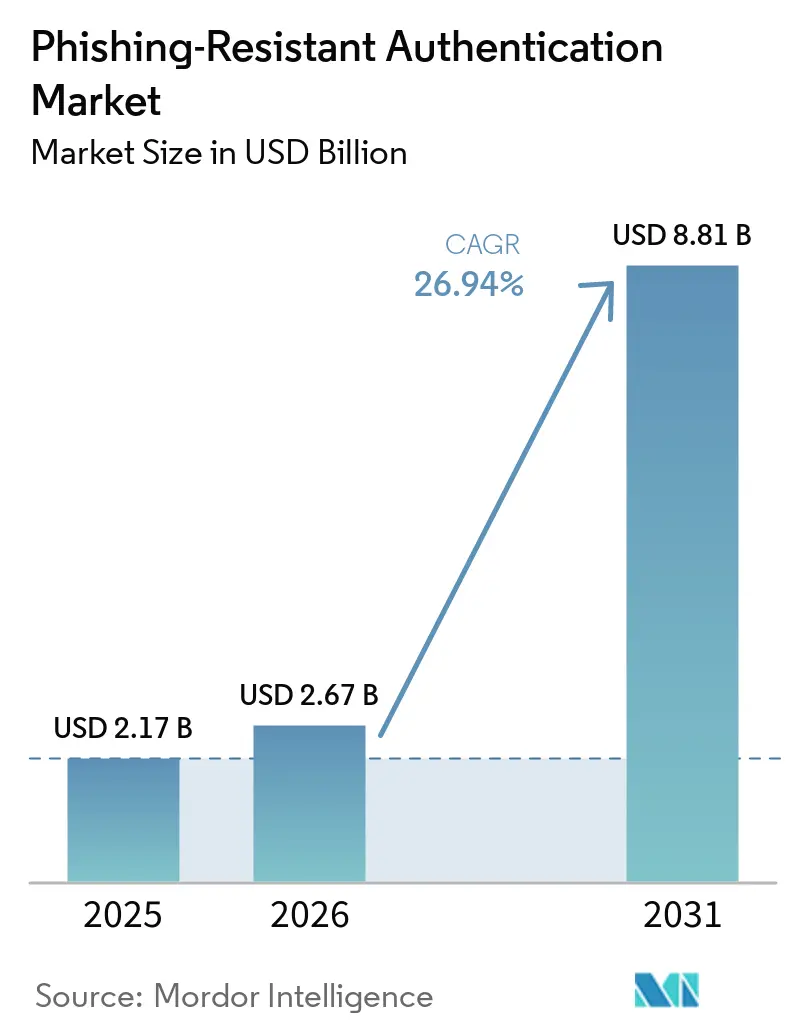
| Market Size (2026) | USD 2.67 Billion |
| Market Size (2031) | USD 8.81 Billion |
| Growth Rate (2026 - 2031) | 26.94 % |
| Fastest Growing Market | Asia-Pacific |
| Largest Market | North America |
| Market Concentration | Low |
Major Players *Disclaimer: Major Players sorted in no particular order Image © Mordor Intelligence. Reuse requires attribution under CC BY 4.0. | |
Phishing-Resistant Authentication Market Analysis by Mordor Intelligence
The Phishing-Resistant Authentication Market size is projected to expand from USD 2.17 billion in 2025 to USD 2.7 billion in 2026, and to USD 8.81 billion by 2031, registering a CAGR of 26.94% between 2026 and 2031. The Phishing-Resistant Authentication Market is being shaped by government regulations that have made cryptographic authentication a compliance requirement for many organizations. Adversary-in-the-middle attacks have also exposed the limits of conventional multi-factor authentication, especially when attackers steal session tokens through proxy tools. Open FIDO2 and WebAuthn standards are becoming easier to deploy because major operating systems and browsers support them natively. This combination is shifting demand toward platforms that manage authenticators, enrollment, policies, recovery, and audit activities across diverse device environments. The Phishing-Resistant Authentication Market also benefits when public-sector requirements influence contractors and suppliers that need comparable levels of identity assurance.
Key Report Takeaways
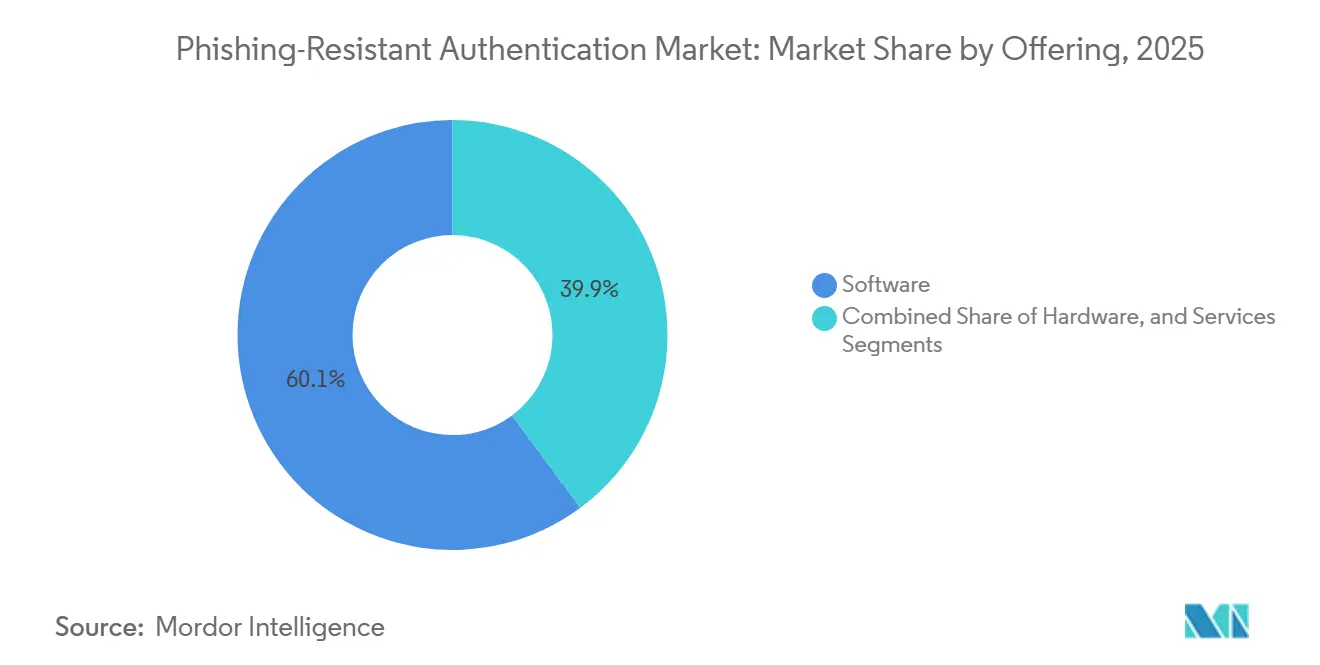
- By offering, software held 60.14% of the Phishing-Resistant Authentication Market share in 2025, while services are projected to expand at a CAGR of 28.12% through 2031.
- By deployment mode, cloud held 62.89% of the Phishing-Resistant Authentication Market share in 2025, while hybrid is projected to expand at a CAGR of 28.34% through 2031.
- By organization size, large enterprises held 71.55% of the Phishing-Resistant Authentication Market share in 2025, while SMEs are projected to expand at a CAGR of 29.02% through 2031.
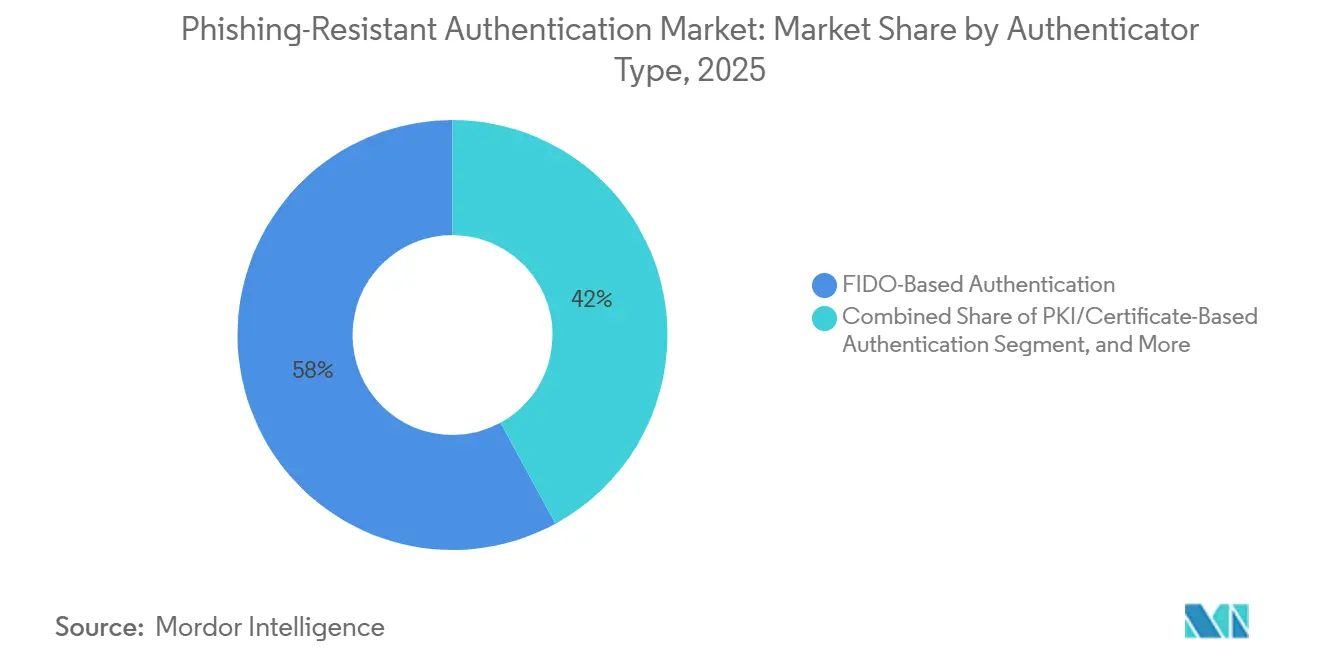
- By authenticator type, FIDO-based authentication held 57.96% of the Phishing-Resistant Authentication Market share in 2025, while PKI/certificate-based authentication is projected to expand at a CAGR of 28.70% through 2031.
- By industry vertical, government and public administration held 21.65% of the Phishing-Resistant Authentication Market share in 2025, while healthcare and life sciences are projected to expand at a CAGR of 27.51% through 2031.
- By geography, North America held 38.20% of the Phishing-Resistant Authentication Market in 2025, while Asia-Pacific is projected to expand at a CAGR of 27.88% through 2031.
Note: Market size and forecast figures in this report are generated using Mordor Intelligence’s proprietary estimation framework, updated with the latest available data and insights as of January 2026.
Global Phishing-Resistant Authentication Market Trends and Insights
Drivers Impact Analysis*
| Driver | (~) % Impact on CAGR Forecast | Geographic Relevance | Impact Timeline |
|---|---|---|---|
| Regulatory Mandates for Phishing-Resistant MFA | +6.5% | Global, concentrated in North America and Europe | Short term (≤ 2 years) |
| Account Takeover and Adversary-in-the-Middle Risk | +5.8% | Global | Short term (≤ 2 years) |
| Passkey Ecosystem Standardization | +4.7% | Global, with early scaling in North America, Europe, and APAC core | Medium term (2-4 years) |
| Passwordless User Experience and Support Cost Reduction | +4.2% | Global, faster uptake in North America and Europe | Medium term (2-4 years) |
| Device-Bound Credential Recovery as a Deployment Accelerator | +2.8% | North America and Europe, spillover to APAC and MEA | Medium term (2-4 years) |
| Hardware-Backed Authentication for Privileged and Operational Technology Access | +2.0% | North America, Europe, and industrial APAC markets | Long term (≥ 4 years) |
| Source: Mordor Intelligence | |||
Regulatory Mandates for Phishing-Resistant MFA
Government requirements are a direct driver of demand for the Phishing-Resistant Authentication Market because they set clear technical expectations and implementation deadlines. NIST finalized SP 800-63B-4 on July 31, 2025, and it requires phishing-resistant authenticators at Authenticator Assurance Level 3 for high-value federal use cases. The guidance also moved away from SMS one-time passwords as an acceptable option at the lower AAL2 level. CISA Binding Operational Directive 25-01 required federal civilian agencies to configure phishing-resistant MFA for all users by June 20, 2025. Executive Order 14144 continued to support the use of FIDO2 and PKI standards within federal identity programs. A July 2026 FIDO Alliance submission supported the inclusion of phishing-resistant authentication in federal contracts involving Controlled Unclassified Information.
Account Takeover and Adversary-in-the-Middle Risk
AiTM phishing has made it harder for organizations to rely on push approvals and other phishable authentication methods. Microsoft documented a 146% year-over-year rise in AI TM attacks in its 2026 Digital Defense Report, with 40,000 incidents detected daily across Microsoft 365 tenants. Okta stated in January 2026 that FIDO2 passkeys and FastPass provide complete protection against real-time vishing and AI TM proxy campaigns. Session-token theft is particularly significant because it can bypass conventional MFA after a user completes a legitimate approval. Phishing-resistant credentials bind the authentication event to the relying party's origin domain, which limits this method of credential relay. Attack kits are also being offered through low-cost subscription models, reducing the skills needed to conduct large-scale MFA bypass campaigns. These conditions are increasing the need for authentication systems that protect privileged accounts, workforce access, and high-value customer transactions.
Passkey Ecosystem Standardization
The Phishing-Resistant Authentication Market is supported by broader adoption of passkeys across consumer and workforce environments. The FIDO Alliance reported in May 2026 that 5 billion passkeys were in active use worldwide based on public platform telemetry and member deployment data. Its 2026 survey found that 68% of organizations had deployed or were actively deploying passkeys for employee authentication. The same survey found that 82% of organizations viewed a fully passwordless workforce as an ultimate objective. A separate study by the FIDO Alliance and HID found that 93% of organizations were on the path to passkey adoption, but only 13% had reached deployment at scale. This gap maintains demand for deployment services, lifecycle management, and specialist support as organizations move from pilot projects to full workforce coverage.
Passwordless User Experience and Support Cost Reduction
Operational savings are widening the appeal of the Phishing-Resistant Authentication Market beyond heavily regulated buyers. Okta reported that adoption of phishing-resistant authenticators grew 63% year-over-year in 2025, while FastPass adoption nearly doubled.[1]Okta, “Secure Sign-in Trends Report 2025,” Okta, okta.com. Password reset requests can account for 20% to 50% of IT help desk activity at large enterprises, making passwordless access relevant to support costs and employee productivity. The FIDO Alliance found that 35% of organizations deploying passkeys reported fewer password-reset tickets. It also found that 32% reported fewer phishing incidents and 45% reported faster employee login times. Microsoft is moving passkeys to the default status in Entra ID starting in September 2026, bringing phishing-resistant capabilities to existing platform relationships without a separate procurement event.
Restraints Impact Analysis*
| Restraint | (~) % Impact on CAGR Forecast | Geographic Relevance | Impact Timeline |
|---|---|---|---|
| Initial Rollout and Lifecycle Management Cost | -3.2% | Global, most acute in SME segments and emerging markets | Short term (≤ 2 years) |
| Legacy Application and Protocol Compatibility | -2.6% | Global, most severe in manufacturing, financial services, and healthcare | Medium term (2-4 years) |
| Recovery and Account Reset Weaknesses | -1.8% | Global | Medium term (2-4 years) |
| Authenticator Supply Chain and Attestation Interoperability | -1.4% | Global, concentrated in government and regulated sectors | Long term (≥ 4 years) |
| Source: Mordor Intelligence | |||
Initial Rollout and Lifecycle Management Cost
Hardware authenticator programs require procurement, issuance, replacement, attestation checks, and user support that are not present in basic password or SMS environments. Device-bound passkey programs can require factory preregistration, global shipping, and help desk preparation across distributed workforces. These activities can extend deployment schedules by 6 to 18 months for enterprises with large international user bases. They can also double total ownership costs compared with a cloud-only passkey deployment. Cost pressure is especially material for SMEs without dedicated identity and access management teams. The FIDO Alliance and HID study found that 33% of organizations without active passkey projects identified cost as a primary barrier.
Legacy Application and Protocol Compatibility
Many enterprise applications were built before WebAuthn and CTAP2 support became available. Organizations must therefore maintain phishing-resistant authentication for newer applications while retaining phishable credentials for legacy systems. Custom applications that rely on RADIUS, LDAP, or proprietary single sign-on frameworks often lack direct FIDO2 endpoints. Middleware can bridge these environments, but it adds integration work and possible points of failure. The issue is pronounced in healthcare, industrial technology environments, and financial institutions operating long-established core systems. This can force a choice between application modernization and a hybrid security position that may fall short of requirements under NIST SP 800-63B-4 and NIS2 Article 21.
*Our forecasts treat driver/restraint impacts as directional, not additive. The impact forecasts reflect baseline growth, mix effects, and variable interactions.
Segment Analysis
By Offering: Software Platforms Support Enterprise Identity Modernization
Software held 60.14% of the Phishing-Resistant Authentication Market share for the offering segment in 2025. Enterprise buyers favor software platforms because they can manage FIDO2 security keys, device passkeys, and PKI credentials within a single policy environment. The Phishing-Resistant Authentication Market is strengthened as the platform's value grows across device types and application environments. Enrollment, attestation, risk evaluation, recovery, and audit activity can be coordinated through the same administrative layer. Microsoft Corporation, Okta Inc., and Beyond Identity Inc. have positioned their identity platforms as central control points for phishing-resistant deployments. Their approach embeds passkey management within wider identity services and reduces the need for separate management tools. This supports software spending even where a customer uses hardware authenticators for selected users. The segment remains closely linked to the quality of lifecycle controls and integrations available to enterprise administrators.
Services are projected to expand at a CAGR of 28.12% from 2026 to 2031. Enterprise deployments often require professional support for design, credential enrollment, migration, and operational change. Managed deployment models also cover factory preregistration, global key logistics, and credential lifecycle management. These models convert one-time hardware purchases into recurring service relationships. Hardware remains important for device-bound passkeys and PIV or CAC credentials in regulated environments. However, FIDO2 certification by a growing number of manufacturers is putting pressure on hardware margins. Hardware providers are responding by offering deeper certification, including FIPS 140-3 and Common Criteria EAL6+, and by providing lifecycle services rather than basic authentication capabilities.



By Deployment Mode: Hybrid Environments Support Phased Migration
Cloud deployment accounted for 62.89% of the deployment-mode segment in 2025. Within the Phishing-Resistant Authentication Market, cloud identity platforms can offer phishing-resistant authentication as part of established service tiers, reducing the need for dedicated server infrastructure. Okta Workforce Identity Cloud, Microsoft Entra ID, and Ping Identity PingOne are examples of platforms that make FIDO2 deployment more accessible. This structure provides organizations with a practical way to use phishing-resistant credentials without building a separate authentication environment. On-premises deployment remains necessary for air-gapped government networks and organizations with data residency needs. Its relative position has declined as regulated users adopt cloud identity brokers that connect phishing-resistant credentials to existing applications. Cloud adoption does not eliminate older applications, but it can centralize the policy and identity functions around them. This explains why the Phishing-Resistant Authentication Market continues to favor cloud delivery for broad workforce programs.
Hybrid deployment is projected to expand at a CAGR of 28.34% through 2031. Large organizations seldom move all identity services from on-premises systems to cloud platforms within one budget cycle. They typically use cloud identity providers for modern applications while connecting older systems through federation arrangements. Hybrid deployment also serves operational technology environments where air-gapped production systems cannot use internet-connected identity services. These environments need authentication tools that operate in connected and disconnected modes. Axiad Conductor received FedRAMP Moderate authorization in August 2026, providing a cloud-first option for Derived PIV and PKI-as-a-Service programs. Tools designed for this mixed architecture can support organizations as they phase migrations without interrupting critical access requirements.
By Organization Size: SMEs Gain Access Through Platform Defaults
Large enterprises held 71.55% of the organization-size segment in 2025. The Phishing-Resistant Authentication Market continues to rely on their greater regulatory exposure and their capacity to fund hardware procurement, lifecycle processes, and dedicated identity teams. Most large deployments begin with privileged accounts and executive roles because these accounts present high operational risk. Organizations then expand coverage to employees who handle intellectual property and, later, to the broader workforce. This ordered rollout extends implementation timelines but also supports multiyear licensing and service demand. Large enterprises are often direct targets of federal requirements and NIS2 designations. They also have the scale to standardize policy across varied divisions and geographies. These factors established their leading position in the Phishing-Resistant Authentication Market during 2025.
SMEs are projected to expand at a CAGR of 29.02% from 2026 to 2031. Their adoption pattern differs because it is increasingly tied to identity platforms they already use. Microsoft is setting passkeys as the default Entra ID experience from September 2026. Okta also includes phishing-resistant options in standard workforce tiers. SMEs on these platforms can gain access to stronger authentication without requiring a standalone purchase. This reduces the cost and complexity barriers that previously limited smaller deployments. The model shifts phishing-resistant access from a discretionary project toward a capability inherited through an existing vendor relationship. The resulting expansion depends on effective user recovery, policy configuration, and coverage of applications that remain outside those platforms.
By Authenticator Type: FIDO Leads While PKI Addresses Regulated Use Cases
FIDO-based authentication held 57.96% of the authenticator-type segment in 2025. Native support across iOS, Android, macOS, Windows, and major browsers has made FIDO2 passkeys central to the Phishing-Resistant Authentication Market for broad workforce use. This support reduces friction for organizations that need consistent access across employee devices. The FIDO Alliance reported that 45% of organizations deploying passkeys achieved faster employee logins. This finding shows that phishing resistance and usability can advance together in everyday authentication. The wider hardware ecosystem also supports use cases that require stronger assurance than platform authenticators provide. Infineon launched the SECORA ID Key S USB in July 2026 as the first FIDO Level 3+ certified authenticator compliant with CTAP 2.1.
PKI/certificate-based authentication is projected to expand at a CAGR of 28.70% through 2031. US federal programs continue to rely on PIV, CAC, and Derived PIV Credentials for privileged access. This reliance supports investment in cloud PKI-as-a-Service and credential management capabilities. The Phishing-Resistant Authentication Market size for this authentication type is driven by hardware that supports both PKI credentials and FIDO2 passkeys. Yubico received FIPS 140-3 validation for its YubiKey 5 FIPS Series in May 2026.[2]Yubico, “Yubico Announces Upgraded YubiKey 5 FIPS Series, Now FIPS 140-3 Validated,” Yubico, yubico.com. The device can support DoD PKI credentials and FIDO2 passkeys on one key. Platform-specific secure enclave solutions and post-quantum implementations remain smaller categories, but Intercede and Swissbit began work on a post-quantum FIDO2 passkey solution in 2025.
By Industry Vertical: Government Leads Demand While Healthcare Expands
Government and public administration held 21.65% of the industry-vertical segment in 2025. Federal identity programs in the United States and NIS2 obligations across EU member states strengthened this vertical within the Phishing-Resistant Authentication Market. Government agencies also act as reference deployments for suppliers and contractors that require compatible access controls. A federal requirement for contractor access can therefore influence private organizations across the related supply chain. BFSI, IT and telecommunication, and industrial manufacturing are other meaningful user groups. BFSI organizations are sensitive to requirements that combine Derived PIV, FIDO2, and DORA risk-management expectations. Industrial users are placing stronger controls around operational credentials as identity attacks affect critical environments. This makes government a durable anchor for the Phishing-Resistant Authentication Market even as adoption broadens across private sectors.
Healthcare and life sciences are projected to expand at a CAGR of 27.51% from 2026 to 2031. The US Department of Health and Human Services proposed changes to the HIPAA Security Rule that would require MFA for access to electronic protected health information. This change would create a formal implementation requirement for hospitals and clinical networks. The Centers for Medicare and Medicaid Services issued a May 2026 directive requiring HIGLAS users to adopt FIDO2 or PIV phishing-resistant MFA by January 1, 2027. The directive also required FIPS-validated tokens for contractor staff before that deadline. Energy and utilities, oil and gas, and retail and e-commerce are also raising adoption as AI TM attacks target operational accounts and high-value commerce credentials. Their demand is reinforced where an organization needs to protect both workforce access and customer-facing transactions.
Geography Analysis
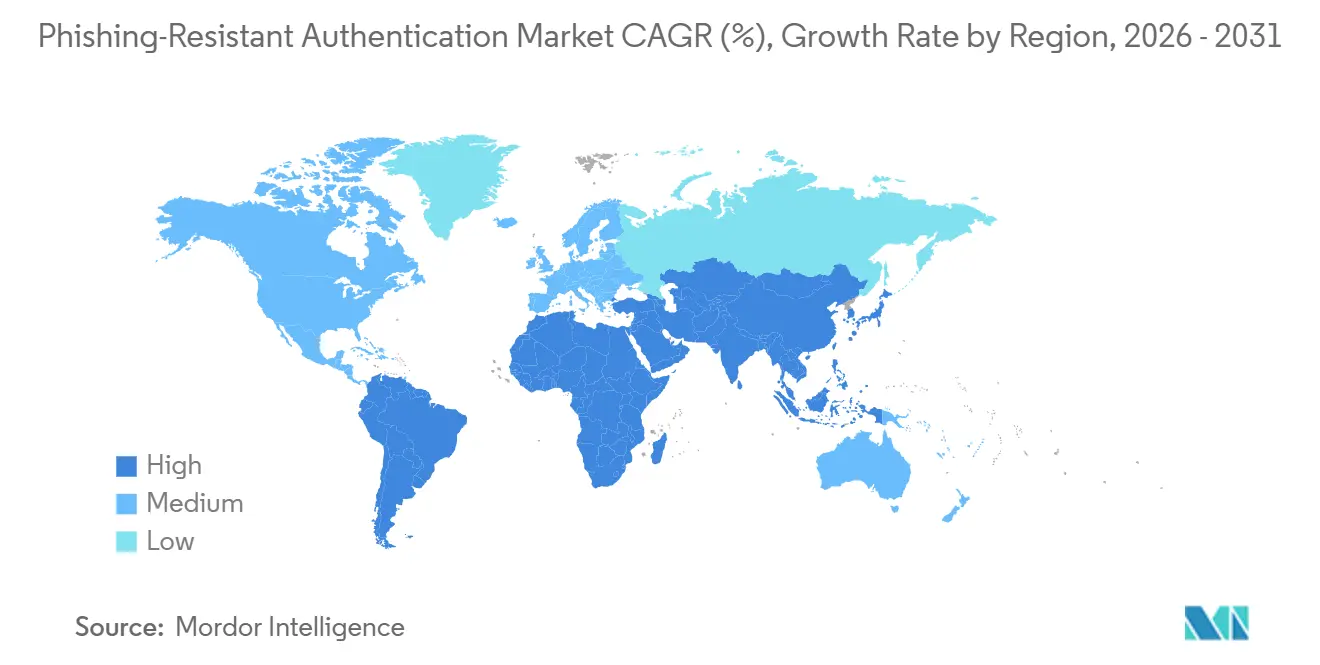
North America held 38.20% of the Phishing-Resistant Authentication Market share in 2025. US federal requirements set specific implementation dates and technical standards that directly stimulate demand for the Phishing-Resistant Authentication Market. FIDO Alliance guidance released in March 2025 under Executive Order 14144 endorsed FIDO2 commercial standards as a complement to Federal PKI, PIV, and CAC programs. This guidance focuses federal modernization spending on compliant products and vendors. Canada contributes through federal identity programs that align closely with US NIST and CISA guidance. Mexico adds demand through BFSI organizations and multinational subsidiaries facing cross-border compliance requirements. Microsoft, Okta, and Beyond Identity are based in the United States, and their platform defaults influence enterprise adoption across many regions.
Europe remains a substantial regional opportunity because NIS2 and DORA affect essential entities across energy, transport, banking, healthcare, and digital infrastructure. NIS2 took effect in October 2024, while DORA took effect in January 2025. These measures require stronger protections for privileged access and remote sessions, in line with ENISA guidance issued in early 2026. Germany entered an operational NIS2 enforcement phase in May 2026, affecting companies that must demonstrate compliant MFA controls. France also advanced the deployment of national healthcare through Pro Santé Connect. NEOWAVE became the first provider of ANS-approved FIDO2 devices for that program, with production deployment scheduled for September 2026.[3]NEOWAVE, “NEOWAVE Becomes the First Manufacturer of ANS-Approved FIDO2 Devices for Pro Santé Connect,” NEOWAVE, neowave.fr. South America remains earlier in its adoption cycle, with Brazil and Argentina providing the main BFSI demand base.
Asia-Pacific is projected to expand at a CAGR of 27.88% from 2026 to 2031. Regional demand is driven by threat exposure and regulatory change rather than by compliance obligations alone. The FIDO Alliance reported that APAC accounted for 34% of global cybersecurity incidents in 2024, while valid-account abuse was the leading entry vector. The Philippines issued BSP Circular 1213 in June 2025, requiring banks to phase out SMS OTPs in favor of phishing-resistant authentication by June 2026. Japan is advancing amendments to supervisory guidelines for financial institutions. Five Japanese securities firms completed FIDO2 rollouts by October 2025, including Rakuten Securities, which completed rollouts across all channels. The Middle East and Africa are smaller today, but national identity initiatives in the UAE and Saudi Arabia, and financial services growth in South Africa, Nigeria, and Egypt support future adoption.

Competitive Landscape
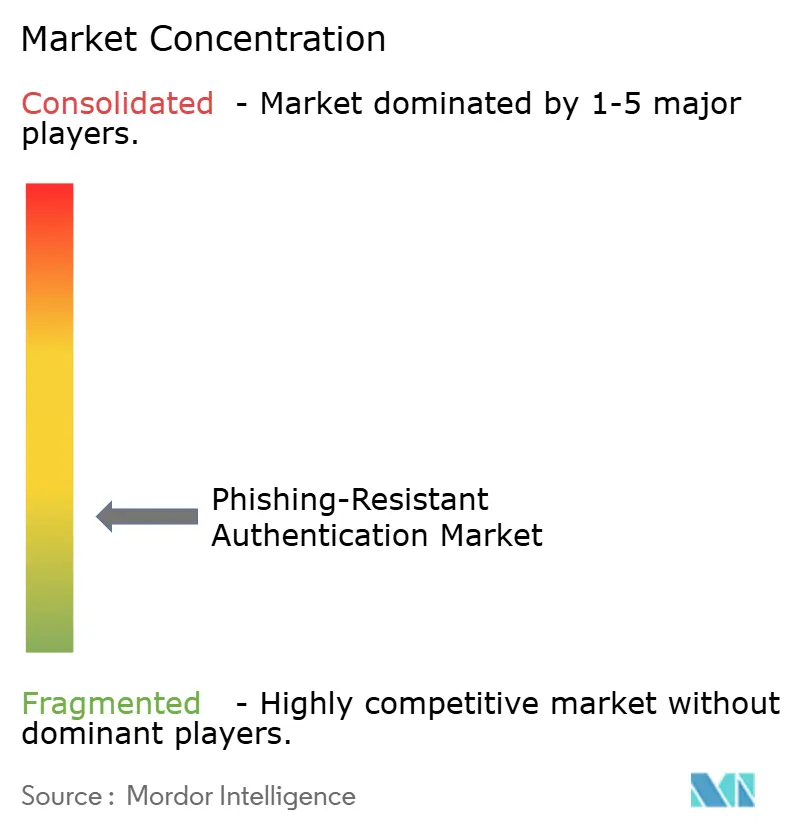
The Phishing-Resistant Authentication Market is moderately fragmented because no vendor leads every authenticator type, deployment model, and end-user segment. Yubico AB has established a strong position in hardware-backed FIDO2 authenticators. YubiKey 5.8 introduced CTAP 2.3 and WebAuthn signing extension support in 2026. These features extend the key into hardware-backed digital signatures and verifiable credentials. HID Global Corporation is pursuing portfolio expansion through its October 2025 agreement to acquire IDmelon. The acquisition is intended to help enterprises use physical cards and mobile devices as FIDO security keys. This approach can reduce the need for duplicate credential infrastructure for organizations already using HID access systems.
Microsoft, Okta, and Ping Identity are changing the competition in the Phishing-Resistant Authentication Market by embedding phishing-resistant capabilities into existing identity platform contracts. Bundling reduces the incremental cost for customers who already use premium identity tiers. It also increases pressure on point-solution providers to differentiate through certification, supply-chain assurance, or vertical specialization. Credential lifecycle governance remains an opening for providers that manage authenticator inventory, replacement, revocation, and audit trails. Intercede Group plc offers its MyID credential management system for this need. Axiad offers a cloud PKI service that supports regulated identity programs. Providers that integrate management capabilities into large identity platforms can address practical deployment gaps that customers face after selecting an authenticator.
Certification is becoming a meaningful competitive factor in government and defense use cases. FIPS 140-3, Common Criteria, and FIDO Level 3+ credentials can be used to determine whether a hardware product meets procurement requirements. This favors providers with validated hardware in use cases where software-only options are not accepted. Thales launched OneWelcome FIDO Key Lifecycle Management in February 2025, combining management capabilities with Thales-branded FIDO keys.[4]Thales, “Thales Introduces New FIDO Key Lifecycle Management Solution to Enable Secure Authentication at Scale,” Thales, cpl.thalesgroup.com. Yubico expanded its Enrollment Suite in March 2026 for Microsoft Entra ID and Ping Identity environments. The service supports factory-programmed, preregistered key delivery and on-premises enrollment. These moves show that vendors are competing not only on authentication strength but also on deployment administration and credential operations.
Phishing-Resistant Authentication Industry Leaders
Okta, Inc.
Ping Identity Corporation
Microsoft Corporation
Intercede Group plc
BIO-key International, Inc.
- *Disclaimer: Major Players sorted in no particular order

Recent Industry Developments
- September 2026: Microsoft retired legacy SMS and voice MFA methods from Entra ID, designating FIDO2 security keys, Microsoft Authenticator passkeys, and Windows Hello for Business as the default sign-in methods for enterprise users globally. The transition, effective September 1, 2026, affects millions of accounts across Microsoft's public cloud tenancy and represents the largest single-organization deployment of phishing-resistant authentication as a default in market history.
- August 2026: Axiad achieved FedRAMP Moderate authorization for its Axiad Conductor cloud platform on Amazon Web Services, providing US federal agencies with a cloud-first deployment path for Derived PIV Credentials and dedicated PKI-as-a-Service without on-premises infrastructure, directly supporting agencies' obligations under OMB M-22-09 and Executive Order 14028.
- July 2026: Infineon Technologies AG launched the SECORA ID Key S USB, the first FIDO2 security key to achieve FIDO Level 3+ certification while complying with CTAP 2.1, combining phishing-resistant authentication with qualified digital signature and PKI functions in a single USB and NFC device targeted at enterprise, financial, and government use cases. Volume production is planned for September 2026.
- May 2026: Yubico received FIPS 140-3 validation, Certificate #5291, for its next-generation YubiKey 5 FIPS Series, enabling government and defense organizations to hold both DoD PKI credentials and FIDO2 passkeys on a single hardware key, addressing the practical need for a unified credential carrier in environments where both PIV and FIDO2 deployments coexist.


Global Phishing-Resistant Authentication Market Report Scope
The Phishing-Resistant Authentication Market comprises hardware, software, and services that enable organizations to deploy authentication mechanisms designed to prevent credential theft, account takeover, phishing attacks, and adversary-in-the-middle attacks. These solutions leverage public-key cryptography and phishing-resistant authentication methods such as FIDO2, WebAuthn, passkeys, security keys, smart cards, hardware tokens, certificate-based authentication, and other qualifying public-key authentication technologies to strengthen identity assurance and support passwordless authentication initiatives across workforce, customer, partner, and privileged-access environments.
The Phishing-Resistant Authentication Market Report is Segmented by Offering (Hardware, Software, and Services), Deployment Mode (Cloud, On-Premises, and Hybrid), Organization Size (Large Enterprises, and Small and Medium-Sized Enterprises), Authenticator Type (FIDO-Based Authentication, PKI/Certificate-Based Authentication, and Other Qualifying Public-Key Authentication), Industry Vertical (Government and Public Administration, Industrial Manufacturing, Retail and E-Commerce, Transportation and Logistics, Energy and Utilities, Oil and Gas, IT and Telecommunication, Media and Entertainment, Education and Research Institutions, Healthcare and Life Sciences, Banking, Financial Services, and Insurance [BFSI], and Other Industry Verticals), and Geography (North America, South America, Europe, Asia-Pacific, and Middle East and Africa). The Market Forecasts are Provided in Terms of Value (USD).
| Hardware |
| Software |
| Services |
| Cloud |
| On-Premises |
| Hybrid |
| Large Enterprises |
| Small and Medium-Sized Enterprises |
| FIDO-Based Authentication |
| PKI/Certificate-Based Authentication |
| Other Qualifying Public-Key Authentication |
| Government and Public Administration |
| Retail and E-Commerce |
| Transportation and Logistics |
| Energy and Utilities |
| IT and Telecommunication |
| Media and Entertainment |
| Healthcare and Life Sciences |
| Banking, Financial Services, and Insurance (BFSI) |
| Other Industry Verticals |
| North America | United States | |
| Canada | ||
| Mexico | ||
| South America | Brazil | |
| Argentina | ||
| Rest of South America | ||
| Europe | Germany | |
| United Kingdom | ||
| France | ||
| Italy | ||
| BENELUX | ||
| Rest of Europe | ||
| Asia-Pacific | China | |
| Japan | ||
| India | ||
| South Korea | ||
| Australia | ||
| Rest of Asia-Pacific | ||
| Middle East and Africa | Middle East | United Arab Emirates |
| Saudi Arabia | ||
| Rest of Middle East | ||
| Africa | South Africa | |
| Nigeria | ||
| Egypt | ||
| Rest of Africa | ||
| By Offering | Hardware | ||
| Software | |||
| Services | |||
| By Deployment Mode | Cloud | ||
| On-Premises | |||
| Hybrid | |||
| By Organization Size | Large Enterprises | ||
| Small and Medium-Sized Enterprises | |||
| By Authenticator Type | FIDO-Based Authentication | ||
| PKI/Certificate-Based Authentication | |||
| Other Qualifying Public-Key Authentication | |||
| By Industry Vertical | Government and Public Administration | ||
| Retail and E-Commerce | |||
| Transportation and Logistics | |||
| Energy and Utilities | |||
| IT and Telecommunication | |||
| Media and Entertainment | |||
| Healthcare and Life Sciences | |||
| Banking, Financial Services, and Insurance (BFSI) | |||
| Other Industry Verticals | |||
| By Geography | North America | United States | |
| Canada | |||
| Mexico | |||
| South America | Brazil | ||
| Argentina | |||
| Rest of South America | |||
| Europe | Germany | ||
| United Kingdom | |||
| France | |||
| Italy | |||
| BENELUX | |||
| Rest of Europe | |||
| Asia-Pacific | China | ||
| Japan | |||
| India | |||
| South Korea | |||
| Australia | |||
| Rest of Asia-Pacific | |||
| Middle East and Africa | Middle East | United Arab Emirates | |
| Saudi Arabia | |||
| Rest of Middle East | |||
| Africa | South Africa | ||
| Nigeria | |||
| Egypt | |||
| Rest of Africa | |||


Key Questions Answered in the Report
What is the size of the Phishing-Resistant Authentication Market?
The Phishing-Resistant Authentication Market is projected to expand from USD 2.7 billion in 2026 to USD 8.81 billion by 2031, at a CAGR of 26.94%.
What is driving adoption of phishing-resistant authentication?
Government MFA rules, growing AiTM attacks, and native support for FIDO2 and WebAuthn are increasing adoption.
Which offering led demand in 2025?
Software led the offering segment with 60.14% share in 2025 because enterprises need centralized authentication policy and lifecycle management.
Which deployment model is growing fastest?
Hybrid deployment is projected to grow at a CAGR of 28.34% through 2031 as organizations connect cloud identity platforms with legacy systems.
Why are passkeys important for enterprise security?
Passkeys bind sign-ins to the legitimate relying party and help protect against credential relay and real-time phishing attacks.
Which region is expected to grow fastest through 2031?
Asia-Pacific is projected to grow at a CAGR of 27.88% through 2031, supported by security needs and regulatory actions.
Page last updated on:


 Your data is secure and never sold or shared.


