
Mobile Authenticator App Market Size and Share
Market Overview
| Study Period | 2021 - 2032 |
|---|---|
| Market Size (2027) | USD 8.48 Billion |
| Market Size (2032) | USD 21.91 Billion |
| Growth Rate (2027 - 2032) | 20.91 % |
| Fastest Growing Market | Asia-Pacific |
| Largest Market | North America |
| Market Concentration | Medium |
Major Players *Disclaimer: Major Players sorted in no particular order Image © Mordor Intelligence. Reuse requires attribution under CC BY 4.0. | |
Mobile Authenticator App Market Analysis by Mordor Intelligence
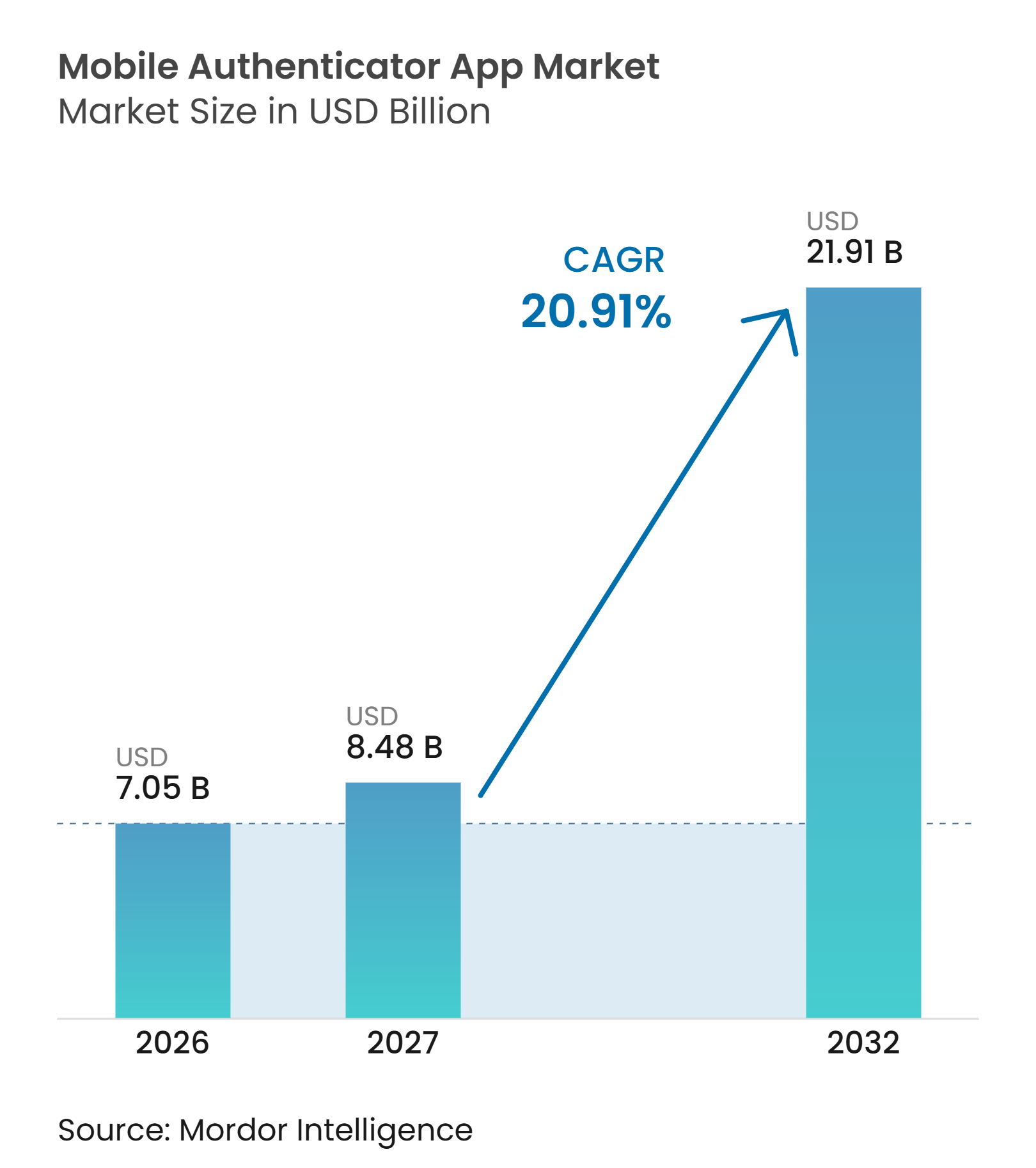
The mobile authenticator app market size was valued at USD 7.05 billion in 2026 and is estimated to reach USD 21.91 billion by 2032, at a CAGR of 20.91% during the forecast period (2027-2032). Credential theft and account takeover have made stronger authentication a necessary part of enterprise security programs, particularly where employees, customers, and external partners access the same business services from personal and managed devices. The move toward passkeys is also changing purchasing decisions, as organizations seek phishing-resistant sign-in methods that work across devices and applications while reducing the need for repeated password resets that create costs and delays for help desks. Regulatory requirements, zero-trust programs, and remote work access needs are encouraging organizations to replace password-led workflows, but they also make compatibility with legacy directories, applications, and recovery processes an important factor in supplier selection. Suppliers are responding by combining push approval, one-time passwords, biometrics, and FIDO2 credentials into a single application, allowing customers to adopt stronger methods without requiring every user group to change simultaneously. The mobile authenticator app market, therefore, benefits from compliance-led replacement projects, broader identity modernization programs, and a gradual transition toward device-bound credentials that can operate alongside existing enterprise access controls.
Key Report Takeaways
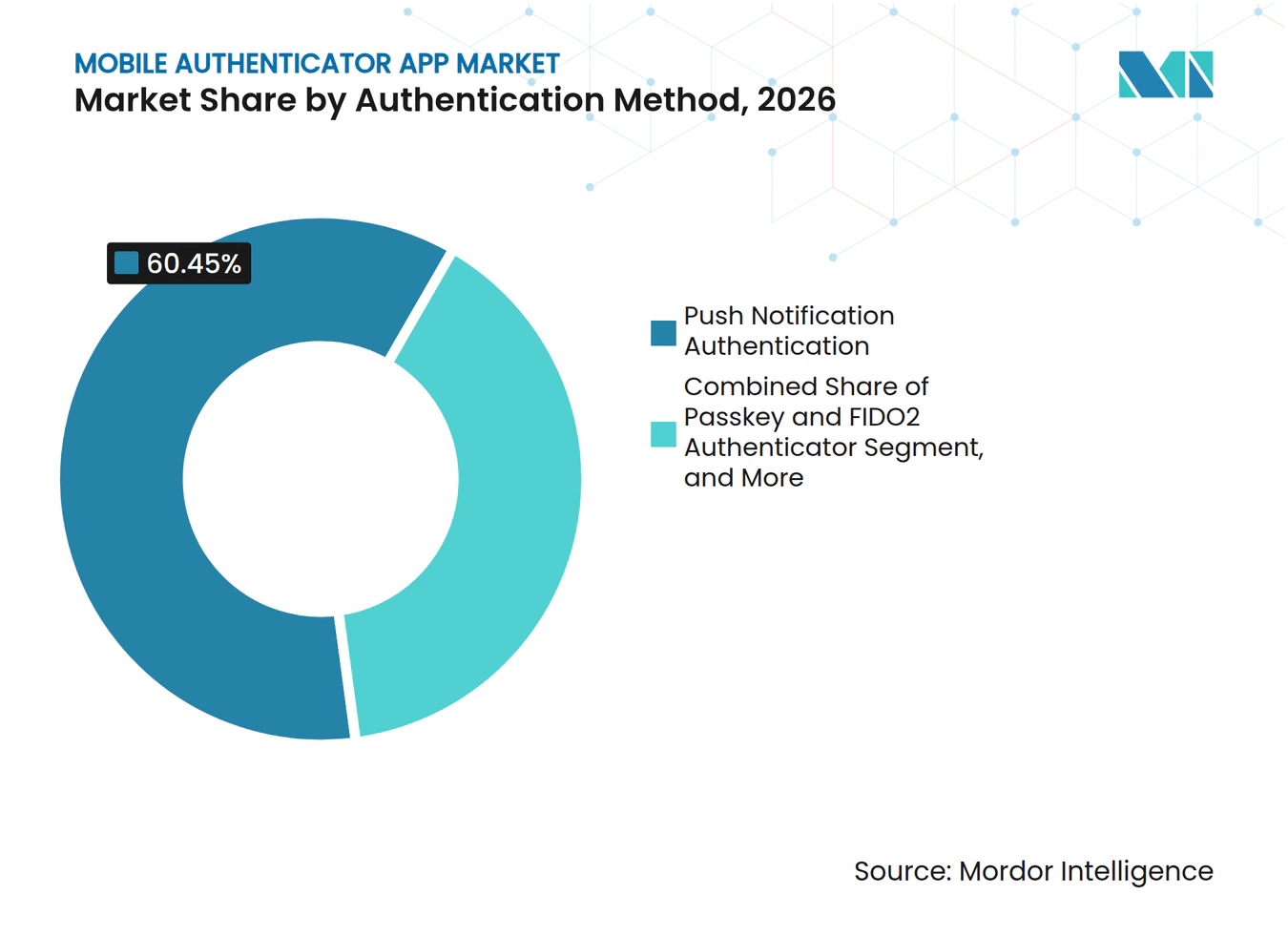
- By authentication method, push notification authentication held 60.45% of the mobile authenticator app market share in 2026, while passkey and FIDO2 authenticators are projected to expand at a 22.29% CAGR through 2032.
- By deployment mode, on-premises deployment held 67.12% of the mobile authenticator app market share in 2026, while cloud deployment is projected to expand at a 22.67% CAGR through 2032.
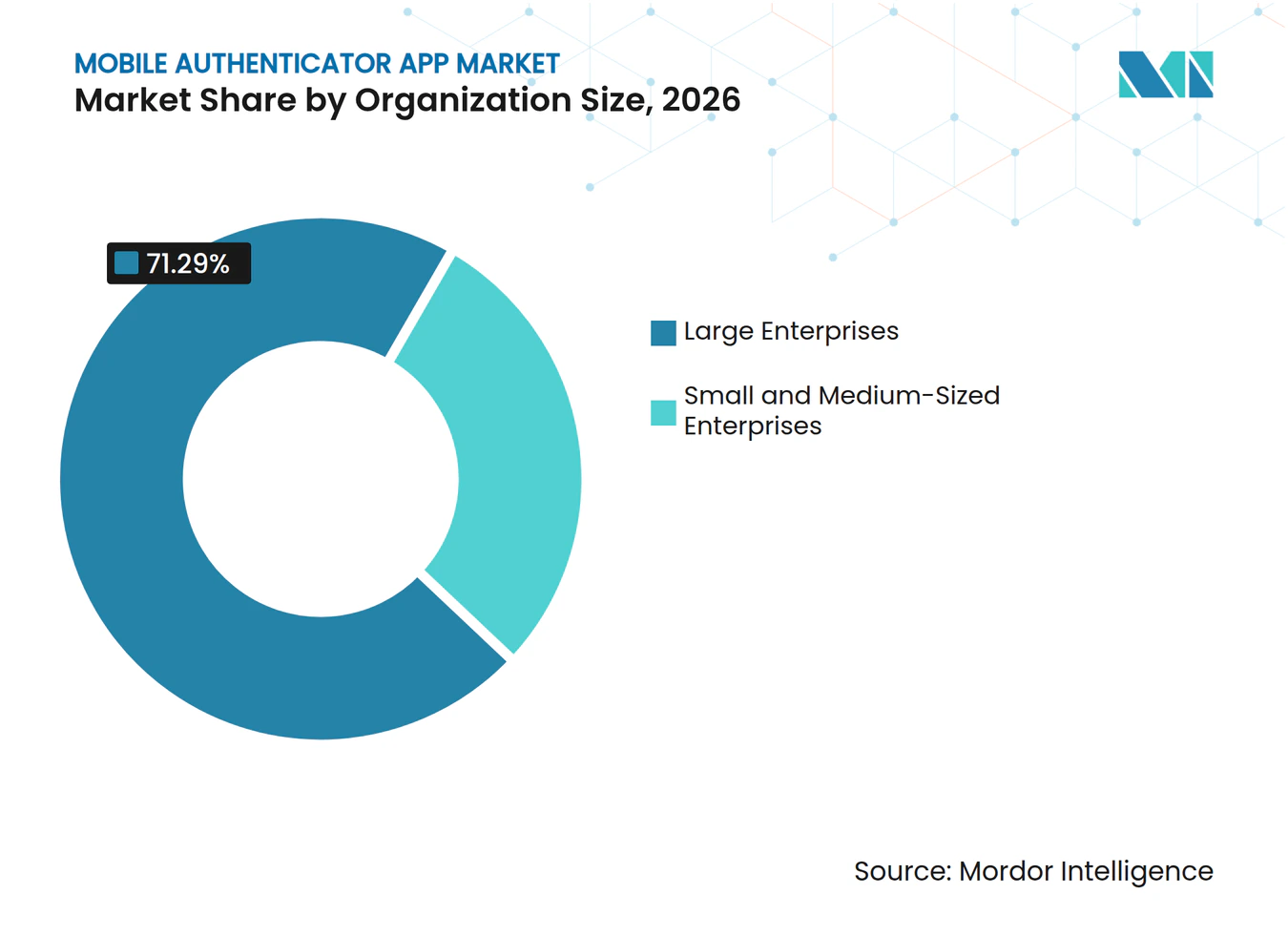
- By organization size, large enterprises accounted for 71.29% of the mobile authenticator app market revenue in 2026, while SMEs are projected to expand at a 22.89% CAGR through 2032.
- By end-user industry, BFSI accounted for 27.41% of the mobile authenticator app market revenue in 2026, while government and public administration are projected to expand at a 21.44% CAGR through 2032.
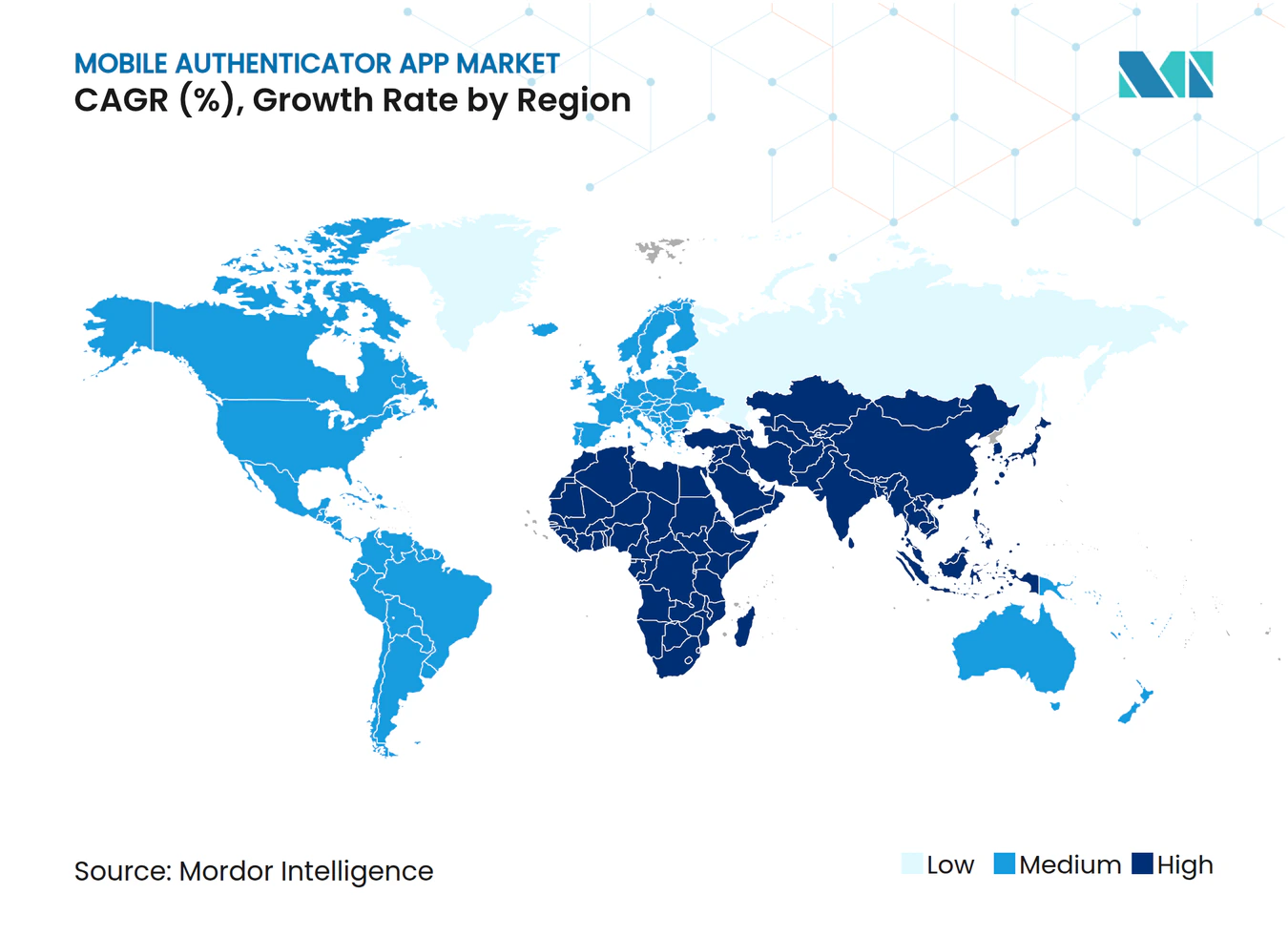
- By geography, North America accounted for 35.66% of the mobile authenticator app market revenue in 2026, while Asia-Pacific is projected to expand at a 21.78% CAGR through 2032.
Note: Market numbers in this report are based on Mordor Intelligence's proprietary estimation framework, which combines nine months of actuals with Q4 projections for base year 2026.
Market Trends and Insights
Drivers Impact Analysis of Mobile Authenticator App Market*
| Driver | (~) % Impact on CAGR Forecast | Geographic Relevance | Impact Timeline |
|---|---|---|---|
| Escalating Credential Theft and Account-Takeover Losses | +5.5% | Global, with peak intensity in North America, India, Brazil, and Spain | Short term (≤ 2 years) |
| Regulatory Mandates for Strong Customer Authentication | +4.2% | EU, North America, and APAC national frameworks | Medium term (2-4 years) |
| Enterprise Zero-Trust and Remote-Work Authentication | +3.8% | North America and Europe, with spill-over to APAC enterprise hubs | Medium term (2-4 years) |
| Passwordless and Passkey Migration | +3.5% | Global, led by North America, Japan, South Korea, and Western Europe | Medium term (2-4 years) |
| Smartphone Biometric Hardware Penetration in Emerging Markets | +2.1% | India, Southeast Asia, Africa, and South America | Long term (≥ 4 years) |
| Carrier-Backed Mobile Identity and Silent Network Authentication | +1.3% | APAC, with spill-over to Middle East and Africa | Long term (≥ 4 years) |
| Source: Mordor Intelligence | |||
Escalating Credential Theft and Account-Takeover Losses
Credential attacks have become a continuing security issue rather than a short-lived threat cycle. Kaspersky reported a 59% year-over-year increase in PC infostealer detections during 2025 and identified more than 1 million compromised online banking accounts across the 100 largest banks worldwide. India, Spain, and Brazil recorded the highest median numbers of compromised accounts per institution in that assessment. The mobile authenticator app market gains when a major credential incident causes organizations to accelerate enrollment programs outside normal technology budgets. Security teams then look for device-bound credentials, biometric checks, and stronger recovery controls. This can shorten sales cycles for vendors that support several authentication methods in a single mobile client.
Regulatory Mandates for Strong Customer Authentication
Regulators increasingly expect organizations to use phishing-resistant authentication rather than basic multi-factor authentication alone. NIST issued SP 800-63B-4 in July 2025 and updated guidance on authentication and authenticator management for government digital identity systems.[1] The guidance influences commercial procurement because many organizations align internal assurance policies with NIST definitions. European payment rules also continue to reinforce strong customer authentication for payment service providers. The mobile authenticator app market benefits where organizations need an application that can provide a distinct biometric or cryptographic factor alongside existing credentials. This requirement is particularly relevant for financial institutions and public agencies that must document their authentication controls.
Enterprise Zero-Trust and Remote-Work Authentication
Hybrid work has moved authentication from a remote-access control to a central part of enterprise access management. NIST describes zero trust as a security model that removes implicit trust and continually evaluates access decisions. CISA’s July 2025 remote user guidance also sets out an approach for securing remote users through modern trust and access controls. The mobile authenticator app market is supported by these architectures because users must validate access more often and across more applications. Push approval, device binding, and biometric verification can support this repeated verification. Cisco reported that its Duo Passwordless deployment across 130,000 employees reduced total authentication actions by 93%, creating a productivity case alongside the security case.
Passwordless and Passkey Migration
Passkeys are becoming a practical priority for organizations that want to reduce password exposure. The FIDO Alliance reported 5 billion passkeys in active use globally in May 2026. Its 2026 survey found that 82% of organizations viewed a fully passwordless workforce authentication as an ultimate goal, while 28% had already reached that position. Deploying organizations cited greater security confidence, faster employee logins, and fewer password reset requests. The mobile authenticator app market has room to grow because 57% of surveyed organizations still use phishable authentication for primary employee sign-in. Vendors that can combine TOTP, push, biometrics, and passkeys can support staged migration rather than requiring customers to replace every legacy workflow at once.
Restraints Impact Analysis of Mobile Authenticator App Market*
| Restraint | (~) % Impact on CAGR Forecast | Geographic Relevance | Impact Timeline |
|---|---|---|---|
| SIM-Swap and Adversary-in-the-Middle Exposure in Phone-Based Flows | -1.8% | Global, with acute impact in the United Kingdom, United States, and Sub-Saharan Africa | Short term (≤ 2 years) |
| Biometric Privacy and Cross-Border Data-Residency Constraints | -1.2% | European Union, Kenya, and APAC data-residency regimes | Medium term (2-4 years) |
| Legacy-System Integration and Protocol Fragmentation | -0.9% | North America and Europe, plus APAC financial services using LDAP and RADIUS stacks | Medium term (2-4 years) |
| Enrollment Friction and Authentication Fatigue | -0.6% | Global, most acute in large enterprise deployments with diverse device estates | Long term (≥ 4 years) |
| Source: Mordor Intelligence | |||
SIM-Swap and Adversary-in-the-Middle Exposure in Phone-Based Flows
Phone-number-based flows remain exposed to SIM-swapping and adversary-in-the-middle attacks. These attacks can intercept a push session or take control of the recovery number. The risk extends beyond individual accounts when a mobile network operator’s verification process is compromised. Carrier-backed identity methods and silent network authentication may then lose their integrity simultaneously. The mobile authenticator app market is affected because the large installed base of push-based workflows may need security upgrades. Device-bound cryptographic credentials and FIDO2 passkeys offer an alternative when organizations need to reduce reliance on a carrier identifier.
Biometric Privacy and Cross-Border Data-Residency Constraints
Biometric information is subject to heightened protection under GDPR Article 9, which can complicate international deployment planning. ISO/IEC 27553-2:2025 establishes security requirements for remote-mode biometric authentication using mobile devices. The standard addresses presentation-attack detection, encrypted template transmission, and consent, where processing is divided between a device and a server. Kenya’s data protection authority issued guidance on biometric data in November 2025, requiring organizations to consider local hosting and safeguards for biometric information. Separate legal and technical reviews can lengthen cross-border sales cycles and increase deployment costs in the mobile authenticator app market.
*Our forecasts treat driver/restraint impacts as directional, not additive. The impact forecasts reflect baseline growth, mix effects, and variable interactions.
Mobile Authenticator App Market Segment Analysis
By Authentication Method:
Push Authentication Leads While Passkeys Set the Next Growth PathPush notification authentication held 60.45% of the mobile authenticator app market share in 2026, supported by a one-tap approval model that is already integrated with enterprise identity platforms used in financial services and technology organizations. Its position reflects installed systems that were designed for push workflows between 2018 and 2022, when many large organizations standardized their remote-access and workforce sign-in procedures. Large enterprises commonly replace authentication systems on multi-year cycles, so established push processes remain in place while security teams assess how to improve recovery controls and resistance to session interception. TOTP also retains a meaningful role because standard QR code provisioning enables it to work with nearly any third-party application, even when proprietary software development kit integration is unavailable. This makes it useful for SMEs, developer teams, and mixed application estates that require broad compatibility without a complex deployment.
Passkey and FIDO2 authenticators are projected to record a 22.29% CAGR through 2032, as organizations migrate to device-bound credentials that are less exposed to password theft. The FIDO Alliance’s 5 billion passkey milestone shows that passkeys now have broad platform support across the consumer devices that employees use. In-app biometric authentication also attracts enterprise interest because match-on-device processes can support local processing preferences without creating a centralized biometric database. The mobile authenticator app market size for passkey-enabled software is supported by organizations that need a practical bridge from TOTP and push workflows to passwordless access, rather than a disruptive replacement of every existing system. Vendors with a unified client for TOTP, push, biometrics, and FIDO2 can reduce device management effort and user training needs across heterogeneous enterprise environments.



By Deployment Mode:
On-Premises Systems Retain Regulated Workloads While Cloud Use RisesOn-premises deployment held 67.12% of the mobile authenticator app market share in 2026, reflecting spending by BFSI institutions, government agencies, and defense contractors. These organizations often require authentication servers, audit logs, and associated identity information to remain within their own controlled environments. The installed base changes slowly because customers frequently upgrade existing systems in place rather than move immediately to a different deployment model. Data-sovereignty policies, internal control requirements, and connectivity restrictions in sensitive environments reinforce this preference. On-premises suppliers must preserve backward compatibility for established directories and protocols while adding modern biometric and cryptographic authentication options.
Cloud deployment is projected to expand at a 22.67% CAGR through 2032, as SMEs adopt identity-as-a-service options without maintaining local server infrastructure. More cloud platforms now carry FedRAMP authorization and ISO/IEC 27001 certification, helping suppliers meet mid-market expectations for security and compliance. Subscription revenue, lower support requirements, and faster feature releases also make cloud offerings commercially attractive to vendors. The mobile authenticator app market is seeing vendors reprice cloud tiers to encourage migration from established on-premises installations. Cloud-native systems can deliver behavioral risk signals, device reputation scores, and threat intelligence feeds with less customer-specific integration than many on-premises deployments require.
By Organization Size:
Large Enterprises Hold Current Revenue While SMEs Grow FasterLarge enterprises accounted for 71.29% of the mobile authenticator app market revenue in 2026, because they support large user populations, complex application portfolios, and material regulatory exposure. Their deployments commonly combine several authentication methods with on-premises directories, cloud identity providers, and centralized workflows for provisioning, access reviews, and audit records. These requirements support premium pricing for suppliers that can provide tailored deployment support and detailed administrative controls. Large customers also negotiate customized service-level agreements, volume pricing, and professional services. This favors vendors with mature enterprise sales teams and the capacity to support long approval processes across business units and regions.
SMEs are projected to expand at a 22.89% CAGR through 2032, as cloud platforms make stronger authentication accessible to organizations without the need for complex identity infrastructure. eSentire reported a 389% year-over-year rise in account-compromise identity threats in 2025, underscoring the security concerns facing smaller organizations. Cyber insurers are increasingly requesting evidence of multi-factor authentication before issuing cyber liability coverage, which turns a security tool into a practical insurance requirement. The mobile authenticator app industry, therefore, serves two different buying motions: negotiated enterprise contracts and self-service SME acquisition through trials and app stores. Suppliers that package products separately for these groups can use SME adoption to establish a base for later enterprise expansion.

By End-User Industry:
BFSI Anchors Spending While Government Expands FastestBFSI accounted for 27.41% of the mobile authenticator app market revenue in 2026, as banks and insurers face direct regulatory obligations and ongoing scrutiny from fraud groups. European payment requirements continue to reinforce strong customer authentication for payment service providers, while India has tightened access controls for digital banking. IT and telecommunications organizations use authenticators to secure access for developers, operations, and privileged administrators across distributed systems. Healthcare organizations use them to protect electronic health records, while retailers use them to secure high-value loyalty accounts and customer transactions. Industrial manufacturers, energy companies, and utilities form smaller user groups, but access control requirements for operational systems are creating additional demand for offline-capable configurations.
Government and public administration is projected to expand at a 21.44% CAGR through 2032 as national digital identity programs introduce authentication services at scale. Japan’s Digital Agency integrated the Digital Authentication App into the MyNA app, bringing related identity services into a unified application.[2] The MyNA ecosystem serves more than 80 million registered users, while related services recorded 12 million monthly logins during 2025. The mobile authenticator app market can meet public-sector needs by providing tools that function in restricted or low-connectivity environments, including configurations for administrative users who cannot rely on continuous network access. Demand also rises in countries where government digital identity services connect public benefits, transport, financial services, and other private-sector applications.
Geography Analysis
North America Mobile Authenticator App Market
North America accounted for 35.66% of the mobile authenticator app market revenue in 2026, supported by a mature identity platform ecosystem and a policy environment that rewards early adoption of stronger authentication. The region has a large installed base of enterprises that operate cloud services, remote work programs, regulated financial products, and government networks, all of which create recurring demand for workforce and customer authentication. The U.S. federal government’s myAuth implementation uses the Okta platform and is operated by Peraton for approximately 20 million Department of Defense users, including service members, veterans, and civilians.[3] This illustrates the scale of public-sector modernization and the importance of managing authentication for users with varied devices, access locations, and assurance requirements. Canada’s financial services environment has also moved closer to NIST-aligned practices, which can reduce some design friction for suppliers serving customers across the region.
Europe and APAC Mobile Authenticator App Market
Europe is the second-largest regional contributor, with Germany, the United Kingdom, and France as important markets for regulated enterprise identity services. NIS2 transposition was complete in 14 member states by mid-2026, converting broad cybersecurity obligations into procurement activity across energy, transport, healthcare, and other organizations operating essential services. The mobile authenticator app market benefits where buyers must show that access controls meet these requirements and can be consistently managed across distributed operations. Asia-Pacific is projected to expand at a 21.78% CAGR through 2032, with Japan, South Korea, and Australia advancing the adoption of passkey and FIDO2 in mature enterprise environments. India, Indonesia, and Vietnam are building new authentication infrastructure that can avoid the need for a large legacy LDAP layer, giving suppliers opportunities to support mobile-first environments without extensive protocol migration.
APAC, MEA and South America Mobile Authenticator App Market
China has a distinct regulatory model for mobile financial authentication, in which financial and cryptographic authorities influence the authentication standards used by banks and securities institutions. CFCA published the Mobile Terminal Digital Certificate Application Technical Standard, JR/T 0340-2025, in August 2025 to standardize FIDO-based biometric authentication across these institutions. South Korea requires ongoing re-authentication for high-value transactions, supporting a high volume of user authentication events, and reinforcing the need for low-friction mobile experiences. The Middle East, Africa, and South America provide longer-term opportunities as smartphone use, digital public services, and financial access channels expand. GSMA reported that smartphones accounted for 63% of total connections in Africa in 2025. Kenya’s biometric data guidance adds a compliance factor for East African deployments, while Brazil and Argentina are building authentication needs through fraud controls and public service digitization.
Competitive Landscape
Market Concentration
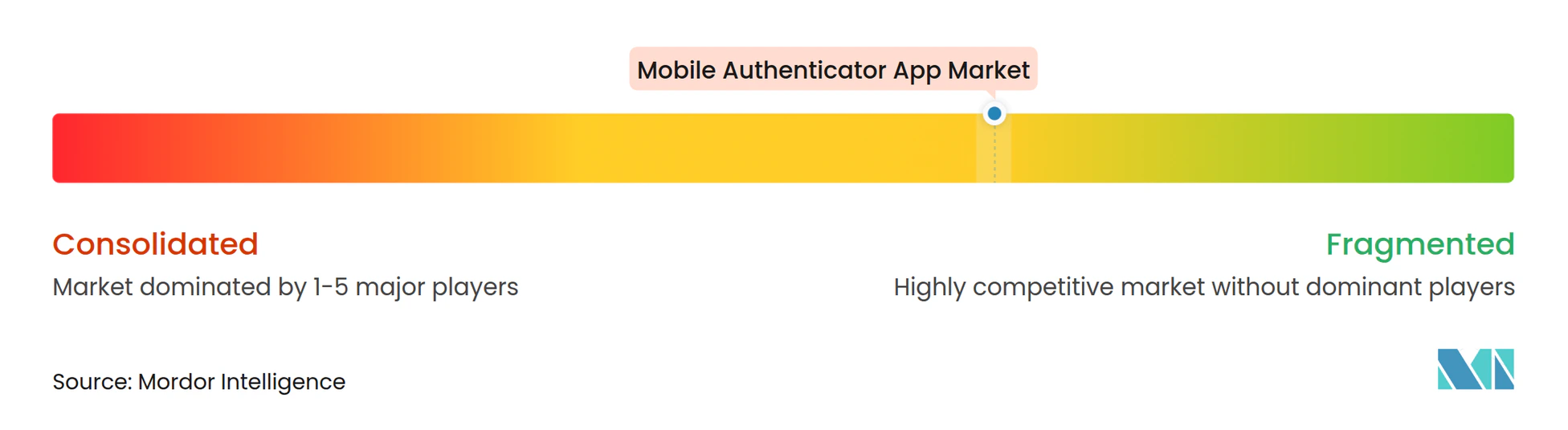
The mobile authenticator app market is moderately concentrated at the platform layer and fragmented among specialist and open-source suppliers. Okta, RSA Security, Thales Digital Identity and Security, and Ping Identity are prominent in large enterprise deployments, while SecurEnvoy, LoginTC, and Deepnet Security compete on pricing, compliance features, and deployment simplicity. Platform vendors seek to embed mobile authentication within broader identity orchestration suites because this raises replacement costs for customers and makes integrated access management more valuable. FIDO2 certification is increasingly a qualification requirement in enterprise requests for proposals that cite NIST- or NIS2-related guidance, rather than a feature suppliers can treat as optional. This leaves room for specialists who address a specific regulated need, but it raises the threshold for companies that want to serve large organizations with formal security assurance requirements.
RSA Security released RSA Authenticator 4.7 for iOS and Android in March 2026, with FIPS 140-3-certified cryptographic modules, biometric verification for new credential enrollment, and proximity and offline QR code support. This move supports zero-trust requirements while maintaining compatibility for customers who continue to operate on-premises identity environments and need passwordless access in locations with restricted connectivity. Okta made its NFC Authenticator and WebAuthn authenticator generally available in the Okta Identity Engine during October 2026. The update expanded support for NFC-enabled physical keys alongside passkeys, illustrating how platform suppliers are combining hardware-backed and device-bound authentication methods within established identity systems.
Ping Identity extended Runtime Identity capabilities across AWS, Google Cloud, and Cloudflare in June 2026, addressing identity controls for AI agents that are not fully covered by existing FIDO and TOTP processes.[4] OneSpan and Yubico are building positions in regulated sectors by pairing hardware fallback with FIDO-certified authenticators and mobile applications, which is relevant for BFSI customers operating in environments with connectivity constraints. Open-source projects are moving upmarket through enterprise support tiers, narrowing the historical commercial price premium in organizations with fewer than 500 seats. The mobile authenticator app market, therefore, requires leading suppliers to compete on breadth of integration, assurance capabilities, ease of deployment, and practical support for both modern cloud systems and established enterprise infrastructure.
Mobile Authenticator App Industry Leaders
-
Okta, Inc.
-
Ping Identity Holding Corp.
-
OneSpan Inc.
-
Yubico AB
-
SecureAuth Corporation
- *Disclaimer: Major Players sorted in no particular order
Mobile Authenticator App Market Companies Covered in this Report
- Okta, Inc.
- OneSpan Inc.
- Entrust Corporation
- Ping Identity Holding Corp.
- Yubico AB
- SecurEnvoy Ltd.
- i-Sprint Innovations Pte Ltd.
- StrikeForce Technologies, Inc.
- Deepnet Security Ltd.
- SAASPASS Inc.
- Two Factor Authentication Service, Inc.
- Ente Technologies, Inc.
- Bitwarden Inc.
- Proton AG
- Keeper Security, Inc.
- LoginTC Inc.
- SecureAuth Corporation
- OneLogin, Inc.
- RSA Security LLC
- Thales Digital Identity and Security S.A.S.
Recent Industry Developments in Mobile Authenticator App Market
- October 2026: Okta made its NFC Authenticator and WebAuthn authenticator generally available in production within the Okta Identity Engine on October 7, 2026, enabling enterprises to authenticate users via NFC-enabled physical keys as a phishing-resistant factor alongside passkeys, materially expanding the hardware authentication surface supported by the platform.
- August 2026: Japan's Digital Agency launched the MyNA app on August 25, 2026, consolidating its Digital Authentication App and My Number Portal App into a unified client for over 80 million registered users. The integration supports My Number Card identity verification across public and private services, with more than 70 private-sector services, including financial institutions and railway operators, already using the Digital Authentication App API before consolidation.
- July 2026: Ping Identity's Verification and Fraud Protection solution was listed in Epic Toolbox on July 28, 2026, enabling healthcare organizations to embed identity verification and fraud controls into Epic-based clinical workflows and to extend mobile authentication into a sector where patient data regulations had historically slowed adoption.
- June 2026: Ping Identity extended its Runtime Identity capabilities across AWS, Google Cloud, and Cloudflare on June 16, 2026, establishing one of the industry's first frameworks for authenticating AI agents in enterprise cloud environments and addressing governance gaps left by existing FIDO and TOTP standards.
Global Mobile Authenticator App Market Report Scope
The Mobile Authenticator App Market comprises software applications and related services that enable secure user authentication on smartphones and other mobile devices via one-time passwords (OTPs), passkeys, FIDO2 credentials, biometric authentication, push-based approvals, and other mobile-centric authentication methods. These solutions are deployed by enterprises, governments, financial institutions, and digital service providers to strengthen access security, support passwordless authentication initiatives, reduce fraud risks, and enhance user experience. The market includes authenticator applications, authentication platforms, integration services, support, maintenance, and managed authentication services.
The Mobile Authenticator App Market Report is Segmented by Authentication Method (Time-Based One-Time Password, Passkey and FIDO2 Authenticator, In-App Biometric Authentication, Push Notification Authentication, and Other Authentication Methods), Deployment Mode (On-Premises, and Cloud), Organization Size (Small and Medium-Sized Enterprises, and Large Enterprises), End-User Industry (Banking, Financial Services, and Insurance [BFSI], Government and Public Administration, Healthcare and Life Sciences, IT and Telecommunication, Industrial Manufacturing, Retail and E-commerce, Energy and Utilities, and Other End-User Industries), and Geography (North America, South America, Europe, Asia-Pacific, Middle East, and Africa). The Market Forecasts are Provided in Terms of Value (USD).
Segmentation Overview
| Time-Based One-Time Password |
| Passkey and FIDO2 Authenticator |
| In-App Biometric Authentication |
| Push Notification Authentication |
| Other Authentication Methods |
| On-Premises |
| Cloud |
| Small and Medium-Sized Enterprises |
| Large Enterprises |
| Banking, Financial Services, and Insurance (BFSI) |
| Government and Public Administration |
| Healthcare and Life Sciences |
| IT and Telecommunication |
| Industrial Manufacturing |
| Retail and E-commerce |
| Energy and Utilities |
| Other End-User Industries |
| North America | United States |
| Canada | |
| South America | Brazil |
| Argentina | |
| Mexico | |
| Rest of South America | |
| Europe | Germany |
| United Kingdom | |
| France | |
| Italy | |
| Russia | |
| Rest of Europe | |
| Asia-Pacific | China |
| Japan | |
| India | |
| South Korea | |
| Rest of Asia-Pacific | |
| Middle East | Saudi Arabia |
| United Arab Emirates | |
| Rest of Middle East | |
| Africa | South Africa |
| Nigeria | |
| Rest of Africa |
| By Authentication Method | Time-Based One-Time Password | |
| Passkey and FIDO2 Authenticator | ||
| In-App Biometric Authentication | ||
| Push Notification Authentication | ||
| Other Authentication Methods | ||
| By Deployment Mode | On-Premises | |
| Cloud | ||
| By Organization Size | Small and Medium-Sized Enterprises | |
| Large Enterprises | ||
| By End-User Industry | Banking, Financial Services, and Insurance (BFSI) | |
| Government and Public Administration | ||
| Healthcare and Life Sciences | ||
| IT and Telecommunication | ||
| Industrial Manufacturing | ||
| Retail and E-commerce | ||
| Energy and Utilities | ||
| Other End-User Industries | ||
| By Geography | North America | United States |
| Canada | ||
| South America | Brazil | |
| Argentina | ||
| Mexico | ||
| Rest of South America | ||
| Europe | Germany | |
| United Kingdom | ||
| France | ||
| Italy | ||
| Russia | ||
| Rest of Europe | ||
| Asia-Pacific | China | |
| Japan | ||
| India | ||
| South Korea | ||
| Rest of Asia-Pacific | ||
| Middle East | Saudi Arabia | |
| United Arab Emirates | ||
| Rest of Middle East | ||
| Africa | South Africa | |
| Nigeria | ||
| Rest of Africa | ||
Key Questions Answered in the Report
What is the mobile authenticator app market size?
The mobile authenticator app market size is USD 7.05 billion in 2026 and is estimated to reach USD 21.91 billion by 2032.
What is driving demand for mobile authenticator applications?
Credential theft, account takeover risks, zero-trust programs, regulatory requirements, and passkey migration are increasing adoption.
Which authentication method leads mobile authenticator adoption?
Push notification authentication leads with 60.45% revenue share in 2026 because it is embedded in many established enterprise identity systems.
Why are passkeys important for enterprise access?
Passkeys provide phishing-resistant, device-bound authentication and can reduce reliance on passwords and weaker recovery flows.
Which deployment model is expanding fastest?
Cloud deployment is projected to expand at a 22.67% CAGR through 2032 as SMEs adopt identity-as-a-service platforms.
Which region is expected to grow fastest?
Asia-Pacific is projected to expand at a 21.78% CAGR through 2032, supported by new authentication infrastructure and national digital identity programs.