
Television and Set Top Box Market Size and Share
Market Overview
| Study Period | 2020 - 2031 |
|---|---|
| Market Volume (2026) | 323.90 Million units |
| Market Volume (2031) | 422.79 Million units |
| Growth Rate (2026 - 2031) | 5.47 % |
| Fastest Growing Market | Asia-Pacific |
| Largest Market | Asia-Pacific |
| Market Concentration | Medium |
Major Players *Disclaimer: Major Players sorted in no particular order Image © Mordor Intelligence. Reuse requires attribution under CC BY 4.0. | |
Television and Set Top Box Market Analysis by Mordor Intelligence
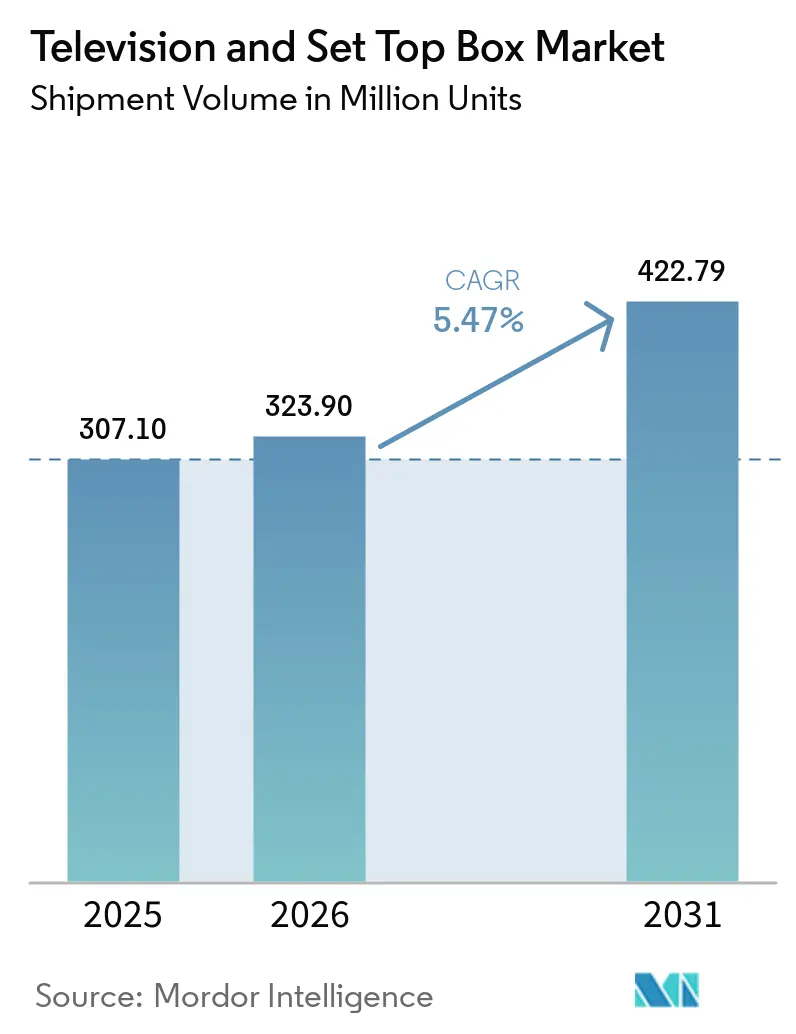
The Television and Set Top Box market size is expected to grow from 307.10 million units in 2025 to 323.9 million units in 2026 and is forecast to reach 422.79 million units by 2031 at 5.47% CAGR over 2026-2031. The Television and Set Top Box market is moving away from legacy broadcast hardware toward connected ecosystems where smart-TV operating systems, streaming dongles, and AI-driven interfaces reshape upgrade cycles and pricing power. Ultra-high-definition 4K remains the mainstream resolution driver, while government-led digital switchover programs and expanding rural satellite-IP–IP hybrids open fresh addressable demand. Asia-Pacific manufacturers leverage scale to shorten product lead times and compress costs, even as North American and European buyers gravitate to large-format premium panels. Meanwhile, edge-based advertising models create recurring revenue streams that partially offset margin pressure from rising semiconductor and panel input costs.[1]Samsung Electronics, “Samsung Maintains Global TV Leadership for 19th Consecutive Year,” samsung.com
Key Report Takeaways
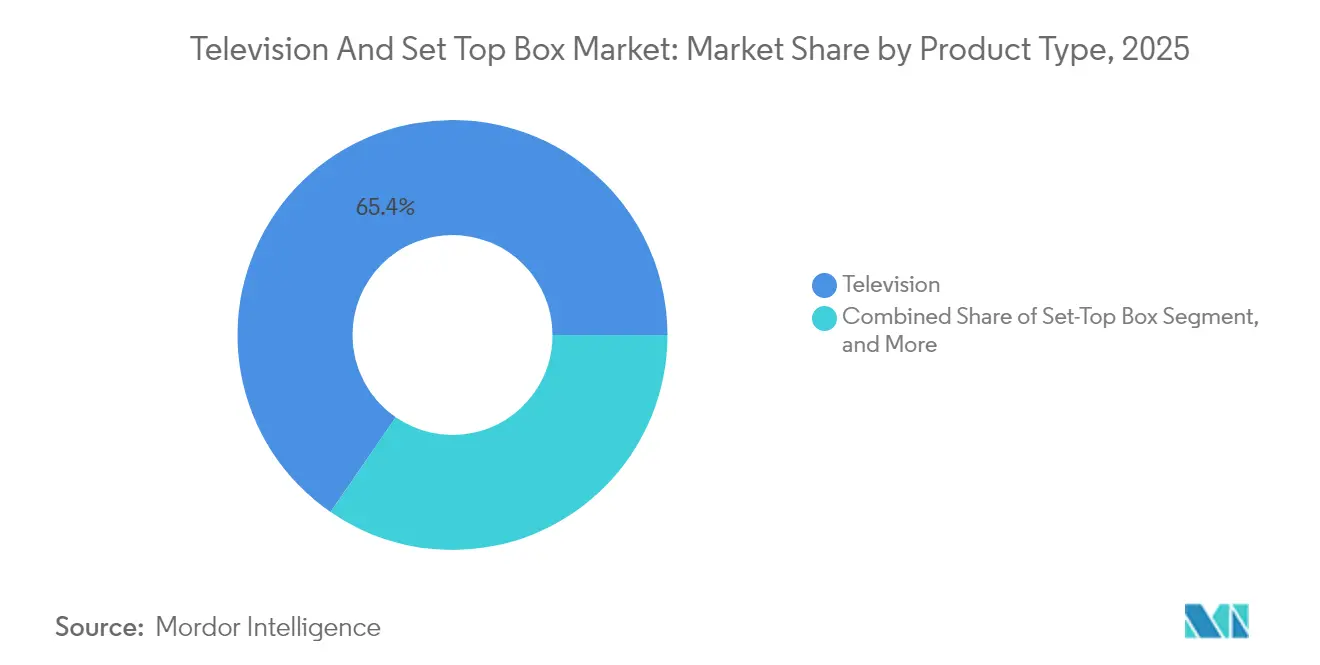
- By product type, streaming dongles and sticks expanded at a 7.74% CAGR between 2026 and 2031, outpacing televisions, which retained 65.40% of the television and set-top box market share in 2025.
- By resolution, 4K accounted for 43.85% of the television and set-top box market share in 2025, while the 8K segment posted the fastest growth at 6.95% CAGR to 2031.
- By screen size, the 56-64-inch class led with 31.95% of the television and set-top box market share in 2025; screens of 75 inches and above are projected to deliver a 7.58% CAGR through 2031.
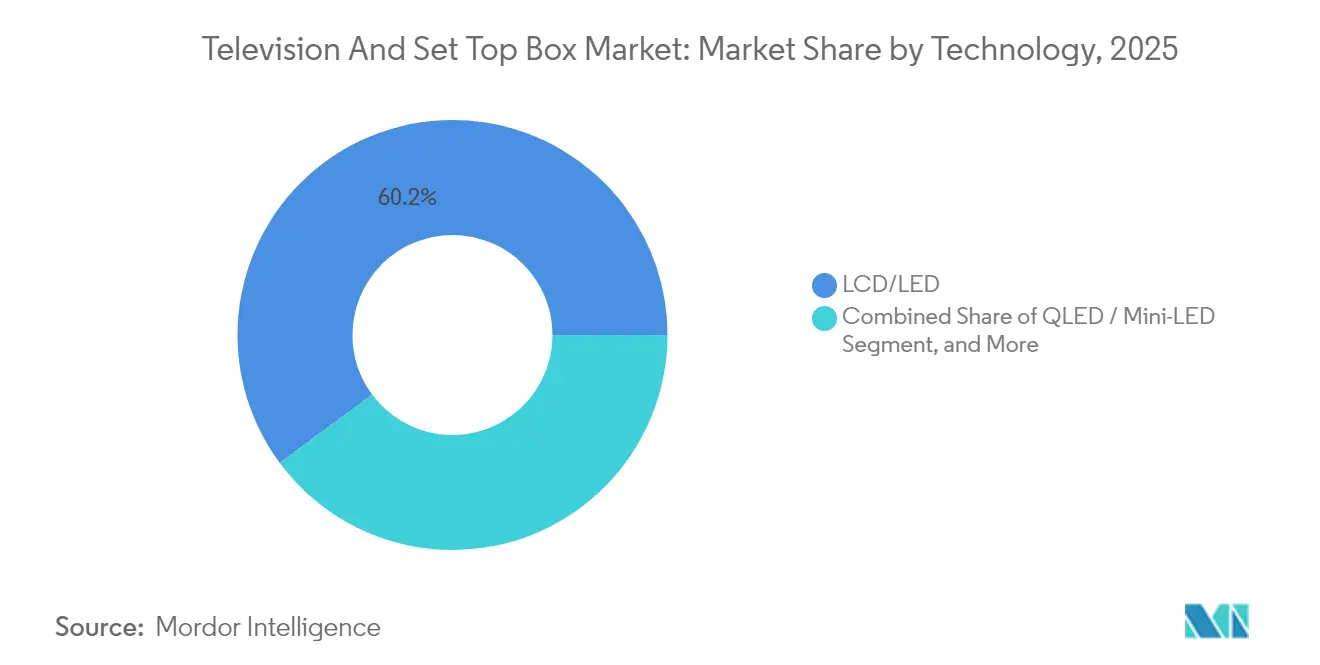
- By technology, LCD/LED held 60.15% of the television and set-top box market share in 2025, whereas QLED and Mini-LED combined are forecast to rise 7.46% annually to 2031.
- By end-user, residential applications commanded 75.85% of the television and set-top box market size in 2025; the commercial and institutional segment is on track for 7.06% CAGR through 2031.
- By geography, Asia-Pacific accounted for 42.20% of the television and set-top box market share in 2025, and is set for a 6.53% CAGR through 2031.
Note: Market size and forecast figures in this report are generated using Mordor Intelligence’s proprietary estimation framework, updated with the latest available data and insights as of 2026.
Market Trends and Insights
Drivers Impact Analysis of Television and Set Top Box Market*
| Driver | (~) % Impact on CAGR Forecast | Geographic Relevance | Impact Timeline |
|---|---|---|---|
| Rapid consumer migration to 4K and 8K UHD | +1.2% | Asia-Pacific, North America | Medium term (2-4 years) |
| Smart-TV OS ecosystems | +1.0% | Developed markets globally | Short term (≤2 years) |
| Government-mandated digital switchover | +0.8% | Emerging Asia-Pacific, Africa, Latin America | Long term (≥4 years) |
| AI-enabled personalized interfaces | +0.7% | North America, Europe, developed Asia-Pacific | Medium term (2-4 years) |
| Edge-based interactive advertising | +0.5% | North America, Europe, Asia-Pacific | Medium term (2-4 years) |
| LEO-satellite rural reach | +0.4% | Rural areas worldwide | Long term (≥4 years) |
| Source: Mordor Intelligence | |||
Rapid Consumer Migration to 4K and 8K UHD Content
Surging demand for higher-resolution screens is compressing replacement cycles and lifting average selling prices. Although 8K hardware exists, limited native content keeps adoption muted, so 4K continues to dominate upgrade decisions. BenQ forecasts that widescale 8K take-up remains at least six years away, reinforcing the mid-term commercial primacy of 4K panels.[2]BenQ Corporation, “Why 8K Adoption Will Take 6–10 Years,” benq.com Samsung’s extensive 8K patent portfolio is also likely to influence cost structures and competitive licensing. The Television and Set Top Box market, therefore, leans on 4K as the principal value driver while treating 8K as a longer-run premium pathway. Demand for 4K content is shaping the set-top box market as households replace older devices.
Smart-TV OS Ecosystems Accelerating Replacement Cycles
Software ecosystems are now the heart of product differentiation. Samsung’s 2025 sets integrate Vision AI to tailor recommendations and voice commands. LG is pairing Microsoft Copilot to add productivity features, shortening perceived product life and encouraging 4- to 5-year upgrade intervals. Platform fragmentation, Android TV, Roku, webOS and others, creates sticky ecosystems that lock users into branded interfaces. As a result, service revenue and targeted advertising are growing alongside hardware revenue, boosting the Television And Set Top Box market.
Government-Mandated Digital-Switchover Programs
The International Telecommunication Union coordinates analog switch-off deadlines, spurring equipment demand in countries such as Nigeria, South Africa, and Indonesia.[3]International Telecommunication Union, “Status of the Digital Terrestrial Television Transition Worldwide,” itu.int Subsidies for compliant set-top boxes and energy-efficient displays generate predictable multi-year procurement. These staggered transitions give manufacturers clear production visibility and support local assembly initiatives that tap emerging-market employment incentives.
AI-Enabled Personalized User Interfaces Enhancing ARPU
AI routines filter vast viewing histories to push bespoke channels, which lifts engagement metrics and advertising CPMs. Samsung’s Vision AI, for instance, parses intent and habits to sharpen contextual promotions. Voice assistants gather additional household data, allowing granular ad segmentation. While Roku’s experience shows that device growth without refined targeting offers limited monetization, the broader Television And Set Top Box industry expects incremental ARPU gains as AI maturity rises.
Restraints Impact Analysis of Television and Set Top Box Market*
| Restraint | (~) % Impact on CAGR Forecast | Geographic Relevance | Impact Timeline |
|---|---|---|---|
| Escalating panel and semiconductor costs | -1.1% | Global | Short term (≤2 years) |
| Saturation in developed markets | -0.9% | North America, Europe, developed Asia-Pacific | Long term (≥4 years) |
| Cord-shifting to mobile and PC | -0.6% | Global, younger demographics | Medium term (2-4 years) |
| Carbon and e-waste regulation on big screens | -0.3% | Europe, North America, expanding to Asia-Pacific | Long term (≥4 years) |
| Source: Mordor Intelligence | |||
Escalating Panel and Semiconductor Input Costs
Display glass, driver ICs, and memory have seen cost rebound since mid-2024. Concentrated panel fabrication in East Asia exposes brands to geopolitical and logistics risks. Smaller suppliers lack hedge leverage and must either absorb costs or raise retail prices, pressuring margins. Larger firms pursue vertical integration and long-term wafer agreements, but these hedges only partially offset the negative 1.1-percentage-point drag on the Television and Set Top Box market CAGR.
Saturation in Developed Markets
Penetration near 100% in North America and Western Europe extends replacement cycles and shifts focus to premium SKUs rather than volume. Software updates can refresh existing sets, further diluting near-term hardware demand. Consequently, manufacturers pivot toward commercial displays, emerging-market rollouts, and software monetization to sustain growth in the Television and Set Top Box market.
*Our forecasts treat driver/restraint impacts as directional, not additive. The impact forecasts reflect baseline growth, mix effects, and variable interactions.
Television and Set Top Box Market Segment Analysis
By Product Type:
Streaming Devices Reshape ViewingThe Television and Set Top Box market size for televisions retained a 65.40% slice of 2025 revenue, yet streaming dongles and sticks posted the segment’s top 7.74% CAGR. Dongles thrive on portability, quick setup, and low entry prices, eroding traditional cable and satellite box relevance. In regions where legacy pay-TV retains sway, hybrid satellite-IP-IP boxes address both linear and OTT viewing. Meanwhile, smart-TV integration lowers future standalone dongle demand in developed economies, but emerging markets still adopt low-cost add-ons as the first step into connected content. Brands increasingly bundle free ad-supported streaming television (FAST) channels in the interface, increasing engagement and data collection.
Price wars in sticks, Roku versus Amazon Fire TV and Xiaomi, compress margins yet expand installed base, which in turn fuels ad inventory. Television manufacturers counter by embedding comparable OS functionality in-panel, retaining value chain control. This tug-of-war ensures product diversity but also blurs category lines, meaning that many households now run multiple streaming devices alongside smart panels, inflating total addressable units within the Television And Set Top Box market.



By Resolution:
4K Mainstay, 8K AspirantThe Television And Set Top Box market share for 4K rose to 43.85% in 2025 and continues to command mid-cycle upgrades, propelled by mature production yields and abundant native content via OTT platforms. Upgraders see tangible visual benefits over HD at mainstream panel sizes, helping 4K sets maintain compelling value. Conversely, the 8K class, while logging a 6.95% CAGR, shipped only 143,000 units in 2024, reflective of its content deficit and premium price positioning. Hardware makers nevertheless push 8K to defend ASPs and brand leadership.
Manufacturers apply AI upscaling to mitigate native content scarcity, hoping to seed an install base ahead of true 8K broadcast. BenQ anticipates mass adoption no sooner than 2031, suggesting continued dominance of 4K through the forecast period. HD and Full HD persist in cost-focused emerging nations and commercial installations where bandwidth and content constraints make 4K overkill.
By Screen Size:
Bigger Becomes StandardThe 56-64-inch class captured 31.95% of 2025 sales, but the 75-inch-plus band will clock a 7.58% CAGR as consumers chase theater-like immersion. Price per diagonal inch for 75-inch LCD has fallen below USD 500 at mainstream retailers, narrowing the upgrade premium and encouraging buyers to leapfrog intermediate sizes. Manufacturers push area-based marketing, selling bigger screens rather than just more units, to maintain revenue per household.
Commercial buyers mirror the trend, specifying 98-inch displays for boardrooms and signage. Consequently, panel makers retool fabs for larger substrates, achieving scale efficiencies that feed back into lower end-user prices, reinforcing the virtuous cycle in the Television And Set Top Box market.
By Technology:
QLED and Mini-LED Narrow the GapLCD/LED still led the Television and Set Top Box market size with 60.15% revenue share in 2025, thanks to favorable cost structures. Yet QLED and Mini-LED surged 7.46% annually as value-conscious buyers traded up for quantum-dot vibrancy and local-dimming brightness. Samsung shipped 8.34 million QLED TVs in 2024, equal to 46.8% of that sub-segment. Chinese brands' fast-follower strategies, Hisense and TCL, double premium volumes annually, pressuring established leaders.
Mini-LED’s micro-lens arrays raise peak luminance while avoiding OLED burn-in, making it a household favorite for bright living rooms. OLED, once the pinnacle, faces a margin squeeze as production costs converge with advanced LCD. Manufacturers now mix technology lineups to hedge volatile material costs and shifting consumer tastes.
By End-User:
Commercial Demand Diversifies RevenueResidential remained dominant at 75.85% of 2025 sales, but commercial and institutional applications expanded 7.06% annually, cushioning cyclical consumer replacement dips. Retail, hospitality, and quick-service restaurants deploy digital menu boards and interactive wayfinding, driving volume in specialized signage panels. Corporations install IPTV and OTA-capture systems for campus communications, favoring ruggedized set-top boxes with extended firmware support.
Education budgets allocate funds to large-screen interactive displays and lecture-streaming appliances, upgrading classroom engagement. Healthcare’s telemetry boards and infotainment solutions require certified hygienic enclosures, commanding premium pricing. This diversification limits revenue volatility and spreads component procurement risk across the Television and Set Top Box market.
Geography Analysis
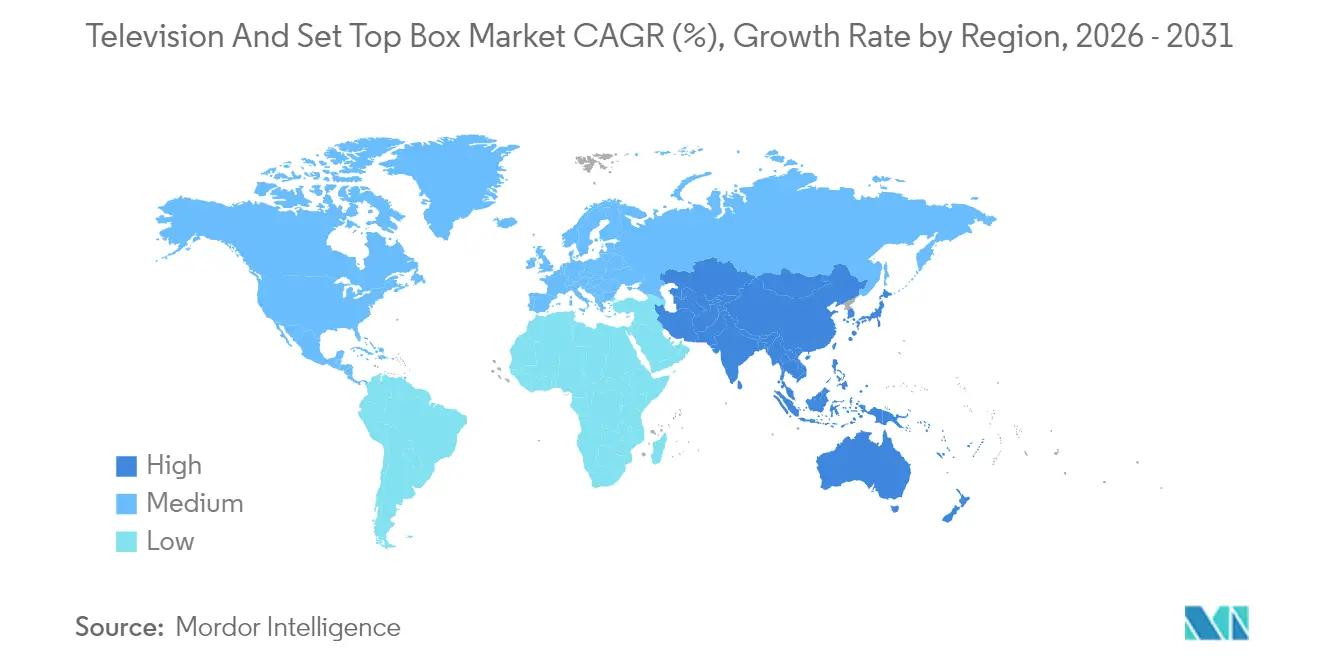
APAC Television and Set Top Box Market
Asia-Pacific generated 42.20% of global 2025 revenue and will advance at a 6.53% CAGR, fueled by China’s scale production and India’s double-digit smart-TV household expansion. Domestic champions TCL and Hisense leverage lower labor costs and state incentives to accelerate premium shipments, narrowing the gap with Korean incumbents. Government digital initiatives in Indonesia, Vietnam, and the Philippines enlarge unit volumes, while Japan and South Korea maintain technology leadership through 8K trials and immersive audio-visual standards.
North America Television and Set Top Box Market
North America presents a mature yet lucrative arena where large-format 4K and 8K panels dominate living-room real estate. Korean brands captured 52% unit share among U.S. adults, reflecting durable brand equity. The region shows solid 7.92% revenue CAGR driven by premium upselling rather than unit expansion, with consumers embracing voice assistants, console gaming, and advanced HDR variants. Trade under the USMCA agreement supports just-in-time logistics from Mexican assembly hubs, moderating inventory risk for retailers.
Europe and Africa Television and Set Top Box Market
Europe’s growth is steadier, constrained by energy-efficiency mandates and early analog switch-off completion. Eco-design rules force power-saving firmware and recyclable packaging, adding compliance costs that smaller Asian entrants may struggle to meet. Nevertheless, Germany, the UK, and France prioritize 65-inch-plus 4K sets, and OLED adoption remains strongest in Western capitals. Emerging Central and Eastern Europe sees digital switchover tailwinds similar to select African states, affording brands a long-term replacement runway once economic indicators stabilize.

Regulatory Landscape
Regulation in the television and set-top box market is increasingly anchored in energy efficiency, accessibility, and interoperability requirements that shape device design and software menus. In the European Union, Regulation (EU) 2023/826 introduced updated ecodesign requirements for electronic household equipment and took effect on May 9, 2025, requiring OEMs to refresh power-management profiles, documentation, and conformity processes for TVs and connected receivers placed on the market. In the United States, the Federal Communications Commission (FCC) continues to govern accessibility-related user interface obligations for television and set-top box controls, menus, and program guides.
A January 15, 2025 FCC Public Notice (DA 25-48) set an August 17, 2026 compliance milestone for making closed-captioning display settings readily accessible, which pushes manufacturers and pay-TV operators toward firmware and UI updates that are consistent across device families and operator-branded boxes. Alongside these market-access rules, standards bodies such as ITU-T are also tightening technical baselines, including ITU-T Recommendation J.298 (approved June 29, 2024) for hybrid set-top boxes spanning terrestrial and satellite transport, supporting convergence of broadcast and IP delivery requirements.
Value Chain Analysis
The value chain spans display glass and panels, semiconductors (SoCs, memory, and connectivity), enclosure and mechanical parts, software platforms (smart-TV OS and set-top middleware), final assembly/EMS, operator certification, and multi-channel distribution through retailers and pay-TV/telecom operators. Panel and SoC availability remains a key upstream influence on product cadence and bill of materials, while midstream differentiation has shifted toward software stacks (for example, Android TV and RDK in operator deployments) and content aggregation layers that convert installed base into advertising and service revenue.
Downstream, operator qualification and regional compliance add time and cost to set-top box rollouts, particularly for hybrid broadcast-broadband devices. Trade policy also affects manufacturing footprints and logistics choices; for instance, US tariff-related shifts cited by industry sources have reinforced interest in diversifying final assembly away from China toward Mexico and Vietnam for North America-bound TV sets. Standards upgrades are feeding back into component and software sourcing decisions: the HbbTV Association integrating DRM into the HbbTV 2.0.5 core specification (March 2026) and DVB Steering Board approvals of major DVB-I updates (July 2026) increase requirements for secure content delivery, service discovery, and hybrid interoperability across TVs, streaming devices, and operator boxes.
Competitive Landscape
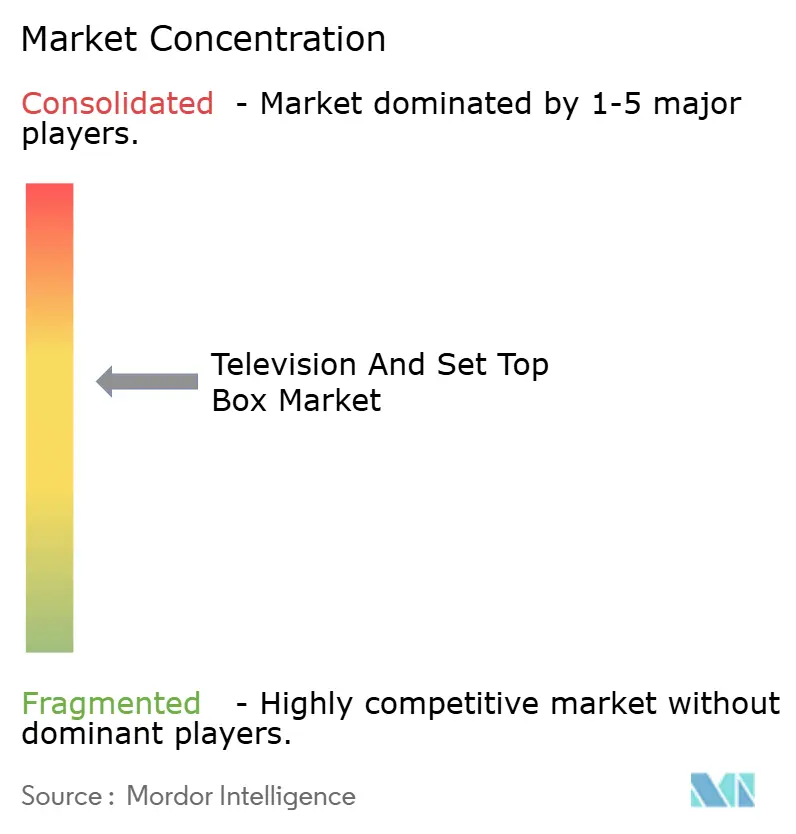
The Television And set-top box market exhibits moderate fragmentation. Samsung retained overall leadership for a 19th consecutive year with 28.3% global share and nearly 50% command of TVs priced above USD 2,500. LG focuses on OLED and cloud-gaming alliances to reinforce its premium standing, yet TCL’s Q4 2024 surge into the high-end bracket illustrates how aggressive Chinese price-performance tactics erode Korean dominance. Hisense’s sustained double-digit shipment growth further reshapes share hierarchies.
Strategically, leaders invest in software ecosystems to differentiate beyond panel technology. Samsung’s Vision AI and LG’s Copilot partnership exemplify the convergence of productivity, smart-home control, and entertainment within one screen. Supply-chain resilience now determines gross-margin stability; vertically integrated panel fabs or secure OLED tie-ups, such as Sony’s use of Samsung Display QD-OLED, mitigate component shocks.
Streaming-device specialists like Roku and Amazon represent adjacent competition, siphoning living-room interface influence. Yet as panel vendors embed equivalent OS layers, standalone streamer ASPs compress, forcing those brands deeper into advertising and platform licensing. The competitive matrix therefore spans hardware, software and services layers, with success hinging on brand resonance, platform lock-in and disciplined cost management across the Television And Set Top Box market.
Television and Set Top Box Industry Leaders
Samsung Electronics Co., Ltd.
LG Electronics Inc.
TCL Technology Group Corp.
Hisense Co., Ltd.
Sony Group Corporation
- *Disclaimer: Major Players sorted in no particular order
Television and Set Top Box Market Companies Covered in this Report
- Samsung Electronics Co., Ltd.
- LG Electronics Inc.
- TCL Technology Group Corp.
- Hisense Co., Ltd.
- Sony Group Corporation
- Panasonic Holdings Corporation
- Sharp Corporation
- Vizio Holding Corp.
- Skyworth Group Co., Ltd.
- Xiaomi Corporation
- Haier Smart Home Co., Ltd.
- Koninklijke Philips N.V.
- TP Vision
- Toshiba Corporation
- Arris International Ltd. (CommScope)
- Technicolor S.A.
- Humax Co., Ltd.
- Sagemcom SAS
- ZTE Corporation
- Kaon Media Co., Ltd.
- Evolution Digital LLC
- Coship Electronics Co., Ltd.
- Intek Digital Inc.
- Gospell Digital Technology Co., Ltd.
- Roku, Inc.
- Amazon.com, Inc. (Fire TV)

Market Opportunities and Future Outlook
Hybrid broadcast-broadband standards and deployments are creating whitespace for device refresh and platform licensing, especially where broadcasters and operators want a single service layer across antenna/satellite and IP streaming. In Brazil, DTV+ (TV 3.0) went live in June 2026 across major cities including Rio de Janeiro, Sao Paulo, and Brasilia, using advanced compression technologies (MPEG-5 LCEVC and VVC) on commercial devices; this supports near-term demand for compatible silicon, firmware, and retail SKUs that can support next-generation terrestrial experiences.
At the same time, ITU-R published Report BT.2568-0 in March 2026 to define requirements for application-oriented television broadcasting platforms, reinforcing a path toward interoperability between legacy broadcast and IP-based services and encouraging OEMs and middleware suppliers to standardize capabilities across regions. Monetization-led opportunities are also visible in the acceleration of managed FAST and pre-installed app ecosystems, which shift bargaining power toward platform owners and smart-TV OS operators. Netgem announced in March 2026 that its Pleio TV platform had been deployed across Bouygues Telecoms TV customer base in France to deliver a managed FAST proposition, highlighting demand for turnkey content, ad insertion, and UI control rather than standalone hardware. In Africa, Canal+ and Samsung expanded a pre-install rollout of the DStv Stream app on new Samsung Smart TVs across 18 markets from June 1, 2026, illustrating how OEM-operator distribution agreements can move viewing and subscription acquisition to the point of sale. Commercial and institutional estates also provide an active deployment channel: Foxtel Business iQ expanded with Fortescue in May 2026 for a large 4K Ultra HD screen rollout across remote Australian mining villages, supporting demand for durable displays and managed distribution layers in non-residential environments.
Recent Industry Developments in Television and Set Top Box Market
- July 2026: Samsung rolled out Vision AI Companion across its 2026 TV lineup and M70+ Smart Monitors to enable more natural voice-based interactions and on-device AI features. The release strengthens Samsungs strategy of using software experiences to differentiate hardware tiers and deepen engagement with connected services.
- June 2026: Canal+ and Samsung expanded a pre-install rollout of the DStv Stream app on new Samsung Smart TVs across 18 markets in Africa, illustrating how OEM-operator distribution agreements can move viewing and subscription acquisition to the point of sale. The deployment underscores growing demand for managed streaming ecosystems integrated at point of sale.
- March 2026: TCL signed definitive agreements with Sony to form Bravia Inc., a joint venture in which TCL holds a 51% stake to take on Sony's home entertainment operations, with the operational shift described as effective in April 2027. The move ties TCL's scale and supply chain leverage to Sony's premium brand and product positioning, reshaping competitive dynamics across the upper end of the TV portfolio.


Television and Set Top Box Market Report Scope and Research Methodology
Market Definition and Coverage
This market covers revenues earned from televisions and set-top boxes sold to end users, including connected and traditional models, and it is measured in USD across major regions.
Scope exclusions: We exclude content subscriptions and pure software or service revenues that are not tied to a device sale.
Segments Covered in This Report
- By Product Type
- Television
- Set-Top Box
- Streaming Dongles/Sticks
- By Resolution
- SD
- HD/FHD
- 4K
- 8K and Above
- By Screen Size
- 32” and Below
- 33–43”
- 44–55”
- 56–64”
- 65–74”
- 75” and Above
- By Technology
- LCD/LED
- QLED / Mini-LED
- OLED
- Laser / Projection TV
- By End-User
- Residential
- Commercial and Institutional
- By Geography
- North America
- United States
- Canada
- Mexico
- South America
- Brazil
- Argentina
- Rest of South America
- Europe
- Germany
- United Kingdom
- France
- Italy
- Rest of Europe
- Asia-Pacific
- China
- Japan
- South Korea
- India
- Rest of Asia-Pacific
- Middle East
- Saudi Arabia
- United Arab Emirates
- Rest of Middle East
- Africa
- South Africa
- Rest of Africa
- North America
Data Sources, Market Sizing, and Validation
Desk Research
We started by building the demand backdrop using public datasets that show how many households can realistically adopt TVs and operator boxes, and how fast video delivery is shifting. Sources reviewed include releases and datasets such as ITU broadband indicators, OECD telecom and household statistics, World Bank macro series, and UN Comtrade trade flows for relevant electronics categories.
To connect this backdrop to device revenues, we also reviewed company filings and investor presentations, plus operator and regulator announcements on digital switchover. For market price context, we used reputable press coverage on panel supply and retail pricing. Where needed, we used paid subscriptions for company financials and news screening, and an import or export shipment level database to sanity check directional flows in key corridors. These are illustrative sources only, and many other public references were also used to collect, verify, and clarify inputs.
Primary Interviews and Surveys
Primary calls and surveys were used to pressure test what we saw in public data, especially around real price bands, replacement cycles, and how operators are shifting between IPTV, hybrid, and legacy boxes. We spoke with a mix of device makers, component and channel participants, pay TV and broadband ecosystem contacts, and large buyers across APAC, EMEA, and the Americas so assumptions could be corrected where regional behaviors differ.
Distribution of primary research fieldwork respondents
| Company type | Respondent position | Region |
|---|---|---|
| Top tier: 33% | CXOs: 13% | APAC: 47% |
| Mid tier: 47% | Functional/Unit leaders: 33% | EMEA: 33% |
| Smaller Players: 20% | Managers: 54% | Americas: 20% |
Market-Sizing & Forecasting
The core sizing starts with a top-down build where household, broadband, and pay TV penetration patterns are used to reconstruct an addressable device demand pool, which is then translated into revenues through region specific average selling prices. To keep the totals realistic, we corroborated the outcome with selective bottom-up approximations such as sampled ASP x unit volumes from channel checks, plus supplier and brand level revenue signals where disclosures were clear.
Key inputs that shaped the model include TV replacement cycles by region, the mix shift across HD, 4K, and 8K (and the related price premiums), screen size mix changes that move value even when units are flat, the operator migration pace toward IPTV and hybrid boxes, and macro drivers like disposable income and inflation that influence upgrade timing. Where bottom-up checks had gaps, the missing pieces were handled through conservative share splits anchored to the closest observable proxy (for example, trade flows or disclosed category revenue) and then revalidated in interviews.
For forecasting, we relied on scenario analysis tied to a small set of variables that respondents could confidently comment on, such as broadband rollouts, pay TV subscriber trends, and expected ASP movements by resolution and screen size. The final forecast path was adjusted only when the scenario outputs aligned with multiple independent signals instead of a single input swing.
Data Validation & Update Cycle
We run multi-step checks so that the total market value and its movement make sense against external signals like trade direction, device replacement rhythm, and operator technology shifts. If large variances show up between regions or between implied units and value, the assumptions are reopened and the relevant experts are contacted again before sign-off.
Every report is refreshed on an annual cycle, and interim updates are made when material events can change pricing, supply, or demand in a meaningful way. Before delivery, an analyst performs a fresh pass across key inputs and calculations so clients receive the latest updated view rather than an older snapshot.
Mordor Intelligence's Tv and Set Top Box Market Estimate Compared With Other Published Estimates
Published market sizes for TVs and set-top boxes can look far apart because the boundary is not always the same, even when the titles sound similar. In practice, differences come from what products are counted, whether value is built from shipments or from demand signals, and how pricing is treated as 4K and larger screens take share.
By tracking resolution and screen-size mix shifts and refreshing the ASP curves through channel checks and interviews, Mordor Intelligence keeps the device revenue pool focused on TVs, set-top boxes, and streaming sticks, instead of blending in adjacent electronics or service revenue. Gaps also show up when one estimate relies on a single region or uses a one-time currency conversion, while another smooths prices over time and validates assumptions across operators and retail channels.
Benchmark comparison
| Source | Market Size | Gaps in Research Methodology |
|---|---|---|
| Mordor Intelligence | USD 323.90 B (2026) | |
| Industry Data Publisher A | USD 37.25 B (2024) | This number sizes only set-top boxes and excludes televisions and streaming sticks, which compresses the total even if growth rates appear similar. |
| Global Media Note B | USD 8.16 B (2024) | The estimate is presented as incremental growth over a short window rather than a full market value, and it also focuses on set-top boxes only with limited clarity on price build assumptions. |
The spread in the table is mainly explained by scope and by the way revenue is expressed, whether as a full device market value or as a growth increment for one device category. When the same product set and consistent price logic are applied across regions and checked against multiple demand indicators, the resulting total becomes easier to trace and repeat from year to year.


Key Questions Answered in the Report
How large is the Television And Set Top Box market in 2026?
The market stands at USD 323.9 billion in 2026 with a forecast to reach USD 422.79 billion by 2031, implying a 5.47% CAGR.
Which segment is expanding most rapidly by product type?
Streaming dongles and sticks post a 7.74% CAGR, outpacing televisions and traditional set-top boxes.
What resolution leads consumer adoption?
4K panels hold 43.85% revenue share and remain the upgrade driver, while 8K adoption is still nascent.
Which region contributes the highest revenue?
Asia-Pacific commands 42.20% of 2025 revenue and maintains the fastest 6.53% regional CAGR to 2031.
Who is the global TV market leader?
Samsung retained first position for the 19th straight year with 28.3% global share and near-half control of the USD 2,500-plus price band.
Why are commercial installations important?
Commercial and institutional deployments grow at 7.06% CAGR, providing a stable revenue stream that buffers consumer market saturation.
Page last updated on:


 Your data is secure and never sold or shared.


