
Market Overview
| Study Period | 2021 - 2031 |
|---|---|
| Forecast Data Period | 2026 - 2031 |
| Base Year Market Size (2025) | USD 9.97 Billion |
| Market Size (2026) | USD 10.32 Billion |
| Market Size (2031) | USD 12.28 Billion |
| Growth Rate (2026 - 2031) | 3.53 % |
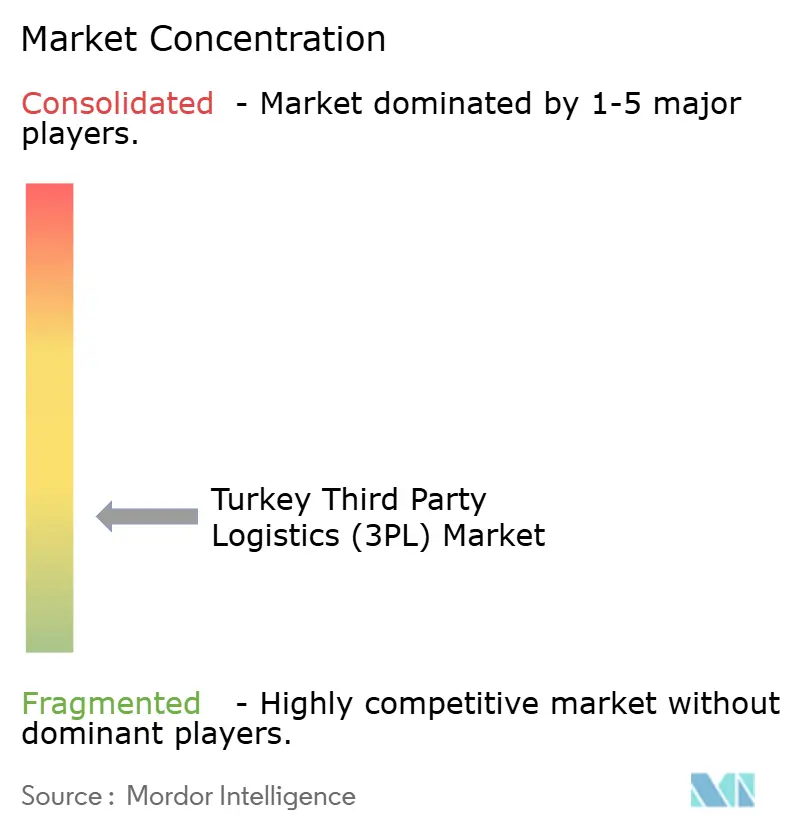
| Market Concentration | Low |
Major Players *Disclaimer: Major Players sorted in no particular order Image © Mordor Intelligence. Reuse requires attribution under CC BY 4.0. | |
Turkey Third Party Logistics (3PL) Market Analysis by Mordor Intelligence
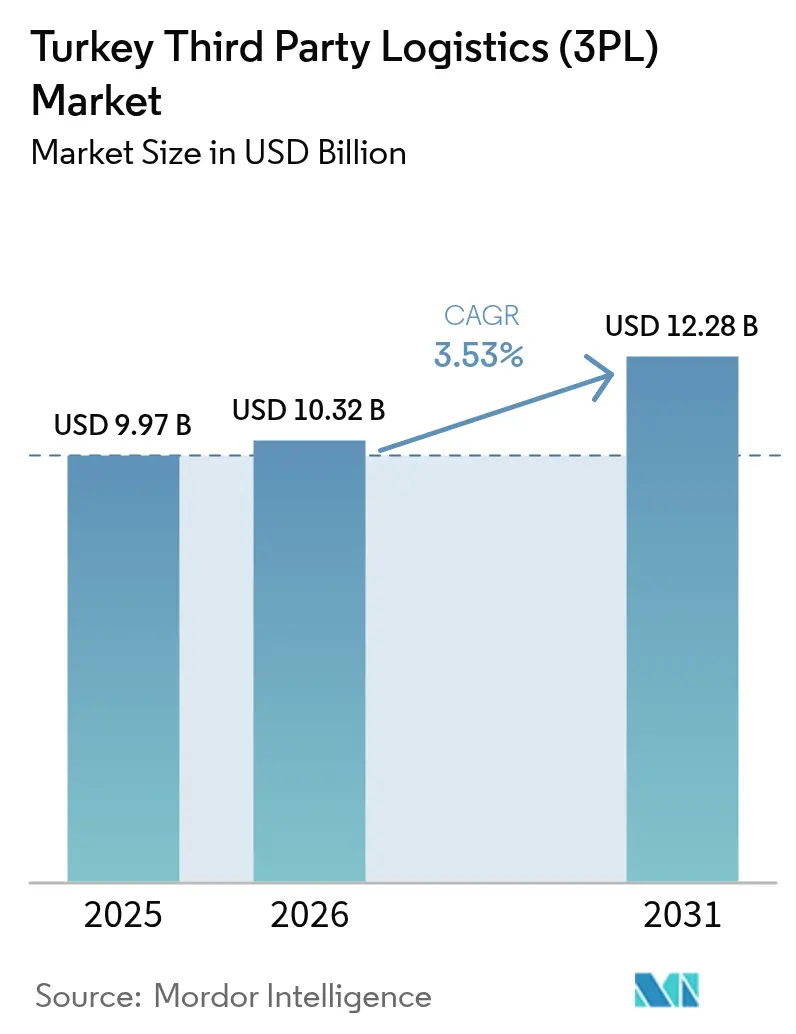
The Turkey Third Party Logistics Market size was valued at USD 9.97 billion in 2025 and estimated to grow from USD 10.32 billion in 2026 to reach USD 12.28 billion by 2031, at a CAGR of 3.53% during the forecast period (2026-2031).
The country’s role as a land-bridge between Europe, Asia, and the Middle East underpins steady demand, while government spending on highways, railways, and 25 dedicated logistics centers strengthens network efficiency [1]Invest in Türkiye, “Turkey’s Logistics Performance and Infrastructure Investments,” Invest in Türkiye, invest.gov.tr. Rising e-commerce parcels, expanding cold-chain requirements in pharmaceuticals and food, and EU near-shoring of production continue to widen the customer base for third-party providers. Operators are favoring asset-light strategies to mitigate currency risk and scale capacity quickly, yet acquisitions such as CEVA’s purchase of Borusan Tedarik and DHL’s takeover of MNG Kargo show that well-located distribution assets still command a premium. Supply-side constraints are visible in a projected driver shortfall of 200,000 positions and looming EU Carbon Border Adjustment Mechanism costs, but Turkey’s target of a top-25 Logistics Performance Index ranking by 2028 indicates sustained policy support.
Key Report Takeaways
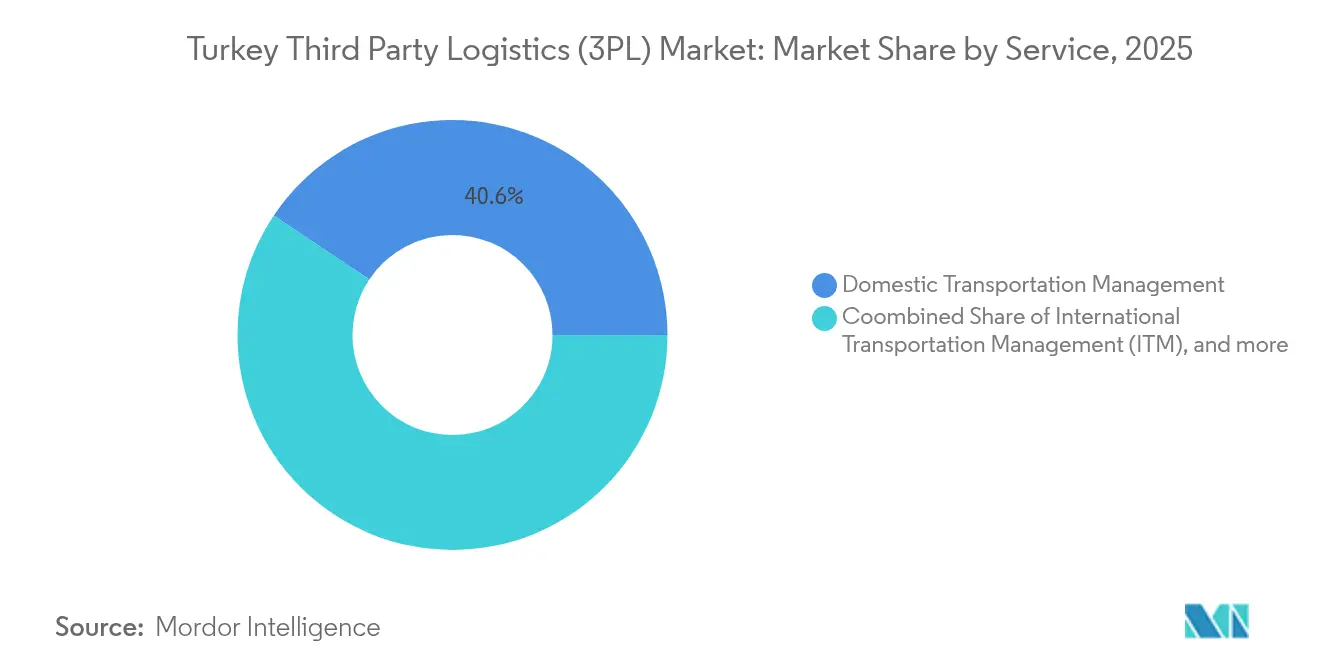
- By service, Domestic Transportation Management led with 40.62% of the Turkey third-party logistics market share in 2025, while Value-Added Warehousing & Distribution is advancing at a 7.66% CAGR, between 2026-2031
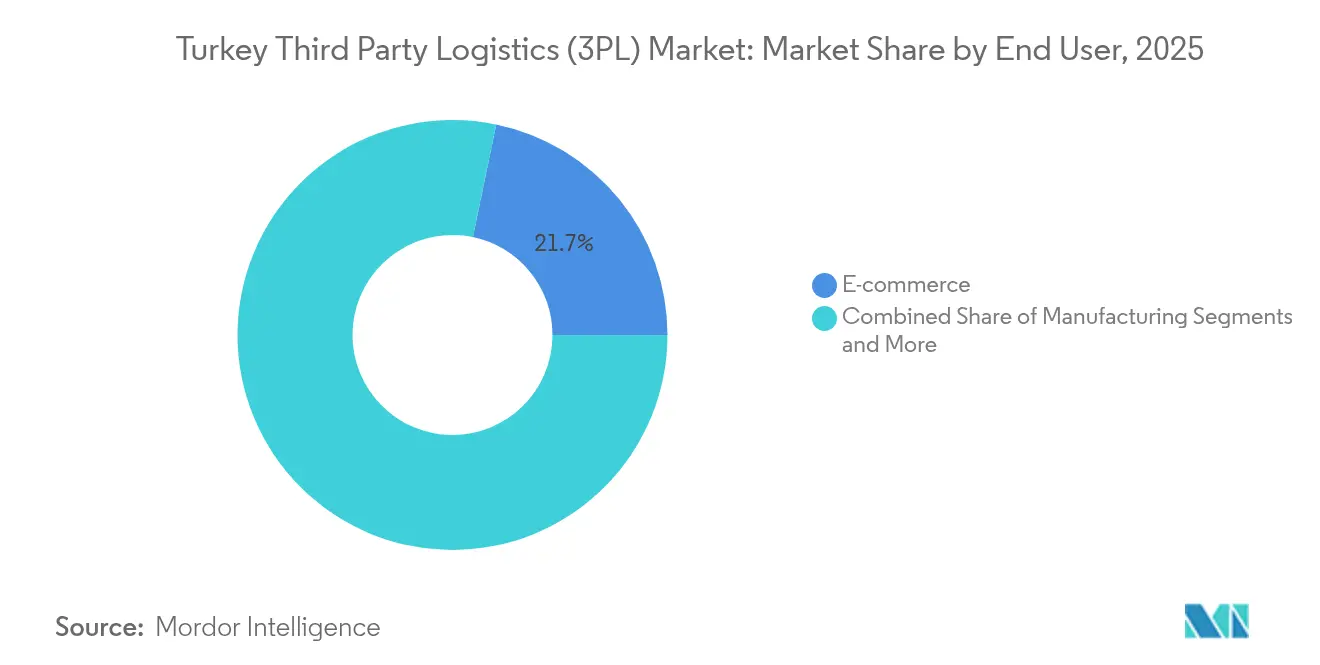
- By end user, E-commerce held 21.74% of the Turkey third-party logistics market share in 2025. while Life Sciences & Healthcare is projected to post a 6.97% CAGR during 2026-2031.
- By logistics model, Asset-Light operators controlled 49.61% of the Turkey third-party logistics market share in 2025, while Hybrid models are expected to expand at a 6.69% CAGR between 2026-2031.
Note: Market size and forecast figures in this report are generated using Mordor Intelligence’s proprietary estimation framework, updated with the latest available data and insights as of 2026.
Turkey Third Party Logistics (3PL) Market Trends and Insights
Drivers Impact Analysis*
| Driver | % Impact on CAGR Forecast | Geographic Relevance | Impact Timeline |
|---|---|---|---|
| E-commerce boom & omnichannel retailing | +0.8% | National, concentrated in Istanbul, Ankara, Izmir | Short term (≤ 2 years) |
| Logistics Master Plan infrastructure upgrades | +0.6% | National priority corridors | Medium term (2-4 years) |
| Near-shoring of EU supply chains to Turkey | +0.7% | Western border provinces, Marmara Region | Medium term (2-4 years) |
| Expansion of cold-chain demand (pharma & food) | +0.4% | Nationwide pharma hubs & farm belts | Long term (≥ 4 years) |
| Incentives for free-zones & bonded warehouses | +0.3% | Port-adjacent free zones | Medium term (2-4 years) |
| SME adoption of digital TMS/WMS platforms | +0.2% | Export-oriented industrial centers | Short term (≤ 2 years) |
| Source: Mordor Intelligence | |||
E-commerce Boom & Omnichannel Retailing
Fast grocery pioneer Getir’s USD 11.8 billion valuation epitomizes Turkey’s online shopping surge, with pandemic-era downloads up 60% and order volumes up 65%. Traditional retailers have reacted by integrating store and online inventories, which drives demand for high-velocity fulfillment centers, smart sorters, and route-optimization software. DHL’s purchase of parcel specialist MNG Kargo, whose automated hubs can sort 65,000 packages an hour, illustrates the capital intensity required to meet one-day delivery promises. Small exporters gain scale through cross-border portals such as DHgate, which has trained 2,500 local merchants and exceeded USD 1 billion in Turkish trade, further inflating parcel volumes. Rapid shopper uptake across Istanbul, Ankara, and Izmir makes e-commerce the single largest incremental contributor to the Turkey third-party logistics market.
Logistics Master Plan Infrastructure Upgrades
An earmarked USD 280 billion investment program since 2003 has allocated 55% to rail, while 38,000 km of divided roads and 8,300 km of highways are targeted for completion by 2053[2]Turkey 2053 Transport and Logistics Master Plan,” Ministry of Transport and Infrastructure, uab.gov.tr. Nine of 25 planned logistics centers are already online, creating 35.6 million tons of annual capacity and dovetailing with port modernization that lifted 2024 maritime throughput to 542.6 million tons. Konya Logistics Center alone aims to raise annual tonnage from 634,000 to 1.679 million, demonstrating how inland nodes will relieve coastal congestion. The 1,200 km Development Road Project, linking Iraq’s Grand Faw Port to Turkey and on to Europe by 2030, promises a time-saving southern corridor that complements the Middle Corridor rail route. Improved connectivity lowers transit costs and reliability risks, lifting demand for contract logistics, intermodal coordination, and cross-dock services across the Turkey third-party logistics market.
Near-shoring of EU Supply Chains to Turkey
Post-pandemic resilience strategies have compelled European manufacturers to shorten supply lines, making Turkey a preferred alternative to East Asia. Blue Water Shipping, DFDS, and InterRail have opened Turkish subsidiaries or added Ro-Ro rotations to speed Marmara–EU flows, while BLG Logistics has set up an automotive logistics unit to support local production of 1.4 million vehicles and imports of 626,000 cars. The uptick in component shuttles and finished-goods exports demands temperature-controlled warehousing, bonded storage, and customs-compliant consolidation—all services intrinsic to the Turkey third-party logistics market. Near-shoring also boosts back-haul utilization, reducing empty-run costs and enhancing 3PL margins, particularly for providers with flexible asset-light fleets.
Expansion of Cold-Chain Demand (Pharma & Food)
Turkish Cargo’s CEIV-Pharma-certified SMARTIST hub now handles 55,000 t of medicines and has delivered 330 million vaccine doses worldwide, highlighting technical competence in GDP-compliant handling. National cold storage already totals 35,000 m³ in Ankara, supplemented by 360 regional facilities and a fleet of insulated trucks serving all 81 provinces. The EBRD’s EUR 25 million investment in Netlog’s new temperature-controlled warehouses confirms institutional confidence in long-haul frozen and chilled chains. Çelebi’s IoT-enabled cargo WMS and Mars Logistics’ move to electric rail traction underline the sustainability imperative in cold logistics. Rising biologic drug output and fresh-produce exports ensure that cold-chain logistics remains the most technology-intensive growth pocket of the Turkey third-party logistics market.
Restraints Impact Analysis*
| Restraint | % Impact on CAGR Forecast | Geographic Relevance | Impact Timeline |
|---|---|---|---|
| Lira volatility inflating import costs | -0.6% | Nationwide, import-heavy sectors | Short term (≤ 2 years) |
| Bureaucratic customs procedures | -0.3% | Ports & border crossings | Medium term (2-4 years) |
| Driver shortages & rising labor costs | -0.4% | Major logistics hubs | Medium term (2-4 years) |
| EU CBAM & decarbonization compliance costs | -0.2% | Export-oriented clusters | Long term (≥ 4 years) |
| Source: Mordor Intelligence | |||
Lira Volatility Inflating Import Costs
The lira’s depreciation raises truck procurement, fuel, and IT hardware expenses because roughly 70% of equipment is priced in euros or dollars. Customs Law No. 4458 was amended to cut the express-cargo duty-free limit from EUR 150 to EUR 30, boosting clearance volumes but squeezing margins on low-value shipments. Mars Logistics is still committed to EUR 70 million to new tractors in 2024 after spending EUR 65 million in 2023, showing the capex needed to preserve service quality despite currency swings. Smaller 3PLs lacking natural hedges face higher working-capital requirements when leasing trailers or importing scanners, which limits their ability to scale. These pressures subtract 0.6% from the forecast CAGR of the Turkey third-party logistics market.
Driver Shortages & Rising Labor Costs
Turkey anticipates a deficit of 200,000 professional drivers—28% of demand—by 2027, driven by an aging workforce and EU migration. Wage hikes of 27% in 2024 outpaced inflation-adjusted freight rates, compressing margins for haulers and forcing 3PLs to invest in retention bonuses and driver-friendly scheduling[3]International Road Transport Union, “Driver Shortage Report 2025 – Turkey Focus,” IRU, iru.org. Autonomous platooning trials remain limited to controlled corridors, so relief via automation is unlikely before 2030. Large fleets charter additional sub-contractors, but this raises coordination complexity and service-quality variance. Shortages subtract an estimated 0.4% from the Turkey third-party logistics market CAGR.
*Our forecasts treat driver/restraint impacts as directional, not additive. The impact forecasts reflect baseline growth, mix effects, and variable interactions.
Segment Analysis
By Service: Transportation Dominates, Warehousing Accelerates
Domestic Transportation Management controlled 40.62% of the Turkey third-party logistics market share in 2025, supported by a 68,494 km road grid that lets truckers complete Istanbul–Gaziantep hauls in under 16 hours. The segment remains price sensitive because diesel accounts for over 30% of trip cost, yet a premium applies for time-definite and GDP-certified moves. International Transportation Management benefits from Ro-Ro frequency gains on the Trieste, Bari, and Toulon loops, but bureaucratic customs and CBAM risks temper its expansion pace. Value-Added Warehousing & Distribution is on track for a 7.66% run-rate, doubling its revenue share by 2030 as fulfillment models shift toward micro-hubs and multi-temperature storage. CEVA’s acquisition of Borusan Tedarik enlarged its national pallet footprint to 1.19 million m², confirming the land-grab underway for urban DC slots near Istanbul’s highway rings.
The Turkey third-party logistics market size for warehousing services is projected to advance at a pace that lifts its absolute revenue by USD 0.94 billion through 2031. Automation orders for shuttle systems and AMRs have risen 18% year-on-year because parcel sortation speed is now a retail KPI. Rail investment—55% of the transport capex budget—introduces fresh intermodal competition that could divert 15% of long-haul trucking volume to wagonload services by 2028. Mars Logistics’ plan for 40 weekly electric-traction trains illustrates how 3PLs hedge fuel price uncertainty while offering CO₂-optimized routes. Turkey third-party logistics market participants that integrate road, rail, and cross-dock assets are set to earn higher EBITDA margins by balancing load factors across modes.



By End User: Retail Leads, Healthcare Surges
E-commerce accounted for 21.74% of the Turkey third-party logistics market share in 2025, underpinned by marketplace sales that grew 35% on GMV and by an urban population with 75% smartphone penetration. High SKU churn and seasonal demand spikes create a constant need for fourth-party orchestration, vendor-managed inventory, and same-day delivery. Life Sciences & Healthcare is forecast to reach a 6.97% CAGR as domestic biologic drug plants and vaccine fill-finish lines expand capacity; Turkish Cargo’s CEIV-Pharma hub sets industry handling benchmarks. Automotive logistics stays a core volume generator with 1.4 million vehicle assemblies and 626,000 imports, requiring just-in-time inbound sequencing and finished-vehicle compound management.
Turkey third-party logistics market size for healthcare shipments could surpass USD 1.07 billion by 2031, assuming present growth trajectories hold. Cold boxes with IoT probes, passive packaging, and GDP-trained handlers are mandatory for serum and insulin cargoes, raising service premiums over ambient freight. Manufacturing and Technology & Electronics together broaden contract-logistics scope through demand for pick-to-light, bonded postponement, and regional hubbing for EU, CIS, and MENA deliveries. Food & Beverages leverage Turkey’s position as a top exporter of cherries, citrus, and frozen fish, calling for reefer consolidation and HACCP-compliant warehousing in Mersin and Izmir. Energy, Utilities, and project cargo segments book steady but lumpy demand, typified by Arkas Logistics’ wind-turbine hub solutions on the Aegean coast.
By Logistics Model: Asset-Light Preference, Hybrid Growth
Asset-Light operators held 49.61% of the Turkey third-party logistics market share in 2025, thanks to subcontracted fleets, leased depots, and digital control towers that minimize currency-denominated asset exposure. Netlog’s SAP-TM deployment coordinates 4,000 vehicles and 1.2 million m² of multi-client space across nine countries, demonstrating the global scalability of a non-asset-heavy balance sheet. Asset-heavy players still dominate hazardous bulk and project cargo, where owned equipment removes reliability risk, but financing costs in a high-interest environment hamper expansion. Hybrid models are growing at 6.69% annually as firms selectively own cross-dock terminals, e-fulfillment hubs, or reefer trailers while subcontracting line-haul or last-mile to local carriers.
Turkey's third-party logistics market size growth in hybrid operations is supported by shippers that demand assured capacity during peak periods yet want variable pricing structures. Transporeon’s cloud platform now connects over 1,400 shippers and 150,000 carriers in Turkey, adding API integrations for status messaging and customs e-declaration. Blockchain pilots for transferable e-CMR documents may further reduce administrative latency, positioning hybrid 3PLs as trusted partners in end-to-end orchestration. ESG reporting requirements, especially Scope 3 emissions accounting under CBAM, will favor hybrids that combine owned low-carbon assets with access to green capacity suppliers, strengthening their competitive stance in the Turkey third-party logistics market.
Geography Analysis
Turkey's third-party logistics market activity is heaviest in the Marmara Region, which hosts 43% of the nation’s 216 coastal facilities and processes the majority of EU-bound Ro-Ro and container flows. Istanbul’s mega-city status concentrates omnichannel fulfillment centers, but land costs drive suburban relocation toward Çorlu and Gebze, where rail-linked inland container terminals cut drayage times by 30%. The ongoing Kemalpaşa Logistics Hub in Izmir addresses Aegean capacity gaps and is forecast to handle 4 million t annually when fully operational, broadening distribution reach to Mediterranean and Balkan customers.
Central Anatolia’s Konya corridor emerges as a strategic cross-dock node due to network intersectionality between north–south and east–west freight flows; capacity upgrades will raise annual tonnage to 1.679 million, supporting agri-bulk and construction materials traffic. Southeastern provinces gain traction from the Development Road Project that links Iraq’s Grand Faw Port via 1,200 km of highway and rail, potentially shifting Gulf transit cargo northward to Turkish ports and on to Europe. The Middle Corridor rail route through Kars avoids Black Sea bottlenecks, and government projections call for tripling throughput by 2030, bolstering the Turkey third-party logistics market size tied to Eurasian land-bridge trade.
The national rail grid measures 10,546 km, of which 51% is electrified and 14% double-tracked; urban bottlenecks near Ankara and Istanbul are being addressed by 5,600 km of high-speed lines planned for completion by 2025, cutting inter-city transit times by half. Coastal regions such as Mersin and Iskenderun benefit from new quay cranes and yard automation, augmenting Turkey third-party logistics market capacity for cold-chain citrus exports and steel imports. Free zones near Izmir, Antalya, and Samsun continue to attract value-added assemblers who require integrated 3PL services for bonded storage, kitting, and reverse logistics, thereby dispersing market growth beyond Istanbul.
Regulatory Landscape
Turkey's 3PL regulatory environment is anchored by the Ministry of Transport and Infrastructure, which governs operator licensing and road-transport compliance under the Road Transport Regulation (Karayolu Tasima Yonetmeligi). In May 2025, amendments formally brought courier operations (kurye isletmeciligi) into the same regulatory perimeter as freight and logistics activities, tightening permitting and operating requirements for parcel and last-mile service providers.
Trade and customs compliance is led by the Ministry of Trade through the Import Regime Decision (Decree No. 3350), which sets the framework for duties, permits, and documentary requirements for inbound flows. This is complemented by the Ministry's digital customs information tools for tariff schedules and documentation. In May 2026, the Ministry of Transport and Infrastructure published further amendments in the Official Gazette (No. 33255), including extensions of transition deadlines for certain vehicle license requirements until 1 January 2027, which affects fleet compliance planning and subcontractor qualification timelines.
Value Chain Analysis
The Turkey 3PL value chain begins with shipper demand from e-commerce, manufacturing, automotive, and life sciences, followed by freight planning and brokerage, line-haul execution (road, Ro-Ro, rail, and air), and contract logistics (multi-client warehousing, fulfillment, and value-added services such as labeling and order management). Control-tower and TMS/WMS layers coordinate capacity across a fragmented carrier base, while customs brokerage and bonded operations act as the compliance bridge for EU-facing and transit cargo moving through ports, border gates, and free-zone nodes.
Downstream outcomes are shaped by infrastructure and intermodal interfaces. Logistics centers and rail connectivity initiatives are shifting more cargo toward rail-linked ports and inland nodes: the Ministry of Transport and Infrastructure initiated work in 2026 to connect 20 ports to the national rail network. Alongside large rail projects such as the Istanbul North Rail Crossing (INRAIL) and the Middle Corridor rail route, these moves strengthen the handoff between seaports, rail terminals, and inland distribution, expanding the addressable scope for 3PLs that bundle road-rail-port drayage, cross-dock, and inventory positioning.
Competitive Landscape
Turkey's third-party logistics market competition is moderate but trending toward higher concentration as multinationals seek domestic platforms. CEVA’s USD 440 million purchase of Borusan Tedarik doubled its warehouse footprint and added nearly 1 million annual domestic shipments, underscoring the appetite for scale. DHL’s acquisition of MNG Kargo places 27 automated sort centers and 800 branches under the German group, enhancing one-day delivery coverage and cross-border parcel synergies. Mars Logistics pursues vertical integration, funding EUR 70 million in new tractors while signing power-purchase agreements to run 100% electric rail services, which differentiates it on ESG compliance.
Technology adoption remains the central battlefield. Netlog’s SAP-TM platform timestamps every pallet movement, providing sellers with real-time ETA and carbon metrics; Turkish Cargo’s AI-driven ULD planning raises load factors on pharma lanes, while Transporeon’s lane-matching engine slashes spot tender time from 4 hours to 15 minutes. Cold-chain capability is the new white space: EBRD funding for Netlog, Çelebi’s IoT sensors, and warehouse retrofits for minus-40 °C blast freezing forecast robust entry barriers. Free-zone exemptions create cost advantages for 3PLs embedded in Mersin and Aliağa, though customs-rule volatility remains a strategic threat.
International entrants, from DFDS to InterRail, increase seaborne and rail capacity to convert near-shoring trade, forcing incumbent Turkish firms to widen service portfolios that now include duty paid/duty free inventory management, sustainability reporting, and chartering of specialized equipment. Asset-light challengers use digital freight platforms to aggregate return loads, but the top five 3PLs still command roughly 45% of gross revenue, suggesting ample room for both consolidation and niche specialization. ESG, digitalization, and cold-chain competencies will likely determine the winner’s circle in the Turkey third-party logistics market through 2030.
Turkey Third Party Logistics (3PL) Industry Leaders
CEVA Logistics
DHL International GmbH.
UPS
Schenker
DSV Panalpina
- *Disclaimer: Major Players sorted in no particular order

Market Opportunities and Future Outlook
Multimodal, rail-integrated contract logistics is an active whitespace as Turkey strengthens its hub role between Europe, the Caucasus, and the Middle East. In March 2026, the World Bank approved USD 2 billion in financing for the Istanbul North Rail Crossing (INRAIL), an electrified bypass intended to raise rail freight capacity across the Bosphorus from 3 million to 50 million tonnes. This creates room for 3PLs to expand intermodal planning, inland container logistics, and CO2-accounted routing for export-oriented shippers.
Corridor-driven logistics services also reflect near-term openings tied to specific programs. Full-capacity operations on the Baku-Tbilisi-Kars (BTK) railway commenced in June 2026, supporting the Middle Corridor for rail freight and increasing demand for consolidation, customs-compliant documentation, and time-definite cross-border execution. Complementary nodes such as the Kayseri rail logistics center (70% complete as of April 2026) and a planned 5 million TEU logistics port in Mersin point to new inland-to-port routings and value-added warehousing needs, while the national target of a top-25 Logistics Performance Index ranking by 2028 keeps policy support focused on professionalized 3PL services.
Recent Industry Developments
- May 2026: DHL Supply Chain Turkiye opened its Asya 1 facility in Tuzla, Istanbul, near Sabiha Gokcen International Airport. The site adds capacity for customized end-to-end logistics services and shows continued investment in energy-efficient, sustainability-oriented operations close to key air and highway gateways.
- November 2025: CEVA Logistics completed the acquisition of 100% of Borusan Tedarik Zinciri Cozumleri ve Teknoloji Sirketi (Borusan Lojistik) for USD 383 million. The transaction expands CEVA's domestic platform in Turkey across warehousing and transport, reinforcing consolidation as a route to nationwide coverage and sector-specific capabilities.
- July 2024: DHL Supply Chain Turkey received a Good Distribution Practices (GDP) compliant transfer center certificate for its Izmir Transfer Center from the Turkish Medicines and Medical Devices Agency. The certification strengthens healthcare and temperature-sensitive distribution credentials and supports higher-value life sciences logistics workflows beyond standard ambient freight.


Research Methodology Framework and Report Scope
Market Definition and Coverage
For this methodology, the Turkey 3PL market covers outsourced logistics services provided by third parties to shippers, where revenue is earned for moving, storing, and managing goods within Turkey and for Turkey-linked flows.
Scope exclusions: We exclude in-house (captive) logistics operations run by shippers for their own networks and pure parcel courier-only activity that is not contracted as a 3PL service.
Segmentation Overview
- By Service
- Domestic Transportation Management (DTM)
- Roadways
- Railways
- Airways
- Waterways
- International Transportation Management (ITM)
- Roadways
- Railways
- Airways
- Waterways
- Value-Added Warehousing & Distribution (VAWD)
- Domestic Transportation Management (DTM)
- By End User
- Automotive
- Energy & Utilities
- Manufacturing
- Life Sciences & Healthcare
- Technology & Electronics
- E-commerce
- Consumer Goods & FMCG
- Food & Beverages
- Others
- By Logistics Model
- Asset-Light (Management-Based)
- Asset-Heavy (Own Fleet & Warehouses)
- Hybrid
Data Sources, Market Sizing, and Validation
Desk Research
Desk work started with public transport and trade statistics that indicate how much freight is moving and where demand is forming. We used sources such as TurkStat for transport and warehousing series, the Central Bank of the Republic of Turkey for macro indicators, UN Comtrade for trade flows, and the World Bank for logistics and trade facilitation signals. We also reviewed updates from the Ministry of Transport and Infrastructure and port authority disclosures where available, because changes in infrastructure capacity can reshape 3PL demand.
To connect activity to revenue pools, we used company annual reports, investor presentations, and reputable press coverage to understand service mix shifts (transport management versus warehousing and value add) and pricing direction. In a few cases, subscription tools for company financials and a shipment-level trade database were used to cross-check scale, particularly for international forwarding and contract logistics lanes. These desk sources are illustrative, and other public documents were also referenced to support data collection, clarification, and validation.
Primary Interviews and Surveys
Primary inputs were gathered through expert interviews and structured surveys with 3PL operators, freight forwarders, warehouse operators, large shippers, and channel partners in Turkey. These conversations were used to confirm service definitions, typical contract structures, utilization trends, and what is outsourced versus kept in-house. This then helped reduce gaps left by public datasets, especially on the boundaries between contracted 3PL services and captive logistics.
Distribution of primary research fieldwork respondents
| Company type | Respondent position |
|---|---|
| Top tier: 37% | CXOs: 16% |
| Mid tier: 42% | Functional/Unit leaders: 36% |
| Smaller Players: 21% | Managers: 48% |
Market-Sizing & Forecasting
The sizing model starts with a top-down build that reconstructs Turkey 3PL demand from freight activity and trade-linked flows, then translates this into outsourced service spend using penetration assumptions. We used inputs such as road freight intensity, port throughput direction, air cargo momentum, warehouse capacity additions, and e-commerce fulfillment pressure to shape the demand pool and keep the logic tied to actual movement of goods.
Totals were then checked using selective bottom-up approximations, such as sampled contract logistics revenue per square meter, representative lane pricing for domestic and cross-border movements, and supplier roll-ups from a limited set of disclosed financials. When some revenue streams were not directly visible (for example, smaller contract warehousing and value add services), we filled gaps through validated ratios from interviews and stress-tested them against macro and trade indicators.
Forecasting is done using scenario analysis supported by trend-based smoothing on core drivers, because demand can shift quickly with trade changes, fuel costs, and currency effects. Assumptions for outsourcing penetration, capacity utilization, and price progression were discussed with practitioners, then adjusted only when the combined signals stayed consistent across multiple checks.
Data Validation & Update Cycle
Model outputs are triangulated through variance checks across independent indicators, including freight activity series, trade movement direction, and disclosed operator performance. Outliers are reviewed in more than one step, first by the analyst building the model and then by a second reviewer who challenges assumptions and unit logic before sign-off.
If new information suggests a material shift, such as a large infrastructure opening, a policy change affecting cross-border flows, or a sudden pricing swing, respondents are re-contacted and the model is re-run for impact. Reports are refreshed annually, with interim updates for material events, and a final pre-delivery review is completed so clients receive the latest updated view.
Mordor Intelligence's Turkey Third Party Logistics 3pl Market Size Versus Other Published Estimates
Published numbers for Turkey 3PL often do not match because different studies mix service categories, use different base years, and convert local currency to USD at different points in time. Another common reason is that the outsourcing share is assumed rather than checked with operator and shipper feedback, which can move the total by a wide margin.
Some estimates roll the full freight and logistics services universe into 3PL, including large chunks of in-house transport and storage spend that never becomes third-party revenue. In Mordor Intelligence, only revenues earned by third-party providers for outsourced transportation management, warehousing, and value-added logistics are counted, and currency timing is kept consistent to reduce inflation-driven distortion.
Benchmark comparison
| Source | Market Size | Gaps in Research Methodology |
|---|---|---|
| Mordor Intelligence | USD 9.97 B (2025) | |
| Trade Journal A | USD 15.00 B (2023) | Uses a broader definition of 3PL services and a different year, so earlier USD conversion and mixed service boundaries can inflate the apparent market level versus outsourced provider revenues only. |
| Industry Advisory B | USD 20.00 B (2028) | Leans on an aggressive forward scenario and longer-range assumptions on outsourcing penetration and price growth, with limited visibility on utilization and contract reset timing that typically moderates revenue expansion. |
The spread in the table is mainly explained by what gets counted as 3PL revenue, plus how currency and timing choices are handled. By anchoring the model to observable freight activity and then validating penetration and pricing assumptions through field feedback, the estimate remains traceable to clear variables and repeatable steps.


Key Questions Answered in the Report
What is the current value of the Turkey third-party logistics market?
It is valued at USD 10.32 billion in 2026 and is expected to reach USD 12.28 billion by 2031.
Which service segment generates the most revenue?
Domestic Transportation Management leads with 40.62% market share, supported by an extensive national road network.
Which end-user group will grow the fastest through 2031?
Life Sciences & Healthcare is forecast to expand at a 6.97% CAGR during 2026-2031 due to rising pharma production and cold-chain upgrades.
How are acquisitions affecting competition?
High-profile deals such as CEVA–Borusan and DHL–MNG Kargo are enlarging warehouse footprints and accelerating market concentration.
What infrastructure projects will influence logistics flows?
The Development Road Project linking Iraq’s Grand Faw Port to Turkey and the national program for 25 logistics centers will reshape trade corridors.
How will EU carbon rules impact Turkish 3PLs?
Compliance with the Carbon Border Adjustment Mechanism could add EUR 138 million in annual costs by 2027, prompting investment in low-carbon fleets and rail services.
Page last updated on:


 Your data is secure and never sold or shared.


