
Traditional Chinese Medicine Market Size and Share
Market Overview
| Study Period | 2020 - 2031 |
|---|---|
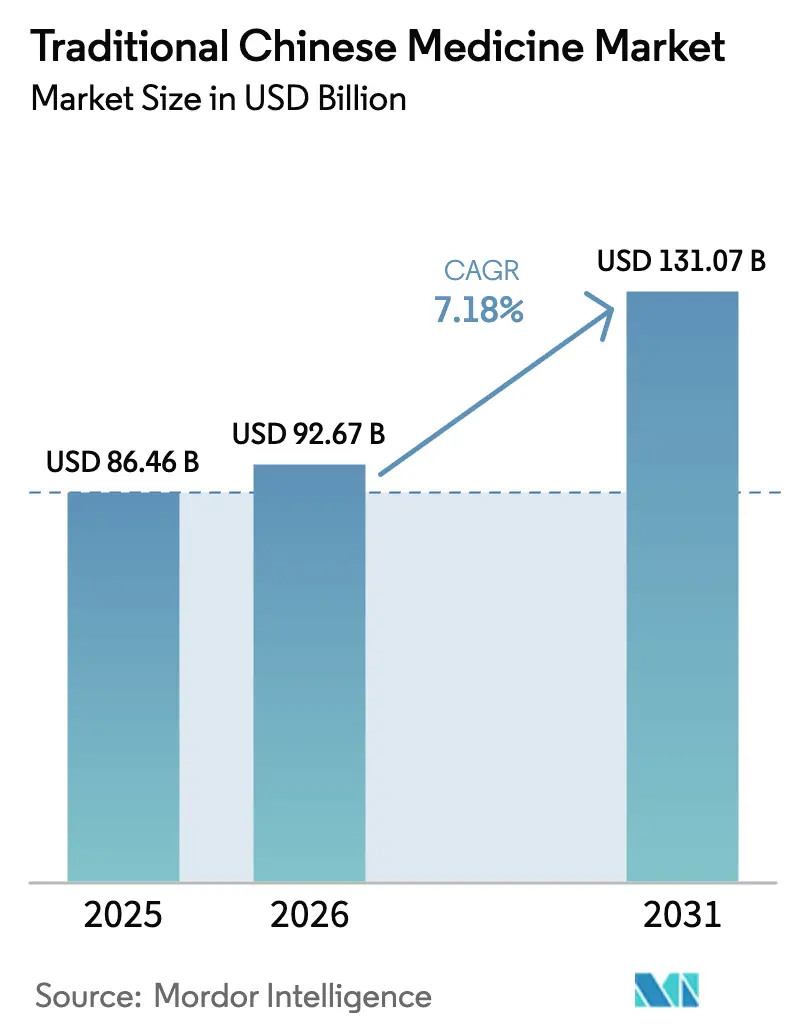
| Market Size (2026) | USD 92.67 Billion |
| Market Size (2031) | USD 131.07 Billion |
| Growth Rate (2026 - 2031) | 7.18 % |
| Fastest Growing Market | North America |
| Largest Market | Asia Pacific |
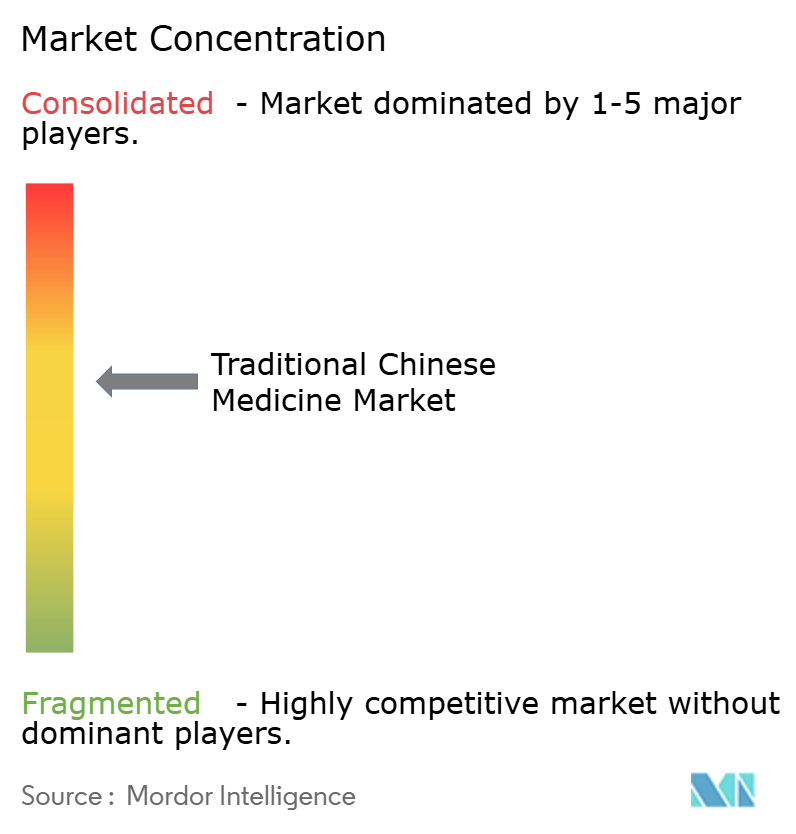
| Market Concentration | Medium |
Major Players *Disclaimer: Major Players sorted in no particular order Image © Mordor Intelligence. Reuse requires attribution under CC BY 4.0. | |
Traditional Chinese Medicine Market Analysis by Mordor Intelligence
Traditional Chinese Medicine market size in 2026 is estimated at USD 92.67 billion, growing from 2025 value of USD 86.46 billion with 2031 projections showing USD 131.07 billion, growing at 7.18% CAGR over 2026-2031. Rapid mainstreaming within hospital systems, expanding reimbursement, and standardized product quality are reinforcing confidence across practitioners, payers, and patients. Robust government backing, evidenced by China’s insurance catalog now listing 3,900 drugs, has broadened access and accelerated producer revenues[1]. Ingredient digital-traceability programs are mitigating adulteration concerns, while e-commerce giants amplify global reach and patient education. Intensifying R&D, highlighted by 12 NMPA approvals in 2024—three of them Class 1 innovative TCMs—signals a pipeline shift toward evidence-based formulations. Consolidation moves such as Sinopharm’s take-private bid for China TCM Holdings underscore investors’ focus on scale economies and integrated supply chains within the Traditional Chinese Medicine market.
Key Report Takeaways
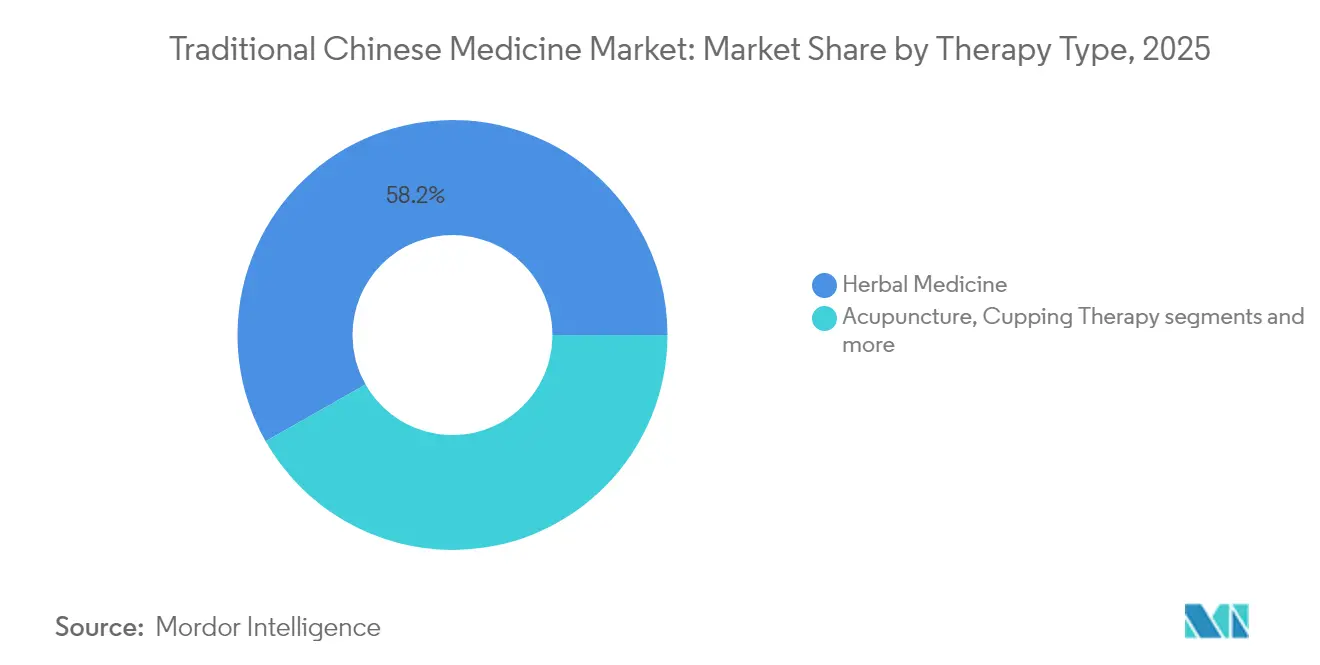
- By therapy type, Herbal Medicine led with 58.23% revenue share in 2025; Acupuncture posts the strongest outlook at 8.08% CAGR to 2031.
- By product form, Extract Powders & Granules held 42.08% of the Traditional Chinese Medicine market share in 2025, while the same segment is projected to increase its slice of the Traditional Chinese Medicine market size at an 8.31% CAGR.
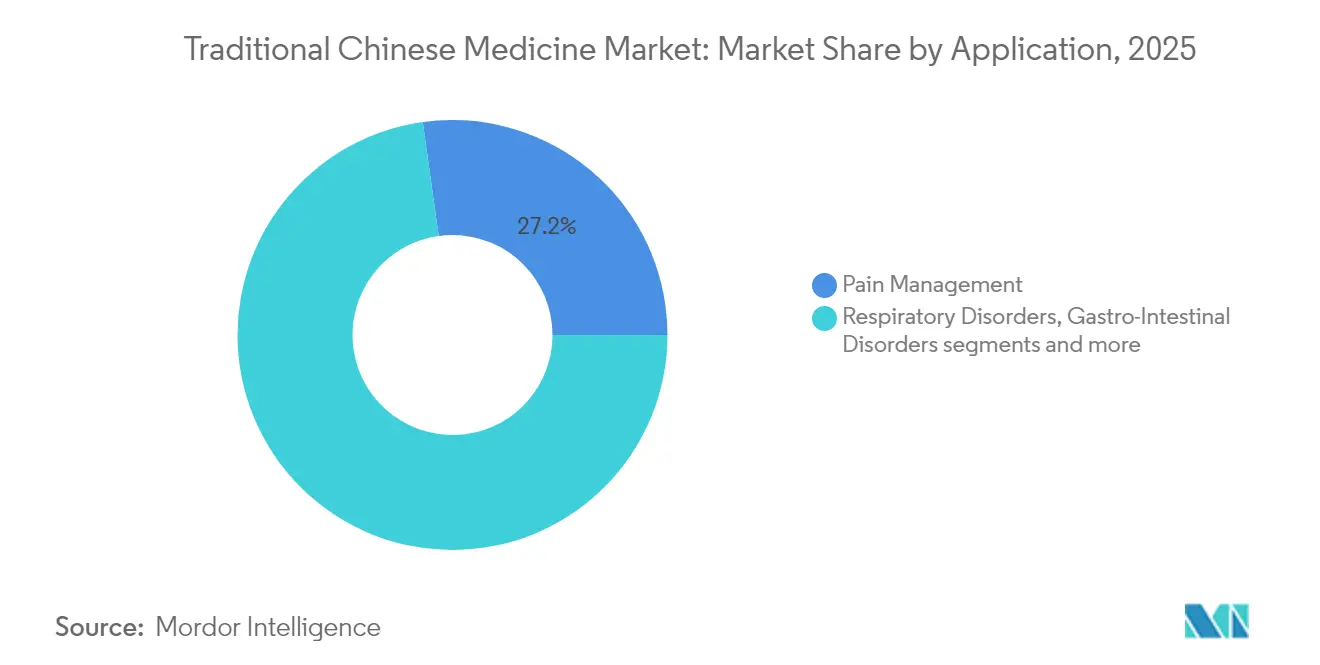
- By application, Pain Management accounted for 27.21% of the Traditional Chinese Medicine market size in 2025; Oncology Supportive Care is set to expand at 8.74% CAGR.
- By distribution channel, Hospitals & TCM Clinics retained 40.79% share in 2025; E-commerce/online pharmacies rise fastest at 9.02% CAGR.
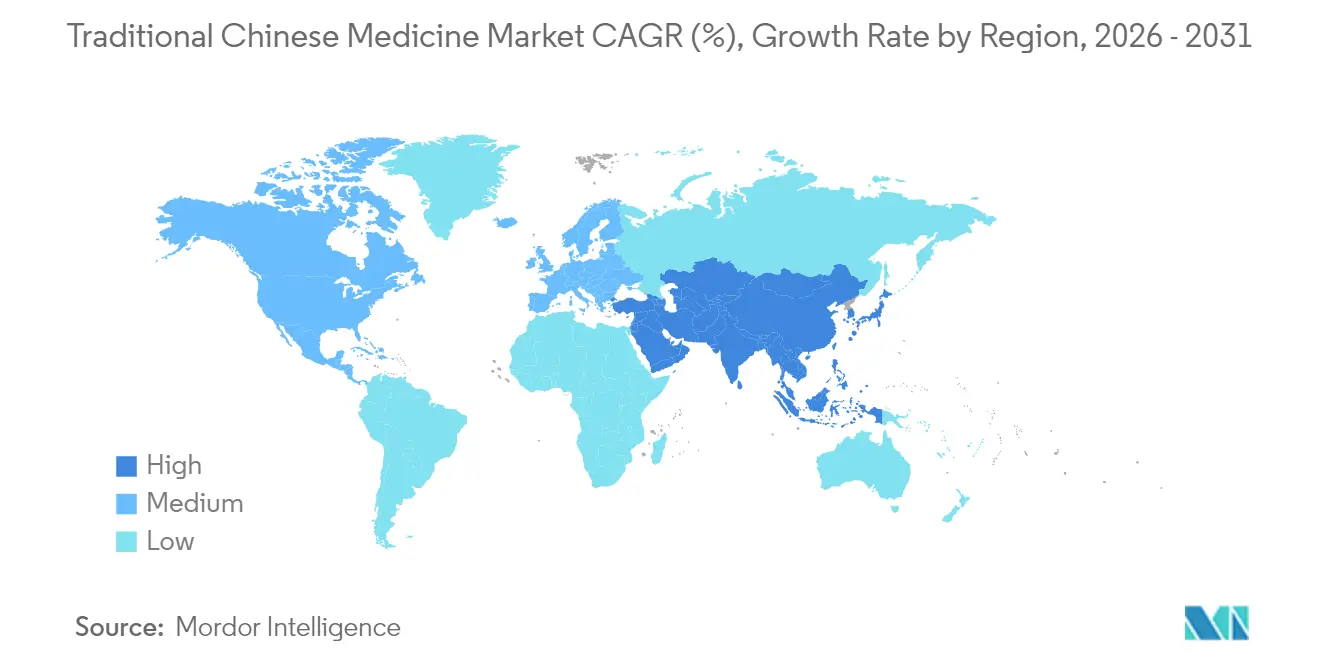
- By geography, Asia-Pacific captured 48.12% of 2025 revenue and is advancing at 9.32% CAGR, topping global growth rankings.
Note: Market size and forecast figures in this report are generated using Mordor Intelligence’s proprietary estimation framework, updated with the latest available data and insights as of 2026.
Market Trends and Insights
Drivers Impact Analysis of Traditional Chinese Medicine Market*
| Driver | (~) % Impact on CAGR Forecast | Geographic Relevance | Impact Timeline |
|---|---|---|---|
| Mainstream acceptance in developed healthcare systems | +1.2% | North America & EU, APAC expansion | Medium term (2-4 years) |
| Government stimulus & inclusion in national insurance | +1.8% | China core, South Korea, emerging APAC | Short term (≤ 2 years) |
| Rising chronic-disease & ageing population burden | +1.5% | Global, concentrated in developed markets | Long term (≥ 4 years) |
| Rapid expansion of e-commerce & pharmacy chains | +1.0% | Global, led by China and North America | Short term (≤ 2 years) |
| AI-enabled formula discovery & digital prescribing platforms | +0.8% | China, North America, EU early adopters | Medium term (2-4 years) |
| Growth of TCM-centric medical-tourism hubs | +0.6% | APAC core, spill-over to MEA | Medium term (2-4 years) |
| Source: Mordor Intelligence | |||
Mainstream Acceptance in Developed Healthcare Systems
Insurance-enabled adoption is rising as nearly 10% of U.S. adults have already experienced acupuncture, and 60% would opt for treatment when covered acupuncturetoday.com. Comparable momentum in the United Kingdom, Austria, and other EU states has embedded services inside national health structures, reinforcing recurring revenue channels. High-quality randomized trials—covering chronic pain, post-operative recovery, and mental health—have intensified trust among clinicians and regulators. Institutional demand has stimulated guideline development, aligning dosage, technique, and safety metrics with Western protocols. Collectively these shifts secure the Traditional Chinese Medicine market as a mainstream component of integrated care pathways
Government Stimulus & Inclusion in National Insurance
China’s 2024 update to its Basic Medical Insurance Drug Directory, effective January 2025, harmonizes reimbursement for countless formulations, erasing regional access disparities. South Korea’s parallel inclusion strategy confirms a broader policy arc prioritizing cost-effective chronic-disease management. Reimbursement removes consumer cost barriers and creates steady demand for regulated manufacturers. Beyond Asia, select European nations are synchronizing pharmacovigilance rules to accommodate herbal traditions, fortifying the Traditional Chinese Medicine market’s cross-border potential. Pharma producers scale GMP facilities to satisfy forecast volume tied to insurance procurement cycles.
Rising Chronic-Disease & Ageing Population Burden
Global diabetes, cardiovascular, and cancer incidence escalates with ageing demographics, prompting systems to seek preventive, multi-modal therapies. Cohort studies show lower hospital admissions among diabetes patients combining TCM and conventional care. Oncology centers report 70.9% satisfaction with herbal supportive regimens, citing relief from chemotherapy side effects. Policymakers recognize TCM’s potential to trim long-run expenditures by blending symptom control with holistic prevention, supporting organic Traditional Chinese Medicine market growth in wealthy economies facing budget strain.
Rapid Expansion of E-commerce & Pharmacy Chains
Cross-border digital storefronts unite overseas consumers with authenticated providers, leveraging serialized QR codes and cold-chain logistics to guarantee product integrity. Personalized recommendation engines and educational livestreams address historic knowledge gaps and foster brand fidelity. Brick-and-mortar drugstore majors link inventories with online platforms, providing last-mile delivery and pharmacist consultation. The frictionless model has quickened demand among technology-comfortable millennials, enlarging the Traditional Chinese Medicine market’s potential customer base beyond clinic walls.
Restraints Impact Analysis of Traditional Chinese Medicine Market*
| Restraint | (~) % Impact on CAGR Forecast | Geographic Relevance | Impact Timeline |
|---|---|---|---|
| Limited large-scale RCT evidence & clinical consensus | -1.1% | Global, acute in North America & EU | Long term (≥ 4 years) |
| Quality-control, adulteration & safety concerns | -0.9% | Global, concentrated in import markets | Medium term (2-4 years) |
| Fragmented global regulatory pathways | -0.7% | Global, severe in cross-border markets | Medium term (2-4 years) |
| Climate-driven supply volatility & herb-price spikes | -0.6% | Global, acute in China & traditional sourcing regions | Short term (≤ 2 years) |
| Source: Mordor Intelligence | |||
Limited Large-Scale RCT Evidence & Clinical Consensus
Although evidence volumes grow, heterogeneous dosing and individualized protocols complicate pooling of outcomes, hampering guideline codification in evidence-based frameworks. Western regulators often require placebo-controlled phase III studies; costs deter small enterprises reliant on artisanal production. Academic-industry consortia have emerged to share trial expenses and develop standardized extracts, yet pipeline velocity still lags. This validation gap may stifle penetration of hospital formularies, restraining an otherwise robust Traditional Chinese Medicine market trajectory.
Quality-Control, Adulteration & Safety Concerns
Heavy-metal contamination, microbial overload, and undisclosed pharmaceuticals continue to surface, undermining consumer confidence and triggering recalls. An inspection of 47 imported herbal samples in Saudi Arabia found 44 exceeded bacterial or heavy-metal limits. Divergent national standards sow confusion, enabling gray-market intermediaries to exploit loopholes. Climate shifts further threaten botanical yields, pushing prices for scarce actives—such as cow gallstones, now CNY 1.7 million/kg—beyond reimbursement ceilings. Producers invest in DNA barcoding, HACCP protocols, and vertically controlled plantations, but smaller players risk exit, reshaping competitive contours of the Traditional Chinese Medicine market.
*Our forecasts treat driver/restraint impacts as directional, not additive. The impact forecasts reflect baseline growth, mix effects, and variable interactions.
Traditional Chinese Medicine Market Segment Analysis
By Therapy Type:
Herbal Strength and Acupuncture MomentumHerbal Medicine commanded 58.23% of revenue in 2025, underpinning its position as the Traditional Chinese Medicine market’s historical core. Scalable extraction facilities, an extensive pharmacopeia, and deep cultural familiarity keep the segment indispensable for chronic-disease regimens. Segment revenues are reinforced by uniform pharmacopoeial monographs and rising export certifications that simplify customs clearance. Integration projects within tertiary hospitals add clinical legitimacy and anchor insurance coverage, cementing Herbal Medicine’s role within the Traditional Chinese Medicine industry.
Acupuncture gains prominence with an 8.08% forecast CAGR, driven by clinical endorsement for pain, anxiety, and post-operative recovery. U.S. and EU insurers now reimburse codes for acupuncture sessions, funneling new revenue to credentialed practitioners. The segment also benefits from device innovation including single-use sterile needles and electro-stimulation consoles that align with hospital hygiene standards. Cupping Therapy, Moxibustion, and Aromatherapy remain specialty niches appealing to wellness consumers and athletes seeking recovery modalities. Compounding Therapy enjoys renewed interest via personalized herbal blends guided by AI-aided syndrome differentiation, while Magneto-Therapy explores synergistic use inside physiotherapy departments. Collectively, therapy diversification widens patient entry points and secures future breadth for the Traditional Chinese Medicine market.

By Product Form:
Extract Powders & Granules Advance StandardizationExtract Powders & Granules captured 42.08% revenue in 2025, illustrating the Traditional Chinese Medicine market’s pivot to convenience and repeatable dosing. GMP lines use closed-loop solvent recovery and real-time infrared analytics to standardize active-marker concentrations, fulfilling global pharmacopeial demands. Rising hospital tender requirements favor shelf-stable sachets that nurses can reconstitute quickly, minimizing preparation error. Supported by 8.31% CAGR, extract makers expand freeze-dry capacity and nitrogen-flushed packing lines to protect volatile oils.
Raw Herbs retain practitioners who value organoleptic assessment and individualized decoction, but batch variation and pesticide residue risks temper growth. Capsules & Tablets profit from blister-pack portability and compatibility with electronic prescription systems that flag drug-herb interactions. Decoctions & Teas leverage premium storytelling and origin certification, courting lifestyle consumers at duty-free outlets. Patented Chinese Medicines, subject to rigorous double-blind trials, build high barriers to entry yet deliver strong pricing power once listed on formularies. Growing innovation in nano-emulsion and sustained-release beads will continue propelling extract dominance inside the Traditional Chinese Medicine market
By Application:
Pain Management Leads, Oncology Support DisruptsPain Management held 27.21% revenue in 2025 as musculoskeletal disorders, headaches, and sports injuries remain pervasive. Hospital pain clinics integrate acupuncture, herbal plasters, and infrared moxibustion, reducing opioid reliance and improving functional outcomes. Stable insurance tariffs guarantee practitioner income and underpin research into adjunct techniques such as laser-acupuncture.
Oncology Supportive Care, expanding at 8.74% CAGR, benefits from hospital cancer centers embedding standardized herbal formulas targeting nausea, neuropathy, and immune modulation. Prospective registries from leading U.S. institutes show improved symptom scores and high patient retention, stimulating guideline inclusion. Respiratory and Gastro-Intestinal Disorders capitalize on evidence for bronchitis and irritable bowel relief, respectively, while Sleep & Mental Health segments respond to surging anxiety prevalence. Skin & Hair Care positions herbal externally applied gels as steroid-sparing options. Wellness & Preventive Health, aligning with global biohacking trends, finds appeal among urban Gen-Z seeking immunity and stress resilience, infusing fresh demand into the Traditional Chinese Medicine market.
By Distribution Channel:
Digital Access Expands Patient ReachHospitals & TCM Clinics maintained 40.79% revenue in 2025, reflecting deep-rooted trust and multidisciplinary referral pathways. Clinical electronic record systems harmonize herbal dosing with western pharmacotherapy, mitigating interaction risks. Insurance reimbursement and informed-consent processes assure transparency and foster sustained patient follow-up.
E-commerce/online pharmacies, advancing at 9.02% CAGR, dismantle geographical limits through cold-chain courier services and regulatory cross-border pilot zones. Algorithms deliver personalized bundles based on symptom questionnaires, while short-video tutorials aid preparation. Retail Pharmacies integrate TCM aisles with OTC counseling teams, enhancing impulse purchases and subscription refills. Health & Wellness Centres couple acupuncture rooms with spa amenities, marketing detox retreats and preventive packages to expatriate, medical-tourist, and corporate clientele. Duty-free and tourism outlets harness cultural curiosity; herbal balms and lion-head plasters remain top souvenir categories, further enlarging the Traditional Chinese Medicine market footprint.
Geography Analysis
APAC Traditional Chinese Medicine Market
Asia-Pacific generated nearly half of global revenue in 2025 and posts a 9.32% forecast CAGR, cementing its position as the epicenter of the Traditional Chinese Medicine market. China’s push to set 180 domestic and 30 international standards by 2026 anchors export credibility chinadaily.com.cn. Provincial governments subsidize plantation acreage for endangered herbs and extend low-interest loans for GMP facility upgrades. India’s National Medicinal Plants Board finances cultivation over 56,305 hectares, nurturing a robust raw-material pipeline and augmenting bilateral trade corridors ayurvedjournal.com. Japan and South Korea refine computerized herbal dispensing robots, reinforcing clinical safety. Australian regulators streamline listing pathways, making APAC a cohesive ecosystem of supply, demand, and innovation that continuously propels the Traditional Chinese Medicine market.
North America Traditional Chinese Medicine Market
North America ranks second in value and enjoys growing mainstream recognition. Almost 10% of U.S. adults have tried acupuncture, and payer coverage expands each renewal season. Provincial Canadian colleges license practitioners and harmonize scope-of-practice rules, encouraging integrated clinics across Toronto and Vancouver. Mexico’s proximity to Mesoamerican botanicals promotes cross-cultural research and joint ventures. Domestic herb farms experiment with Chinese varietals, yet capital intensity and agronomic know-how remain challenges. Policy debates center on balancing botanical import reliance with strategic autonomy, shaping future supply-chain investments across the Traditional Chinese Medicine market.
Europe Traditional Chinese Medicine Market
Europe posts steady uptake as EU Directive 2004/24/EC provides a common framework for traditional-use registration, lowering legal uncertainty. Germany’s statutory insurers reimburse acupuncture for chronic low-back pain, mainstreaming procedure codes and bolstering clinic volumes. The United Kingdom’s NHS pilots integrative dermatology protocols, while France studies herbal adjuvants for long-COVID fatigue. Italy leads botanical ingredient extraction, exporting refined flavonoid isolates to Asian finished-dose manufacturers. However, 40% cost advantages enjoyed by Chinese API exporters challenge European producers’ competitiveness. Cross-border academic networks seek joint R&D grants to sustain local innovation within the Traditional Chinese Medicine market.
Competitive Landscape
Fragmented yet rapidly consolidating, the Traditional Chinese Medicine market sees national champions merging with distributors to capture scale and regulatory clout. Sinopharm’s USD 2.2 billion privatization bid for China Traditional Chinese Medicine Holdings aims to simplify governance and integrate distribution muscle yicaiglobal.com. Mitsui’s SGD 800 million purchase of Eu Yan Sang secures 170 retail outlets and 30 clinics, granting the Japanese conglomerate immediate brand resonance across Southeast Asia. Haleon’s planned CNY 4.47 billion investment to boost its Tianjin capacity underscores multinational intent to localize supply chains and innovate around consumer health.
Domestic giants such as Beijing Tongrentang invest in AI-driven diagnostic kiosks and blockchain provenance to differentiate on safety and convenience. International players Schwabe Pharma and Himalaya Global Holdings target segment niches—cognitive health and dermatology—leveraging clinical data to satisfy European regulators. Start-ups focus on tele-acupuncture platforms, remote pulse sensors, and personalized granule pods, with venture capital chasing subscription models in the Traditional Chinese Medicine industry. Ingredient inflation compels vertical integration; several firms now lease mountain acreage to secure wild yam and astragalus crops, mitigating margin erosion. Technology adoption, global brand building, and supply assurance will determine future competitive rank
Traditional Chinese Medicine Industry Leaders
-
China National Pharmaceutical Group Co Ltd.
-
China SXT Pharmaceuticals, Inc
-
PuraPharm International
-
Zhangzhou Pien Tze Huang Pharmaceutical Co.,Ltd
-
Beijing Tong Ren Tang Chinese Medicine Co. Ltd.
- *Disclaimer: Major Players sorted in no particular order
Traditional Chinese Medicine Market Companies Covered in this Report
- Beijing Tong Ren Tang
- China TCM Co. Limited
- Yunnan Baiyao Group
- Tasly Pharmaceutical
- Guangzhou Baiyunshan Pharm. Holdings
- Kangmei Pharmaceutical
- Harbin Pharm. Group (GNC, Hayao)
- Jilin Aodong Pharmaceutical
- Shineway Pharmaceutical Group
- Tonghua Dongbao
- Hubei Jumpcan Pharmaceutical
- Sanjiu Enterprise Group (999)
- Tianjin Zhongxin Pharm. Group
- China Shineway Pharmaceutical
- Tsumura & Co.
- Schwabe Pharma (Nature’s Way)
- Himalaya Global Holdings
- Patanjali Ayurved
- Weleda
- New Roots Herbal
- Sun Ten Pharm. Co. (Taiwan)
Recent Industry Developments in Traditional Chinese Medicine Market
- March 2025: The State Council issued guidelines to reform drug and device regulation, explicitly supporting TCM R&D through evidence-based review systems and standardized human-use data collection.
- September 2024: Haleon Plc moved to raise its Tianjin TSKF stake to 88% for CNY 4.47 billion (USD 615 million) to strengthen Chinese consumer-health operations
- August 2025: China announced plans for 180 domestic and 30 international TCM standards by 2026 to accelerate industrial modernization
Global Traditional Chinese Medicine Market Report Scope
As per the scope of the report, traditional Chinese medicine practitioners use various psychological and physical approaches (such as acupuncture and tai chi) as well as herbal products to address various health problems. Traditional Chinese medicine is about creating bodily balance to maintain health and wellness. The traditional Chinese medicine market is segmented into therapy type, application, end-user, and geography. By therapy type, the market is segmented into acupuncture, cupping therapy, herbal medicine, aroma therapy, compounding therapy, and magneto therapy. By application, the market is segmented into osteoarthritis, cold and flu, menstrual pain, cardiovascular diseases, diabetes, and others (sexual dysfunction in men, infertility in women and others). By end-user, the market is segmented into hospitals and clinics, and home care settings. By geography, the market is segmented into North America, Europe, Asia-Pacific, and the Rest of the World. The report also covers the estimated market sizes and trends for 13 countries across significant global regions. The report offers the value (in USD) for the above segments.
Segmentation Overview
| Herbal Medicine |
| Acupuncture |
| Cupping Therapy |
| Moxibustion |
| Aromatherapy |
| Compounding Therapy |
| Magneto-Therapy |
| Raw Herbs |
| Extract Powders & Granules |
| Capsules / Tablets |
| Decoctions & Teas |
| Patented Chinese Medicines |
| Pain Management |
| Respiratory Disorders |
| Gastro-Intestinal Disorders |
| Oncology Supportive Care |
| Sleep & Mental Health |
| Skin & Hair Care |
| Wellness & Preventive Health |
| Hospitals & TCM Clinics |
| Retail Pharmacies & Drugstores |
| E-commerce / Online Pharmacies |
| Health & Wellness Centres |
| Others (Duty-free, Tourism Outlets) |
| North America | United States |
| Canada | |
| Mexico | |
| Europe | Germany |
| United Kingdom | |
| France | |
| Italy | |
| Spain | |
| Rest of Europe | |
| Asia-Pacific | China |
| India | |
| Japan | |
| South Korea | |
| Australia | |
| Rest of Asia-Pacific | |
| South America | Brazil |
| Argentina | |
| Rest of South America | |
| Middle East and Africa | GCC |
| South Africa | |
| Rest of Middle East and Africa |
| By Therapy Type | Herbal Medicine | |
| Acupuncture | ||
| Cupping Therapy | ||
| Moxibustion | ||
| Aromatherapy | ||
| Compounding Therapy | ||
| Magneto-Therapy | ||
| By Product Form | Raw Herbs | |
| Extract Powders & Granules | ||
| Capsules / Tablets | ||
| Decoctions & Teas | ||
| Patented Chinese Medicines | ||
| By Application | Pain Management | |
| Respiratory Disorders | ||
| Gastro-Intestinal Disorders | ||
| Oncology Supportive Care | ||
| Sleep & Mental Health | ||
| Skin & Hair Care | ||
| Wellness & Preventive Health | ||
| By Distribution Channel | Hospitals & TCM Clinics | |
| Retail Pharmacies & Drugstores | ||
| E-commerce / Online Pharmacies | ||
| Health & Wellness Centres | ||
| Others (Duty-free, Tourism Outlets) | ||
| By Geography | North America | United States |
| Canada | ||
| Mexico | ||
| Europe | Germany | |
| United Kingdom | ||
| France | ||
| Italy | ||
| Spain | ||
| Rest of Europe | ||
| Asia-Pacific | China | |
| India | ||
| Japan | ||
| South Korea | ||
| Australia | ||
| Rest of Asia-Pacific | ||
| South America | Brazil | |
| Argentina | ||
| Rest of South America | ||
| Middle East and Africa | GCC | |
| South Africa | ||
| Rest of Middle East and Africa | ||
Key Questions Answered in the Report
What is the current size of the Traditional Chinese Medicine market?
• The sector generated USD 92.67 billion in 2026 and is forecast to climb to USD 131.07 billion by 2031 at a 7.18% CAGR.
Which therapy type commands the largest revenue?
• Herbal Medicine leads with a 58.23% share, underpinned by standardized extracts and widespread clinical use.
Why is Oncology Supportive Care the fastest-growing application?
• Hospitals integrate herbal formulas and acupuncture to mitigate chemotherapy side effects, pushing the segment at a 8.74% CAGR through 2031.
How is e-commerce influencing sales channels?
• Online pharmacies are expanding at 9.02% CAGR by pairing authenticated supply chains with algorithm-driven product recommendations and rapid home delivery.