
Market Overview
| Study Period | 2022 - 2031 |
|---|---|
| Forecast Data Period | 2026 - 2031 |
| Base Year Market Size (2025) | USD 4.05 Billion |
| Market Size (2026) | USD 4.18 Billion |
| Market Size (2031) | USD 4.89 Billion |
| Growth Rate (2026 - 2031) | 3.24 % |
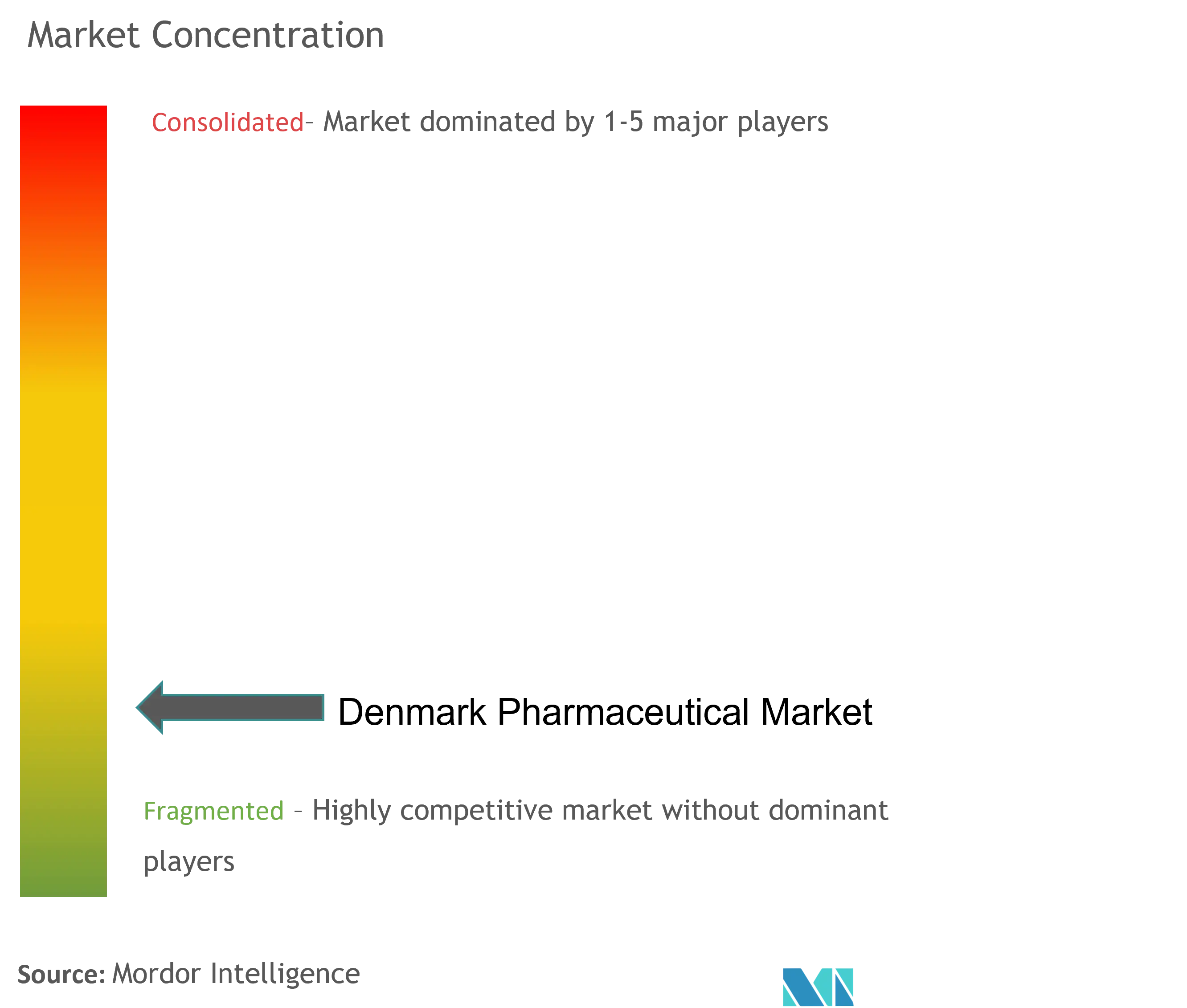
| Market Concentration | Low |
Major Players *Disclaimer: Major Players sorted in no particular order Image © Mordor Intelligence. Reuse requires attribution under CC BY 4.0. | |
Denmark Pharmaceutical Market Analysis by Mordor Intelligence
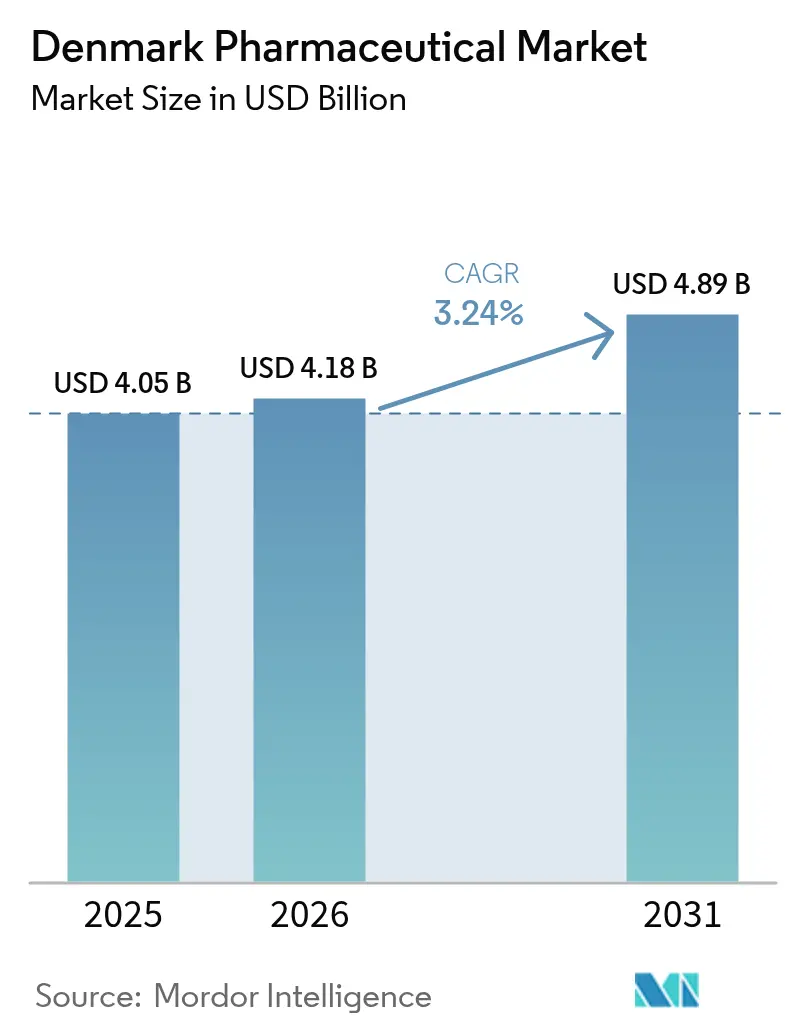
The Denmark pharmaceutical market size was valued at USD 4.05 billion in 2025 and estimated to grow from USD 4.18 billion in 2026 to reach USD 4.89 billion by 2031, at a CAGR of 3.24% during the forecast period (2026-2031). Solid domestic demand for chronic-disease therapies, coupled with aggressive export growth, underpins steady top-line expansion in the Denmark pharmaceutical market as value creation shifts toward intellectual-property-driven assets rather than high-volume manufacturing. Novo Nordisk’s outsized valuation amplifies systemic importance, prompting regulators to balance innovation incentives with macro-prudential oversight. Real-world evidence drawn from nationwide e-health infrastructure accelerates time-to-market for advanced therapies, while cross-border collaboration in Medicon Valley sustains a high-density talent pool. Biosimilar capacity investments diversify the Denmark pharmaceutical market’s production base, yet supply-chain dependence on imported active ingredients remains a structural vulnerability.
Key Report Takeaways
- By therapeutic category, cardiovascular treatments led with 14.18% of the Denmark pharmaceutical market share in 2025; oncology is forecast to expand at a 4.21% CAGR through 2031.
- By drug type, prescription medicines dominated with an 86.05% share of the Denmark pharmaceutical market size in 2025, whereas OTC products are poised to grow at a 3.8% CAGR to 2031.
- By formulation, tablets commanded 51.72% of the Denmark pharmaceutical market size in 2025, while injectables post the fastest 3.94% CAGR outlook.
- By route of administration, oral drugs accounted for 55.21% of the Denmark pharmaceutical market share in 2025, but parenteral delivery is advancing at a 3.74% CAGR.
- By distribution channel, hospital pharmacies captured 46.83% revenue share in 2025; online pharmacies are projected to climb at a 4.14% CAGR through 2031.
Note: Market size and forecast figures in this report are generated using Mordor Intelligence’s proprietary estimation framework, updated with the latest available data and insights as of 2026.
Denmark Pharmaceutical Market Trends and Insights
Drivers Impact Analysis*
| Driver | (~) % Impact on CAGR Forecast | Geographic Relevance | Impact Timeline |
|---|---|---|---|
| Rising R&D investments in biopharmaceuticals | +0.8% | Denmark, spillover to Nordic region | Long term (≥ 4 years) |
| Increasing prevalence of chronic diseases & aging population | +0.6% | National, urban concentration | Medium term (2-4 years) |
| Government incentives for life-science innovation clusters | +0.4% | Medicon Valley, Greater Copenhagen | Medium term (2-4 years) |
| Expansion of biosimilar manufacturing capabilities | +0.5% | National, export focus | Long term (≥ 4 years) |
| Digital health integration for adherence & companion services | +0.3% | National, early system adoption | Short term (≤ 2 years) |
| EU strategy harmonizing EMA fast-track approvals | +0.2% | EU-wide, Denmark first mover | Medium term (2-4 years) |
| Source: Mordor Intelligence | |||
Rising R&D Investments in Biopharmaceuticals
Sector R&D now absorbs roughly 60% of Denmark’s total research outlays, propelling the Denmark pharmaceutical market toward discovery-led value creation. The Novo Nordisk Foundation funds almost one-quarter of private research, compressing decision cycles but heightening concentration risk [1]. A USD 80 billion API capacity program accelerates scale-up, while USD 94 million of venture backing for oral biologics signals investor confidence beyond incumbents. Government life-science policy earmarks DKK 100 million annually to double exports by 2030, cementing long-run growth. Regulatory sandboxes that legitimize real-world data shorten approval timelines for advanced-therapy medicinal products, reinforcing Denmark’s first-mover edge.
Increasing Prevalence of Chronic Diseases & Aging Population
Demographic aging intensifies demand for diabetes, obesity, and cardiovascular drugs, anchoring revenue momentum in the Denmark pharmaceutical market. SELECT trial data broaden GLP-1 indications, spurring uptake across cardiometabolic cohorts. Off-label semaglutide use fell from 33% to 13% between 2022 and 2024 as clinical governance tightened. General-practice spending hit DKK 10.5 billion within a DKK 266 billion health budget, indicating resource strain from chronic care. Nationwide medication registers enable precision epidemiology that feeds drug-development pipelines. Digital prescriptions and patient portals close adherence gaps, generating data loops that further shape product design.
Government Incentives for Life-Science Innovation Clusters
A “red-carpet” licensing scheme cuts approval lead-times, pulling new capacity into the Denmark pharmaceutical market. Medicon Valley Alliance harmonizes Danish-Swedish research, reducing redundancy and amplifying shared infrastructure. Greater Copenhagen’s 40-plus microbiome startups leverage unique biobanks to accelerate clinical validation. A 2025 R&D tax credit lowers effective innovation costs by up to 25%. The Lundbeck Foundation targets strategic Danish ownership positions in five to eight health companies, ensuring patient capital for long-cycle science. Cluster effects now support 153,000 life-science jobs, reinforcing multiplier impacts across adjacent industries.
Expansion of Biosimilar Manufacturing Capabilities
Fermentation expertise and stringent regulators position Denmark as a low-risk choice for biosimilar scale-up, just as key biologics face patent expiry. Xellia’s USD 185 million asset sale to Hikma validates global appetite for Danish production quality. Sandoz booked 9% European growth underpinned by Danish supply nodes. Nordic manufacturers pursue net-zero facilities, differentiating their bids in tenders that now score carbon metrics. Skilled labor supply supports expansion, though wage inflation emerges as Novo Nordisk absorbs technical talent at scale.
Restraints Impact Analysis*
| Restraint | (~) % Impact on CAGR Forecast | Geographic Relevance | Impact Timeline |
|---|---|---|---|
| High cost of innovative therapies limiting reimbursement | -0.4% | National, EU price spillover | Medium term (2-4 years) |
| Stringent price-cap negotiations with Danish Medicines Council | -0.3% | National | Short term (≤ 2 years) |
| Talent shortage in advanced cell & gene therapy manufacturing | -0.2% | National, biotech hubs | Long term (≥ 4 years) |
| Supply-chain dependence on imported APIs | -0.3% | National, EU linkage | Medium term (2-4 years) |
| Source: Mordor Intelligence | |||
High Cost of Innovative Therapies Limiting Reimbursement
GLP-1 drugs consumed 18% of regional drug budgets in 2024, straining payer headroom. A new QALY-based assessment adds transparency but leaves implicit cost-effectiveness thresholds, fueling launch-price uncertainty. Novo Nordisk trimmed Ozempic’s monthly list to USD 125 amid negotiations, illustrating leverage limits even for market leaders. A proposed three-year confidential discount program may delay patient access as details are ironed out. Pediatric reimbursement is 60% from first krone, while adults see zero support until surpassing DKK 1,075, creating equity debates. Cannabis pilot reimbursement caps illustrate selective subsidy expansion rather than broad budget loosening.
Stringent Price-Cap Negotiations with Danish Medicines Council
A 1.5% annual ceiling since 2008 forces real-price erosion, compelling firms to pursue high-value niches. New dispensing permits for unlicensed products ease shortage crises but add bureaucracy that smaller entrants may find prohibitive. Active-substance prescribing under study could accelerate generic uptake, but safety concerns linger. Antitrust scrutiny, highlighted by excessive-pricing findings in oxytocin, underscores aggressive enforcement appetite. Pharmacy Act reforms segregate prescription and retail margins, prompting renegotiation of channel economics.
*Our forecasts treat driver/restraint impacts as directional, not additive. The impact forecasts reflect baseline growth, mix effects, and variable interactions.
Segment Analysis
By Therapeutic Category: Cardiovascular Leadership Drives Stability
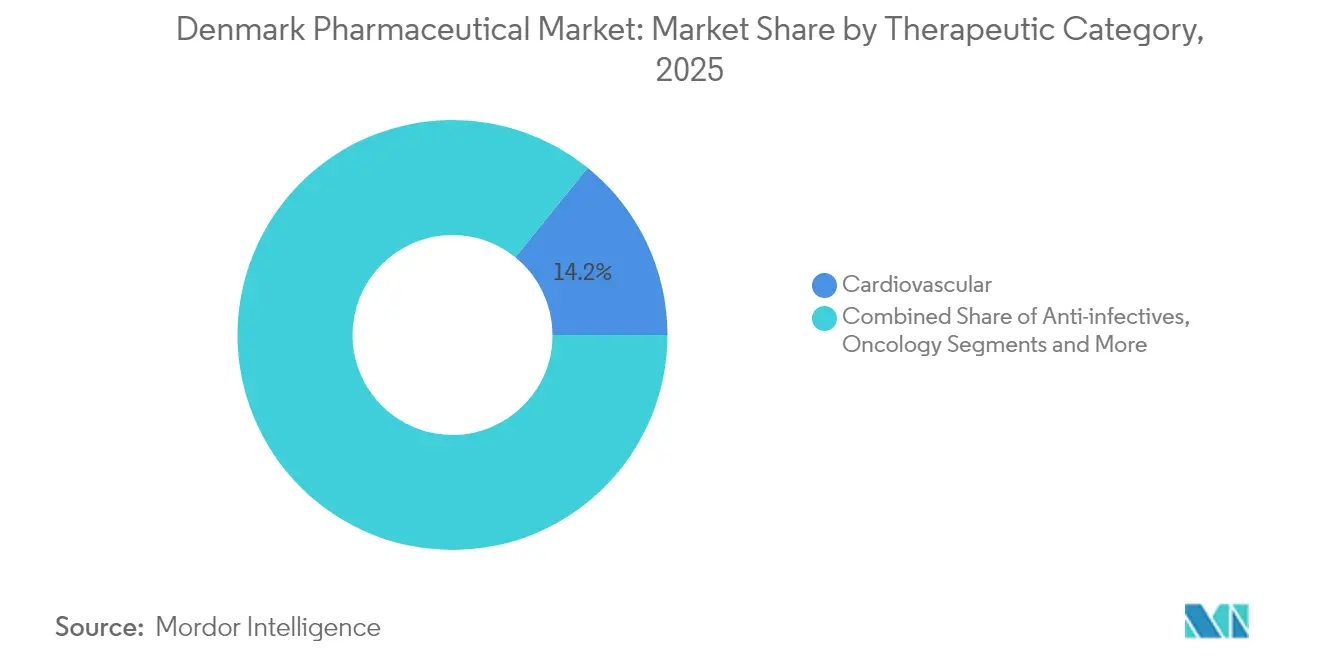
Cardiovascular drugs generated the largest slice of the Denmark pharmaceutical market in 2025 at a 14.18% share and will keep its lead as demographics skew older. Oncology contributes the fastest 4.21% CAGR, adding USD 0.1 billion in incremental revenue by 2031. Layered risk screening programs, such as the DANCAVAS trial, heighten early detection, expanding eligible patient pools. M&A momentum, highlighted by Novo Nordisk’s USD 1.112 billion Cardior purchase, shows incumbents reinforcing cardiovascular depth. Anti-infective volume remains relevant via Xellia’s fermentation stronghold, while gastroenterology explores nerve-stimulation modalities that could reset treatment paradigms.
Second-tier categories, including respiratory and anti-diabetes, benefit from digital inhaler monitoring and GLP-1 oral-formulation research, respectively. EMA safety guidance pushes continuous glucose monitors into standard diabetes trials, tightening cardiovascular endpoints and raising data-generating costs. Therapeutic diversification hedges against single-franchise risk inherent in the Denmark pharmaceutical market given Novo Nordisk’s weight.

By Drug Type: Prescription Dominance Faces OTC Momentum
Prescription lines contributed 86.05% of 2025 revenue, reflecting specialist-led care pathways embedded in Denmark’s health system. The Denmark pharmaceutical industry leverages strong payer relationships to secure formulary uptake, yet patent cliffs challenge branded products. OTC products expand 3.8% CAGR on self-medication trends and e-commerce convenience. Active-substance prescribing would further tilt scripts toward generics, eroding brand premiums. Trintellix exclusivity expiry in 2026 pressures Lundbeck to focus on Rexulti lifecycle management. Cannabinoid RX categories mature after the 2026 pilot transition, feeding both prescription and behind-the-counter segments.
By Formulation: Injectable Innovation Outpaces Tablets
Tablets retain 51.72% revenue share due to ease of administration, yet injectables increase at 3.94% CAGR thanks to biologics. Large-volume subcutaneous formats gain traction; a systematic pipeline review identified 182 candidates in late development. Novo Nordisk’s Hillerød expansion underscores device-driven stickiness in chronic therapies. Oral-biologic innovation financed by Orbis could erode parenteral share if bioavailability hurdles fall. Gene-therapy vectors push specialized vial and cold-chain solutions, adding complexity to formulation strategy in the Denmark pharmaceutical market.
By Route of Administration: Oral Preference Meets Parenteral Innovation
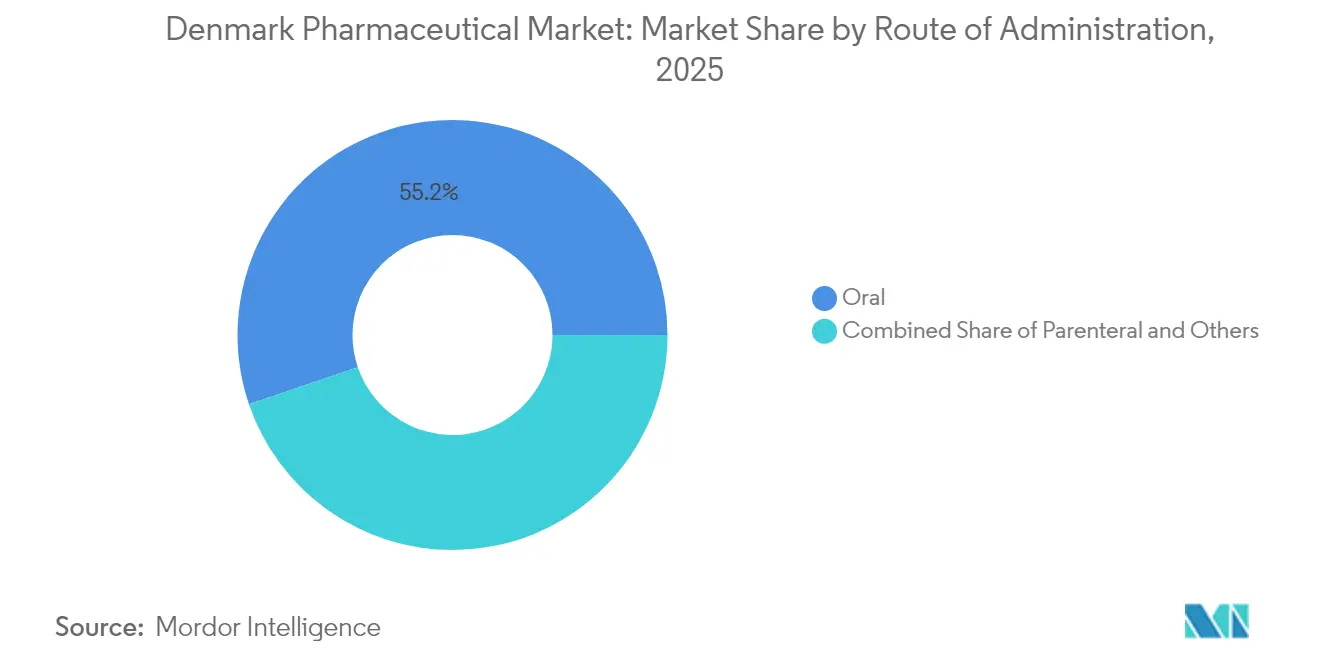
Oral products commanded 55.21% share, but parenteral delivery’s 3.74% CAGR aligns with biologics growth. Deal activity such as Novo Nordisk’s USD 2.2 billion obesity-pill partnership illustrates pursuit of oral alternatives to injectables. Transdermal research expands, though regulatory proving remains lengthy. Inhalational routes capture niche respiratory portfolios, aided by integrated digital spirometry that confirms dose compliance. Real-time adherence data feed value-based contract negotiations, deepening payer engagement across administration modes.
By Distribution Channel: Hospital Dominance Faces Digital Disruption
Hospital pharmacies controlled 46.83% of 2025 sales, reflecting centralized specialty dispensing. Online channels will add the most absolute revenue through 2031 as electronic prescriptions integrate with national ID authentication. Pharmacy-act amendments allow hospitals to sell directly to patients, intensifying competition with retail chains. Shared Medication Card interoperability cuts duplication, improving safety and enabling omni-channel fulfillment. Cross-border e-pharmacies within the EEA expand choice yet must still receive physical prescriptions, tempering convenience gains.
Geography Analysis
Pharmaceutical exports reached 24% of Danish goods trade in 2024, though two-thirds of physical output occurs abroad through merchanting, aligning profits with intellectual property domiciled in the Denmark pharmaceutical market . Medicon Valley accounts for over 60% of Scandinavian pharma jobs, leveraging cross-border research synergies and shared infrastructure. Greater Copenhagen’s microbiome specialization attracts capital with deep biobank assets. National e-health integration enables nationwide real-world evidence capture, reinforcing clinical-trial recruitment advantages.
Nordic ministers collaborate on medicine supply to buffer small-market vulnerabilities, including joint tenders for critical drugs. EU presidency periods allow Denmark to imprint patient-centric policy elements into continental legislation, shaping fast-track pathways that benefit its domestic innovators. Export dependence raises trade-policy sensitivity; any shift in U.S. or Chinese procurement could reverberate through Danish GDP given Novo Nordisk’s weight. Supply-neutral merchanting models mitigate tariff exposure but not reputational or regulatory shifts.
Regulatory Landscape
Denmark regulates pharmaceuticals through the Danish Medicines Agency (Laegemiddelstyrelsen), which oversees marketing authorization processes, GMP/GDP compliance, pharmacovigilance, inspections, and supply monitoring alongside EU frameworks (including EMA procedures). In hospital channels, price setting and procurement are shaped by national negotiations, and the Danish Medicines Council influences assessments that affect reimbursement and uptake for new, higher-cost therapies.
From 1 September 2025, the Danish Medicines Agency requires marketing-authorization application and variation datasets to be submitted in CDISC format, strengthening standardization of regulatory dossiers. From 1 January 2026, Denmark implemented new rules for personal import of medicines for personal use, allowing import from any country while maintaining exceptions (including antibiotics and certain controlled categories).
Value Chain Analysis
The Denmark pharmaceutical value chain runs from R&D and clinical development (supported by national e-health infrastructure and real-world data) to manufacturing and secondary packaging (with both domestic production and merchanting-linked global output). Distribution then flows through authorized wholesalers, parallel distributors, and pharmacies, with GDP compliance shaping cold-chain and ambient logistics, traceability, and recall readiness. The Danish Medicines Agency conducts risk-based GDP inspections and issues GDP certificates that are uploaded to the EMA-managed EudraGMDP database.
Operational nodes center on supply resilience and qualification requirements. Safety-stock rules for critical medicines took effect on 1 July 2024, requiring marketing authorization holders to maintain a six-week safety stock (generally located in Denmark) and to report stock levels to the Danish Medicines Agency every two weeks. Bottlenecks can also emerge from mandatory supplier approval processes for wholesalers and parallel distributors, which require documented qualification and ongoing review before alternative suppliers or routing can be used. For temperature-controlled handling across air and sea interfaces, certified cold-chain capacity supports operations, including the IATA CEIV Pharma certified Copenhagen hub operated by GEODIS.
Competitive Landscape
Novo Nordisk’s capitalization surpasses Denmark’s GDP, illustrating extraordinary concentration in the Denmark pharmaceutical market. The Danish Competition Authority increases surveillance, evidenced by pricing cases against mid-tier suppliers. Specialty champions such as LEO Pharma, ALK-Abelló, and H. Lundbeck pursue deep therapeutic focus to avoid head-on clashes with the diabetes giant. Ferring scales gene-therapy capabilities through Nordic facilities, while Xellia capitalizes on complex anti-infective fermentation niches [3].
Venture funding supports new entrants; Orbis and Pharmacosmos exemplify start-ups expanding beyond legacy strongholds. Digital-health partnerships emerge as differentiators; AI-enabled discovery shortens target-identification cycles, while adherence apps bundle with high-value injectables.
Strategic expansions include a USD 1.2 billion rare-disease plant in Odense and a USD 400 million quality-control hub, showing Novo Nordisk’s reinvestment alignment with national priorities. Layoffs at LEO Pharma underscore cost-containment amid dermatology competition. Japanese and Indian firms deepen footholds via Danish subsidiaries and acquisitions, enhancing supply-chain diversity.
Denmark Pharmaceutical Industry Leaders
-
Novo Nordisk A/S
-
Leo Pharma A/S
-
H. Lundbeck A/S
-
Orifarm Group A/S
-
ALK-Abelló Nordic A / S
- *Disclaimer: Major Players sorted in no particular order
Market Opportunities and Future Outlook
Denmark shows clear white space across data-driven development, advanced therapies, and export-oriented scaling that aligns with the government-backed Strategy for Life Science Towards 2030 and the associated 2024-2027 agreement. That agreement allocates DKK 100 million annually to support goals such as doubling life science exports to DKK 350 billion by 2030. The strategy emphasizes research-industry collaboration, clinical research enhancement, and scaling AI and health data usage, which supports companies focused on trial enablement, real-world evidence workflows, and companion-service models tied to e-prescribing and national health registers.
Market access and supply-security programs also shape where value can be created. A three-year pilot program running from 1 July 2025 to 30 June 2028 for reimbursement of certain medicines based on confidential prices negotiated with Amgros provides a concrete pathway for manufacturers of high-cost specialty products to work through price-access tradeoffs. In parallel, the mandatory safety-stock regime for critical medicines (six weeks of expected sales, with in-country placement as the general rule, and biweekly reporting to the Danish Medicines Agency) creates opportunities for compliant local inventory, cold-chain handling, and GDP-ready distribution services, especially for injectables and specialty hospital products that already account for a large share of channel demand.
Recent Industry Developments
- July 2026: The last patient was randomized in H. Lundbeck A/S' global Phase III DEEp OCEAN trial for bexicaserin in developmental and epileptic encephalopathies. The trial result readout strengthens Lundbeck's pipeline trajectory and informs future lifecycle planning for rare neurology assets.
- September 2025: The Danish government, the City of Copenhagen, and the University of Copenhagen signed an agreement to develop an innovation district focused on life science and quantum technology in Copenhagen. The initiative supports cluster infrastructure that can accelerate translational research, attract deep-tech talent, and deepen collaboration between academia and pharmaceutical R&D.
- December 2024: Novo Nordisk allocated DKK 8.5 billion for a rare-disease manufacturing site in Odense. The investment expands domestic advanced-manufacturing capacity and reinforces Denmark's role in high-value biologics supply chains where quality systems, specialized workforce, and cold-chain logistics are central.
Research Methodology Framework and Report Scope
Market Definition and Coverage
For this study, the Denmark pharmaceutical market is defined as the value of human-use prescription and over-the-counter medicines sold within Denmark through retail and hospital channels, measured in current US dollars.
Scope exclusions: This scope excludes medical devices, diagnostics, consumer supplements, and veterinary medicines.
Segmentation Overview
- By Therapeutic Category
- Anti-infectives
- Cardiovascular
- Gastrointestinal
- Anti-diabetic
- Respiratory
- Oncology
- Others
- By Drug Type
- Prescription Drugs
- Branded
- Generics
- OTC Drugs
- Prescription Drugs
- By Formulation
- Tablets
- Capsules
- Injectables
- Others (Topicals, Patches, etc.)
- By Route of Administration
- Oral
- Parenteral
- Others (Inhalational, Transdermal)
- By Distribution Channel
- Hospital Pharmacies
- Retail Pharmacies
- Online Pharmacies
Data Sources, Market Sizing, and Validation
Desk Research
We start by mapping the Denmark medicines demand and supply context using official health and trade statistics, followed by a review of how medicines are priced and reimbursed. Public sources such as the Danish Health Data Authority (Medstat medicine sales statistics), Statistics Denmark, the Danish Medicines Agency, OECD Health Statistics, and Eurostat help anchor the model to repeatable data series.
Company annual reports, audited financial statements, investor presentations, and credible press are then used to cross-check product exposure and commercial timelines, especially where Denmark sales are not explicitly split out. Where helpful, paid subscriptions for company financials and news intelligence, import or export shipment tracking, and patent databases are referenced to clarify ownership changes, launch timing, and trade intensity. The desk sources listed here are illustrative only, and many other public and paid references were also used to collect data, validate numbers, and resolve open questions.
Primary Interviews and Surveys
Primary interviews and surveys in Denmark cover CXOs, functional or unit leaders, and managers from manufacturers, distributors, pharmacies, hospitals, and public procurement. Respondents clarify prescription trends, launch timing, tender effects, reimbursement changes, and gaps in reported hospital or OTC sales. Their responses are compared with secondary series, and assumptions are adjusted when field evidence differs from published data.
Distribution of primary research fieldwork respondents
| Company type | Respondent position |
|---|---|
| Top tier: 29% | CXOs: 18% |
| Mid tier: 46% | Functional/Unit leaders: 33% |
| Smaller Players: 25% | Managers: 49% |
Market-Sizing & Forecasting
The core sizing uses a top-down approach where Denmark medicine sales totals are reconstructed from official sales statistics and then adjusted for channel splits and product mix to stay aligned with what is dispensed and purchased locally. To make sure the totals are not drifting, we run selective bottom-up checks such as sampled volume multiplied by average price for key therapy groups, distributor channel checks, and supplier revenue splits where Denmark exposure is visible.
Inputs that typically move the model include ATC-level sales trends, prescription versus OTC mix, hospital versus retail share, reimbursement and co-pay rules, parallel trade signals, and launch and loss-of-exclusivity timing that changes average selling prices. Forecasting is run using scenario analysis supported by short time-series smoothing on the historical run-rate, and then the path is refined using expert views on policy updates, tender cycles, and expected pricing pressure. Where bottom-up detail is missing for a product group, we use conservative proxies based on adjacent ATC categories and validate the implied growth with interview feedback.
Data Validation & Update Cycle
We run multiple checks before sign-off so outputs match real-world signals and do not change without a reason. Model totals are compared with independent indicators such as medicine sales time-series, health spending context, and observed pricing and reimbursement changes, and then any variances are reviewed and corrected.
If an outlier appears, the underlying driver is traced back to a specific assumption, and respondents are re-contacted when the gap cannot be explained from public releases. Reports are refreshed annually, with interim updates when material events occur, for example, policy changes or major launch waves. Before delivery, an analyst performs a final pass so the numbers reflect the latest available information.
Mordor Intelligence's Denmark Pharmaceutical Market Size Compared Against Other Published Estimates
Published market values for Denmark pharmaceuticals can vary, even when the topic sounds the same, because the scope and measurement point are not always aligned. Differences usually come from whether figures reflect retail only or retail plus hospital, whether values are manufacturer level or pharmacy selling value, and how currency timing is handled.
The table shows a tight cluster around USD 4 billion, and in Mordor Intelligence's model the total includes both Rx and OTC medicines across hospital and retail purchasing, which tends to differ from write-ups that only describe one channel or mix local sales with broader life science activity.
Benchmark comparison
| Source | Market Size | Gaps in Research Methodology |
|---|---|---|
| Mordor Intelligence | USD 4.05 B (2025) | |
| Trade Journal A | USD 4.00 B (2025) | Often stated as an approximate domestic value, with the year, channel coverage, and whether figures represent selling price versus net ex-manufacturer value not fully specified. |
| Industry Report B | USD 3.81 B (2024) | Uses a different base year and can embed a separate inflation and price progression path, and it may not clearly separate hospital purchasing, retail dispensing value, and currency conversion timing. |
Across the three figures, most of the spread is explained by year selection and what is counted as sales value at each point in the supply chain. By tying the estimate to observed medicine sales series and stress-testing price and channel assumptions through interviews, the final number stays traceable to inputs that can be repeated on the next refresh.
Key Questions Answered in the Report
How big is the Denmark Pharmaceutical Market?
The Denmark Pharmaceutical Market size is expected to reach USD 4.18 billion in 2026 and grow at a CAGR of 3.24% to reach USD 4.89 billion by 2031.
What distribution channels are gaining the most traction through 2031?
Online pharmacies are expected to post a 4.14% CAGR as e-prescriptions integrate with Denmark’s national ID system and consumer uptake accelerates.
Who are the key players in Denmark Pharmaceutical Market?
Novo Nordisk A/S, Leo Pharma A/S, H. Lundbeck A/S, Orifarm Group A/S and ALK-Abelló Nordic A / S are the major companies operating in the Denmark Pharmaceutical Market.
Which therapeutic category contributes the largest share to Danish drug sales?
Cardiovascular treatments hold 14.18% of 2025 sales, driven by an aging population and expanded screening efforts.