
Total Ankle Replacement Market Size and Share
Market Overview
| Study Period | 2020 - 2031 |
|---|---|
| Market Size (2026) | USD 1.36 Billion |
| Market Size (2031) | USD 1.82 Billion |
| Growth Rate (2026 - 2031) | 6.07 % |
| Fastest Growing Market | Asia Pacific |
| Largest Market | North America |
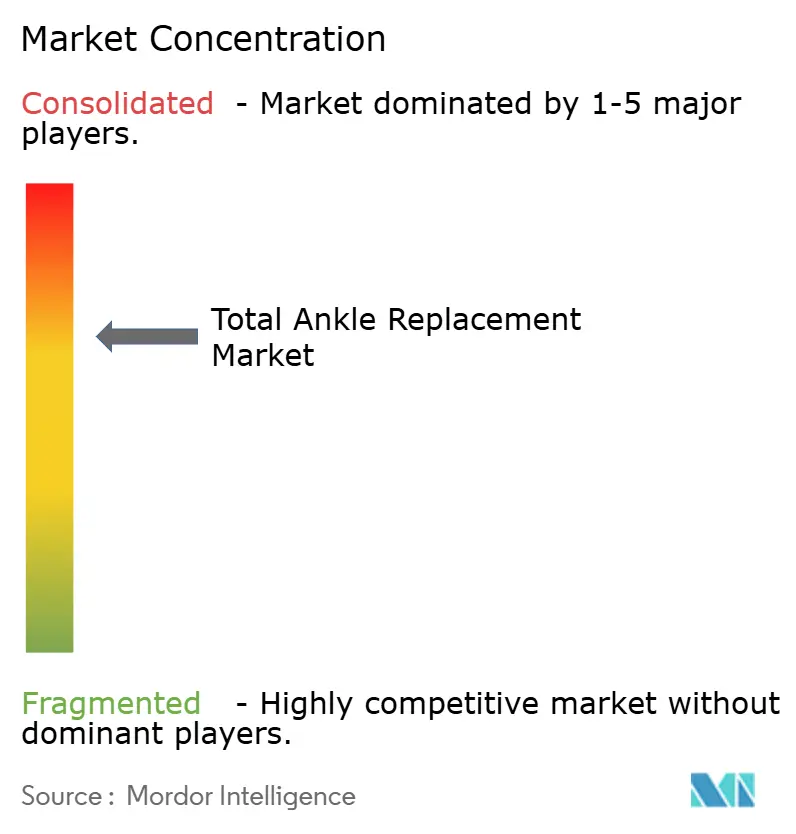
| Market Concentration | Medium |
Major Players *Disclaimer: Major Players sorted in no particular order Image © Mordor Intelligence. Reuse requires attribution under CC BY 4.0. | |
Total Ankle Replacement Market Analysis by Mordor Intelligence
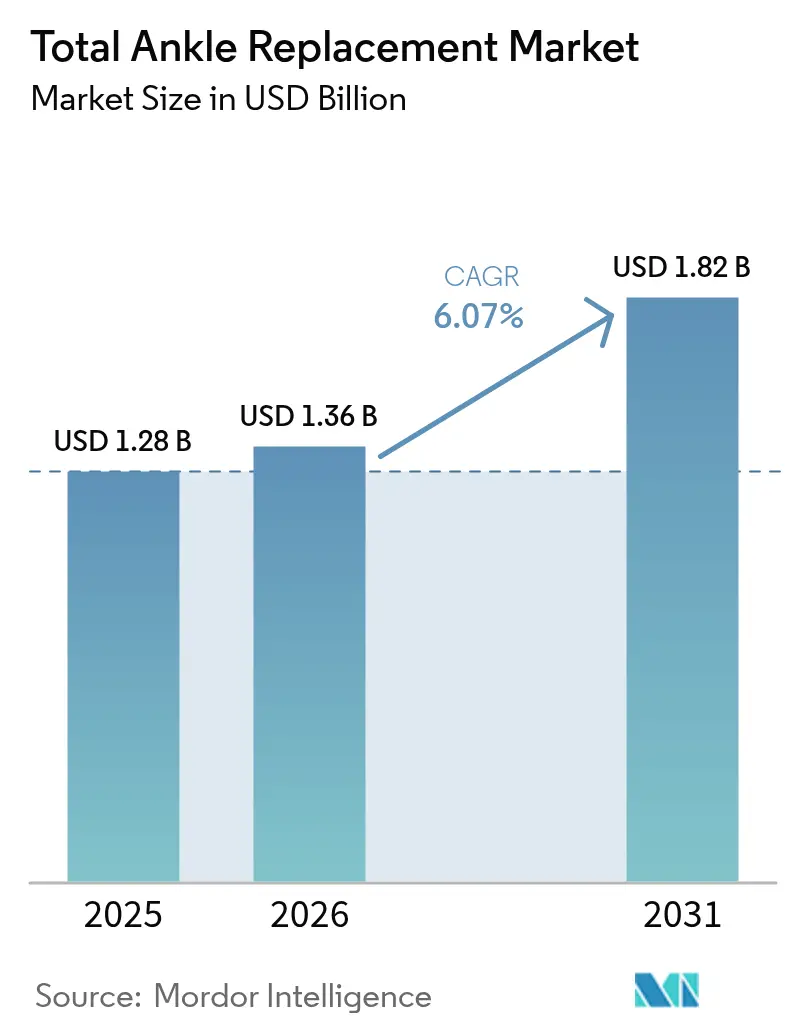
The Total Ankle Replacement Market size was valued at USD 1.28 billion in 2025 and estimated to grow from USD 1.36 billion in 2026 to reach USD 1.82 billion by 2031, at a CAGR of 6.07% during the forecast period (2026-2031).
This growth shows the procedure’s transformation from a niche therapy to a mainstream option for end-stage ankle arthritis as fourth-generation implants extend survivorship, reduce revision risk, and allow surgeons to select designs that mimic native ankle biomechanics. Adoption is rising as patient-specific 3D-printed components, smart instrumentation, and robotic guidance improve accuracy, while clinical guidelines now recommend motion-preserving surgery for younger and more active cohorts. Outpatient migration advances because CMS removed total ankle arthroplasty from the inpatient-only list in 2024, prompting hospitals and ambulatory surgical centers to re-organize care pathways around same-day discharge protocols. Competitive pressure remains high after Zimmer Biomet’s USD 1.1 billion acquisition of Paragon 28 in 2025, and manufacturers continue to bundle implants with digital planning software, artificial-intelligence-enabled sensors, and value-based service agreements to protect share. Reimbursement remains a critical factor; although commercial payers increasingly recognize the procedure’s cost-utility versus fusion, emerging markets still wrestle with high device prices, limited surgeon training, and inconsistent insurance coverage.
Key Report Takeaways
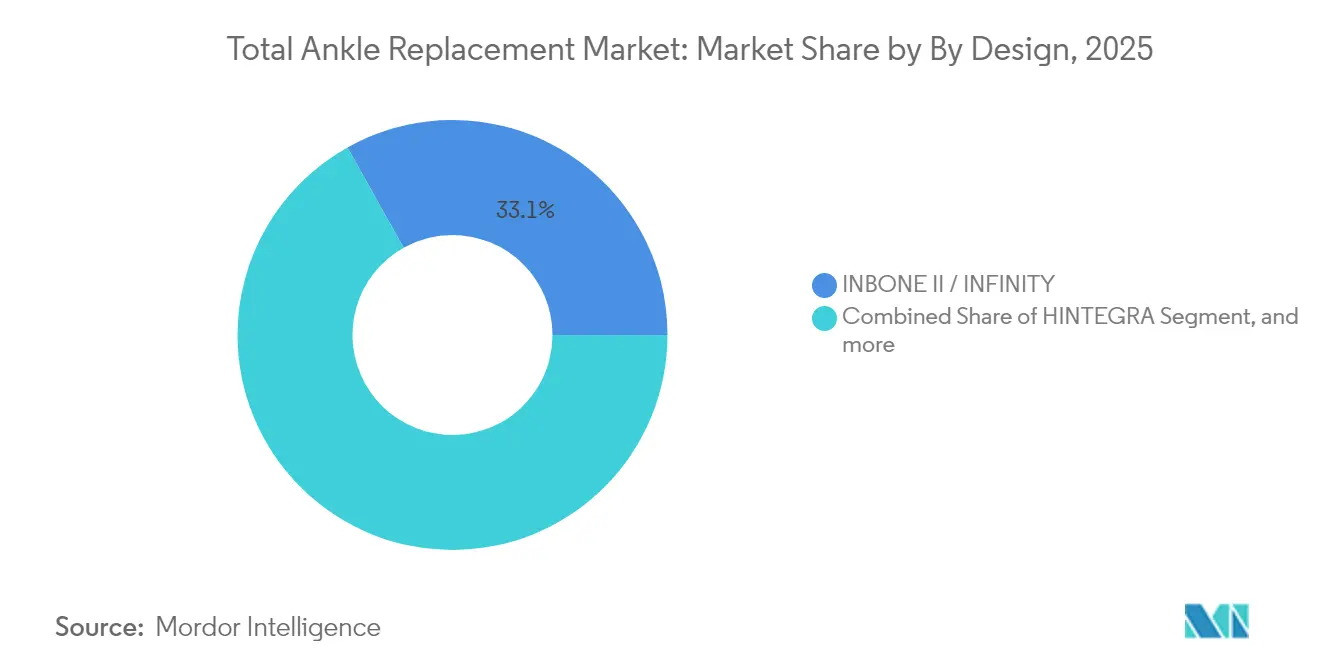
- By design, INBONE II/INFINITY held 33.12% of total ankle replacement market share in 2025, while CADENCE is forecast to expand at an 8.63% CAGR through 2031.
- By bearing type, mobile-bearing systems captured 52.98% revenue share in 2025; hybrid or semi-constrained platforms are projected to grow at an 11.18% CAGR to 2031.
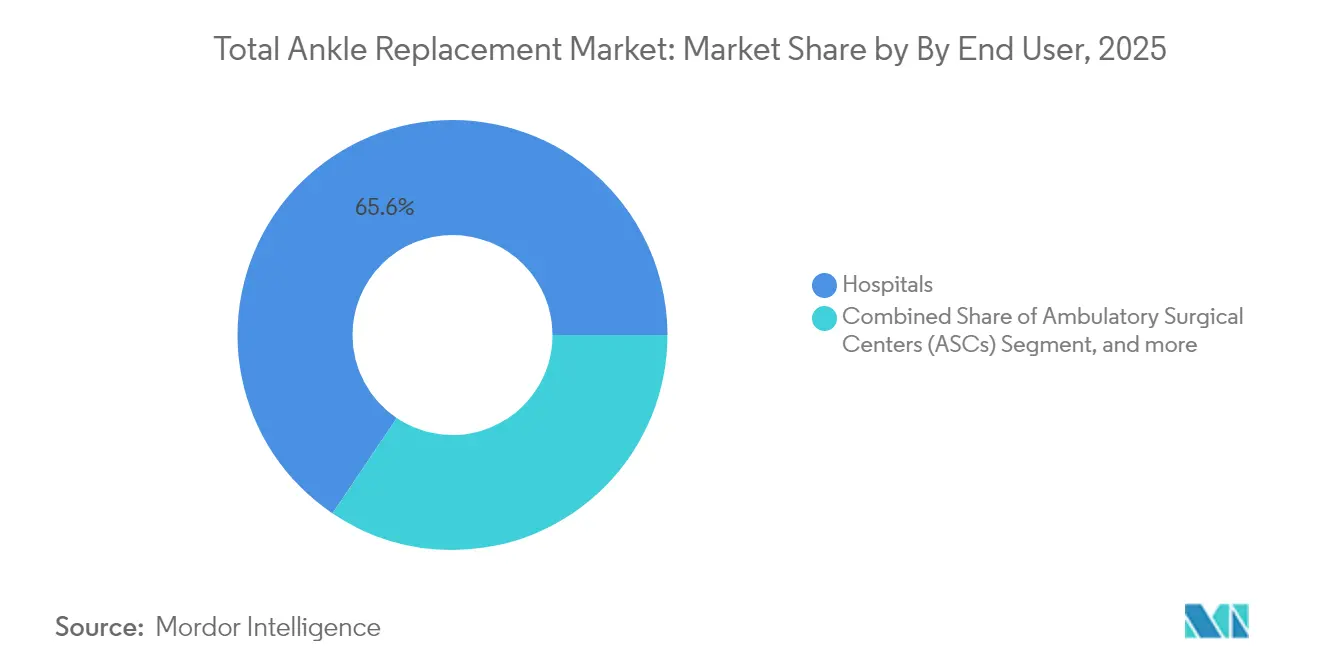
- By end user, hospitals accounted for a 65.58% share of the total ankle replacement market size in 2025, whereas ambulatory surgical centers are advancing at a 9.41% CAGR through 2031.
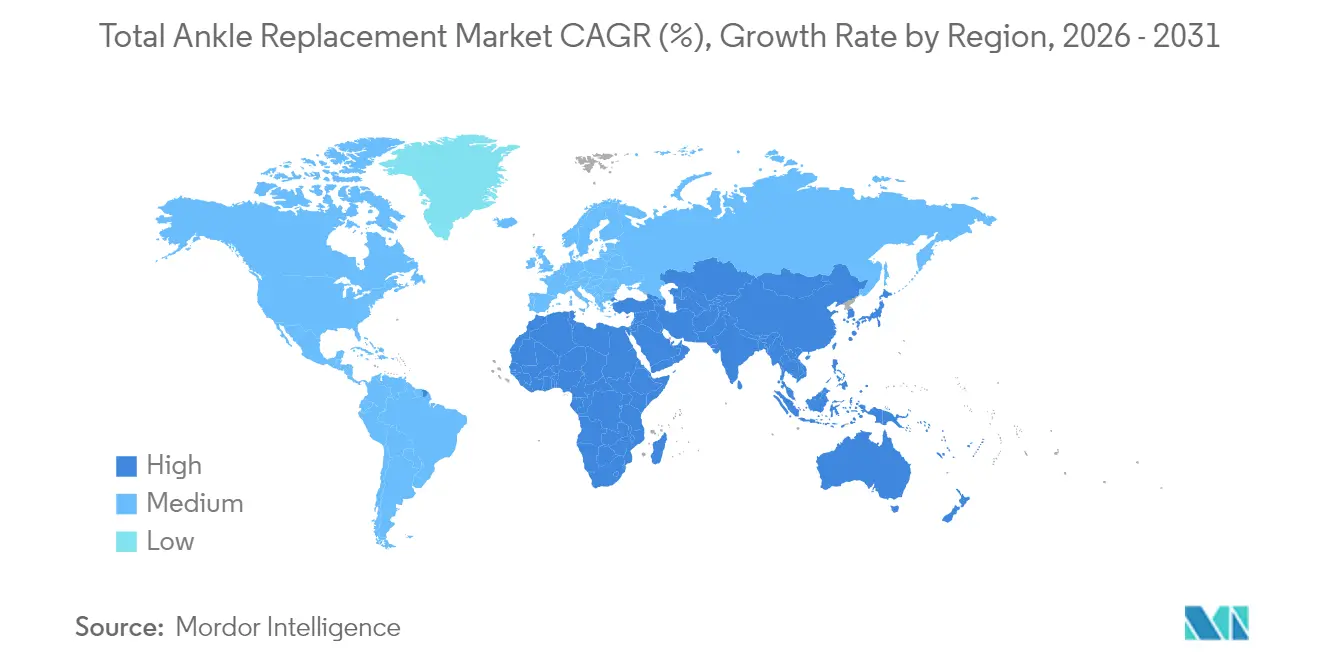
- By geography, North America led with 42.71% revenue share in 2025, while Asia-Pacific is set to register the fastest 10.35% CAGR between 2026 and 2031.
Note: Market size and forecast figures in this report are generated using Mordor Intelligence’s proprietary estimation framework, updated with the latest available data and insights as of 2026.
Market Trends and Insights
Drivers Impact Analysis of Total Ankle Replacement Market*
| Driver | (~) % Impact on CAGR Forecast | Geographic Relevance | Impact Timeline |
|---|---|---|---|
| Rising prevalence of ankle osteoarthritis and aging population | +1.8% | Global, strongest in North America and Europe | Long term (≥ 4 years) |
| Surge in minimally invasive, image-guided, and robotic TAR procedures | +1.2% | North America and Europe, expanding to Asia-Pacific | Medium term (2-4 years) |
| Favourable reimbursement expansion | +0.9% | Primarily North America, selective European markets | Short term (≤ 2 years) |
| Additive-manufactured, patient-specific implants gain FDA clearances | +0.7% | Global, led by United States approvals | Medium term (2-4 years) |
| Growing demand from younger sports-injury cohort | +0.5% | North America and Europe, emerging in Asia-Pacific | Long term (≥ 4 years) |
| Outpatient TAR adoption in ASC settings | +0.3% | United States mainly | Short term (≤ 2 years) |
| Source: Mordor Intelligence | |||
Rising Prevalence of Ankle Osteoarthritis & Aging Population
The demographic shift toward older, more active adults elevates the incidence of ankle osteoarthritis and fuels the total ankle replacement market. Trauma is the leading etiology, so the disease burden grows as sports participation and road traffic injuries increase. Clinical studies show postoperative return-to-sport rates climbing from 31.1% to 85.4%, confirming that modern implants maintain mobility and independence among seniors.[1] Multinational health systems, therefore, position total ankle arthroplasty as a quality-of-life intervention rather than a last resort, embedding it into arthritis care pathways and driving long-term demand.
Surge in Minimally-Invasive, Image-Guided & Robotic TAR Procedures
Navigation and robotic platforms translate lessons from knee arthroplasty to the ankle by improving resection accuracy, minimizing soft-tissue disruption, and shortening learning curves. About 13% of United States knee replacements already use robotics, and leading orthopedic centers now deploy similar workflows for ankles.[2] Robotics supports lateral approaches that conserve bone and mitigate subsidence, while intraoperative sensors quantify implant alignment in real time. These advantages widen candidacy to deformity cases previously slated for fusion and enhance the appeal of outpatient protocols, together accelerating the total ankle replacement market.
Favourable Reimbursement Expansion
CMS raised ambulatory surgical center reimbursement by 2.9% for 2025, boosting total ASC payments to USD 7.4 billion and removing financial disincentives for same-day ankle arthroplasty.[3] Cost-effectiveness models calculated an incremental cost-utility ratio of USD 11,800 per QALY versus fusion, comfortably inside payer thresholds. Commercial insurers follow Medicare’s lead, recognizing downstream savings from preserved joint motion and lower adjacent-joint degeneration. Although reimbursement cuts to physician fees continue elsewhere, the broader payment environment remains net positive for procedure growth.
Additive-Manufactured, Patient-Specific Ankle Implants Gain FDA Clearances
Clearances for restor3d, 3D Systems, and MedCAD devices between 2023 and 2025 validate the regulatory pathway for bespoke implants that match individual bone morphology. One multicenter cohort reported 96.3% device survivorship with patient-specific total talus replacements.[4] Porous titanium and vitamin E-infused polyethylene lower wear and loosen risk, and pre-navigated cutting guides shorten operative time. As printing costs fall, companies leverage digital libraries for rapid production, giving surgeons on-demand options that strengthen brand loyalty and stimulate replacement cycles across the total ankle replacement market.
Restraints Impact Analysis of Total Ankle Replacement Market*
| Restraint | (~) % Impact on CAGR Forecast | Geographic Relevance | Impact Timeline |
|---|---|---|---|
| Surgical-site complications and revision burden | -1.4% | Global, stronger in emerging markets | Medium term (2-4 years) |
| High device and procedure costs limit adoption in emerging markets | -0.8% | Asia-Pacific, Latin America, Middle East and Africa | Long term (≥ 4 years) |
| Absence of long-term global implant registry data | -0.6% | Global, more critical for new entrants | Medium term (2-4 years) |
| Joint-preserving alternatives delaying TAR | -0.4% | North America and Europe | Short term (≤ 2 years) |
| Source: Mordor Intelligence | |||
Surgical-Site Complications & Revision Burden
Long-term datasets reveal 10-year revision rates near 10.9% and 20-year rates at 13.5%, materially higher than hip or knee arthroplasty. Periprosthetic infection risks run from 1% to 14%, and ankle soft-tissue envelopes complicate wound healing. The FDA flagged the Hintermann H3 system in 2024 for failure rates exceeding 16.1%, underscoring vigilance requirements. Surgeons respond by tightening indications, extending preoperative optimization, and limiting bilateral cases, all of which temper procedure volume growth within the total ankle replacement market.
High Device & Procedure Costs Limit Adoption in Emerging Markets
The procedure costs USD 20,200 more than fusion, with implants alone exceeding USD 8,000 in some markets. Emerging payers rarely reimburse premium instrumentation, forcing providers either to shift costs to patients or to default to fusion. Limited fellowship programs, restricted CT imaging, and scarce revision expertise further slow penetration. Manufacturers must therefore develop tiered portfolios and local training academies to unlock latent demand and widen the total ankle replacement market footprint.
*Our forecasts treat driver/restraint impacts as directional, not additive. The impact forecasts reflect baseline growth, mix effects, and variable interactions.
Total Ankle Replacement Market Segment Analysis
By Design:
INBONE Systems Lead While CADENCE Drives InnovationINBONE II and INFINITY platforms combined for a 33.12% revenue share in 2025, giving them the most significant stake in the total ankle replacement market. Their modular tibial stems provide customizable fixation ranging from short metaphyseal posts to long intramedullary segments, an approach that improves initial stability in revision and osteoporotic cases. Seven-year survivorship of 95.9% underscores dependable mid-term performance, and global users passed 48,000 implants by 2024. Competitive differentiation centers on integrated patient-specific guides and streamlined instrumentation sets that cut setup time and radiation exposure, advantages prized in ambulatory settings. Parallel clinical programs collect fluoroscopic kinematic data that illustrate near-native sagittal and coronal plane motion, bolstering evidence packages for payer submissions and further fortifying leadership in the total ankle replacement market.
CADENCE rose on an 8.63% CAGR trajectory through 2031, propelled by breakthroughs in polyethylene formulation, talar dome curvature, and streamlined lateral approach instrumentation. Early outcome registries show 98% patient satisfaction at two years, and surgeons report simplified bone resections that trim learning curves for community hospitals. VANTAGE, STAR, and SALTO Talaris retain loyal followings, each leveraging distinct bearing philosophies and regional reimbursement footholds. Paragon 28’s 3D-printed APEX system adds porous trabecular surfaces and vitamin E stabilized liners to resist oxidation and wear. Over the forecast, design innovations will hinge on smart sensor integration and MRT-compatible alloys that let clinicians monitor implant health remotely, fueling repeat procedures and secondary revenue streams for manufacturers.

By Bearing Type:
Mobile Systems Dominate as Hybrid Designs Gain MomentumMobile-bearing constructs captured 52.98% share in 2025, reflecting surgeon faith in implants that allow polyethylene inserts to self-align under load and reduce edge stresses. Finite-element analyses verify that stress distribution reaches physiologic patterns when cartilage overlay thickness is tuned to 0.5 mm, an insight guiding next-generation mobile bearings. Fixed designs remain valuable for compromised bone stock or ligamentous insufficiency, yet concerns about constrained kinematics limit widespread adoption.
The hybrid segment, blending inherent rotational mobility with built-in stability features, expands at an 11.18% CAGR, highlighting the market’s search for balanced solutions. Companies now pair hybrid talar components with ultracongruent inserts to harmonize contact pressures, attracting surgeons who once vacillated between mobile and fixed platforms. As personalized gait analytics become routine, bearing selection will increasingly derive from preoperative motion datasets, embedding decision support tools deeper into the total ankle replacement market sales process.
By End User:
Hospital Dominance Challenged by ASC GrowthHospitals held 65.58% of the total ankle replacement market size in 2025, leveraging operating-room infrastructure, intensive-care backup, and residency training pipelines. Academic centers drive early adoption of robotics, and bundled-payment pilots anchor risk-sharing contracts. Even so, ambulatory surgical centers advance at a 9.41% CAGR as insurers prefer lower facility fees and patients seek same-day recovery.
Device makers responded with single-tray systems and disposable saws that align with ASC sterility protocols, shaving turnover time by 12 minutes per case. Quality registries show 30-day readmission parity between settings, reinforcing payer confidence. Specialty orthopedic clinics serve as preoperative hubs for imaging, gait analysis, and shared-decision counseling, then hand patients to either hospitals or ASCs for surgery, integrating services across the care continuum and broadening channel access within the total ankle replacement market.
Geography Analysis
North America Total Ankle Replacement Market
North America generated 42.71% of revenue in 2025 and anchors global clinical guideline development, driven by CMS coverage, high surgeon density, and consumer willingness to pay for premium implants. United States physicians perform more than 11,000 ankle replacements annually and frequently combine procedures such as ligament reconstruction to optimize alignment. Canada contributes through publicly funded specialist centers in Ontario and Alberta, whereas Mexico’s private sector captures medical tourists from Central America seeking motion-preserving procedures.
Europe Total Ankle Replacement Market
Europe remains the second-largest cluster, with Germany, France, and the United Kingdom leading volumes under stringent CE-mark requirements and cost-utility thresholds. National health systems conduct health-technology assessments that scrutinize long-term revision rates, encouraging manufacturers to publish peer-reviewed survivorship data. Scandinavian countries share registry insights that influence broader European reimbursement negotiations.
APAC, MEA and South America Total Ankle Replacement Market
Asia-Pacific is the fastest-growing region at a 10.35% CAGR to 2031 as aging populations and rising disposable income heighten demand for advanced orthopedic care. China ramps fellowship programs in Shanghai and Beijing, Japan leverages universal insurance to cover select technologies, and India’s tier-1 hospitals attract domestic medical tourists. The combination of heavy trauma incidence and large diabetes populations increases arthritis burden, creating a fertile expansion corridor for the total ankle replacement market. Middle East and Africa plus South America show nascent uptake as private hospital chains import expertise, though currency fluctuations and out-of-pocket dynamics temper near-term procedure counts.
Competitive Landscape
The total ankle replacement market features moderate consolidation yet intense innovation rivalry. Zimmer Biomet closed the USD 1.1 billion Paragon 28 acquisition in April 2025, gaining the APEX 3D system, Smart 28 instrumentation, and a focused ankle sales force that complements Zimmer’s global network. Stryker sustains leadership through Infinity’s 98.8% two-year survivorship and the 2024 launch of Ankle Truss and Osteotomy Truss adjunct systems that expand revision toolbox breadth. Smith+Nephew reported 5.3% underlying revenue growth in 2024 and released patient-matched guides that integrate CT mapping with intraoperative navigation, simplifying component alignment and boosting surgeon adoption.
Niche players chase white-space by focusing on patient-specific implants, additive manufacturing, and sensorized polyethylene inserts that monitor load and temperature. Restor3d leverages machine-learning design algorithms to optimize lattice structures, whereas 3D Systems targets orthoplastic trauma surgeons with an end-to-end digital workflow. Competitive dynamics now extend beyond hardware to software ecosystems, remote monitoring platforms, and value-based contracting models that tie payments to long-term functional scores. Regulatory scrutiny intensifies after the FDA’s 2024 safety communication, prompting firms to invest heavily in post-market surveillance and real-world data generation. As a result, top manufacturers bundle cloud registries and longitudinal outcome analytics with implant sales, raising switching costs and shaping purchase decisions across the total ankle replacement market.
Total Ankle Replacement Industry Leaders
-
Zimmer Biomet
-
Exactech, Inc.
-
Enovis
-
Smith + Nephew
-
Stryker Corporation
- *Disclaimer: Major Players sorted in no particular order
Total Ankle Replacement Market Companies Covered in this Report
- Stryker
- Zimmer Biomet
- Smiths Group
- Paragon 28
- Exactech
- Enovis (DJO)
- Vilex
- restor3d
- Conmed
- Allegra Orthopaedics
- Integra LifeSciences
- Wright Medical Group
- Arthrex
- Medartis
- Johnson & Johnson
- Ossur
- Corin Group
- Zimmer Surgical
- Medtronic
- BioPoly LLC
Market Opportunities and Future Outlook
Outpatient migration and the shift of select total ankle arthroplasty cases into ambulatory surgical centers create whitespace for implant systems and instrumentation designed for fast, repeatable workflows. In the United States, the 2024 CMS decision to remove total ankle arthroplasty from the inpatient-only list, together with the 2.9% ASC payment update for 2025 (total ASC payments at USD 7.4 billion), has pushed hospitals and ASCs to redesign pathways around same-day discharge. This refocuses adoption conversations on single-tray sets, disposable instrumentation, and integrated digital planning.
Technology-led differentiation is concentrating around patient-specific and 3D-printed solutions, plus navigation-enabled execution to reduce alignment variability, particularly in deformity and revision-adjacent cases (within the report scope of primary systems and supplied single-use instruments). Active product and regulatory throughput also signals near-term momentum: restor3d receiving FDA 510(k) clearance for the Kinos Total Ankle System in September 2025, Paragon 28 receiving FDA 510(k) clearance for the APEX 3D Total Ankle Replacement System in May 2025, and Smith+Nephew launching TOTAL ANKLE Patient-Matched Guides (built on 3D Systems VSP surgical planning) in September 2024. Outside the US, growth opportunities also depend on expanding surgeon training and repeatable CT-to-plan workflows for emerging markets where device price, imaging access, and limited fellowship pipelines constrain penetration. Manufacturers are already targeting this friction by bundling implants with planning software and service agreements.
Recent Industry Developments in Total Ankle Replacement Market
- April 2026: restor3d announced the full commercial release of the Aeros Modular Stem System in the United States. Moving from a limited market release into broad commercialization increases competitive intensity in modular-stem, fixation-focused designs and strengthens the companys positioning in personalized ankle arthroplasty workflows.
- June 2025: Stryker received FDA 510(k) clearance for the Incompass Total Ankle System, which integrates elements associated with the INBONE and INFINITY technology base. The clearance adds another major-platform option for accounts standardizing on established design families while seeking updated instrumentation and system-level compatibility.
- September 2024: Smith+Nephew launched TOTAL ANKLE Patient-Matched Guides in collaboration with 3D Systems VSP surgical planning. The release broadened access to pre-operative planning and patient-specific guides for component placement, supporting faster adoption among surgeons focused on reproducibility and efficiency across hospital and ASC settings.
Total Ankle Replacement Market Report Scope and Research Methodology
Market Definition and Coverage
This market covers the revenue generated from total ankle replacement prosthetic systems used to replace the ankle joint in patients with end-stage arthritis or severe traumatic damage, and sold into hospital and ambulatory surgical center settings.
Scope exclusions: We exclude revision ankle replacement implants, partial ankle arthroplasty solutions, ankle fusion hardware, and aftermarket service or repair kits.
Segments Covered in This Report
- By Design
- HINTEGRA
- STAR
- SALTO / SALTO Talaris
- INBONE II / INFINITY
- CADENCE
- Other Designs
- By Bearing Type
- Mobile-Bearing Systems
- Fixed-Bearing Systems
- Hybrid / Semi-constrained
- By End User
- Hospitals
- Ambulatory Surgical Centers
- Specialty Orthopaedic Clinics
- By Geography
- North America
- United States
- Canada
- Mexico
- Europe
- Germany
- United Kingdom
- France
- Italy
- Spain
- Rest of Europe
- Asia-Pacific
- China
- Japan
- India
- Australia
- South Korea
- Rest of Asia-Pacific
- Middle East & Africa
- GCC
- South Africa
- Rest of Middle East & Africa
- South America
- Brazil
- Argentina
- Rest of South America
- North America
Data Sources, Market Sizing, and Validation
Desk Research
Desk research was used to set the clinical and procedure context before building the model. We referenced public sources such as the US Centers for Disease Control and Prevention (CDC) and the National Center for Health Statistics for osteoarthritis burden signals, the OECD health statistics portal for surgery system capacity indicators, and CMS datasets to understand reimbursement and procedure coding direction.
To keep assumptions grounded, we reviewed published clinical literature (peer reviewed orthopedic journals) and guidance from relevant professional bodies (such as AAOS and similar regional associations) on indication patterns, revision risk considerations, and how design adoption has changed over time. We also used company filings and investor decks for high level revenue cues, along with reputable press coverage for product approvals and recall events. A paid subscription for company financials and patent databases helped cross check product pipelines and innovation intensity. These examples are not exhaustive, and other public sources were also used for data collection, validation, and research clarification.
Primary Interviews and Surveys
Primary work focused on validating what drives procedure volumes and pricing in real settings, then stress testing the draft model outputs. We spoke with a mix of implant channel participants, orthopedic surgeons, procurement roles, and care delivery managers to confirm utilization by setting, realistic ASP bands, and the pace at which newer designs are being adopted.
Because this is a global market, we collected feedback across major regions to avoid over-weighting one reimbursement system. When interview inputs materially disagreed with desk signals, we re-contacted those sources to clarify the drivers behind the difference.
Distribution of primary research fieldwork respondents
| Company type | Respondent position | Region |
|---|---|---|
| Top tier: 25% | CXOs: 13% | APAC: 44% |
| Mid tier: 59% | Functional/Unit leaders: 27% | EMEA: 29% |
| Smaller Players: 16% | Managers: 60% | Americas: 27% |
Market-Sizing & Forecasting
Our sizing logic starts with a top-down build where procedure demand is reconstructed from the treated patient pool, orthopedic surgical capacity signals, and typical eligibility for total ankle replacement, then translated into device revenue using region-level ASP ranges. In parallel, we run selective bottom-up checks using sampled supplier roll ups, distributor channel feedback, and volume by care setting, to confirm that totals remain realistic and do not drift from observable patterns.
Key model inputs include ankle arthritis prevalence and progression to surgery, share shift between fusion and replacement, average implants per procedure with scrap and sizing mix, hospital versus ambulatory surgical center utilization splits, and regional pricing differences tied to reimbursement and procurement behavior. If a country lacks clean procedure series, we handle the gap using proxy markets with similar payer structure and orthopedic capacity, followed by an adjustment step informed by interview feedback.
For forecasting, we use scenario analysis to reflect sensitivity to surgeon training curves, regulatory approvals, and product iteration cycles, then tighten variables using expert consensus from interviews. We also sense check forecast growth against longer-run orthopedic implant growth signals so the year-to-year curve stays plausible.
Data Validation & Update Cycle
Validation is done in layers so the final numbers are not dependent on one assumption. Analysts compare the model output against independent signals such as procedure intensity per population, reported implant business momentum in public filings, and reimbursement or coding changes, then investigate outliers before sign-off.
If a variance cannot be explained through desk evidence, we return to primary sources to confirm whether it reflects a temporary disruption, a pricing step change, or a scope mismatch. Reports are refreshed annually, with interim updates when material events occur, and a final pre-delivery review pass is completed so clients receive the latest updated view.
Mordor Intelligence's Total Ankle Replacement Market Size Compared With Other Published Estimates
Published values for total ankle replacement can look far apart because boundaries are not always defined the same way, and because procedure volume and pricing assumptions are updated on different timelines. Differences also show up when one estimate is based on hospital-only demand while another blends hospital and ambulatory settings, or when revisions are counted together with primary procedures.
By tracking procedure volume proxies and refreshing ASP bands with region-level validation, Mordor Intelligence keeps the count limited to new total ankle replacement systems and aligns the 2026 base with what procurement and clinical adoption signals support. This is why some estimates that start from older base years or use broader product baskets land lower.
Benchmark comparison
| Source | Market Size | Gaps in Research Methodology |
|---|---|---|
| Mordor Intelligence | USD 1.36 B (2026) | |
| Global Consultancy A | USD 0.71 B (2023) | Uses an earlier base year and can understate the impact of more recent adoption and pricing progression, and it may apply a single global CAGR without fully separating hospital versus ambulatory demand shifts. |
| Industry Publisher B | USD 0.75 B (2024) | Often leans on a narrower device revenue lens and a fixed starting-year estimate, and it can treat fixation subtypes as the full market without consistently excluding adjacent ankle hardware categories. |
The spread in the table is largely explained by base-year choice, what is included in the product scope, and how pricing is carried forward across regions. When the scope is kept to primary total ankle replacement systems and assumptions are cross checked with realistic procedure and procurement signals, the final market value becomes easier to trace and repeat year after year.
Key Questions Answered in the Report
What is the current size of the total ankle replacement market?
The total ankle replacement market is valued at USD 1.36 billion in 2026 and is expected to reach USD 1.82 billion by 2031.
How fast is the total ankle replacement market growing?
The market grows at a 6.07% CAGR during the 2026-2031 forecast period.
Which design platform leads the total ankle replacement market share today?
INBONE II/INFINITY holds 33.12% of global revenue in 2025, making it the leading design family.
Why are ambulatory surgical centers important for future growth?
ASC settings support same-day discharge, reduce facility costs, and benefit from CMS reimbursement increases, driving a 9.41% CAGR among ASCs through 2031.
Which region will expand the fastest by 2031?
Asia-Pacific is forecast to grow at a 10.35% CAGR, propelled by aging populations, higher healthcare spending, and expanding access to specialist orthopedic care.
What technology trends shape competition in the total ankle replacement industry?
Patient-specific 3D-printed implants, robotic guidance, and sensorized liners are the core technologies differentiating products and influencing purchasing decisions.