
Timing Relay Market Size and Share
Market Overview
| Study Period | 2021 - 2031 |
|---|---|
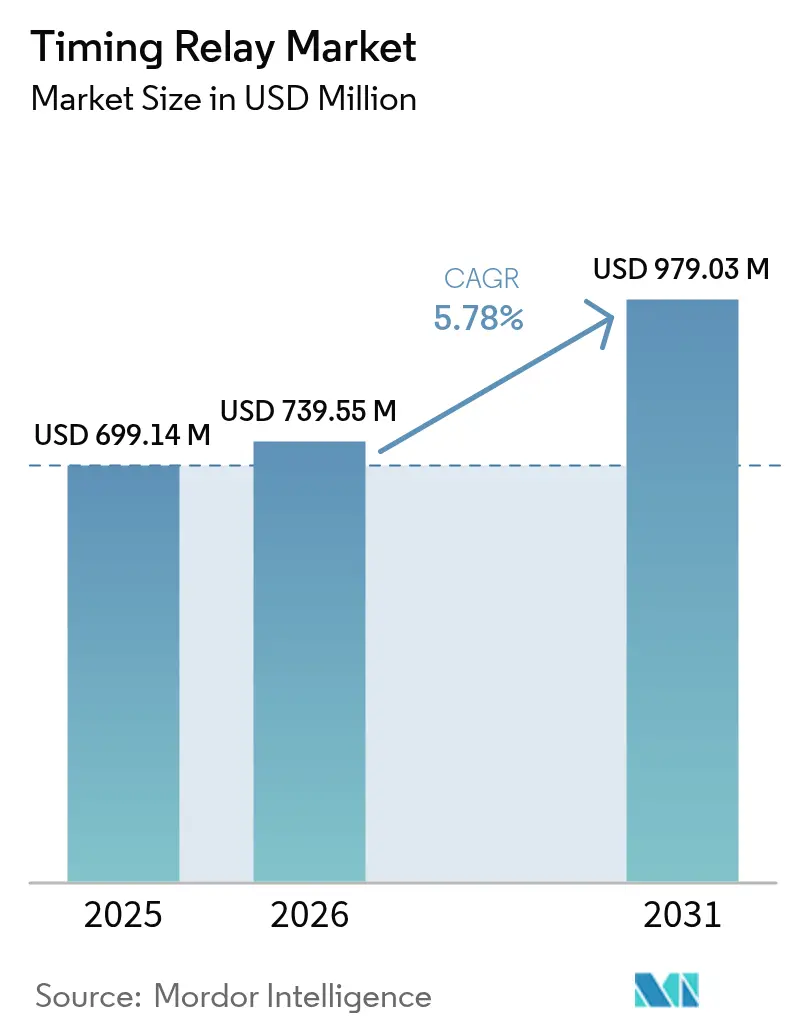
| Market Size (2026) | USD 739.55 Million |
| Market Size (2031) | USD 979.03 Million |
| Growth Rate (2026 - 2031) | 5.78 % |
| Fastest Growing Market | Asia Pacific |
| Largest Market | Asia Pacific |
| Market Concentration | Medium |
Major Players *Disclaimer: Major Players sorted in no particular order Image © Mordor Intelligence. Reuse requires attribution under CC BY 4.0. | |
Timing Relay Market Analysis by Mordor Intelligence
The Timing Relay Market size was valued at USD 699.14 million in 2025 and estimated to grow from USD 739.55 million in 2026 to reach USD 979.03 million by 2031, at a CAGR of 5.78% during the forecast period (2026-2031).
Strong demand for digital, multi-function devices, growing electrification of industrial processes, and tightening safety regulations are steering this expansion. Manufacturers are retiring legacy electromechanical models in favor of IoT-enabled units that integrate diagnostics, cybersecurity features, and predictive maintenance capabilities. The automotive shift to electric drivetrains, large-scale HVAC retrofits in commercial real estate, and power-grid modernization all require millisecond-level control, lifting shipment volumes across voltage classes. At the same time, miniaturization—which allows relays to be embedded directly on PCBs—opens incremental opportunities in compact machinery and smart-building controllers. Suppliers respond through acquisitions, regional production hubs, and product platforms that compress multiple timing functions into a single housing.
Key Report Takeaways
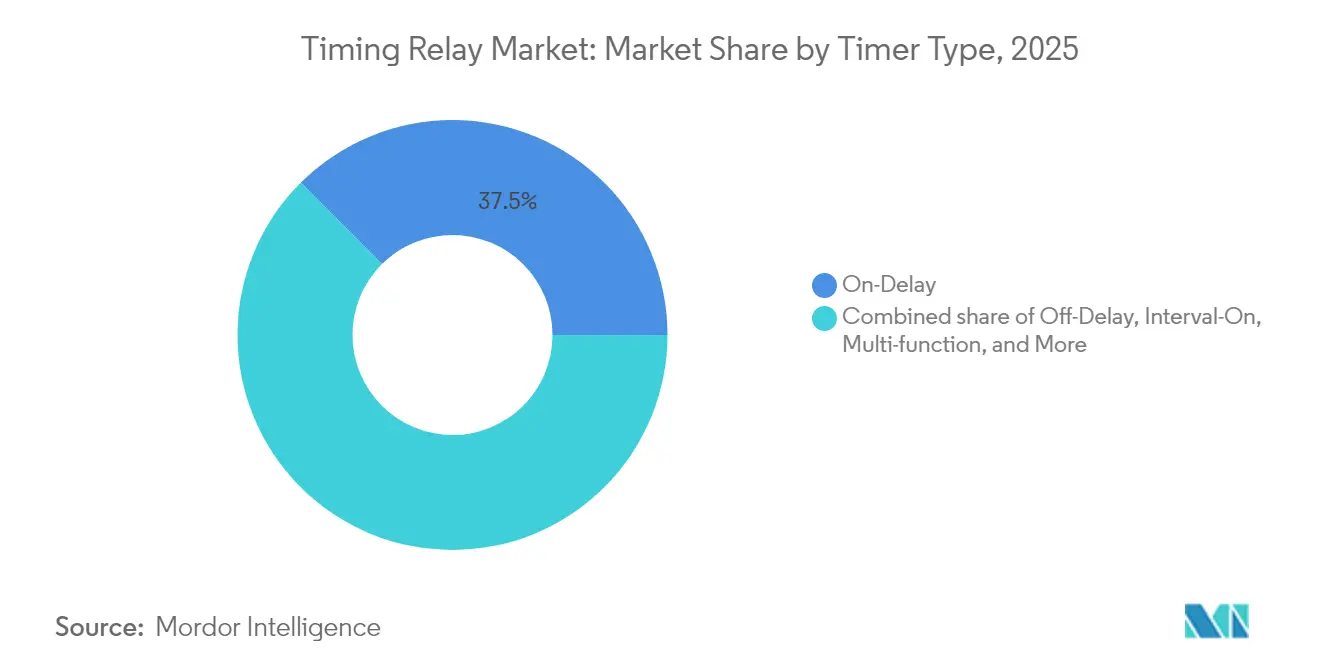
- By timer type, on-delay timers led with 37.46% revenue share in 2025; multi-function timers are forecast to record an 8.45% CAGR through 2031.
- By mounting type, DIN-rail units accounted for a 41.28% share of the timing relay market size in 2025, while PCB-mounted variants are projected to expand at a 8.92% CAGR through 2031.
- By function, multi-function timing relays held a 58.35% market share in the timing relay market in 2025, and the same is also likely to grow the fastest, at a 6.86% CAGR through 2031.
- By rated voltage, the 121-240 V band commanded a 45.22% share of the timing relay market size in 2025, whereas devices with a voltage below 120 V are expected to advance at an 8.07% CAGR between 2026 and 2031.
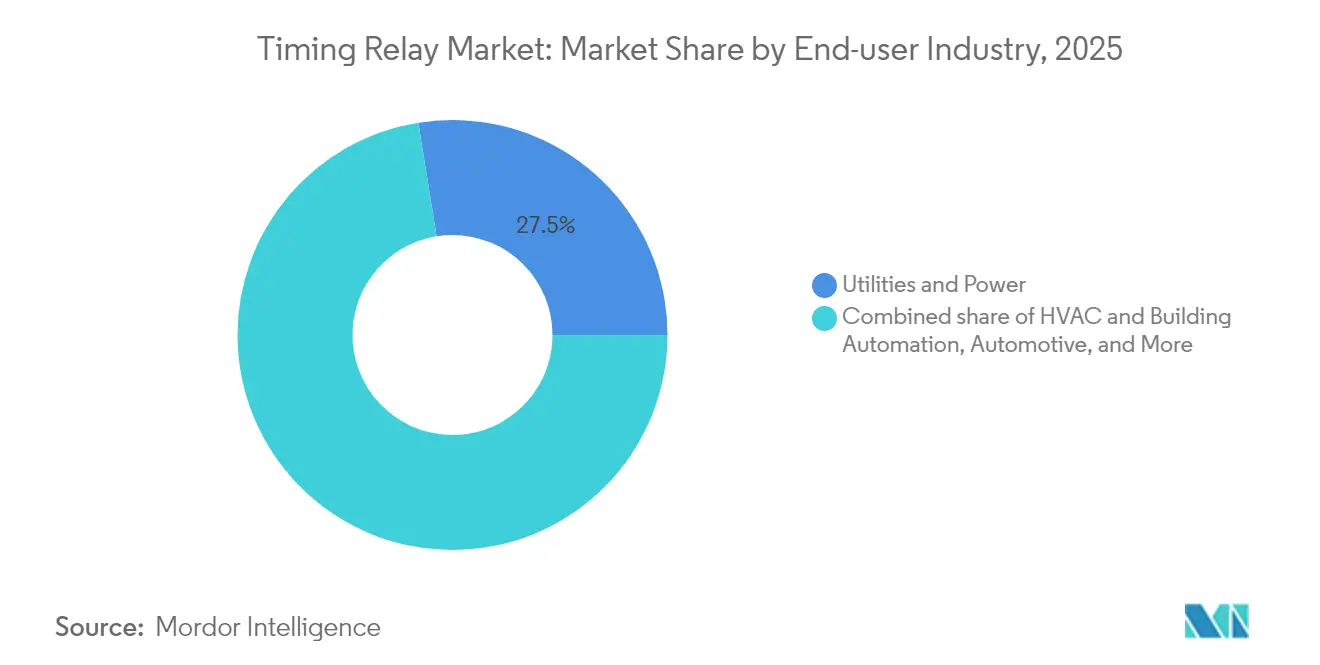
- By end-user industry, utilities and power held 27.54% of the timing relay market share in 2025, while the HVAC and building automation segment is projected to register a 9.96% CAGR to 2031.
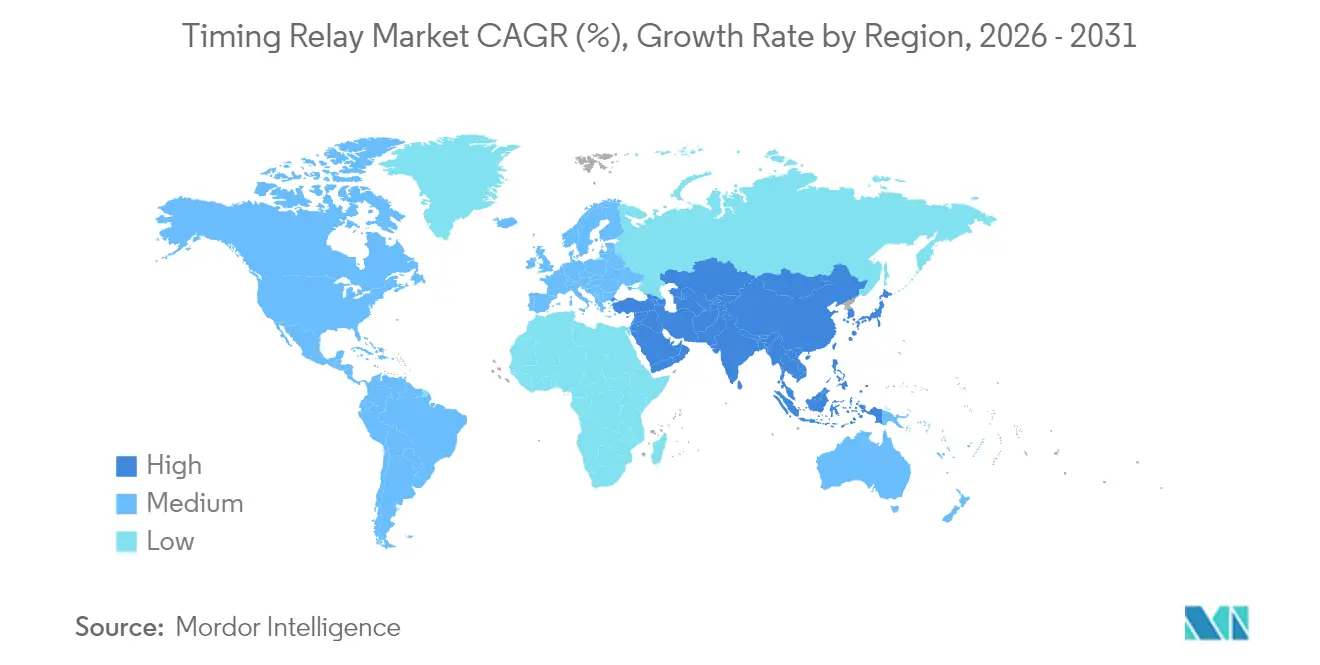
- By geography, the Asia-Pacific region captured a 34.72% share of the timing relay market in 2025 and is projected to grow at a 7.52% CAGR through 2031.
Note: Market size and forecast figures in this report are generated using Mordor Intelligence’s proprietary estimation framework, updated with the latest available data and insights as of 2026.
Market Trends and Insights
Drivers Impact Analysis of Timing Relay Market*
| Driver | (~) % Impact on CAGR Forecast | Geographic Relevance | Impact Timeline |
|---|---|---|---|
| Rising industrial automation & Industry 4.0 upgrades | 1.80% | Global, with APAC leading adoption | Medium term (2-4 years) |
| Power T&D network expansion projects | 1.20% | Global, concentrated in emerging markets | Long term (≥ 4 years) |
| Surge in HVAC & building-automation retrofits | 1.00% | North America & Europe primary, APAC growing | Short term (≤ 2 years) |
| Manufacturing boom in emerging Asia | 0.80% | APAC core, spill-over to MEA | Medium term (2-4 years) |
| Mini-multifunction timers for PLC-less SMB control | 0.60% | Global, with higher penetration in cost-sensitive markets | Short term (≤ 2 years) |
| Arc-flash safety regulations mandating delay relays | 0.40% | North America & EU, expanding to other regions | Long term (≥ 4 years) |
| Source: Mordor Intelligence | |||
Rising Industrial Automation & Industry 4.0 Upgrades
Factory floors worldwide are layering robotics, AI-driven motion control, and digital twins into production workflows, and each interconnected cell relies on relays to synchronize start-stop intervals, motor ramps, and protection sequences. Siemens’ second-generation SIMATIC S7-1200 controllers, unveiled in 2024, embed richer motion profiles that necessitate high-accuracy, multi-range timers capable of exchanging status data over Profinet.[1]Siemens AG, “Second-Generation SIMATIC S7-1200 Controllers,” siemens.comAutomotive OEMs and consumer-electronics assemblers increasingly select relays with embedded self-diagnostics to support predictive maintenance dashboards. Schneider Electric’s generative AI copilot for PLC programming reinforces this trajectory by generating sequence logic that calls timing routines natively, thereby cementing discrete relays as a complementary layer that guards against single-point PLC failures. The net effect is a persistent pull for configurable, microprocessor-based devices that shorten commissioning times, reduce spare inventory, and meet Industry 4.0 data integrity expectations.
Power T&D Network Expansion Projects
Massive grid-reinforcement programs, ranging from high-voltage DC interconnects to sub-transmission automation, rely on precise timing to coordinate distance protection, synch-checking, and load shedding. Utilities migrating from electromechanical to digital protection assemblies integrate timing relays that deliver sub-10-ms repeatability, thereby improving fault-clearing selectivity. ABB’s SENTRON ECPD electronic circuit-protection technology, which interrupts faults up to 1,000 times faster than conventional breakers, demonstrates the performance envelope now expected from ancillary timing devices.[2] ABB Group, “ABB Debuts SENTRON ECPD,” abb.com Renewable-heavy feeders further magnify the requirement, because inverter-dominated sections of the grid exhibit low inertia and need tightly orchestrated protection delays to avoid nuisance trips. These dynamics channel investments toward relay variants certified to the latest IEC 60255 standards and fitted with wide-range auxiliary supplies for universal deployment.
Surge in HVAC & Building-Automation Retrofits
Commercial building owners prioritizing energy efficiency adopt timing logic to stagger compressor starts, enforce anti-short-cycle intervals, and schedule lighting loads accordingly. Studies published in the journal Sensors report 36.8 kW-per-hour savings when rooftop units are equipped with intelligent timing control.[3]MDPI Editorial, “Energy Savings via Intelligent HVAC Timing,” mdpi.com Retrofit projects often favor plug-in or DIN-rail relays over full PLC swaps because installers can insert them into existing panels with minimal rewiring. Eaton’s AbleEdge smart panel, introduced in November 2024, integrates modular breakers that accept timing commands to align household loads with off-peak tariffs. Demand is equally buoyant in data-center HVAC, where uptime imperatives and rapid rack turnover drive preference for multi-function timers offering hot-swappable presets.
Manufacturing Boom in Emerging Asia
China, India, and Vietnam continue to add electronics, textile, and automotive capacity, prompting machinery builders to down-spec when appropriate yet still comply with tightening safety codes. Mitsubishi Electric’s “Lingling” brand targets China with localized feature sets and price points, bundling star-delta-ready timers that condense wiring and slash panel depth. Omron attributes roughly half of its Device & Module Solutions revenue to relays, underscoring the volume leverage associated with its APAC-centric expansion strategies. As wage costs climb and demographic headwinds reduce labor availability, manufacturers automate auxiliary lines such as packaging and inspection, further enlarging the timing relay market.
Restraints Impact Analysis of Timing Relay Market*
| Restraint | (~) % Impact on CAGR Forecast | Geographic Relevance | Impact Timeline |
|---|---|---|---|
| Substitution threat from low-cost PLC timers | -1.4% | Global, particularly in developed markets | Medium term (2-4 years) |
| Price erosion & intense supplier competition | -0.8% | Global, most severe in Asia-Pacific | Short term (≤ 2 years) |
| Specialty bimetal-alloy supply shortages | -0.5% | Global, with highest impact in North America & Europe | Medium term (2-4 years) |
| Cyber-security concerns for IoT-enabled relays | -0.3% | Global, concentrated in critical infrastructure sectors | Long term (≥ 4 years) |
| Source: Mordor Intelligence | |||
Substitution Threat from Low-Cost PLC Timers
Modern micro-PLCs embed configurable IEC 61131 timers at negligible incremental cost, allowing OEMs to eliminate discrete relays in tightly integrated machines. Siemens’ SIMATIC Automation Workstation takes it a step further by virtualizing the PLC and HMI stack on an industrial PC, thereby reducing the number of hardware layers and panel wiring. Small-scale fabricators tend to gravitate towards such platforms for their flexibility and convenience in remote updates. Yet discrete relays remain favored where galvanic isolation, high breaking capacity, or fail-safe redundancy is mandatory—for example, in emergency-stop chains or motor-control centers that must continue functioning even if a PLC resets.
Price Erosion & Intense Supplier Competition
Asian producers have leveraged scale advantages and narrowed historical quality gaps, exerting downward pressure on average selling prices. In tandem, the volatility of steel and copper squeezes gross margins, limiting large OEMs’ ability to absorb cost spikes without passing them on. Distributors now publish real-time price grids online, raising transparency and tilting leverage toward buyers. To defend value, leading brands integrate Ethernet diagnostics, cybersecurity firmware, and predictive maintenance counters, positioning premium SKUs as lifetime cost savers rather than commodity components.
*Our forecasts treat driver/restraint impacts as directional, not additive. The impact forecasts reflect baseline growth, mix effects, and variable interactions.
Timing Relay Market Segment Analysis
By Timer Type:
Multi-Function Devices Lead InnovationThe on-delay category retained a 37.46% revenue share of the timing relay market in 2025, reflecting its ubiquity in motor-start and conveyor sequencing duties. Developers now overlay microcontrollers onto the traditional coil-and-contact architecture, tightening tolerance to ±1% and enabling field programming via NFC. Multi-function units, although costlier, capture applications where installers want a single SKU to cover on-delay, off-delay, interval, and repeat-cycle modes, a capability that propels an 8.45% CAGR through 2031.
Across the forecast horizon, the timing relay market size for multi-function products is poised to expand fastest as OEMs compress panel footprints and reduce wiring errors. Designs such as AMETEK’s TMM series offer universal 24-240 V inputs, eliminating the need for separate AC and DC stock maintenance. This versatility underpins lights-out manufacturing, where changeovers occur without human presence and downtime penalties are steep.



By Mounting Type:
PCB Solutions Drive MiniaturizationDIN-rail mounting dominated the market with a 41.28% share in 2025 due to its simplicity in installing and replacing legacy panels. Nevertheless, the form factor now demanded by cobot controllers and compact VFDs, which is below 5 cm wide, accelerates the adoption of board-level devices, lifting the PCB-mounted slice at a 8.92% CAGR.
Future system architectures, especially in automated guided vehicles and low-voltage switchboards, position the timing relay market for incremental penetration as PCB modules eliminate socket depth and withstand higher vibration profiles. TE Connectivity’s hermetically sealed relays for nuclear plants illustrate how board integration can coexist with rigorous environmental ratings. Planner preference is expected to tilt further once edge-computing enclosures target IP67 ingress protection, leaving little room for bulkier plug-ins.
By Function:
Integration Favors Multi-Function DominanceMulti-function timing relays represented 58.35% of 2025 shipments, a share underpinned by the drive to minimize component count. Their richer logic blocks trim cabinet surface area by up to 30%, a benefit that directly translates into floor-space savings for machine builders. Single-function models remain relevant in price-sensitive markets and in circuits where regulatory validation limits the use of programmable parts.
The timing relay market size attached to multi-function SKUs is forecast to grow at a 6.86% annual rate, buoyed by diagnostics that log cycle counts and contact wear, thereby feeding maintenance dashboards. Product lines, such as Rockwell’s 700-HX series, incorporate OLED screens and NFC pairing, allowing technicians to adjust delays without energizing the circuit, thereby slashing mean time to repair.

By Rated Voltage:
Low-Voltage Segment AcceleratesDevices rated below 120 V chart the steepest curve at an 8.07% CAGR, as safety standards encourage the use of reduced-voltage control loops. Battery-storage farms and PV inverters, for instance, deploy 48 V DC relay boards to isolate string combiners. Conversely, the 121-240 V tier held 45.22% of 2025 revenue and remains the baseline for conventional industrial panels. Above-240 V applications, though niche, demand arc-energy containment and are typically bundled with medium-voltage switchgear.
Emerging EV infrastructure further expands the low-voltage addressable base. TE Connectivity markets 450 V DC relays to disconnect traction-battery packs within 10 ms, showing how automotive electrification intersects with industrial relay technology. Fast-acting solutions also complement Siemens’ SENTRON ECPD, which coordinates with short-delay protective devices to clear faults before thermal limits are reached.
By End-User Industry:
HVAC Automation Drives GrowthUtilities and power represented 27.54% of the timing relay market share in 2025, driven by substation automation, feeder protection, and renewable inverter synchronization. Despite this lead, HVAC and building automation are projected to grow at a rate of 9.96% annually as property managers retrofit legacy mechanical thermostats with smart, relay-controlled schedules.
The timing relay industry also benefits from the electrification of oil and gas. SLB’s 2025 electric well-control package eliminates hydraulics, substituting rapid-response electric valves actuated via tightly timed sequences. Water-treatment plants adopt similar patterns; sequential pump starts prevent pressure shock, a task readily executed with off-delay and star-delta timers housed in IP65 panels.
Geography Analysis
APAC Timing Relay Market
Asia-Pacific contributed 34.72% of 2025 revenue and is advancing at a 7.52% CAGR thanks to relentless capacity additions in automotive, consumer electronics, and battery manufacturing. Regional OEMs leverage their proximity to component suppliers and a favorable policy climate, such as India’s Production-Linked Incentive scheme, which reimburses up to 4% of the domestic value added on electronics assemblies. Manufacturers embed timing relays directly onto machine controller boards to squeeze factory footprints in densely populated industrial parks.
North America and Europe Timing Relay Market
North America and Europe form the second growth tier, driven by grid-modernization budgets and tightening arc-flash rules. Eaton notes that NEC thresholds for arc-energy mitigation fell from 1,200 A to 1,000 A in 2023, broadening the universe of panels that now require delay relays in shutdown algorithms. Schneider Electric’s USD 140 million expansion of US switchgear capacity in 2024 illustrates how reshoring trends favor local production of critical components, including relays. Building energy codes such as ASHRAE 90.1 in the United States and the EU’s EPBD revisions likewise stimulate demand for timed load-shed modules.
MEA and South America Timing Relay Market
South America, the Middle East, and Africa collectively account for a smaller base, yet they deliver long-term upside linked to industrial diversification agendas. Saudi Aramco’s adoption of cloud-based pre-commissioning platforms in the Marjan field underscores the region’s shift toward digital operations, which rely on precise timing logic. Brazilian water utilities, facing non-revenue water losses, deploy interval timers to sequence booster pumps only when pressure sensors indicate specific thresholds, thereby minimizing energy waste. Governments across these regions increasingly tie project finance to demonstrable energy-efficiency gains, a factor that positions timing relays as low-cost compliance enablers.

Regulatory Landscape
Timing relays used in low-voltage control circuits are primarily governed by international and regional electrical-safety and performance standards. IEC 60947-5-1:2024 (5th edition) updated requirements for control circuit devices, including expanded expectations around marking, EMC, and environmental information, and it is increasingly reflected through national and regional adoptions such as CENELEC-aligned EN versions (for example, SIST EN IEC 60947-5-1:2025 for equipment up to 1,000 V AC and 600 V DC). These revisions raise the compliance bar for legacy electromechanical products and newer microprocessor-based designs used in industrial panels, utilities, and building controls.
In buildings and commercial applications where time switches and smart-enabled timers overlap with timing-relay functionality, IEC 60730-2-7:2026 (published April 7, 2026) introduces updated safety and performance criteria for timers and time switches up to 690 V AC or 600 V DC, tightening product design and verification requirements for connected and integrated control. In Europe, market access continues to be framed by the Low Voltage Directive (2014/35/EU), where compliance is commonly demonstrated through harmonised standards, shaping documentation, conformity assessment, and product labeling practices across multinational relay suppliers.
Competitive Landscape
The timing relay market strikes a balance between moderate consolidation and room for specialist disruptors. ABB, Siemens, and Schneider Electric collectively control a sizable installed base, leveraging end-to-end portfolios that fuse relays with PLCs, drives, and software stacks. ABB’s 2024 purchase of Gamesa Electric expanded its power-conversion backlog by 40 GW and provides a channel to cross-sell digital relays into renewable energy platforms.
Meanwhile, Siemens integrates NVIDIA GPUs into industrial PCs to accelerate AI workloads, a move that elevates response-time expectations for downstream relay devices. Eaton and Rockwell Automation are driving residential and MES-level innovations, respectively, weaving timing functions into broader energy-management and production-execution suites. Mid-cap players are pivoting toward niche certifications—such as nuclear, railway, and hazardous-location—where entry barriers temper price erosion.
Price competition intensifies below the high end, especially in China, where local brands replicate leading-edge features at lower BOM cost. Global incumbents counter through regional assembly lines, shortened lead times, and lifecycle services such as condition monitoring. Cybersecurity has emerged as a differentiation lever; Siemens’ SIBERprotect automatic cyber-response kit can isolate compromised production cells within seconds, and relay modules that speak hardened protocols fit naturally into such architectures.
Timing Relay Industry Leaders
Siemens AG
Schneider Electric SE
ABB Ltd
Omron Corporation
TE Connectivity Ltd
- *Disclaimer: Major Players sorted in no particular order

Timing Relay Market Companies Covered in this Report
- ABB Ltd
- Omron Corporation
- Siemens AG
- Schneider Electric SE
- TE Connectivity Ltd
- Eaton Corporation plc
- General Electric Co.
- Rockwell Automation Inc.
- Mitsubishi Electric Corp.
- Littelfuse Inc.
- Carlo Gavazzi Holding
- Finder SPA
- Phoenix Contact GmbH
- IDEC Corp.
- Crouzet Automatisme
- Macromatic Industrial Controls
- Hager (Eberle)
- CHINT Group
- Tele Haase Ges.m.b.H
- S&C Electric Company

Market Opportunities and Future Outlook
A tangible whitespace sits at the intersection of panel modernization and labor availability: simplified installation and wiring-efficiency features are increasingly treated as purchase criteria by OEMs and panel builders, not just as secondary specifications. Schneider Electric selecting Weidmuller SNAP IN connection technology for its new TeSys series (June 2026), which includes control relays, points to how connection ecosystems and accessory compatibility can differentiate relay platforms by reducing wiring time in North American OEM workflows. This supports demand for relays designed around fast termination, modular sockets, and standardized footprints.
Another opportunity area is DC-centric loads and solid-state switching in electrified infrastructure, where timing and switching functions are placed closer to electronics that manage fast transients and frequent cycling. Siemens unveiling a broader DC portfolio in April 2026, including SIRIUS 3RF5 solid-state switching for high-frequency resistive-load switching, reinforces the shift toward architectures that can accommodate low-voltage DC distribution in applications such as data centers, battery energy storage systems, and automation subpanels. Together with compliance-driven product refresh cycles tied to IEC 60947-5-1:2024/2025 updates and the publication of IEC 60730-2-7:2026, these developments create room for suppliers offering compact, multifunction timing relays with diagnostics and hardened EMC behavior, while staying cost-competitive in high-volume industrial and building-automation deployments.
Recent Industry Developments in Timing Relay Market
- June 2026: Schneider Electric selected Weidmuller SNAP IN connection technology for its new TeSys series, including control relays, targeting reduced wiring time for North American OEMs. The move links relay and contactor product updates with faster, more standardized panel-building practices. It also elevates the role of connection ecosystems and accessory interoperability in relay platform selection.
- April 2026: Siemens expanded its direct-current portfolio and highlighted SIRIUS 3RF5 solid-state switching for high-frequency switching of resistive loads. This supports control architectures aligned with low-voltage DC distribution and frequent-cycling applications. The announcement reinforces the push toward electronic and solid-state approaches where fast, repeatable timing and switching behavior is critical.
- January 2026: ABB completed the acquisition of Siemens Gamesa's power electronics business in Spain, adding converter and power-module capabilities relevant to renewable integration. Bringing these assets into ABB's electrification and motion activities strengthens vertical integration around power conversion and associated protection and control stacks. It also broadens ABB's channel to adjacent relay and control-device opportunities in grid-connected applications.


Timing Relay Market Report Scope and Research Methodology
Market Definition and Coverage
For this report, the market covers revenue earned from timing relays that control an electrical circuit based on a preset time function. This includes commonly used on-delay, off-delay, and interval timer behaviors applied in industrial and building control systems.
Scope exclusions: We exclude broader relay classes that do not have an intentional timing function, and we exclude stand-alone PLC or software-only timing functions that are not sold as timing relay hardware.
Segments Covered in This Report
- By Timer Type
- On-Delay
- Off-Delay
- Interval-On
- One-Shot
- Repeat-Cycle
- Star-Delta
- Multi-function
- By Mounting Type
- DIN-Rail
- Panel-Mounted
- Plug-In
- PCB
- By Function
- Single-Function
- Multi-Function
- By Rated Voltage
- Below 120 V
- 121 to 240 V
- Above 240 V
- By End-user Industry
- Utilities and Power
- Manufacturing and Industrial Automation
- HVAC and Building Automation
- Automotive
- Oil and Gas
- Water and Waste-water
- Telecom and Others
- By Geography
- North America
- United States
- Canada
- Mexico
- Europe
- Germany
- United Kingdom
- France
- Italy
- Spain
- Russia
- Rest of Europe
- Asia-Pacific
- China
- Japan
- India
- South Korea
- ASEAN Countries
- Rest of Asia-Pacific
- South America
- Brazil
- Argentina
- Rest of South America
- Middle East and Africa
- Saudi Arabia
- United Arab Emirates
- South Africa
- Egypt
- Rest of Middle East and Africa
- North America
Data Sources, Market Sizing, and Validation
Desk Research
Desk research was used to build the first market structure and set practical boundaries before any modeling was finalized. We reviewed public information such as USITC trade statistics for electrical control equipment, US Census and BLS series that indicate industrial activity, and energy and building indicators from the U.S. Energy Information Administration.
To keep the demand signals aligned with real usage, we also referenced standards and technical references from IEC and IEEE, along with association and regulator materials connected to industrial automation and building systems. Company filings, investor decks, and credible press coverage were used to map product positioning and the typical deployment of timing relays in panels and control cabinets. For cross-checking supplier footprint and product availability, we used paid subscriptions for company financials and intelligence, plus patent databases to see where product development is active. This desk research list is illustrative only, and many other public sources were also used for data collection, validation, and clarification.
Primary Interviews and Surveys
Primary work focused on confirming what timing relays are actually used for, and how demand shifts by end use such as utilities, building automation, and factory automation. We spoke with manufacturers, channel partners, system integrators, and buyers who manage panels and control systems. Their input helped correct secondary assumptions on adoption, replacement cycles, and how pricing moves by application. Because this is a global market, outreach covered major regions so the final model did not overfit one geography's construction or industrial cycle.
Distribution of primary research fieldwork respondents
| Company type | Respondent position | Region |
|---|---|---|
| Top tier: 28% | CXOs: 18% | APAC: 38% |
| Mid tier: 52% | Functional/Unit leaders: 22% | EMEA: 37% |
| Smaller Players: 20% | Managers: 60% | Americas: 25% |
Market-Sizing & Forecasting
Sizing starts with a top-down build where industrial output, construction and building activity, and automation spending signals are translated into an addressable demand pool for timed control functions. That demand pool is then shaped by timing relay penetration in control panels, typical replacement cadence, and the balance between single-function and multi-function timers. Together, these inputs drive the likely unit demand and value.
To keep the totals grounded, we corroborate with selective bottom-up checks. These include sampled average selling price ranges by rated voltage class, channel checks on common order sizes, and supplier roll-ups for a limited set of visible product families. When coverage is uneven, for example where smaller local brands have limited disclosures, we apply gap fills using proxy indicators such as installed base intensity in target industries and distributor breadth. We then re-check the result with interview feedback.
For forecasting, we used scenario analysis supported by a multivariate regression on leading indicators that influence demand, including industrial production trend, building starts and retrofit activity, energy infrastructure additions, and automation investment cycles. After confirming the driver paths with experts, we translated the scenarios back into volume and value using realistic price progression assumptions rather than a flat CAGR-only curve.
Data Validation & Update Cycle
Validation was done through multiple checks that are easy to follow and repeat. Model outputs were compared with independent signals such as industrial production direction, electrical equipment trade trends, and the pace of building automation upgrades, then reviewed for mismatches that could indicate an over-count or under-count.
If a variance appeared material, assumptions were revisited and, where needed, respondents were re-contacted to confirm whether the issue came from scope, pricing, or end-use allocation. A second analyst review is completed before sign-off, so arithmetic, logic, and definitions are consistent across sections. Reports are refreshed annually, with interim updates when a major event shifts demand, pricing, or supply, followed by a final pre-delivery check to ensure clients receive the latest view.
Mordor Intelligence's Timing Relay Market Size Measured Against Other Published Estimates
Published numbers for timing relays can look far apart because the boundary is not always handled in the same way. Differences usually come from whether studies treat time delay relays, electronic time relays, and broader timers as the same category, and how they convert units and prices into a single revenue figure.
The table shows a noticeable spread around the 2026 value. In Mordor Intelligence's model, the count is limited to timing relay hardware revenue tied to defined time functions, rather than folding in adjacent safety relay systems or generic control relays that may be timed through external logic.
Benchmark comparison
| Source | Market Size | Gaps in Research Methodology |
|---|---|---|
| Mordor Intelligence | USD 739.55 M (2026) | |
| Trade Journal A | USD 606.00 M (2024) | This figure is often built from manufacturer-oriented time delay relay groupings that can understate building automation demand and may not normalize prices across voltage classes, which makes cross-year comparisons less stable. |
| Industry Blog B | USD 476.85 M (2023) | The estimate appears to use a narrow definition and a conservative growth path, with limited clarity on end-use coverage and whether multi-function timers and different mounting formats are included consistently. |
Taken together, the gap mostly comes from what is counted as a timing relay, and how pricing and year alignment are handled. By tying the total back to clear demand drivers, practical penetration assumptions, and repeatable cross-checks, our estimate stays traceable and easier to reconcile with what buyers see in real installations.


Key Questions Answered in the Report
What is the current timing relay market size?
The Timing Relay Market size is USD 739.55 million in 2026.
How fast is the timing relay market growing?
It is projected to expand at a 5.78% CAGR between 2026 and 2031.
Which region dominates the timing relay market?
Asia-Pacific leads with 34.72% revenue share in 2025 and is the fastest-growing geography at 7.52% CAGR.
Which end-use sector will grow most rapidly?
HVAC and building-automation applications are forecast to post a 9.96% CAGR through 2031, the highest among end-user industries.
Why are multi-function relays gaining ground?
They consolidate several timing modes into one housing, save panel space, and support predictive-maintenance data, driving their 6.86% yearly growth.
What is driving demand for low-voltage timing relays?
Safety standards, renewable-energy systems, and EV platforms favor sub-120 V control circuits, elevating that segment’s growth to 8.07% CAGR.
Page last updated on:


 Your data is secure and never sold or shared.


