
Testing, Inspection, and Certification Market Analysis by Mordor Intelligence
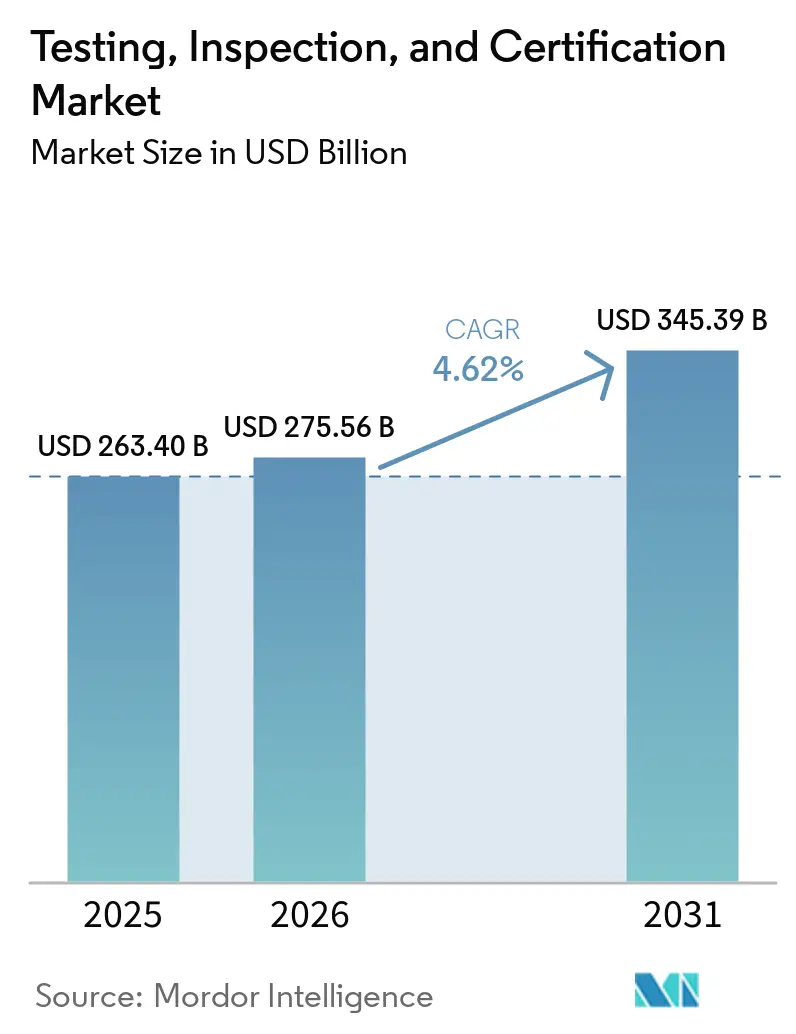
The testing, inspection, and certification market size was valued at USD 275.6 billion in 2026 and estimated to grow from USD 288.3 billion in 2027 to reach USD 358.4 billion by 2032, at a CAGR of 4.45% during the forecast period (2027-2032).
Product-safety duties sustain demand for usable conformity evidence, including for products covered by China’s certification framework. Providers combine specialized laboratory capabilities with external assurance to cover more buyer requirements within a single commercial relationship. Remote assessment can extend that relationship through repeated review of asset conditions. In battery assessment, notified-body status held by a specific group company defines which entity can provide the regulated service within its authorized scope. Price pressure and recognition barriers can limit the returns available from this expanding service scope.
Key Report Takeaways
- By service type, testing held a 61.28% testing, inspection, and certification market share in 2026, while certification is forecast to be the fastest-growing segment at a 4.74% CAGR during 2027-2032.
- Sourcing type was led by outsourced services, with a 74.68% share of the testing, inspection, and certification market size in 2026 and the fastest forecast CAGR of 4.51% during 2027-2032.
- Across industry verticals, consumer goods and retail led with 13.19% of revenue in 2026, while food, agriculture and beverage is forecast to grow fastest at a 5.95% CAGR during 2027-2032.
- By mode of service delivery, on-site services represented 44.38% of revenue in 2026, while remote and digital services are forecast to grow fastest at a 6.55% CAGR during 2027-2032.
- Geographically, Asia-Pacific accounted for 47.35% of revenue in 2026 and is forecast to be the fastest-growing region at a 5.1% CAGR during 2027-2032.
Note: Market numbers in this report are based on Mordor Intelligence's proprietary estimation framework, which combines nine months of actuals with Q4 projections for base year 2026.
Market Trends and Insights
Drivers Impact Analysis of Testing, Inspection, and Certification Market*
| Driver | (~) % Impact on CAGR Forecast | Geographic Relevance | Impact Timeline |
|---|---|---|---|
| Increasing regulatory compliance and product-safety mandates | +1.8% | European Union countries | Short term (≤ 2 years) |
| Expansion of global supply chains demanding third-party assurance | +1.4% | North America, Europe, and Asia-Pacific | Medium term (2-4 years) |
| Surge in consumer electronics and IoT product launches | +1.1% | North America, Europe, and Asia-Pacific | Short term (≤ 2 years) |
| AI-enabled remote and continuous monitoring platforms | +0.65% | England and Wales | Medium term (2-4 years) |
| CBAM verification of actual embedded emissions for covered exports to the EU | +0.55% | European Union countries | Short term (≤ 2 years) |
| Cyber-physical security certification for connected products | +0.4% | European Union countries | Short term (≤ 2 years) |
| Source: Mordor Intelligence | |||
Increasing regulatory compliance and product-safety mandates
Product-safety mandates give manufacturers a defined need for evidence supporting the safety of goods sold in the European Union. Since December 13, 2024, the General Product Safety Regulation has required manufacturers to assess risks and prepare technical documentation before placing covered products on that market.[1] These obligations apply to products within its scope regardless of where they were produced. Where appropriate to possible product risks, the documentation includes risk analysis and mitigation that may incorporate test reports from manufacturers or parties acting on their behalf. Manufacturers retaining the internal analysis can therefore buy external testing to substantiate an identified risk in the required technical file. The commercial opening is risk-specific evidence, so laboratory work must answer the documented safety question to contribute to that file.
Expansion of global supply chains demanding third-party assurance
As supply chains extend across operating locations, accredited management-system certification can give buyers a common basis for assessing distributed suppliers. At December 31, 2025, Global ACI’s survey counted more than 3.28 million valid accredited management-system certificates across the included standards. Those certificates covered more than 5.25 million associated sites worldwide and were issued by bodies accredited by Global ACI Multilateral Recognition Arrangement signatories. Site coverage therefore matters alongside the certificate itself when suppliers design assurance services for distributed operations. Network expansion offers a way to broaden an existing assurance engagement beyond its original locations, rather than depend solely on winning new certificate holders.
Surge in consumer electronics and IoT product launches
For a consumer-electronics manufacturer releasing smartphones or IoT wearables, simultaneous hardware and firmware changes can create new conformity questions. Where a device changes both hardware and software, a provider can assess the interaction between those changes and the product’s intended use. Related designs also create a commercial choice between evaluating each introduction separately and organizing a program around the functions that have changed. A focused assessment can identify which hardware-software interaction needs fresh evidence for a particular smartphone release. This makes the release configuration a practical unit for commissioned assessment, helping the manufacturer address the changed interaction without treating every unchanged component as a new design.
AI-enabled remote and continuous monitoring platforms
AI-assisted remote inspection can expand service demand by making asset evidence available for review without placing the assessor at every observation point. In September 2025, National Grid and sees.ai launched network-wide autonomous drone inspections across England and Wales. The system used flights beyond visual line of sight and AI and machine-learning analysis to inform transmission-network maintenance planning. National Grid, which owns and operates the transmission network, is the inspection buyer, and sees.ai supplies the autonomous drone capability. When an operator needs condition comparisons over time, a repeated-inspection engagement can provide a maintenance-planning record beyond the findings of a single survey.
Restraints Impact Analysis of Testing, Inspection, and Certification Market*
| Restraint | (~) % Impact on CAGR Forecast | Geographic Relevance | Impact Timeline |
|---|---|---|---|
| Margin squeeze from price competition | -0.45% | People’s Republic of China | Short term (≤ 2 years) |
| Trade frictions and divergent national standards | -0.6% | United States and European Union | Short term (≤ 2 years) |
| OEM self-certification via digital twins | -0.2% | European Union countries | Long term (≥ 4 years) |
| Talent shortages in niche test domains (battery, 5G, biotech) | -0.2% | North America, Europe, and Asia-Pacific | Medium term (2-4 years) |
| Source: Mordor Intelligence | |||
Margin squeeze from price competition
Price competition narrows the earnings available from specialized security assessments. In the first half of 2026, Xinjiang Xiling Information Technology reported a year-over-year gross-margin decline at its wholly owned subsidiary Guping Security. The affected services were network security assessment and information-security risk assessment in China, where industry quotations faced pressure. The company’s risk disclosure also described price wars, service homogeneity, and constraints on innovation and research investment in China’s cybersecurity sector. This creates a commercial risk because lower fees leave less room to develop the capabilities that distinguish an assessment.
Trade frictions and divergent national standards
Cross-border assurance becomes more costly when the location of an assessment body restricts acceptance of its work. In its 2026 trade-barriers report, the Office of the United States Trade Representative said EU restrictions outside existing mutual-recognition agreements increased U.S. exporters’ costs and time to market. This makes the applicable recognition arrangement part of the commercial choice of assessment provider, alongside technical capability. For U.S. exporters affected by the reported EU restrictions, provider eligibility adds a market-entry burden beyond the technical work itself.
*Our forecasts treat driver/restraint impacts as directional, not additive. The impact forecasts reflect baseline growth, mix effects, and variable interactions.
Testing, Inspection, and Certification Market Segment Analysis
By Service Type:
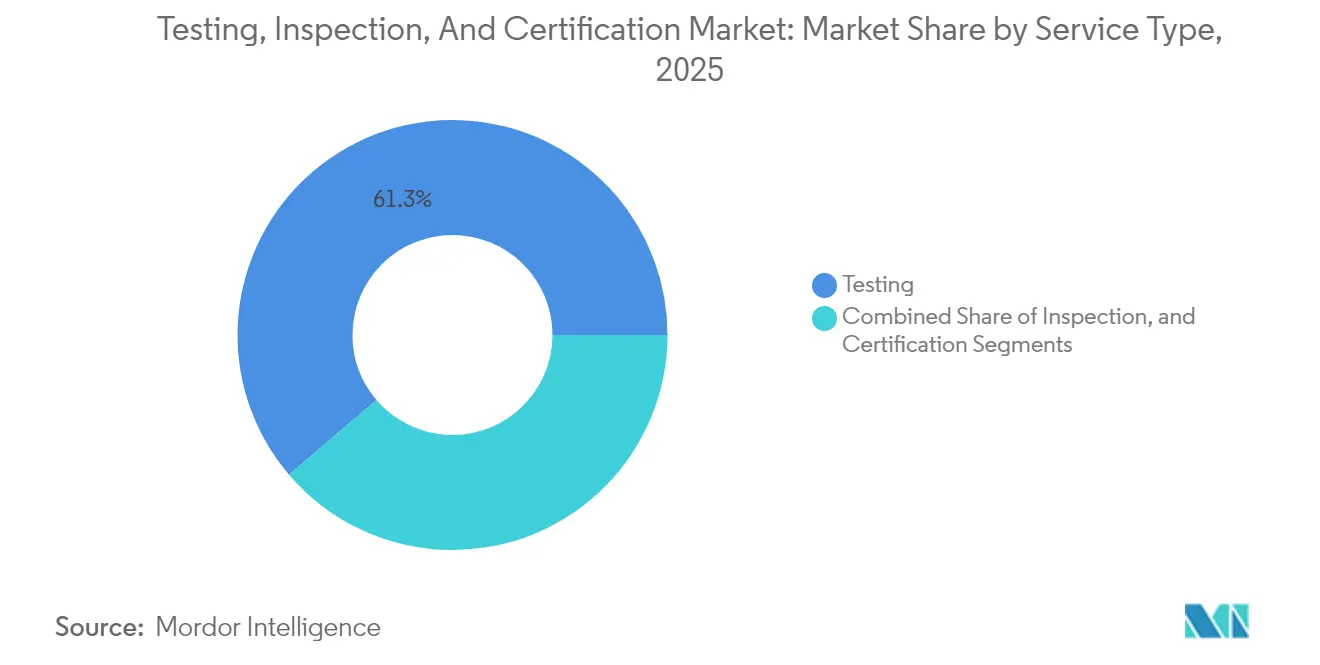
Testing Scale Supports Certification ExpansionTesting accounted for a 61.28% share of the testing, inspection, and certification market size in 2026, making it the largest segment. Intertek Group plc reported testing as its largest assurance, testing, inspection, and certification service by revenue in 2025. Its testing work evaluates how products and services meet quality, safety, sustainability, and performance standards. That breadth brings several buyer requirements within the same service category and gives laboratory capability a wide commercial application. A laboratory able to address those different evaluation needs can pursue more of the assessment work associated with a customer’s product requirements.
Certification is forecast to be the fastest-growing segment, with a 4.74% CAGR during 2027-2032. Bureau Veritas SA reported 7.9% organic revenue growth in its Certification business in 2025. SGS SA’s Business Assurance division recorded 4.2% organic sales growth that year. These results show commercial expansion within 2 established certification businesses, giving the growth opportunity an operating basis beyond a single provider’s experience. The differing organic readings show that expansion in these certification businesses varied by provider in 2025, rather than following a uniform pace.

By Sourcing Type:
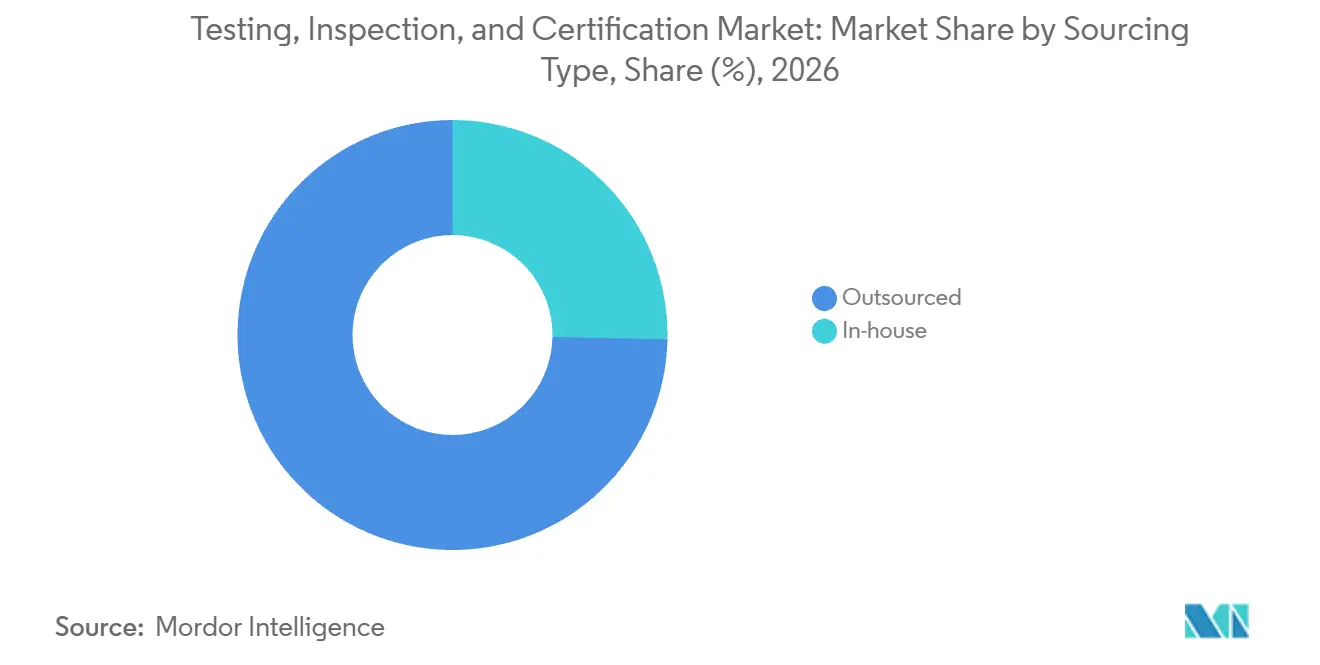
External Contracts Coexist With Internal Release ControlsOutsourced services represented a 74.68% testing, inspection, and certification market share in 2026, making them the largest segment, and are forecast to grow fastest at a 4.51% CAGR during 2027-2032. In February 2025, SGS SA reported a 38-month European Commission contract for soil laboratory analysis across the EU through the Joint Research Centre and LUCAS Survey. More than 35,000 soil samples had been collected across the EU for the program. This procurement model connects a public buyer’s analytical requirement with an external provider’s laboratory capability. Executing a defined analytical program lets the provider serve an assessment need spread across the buyer’s many collection locations.
In-house quality control connects inspection evidence directly to the manufacturer’s decision to release a pharmaceutical product. In its 2025 reporting, 3SBIO described manufacturing bases where products could leave the factory only after internal quality inspection and verification and approval by quality-control managers. Its system also included procedures for inspection data, audit trails, and reporting inspection results. That combination places evidence management alongside the physical inspection within the manufacturer’s release process. External providers serving such manufacturers need findings that can pass through the buyer’s internal inspection and release controls, making the fit with that retained decision process commercially relevant.
By Industry Vertical:
Retail Breadth Meets Specialized Food DemandConsumer goods and retail was the largest segment, accounting for 13.19% of revenue in 2026. Intertek Group plc’s Consumer Products division, which also serves industrial and other sectors, reported 5.5% revenue growth at constant currency year over year in the first half of 2026. The division serves retailers, manufacturers, and distributors across textiles, footwear, toys, home appliances, and other products. Its accredited facilities support quality, safety, regulatory, and brand standards. For retailers and manufacturers, the value of that broad product coverage lies in applying the relevant quality, safety, and brand requirements to each category of goods.
Food, agriculture and beverage is forecast to be the fastest-growing segment, with a 5.95% CAGR during 2027-2032. Eurofins Scientific SE reported mid-single-digit organic growth across most Food & Feed Europe geographies and end markets in the first half of 2026 after unusually adverse January weather slowed the start. It also added 3 North American laboratories for microbiology and food supplement testing in that period. On June 22, 2026, its Eurofins Agro Testing unit announced its completed acquisition of Czech agricultural laboratory Laboratoř Postoloprty, whose services include soil, plant, feed, fertilizer, and water analysis. Together, the new North American laboratories and acquired Czech operation extend Eurofins’ capacity to serve both food-product testing and the agricultural materials underlying those products.
By Mode of Service Delivery:
Production Testing Anchors Physical PresenceOn-site services were the largest segment, accounting for 44.38% of revenue in 2026. ALS Limited reported revenue growth from mine-site production testing in its Minerals business during FY26, which ended March 31, 2026. ALS also delivers on-site coal testing in resource-company-owned laboratories and in ALS-owned mobile laboratories. The operating location and the ownership of the laboratory consequently answer different commercial questions for a mine operator. An on-site service can therefore be structured around the buyer’s production requirement while allowing different ownership arrangements for the laboratory used to deliver it.
Remote / digital services are forecast to be the fastest-growing segment, with a 6.55% CAGR during 2027-2032. SGS SA’s 36-month Pre-shipment Verification of Conformity agreement with the Tanzania Bureau of Standards took effect on March 1, 2025, and included remote shipment inspection. SGS describes the remote service as offering faster turnaround than traditional on-site inspections. The example ties digital delivery to a specified conformity program and public-sector counterparty, keeping the assessment purpose distinct from the technology used to carry it out. A remote shipment assessment can thus be sold within a wider conformity-service agreement, keeping the buyer’s accepted inspection result at the center of the offer.
Geography Analysis
Asia-Pacific Testing, Inspection, and Certification Market
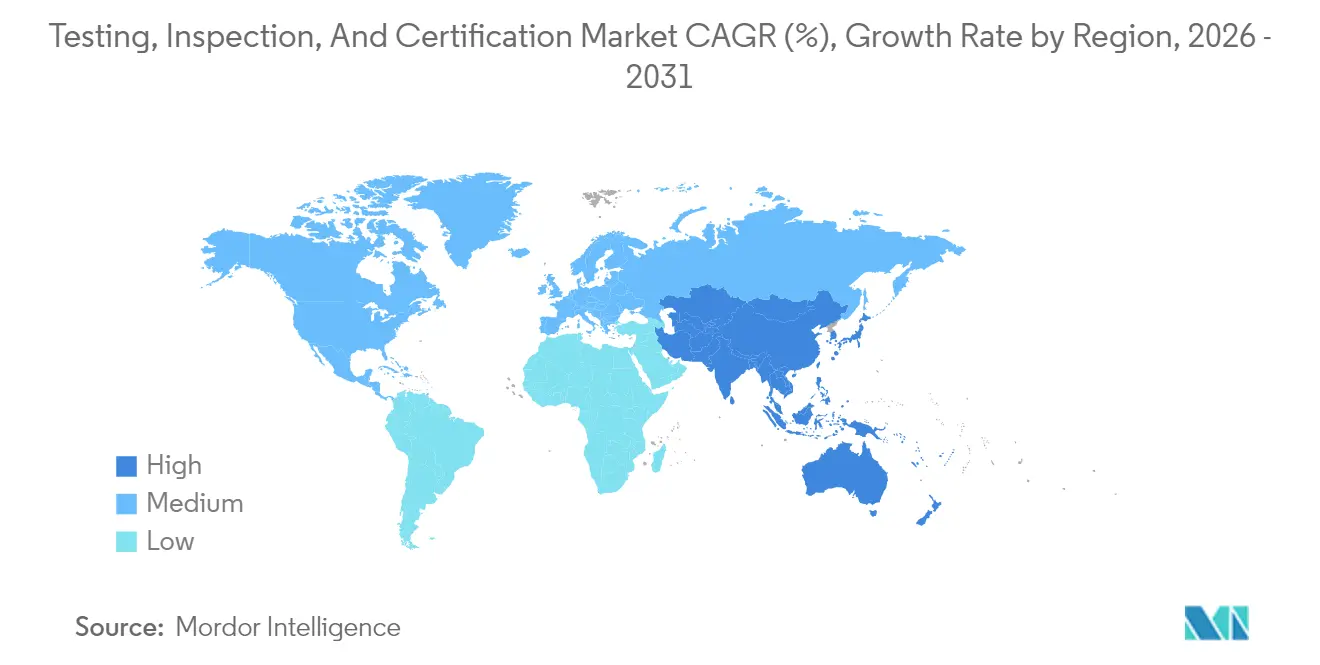
Asia-Pacific represented 47.35% of the testing, inspection, and certification market size in 2026 and is forecast to be the fastest-growing geography, with a 5.1% CAGR during 2027-2032. China’s qualified inspection and testing institutions issued 571 million inspection and testing reports in 2025.[2] China had 54,340 qualified inspection and testing institutions that year, providing a substantial delivery base. Separately in Asia-Pacific, on February 9, 2026, New Zealand’s Ministry of Business, Innovation and Employment published 54 notices recognizing selected Australian WaterMark-certified plumbing and drainage products against specific New Zealand Building Code clauses. China’s qualified inspection and testing institutions also reported 8.76% revenue growth in 2025, indicating commercial expansion among those qualified institutions in China.
In North America, U.S. manufacturers and importers of children’s wearing apparel covered by federal flammability standards in 16 CFR parts 1610 and 1611 must certify compliance using Consumer Product Safety Commission-accredited third-party tests. In Europe, Poland’s Legnica district sanitary and epidemiological station performs physicochemical and microbiological water testing, food and production-environment microbiological testing, and medical microbiology work. The public laboratory combines sampling and testing within accreditation AB 636 with sampling and testing outside that accredited scope. Selecting a laboratory therefore requires matching the particular test’s accreditation status to the compliance task, even when the institution handles several different kinds of samples.
In South America, Chile’s National Standardization Institute awarded DAVIS S.A. the first geodimensional-measurement accreditation for a calibration laboratory in 2025. For instrument users, this opens an accredited calibration option in a measurement field receiving its first such recognition. In Saudi Arabia, the Saudi Standards, Metrology and Quality Organization’s platform lets establishments select an appropriate assessment body to register certificates for technically regulated imported or locally manufactured products. Within the Middle East and Africa, the Standards Organisation of Nigeria began operating separate departments for certification of locally manufactured and imported products in September 2025. A supplier serving both markets files imported and locally manufactured products through the same SASO platform in Saudi Arabia, while in Nigeria the product’s origin decides which Standards Organisation department handles certification.
Regulatory Framework and Outlook
Selected jurisdictions are compared from the perspective of manufacturers buying conformity-assessment services for market access. U.S. electronic certificate-data filing places documentation duties on covered importers, while China’s CCC framework uses designated certification bodies and laboratories. For buyers, that distinction affects which external service can fulfill a required compliance task and which responsibilities stay with the product maker or importer.
Regulatory Table of Testing, Inspection, and Certification Market
| Decision factor | United States | Brazil | Germany | China |
|---|---|---|---|---|
| Primary authority | Consumer Product Safety Commission | Inmetro | Bundesamt für Sicherheit in der Informationstechnik (BSI) under the adopted CRA implementation bill, with assignment effective the day after promulgation | State Administration for Market Regulation |
| Key instruments or direction | 16 CFR part 1110 certificate-data filing from July 8, 2026, with specified FTZ entries from January 8, 2027 | Portaria Inmetro No. 258 registration pathways and 2026-2027 conformity-assessment agenda | EU Cyber Resilience Act and implementation bill adopted October 15, 2026 | CCC catalog rules and announced third-party certification transition for 16 product types from January 1, 2027 |
| Commercial effect | Covered importers electronically file required certificate data | Eligible registrations require certificates, accredited test reports, or technical inspections according to mechanism | Pre-market cybersecurity and lifecycle vulnerability duties for covered products under full application from December 11, 2027 | Designated bodies arrange type testing and factory inspection where product-specific rules require it |
| Current policy attractiveness | Medium | Medium | Medium | Low |
| Future direction of policy attractiveness | Hardening | No change | Hardening | Hardening |
| Source: Mordor Intelligence | ||||
The United States is rated Medium with Hardening because covered importers face electronic certificate-data duties and the specified foreign trade zone phase begins January 8, 2027. Brazil is rated Medium with No change because mechanism-specific registration sets the access route, while the 2026-2027 agenda schedules reviews rather than adopting replacement requirements. Germany’s Medium and Hardening reflect the scheduled pre-market cybersecurity and lifecycle vulnerability duties from December 11, 2027. China’s Low and Hardening reflect designated-provider requirements and the announced January 1, 2027 third-party certification transition for 16 specified product types.
Value Chain Stages
The value chain compares laboratory deployment, analytical work, certification, and the inspection services that follow certification. In mining geochemistry, SGS SA offers both supplier-funded laboratory setups amortized over the contract term and client-funded setups. These alternatives connect infrastructure deployment with the economics of operating a laboratory, making contract design part of how the supplier recovers its initial commitment.
Value Chain Analysis Table of Testing, Inspection, and Certification Market
| Primary activity | Key participants | Value capture | Bottleneck | Resilience response |
|---|---|---|---|---|
| Laboratory design and deployment | Mining laboratory designers and operators such as SGS SA | Design, installation, and operating contract revenue | Site-specific infrastructure and funding commitment | Align the funding model with the operating contract |
| Sample preparation and laboratory testing | Laboratory operators such as SGS SA and Bureau Veritas SA through GeoAssay | Analytical testing and laboratory service fees | Fit between sample preparation and the required analysis | Coordinate preparation and analytical capability within the service network |
| Product certification | Certification providers such as SGS SA and UL Solutions Inc. | Certification assessment fees | Demonstrating compliance within the applicable certification scope | Define the required evidence before the certification assessment |
| Continuing-conformity inspection | Factory inspection and audit providers such as UL Solutions Inc. | Follow-up inspection and audit service revenue | Consistency with original certification requirements at authorized manufacturing locations | Conduct factory inspections and audits at those locations |
| Source: Mordor Intelligence | ||||
Bureau Veritas SA acquired GeoAssay in 2025, adding 3 Chilean mineral-sample preparation and analysis laboratories and 264 technical employees.[3] That combination shows why laboratory expansion involves both physical infrastructure and people with the relevant analytical expertise. UL Solutions Inc.’s follow-up inspections and audits take place after certification at authorized manufacturing locations, checking continued compliance with the original requirements. For UL Solutions, this creates an ongoing plant-level service relationship, making certification the starting point for further inspection work after the initial assessment.
Competitive Landscape
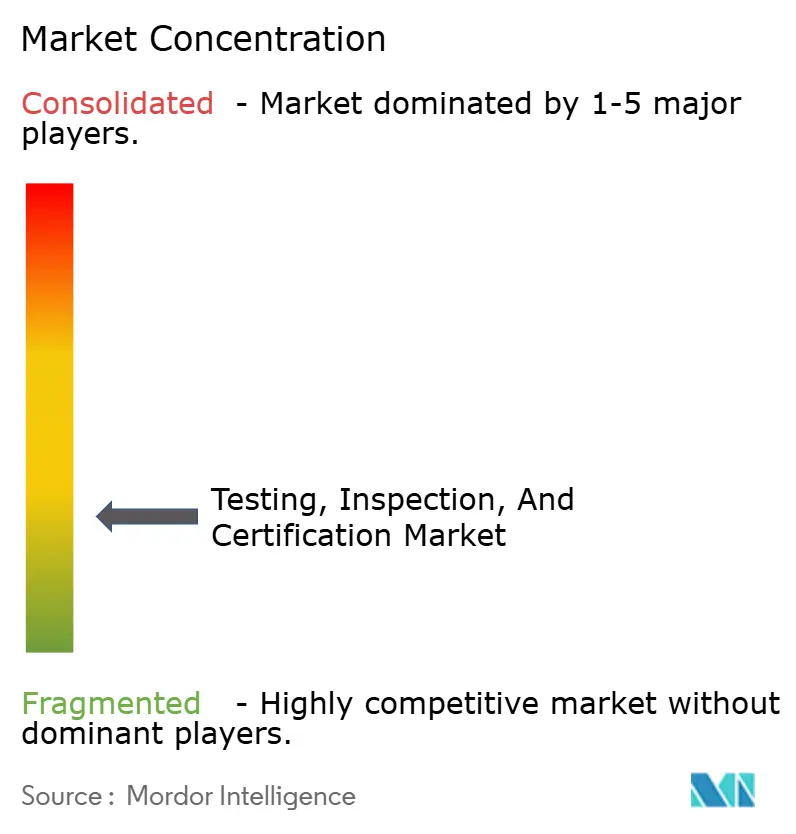
Several global service groups compete alongside specialist testing businesses, giving the industry both broad networks and narrow technical propositions. SGS SA, Bureau Veritas SA, Intertek Group plc, TÜV SÜD AG, and TÜV Rheinland AG participate in testing and conformity-assurance services. TÜV SÜD AG employed more than 30,000 people in 2025, providing one example of the staffing scale of a global service group. SGS and Intertek illustrate how those structures overlap, bringing specialist assessment businesses inside broader networks through acquisitions.
In January 2026, SGS SA acquired Applied Technical Services, adding specialized testing, inspection, calibration, and forensics services in North America. Intertek Group plc acquired Professional Testing Laboratory in November 2025, expanding its U.S. flooring-materials testing business. On June 18, 2026, Intertek Group plc and Isotope Bidco Limited, indirectly owned by EQT funds alongside minority co-investors, agreed a recommended cash acquisition of Intertek. At announcement, completion was expected in Q4 2026 or Q1 2027, subject to satisfaction or waiver of conditions. Intertek described Professional Testing Laboratory as highly complementary to its North American offering and as strengthening its presence in the flooring materials market.
Regulatory designation provides a competitive position separate from network scale. On February 2, 2026, TÜV Rheinland announced that Hungary-based group company TÜV Rheinland InterCert Kft had received notified-body status. The designation identified body number 1008 under Regulation (EU) 2023/1542 for batteries and waste batteries. The designated group company holds that status separately from its parent, making the legal identity of the assessment provider relevant to battery manufacturers. Battery manufacturers seeking that regulated assessment therefore need the entity with the applicable designation, rather than relying on the group’s broader technical capabilities.
Testing, Inspection, and Certification Industry Leaders
-
SGS SA
-
Bureau Veritas SA
-
Intertek Group plc
-
TÜV SÜD AG
-
TÜV Rheinland AG
- *Disclaimer: Major Players sorted in no particular order
Testing, Inspection, and Certification Market Companies Covered in this Report
- SGS SA
- Bureau Veritas SA
- Intertek Group plc
- TÜV SÜD AG
- TÜV Rheinland AG
- TÜV NORD GROUP
- DEKRA SE
- UL Solutions Inc.
- DNV AS
- Applus Servicios Tecnológicos, S.L.
- Eurofins Scientific SE
- ALS Limited
- Kiwa N.V.
- Lloyd’s Register Group Limited
- RINA S.p.A.
- Element Materials Technology Group
- Centre Testing International Group Co. Ltd.
- SAI Global Pty Ltd
- MISTRAS Group Inc.
- NSF International
- BSI Group (The British Standards Institution)
- Cotecna Inspection SA
- SOCOTEC Group SA
- FLOCERT GmbH
- Perry Johnson Registrars Inc.
Read Analysis of Testing, Inspection, and Certification Companies
Key Opportunities for Market Participants
The comparison focuses on assessment opportunities created by specific emissions and digital-product rules. CBAM provides a default-values route, creating verification work for covered non-EU production when actual emissions are used. Full application of the Cyber Resilience Act is scheduled for December 11, 2027. These rules connect the commercial opening to a defined assessment role, making qualification and technical scope central to the service offer.
Market Opportunities Table of Testing, Inspection, and Certification Market
| Opportunity | Why now | Buyer / lead segment | Recommended play | Main barrier | Likely beneficiaries |
|---|---|---|---|---|---|
| Installation-level CBAM verification | Registry verification reports scheduled from January 2027 for covered imports from 2026 using actual emissions | Non-EU covered-goods producers serving EU importers | Build accredited verification capability around covered production sites | Producing verifiable installation-level emissions evidence | Accredited emissions verifiers |
| Critical digital-product conformity assessment | Mandatory notified-body route for critical products under full CRA application from December 11, 2027 | Manufacturers of smart cards, secure elements, and smart meter gateways | Qualify for defined critical-product assessment scopes | Competence assessment, national designation, and notification before service launch | Qualified hardware security assessment providers |
| Assessment of important software and network products | Notified-body assessment in some cases, especially without harmonized standards, from December 11, 2027 | Manufacturers of affected important products such as operating systems, antivirus software, routers, and firewalls | Develop assessment services for the applicable software and network-product scopes | Demonstrating competence for the relevant product scope before national designation | Qualified software and network-product assessors |
| Source: Mordor Intelligence | |||||
The central opening is installation-level CBAM verification for actual emissions, with registry reports scheduled from January 2027, ahead of full Cyber Resilience Act application on December 11, 2027. Accreditation for CBAM verification and designation for CRA assessment attach to the provider’s assessment role, making authorization a separate requirement from technical capability. This earlier reporting milestone makes CBAM accreditation the nearer-term qualification opportunity, while CRA work also depends on national assessment, designation, notification, and monitoring.
Recent Industry Developments in Testing, Inspection, and Certification Market
- Oct 2026: Element Materials Technology Group reported that it had purchased 11 advanced dynamics systems through its IMV partnership across several laboratories, including sites in Huntsville, Alabama, and Longmont, Colorado.
- Oct 2026: Namibia’s Competition Commission approved without conditions Isotope Bidco Limited’s proposed acquisition of Intertek Group plc on October 6, with sole control conditional on implementation. The June 18, 2026 agreement involved a Bidco indirectly owned by EQT funds alongside minority co-investors.
- Jun 2026: Eurofins Agro Testing completed its acquisition of Laboratoř Postoloprty, an accredited Czech agricultural testing laboratory providing soil, plant, feed, fertilizer, water, and other material analyses.
Testing, Inspection, and Certification Market Report Scope and Research Methodology
Market Definition and Coverage
The global testing, inspection, and certification market measures annual worldwide spending on conformity-assurance services, including calibration, performed in-house or by external providers for organizations across industries. These services are classified by service type, sourcing, customer industry, delivery mode, and demand geography.
Scope exclusions: Laboratory instruments and testing equipment sold separately, standalone software products, non-TIC consulting and remediation work, and routine internal quality control without a distinct TIC service are excluded.
Segments Covered in This Report
- By Service Type
- Testing
- Inspection
- Certification
- By Sourcing Type
- In-house
- Outsourced
- By Industry Vertical
- Consumer Goods and Retail
- ICT and Telecom
- Automotive and Transportation
- Aerospace and Defense
- Oil, Gas and Petrochemicals
- Energy and Utilities
- Industrial Manufacturing and Machinery
- Chemicals and Materials
- Construction and Infrastructure
- Life Sciences and Healthcare
- Food, Agriculture and Beverage
- Others (Environment, Sustainability, etc.)
- By Mode of Service Delivery
- On-site
- Off-site/Laboratory
- Remote / Digital
- By Geography
- North America
- United States
- Canada
- Mexico
- South America
- Brazil
- Argentina
- Rest of South America
- Europe
- Germany
- United Kingdom
- France
- Italy
- Spain
- Russia
- Rest of Europe
- Asia-Pacific
- China
- Japan
- India
- South Korea
- South-East Asia
- Rest of Asia-Pacific
- Middle East and Africa
- Middle East
- Saudi Arabia
- United Arab Emirates
- Turkey
- Rest of Middle East
- Africa
- South Africa
- Nigeria
- Rest of Africa
- Middle East
- North America
Data Sources, Market Sizing, and Validation
Desk Research
Public sources such as the European Commission's conformity-assessment guidance and mutual-recognition agreement listings help identify when testing, inspection, certification, and calibration are required and which assessment bodies can supply recognized results. ILAC's Mutual Recognition Arrangement materials describe accredited testing, inspection, and calibration activity, while the TIC Council's annual report provides industry context on independent service providers and standards work.
Company annual reports, regulatory notices, and investor materials help cross-check service portfolios, operating footprints, disclosed business lines, and changes in demand. Reputable trade and financial press can clarify dated acquisitions or market events. The named sources are not exhaustive, and further sources inform collection, validation and clarification.
Primary Interviews and Surveys
Interviews and structured surveys would draw on senior executives, service-line leaders, laboratory and inspection managers, procurement professionals, and relevant industry specialists across APAC, EMEA, and the Americas. Respondents would check secondary findings on service demand, sourcing, delivery mode, customer industries, regional conditions, pricing, and forecast drivers, with questions focused on observable operations and spending.
Where published evidence does not resolve a market boundary, share, or forecast input, follow-up questions would clarify the transaction counted and the applicable service category. Estimates would then be triangulated against regulatory requirements, provider disclosures, and other independent indicators. Conflicting accounts would be retained for analyst review and resolved through additional evidence rather than treated as consensus.
Distribution of primary research fieldwork respondents
| Company type | Respondent position | Region |
|---|---|---|
| Top tier: 37% | CXOs: 20% | APAC: 40% |
| Mid tier: 38% | Functional/Unit leaders: 35% | EMEA: 32% |
| Smaller Players: 25% | Managers: 45% | Americas: 28% |
Market-Sizing & Forecasting
The model estimates global annual TIC spending from the top down, using the approved service-spending boundary, and checks selected totals from the bottom up through provider service-line roll-ups, disclosed contract activity, and sampled service price multiplied by activity volume. It separates outsourced fees from attributable operating expenditure on identifiable in-house TIC services, counts calibration within testing, and counts a bundled engagement once.
Service-type shares are built from provider business-line disclosures and the nature of required conformity work. Sourcing shares use disclosed external contracts and identifiable internal testing or inspection operations. Industry and geography shares are informed by the distribution of regulated products, installed assets, production, trade exposure, and provider activity, while delivery-mode shares reflect the work performed on-site, in laboratories, or remotely. Forecast inputs include regulatory and standards changes, manufacturing and product launch activity, supply-chain trade, installed asset bases, and the mix of internal versus outsourced capability. Multivariate regression can relate these indicators to historical spending, with scenario analysis used where regulations or trade conditions create distinct paths.
Analysts would reconcile indicators that use different periods or definitions and use the closest documented proxy when direct activity data are unavailable. Selective supplier roll-ups and sampled price-times-volume checks would test the larger service lines, with gaps recorded and bridged against disclosed business mix and demand indicators. Primary respondents would be asked to assess whether each forecast variable and its direction fit operating conditions, after which analysts would review the variable-level assumptions against independent evidence.
Data Validation & Update Cycle
Analysts triangulate market totals and segment shares across regulations, provider disclosures, industry indicators, and selective supplier or channel checks, then investigate unusual movements and material differences between independent estimates before sign-off. A multi-step review checks source dates, units, coverage, arithmetic, and the consistency of each estimate with its stated boundary. Re-contact is triggered when an input remains unclear, an account conflicts materially with published evidence, or a material event changes an assumption.
The dataset is refreshed annually, updated between cycles when a material regulatory, trade, or industry event changes the outlook, and given a fresh source and calculation review immediately before delivery.
Mordor Intelligence's Testing Inspection and Certification Market Sizing Compared With Other Published Estimates
Published estimates can differ in the transactions and products they count and the inputs used to model demand. The global testing, inspection, and certification market measures annual worldwide spending on conformity-assurance services, including calibration, performed in-house or by external providers for organizations across industries.
Key Gap Drivers include the study's defined coverage and market-specific modeling choices. Forecast inputs include regulatory and standards changes, manufacturing and product launch activity, supply-chain trade, installed asset bases, and the mix of internal versus outsourced capability.
Benchmark comparison
| Source | Market Size | Gaps in Research Methodology |
|---|---|---|
| Mordor Intelligence | USD 288.3 B (2027) | |
| Global Consultancy A | USD 254.41 B (2026) | At its 2026 base, this estimate is 11.8% below this report's 2027 value of USD 288.3 B, 1 year later. The page's 2026 base and 2026-2031 forecast use a separately estimated in-house component combined with outsourced activity, so the published amount precedes this report's 2027 measurement year. |
| Global Consultancy B | USD 265.6 B (2025) | At its 2025 base, this estimate is 7.9% below this report's 2027 value of USD 288.3 B, 2 years later. The page reports a 2025 base within a 2026-2035 series and a separately identified calibration service category, so its displayed amount reflects an earlier measurement year. |
Mordor Intelligence's analysts triangulate market totals and segment shares across regulations, provider disclosures, industry indicators, and selective supplier or channel checks, then investigate unusual movements and material differences between independent estimates before sign-off.
Key Questions Answered in the Report
What is the testing, inspection, and certification market size and growth outlook?
The size is estimated at USD 288.3 billion in 2027 and forecast to reach USD 358.4 billion by 2032, at a 4.45% CAGR during 2027-2032.
Which forces support demand for conformity-assessment services?
EU product-safety rules require manufacturers to document covered products’ risks before sale. Where appropriate, documentation may include test reports from parties acting on their behalf, while China’s CCC catalog requires designated certification bodies for covered products.
Which conformity-assessment service type has the largest revenue share?
Testing was the largest service type, with a 61.28% share in 2026. Certification is forecast to grow fastest at a 4.74% CAGR during 2027-2032.
Which companies are major testing and conformity-assurance providers?
SGS SA, Bureau Veritas SA, Intertek Group plc, TÜV SÜD AG, and TÜV Rheinland AG are major providers.
What could constrain growth in conformity-assessment services?
Xinjiang Xiling Information Technology reported lower cybersecurity-assessment margins at its wholly owned Guping Security subsidiary in China in the first half of 2026. U.S. trade officials reported higher exporter costs and delays outside existing EU mutual-recognition agreements in 2026.
Which region leads revenue from conformity-assessment services?
Asia-Pacific held 47.35% of revenue in 2026 and is forecast to grow fastest at a 5.1% CAGR during 2027-2032.