
Switzerland Data Center Networking Market Size and Share
Market Overview
| Study Period | 2020 - 2031 |
|---|---|
| Forecast Data Period | 2026 - 2031 |
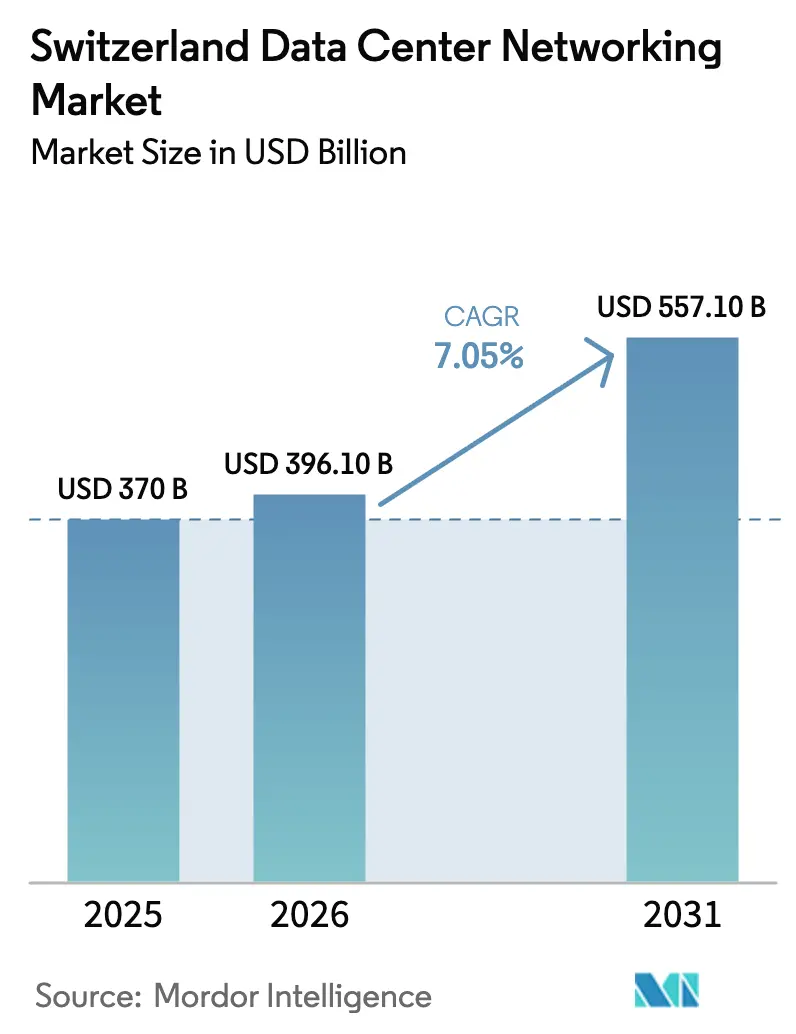
| Base Year Market Size (2025) | USD 370 Billion |
| Market Size (2026) | USD 396.1 Billion |
| Market Size (2031) | USD 557.1 Billion |
| Growth Rate (2026 - 2031) | 7.05 % |
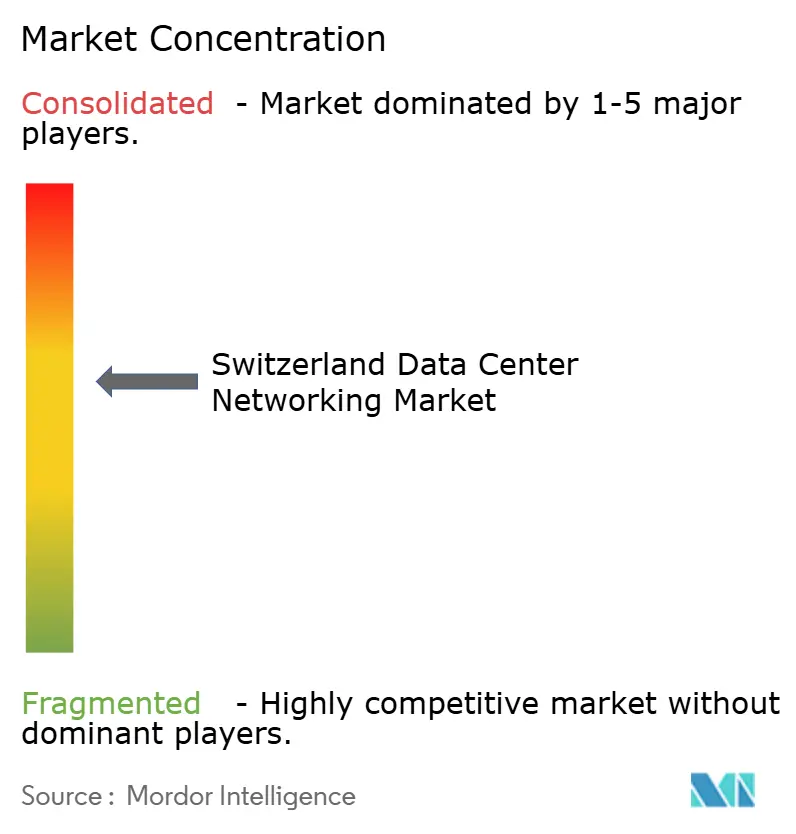
| Market Concentration | Medium |
Major Players *Disclaimer: Major Players sorted in no particular order Image © Mordor Intelligence. Reuse requires attribution under CC BY 4.0. | |
Switzerland Data Center Networking Market Analysis by Mordor Intelligence
The Switzerland data center networking market size in 2026 is estimated at USD 396.1 million, growing from 2025 value of USD 370 million with 2031 projections showing USD 557.1 million, growing at 7.05% CAGR over 2026-2031. Growth is propelled by the country’s data-sovereignty reputation, strict residency rules under the revised Federal Act on Data Protection (revFADP), and a mature IT infrastructure that attracts hyperscale, edge, and colocation investments. Hyperscale cloud providers expanding Swiss footprints, the financial sector’s appetite for micro-second trading latency, and nationwide sustainability targets are jointly accelerating upgrades from 10 GbE fabrics to 50-100 GbE and >100 GbE architectures. Meanwhile, corporate net-zero pledges and the Swiss Datacenter Efficiency Association’s efficiency label have turned energy-efficient switching platforms into a procurement priority, forcing vendors to integrate silicon photonics and heat-re-use capabilities. Vendors unable to satisfy in-country data-residency or efficiency thresholds face elevated entry barriers. These intertwined regulatory, technological, and environmental forces shape a market where compliance and performance are no longer trade-offs but simultaneous purchase criteria
Key Report Takeaways
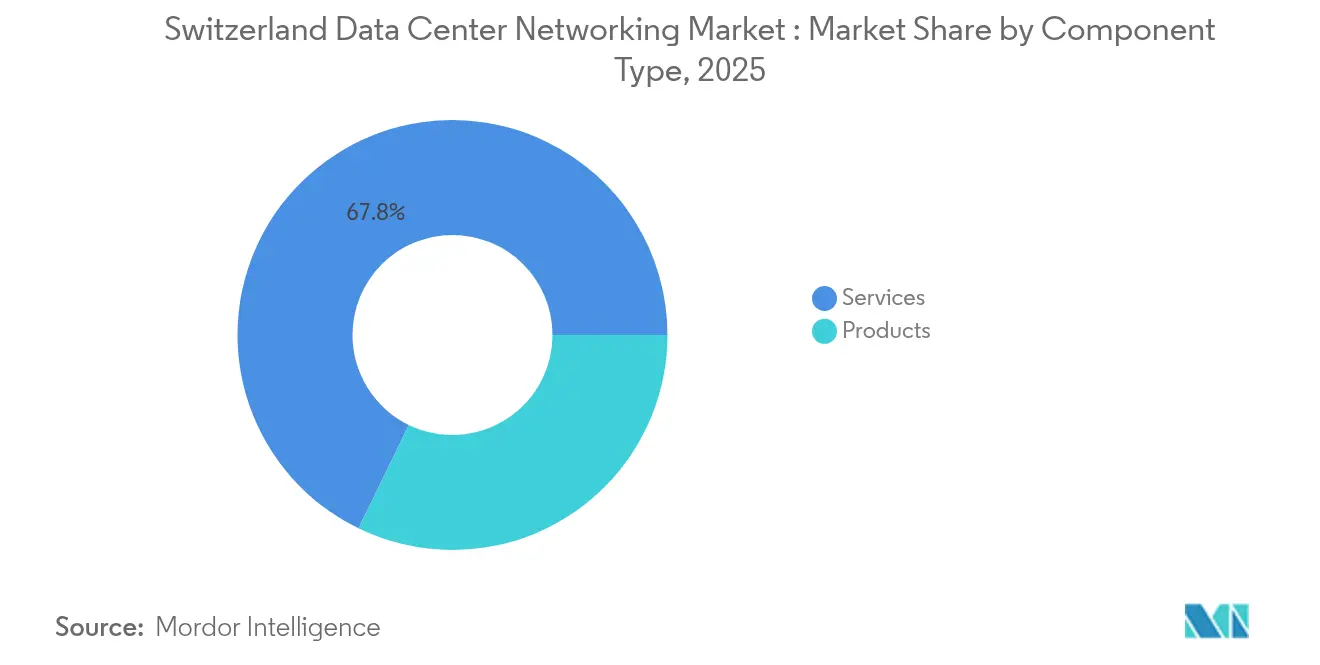
- By component, Ethernet switches led with 32.20% of the Switzerland data center networking market share in 2025, while software-defined networking (SDN) controllers are projected to expand at a 12.76% CAGR through 2031.
- By end-user, the IT & telecommunications segment commanded 33.90% share of the Switzerland data center networking market size in 2025; banking, financial services, and insurance (BFSI) is growing fastest at 11.92% CAGR.
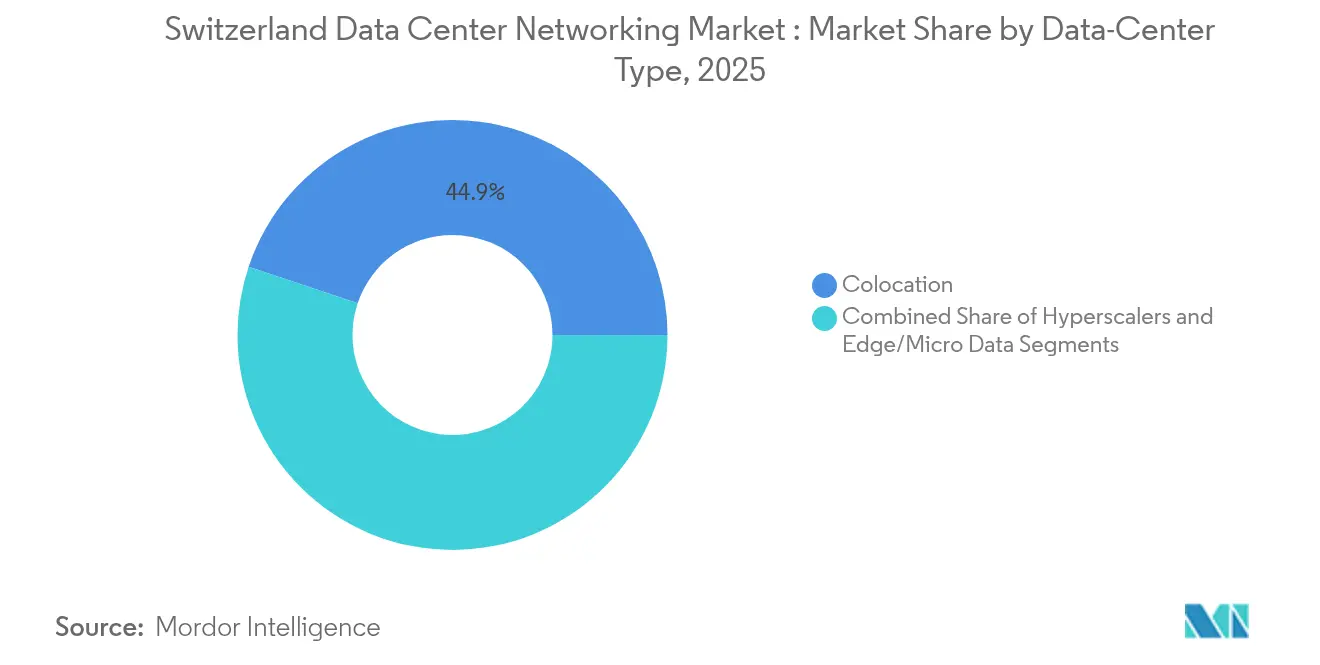
- By data-center type, colocation facilities held 44.85% revenue share in 2025, whereas hyperscale/cloud deployments are set to rise at a 14.05% CAGR to 2031.
- By bandwidth, 50-100 GbE connections represented 36.40% of deployments in 2025; >100 GbE is the quickest-advancing tier, progressing at a 14.72% CAGR.
Note: Market size and forecast figures in this report are generated using Mordor Intelligence’s proprietary estimation framework, updated with the latest available data and insights as of 2026.
Switzerland Data Center Networking Market Trends and Insights
Drivers Impact Analysis*
| Driver | (~) % Impact on CAGR Forecast | Geographic Relevance | Impact Timeline |
|---|---|---|---|
| Growing adoption of cloud services and hyperscale build-outs | +1.8% | Zurich, Geneva, Basel | Medium term (2-4 years) |
| Surge in data backup/archival mandates | +1.2% | National, finance hubs | Short term (≤ 2 years) |
| Edge and micro-data-center rollout | +1.5% | Urban and industrial regions | Medium term (2-4 years) |
| revFADP in-country compliance upgrades | +0.9% | National | Short term (≤ 2 years) |
| Corporate net-zero targets | +0.7% | Major data-center hubs | Long term (≥ 4 years) |
| Ultra-low-latency trading infrastructure | +0.4% | Zurich financial district | Short term (≤ 2 years) |
| Source: Mordor Intelligence | |||
Growing adoption of cloud services and hyperscale build-outs
Hyperscale operators are accelerating Swiss expansions to attract European clients requiring local data residency. Microsoft earmarked USD 400 million to enlarge its Swiss cloud region in June 2025, signalling confidence in Switzerland’s strategic location for pan-European workloads.[1]Microsoft Corp., “Microsoft Expands Swiss Cloud Region,” microsoft.com Enterprises upgrading to 25-100 GbE fabrics now treat network modernization as a prerequisite for multicloud workloads rather than a discretionary refresh. Swisscom’s Network Vision 2030+ consolidates ten legacy IP networks into a unified backbone, creating capacity headroom for 25% annual traffic growth and offering deterministic latency suited to real-time finance applications. Financial-services participants in Zurich are migrating algorithmic trading engines to new high-density fabrics where microsecond latency reductions translate directly into competitive trading advantages.
Surge in data backup/archival mandates among Swiss enterprises
revFADP demands exhaustive audit trails, compelling firms to implement geo-redundant archival nodes. Swissmedic’s CHF 185 million (USD 208 million) 15-year deal with Swisscom embeds robust archival, encryption, and disaster-recovery functions into the regulator’s pharmaceutical oversight IT stack. Similar mandates in healthcare and life sciences trigger the procurement of storage-area-network controllers able to automate data migration across twin or triple-site architectures. The resulting traffic shifts stimulate uptake of load balancers and application-delivery controllers sized for encrypted throughput as archival windows narrow from overnight to near-real-time.
Edge and micro-data-center rollout for low-latency IoT workloads
Smart-factory pilots, autonomous vehicle tests, and city-wide sensor grids require compute nodes within single-digit millisecond proximity. NTT’s All-Photonics Network proof-of-concept demonstrated sub-millisecond cross-data-center latency, validating optical topologies designed for Swiss municipal edge clusters.[2]NTT DATA, “All-Photonics Network Demonstration in Switzerland,” nttdata.com nLighten’s purchase of seven Swiss edge sites from EXA Infrastructure brings micro-data-center capacity closer to industrial zones and transit corridors, elevating demand for compact, high-performance switches featuring redundant power in sub-5 kW footprints.[3]EdgeIR, “nLighten Acquires Seven Swiss Edge Data Centers,” edgeir.com Industrial clients consequently seek dual-stack fabrics able to bridge OT protocols with standard Ethernet on a single switching plane.
Corporate net-zero targets driving energy-efficient switching fabrics
Energy-efficiency labels now influence tender award criteria alongside throughput and latency scores. The Swiss Datacenter Efficiency Association’s certification scheme, underwritten by the Federal Office of Energy, rates facilities on the holistic energy balance of cooling, compute, and networking subsystems. Green Datacenter’s forthcoming 12 MW Zurich West facility integrates waste-heat extraction for district heating and natural-cooling airflow, proving that sustainability need not limit high-density pods. Such initiatives advance silicon-photonics modules and co-packaged optics that extend bandwidth while reducing watt-per-gigabit ratios.
Restraints Impact Analysis*
| Restraint | (~) % Impact on CAGR Forecast | Geographic Relevance | Impact Timeline |
|---|---|---|---|
| Scarcity of certified data-center networking talent | -0.8% | National, German-speaking cantons | Medium term (2-4 years) |
| High capex/opex for 100 GbE+ optical and silicon | -1.1% | Major data-center hubs | Short term (≤ 2 years) |
| EU chip-supply bottlenecks | -0.6% | Nationwide | Short term (≤ 2 years) |
| Regulatory scrutiny on Chinese-origin gear | -0.4% | Finance sector nodes | Medium term (2-4 years) |
| Source: Mordor Intelligence | |||
Scarcity of certified data-center networking talent
Switzerland hosts only a limited pool of engineers certified on SDN, optical interconnects, and AI-aware fabrics. Swisscom already employs 200 data-security specialists across six data centers and invests CHF 1.7 billion (USD 1.91 billion) annually in infrastructure and training to secure talent retention. Immigration ceilings tighten availability further, prompting enterprises to outsource run-ops to managed services or adopt low-touch automation platforms that curb manual configuration workloads
High capex/opex for 100 GbE+ optical and silicon
Transitioning from 10 GbE to 100 GbE+ demands fresh cabling plans, higher-grade optics, and staff upskilling, pushing project outlays 40–60% beyond electrical upgrades according to silicon-photonics supplier benchmarks. EU supply volatility in rare-earth metals inflates transceiver costs, while limited Swiss repair depots elevate spares logistics. Mid-market enterprises therefore pace migrations in line with depreciation cycles rather than immediate performance demands, tempering overall bandwidth-mix acceleration.
*Our forecasts treat driver/restraint impacts as directional, not additive. The impact forecasts reflect baseline growth, mix effects, and variable interactions.
Segment Analysis
By Component: Software-Defined Innovation Outpaces Legacy Gear
Switzerland data center networking market size for SDN controllers is projected to expand at 12.76% CAGR, reflecting enterprises’ preference for controller-based policy orchestration across on-premises, colocation, and multicloud footprints. The Switzerland data center networking market share for Ethernet switches remained highest at 32.20% in 2025, yet fabrics are undergoing generational upgrades from fixed 10 GbE leaf-spine layouts toward modular 50-100 GbE systems that exploit breakout optics and deep buffer memory. Routers maintain relevance for inter-data-center links, where deterministic routing tables guarantee compliance with financial-sector latency SLAs. AI clusters further spur adoption of 400G optical interconnects, and Cisco’s purpose-built optics for GPU fabrics illustrate vendor strategies aimed at GPU-to-GPU lossless throughput. Network-security appliances post steady gains as zero-trust models enforce east-west traffic inspection inside virtualization domains.
The component mix is experiencing silicon innovation couched in sustainability goals. Co-packaged optics lower watts-per-gigabit, helping enterprises align with the efficiency label’s power-usage-effectiveness benchmarks. Storage-area-network gear sees renewed investment as revFADP prompts triple-site backup replication. Vendors offering controller plug-ins for hybrid-cloud policy mapping win preference over point products, while open-hardware white-box offerings secure niche deployments at hyperscalers aiming for cost control and disaggregated procurement.



By End-User: Financial Verticals Pursue Deterministic Latency
Within the Switzerland data center networking market, BFSI workloads drive premium switch and timing-protocol demand. High-frequency trading desks invest in Layer 1 optical bypass fabrics to shave microseconds, spurring 11.92% CAGR through 2031 for the segment. The Switzerland data center networking industry’s IT & telecom operators, holding 33.90% share, remain anchor tenants of colocation halls and early adopters of 800G backbones linking metropolitan rings. Public-sector agencies upgrade to air-gapped enclaves featuring mandatory on-shore key-management modules. Healthcare providers integrate network slicing to prioritize telemedicine packets alongside imaging archives compliant with Swissmedic retention rules, while life-science firms rely on deterministic east-west throughput for genomics pipelines. Manufacturers adopt converged OT/IT fabrics to monitor predictive-maintenance telemetry and close control-loop latency inside factory floors. Media companies transition from satellite uplinks to IP-based 4K/8K contribution feeds, demanding multicast-optimized leaf-tier switches.
By Data-Center Type: Hyperscalers Dominate Expansion Projects
Colocation continues as Switzerland data center networking market’s largest venue at 44.85% share, but hyperscalers enjoy the strongest 14.05% CAGR as global providers establish in-country regions to serve European workloads under revFADP. The Switzerland data center networking market size for hyperscale segments benefits from custom ASICs and electrical-mechanical co-design that squeeze rack power envelopes while targeting ≥95% network uptime. Edge and micro-facilities emerge along rail hubs, factory campuses, and alpine tunnels, catering to ultra-low-latency IoT and content-delivery cases. Swisscom’s December 2024 buy-out of the Bonvillars site enlarges its colocation cluster in Romandie, underpinning geo-redundancy for French-speaking enterprises. Underground data-center blueprints, such as the 82% cost-index Flums facility, illustrate innovative responses to land scarcity and thermal management within a geology that assures physical security.
By Bandwidth: Greater Than 100 GbE Transitions Gain Momentum
Mainstream Swiss facilities standardized on 50-100 GbE, which captured a 36.40% share in 2025. However, >100 GbE lines, led by 400G and 800G Ethernet, are scaling at 14.72% CAGR as GPU clusters, AI inference farms, and market-data distribution platforms saturate current pipes. The Switzerland data center networking market size for >100 GbE portfolios is primed to peak as silicon-photonics costs normalize. QSFP-TEK and linear-drive pluggable optics offer vendors alternate power-latency trade-offs. Conversely, ≤25 GbE persists in edge pop-ups where cost and power budgets outrank raw throughput. Network teams architect cable-plant migrations toward single-pair multimode pathways to future-proof against upcoming 1.6T modules, while software toolchains evolve to automate load balancing across mixed speed tiers.
Geography Analysis
The Switzerland data center networking market clusters around Zurich, Geneva, and Basel, home to finance, international organizations, and life-sciences headquarters respectively. Zurich’s trading venues compel micro-second fiber routes between data centers and exchange engines, sustaining premium connectivity tariffs. Geneva appeals to multinational bodies demanding neutral hosting under strong privacy laws, while Basel’s pharmaceutical corridor upgrades network fabrics to accommodate genomic analytics. Hydroelectric resources supply 60% of national power, enabling operators to tout renewable energy mixes that complement net-zero targets. Fiber-to-the-home penetration exceeds 50% nationally, yet rural canton variance prompts government incentives for last-mile optic builds. Cross-border dark-fiber links to Frankfurt and Milan extend bandwidth pools, though operators maintain in-country mirrors to uphold revFADP. Underground designs, including caverns repurposed from military bunkers, reduce cooling loads by leveraging ambient rock temperatures and deliver resilience from surface hazards. These geographical strengths reinforce Switzerland’s perception as Europe’s data-sovereignty enclave where robust regulatory governance coexists with innovative infrastructure models.
Regulatory Landscape
Switzerland’s data center networking requirements are shaped by converging privacy, cybersecurity, and sectoral outsourcing rules that push operators toward in-country control, strong auditability, and higher security baselines. The revised Federal Act on Data Protection (revFADP) reinforces data-governance expectations that, in practice, drive network segmentation, logging, and encryption upgrades for regulated workloads hosted in colocation and cloud environments. In parallel, the Information Security Act (ISA) has been in force since 1 January 2024, introducing cyber-attack reporting obligations for critical infrastructure operators effective 1 April 2025, with sanctionability in place since 1 October 2025 (fines up to CHF 100,000). This raises demand for resilient, observable switching and security architectures.
Financial-services and telecom-related deployments face additional compliance drivers. FINMA’s Outsourcing Circular 2018/3 and related guidance (including Guidance 03/2024) influence how supervised institutions govern ICT and cloud outsourcing, often translating into requirements for demonstrable control over network security, monitoring, and supplier risk. Procurement and assurance also reference minimum ICT standards published by the Federal Office for National Economic Supply (FONES), aligned to NIST concepts. Separately, the Federal Act on the Surveillance of Post and Telecommunications (SPTA) imposes lawful-interception enablement on relevant providers, affecting network design and vendor selection for in-country connectivity services.
Competitive Landscape
Global incumbents—Cisco, Juniper, Arista—address performance and compliance by embedding revFADP-aware telemetry and integrating local key-management servers. Regional integrators partner with these vendors to compensate for talent shortages, delivering turnkey fabric swaps that accelerate go-live cycles. Arista’s collaboration with NVIDIA on EOS AI Agent joins switch telemetry with GPU utilization metrics, delivering closed-loop congestion control tailored for AI clusters. Optical specialists such as Infinera and Nokia supply coherent pluggables for metro links, while white-box ODMs target hyperscalers seeking cost efficiencies through disaggregation. Sustainability pressures spur vendor roadmaps toward co-packaged optics and recyclable chassis materials, with Green Datacenter trialing circular-economy procurement for network racks. Regulatory scrutiny on Chinese-origin equipment directs finance clients toward Western or Japanese suppliers, compressing vendor diversity but elevating compliance confidence. Medium-sized firms exploit niches in edge orchestration, selling controller software that provisions multi-site micro-data-center arrays from a single dashboard. The overall vendor field remains moderately fragmented, yet solution breadth and local alignment increasingly dictate long-term share retention.
Switzerland Data Center Networking Industry Leaders
Cisco Systems, Inc.
Arista Networks, Inc.
Hewlett Packard Enterprise Company
Juniper Networks, Inc.
Dell Technologies Inc.
- *Disclaimer: Major Players sorted in no particular order

Market Opportunities and Future Outlook
The clearest opportunity is compliance-led modernization that pairs higher bandwidth fabrics with provable security and reporting capabilities. The ISA’s incident reporting obligations (effective 1 April 2025) and the sanction regime from 1 October 2025 increase the need for advanced telemetry, segmentation, and security inspection inside east-west traffic flows. That, in turn, supports demand for SDN controllers, network security appliances, and encrypted high-throughput load balancing across geo-redundant architectures. In BFSI, FINMA outsourcing expectations reinforce procurement for controlled, auditable networking stacks in colocation and private-cloud footprints, widening whitespace for managed network services and integration partners that can package compliance controls alongside 50-100 GbE and >100 GbE migration programs.
Capacity expansions and sovereignty-focused cloud build-outs keep the pipeline active for next-generation switching and optical interconnects. Microsoft’s USD 400 million Swiss cloud and AI investment announced in June 2025, and Green’s large-scale data center campus investment near Zurich (CHF 500 million, 46,000 square meters), anchor near-term infrastructure additions that require spine-leaf refreshes, metro optical upgrades, and power-efficient architectures aligned with energy-efficiency labeling initiatives in Switzerland. International Geneva’s emphasis on cyber resilience and secure digital infrastructure also supports demand for sovereign, high-assurance connectivity, including approaches such as quantum-resistant networking and hardened private data-center designs, leaving room for vendors and integrators that can deliver secure fabrics with strong lifecycle support under Swiss compliance expectations.
Recent Industry Developments
- June 2026: Arista Networks introduced a next-generation 1.6 Terabit portfolio designed for AI networking fabrics. The launch strengthens Switzerland hyperscale and edge deployment capabilities for AI data-center modernization. The move enhances Arista's positioning in Swiss high-performance networking for data centers.
- April 2026: Cisco Systems announced the official agenda for Cisco Connect 2026 Switzerland, focusing on AI-ready data centers and digital resilience. The agenda signals a strategic emphasis on AI-enabled infrastructure and sovereign-grade deployments in Switzerland. The initiative broadens Cisco's footprint in Swiss data-center upgrades and government-aligned resilience projects.
- March 2026: Arista Networks appointed Lars Walter to lead Swiss market expansion efforts for cloud and AI data center networking. The leadership appointment reinforces Arista's Swiss market execution for cloud and AI data-center networking. The decision accelerates go-to-market momentum in the Swiss data-center ecosystem.


Research Methodology Framework and Report Scope
Market Definition and Coverage
For this study, the market covers spending in Switzerland on networking equipment and related services used inside data centers to move data reliably across servers, storage, and external connectivity. The value is counted when the solution is purchased for data center use, across new builds and refresh cycles.
Scope exclusions: We exclude general enterprise campus networking that is not deployed in a data center environment, along with pure facility construction spend such as buildings, power, and cooling.
Segmentation Overview
- By Component
- Products
- Ethernet Switches
- Routers
- Storage Area Network (SAN)
- Application Delivery Controllers (ADC)
- Network Security Appliances
- Software-Defined Networking (SDN) Controllers
- Optical Interconnects
- Services
- Installation and Integration
- Training and Consulting
- Support and Maintenance
- Managed Network Services
- Products
- By End-User
- IT and Telecommunications
- Banking, Financial Services and Insurance (BFSI)
- Government and Defense
- Media and Entertainment
- Healthcare and Life Sciences
- Manufacturing and Industrial
- Other End-Users
- By Data-Center Type
- Colocation
- Hyperscalers/Cloud Service Providers
- Edge/Micro Data Centers
- By Bandwidth
- LessThan equals to 10 GbE
- 25–40 GbE
- 50–100 GbE
- Greater Than 100 GbE
Data Sources, Market Sizing, and Validation
Desk Research
Desk research was used to set the outer boundaries of demand in Switzerland and to anchor assumptions that are hard to validate only from interviews. We referenced public infrastructure and telecom indicators, then translated them to the way data centers typically refresh switching, routing, and related network layers.
The main public sources used include official statistics and policy releases from the Swiss Federal Statistical Office (FSO) and the Federal Office of Communications (OFCOM), along with international datasets such as the ITU and OECD for broadband and digital adoption context. We also reviewed publications from internet exchange and networking bodies such as RIPE NCC and IETF, plus peer-reviewed papers that track traffic growth and data center network design shifts. To connect the model to commercial realities, we used company filings, investor presentations, and reputable press coverage, plus selective paid subscriptions for company financials and intelligence, patent databases, and import-export shipment checks where relevant. This list is illustrative only, and other sources were also used to support data collection, validation, and clarification.
Primary Interviews and Surveys
Our interviews and surveys in Switzerland cover data-center operators, cloud and colocation teams, network integrators, distributors, and enterprise IT buyers. Respondents clarify refresh cycles, bandwidth mix, ASP movement, utilization, project timing, and the networking share of data-center budgets. Their input is used to test secondary indicators, fill missing details, and support final triangulation within the Swiss market.
Distribution of primary research fieldwork respondents
| Company type | Respondent position |
|---|---|
| Top tier: 29% | CXOs: 18% |
| Mid tier: 46% | Functional/Unit leaders: 32% |
| Smaller Players: 25% | Managers: 50% |
Market-Sizing & Forecasting
Sizing starts from a top-down build where data center capacity signals in Switzerland are translated into networking demand through equipment intensity and refresh behavior, and then the total is rebuilt by bandwidth steps and typical architecture layers. Once the first model is prepared, it is cross-checked with bottom-up approximations, such as sampled ASP-by-port x estimated port volumes for common switch classes, plus channel checks on mix split between new deployment and replacement.
A few practical inputs that shape the model include: installed and planned data center capacity, rack density shifts that push east-west traffic, adoption of higher-speed Ethernet (10 GbE moving to 25 to 40 GbE and above), average refresh cycles for core and leaf layers, and observed service attachment for design, integration, and maintenance. When some parts of the mix are not visible enough, gaps are handled by applying conservative ranges that are later narrowed through interview consensus. For forecasting, scenario analysis is used so that demand can be flexed based on build-out timing, bandwidth migration pace, and pricing movement, and then reviewed against what buyers and supply-side experts expect over the next few years.
Data Validation & Update Cycle
Outputs are validated through multiple checks so single-source bias is reduced. We compare totals against independent signals such as capacity additions, procurement timing, and the implied unit volumes behind the revenue estimate, then investigate any large jumps that do not match known refresh patterns.
Before sign-off, the model and assumptions go through stepwise analyst reviews, and re-contacts are triggered when there are material variances by component, bandwidth, or end-user category. Reports are refreshed annually, with interim updates when major events change pricing, supply, or build-out plans. Right before delivery, a fresh pass is completed so the final view reflects the most recent developments.
Mordor Intelligence's Switzerland Data Center Networking Market Size Versus Other Published Estimates
Published market sizes for Switzerland data center networking can look far apart because the boundaries are not always set the same way, and because pricing and upgrade timing can be handled differently. In practice, the biggest swings usually come from whether services are counted, how bandwidth migration is timed, and whether adjacent IT infrastructure spend is blended into the networking number.
By tracking bandwidth mix, refresh cycles, and Switzerland-specific pricing inputs, Mordor Intelligence keeps the model focused on data center networking spend only, and it avoids mixing in broader data center infrastructure categories that can inflate totals.
Benchmark comparison
| Source | Market Size | Gaps in Research Methodology |
|---|---|---|
| Mordor Intelligence | USD 370 B (2025) | |
| Regional Consultancy A | USD 578.3 M (2025) | This estimate appears to use a narrower networking-only view with different unit pricing and a longer horizon, and it may not align the base year and currency timing to the same refresh cycle assumptions used in this study. |
| Trade Journal B | USD 820.8 M (2025) | This value likely blends networking with wider data center infrastructure spending (where networking is a sub-part), and it can therefore overstate pure switching and routing demand when mapped back to ports and bandwidth adoption. |
The spread in published values is mainly explained by scope boundaries and how bandwidth upgrades are converted into dollars over time. When definitions are kept tight and assumptions are checked against capacity signals and realistic refresh timing, the resulting market size becomes easier to trace and repeat across updates.


Key Questions Answered in the Report
What is the current value of the Switzerland data center networking market?
The market is valued at USD 396.1 million in 2026 and is projected to reach USD 557.1 million by 2031.
Which component segment holds the largest share?
Ethernet switches accounted for 32.20% market share in 2025, making them the largest component category.
Why are hyperscalers expanding rapidly in Switzerland?
Strict data-residency laws, political stability, and renewable energy availability encourage hyperscalers to build local regions while serving wider European workloads.
How are sustainability goals influencing networking hardware choices?
Corporate net-zero targets and the Swiss Datacenter Efficiency Association’s label push operators toward energy-efficient switches, silicon-photonics optics, and waste-heat-re-use designs.
Which bandwidth tier is growing fastest?
Greater Than 100 GbE lines, fueled by AI and high-frequency trading needs, are advancing at a 14.72% CAGR to 2031.
What is the main talent-related restraint in the Swiss market?
A shortage of certified engineers in SDN and optical networking inflates labor costs and slows deployment velocity, particularly in German-speaking cantons.
Page last updated on:
- Data Center Server Market Servers worldwide, split by tier, facility size and facility type.
- Artificial Intelligence (AI) Data Center Market AI facilities across the global market, covering facility type, component and tier.
- Data Center Construction Market Construction across the global market, covering tier, facility size and facility type.
- Switzerland Data Center Physical Security Market Switzerland physical security, split by solution type and service type.
- Switzerland Data Center Storage Market Switzerland storage, split by storage technology, storage type and facility type.
- Mexico Data Center Cooling Market Cooling in Mexico, split by cooling technology, type and end-user industry.
- Brazil Data Center Water Consumption Market Brazil's water use, split by source of water procurement, data-centre type and data-centre size.
- Switzerland Data Center Cooling Market Cooling in Switzerland, split by facility type, tier and cooling technology.





