
Switzerland Data Center Rack Market Size and Share
Market Overview
| Study Period | 2020 - 2031 |
|---|---|
| Forecast Data Period | 2026 - 2031 |
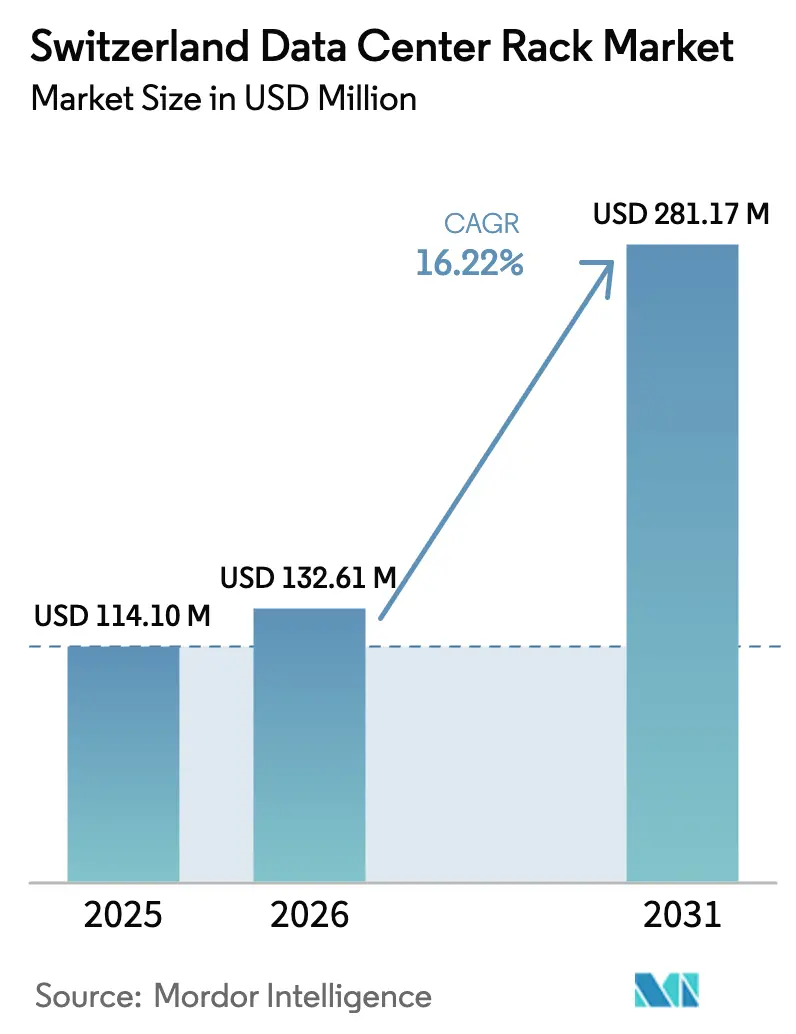
| Base Year Market Size (2025) | USD 114.1 Million |
| Market Size (2026) | USD 132.61 Million |
| Market Size (2031) | USD 281.17 Million |
| Growth Rate (2026 - 2031) | 16.22 % |
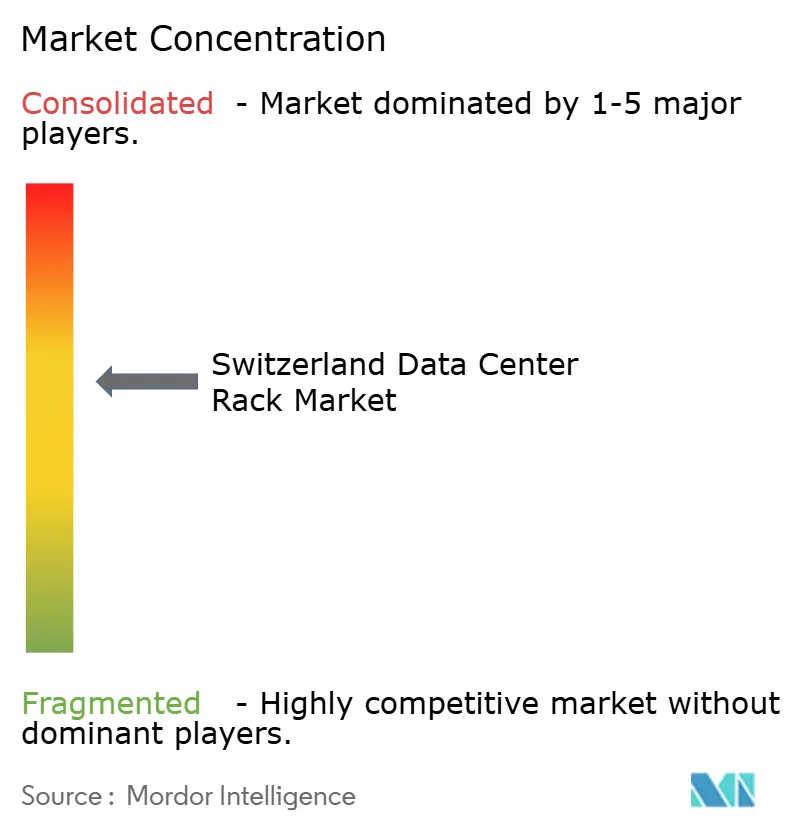
| Market Concentration | Medium |
Major Players *Disclaimer: Major Players sorted in no particular order Image © Mordor Intelligence. Reuse requires attribution under CC BY 4.0. | |
Switzerland Data Center Rack Market Analysis by Mordor Intelligence
The Switzerland data center rack market size was valued at USD 114.1 million in 2025 and estimated to grow from USD 132.61 million in 2026 to reach USD 281.17 million by 2031, at a CAGR of 16.22% during the forecast period (2026-2031). Heightened investments by global cloud providers, including Microsoft’s multi-year expansion of AI-ready infrastructure in Zurich and Geneva, continue to anchor growth. [1]Microsoft Corporation, “Investing in Switzerland’s Digital Future,” microsoft.comFinancial-services digitalization, pharma research digitization, and Switzerland’s expanding role as a European data-sovereignty hub amplify demand for high-density cabinets that pair seamlessly with liquid cooling systems. A supportive regulatory backdrop—ranging from cantonal waste-heat reuse mandates to federal incentives that favor renewable power—pushes operators toward energy-efficient rack designs that blend steel strength with lighter aluminum innovations. At the same time, the nation’s land scarcity accelerates micro-modular deployments that pack more compute into smaller footprints while easing grid constraints. Supply-chain volatility, notably a 5.9% jump in steel prices during 2025, is nudging buyers to diversify materials and source locally. [2]Engineering News-Record Staff, “Steel Prices Spike on Tariffs,” enr.com
Key Report Takeaways
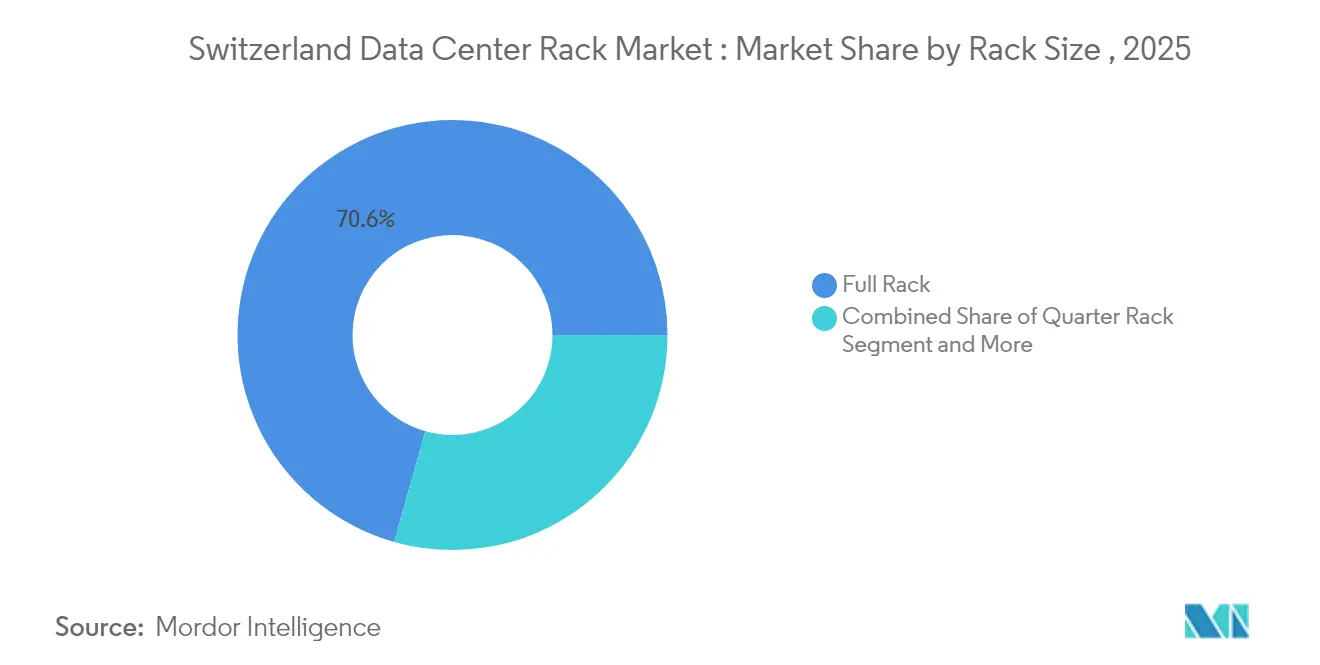
- By rack size, full rack configurations led with 70.62% of Switzerland data center rack market share in 2025; half rack installations are projected to rise at a 19.12% CAGR to 2031.
- By rack height, the 42U format dominated with 54.55% of Switzerland data center rack market size in 2025, while 48U designs are advancing at an 18.27% CAGR through 2031.
- By rack type, cabinet enclosures captured 75.62% revenue share in 2025; they also deliver the swiftest growth at 19.06% CAGR through 2031.
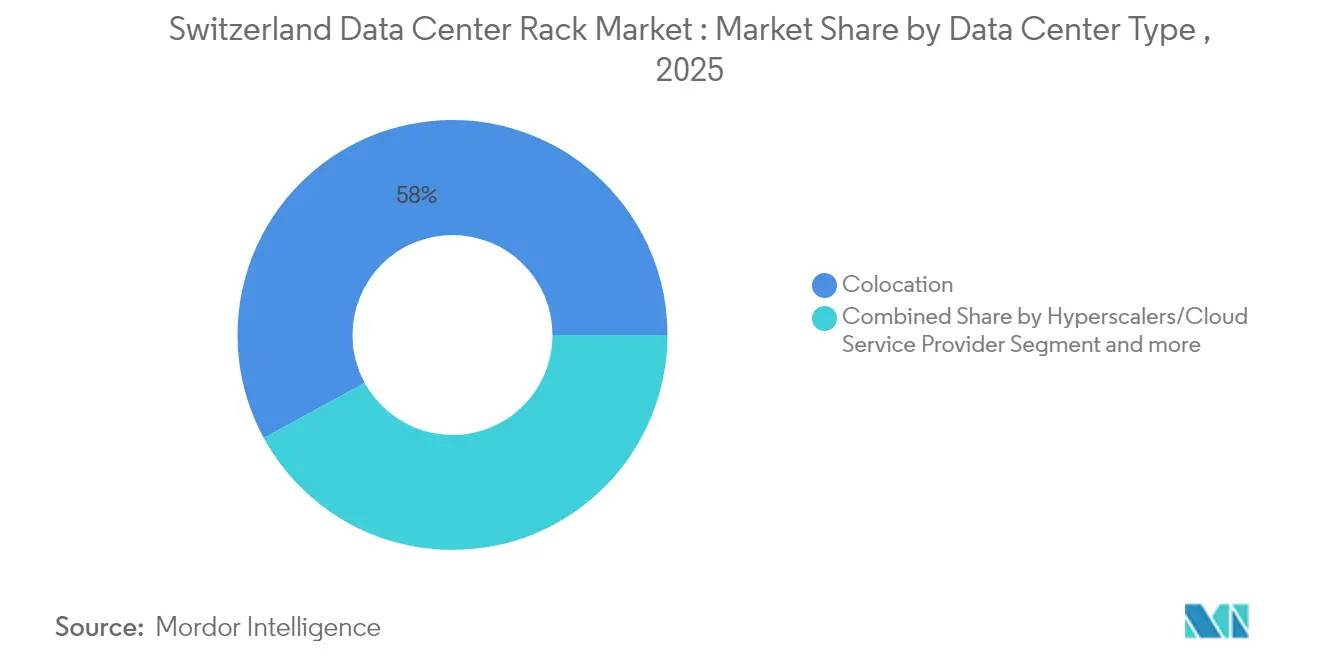
- By data-center type, colocation sites held 57.95% of Switzerland data center rack market size in 2025, whereas hyperscale facilities are expanding fastest at a 20.14% CAGR to 2031.
- By material, steel accounted for 74.58% of Switzerland data center rack market share in 2025; aluminum adoption is accelerating at a 19.19% CAGR through 2031.
Note: Market size and forecast figures in this report are generated using Mordor Intelligence’s proprietary estimation framework, updated with the latest available data and insights as of 2026.
Switzerland Data Center Rack Market Trends and Insights
Drivers Impact Analysis*
| Driver | (~) % Impact on CAGR Forecast | Geographic Relevance | Impact Timeline |
|---|---|---|---|
| Increased migration to cloud-based business operations | +3.2% | Switzerland and wider DACH region | Medium term (2-4 years) |
| Internet adoption and IT-services boom | +2.8% | Zurich and Geneva metro areas | Short term (≤ 2 years) |
| Surge in AI/ high-density workloads | +4.1% | Swiss financial and pharma hubs | Medium term (2-4 years) |
| Federal and cantonal green-energy incentives | +2.3% | Nationwide | Long term (≥ 4 years) |
| Adoption of in-rack liquid cooling | +2.9% | Switzerland plus aligned EU markets | Medium term (2-4 years) |
| Land scarcity driving micro-modular roll-outs | +1.5% | Urban cores in Zurich and Basel | Long term (≥ 4 years) |
| Source: Mordor Intelligence | |||
Increased Migration to Cloud-Based Business Operations
Swiss enterprises rapidly shifted workloads off-premises after Digital Realty enlarged its Zurich power capacity from 4 MW in 2019 to 45 MW in 2024, a more than ten-fold jump. Less than half of corporate applications now remain in-house, fueling standard cabinet demand that supports multi-tenant colocation security. Financial-services firms spearhead the move, favoring racks that enable hybrid architectures across low-latency edge nodes and central hyperscale halls. These factors firmly reinforce purchasing momentum for the Switzerland data center rack market.
Internet Adoption & IT Services Boom
Zurich alone hosts 25 carrier-dense data-center sites spanning 668,501 sq.ft and 198 MW of IT load, underscoring the nation’s digital-service appetite. Operators gravitate toward 42U full racks to maximize cubic efficiency inside premium real estate. Swisscom’s CHF 60 million Wankdorf site operates at a 1.2 PUE, well below the European average of 1.95, setting a local benchmark for rack-level thermal management. [3]Swisscom AG, “Wankdorf Data Center Factsheet,” swisscom.ch These efficiency contrasts drive competitive differentiation and incentivize adoption of energy-conscious rack frames in the Switzerland data center rack market.
Surge in AI / High-Density Workloads
Average power draw per rack has doubled, climbing from 8 kW to 17 kW today with trajectories toward 30 kW by 2027. Roughly 22% of Swiss operators already employ direct liquid cooling, and abundant hydro-electric supply bolsters uptake. Dell’s Integrated Rack 7000 and similar lines merge liquid manifolds, higher static loading, and integrated monitoring to serve GPU-rich clusters . These capabilities lower cooling energy by as much as 88%, cementing a structural tailwind for the Switzerland data center rack market.
Federal & Cantonal Green-Energy Incentives for Data Centers
Switzerland targets 35,000 GWh of renewable electricity by 2035, with federal grants favoring data centers that cut carbon intensity. Zurich’s 2023 Energy Act obligates new facilities to harness waste heat, prompting rack suppliers to deliver thermal-recovery-ready cabinets. Incentives also promote lighter aluminum frames that ease floor loading and heighten thermal conductivity, nudging purchasing in the Switzerland data center rack market toward innovative alloys.
Restraints Impact Analysis*
| Restraint | (~) % Impact on CAGR Forecast | Geographic Relevance | Impact Timeline |
|---|---|---|---|
| Limited land and power availability | -2.1% | Zurich and Geneva cores | Short term (≤ 2 years) |
| High capex for state-of-the-art rack systems | -1.8% | Nationwide and premium EU | Medium term (2-4 years) |
| Stringent Swiss carbon-disclosure regulations | -1.2% | Federal jurisdiction | Long term (≥ 4 years) |
| Skilled-labour shortage for high-density racks | -1.6% | Switzerland and DACH | Medium term (2-4 years) |
| Source: Mordor Intelligence | |||
Limited Land & Power Availability
Land scarcity presses operators to compress compute footprint, embracing 48U racks that yield more kilowatts per square meter. EU studies forecast data-center energy consumption to quadruple to 160 TWh by 2030, magnifying grid strain dentons. Vendors answer with taller frames, integrated chillers, and modular edge pods that circumvent the real-estate bottleneck yet temper overall growth in the Switzerland data center rack market.
High Capex for State-of-the-Art Rack Systems
Advanced liquid-ready racks carry higher price tags just as steel tariffs elevated construction inputs 7-8% during 2025, squeezing ROI for midsized operators. Many Swiss firms now prolong equipment life cycles or stagger upgrades in modular increments. Consolidation among manufacturers accelerates as capital intensity climbs.
*Our forecasts treat driver/restraint impacts as directional, not additive. The impact forecasts reflect baseline growth, mix effects, and variable interactions.
Segment Analysis
By Rack Size: Full Rack Dominance Driven by AI Workload Consolidation
Full racks owned 70.62% of Switzerland data center rack market share in 2025, and they are set to expand at 18.35% CAGR because AI clusters benefit from contiguous GPU pools and manifold-based cooling. Dell’s AI Factory bundles underscore how pre-engineered full racks streamline deployment and hasten inference speed. Half racks remain relevant for distributed finance nodes that seek geographic diversity, while quarter racks cater to containerized micro sites lodged near users to shave latency.
Emerging regulatory and energy incentives strengthen the full-rack thesis. As power densities breach 20 kW per frame, Swiss colocation providers invest in manifold-equipped steel enclosures that accept chilled plates without downtime. This operational agility keeps the Switzerland data center rack market positioned for continued full-rack leadership across new builds and retrofit projects alike.



By Rack Height: 42U Standard Persists Despite 48U Innovation Push
The 42U profile held 54.55% of Switzerland data center rack market size during 2025, thanks to abundant supply, mature accessory ecosystems, and installer familiarity. Yet 48U frames outpace all others at an 18.27% CAGR, propelled by GPU-dense servers that require extra clearance for vertical airflow and coolant hoses. nVent’s liquid cooling suite exemplifies how taller cabinets accommodate heavier AI nodes without sacrificing serviceability.
Operators weigh trade-offs: 42U racks simplify mixing older and newer gear, whereas 48U variants maximize power density in land-constrained metro halls. Dual-format strategies surface, wherein legacy halls stay 42U while new AI labs pivot to 48U, sustaining flexible asset management within the Switzerland data center rack market.
By Rack Type: Cabinet Solutions Lead Through Security and Cooling Integration
Cabinets captured 75.62% market share in 2025, reflecting strict data-sovereignty rules that demand physical safeguards for sensitive workloads. Enclosed designs isolate hot and cold aisles, reduce electromagnetic interference, and simplify immersion or manifold cooling attachment. NVIDIA’s recent patents for configurable closed-loop racks highlight industry focus on sealed environments that prevent coolant leaks.
Open-frame racks appeal to telecom rooms and test labs where airflow and easy access dominate concerns, but their presence wanes as security expectations tighten. Wall-mount enclosures gain traction at distributed fintech and healthcare nodes that require tamper resistance in non-traditional spaces, yet they remain a niche slice of the Switzerland data center rack market.
By Data Center Type: Colocation Leadership Challenged by Hyperscale Acceleration
Colocation providers stood atop the market with 57.95% of Switzerland data center rack market size in 2025, buoyed by multinational clients pursuing neutral ground for European data. However, hyperscale operators are logging a blistering 20.14% CAGR through 2031 as Amazon, Google, and Microsoft accelerate AI cluster rollouts. Vantage’s CHF 370 million second site in Glattfelden epitomizes the capex surge and appetite for standardized racks at scale.
Edge and enterprise builds persist for latency-sensitive or regulated workflows but yield slower growth. To stay competitive, colocation firms now retrofit halls with liquid-ready cabinets and AI cages, narrowing performance gaps and sustaining their share of the Switzerland data center rack market.
By Material: Steel Dominance Faces Aluminum Challenge from Weight Optimization
Steel framed 74.58% of shipments in 2025 because of superior load bearing and cost advantages, yet aluminum racks are accelerating at 19.19% CAGR as operators seek easier handling and better thermal conductivity. The 2025 tariff-linked steel price uptick sharpened aluminum’s total-cost appeal. Lighter alloys cut floor loading, simplify top-rack manifold installs, and support rapid reconfiguration in micro-modular pods.
Composite and hybrid materials appear in research labs and military data shelters where corrosion resistance or electromagnetic shielding overrides cost. Overall, steel remains entrenched, but high-density AI sites increasingly pilot aluminum frames, diversifying material demand within the Switzerland data center rack market.
Geography Analysis
Switzerland’s data-center footprint clusters around the Zurich metropolitan area, home to 25 facilities and 198 MW of IT capacity, ranking ninth in EMEA scale. The city’s concentration of financial services and cloud on-ramps creates a vibrant corridor for high-density rack deployments. Federalism shapes the regulatory canvas: Zurich’s 2023 Energy Act obliges waste-heat reuse, so racks with heat-exchanger stubs gain preference.
Outside Zurich, Geneva and Basel host secondary clusters where land scarcity boosts micro-modular adoption. NorthC’s Winterthur launch in early 2025 expanded colocation capacity and signalled confidence in demand beyond Zurich’s urban core. Cantonal permitting agility remains key; Basel’s life-science hub often fast-tracks AI-driven research workloads, leading to cabinet selections that prioritize security and liquid cooling in constrained footprints.
Switzerland’s linkage to pan-European data-residency mandates draws cross-border clients seeking neutrality. The Swiss Datacenter Efficiency Association’s new sustainability label—achieved by merely one-third of domestic halls—acts as a differentiator for foreign tenants who face ESG scrutiny. Racks with embedded metering empower operators to document energy consumption and carbon intensity, aligning with EU taxonomy criteria and reinforcing market momentum.
Regulatory Landscape
Switzerland’s policy environment for data centers and their physical infrastructure shapes rack selection around metering, security, and energy efficiency. For the civil federal administration, the Federal Chancellery’s SB022 Strategy for Data Centres (enacted 9 June 2025) defines tiered requirements for federal workloads, reinforcing demand for cabinet (closed) racks with stronger physical access control and facility-grade documentation. On the energy side, Zurich’s 2023 Energy Act obligates waste-heat use for new facilities, while policy debate on broader waste-heat recovery thresholds keeps heat-recovery-ready layouts (aisle containment compatibility and liquid-cooling integration) in focus for operators and suppliers.
Cybersecurity and resilience requirements also affect rack ecosystems through compliance-driven infrastructure standardization. The National Cyber Security Centre (NCSC) oversees ICT Minimum Standards that became mandatory for the electricity sector from 1 July 2024, pushing critical operators toward standardized, auditable deployments that pair cabinets with monitored power distribution and environmental sensing. A Federal Council decision on 5 June 2026 indicated no new federal waste-heat regulation for now, leaving reliance on cantonal guidelines and a fragmented permitting and efficiency compliance landscape across Swiss locations.
Value Chain Analysis
The Switzerland data center rack value chain runs from raw materials and fabrication (steel and aluminum frames, doors, rails, fasteners) to rack integration (PDUs, busways, sensing, and increasingly liquid-cooling-ready manifolds), then distribution through OEM and channel partners. Installation and lifecycle services are typically delivered by data center operators and specialist integrators. Global and Swiss-rooted suppliers map onto different layers of the stack: Rittal supplies racks and adjacent enclosure, power, and cooling components, Eaton contributes power management and energy infrastructure elements, and Reichle & De-Massari (R&M) supports the rack-level connectivity layer through structured cabling and related systems. Higher power density and liquid cooling adoption also brings specialized sub-suppliers for piping, quick-connects, and monitoring, which tie racks more tightly to facility mechanical design.
Industry bodies and public-sector programs influence procurement criteria and supplier qualification. The Swiss Data Center Association (SDCA) operates as a coordination and advocacy node connecting operators with equipment suppliers, and its ecosystem activity (including supplier participation such as Eaton joining in May 2026) supports shared sustainability and quality narratives used in bids and tenant acquisition. On the demand side, colocation operators and hyperscalers drive standardized, high-volume rack orders for Zurich-area campuses, while federal and regulated-sector buyers anchor a parallel chain oriented toward secure, documented hybrid architectures that align with public cloud interconnects and sovereign requirements.
Competitive Landscape
Competition in the Switzerland data center rack market remains moderate. Global heavyweights Schneider Electric, Rittal, Vertiv, and Eaton anchor share yet face nimble Swiss specialists that carve out niches in micro-modular and immersion-ready cabinets. Schneider’s acquisition of Motivair embedded direct-to-chip cooling expertise, enabling a turnkey stack from chassis to coolant distribution schneider-electric. Eaton’s USD 1.65 billion Tripp Lite deal expanded edge UPS-rack bundles, sharpening its appeal for branch-office deployments .
Innovation skews toward liquid cooling, tool-less assembly, and embedded telemetry. NVIDIA’s heavy filing of rack-level cold-plate patents underscores rising chipset influence on enclosure design . Meanwhile, emergent vendors deliver 48U aluminum racks pre-plumbed for dielectric immersion, targeting AI startups that lease pods inside colocation halls. Supply-chain volatility rewards manufacturers with Swiss-based assembly that trims lead times and meets stringent origin documentation for public-sector bids.
Strategic alliances also proliferate. Siemens joined Cadolto and Legrand to roll out a prefab edge module headquartered in Zug that integrates racks, chillers, and switchgear for rapid deployment inside 6 months. Such ecosystem plays sharpen differentiation, yet rising capex complexities drive gradual consolidation as smaller fabricators struggle to bankroll R&D for high-density liquid systems.
Switzerland Data Center Rack Industry Leaders
Eaton Corporation
Rittal GMBH & Co.KG
Schneider Electric SE
Vertiv Group Corp.
Reichle and De-Massari AG
- *Disclaimer: Major Players sorted in no particular order

Market Opportunities and Future Outlook
Retrofit-led efficiency programs create near-term whitespace for rack upgrades that bundle instrumentation and thermal readiness rather than simple frame replacement. A Swissinfo (2026) synthesis highlighted that data centers can improve energy efficiency by up to 46% through systematic optimization, translating into opportunities for cabinet enclosures with improved airflow management, rack-level metering, and liquid-cooling-ready mechanical provisions that deliver measurable gains during refresh cycles. Waste-heat utilization is also increasingly treated as strategic infrastructure in Swiss energy discussions, which raises the value of rack designs that support predictable heat capture (through containment and liquid-cooled architectures) and simplify integration with facility heat recovery systems.
Public-sector digitization and sovereign or hybrid cloud initiatives widen the buyer base for standardized, compliant rack infrastructure across Switzerland. The Swiss Government Cloud (SGC) project (2025-2032) under the Federal Office of Information Technology, Systems and Telecommunication (FOITT) reinforces demand for secure hybrid infrastructure and domestic processing, favoring closed cabinets and accessory ecosystems that support auditability and controlled access. Separately, the Swiss Confederation’s AI action planning includes work on resilient digital infrastructure and spatial planning concepts such as priority zones for faster permitting and grid integration, aligning with modular and micro-modular rack-and-row deployments for constrained urban sites.
Recent Industry Developments
- July 2026: Flexbase commenced initial work on the Laufenburg Technology Center, planned to house a 480 MW AI data center by 2029. The project signals a potential surge in demand for high density rack systems as Swiss capacity expands to accommodate AI workloads. The initiative could accelerate modular infrastructure deployment in Switzerland and attract further supplier investments.
- June 2026: Reichle & De-Massari (R&M) launched the fourth generation of the R&Mfreenet cabling and connectivity system. This advance enhances cable density and reliability for high density racks. It strengthens Swiss rack ecosystem with next gen connectivity, enabling denser deployments and improved reliability.
- March 2026: Siemens and Rittal formed a strategic partnership to develop modular, high density power distribution infrastructure for data centers. The collaboration supports AI ready racks with scalable power. It enhances Swiss market capability for modular power and rapid deployment in new builds.


Research Methodology Framework and Report Scope
Market Definition and Coverage
This market covers the value of racks and rack cabinets used to mount, secure, and organize IT and networking equipment inside data centers located in Switzerland, covering both new installations and replacement demand, and measured in revenue terms.
Scope exclusions: We exclude servers, storage, switches, PDUs, cooling systems, construction spend, colocation services, and software, even if they are procured in the same expansion cycle.
Segmentation Overview
- By Rack Size
- Quarter Rack
- Half Rack
- Full Rack
- By Rack Height
- 42U
- 45U
- 48U
- Other Heights (?52U and Custom)
- By Rack Type
- Cabinet (Closed) Racks
- Open-Frame Racks
- Wall-Mount Racks
- By Data Center Type
- Colocation Facilities
- Hyperscale and Cloud Service Provider DCs
- Enterprise and Edge
- By Material
- Steel
- Aluminum
- Other Alloys and Composites
Data Sources, Market Sizing, and Validation
Desk Research
Desk research was used to set the Switzerland context and build the starting demand pool for racks. Public and official sources such as the International Telecommunication Union (ITU), OECD digital economy datasets, the International Energy Agency (IEA), and Switzerland-focused regulator publications were reviewed to understand data growth signals and energy constraints that shape data center build decisions. We also used non-paywalled infrastructure and planning disclosures, customs and trade statistics where applicable, and peer reviewed papers that describe rack density and airflow practices.
To connect market demand to measurable signals, we reviewed reputable commercial real estate and data center market briefs, including Switzerland data center rental stock and capacity indicators published by major brokerages. Company filings, investor presentations, and press releases helped validate which expansions were active and what delivery timing looked realistic. In parallel, we used paid subscriptions for company financials and intelligence, news and financials, and patent databases to cross-check product positioning and technology shifts. The sources listed here are illustrative, and other public references were also used to collect, validate, and clarify data points.
Primary Interviews and Surveys
Primary interviews and surveys in Switzerland cover data center operators, infrastructure buyers, distributors, installers, and rack specialists. We use responses to validate secondary indicators, fill gaps in rack counts and pricing, and adjust assumptions before final analysis.
Distribution of primary research fieldwork respondents
| Company type | Respondent position |
|---|---|
| Top tier: 29% | CXOs: 20% |
| Mid tier: 48% | Functional/Unit leaders: 35% |
| Smaller Players: 23% | Managers: 45% |
Market-Sizing & Forecasting
Market sizing was built using a top-down demand reconstruction that starts from Switzerland data center capacity and space signals, and then converts that demand pool into rack requirements using practical build and refresh assumptions. Once plausible white space expansion and IT load direction were set, rack count equivalents and average selling prices were applied to arrive at market value.
To keep the model grounded, the inputs were tied to market fingerprints that can be explained and checked. These included data center expansion timing by metro focus, typical rack widths and depths adopted in new halls, the mix of standard racks versus higher-density cabinets, replacement frequency in operating sites, and the pace of ASP changes driven by materials and configuration complexity. We also used country signals like available capacity and rental stock as sanity checks for how quickly physical deployment can grow.
Forecasting relied mainly on scenario analysis, where base, conservative, and accelerated buildout paths were shaped through expert views on permitting, power availability, and delivery lead times. Results were then corroborated with selective bottom-up approximations, such as supplier and channel checks on shipment momentum and sampled ASP time-on-volume calculations, and gaps were handled by using conservative defaults that were re-tested in follow-up calls.
Data Validation & Update Cycle
Outputs were validated through triangulation across capacity signals, rack deployment logic, and interview feedback, which helped identify cases where the model was growing faster than what construction timing would allow. Variance checks were run across key levers like rack density, replacement share, and ASP, and any outlier movement was reviewed before numbers were finalized.
A multi-step analyst review is followed, and respondents are re-contacted when a key assumption moves outside the expected range or when a major project announcement changes the near-term demand picture. Reports are refreshed annually, and interim updates are done when material events occur. Before delivery, a final pass is completed so clients receive the latest updated view.
Mordor Intelligence's Switzerland Data Center Rack Market Size Measured Against Other Published Estimates
Published market values for Switzerland data center racks can differ even when the topic sounds the same, since the inputs are sensitive to how racks are counted, which sites are included, and what timing is used for price and deployment assumptions. In practice, differences show up when one estimate leans more on facility build announcements, while another leans more on shipment style proxies or broader infrastructure spend.
The table shows a visible spread in 2026, and in Mordor Intelligence's model the number is limited to racks and rack cabinets sold into Switzerland data centers, with adjacent items like power and cooling infrastructure not added into the rack total, even when they are bundled in projects.
Benchmark comparison
| Source | Market Size | Gaps in Research Methodology |
|---|---|---|
| Mordor Intelligence | USD 132.61 M (2026) | |
| Industry Newsletter A | USD 160.00 M (2026) | Often blends rack cabinets with broader white-space fit-out items, and applies a higher ASP uplift that assumes a faster shift to fully configured high-density cabinets. |
| Regional Consultancy B | USD 105.00 M (2026) | Uses a more conservative build schedule proxy and a slower replacement cycle, which can understate demand from refresh projects in operating facilities. |
Looking across the three figures, the main drivers behind the gap are scope boundaries around what counts as rack-only revenue, and how quickly capacity additions are translated into delivered racks. By tying the total to observable capacity and space signals and then pressure-testing rack density, replacement, and ASP assumptions through expert checks, the estimate stays traceable and repeatable for decision-making.


Key Questions Answered in the Report
What is the current value of the Switzerland data center rack market?
The market stands at USD 132.61 million as of 2026 and is projected to reach USD 281.17 million by 2031.
Which rack configuration dominates Swiss data centers?
Full racks command 70.62% share, favored for consolidating GPU-dense AI workloads.
How fast are 48U racks growing in Switzerland?
The 48U segment is expanding at an 18.27% CAGR through 2031 owing to taller server architectures and liquid cooling needs.
Why are aluminum racks gaining popularity?
Aluminum’s lighter weight and superior thermal conductivity support high-density racks, accelerating adoption at a 19.19% CAGR even though steel still holds 74.58% share.
Page last updated on:
- Africa Data Center Rack Market
- Australia Data Center Rack Market
- Belgium Data Center Rack Market
- Canada Data Center Rack Market
- Chile Data Center Rack Market
- China Data Center Rack Market
- Denmark Data Center Rack Market
- Germany Data Center Rack Market
- Hong Kong Data Center Rack Market
- Indonesia Data Center Rack Market
- Ireland Data Center Rack Market
- Artificial Intelligence (AI) Data Center Market AI facilities across the global market, covering facility type, component and tier.
- Data Center Construction Market Construction across all regions, split by tier, facility size and facility type.
- Data Center Server Market Servers across the global market, covering tier, facility size and facility type.





