Superdisintegrants Market Size and Share
Market Overview
| Study Period | 2020 - 2031 |
|---|---|
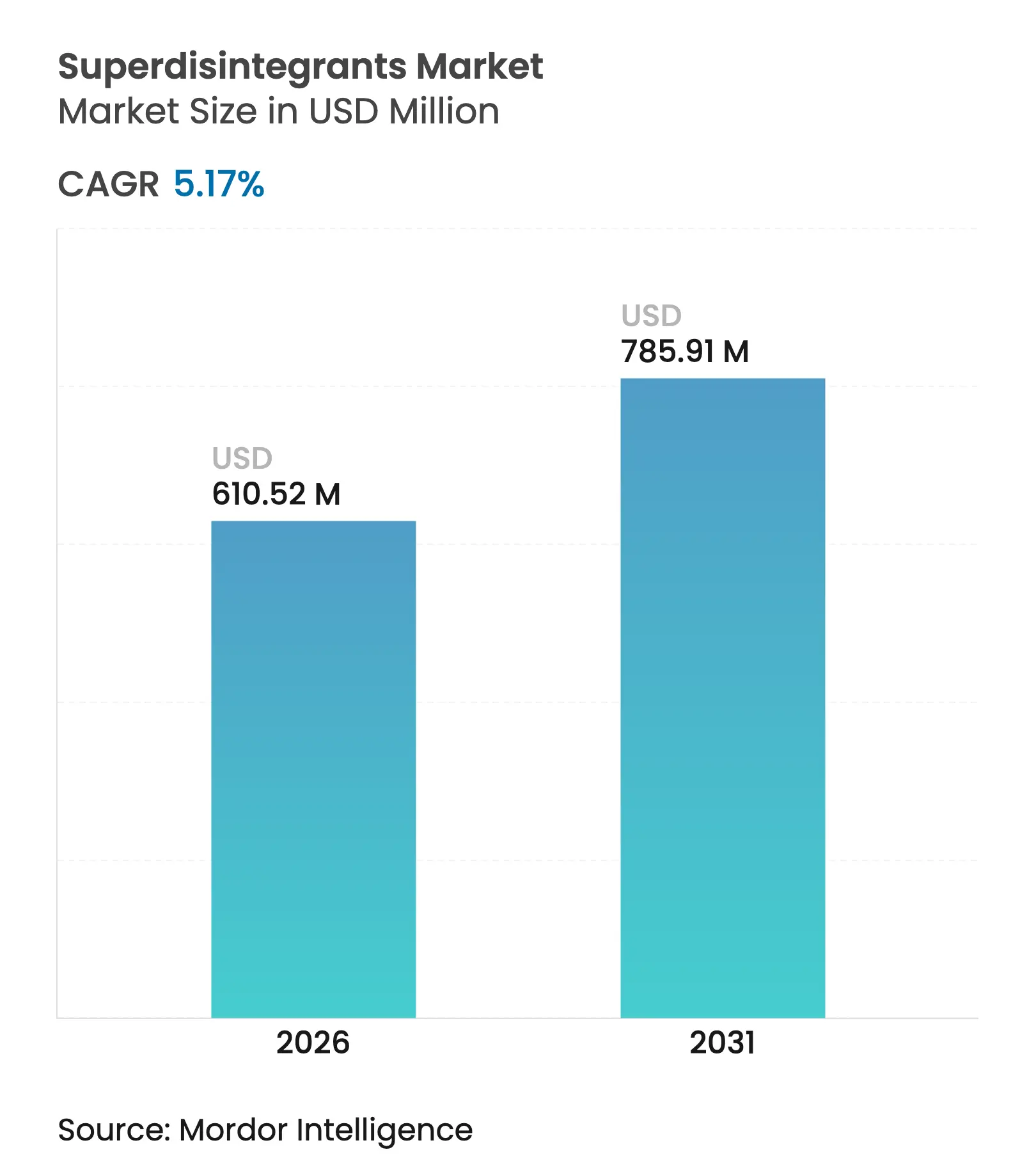
| Market Size (2026) | USD 610.52 Million |
| Market Size (2031) | USD 785.91 Million |
| Growth Rate (2026 - 2031) | 5.17 % CAGR |
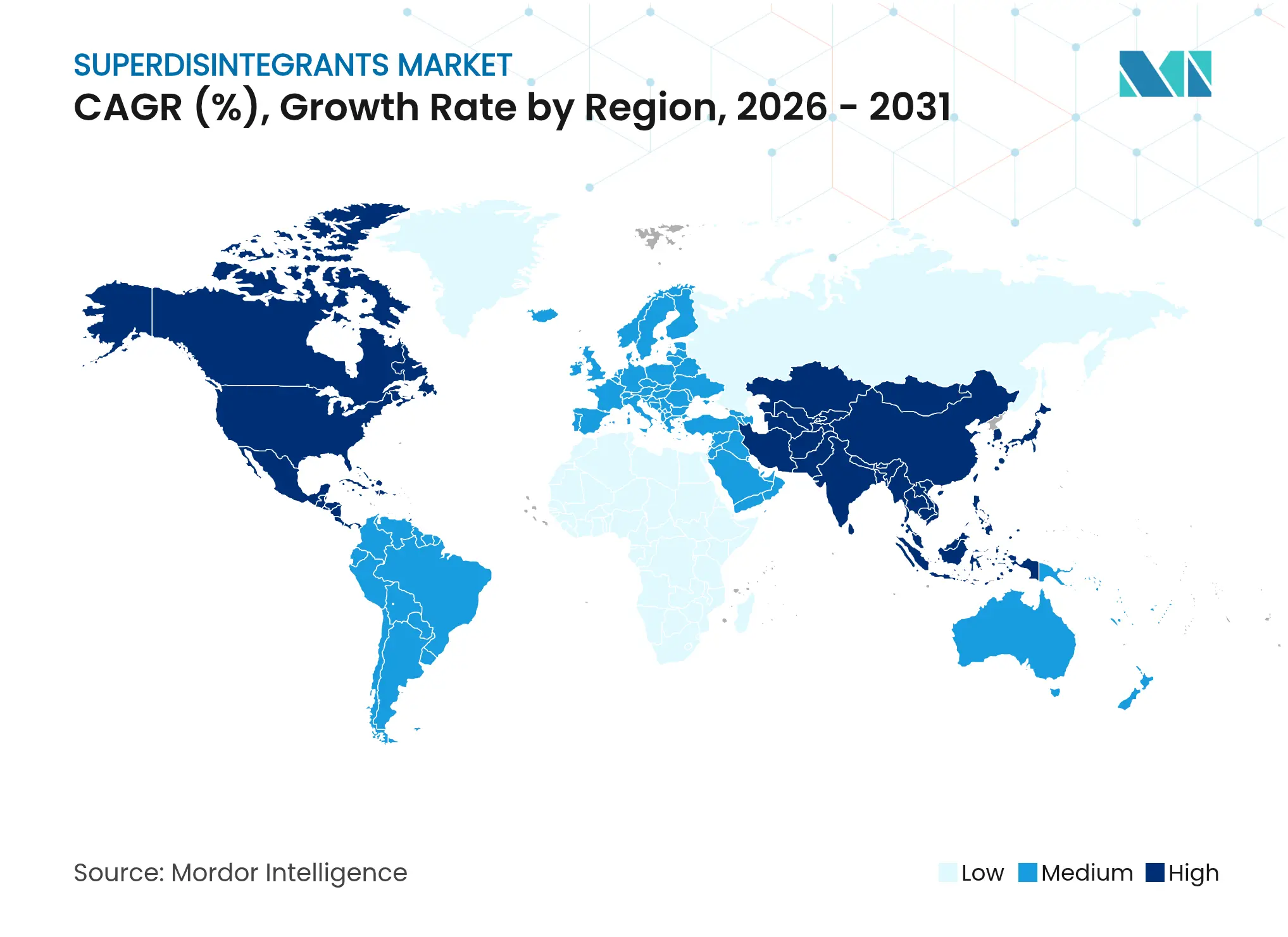
| Fastest Growing Market | Asia Pacific |
| Largest Market | North America |
| Market Concentration | Medium |
Major Players *Disclaimer: Major Players sorted in no particular order. Image © Mordor Intelligence. Reuse requires attribution under CC BY 4.0. |

Superdisintegrants Market Analysis by Mordor Intelligence
The superdisintegrants market size is expected to grow from USD 580.49 million in 2025 to USD 610.52 million in 2026 and is forecast to reach USD 785.91 million by 2031 at 5.17% CAGR over 2026-2031. Patient-centric drug-delivery priorities, a sharp rise in orally disintegrating tablets for aging and pediatric users, and regulatory streamlining in the United States and Europe are the principal engines of growth. Fast-dissolving dosage approvals now move through an expedited route after the Food and Drug Administration’s June 2025 draft administrative order, removing a key procedural hurdle [1]. Manufacturers are pivoting toward sustainability as synthetic polymer scrutiny intensifies, even while synthetic grades retain technical dominance. Consolidation—most notably Roquette’s USD 2.85 billion agreement to acquire IFF Pharma Solutions—signals a market in which scale, global compliance systems, and local supply chains are decisive strategic assets.
Key Report Takeaways
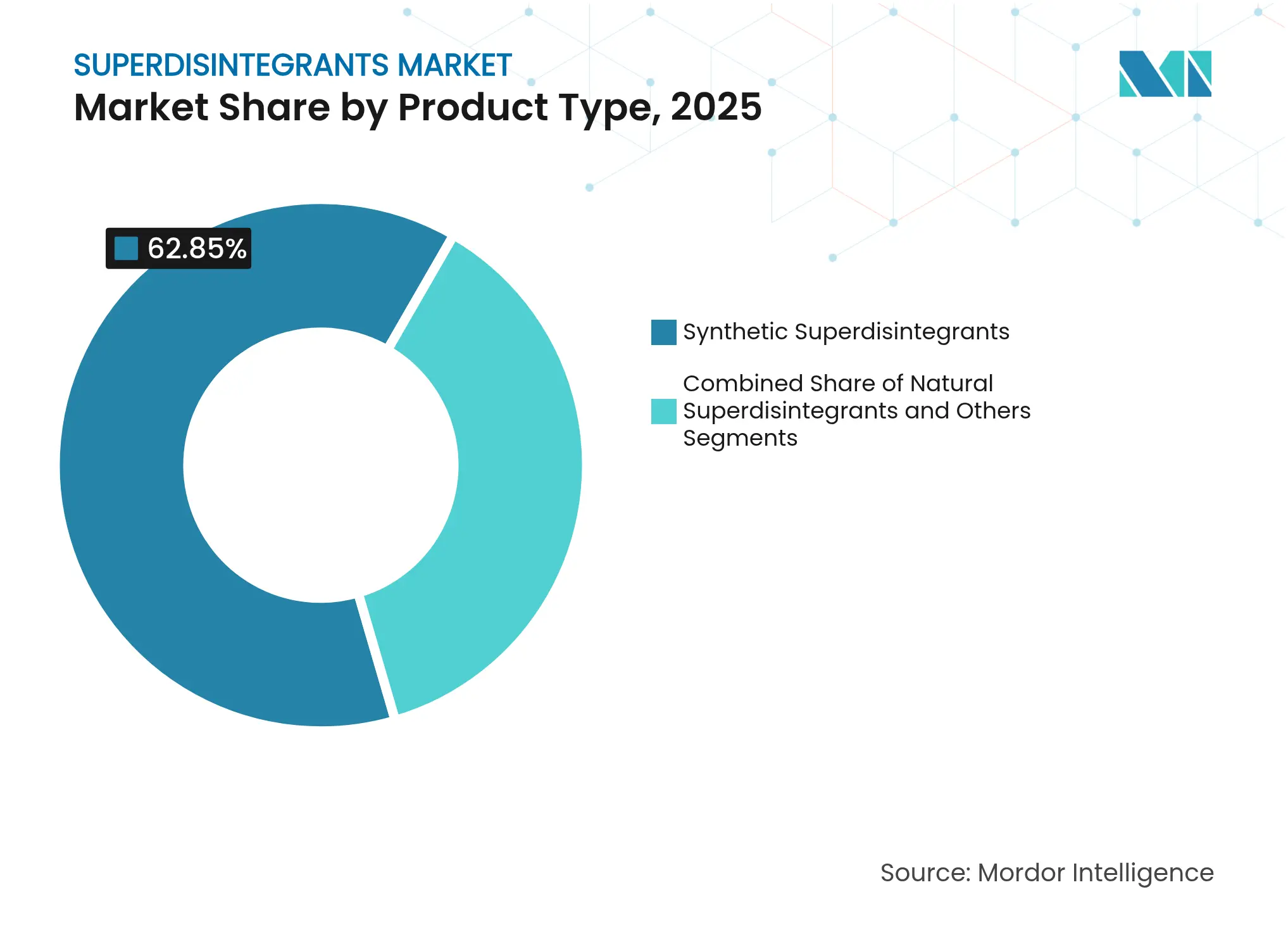
- By product type, synthetic variants held 62.85% of the superdisintegrants market share in 2025; natural alternatives are forecast to expand at a 5.98% CAGR through 2031.
- By formulation, tablets accounted for 71.60% of the superdisintegrants market size in 2025 while capsules are projected to grow at 6.05% CAGR during 2026-2031.
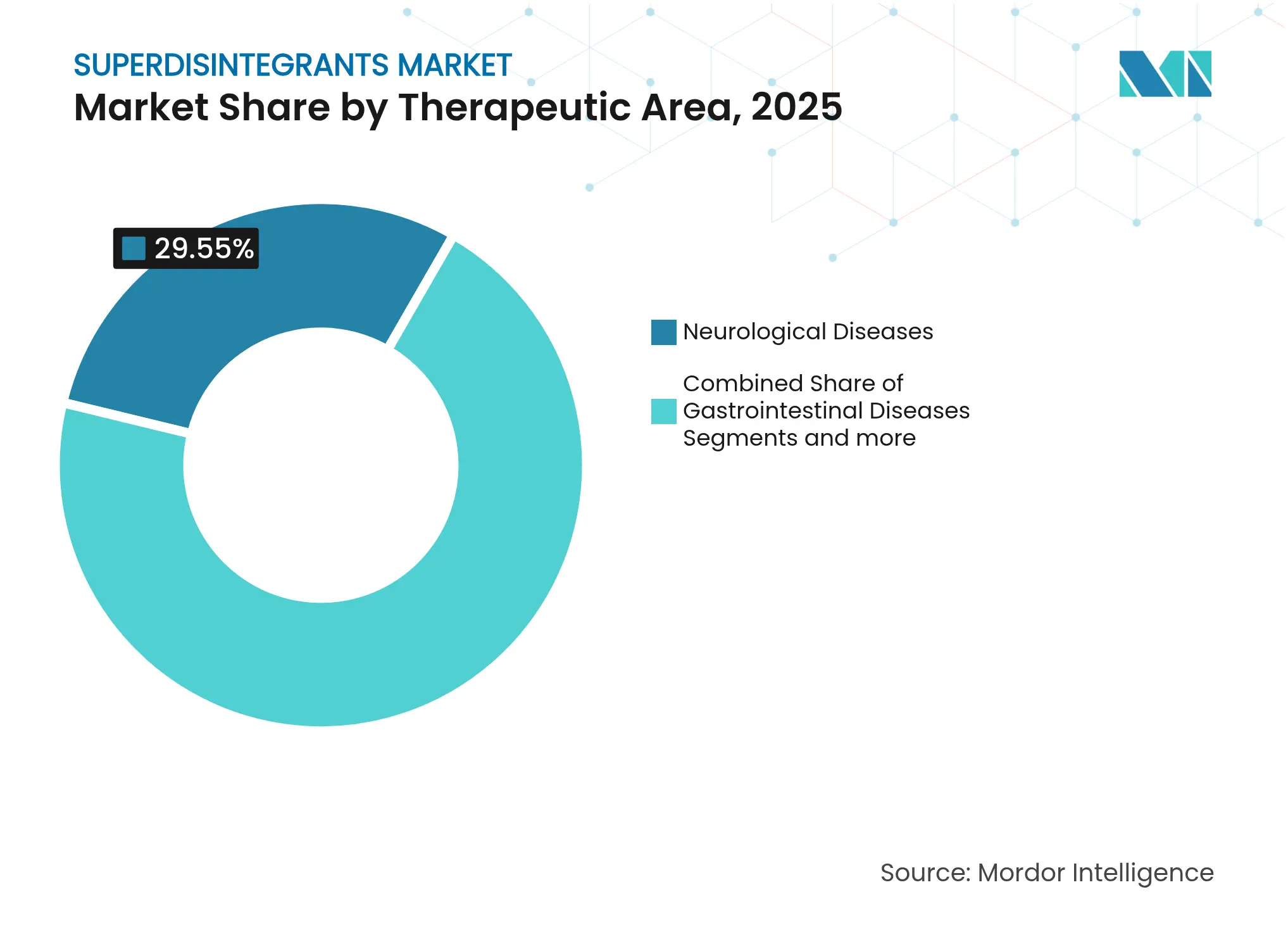
- By therapeutic area, neurological disorders led with a 29.55% revenue share in 2025 whereas oncology applications are advancing at a 6.15% CAGR to 2031.
- By geography, North America captured 39.40% of 2025 revenue; Asia-Pacific records the fastest regional CAGR at 6.18% through 2031.
Note: Market size and forecast figures in this report are generated using Mordor Intelligence's proprietary estimation framework, updated with the latest available data and insights as of 2026.
Global Superdisintegrants Market Trends and Insights
Drivers Impact Analysis
| Driver | (~) % Impact on CAGR Forecast | Geographic Relevance | Impact Timeline |
|---|---|---|---|
Rising adoption of orally disintegrating tablets
|
+1.2%
|
North America, Europe, global spillover
|
Medium term (2-4 years)
|
Expanding geriatric & pediatric populations
| +0.9% | Asia-Pacific, global | Long term (≥ 4 years) |
Growth in R&D pipelines for patient-centric solids
| +0.8% | North America, European Union | Medium term (2-4 years) |
Regulatory support for fast-dissolving forms
| +0.6% | Global | Short term (≤ 2 years) |
3-D printed dosage forms
| +0.4% | North America, Europe | Long term (≥ 4 years) |
Supply-chain localization
| +0.5% | Asia-Pacific, Latin America, Middle East & Africa | Medium term (2-4 years) |
| Source: Mordor Intelligence | |||
Rising adoption of orally disintegrating tablets (ODTs)
Expanding clinical proof of improved adherence and faster onset is propelling ODT uptake, bolstering the superdisintegrants market. Intraoral drug-delivery spending rose from USD 36 billion in 2023 to a projected USD 55 billion by 2030, reflecting a 4.88% CAGR that sharply eclipses conventional tablets [2]. Neurological agents, notably sublingual levodopa, show greater pharmacokinetic predictability than standard oral solids, reinforcing demand for high-performance crospovidone and sodium starch glycolate grades [3]. Quality-by-Design toolkits now produce tablets that disintegrate in under 10 seconds without compromising mechanical strength. Collectively, these advances place superdisintegrants at the heart of next-generation dosage design.
Expanding geriatric & pediatric patient pools
The proportion of people aged ≥ 65 years climbs steadily across Asia-Pacific and Europe, while almost one-third of global births occur in nations modernizing pediatric formularies. Swallowing impairment affects 15% of the population; tablet dimension research shows handling difficulty spikes when combined length and width touch 13.3 mm, validating the commercial logic of ODTs. Clean-label products such as CompactCel DIS permit 1-5% inclusion levels, matching synthetic speed while meeting excipient transparency mandates. Proposed single-unit ODT packaging rules from the FDA further protect young and frail users. These demographic realities ensure steady long-run tailwinds for the superdisintegrants market.
Growth in R&D pipelines for patient-centric solid dosage
Branded and generic firms have elevated superdisintegrants from commodity excipients to strategic formulation levers. Amorphous solid dispersions containing polyvinylpyrrolidone markedly enhance poorly soluble actives, helping unlock an addressable pipeline valued at USD 4.58 billion by 2035. Continuous manufacturing lines use real-time particle imaging to hit target disintegration windows, cutting waste and cycle time while lifting product robustness. As intellectual property protection tightens around formulation know-how, suppliers offering analytical support and global documentation gain bargaining power, sustaining premium pricing within the superdisintegrants market.
Regulatory support for fast-dissolving formulations
The FDA’s 2025 draft order removes duplication by letting over-the-counter brands shift to ODT formats without separate monograph requests, clearing a route for rapid portfolio conversion. Europe codified “oral dissolving tablets” with definitive acceptance criteria, giving formulators a regulatory map that minimizes rework. India’s 2024 rule requiring label-level excipient talk strengthens quality-control favorite suppliers who already maintain detailed technical packages. Harmonization work at the International Council for Harmonisation is aligning excipient specs worldwide, compressing development timelines for global launches.
Restraints Impact Analysis
| Restraint | (~) % Impact on CAGR Forecast | Geographic Relevance | Impact Timeline |
|---|---|---|---|
Stringent quality & pharmacopoeial compliance demands
|
−0.8%
|
United States, European Union
|
Short term (≤ 2 years)
|
Raw-material price volatility
| −0.6% | Asia-Pacific sourcing hubs | Medium term (2-4 years) |
Substitution by alternative drug-delivery formats
| −0.4% | Developed markets | Medium term (2-4 years) |
Sustainability pressure on synthetic polymers
| −0.3% | Europe, North America, developed Asia | Long term (≥ 4 years) |
| Source: Mordor Intelligence | |||
Stringent quality & pharmacopoeial compliance demands
Parallel but non-identical monographs in the USP, Ph. Eur., and JP compel multi-spec product lines, soaring analytical costs, and overlapping audits. Nitrosamine vigilance has forced low-peroxide crospovidone grades such as Polyplasdone LN, necessitating fresh stability protocols and capital-intensive testing equipment. Smaller producers find these hurdles prohibitive, driving consolidation and elevating barriers to entry.
Raw-material price volatility
Geopolitical tension and shipping cost spikes lift input prices for vinylpyrollidone, cellulose, and maize starch. China’s 2023 Anti-Espionage Law curtailed Western quality audits, complicating freight and insurance contracts and raising landed costs. United States Pharmacopeia data show 27% of drug shortages link to excipient or API scarcities, intensifying pressure for dual-sourcing programs. Capital deployment into localized plants exceeds USD 34 billion since 2024, squeezing near-term margins as networks rebalance.
Segment Analysis
By Product Type: Synthetic Superiority Meets Natural Upswing
Synthetic grades retained a commanding 62.85% of the superdisintegrants market share in 2025, reflecting reliable performance and established compliance files that multinational drug makers lean on for high-throughput lines. Commercial benchmarks such as crospovidone frequently achieve <30 second dissolution at 2-5% loadings, supporting direct-compression throughput above 300,000 tablets per hour. Yet sustainability audits, petrochemical cost movements, and consumer preference accelerators are steering formulators toward plant-derived options. Natural alternatives are projected to climb at a 5.98% CAGR, narrowing the gap but not eclipsing synthetics through 2031. Advanced sago starch glycolates now meet USP substitution thresholds, underscoring material science gains that underpin this upswing. The superdisintegrants market therefore exhibits a dual-track dynamic: legacy synthetic volumes sustain core revenue while natural portfolios carve new lanes in pediatric, nutraceutical, and clean-label drugs.
The synthetic franchise nevertheless innovates. Ultra-low peroxide and nitrosamine-controlled grades shore up compatibility with sensitive oncology actives. Co-processed excipients pairing crospovidone with mannitol or silicified microcrystalline cellulose further speed wet-granulation lines. Suppliers with backward integration into vinyl monomer plants mitigate cost volatility and protect margin by selling functional-blend systems instead of single excipients, reinforcing pricing resilience within the superdisintegrants market.
Note: Segment shares of all individual segments available upon report purchase
By Formulation: Tablets Dominate as Capsules Accelerate
Tablets retained 71.60% contribution to the superdisintegrants market size in 2025 owing to cost efficiency, dose precision, and extensive installed compression capacity. Orally disintegrating tablets lead incremental demand and will likely outpace the broader category through 2031 because formulators value their marketing edge in crowded therapeutic classes. Continuous direct-compression platforms allow formulators to shift between APIs in minutes, locking superdisintegrant demand tightly to high-mix portfolios.
Capsules, while smaller, expand at a 6.05% CAGR, capitalizing on consumer perception of easier swallowing and the pharmaceutical industry’s embrace of multiparticulate fills. Hard-shell plant-based capsules dovetail with brand sustainability narratives while tolerating integrated superdisintegrant pellets that burst upon contact with gastric fluid. Enteric-coated capsule variants for peptide drugs add another design frontier, broadening functional space for superdisintegrant use in modified release. Moisture sensitivity and shell brittleness remain engineering challenges; nevertheless, optionality and patient comfort sustain capsule momentum inside the superdisintegrants market.
By Therapeutic Area: Neurological Leadership Spurs Oncology Focus
Neurological disorders—Parkinson’s, Alzheimer’s, epilepsy—held 29.55% revenue share in 2025, affirming chronic-dosing realities where swallowing difficulty frequently worsens over time. Rapid-melting tablets circumvent hepatic first-pass effects, providing tighter symptom control and elevating adherence. Nanoparticle-linked superdisintegrant matrices now advance CNS permeability for investigational molecules while keeping patient handling simple, securing a dependable anchor for the superdisintegrants market.
Oncology logs the fastest CAGR at 6.15% through 2031 as chemo-related mucositis and nausea spark demand for water-free dosage. Antiemetics, analgesics, and supportive care vitamins are increasingly launched in fast-dissolve forms that leverage crospovidone or natural multifunctionals to soothe irritated mucosa. Regulatory fast lanes for oncology supportive care further catalyze adoption. Compatibility issues with potent, reactive APIs require novel low-peroxide or silica-grafted superdisintegrants, a niche where innovation premiums flourish within the superdisintegrants market.
Note: Segment shares of all individual segments available upon report purchase
Geography Analysis
North America, home to stringent cGMP enforcement and extensive R&D spend, captured 39.40% of 2025 sales. Mature formulators value validated supply chains: the FDA’s site inspection cadence and high biopharma investment underpin predictable volume call-offs that safeguard incumbents. While growth steadies near the market average, premium formulations and high-margin controlled substances keep revenue dense.
Asia-Pacific shows pronounced dynamism. Regional modernization, local excipient declarations, and medical-device influx together propel a 6.18% regional CAGR. India’s label mandate and growing share of DMFs strengthen transparency, allowing verified suppliers to differentiate. Chinese policy changes sparked geographic supply diversification, fertilizing new plants in Vietnam, Indonesia, and South Korea. Healthcare outlays in ASEAN stand to pass USD 138 billion by 2027, embedding structural pull for the superdisintegrants market.
Europe remains technologically advanced yet regulated under sustainability imperatives. Corporate Sustainability Reporting Directive metrics guide excipient procurement toward biodegradable options, boosting natural superdisintegrants adoption. The European Pharmacopoeia formally defines fast-dissolve performance windows; hence, European buyers gravitate toward grades with dossier-ready Particle-Size Distribution and Residual-Solvent certificates. Supply-chain continuity remains solid, yet incremental demand migrates Eastward as local formulations proliferate.

Competitive Landscape
Market Concentration
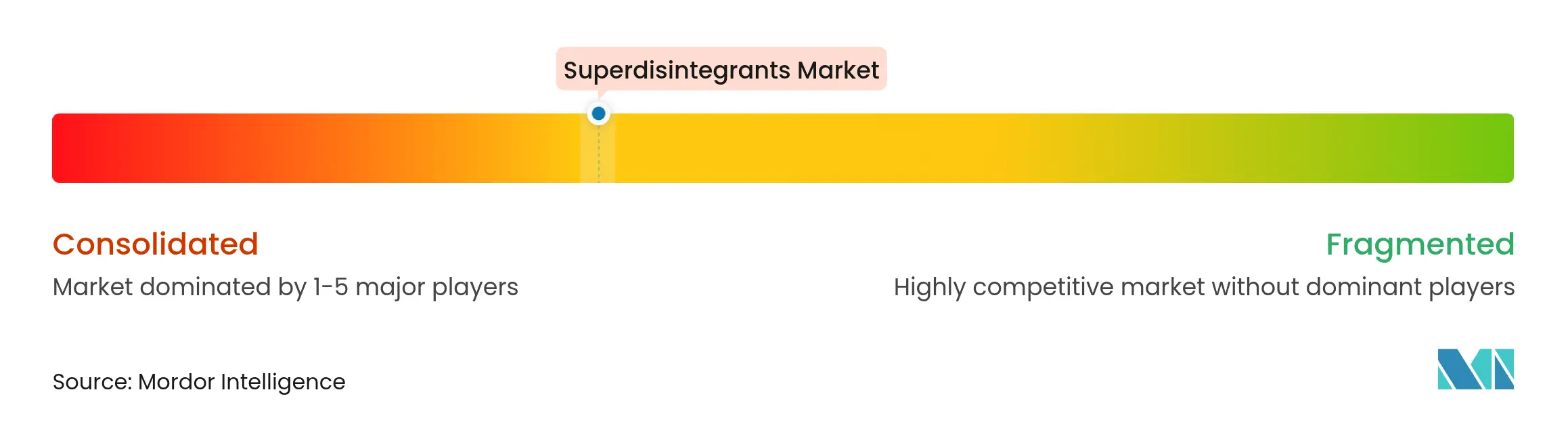
Consolidation is reshaping competitive intensity. Roquette’s purchase of IFF Pharma Solutions will create a USD 1-billion-revenue excipient giant across 10 plants, lifting share in co-processed disintegrants and cross-linking know-how. Vertically integrated models that cover corn wet-milling, chemical derivatization, and tabletting support now command strategic premiums.
Mid-tier firms sharpen focus on regional manufacturing and clean-label portfolios. Biogrund’s CompactCel series attracts nutraceutical and pediatric buyers, while Lotte Fine Chemical leverages a USD 58.6 million cellulose expansion to secure decade-long Colorcon distribution. Partnerships provide speed: Avantor and Rubicon Research join process engineering with channel scale to co-develop gastric-retentive excipients that widen superdisintegrants market addressability.
Technology frontiers add fresh rivalry. 3-D printing specialists use polymer-bonded superdisintegrant filaments to create unit-dose geometries for personalized therapy. Nanofiber deposition and electrospinning lines further dissolve entry barriers between drug-device and excipient players. Competitors strong in spectroscopy and real-time release testing accrue bargaining leverage as continuous-manufacturing adopters seek turnkey support. Overall, balanced market power among the five largest suppliers yields a moderate concentration environment for the superdisintegrants market.
Superdisintegrants Industry Leaders

*Disclaimer: Major Players sorted in no particular order
Recent Industry Developments
- June 2025: FDA proposed an order enabling fast transitions to orally disintegrating dosage for OTC monograph medicines, eliminating individual pre-clearance cycles.
- May 2025: Roquette agreed to acquire IFF Pharma Solutions for USD 2.85 billion, combining into a top-tier oral‐dosage excipient platform pending regulatory nods in H1 2025.
- November 2024: Univar Solutions finalized exclusive distribution of SD Head USA pharmaceutical excipients across North America, enlarging reach in cellulose ethers and plant-based capsules.
- October 2024: Lotte Fine Chemical signed a USD 740 million, 10-year global distribution pact with Colorcon and started a USD 58.6 million plant upgrade to become the world’s largest pharma-cellulose producer.
Table of Contents for Superdisintegrants Industry Report
1. Introduction
- 1.1 Study Assumptions & Market Definition
- 1.2 Scope of the Study
2. Research Methodology
3. Executive Summary
4. Market Landscape
- 4.1 Market Overview
- 4.2 Market Drivers
- 4.2.1 Rising adoption of orally disintegrating tablets (ODTs)
- 4.2.2 Expanding geriatric & pediatric patient pools
- 4.2.3 Growth in R&D pipelines for patient-centric solid dosage
- 4.2.4 Regulatory support for fast-dissolving formulations
- 4.2.5 3-D printed dosage forms embedding superdisintegrants
- 4.2.6 Localization of supply chains in emerging markets
- 4.3 Market Restraints
- 4.3.1 Stringent quality & pharmacopoeial compliance demands
- 4.3.2 Raw-material price volatility
- 4.3.3 Substitution by alternative drug-delivery formats
- 4.3.4 Sustainability pressure on synthetic polymers
- 4.4 Regulatory Landscape
- 4.5 Porter's Five Forces Analysis
- 4.5.1 Threat of New Entrants
- 4.5.2 Bargaining Power of Buyers
- 4.5.3 Bargaining Power of Suppliers
- 4.5.4 Threat of Substitute Products
- 4.5.5 Intensity of Competitive Rivalry
5. Market Size & Growth Forecasts (Value, USD)
- 5.1 By Product Type
- 5.1.1 Natural Superdisintegrants
- 5.1.2 Synthetic Superdisintegrants
- 5.1.2.1 Modified Starch
- 5.1.2.2 Modified Cellulose
- 5.1.2.3 Crospovidone
- 5.1.2.4 Calcium Silicates
- 5.1.2.5 Ion-Exchange Resins
- 5.1.3 Others
- 5.2 By Formulation
- 5.2.1 Tablets
- 5.2.2 Capsules
- 5.2.3 Others
- 5.3 By Therapeutic Area
- 5.3.1 Neurological Diseases
- 5.3.2 Gastrointestinal Diseases
- 5.3.3 Cardiovascular Diseases
- 5.3.4 Oncology
- 5.3.5 Respiratory Diseases
- 5.3.6 Others
- 5.4 By Geography
- 5.4.1 North America
- 5.4.1.1 United States
- 5.4.1.2 Canada
- 5.4.1.3 Mexico
- 5.4.2 Europe
- 5.4.2.1 Germany
- 5.4.2.2 United Kingdom
- 5.4.2.3 France
- 5.4.2.4 Italy
- 5.4.2.5 Spain
- 5.4.2.6 Rest of Europe
- 5.4.3 Asia-Pacific
- 5.4.3.1 China
- 5.4.3.2 Japan
- 5.4.3.3 India
- 5.4.3.4 Australia
- 5.4.3.5 South Korea
- 5.4.3.6 Rest of Asia-Pacific
- 5.4.4 Middle East and Africa
- 5.4.4.1 GCC
- 5.4.4.2 South Africa
- 5.4.4.3 Rest of Middle East and Africa
- 5.4.5 South America
- 5.4.5.1 Brazil
- 5.4.5.2 Argentina
- 5.4.5.3 Rest of South America
6. Competitive Landscape
- 6.1 Market Concentration
- 6.2 Market Share Analysis
- 6.3 Company Profiles (includes Global level Overview, Market level overview, Core Segments, Financials as available, Strategic Information, Market Rank/Share for key companies, Products & Services, and Recent Developments)
- 6.3.1 BASF SE
- 6.3.2 Ashland Global Holdings Inc.
- 6.3.3 DuPont
- 6.3.4 Roquette Freres
- 6.3.5 DFE Pharma
- 6.3.6 JRS Pharma
- 6.3.7 Asahi Kasei Corp.
- 6.3.8 Merck KGaA
- 6.3.9 Corel Pharma Chem
- 6.3.10 SPI Pharma
- 6.3.11 Avantor
- 6.3.12 Mingtai Chemical
- 6.3.13 Colorcon
- 6.3.14 Lubrizol Life Science
- 6.3.15 IFF (FMC)
- 6.3.16 Maple Biotech
- 6.3.17 Gattefosse
- 6.3.18 Qufu Tianli Pharma
- 6.3.19 Hunan Yuantong Pharmaceutical
- 6.3.20 Zhejiang Fiberon
7. Market Opportunities & Future Outlook
- 7.1 White-space & unmet-need assessment
Global Superdisintegrants Market Report Scope
As per the scope of the report, superdisintegrant is a kind of excipient that is used for the tablet-based drug delivery in the pharmaceutical industry. This report is segmented by Product Type, by Formulation, by Therapeutic Area, and by Geography.
| By Product Type | Natural Superdisintegrants | |
| Synthetic Superdisintegrants | Modified Starch | |
| Modified Cellulose | ||
| Crospovidone | ||
| Calcium Silicates | ||
| Ion-Exchange Resins | ||
| Others | ||
| By Formulation | Tablets | |
| Capsules | ||
| Others | ||
| By Therapeutic Area | Neurological Diseases | |
| Gastrointestinal Diseases | ||
| Cardiovascular Diseases | ||
| Oncology | ||
| Respiratory Diseases | ||
| Others | ||
| By Geography | North America | United States |
| Canada | ||
| Mexico | ||
| Europe | Germany | |
| United Kingdom | ||
| France | ||
| Italy | ||
| Spain | ||
| Rest of Europe | ||
| Asia-Pacific | China | |
| Japan | ||
| India | ||
| Australia | ||
| South Korea | ||
| Rest of Asia-Pacific | ||
| Middle East and Africa | GCC | |
| South Africa | ||
| Rest of Middle East and Africa | ||
| South America | Brazil | |
| Argentina | ||
| Rest of South America | ||

