
Styrene Butadiene Styrene Rubber Market Size and Share
Market Overview
| Study Period | 2020 - 2031 |
|---|---|
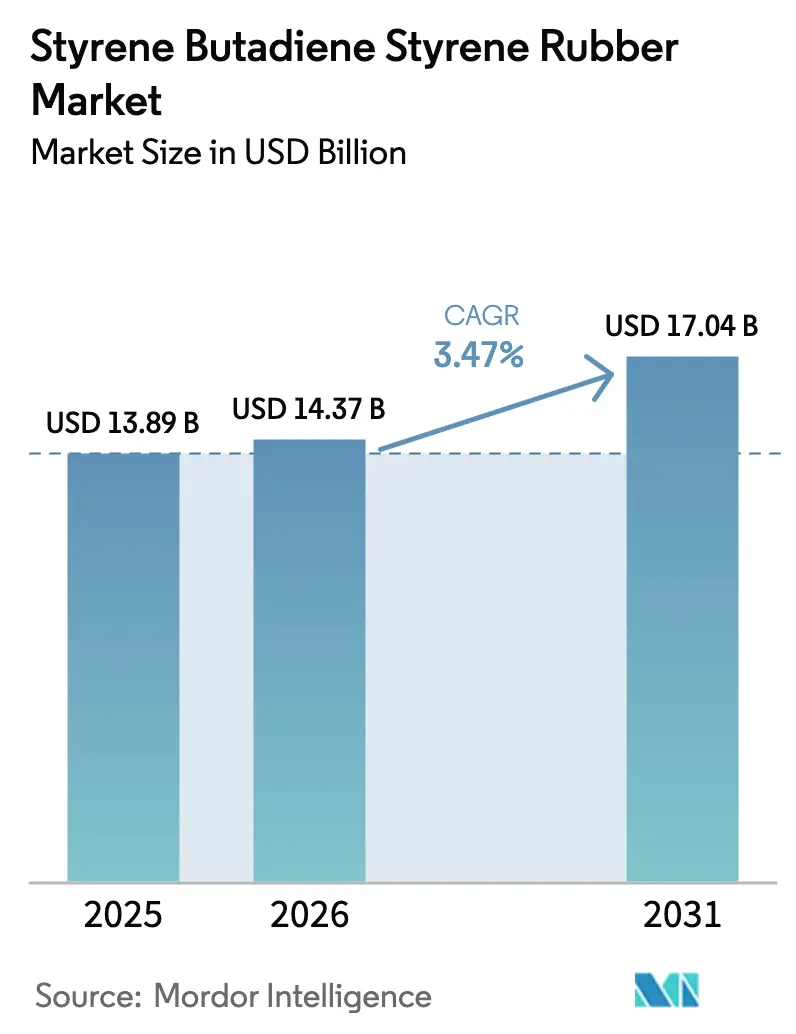
| Market Size (2026) | USD 14.37 Billion |
| Market Size (2031) | USD 17.04 Billion |
| Growth Rate (2026 - 2031) | 3.47 % |
| Fastest Growing Market | Middle East and Africa |
| Largest Market | Asia-Pacific |
| Market Concentration | Medium |
Major Players *Disclaimer: Major Players sorted in no particular order Image © Mordor Intelligence. Reuse requires attribution under CC BY 4.0. | |
Styrene Butadiene Styrene Rubber Market Analysis by Mordor Intelligence
The Styrene Butadiene Styrene Rubber market size is expected to grow from USD 13.89 billion in 2025 to USD 14.37 billion in 2026 and is forecast to reach USD 17.04 billion by 2031 at 3.47% CAGR over 2026-2031. Persistent infrastructure upgrades in emerging economies, along with ongoing demand for high-performance footwear, compounds, and the irreplaceable balance of elastomeric behavior with thermoplastic processability, continue to drive consumption. Integrated supply chains in Asia-Pacific, where upstream feedstocks connect seamlessly with downstream processing clusters, create cost advantages that support resilient volume growth even as the industry matures. Product differentiation now centers on purity, bio-attributed content, and application-specific performance improvements more than on bulk price positioning, a shift reinforced by tightening sustainability mandates. Companies that secure reliable styrene and butadiene streams while reducing the carbon intensity of production are well-positioned to protect margins against raw material volatility.
Key Report Takeaways
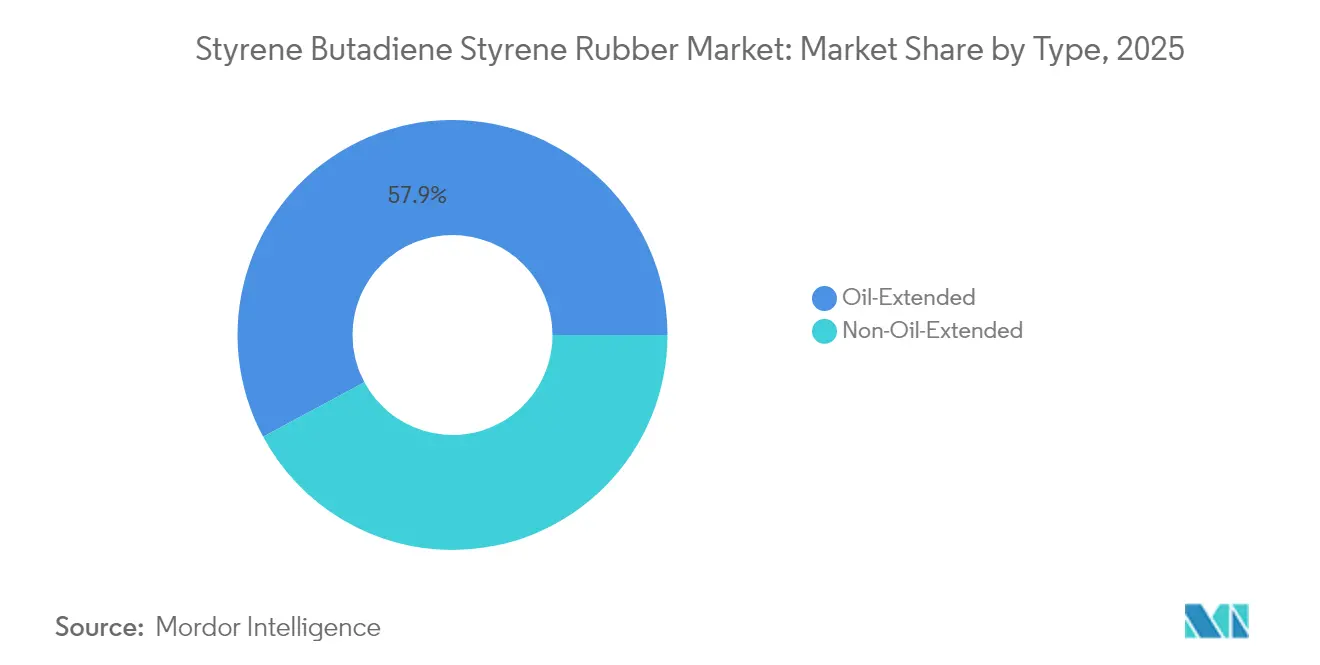
- By type, oil-extended grades accounted for 57.85% of the Styrene Butadiene Styrene Rubber market share in 2025. However, the market share of the non-oil-extended type is expected to increase with the fastest CAGR of 4.05% during the forecast period.
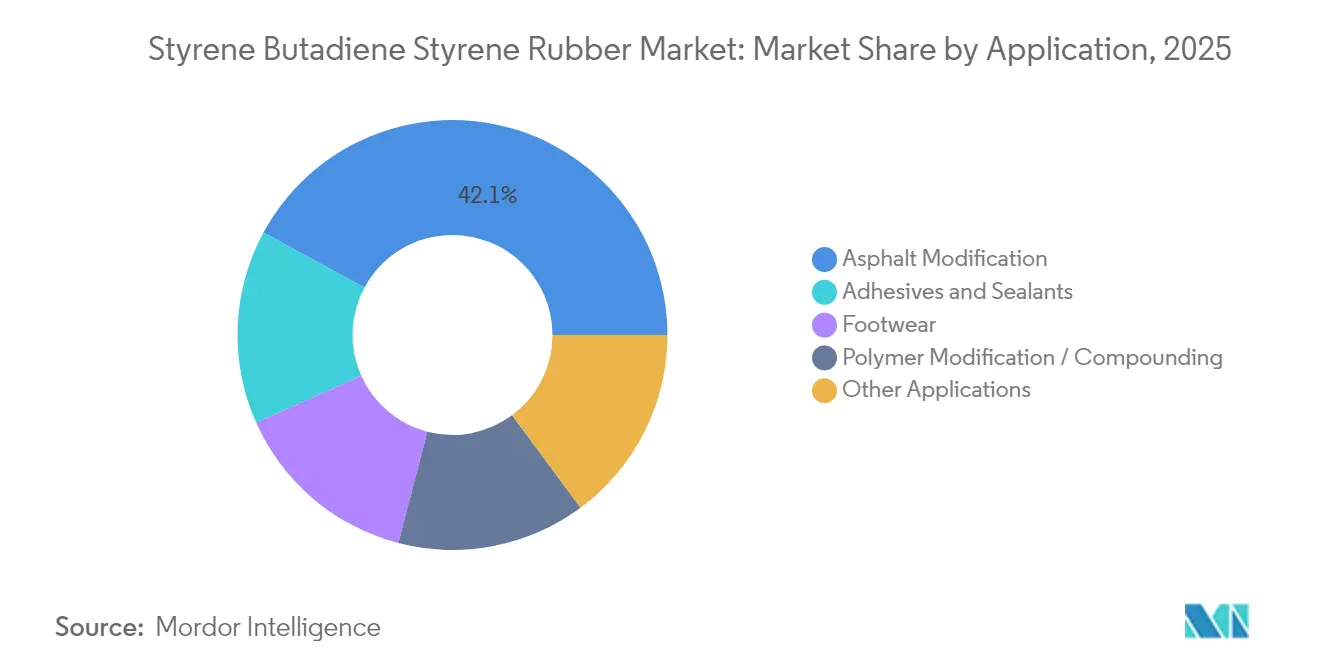
- By application, asphalt modification commanded a 42.10% share of the Styrene Butadiene Styrene Rubber market size in 2025, while adhesives and sealants are projected to advance at a 4.86% CAGR through 2031.
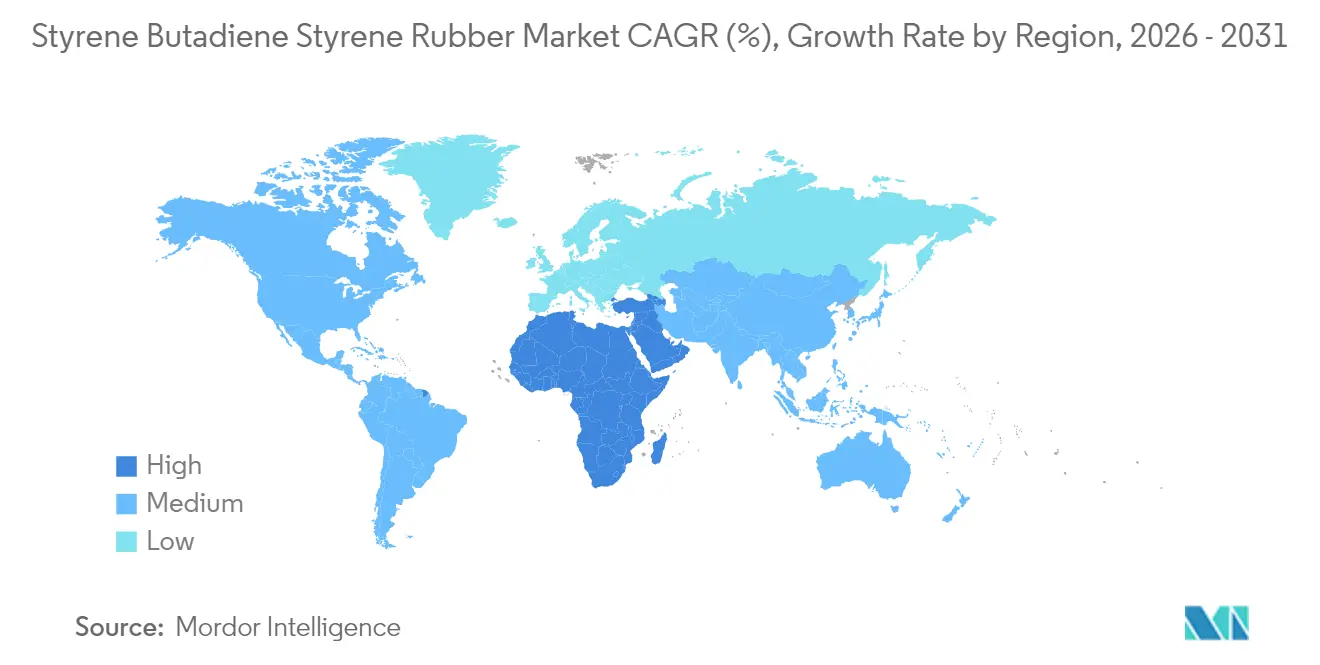
- By geography, the Asia-Pacific region held a 45.75% revenue share in 2025; the Middle East and Africa region is forecast to expand at a 3.75% CAGR through 2031.
Note: Market size and forecast figures in this report are generated using Mordor Intelligence’s proprietary estimation framework, updated with the latest available data and insights as of 2026.
Market Trends and Insights
Drivers Impact Analysis of Styrene Butadiene Styrene Rubber Market*
| Driver | (~) % Impact on CAGR Forecast | Geographic Relevance | Impact Timeline |
|---|---|---|---|
| Rapid expansion of footwear manufacturing hubs | +0.8% | Asia-Pacific core, spill-over to Latin America | Medium term (2-4 years) |
| Rising SBS-modified bitumen use in road and roofing projects | +1.2% | Global, with concentration in MEA and APAC | Long term (≥ 4 years) |
| Accelerating demand from hot-melt adhesives and sealants | +0.9% | North America & EU, expanding to APAC | Short term (≤ 2 years) |
| Thermoplastic elastomer substitution for recyclable consumer goods | +0.6% | EU and North America, regulatory-driven | Medium term (2-4 years) |
| 3-D printing adoption for flexible and transparent parts | +0.4% | North America & EU, technology hubs | Long term (≥ 4 years) |
| Source: Mordor Intelligence | |||
Rapid Expansion of Footwear Manufacturing Hubs
Vietnam, China, and Indonesia now form a contiguous manufacturing corridor that demands specialized SBS grades engineered for midsoles, outsoles, and cushioning inserts. High-elastic variants deliver energy return properties sought by performance footwear brands while maintaining anti-slip coefficients critical for workplace and athletic safety. Sustainability targets from global shoe brands are spurring pilot orders for bio-attributed SBS, and SCG Chemicals’ USD 700 million ethane upgrade at its LSP Vietnam complex underlines the priority of monomer self-sufficiency for regional sole compounders[1]SCG Chemicals, “SCG invests USD 700 million in LSP ethane upgrade,” scgchemicals.com. Clustered production also shortens lead times, enabling just-in-time inventory models that lower working capital for finished-goods assemblers.
Rising SBS-Modified Bitumen Use in Road and Roofing Projects
Government-funded highway expansions and urban roofing retrofits specify SBS-modified binders for resilience against rutting at 60°C and cracking at -20°C. Rheological testing confirms service-life extensions of up to 40% versus conventional asphalt, offsetting the higher initial polymer cost. National infrastructure plans in Saudi Arabia and India require performance-grade asphalt with polymer modification, positioning SBS at the top of bidder specifications for both new lane construction and resurfacing programs.
Accelerating Demand from Hot-Melt Adhesives and Sealants
Packaging converters are transitioning from solvent-borne systems to SBS-based hot melts, which are processed at 150-170°C, thereby reducing cycle times and minimizing VOC emissions. Formulators blend 15-25% SBS with hydrogenated hydrocarbon resins to achieve pressure-sensitive tack that retains peel strength down to -40°C for automotive wire harness tapes. Hygiene product makers specify medical-grade SBS for diaper fastening systems, valuing its skin-friendly rebound and odor neutrality.
Thermoplastic Elastomer Substitution for Recyclable Consumer Goods
European extended producer responsibility laws require designs that tolerate multiple melt-recycle loops without significant property loss. Non-oil-extended SBS maintains tensile strength above 18 MPa even after two reprocessing cycles, supporting circular packaging initiatives. PLAYMOBIL’s migration of its toddler line to plant-based styrenics with SBS content illustrates how mass-balance certification de-risks brand exposure to future bans[2]INEOS Styrolution, “INEOS Styrolution to permanently close Sarnia styrene plant,” ineos-styrolution.com .
Restraints Impact Analysis of Styrene Butadiene Styrene Rubber Market*
| Restraint | (~) % Impact on CAGR Forecast | Geographic Relevance | Impact Timeline |
|---|---|---|---|
| High feedstock (styrene, butadiene) price volatility | -1.1% | Global, acute in regions with limited integration | Short term (≤ 2 years) |
| Competition from hydrogenated SEBS and other advanced TPEs | -0.7% | North America & EU, premium applications | Medium term (2-4 years) |
| Tightening VOC / environmental regulations on styrenics | -0.5% | EU and California, expanding globally | Long term (≥ 4 years) |
| Source: Mordor Intelligence | |||
High Feedstock Price Volatility
The permanent shutdown of INEOS Styrolution’s 430 kt styrene unit in Sarnia constrains North American monomer supply and lifts spot prices, prompting smaller SBS formulators to negotiate short-term imports or pay premiums for domestic volumes. Kraton raised global SBS list prices in April 2025 to defend margin against styrene spikes, highlighting the 31% cost-of-goods exposure to raw materials. Parallel expansions in S-SBR tire elastomers siphon butadiene from SBS producers, further tightening balances.
Competition from Hydrogenated SEBS and Other Advanced TPEs
Styrene-Ethylene-Butylene-Styrene (SEBS) copolymers, with superior UV resistance, thermal stability, and weatherability, are surpassing traditional SBS in outdoor and automotive applications, where durability justifies higher costs. The hydrogenation process enhances SEBS's performance under UV exposure and high temperatures, making it ideal for applications that require a service life of over a decade. Propylene-based elastomers (PBEs), developed using advanced metallocene catalysts, are emerging as strong competitors due to their recyclability and potential for bio-based feedstocks. Commercial PBE grades, such as ExxonMobil's Vistamaxx, Dow's Versify, and Mitsui's Tafmer, offer elongation at break exceeding 1,700% and elastic recovery rates of 80-94%, rivaling SBS.
*Our forecasts treat driver/restraint impacts as directional, not additive. The impact forecasts reflect baseline growth, mix effects, and variable interactions.
Styrene Butadiene Styrene Rubber Market Segment Analysis
By Type:
Oil-Extended Dominance Faces Non-Oil-Extended GrowthOil-extended grades continued to command a 57.85% volume share in 2025, sustained by asphalt and footwear compounders who appreciate the melt-viscosity reduction that can be achieved at loadings of up to 25% process oil. This share reflects economic optimization where tensile retention above 12 MPa satisfies application thresholds, and processing windows widen for high-throughput extrusion. Non-oil-extended SBS delivers superior clarity and chemical resistance, positioning it for applications such as medical plugs, automotive vent gaskets, and electronics housings that require passing stringent VOC benchmarks. Rising demand lifts non-oil-extended consumption at a 4.05% CAGR, outpacing overall styrene butadiene styrene market growth.
Lower-viscosity oil-extended grades simplify hot-melt adhesive coating at 180 m/min for packaging lines, while non-oil-extended variants are suitable for injection-molded soft-touch grips that require dimensional stability. Bio-based process oils offer a hybrid approach that retains processing advantages while enhancing sustainability scores, potentially shifting some buyers back toward oil-plasticized offerings as commercial volumes increase.



By Application:
Asphalt Modification Leads While Adhesives AccelerateAsphalt modification’s 42.10% share in 2025 indicates that the expansion of the styrene butadiene styrene market size is still primarily driven by road surfacing and roofing systems. National highway agencies specify SBS loadings of 3–7% to achieve rut depth reductions and crack resistance, which can lengthen pavement life by up to 40%. Life-cycle cost analyses validate the SBS premium when traffic volumes exceed 10,000 vehicles per day.
Adhesives and sealants post the fastest 4.86% CAGR, reflecting a pivot to high-value, low-VOC bonding solutions for automotive lightweighting and recyclable packaging. Formulators exploit SBS tack and thermofusibility to create one-component systems, eliminating the need for multi-polymer blends. Footwear compounds remain a stable volume outlet, and polymer modification continues to serve as a niche enhancer for rigid styrenics, where added impact resistance offsets minor stiffness losses. Emerging 3-D-printing filaments and transparent medical tubing provide incremental but higher-margin tonnage.
Geography Analysis
APAC Styrene Butadiene Styrene Rubber Market
The Asia-Pacific region held 45.75% of 2025 revenue and remains the anchor for the styrene butadiene styrene market due to integrated petrochemicals in China and ASEAN manufacturing corridors. Footwear exports from Vietnam increased by 11% in 2024, directly boosting SBS sole-compound consumption. Government road programs in India and Indonesia also specify SBS-modified bitumen for climate resilience, supporting steady regional drawdown.
North America Styrene Butadiene Styrene Rubber Market
North America’s refinery rationalization reduces domestic styrene output, and the Sarnia closure shifts the region toward import dependence for commodity SBS, even as elevated automotive and construction standards sustain demand for premium grades with low VOC signatures. Producers leverage application development services to protect their share against imported material.
Europe Styrene Butadiene Styrene Rubber Market
Europe shows mature volume yet steady uptake for recyclable consumer goods, where SBS’s thermoplastic recoverability aligns with circular-economy directives. Stringent REACH protocols are pushing formulators toward low-styrene-residual and bioattributed variants.
MEA and South America Styrene Butadiene Styrene Rubber Market
The Middle East and Africa’s 3.75% CAGR through 2031 is driven by sovereign infrastructure megaprojects and the region’s advantage in feedstock-rich petrochemical parks that can backward integrate SBS. South America relies on macroeconomic recovery; Brazil’s uptick in automobile production supports adhesives and interior trim applications, despite limited local SBS resin capacity.

Regulatory Landscape
Regulatory requirements affecting SBS increasingly focus on chemicals safety, emissions, and product environmental disclosures, shaping both polymer producers and downstream formulators (including asphalt, adhesives, footwear, and consumer goods). In the European Union, REACH-related obligations continue to influence formulation and stewardship practices. For example, the restriction on synthetic polymer microparticles under REACH Annex XVII (Entry 78) requires suppliers to provide instructions that minimize environmental release, which can affect additive selection, handling, and end-of-life guidance for SBS-containing systems.
In parallel, sustainability frameworks are being used as a practical compliance and procurement filter. The European Commission updated its Safe and Sustainable by Design (SSbD) framework in March 2026 with additional methodological guidance, reinforcing a policy direction that favors lower-impact chemistries and transparent assessment approaches. On the product-declaration side, third-party verified Environmental Product Declarations (EPDs) for SBS polymers, including AENOR verification under ISO 14025 and EN 15804-based rules, support customer requests for LCA-backed documentation in construction and industrial applications where tendering and supplier qualification increasingly reference environmental performance data.
Value Chain Analysis
The SBS value chain begins with upstream petrochemical feedstocks, primarily styrene monomer and 1,3-butadiene, where pricing and availability influence SBS producer margins and contracting behavior. These monomers feed solution polymerization routes that also rely on catalysts and initiators (commonly lithium-based systems), solvents, utilities, and energy-intensive processing steps, so electricity and steam costs meaningfully affect conversion economics. Cost pass-through shows up in pricing actions such as Kraton Polymer Japan’s announcement of an 85 yen/kg increase for SBS and SIS effective May 1, 2026, citing volatility in raw material and energy costs.
In the midstream, SBS producers, often integrated or feedstock-advantaged, compound and pelletize grades such as oil-extended and non-oil-extended variants, then supply downstream converters through direct contracts and regional distributors. Downstream demand is driven by asphalt modification, footwear compounding, and hot-melt adhesives and sealants, where processors tailor formulations with resins, oils or plasticizers, and additives to meet VOC, performance, and durability targets. Sustainability and documentation are increasingly cross-cutting across the chain. For example, Dynasol Elastomeros SAU has published cradle-to-gate LCA work aligned with ISO 14040/14044 for SBS products, supporting customers that require traceability and quantified environmental data alongside conventional performance specifications.
Competitive Landscape
The Styrene-Butadiene-Styrene Rubber market is moderately concentrated, placing vertically integrated majors, such as LG Chem, Kumho Petrochemical, and INEOS Styrolution, at the cost-curve bottom due to their ownership of styrene and butadiene streams. Producers vie to certify ISCC mass-balance SBS and develop bio-feed pathways that enable converters to meet their Scope 3 emission targets. R&D budgets target easy-process oil-extended grades with lower VOC emissions and medical-compliant non-oil-extended products for wearable devices. Mergers, joint ventures, and feedstock-swap contracts align with the need for scale to weather feedstock volatility.
Styrene Butadiene Styrene Rubber Industry Leaders
LG Chem
LCY
Kumho Petrochemical Co., Ltd.
Kraton Corporation
Dynasol Group
- *Disclaimer: Major Players sorted in no particular order

Styrene Butadiene Styrene Rubber Market Companies Covered in this Report
- ARLANXEO
- Asahi Kasei Corporation
- Bridgestone
- China National Petroleum Corporation (CNPC)
- Dycon Chemicals
- Dynasol Group
- Exxon Mobil Corporation.
- The Goodyear Tire & Rubber Company
- JSR Corporation
- Kraton Corporation
- Kumho Petrochemical Co., Ltd.
- LCY GROUP
- LG Chem Ltd.
- SIBUR Holding PJSC
- Synthos
- Trinseo
- TSRC Corporation
- Versalis S.p.A.
- ZEON CORPORATION

Market Opportunities and Future Outlook
A key whitespace is premiumization of SBS portfolios around documented sustainability (mass-balance or bio-attributed inputs) and application-specific compliance, especially for low-odor, low-residual grades used in adhesives, sealants, and consumer goods. LG Chem highlighted Bio-Circular Balanced SBS with ISCC Plus certification in April 2024, showing how producers are positioning SBS to fit customer procurement rules tied to Scope 3 reporting and circularity claims. Third-party EPD and LCA documentation, such as AENOR-verified EPDs for SBS polymers, is also becoming a practical differentiator in construction-linked end uses like roofing and asphalt, where bidders increasingly face environmental disclosure requirements.
Another opportunity area is supply and formulation resilience amid feedstock and energy volatility, where customers value suppliers that can maintain consistent quality, predictable lead times, and transparent stewardship data. The April 2026 price increase announced by Kraton Polymer Japan (effective May 1, 2026) reinforces ongoing cost and supply management in SBS-related product lines, supporting differentiated contracting, regional warehousing, and technical service models. At the same time, competitive pressure from higher-performance styrenic elastomers and adjacent elastomer families is pushing SBS producers and compounders toward clearer performance-to-cost advantages in asphalt durability, solvent-free hot-melt processing, and recyclable thermoplastic designs, rather than competing mainly on commodity pricing.
Recent Industry Developments in Styrene Butadiene Styrene Rubber Market
- April 2026: Kraton Polymer Japan announced an 85 yen/kg price increase for SBS and SIS products effective May 1, 2026, citing volatility in raw material and energy costs. The move signals continued cost pass-through dynamics in styrenic block copolymers and reinforces the importance of feedstock-linked contracting and regional supply planning for SBS users in adhesives, compounding, and construction applications.
- February 2026: Kumho Petrochemical brought additional solution styrene-butadiene rubber (SSBR) capacity into commercial operation in Q1 2026, adding 35,000 tons per year aimed at higher-value elastomer demand such as EV tires. While SSBR is a different elastomer category than SBS, the capacity shift highlights producers prioritizing specialty elastomers and can tighten competition for shared feedstocks and manufacturing resources across styrene-butadiene value chains.
- April 2024: LG Chem highlighted its Bio-Circular Balanced Styrene Butadiene Styrene (SBS) offering using renewable bio-based raw materials under an ISCC Plus approach. The product positioning supports converters pursuing mass-balance sustainability claims without changing processing routes, accelerating interest in certified SBS grades for brand-sensitive applications such as consumer goods, footwear components, and adhesives.


Styrene Butadiene Styrene Rubber Market Report Scope and Research Methodology
Market Definition and Coverage
For this methodology, the market covers the sales value of styrene butadiene styrene (SBS) rubber used as an elastomer in downstream products, tracked across global demand and supply for commercial applications.
Scope exclusions: Excludes other elastomers and adjacent styrenic block copolymers that are not SBS, even if they serve similar end uses.
Segments Covered in This Report
- By Type
- Oil-Extended
- Non-Oil-Extended
- By Application
- Footwear
- Asphalt Modification
- Polymer Modification / Compounding
- Adhesives and Sealants
- Other Applications
- By Geography
- Asia-Pacific
- China
- India
- Japan
- South Korea
- Rest of Asia-Pacific
- North America
- United States
- Canada
- Mexico
- Europe
- Germany
- United Kingdom
- Italy
- France
- Russia
- Rest of Europe
- South America
- Brazil
- Argentina
- Rest of South America
- Middle-East and Africa
- Saudi Arabia
- United Arab Emirates
- South Africa
- Egypt
- Rest of Middle-East and Africa
- Asia-Pacific
Data Sources, Market Sizing, and Validation
Desk Research
Desk research started by mapping the SBS value chain from feedstocks (styrene and butadiene) to polymerization and then to key uses such as asphalt modification, footwear compounds, and adhesives. We relied on public sources that anchor demand signals and track industry activity, such as U.S. Geological Survey materials data, U.S. Census Bureau trade statistics, Eurostat external trade data, UN Comtrade, and macro and construction indicators published by the World Bank and OECD.
To tie the market to operating behavior, we also reviewed company annual reports, investor presentations, and technical notes published by industry bodies and standards groups where relevant. In parallel, paid subscriptions for company financials and news helped us follow capacity announcements, plant restarts, and pricing moves that flow through to revenue sizing. This desk list is illustrative only, and additional public and paid sources were also used for data collection, validation, and clarification.
Primary Interviews and Surveys
Primary work was used to sanity-check the model with people close to SBS production, distribution, and end use, so assumptions did not remain purely desk-based. We spoke with a mix of manufacturers, compounders, distributors, and downstream users in construction and consumer applications, and we cross-checked the inputs across major consumption regions to close gaps and keep the ranges realistic.
Distribution of primary research fieldwork respondents
| Company type | Respondent position | Region |
|---|---|---|
| Top tier: 31% | CXOs: 13% | APAC: 42% |
| Mid tier: 50% | Functional/Unit leaders: 37% | EMEA: 31% |
| Smaller Players: 19% | Managers: 50% | Americas: 27% |
Market-Sizing & Forecasting
Sizing was built using a top-down approach where production, trade flows, and application-level consumption indicators were used to reconstruct the value pool for SBS by region, and then converted into revenue using observed pricing ranges. The totals were then corroborated using selective bottom-up approximations, such as rolling up a sample of supplier revenues, and checking implied volumes against typical use rates in asphalt modification and footwear compounding.
The inputs that mattered most were regional infrastructure spending and paving activity, polymer-modified bitumen penetration, footwear output trends, and the direction of styrene and butadiene feedstock costs that influence SBS pricing. Where direct country detail was thin, gaps were handled with proxy indicators such as imports as a share of apparent consumption and capacity utilization ranges confirmed by interviews, then conservative adjustments were applied so modeled demand did not exceed observable trade and production signals.
For the forecast, scenario analysis was used around two drivers that primary respondents flagged as the most sensitive: construction cycles tied to road works and the pace of formulation shifts in adhesives and compounds. Scenario outputs were blended into a base case that stays consistent with capacity additions, regional demand momentum, and the pricing outlook implied by feedstock trends.
Data Validation & Update Cycle
Validation was done through stepwise checks that compare modeled revenue against independent signals, such as apparent consumption from production plus net imports, and pricing realism versus feedstock-linked movements. Any large jumps by region or end use were reviewed again, and if the variance could not be explained by a known event such as capacity change, trade disruption, or pricing swing, the assumptions were revisited and expert inputs were re-contacted.
Before sign-off, the model and write-up go through multiple analyst reviews so unit logic, currency conversions, and time-series continuity are consistent. Reports are refreshed annually, and interim updates are triggered when material events occur, such as major plant expansions, shutdowns, or sharp feedstock price shifts. A final pre-delivery pass is completed so clients receive the most current view available at the time of publication.
Mordor Intelligence's Styrene Butadiene Styrene Rubber Market Size Compared Against Other Published Estimates
Published SBS market values can look far apart because some sources mix product definitions, use different base years, and apply pricing assumptions that move quickly with styrene and butadiene costs. Differences also show up when one publisher reports a short-term value view, while another leans on a longer forecast window that reflects a more optimistic construction cycle.
SIS and SEBS often get bundled into the same bucket in some estimates, but they sit outside Mordor Intelligence's scope for this SBS market, which is one reason the external numbers can run higher even when the underlying demand drivers are similar. Other gaps come from how polymer-modified asphalt is counted (only SBS modifiers versus broader bitumen additives), how regional trade is converted into apparent consumption, and how frequently price decks are refreshed when feedstock volatility is elevated.
Benchmark comparison
| Source | Market Size | Gaps in Research Methodology |
|---|---|---|
| Mordor Intelligence | USD 14.37 B (2026) | |
| Syndicated Publisher A | USD 12.11 B (2025) | Uses a different base year and a longer forecast window, and the public summary does not clarify if the value is tied to spot pricing or contract-average pricing, which can shift totals meaningfully. |
| Syndicated Publisher B | USD 10.91 B (2025) | Lower 2025 value likely reflects narrower application counting or more conservative pricing and penetration assumptions, with limited disclosure on how asphalt modification volumes and regional trade are treated. |
The table shows that year selection and product and application counting rules explain most of the spread, not a single demand factor. By keeping the inputs tied to visible demand signals (construction activity, trade balances, and use-rate checks) and then pressure-testing the totals with interviews, the final number stays traceable to repeatable steps rather than hidden inclusions.


Key Questions Answered in the Report
What is the projected value of the styrene butadiene styrene market in 2031?
It is forecast to reach USD 17.04 billion by 2031 on the back of a 3.47% CAGR.
Which application is expanding fastest for SBS through 2031?
Adhesives and sealants, driven by automotive lightweighting and packaging, is growing at a 4.86% CAGR.
Why does Asia-Pacific dominate global SBS demand?
The region concentrates footwear production, asphalt projects, and integrated petrochemical supply chains that together account for 45.75% of 2025 revenue.
How are sustainability goals influencing SBS product development?
Producers are launching bio-attributed and ISCC-certified grades to meet circular-economy mandates while retaining thermoplastic processing benefits.
What key factor negatively impacts SBS margins today?
Volatility in styrene and butadiene feedstock prices can cut operating margins, especially for producers without vertical integration or long-term supply contracts.
Page last updated on:


 Your data is secure and never sold or shared.


