
Acrylonitrile Butadiene Styrene (ABS) Resin Market Size and Share
Market Overview
| Study Period | 2021 - 2031 |
|---|---|
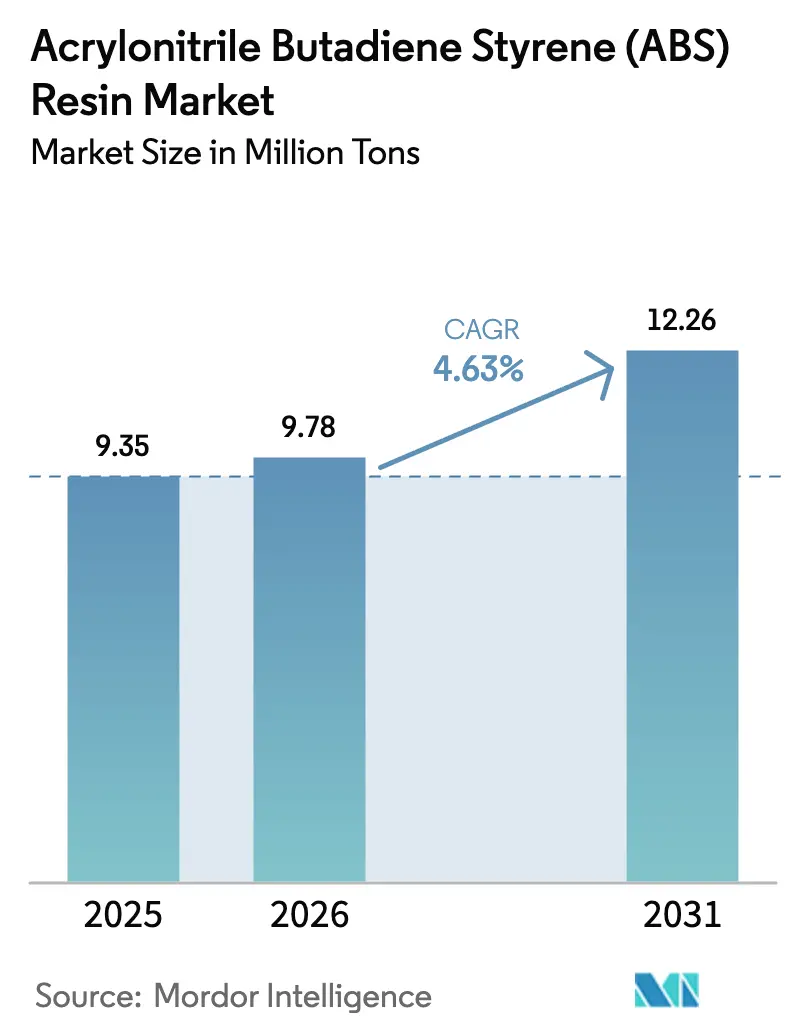
| Market Volume (2026) | 9.78 Million tons |
| Market Volume (2031) | 12.26 Million tons |
| Growth Rate (2026 - 2031) | 4.63 % |
| Fastest Growing Market | Asia Pacific |
| Largest Market | Asia Pacific |
| Market Concentration | Medium |
Major Players *Disclaimer: Major Players sorted in no particular order Image © Mordor Intelligence. Reuse requires attribution under CC BY 4.0. | |
Acrylonitrile Butadiene Styrene (ABS) Resin Market Analysis by Mordor Intelligence
The Acrylonitrile Butadiene Styrene Resin Market size is expected to grow from 9.35 Million tons in 2025 to 9.78 Million tons in 2026 and is forecast to reach 12.26 Million tons by 2031 at 4.63% CAGR over 2026-2031. Capacity additions of more than 1.5 million tons in China between 2024 and 2025 have kept volumes growing even as acrylonitrile feedstock prices swing sharply and biopolymer alternatives nibble at demand in electronics housings. Injection blow molding’s 48.21% share in 2025 highlights the technology’s efficiency advantage in complex hollow parts, while general-purpose grades retain a 37.56% foothold in cost-sensitive consumer goods. Asia-Pacific’s 76.12% share underscores the region’s vertically integrated supply base and the pull of downstream appliance and auto production hubs. Competitive intensity remains moderate: the five largest producers hold roughly 45% of capacity, yet rising specialty-grade demand leaves room for regional players to carve out niches.
Key Report Takeaways
- By processing technology, injection blow molding held 48.21% of Acrylonitrile Butadiene Styrene (ABS) resin market share in 2025 and is poised to grow at 5.2% CAGR to 2031.
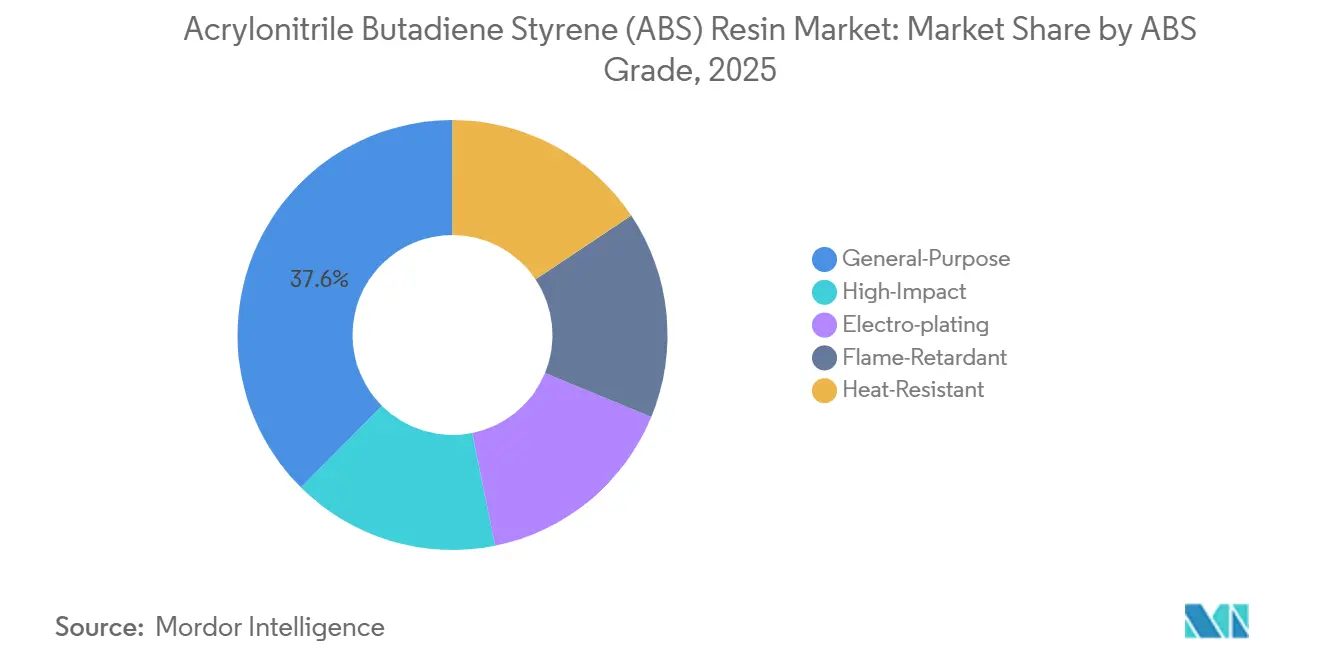
- By ABS grade, general-purpose accounted for 37.56% share of the Acrylonitrile Butadiene Styrene (ABS) resin market size in 2025, while flame-retardant is advancing at 6.6% CAGR through 2031.
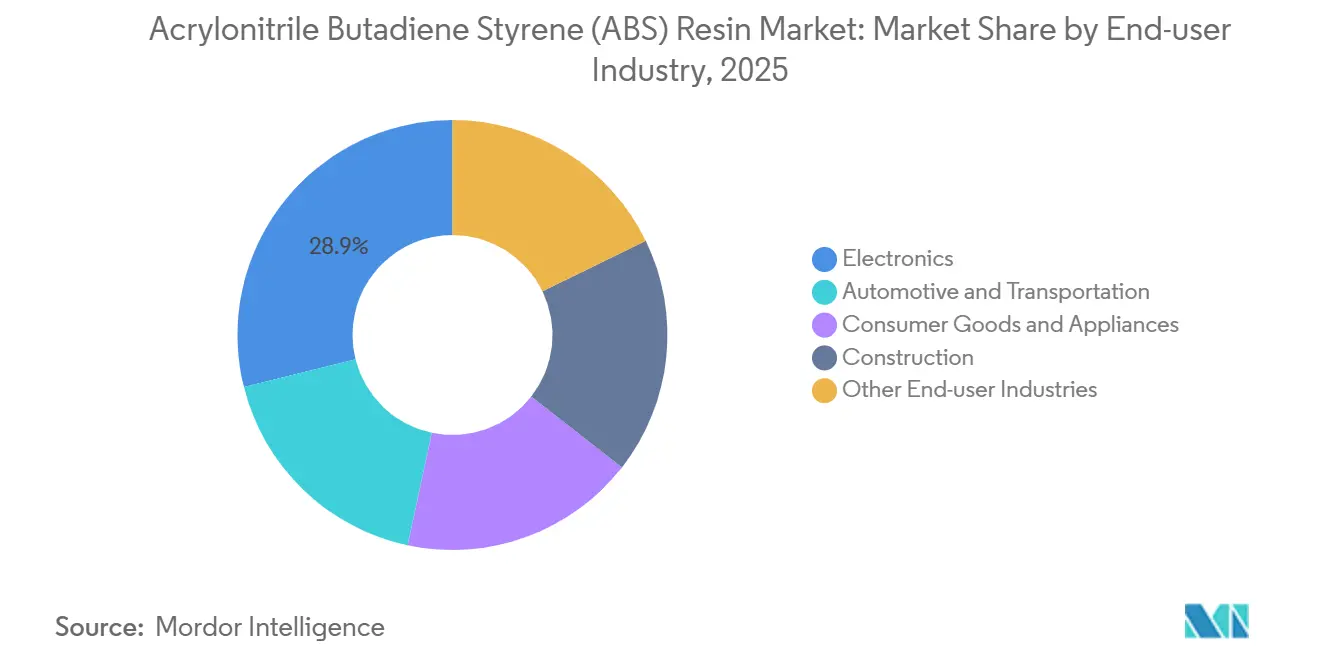
- By end-user industry, electronics led with 28.89% revenue share in 2025; consumer goods and appliances is forecast to expand at 6.26% CAGR through 2031.
- By geography, Asia-Pacific commanded 76.12% share of the Acrylonitrile Butadiene Styrene (ABS) resin market size in 2025 and is growing at 5.23% CAGR to 2031.
Note: Market size and forecast figures in this report are generated using Mordor Intelligence’s proprietary estimation framework, updated with the latest available data and insights as of January 2026.
Global Acrylonitrile Butadiene Styrene (ABS) Resin Market Trends and Insights
Drivers Impact Analysis*
| Drivers | (~) % Impact on CAGR Forecast | Geographic Relevance | Impact Timeline |
|---|---|---|---|
| Lightweighting and Metal Replacement in E-Mobility Platforms | +1.2% | Global with concentration in China, EU, North America | Medium term (2-4 years) |
| Smart-Home Appliances Requiring High-Gloss Heat-Resistant Grades | +0.9% | China, India, South Korea; spill-over to Middle East and Africa | Medium term (2-4 years) |
| Asia-Pacific Capacity Expansions and Down-Stream Integration | +1.5% | China, Thailand, Indonesia, Vietnam | Short term (≤ 2 years) |
| Demand for Electroplatable ABS in 5G mmWave Radomes | +0.3% | South Korea, China, United States | Long term (≥ 4 years) |
| Halogen-Free Flame-Retardant Cockpit Components for Regional Jets | +0.4% | North America, Europe | Long term (≥ 4 years) |
| Source: Mordor Intelligence | |||
Lightweighting and Metal Replacement in E-Mobility Platforms
Electric-vehicle makers are swapping steel and aluminum for reinforced ABS to offset battery mass and extend range. SABIC’s ENLITE long-glass-fiber ABS, commercialized in 2025, trims 25-30% weight from battery-tray covers while meeting UL 94 HB flammability limits[1]SABIC, “ENLITE Long-Glass-Fiber ABS Launch,” sabic.com. Trinseo co-developed door modules that remove 18 kg per vehicle and add roughly 2 km of driving range per charge. Chinese start-ups still favor polypropylene in under-body shields, but European OEMs specify ABS where surface appearance matters. The American Chemistry Council puts ABS use in North American light vehicles at 24 lb in 2023, a figure set to rise with battery-electric platforms[2]American Chemistry Council, “Plastic Content in North American Vehicles,” americanchemistry.com. EU 2027 CO₂ targets tighten the push toward lightweighting, nudging automakers to pre-qualify flame-retardant grades that pass ISO 3795 burn tests.
Smart-Home Appliances Requiring High-Gloss Heat-Resistant Grades
Touch-enabled refrigerators, IoT washing machines, and inductive cooktops need ABS compounds that stay glossy, resist heat, and shield electronics from static discharge. LG Electronics’ 2025 premium refrigerators use heat-resistant ABS with a deflection temperature above 95 °C, allowing thinner walls and larger displays during South Asian summer transport. Samsung debuted a grade whose surface resistivity under 10¹⁰ Ω/sq minimizes electrostatic discharge around Wi-Fi modules. India’s Bureau of Energy Efficiency raises appliance energy-label hurdles in 2026, and Whirlpool has lifted ABS content in its top-load washers from 8% to 12% of material cost since 2023. Halogen-free flame retardants add 3-5% to compounding cost but satisfy RoHS and REACH export requirements.
Asia-Pacific Capacity Expansions and Down-Stream Integration
China alone added about 1.5 million tons of ABS capacity between 2024 and 2025, led by INEOS-Sinopec’s 600 kt Ningbo plant and Zhejiang Petrochemical’s 600 kt Zhoushan complex. Co-located styrene and acrylonitrile units shave USD 80-100 per ton in logistics costs and hedge feedstock swings. Yulong Petrochemical’s 300 kt Liaoning line, online since mid-2025, targets high-impact grades for nearby auto plants. Thailand’s PTT Global Chemical and Indonesia’s Chandra Asri are following with expansions that will supply ASEAN appliance makers relocating out of China. The fresh capacity cut Northeast Asian ABS spot prices by 12% year-on-year in Q4 2025, squeezing non-integrated producers in Europe and North America.
Demand for Electroplatable ABS in 5G mmWave Radomes
Millimeter-wave 5G base stations need radomes that accept metal plating for EMI shielding yet keep dielectric loss low. Electroplatable ABS, pre-treated with palladium, offers a dielectric constant near 2.8 at 28 GHz, good enough for urban small cells used by Samsung and LG vendors, although PTFE performs better in rural macro sites. EU REACH restrictions on hexavalent chromium forced a switch to trivalent baths that bond poorly to ABS unless costly pre-treatments are added. China targets 2.5 million 5G base stations by 2027, yet industry estimates suggest only 8-10% will employ ABS radomes, with most opting for PC-PBT blends that skip plating.
Restraints Impact Analysis*
| Restraints | (~) % Impact on CAGR Forecast | Geographic Relevance | Impact Timeline |
|---|---|---|---|
| Volatile Acrylonitrile Feedstock Prices | -0.8% | Europe and North America (non-integrated sites), global | Short term (≤ 2 years) |
| Substitution by Bio-Based/Compostable Polymers in Electronics | -0.5% | Europe, North America, Japan | Medium term (2-4 years) |
| Stringent Nordic VOC Limits on ABS Processing Plants | -0.2% | Sweden, Norway, Finland, Denmark | Long term (≥ 4 years) |
| Source: Mordor Intelligence | |||
Volatile Acrylonitrile Feedstock Prices
Acrylonitrile makes up 35-40% of ABS cost, and a 25% drop in Northeast Asian spot prices during 2024 slashed margins for non-integrated producers in Europe and the United States. German and Texan facilities idled lines in Q3 2025 after margin compression of USD 150-200 per ton. Propylene volatility compounds the issue: U.S. Gulf Coast contracts spiked 18% in early 2025 after refinery outages, only to retreat once Asian naphtha crackers ramped. Automotive Tier 1 suppliers increasingly insist on quarterly resin price resets, pushing risk back upstream. Vertically integrated players such as INEOS and Formosa Plastics enjoy a USD 100-120 per ton advantage and can weather downdrafts. The International Energy Agency expects broadly stable crude through 2027 but flags Middle East propane supply as a wild card.
Substitution by Bio-Based/Compostable Polymers in Electronics
Consumer-electronics brands are trialing PLA and PHA blends to hit sustainability pledges. European Bioplastics projects global bioplastic capacity will reach 7.43 million tons by 2028, a 27.2% CAGR, directly challenging ABS in thin-wall parts. Samsung’s 2025 Galaxy line adopted a PLA back cover certified to ISO 14855, though the 58 °C heat-deflection temperature limits structural use. Apple already sources 12% of MacBook plastic mass from recycled or bio-based feedstocks and aims to double that by 2027. Bio-based polymers cost 20-30% more than virgin ABS, yet European and Japanese regulations on extended producer responsibility justify the premium. Technical gaps remain: PLA’s notch sensitivity and limited composting infrastructure slow mainstream adoption.
*Our forecasts treat driver/restraint impacts as directional, not additive. The impact forecasts reflect baseline growth, mix effects, and variable interactions.
Segment Analysis
By Processing Technology: Injection Blow Molding Extends Its Lead
Injection blow molding held a 48.21% share of the acrylonitrile butadiene styrene (ABS) resin market size in 2025 and is forecast to secure a 5.2% CAGR through 2031 as appliance, auto, and electronics producers favor its short cycle times. ENGEL’s 2025 servo-hydraulic machine with in-mold labeling cut per-part energy use 18% amid surging European electricity prices. Extrusion blow molding is growing slowly as rotational molding competes for large-format parts. Injection stretch blow molding is used mainly for cosmetic and pharma bottles and faces single-use plastics bans in the EU and India.
Chinese machinery makers such as Haitian and Borch rolled out all-electric injection-blow systems priced 25-30% below European rivals in 2024, accelerating uptake across ASEAN and South Asia. BMW’s 2025 iX electric SUV uses injection-blow-molded ABS ducts for battery thermal control, underscoring the technology’s versatility. Co-injection blow molding that sandwiches recycled polypropylene between ABS skins is being piloted by Bosch to hit EU Ecodesign recycled-content rules. ISO 16012 validation practices are spreading, and tier-one suppliers cite tighter tolerances as a factor favoring injection blow molding.
By ABS Grade: Specialty Grades Capture Growth Premium
General-purpose ABS retained 37.56% of volume in 2025. Flame-retardant ABS leads growth at 6.6% CAGR, boosted by UL 94 V-0 requirements for 5G hardware and FAA cockpit rules. SABIC’s LNP STAT-KON grade with aluminum trihydrate and red phosphorus delivers a limiting-oxygen index of 28% while keeping Izod impact above 18 kJ/m², meeting Siemens’ 2025 switchgear needs.
High-impact grades feed bumper fascias and power-tool bodies, while electroplating ABS splits between emerging-market auto trim demand and declining Western Europe usage due to REACH chromium limits. Heat-resistant ABS benefits from smart-appliance penetration; LG Chem’s HR-180 with a 105 °C Vicat point replaced polycarbonate in induction-cooktop panels, cutting material cost 15%. Trinseo’s Magnum FR grades marry flame retardancy and heat stability for EV charging stations and data-center racks, illustrating converging performance requirements.



By End-User Industry: Consumer Goods Momentum Builds
Electronics led with 28.89% demand in 2025, but consumer goods and appliances advance fastest at 6.26% CAGR as rising incomes in India and Southeast Asia spur premium home-product purchases. Whirlpool India boosted ABS content in washing machines from 8% to 12% of material cost between 2023 and 2025 to keep pace with LG and Samsung. Demand from the automotive and transportation segment is driven by EV lightweighting and parts like SABIC’s ENLITE battery-tray covers.
Construction holds a relatively lower share as PVC and cross-linked polyethylene challenge ABS in piping. Medical devices, sporting goods, and 3D printing show wide variability: Stratasys released a flame-retardant ABS filament for aerospace tooling in 2025, while Philips’ appliance recycling pilot fed 15% recycled ABS into new coffee-maker housings without losing UL approvals.
Geography Analysis
Asia-Pacific captured 76.12% of volume in 2025 and will grow at 5.23% CAGR through 2031, anchored by mega-integrated complexes such as INEOS-Sinopec Ningbo and Zhejiang Petrochemical Zhoushan that slice USD 80-100 per ton in feedstock logistics and blunt acrylonitrile gyrations. India’s demand rises significantly on surging appliance output, with Bureau of Energy Efficiency 2026 labels nudging heat-resistant ABS adoption. ASEAN growth accelerates as PTT Global Chemical and Chandra Asri add capacity serving relocated appliance lines.
North America market growth is influenced by flat auto builds and TPO substitution in interiors. SABIC’s Texas plant supplies flame-retardant grades for data-center racks, while Mexico’s re-export of chrome-plated trim keeps electroplating ABS afloat despite looming USMCA chromium limits.
Europe’s market is growing under tightening VOC and carbon-border rules that elevate costs for smaller molders. German OEMs shift to PC-ABS blends, and Covestro’s Bayblend won 2025 dashboards at Volkswagen and BMW. Brazil’s auto and appliance sectors lead South America ABS demand, though exchange-rate swings squeeze Unigel's margins. The Middle East and Africa’s ABS demand is backed by SABIC’s low-cost Jubail output and Saudi downstream diversification.


Regulatory Landscape
ABS resin producers and converters operate under air-emissions and chemicals compliance frameworks that affect plant economics and cross-border trade flows. In the United States, ABS manufacturing falls under the US EPA Group IV Polymers and Resins NESHAP program under the Clean Air Act, which targets organic hazardous air pollutant emissions from process vents, storage, and wastewater systems. This drives higher value for best-available control equipment and more stringent operating practices at large integrated sites.
In the European Union, trade and product-compliance measures have tightened market access conditions for ABS. The European Commission issued Regulation (EU) 2026/316 on 12 February 2026, imposing definitive anti-dumping duties on ABS imports from the Republic of Korea and Taiwan, which can shift sourcing decisions for European compounders and molders. Separately, Commission Regulation (EU) 2025/351 reinforces documentation and transition requirements for certain plastic materials used in food-contact applications, including a cutoff date of 16 September 2026 for non-compliant stocks. That creates additional pressure for traceability and supplier declarations across the ABS supply chain. While ABS as a polymer generally does not require registration under EU REACH, the constituent monomers (styrene, acrylonitrile, and 1,3-butadiene) remain within the REACH registration and hazard-management regime, influencing upstream procurement and compliance costs.
Value Chain Analysis
The ABS resin value chain starts with upstream petrochemical feedstocks and monomer production, primarily acrylonitrile, butadiene, and styrene, which drive a large share of ABS cash costs (acrylonitrile alone accounts for about 35-40% of ABS cost in the current RD scope). Integrated complexes in Asia-Pacific, especially in China, benefit from co-located monomer and polymer units, which reduce logistics exposure and improve responsiveness during feedstock swings. Non-integrated producers in Europe and North America face more margin volatility when monomer prices move sharply.
Midstream, ABS is produced via mass (bulk), emulsion, or hybrid polymerization routes, then sold as virgin pellet-grade resin (the report scope) or converted by compounders into application-specific formulations. Downstream demand concentrates in electronics, consumer goods and appliances, and automotive and transportation, where molders and OEMs specify properties linked to standards and approvals, such as UL 94 flammability classifications for electrical and electronic housings. Distribution typically runs from producer to regional warehouses and compounders, then to injection blow molding and other processing converters. Lead time, color-matching capability, and compliance documentation increasingly sit alongside price as differentiators.
Competitive Landscape
The Acrylonitrile Butadiene Styrene (ABS) Resin Market is moderately consolidated. INEOS Styrolution’s Ningbo and Antwerp hubs integrate styrene, acrylonitrile, and polymerization, carving a USD 100-120 per ton cost edge. SABIC tilts toward specialty ABS that earn 15-25% pricing premiums; its 2025 ENLITE launch for EV battery cases shows how incumbents defend share with lightweighting solutions. Trinseo’s halogen-free flame-retardant patent portfolio aligns with aerospace and data-center demand, while Formosa Plastics’ Louisiana greenfield plant, due in 2028, leverages cheap shale-ethane feedstock to serve southern U.S. and Mexican customers. Emerging bio-based acrylonitrile start-ups are piloting blends with Samsung, hinting at long-term substitution risk, yet commercial volumes remain negligible. Nordic processors that pre-installed VOC abatement now underbid rivals facing 2026 EU compliance deadlines, gaining a foothold in auto supply chains that prize ISO 14001 credentials.
Acrylonitrile Butadiene Styrene (ABS) Resin Industry Leaders
LG Chem
INEOS
CHIMEI
SABIC
Formosa Plastics Group
- *Disclaimer: Major Players sorted in no particular order


Market Opportunities and Future Outlook
Specialty ABS grades that address electrification, appliance premiumization, and compliance constraints define the most actionable whitespace within the virgin ABS scope. Flame-retardant and heat-resistant grades already show visible pull from electrical and electronic housings and smart-home appliances, supported by named developments such as SABIC commercializing ENLITE long-glass-fiber ABS in 2025 for EV battery-tray covers and LG Electronics using heat-resistant ABS in 2025 premium refrigerators. Processor-side investment also tracks these higher-value formulations, including INEOS Styrolution committing EUR 120 million in January 2026 to expand its Antwerp ABS compounding site by 80 kt per year, with added twin-screw lines for flame-retardant and heat-resistant grades.
Circularity-linked differentiation is another opportunity area while staying within the virgin pellet-grade ABS boundary: producers are using mass-balance certified recycled feedstocks in virgin-grade offerings to meet customer sustainability procurement. Trinseo launched MAGNUM ECO+ ABS resins in June 2024 using up to 60% chemically recycled styrene under an ISCC+ mass balance approach, giving automotive, industrial, and consumer goods customers a way to lower footprint while keeping familiar ABS processing behavior. Public programs are also pushing recycling capability for end-of-life ABS, including the European Commission-backed ABSolEU project (active in 2026 per CORDIS), which points to a growing ecosystem around ABS recycling and traceability. This can support demand for more consistent, additive-compatible virgin ABS streams in closed-loop designs and higher-performance blends.
Recent Industry Developments
- June 2026: Suzhou Plenty Plastic reported an export shipment of 125 metric tons of ABS resin to the Netherlands, marking a direct market entry into Europe via the Port of Rotterdam. The move highlights how smaller Asian suppliers are pursuing export channels into regulated end-markets, adding incremental competitive pressure on incumbent distribution networks.
- December 2025: LG Chem completed a KRW 150 billion continuous-polymerization upgrade at Yeosu to shorten cycle times and expand output flexibility for ABS used in high-gloss appliance panels. The upgrade was paired with a five-year supply pact with Samsung Electronics, strengthening secured offtake for specialty appliance-facing grades and tightening supplier alignment with large electronics buyers.
- June 2024: Trinseo launched MAGNUM ECO+ ABS and SAN resins incorporating chemically recycled styrene using an ISCC+ mass balance approach, positioned as drop-in materials for automotive, industrial, and consumer goods applications. This expanded the set of commercially available lower-footprint ABS options and raised the bar for traceability and sustainability attributes in competitive tenders.


Research Methodology Framework and Report Scope
Market Definition and Coverage
This market covers virgin ABS resin sold as pellets for downstream molding and extrusion into finished components across industries like automotive, electronics, appliances, and construction. The sizing is built in volume terms, since ABS is commonly contracted and tracked in tons.
Scope exclusions: Recycled ABS, PC-ABS blends, and SAN copolymers are excluded to avoid mixing resin demand with compounding and recycling loops.
Segmentation Overview
- By Processing Technology
- Injection Blow Molding
- Extrusion Blow Molding
- Injection Stretch Blow Molding
- By ABS Grade
- General-Purpose
- High-Impact
- Electro-plating
- Flame-Retardant
- Heat-Resistant
- By End-user Industry
- Automotive and Transportation
- Electronics
- Consumer Goods and Appliances
- Construction
- Other End-user Industries
- By Geography
- Asia-Pacific
- China
- India
- Japan
- South Korea
- Thailand
- Vietnam
- Malaysia
- Indonesia
- Rest of Asia-Pacific
- North America
- United States
- Canada
- Mexico
- Europe
- Germany
- United Kingdom
- France
- Italy
- Spain
- Russia
- Turkey
- Nordics
- Rest of Europe
- South America
- Brazil
- Argentina
- Colombia
- Rest of South America
- Middle East and Africa
- Saudi Arabia
- United Arab Emirates
- Qatar
- Egypt
- South Africa
- Nigeria
- Rest of Middle East and Africa
- Asia-Pacific
Data Sources, Market Sizing, and Validation
Desk Research
Desk research was used to set the supply and demand context for ABS and to anchor the model inputs that can be checked against public disclosures. We referenced public sources such as UN Comtrade trade statistics, national statistical offices for industrial production indices, OECD economic indicators, and open technical literature and journals on polymer processing and end-use performance.
Along with that, we used company annual reports, investor presentations, plant announcements, and credible press coverage to map capacity changes and typical grade positioning. A paid subscription for company financials and intelligence was used selectively to standardize producer footprints, and an import-export shipment level database was used when trade flows helped explain regional balances. The examples above are illustrative only, and many other public documents were also reviewed for data collection, validation, and research clarification.
Primary Interviews and Surveys
Primary work was used to stress-test the desk view and to fill gaps that public data cannot explain well, including typical ABS grade mix shifts, substitution with PP or PC-ABS in specific parts, and how converters handle price pass-through. We spoke with producers, distributors, compounders, and large converters across APAC, EMEA, and the Americas, so the assumptions could be checked against real purchasing and processing behavior.
Distribution of primary research fieldwork respondents
| Company type | Respondent position | Region |
|---|---|---|
| Top tier: 36% | CXOs: 21% | APAC: 47% |
| Mid tier: 42% | Functional/Unit leaders: 23% | EMEA: 31% |
| Smaller Players: 22% | Managers: 56% | Americas: 22% |
Market-Sizing & Forecasting
Our core sizing starts from a top-down demand pool build, where polymer consumption is reconstructed by combining regional production and trade signals with end-use pull indicators. Once that demand pool is set, it is split using practical ABS fingerprints such as injection molding intensity in appliances and automotive interiors, electronics enclosure production trends, and the pace of lightweighting and design changes that influence resin choice.
To keep the totals realistic, selective bottom-up checks were run using producer capacity additions, typical operating rate ranges shared in interviews, and sampled conversion volumes where credible. When gaps showed up, for example where trade codes blur ABS with related styrenics, the assumptions were adjusted using interview feedback and cross-region consistency checks. Forecasts were built using scenario analysis tied to variables like industrial production, auto builds, consumer durable output, electronics shipment direction, and expected ABS substitution patterns, and then the trajectory was reviewed with experts to confirm the forward view is workable.
Data Validation & Update Cycle
Validation is done through multiple passes so the final numbers do not rely on a single data stream. We compare model outputs against independent signals like capacity change timelines, trade balance logic, and downstream manufacturing momentum, and then investigate outliers before the dataset is locked.
A second analyst review is used to re-check calculations, units, and any step where a proxy variable was used. If a large variance is seen versus expected consumption patterns, respondents are re-contacted and assumptions are refined. Reports are refreshed annually, and interim updates are made when material events occur, followed by a final pre-delivery check so clients receive the latest view.
Mordor Intelligence's Acrylonitrile Butadiene Styrene Abs Resin Market Size Compared Against Other Published Estimates
Published ABS market numbers often do not match because the scope is not kept consistent, and because some sources present revenue values while others track tons. Differences also come from whether recycled and compounded materials are counted, and from how much of the downstream conversion chain is included.
The main gap comes from mixing resin-only demand with adjacent materials, where Mordor Intelligence keeps the estimate to virgin, pellet-grade ABS in tons and excludes recycled ABS and PC-ABS alloy volumes that can inflate reported totals when counted together.
Benchmark comparison
| Source | Market Size | Gaps in Research Methodology |
|---|---|---|
| Mordor Intelligence | USD 9.78 M (2026) | |
| Global Consultancy A | USD 23.11 B (2024) | Uses a revenue-based definition with broader application coverage and does not clearly separate virgin ABS resin from compounded or adjacent styrenic materials, which shifts the total upward versus a tons-only resin view. |
| Industry Publisher B | USD 24.17 B (2025) | Frames the market by end-use revenue pools and regional value shares, and the exclusions are not explicit, so recycled and blended material economics can be indirectly captured in the number. |
The comparison shows that the spread is driven more by what is being counted and the unit of measurement than by a disagreement on demand direction. By keeping the scope tied to a clear resin form and then checking it against capacity, trade, and end-use indicators, the model stays traceable and repeatable for planning discussions.


Key Questions Answered in the Report
What is the projected global demand for Acrylonitrile Butadiene Styrene (ABS) resin by 2031?
Global ABS resin demand is forecast to reach 12.26 million tons in 2031, expanding from 9.78 million tons in 2026 at a 4.63% CAGR.
Which region is expected to contribute the largest share of ABS resin volume through 2031?
Asia-Pacific will remain dominant, holding 76.12% of global volume in 2025 and growing at a 5.23% CAGR on the back of integrated Chinese and Southeast Asian capacity additions.
Which ABS grade is anticipated to post the fastest growth rate over the forecast period?
Flame-retardant ABS grades are set to grow at 6.6% CAGR, spurred by UL 94 V-0 and FAA 14 CFR 25 flammability requirements in 5G base-station and aerospace parts.
How will injection blow molding adoption evolve for ABS processors?
Injection blow molding already commands 48.21% of 2025 volume and is expected to rise at 5.2% CAGR as appliance, auto, and electronics makers favor its shorter cycles and energy savings.
What key challenge could pressure ABS producers’ profitability in the near term?
Acrylonitrile feedstock volatility, which cut margins by up to USD 150-200 per ton for non-integrated European and U.S. producers in 2025, poses the most immediate threat.
Which emerging material trend is likely to displace some ABS demand in electronics housings?
Bio-based polyesters such as PLA and PHA blends are gaining traction, with global bioplastic capacity projected to triple to 7.43 million tons by 2028, challenging ABS in thin-wall applications.
Page last updated on:




