
Market Overview
| Study Period | 2020 - 2031 |
|---|---|
| Forecast Data Period | 2026 - 2031 |
| Base Year Market Size (2025) | USD 4.57 Billion |
| Market Size (2026) | USD 5.01 Billion |
| Market Size (2031) | USD 7.91 Billion |
| Growth Rate (2026 - 2031) | 9.56 % |
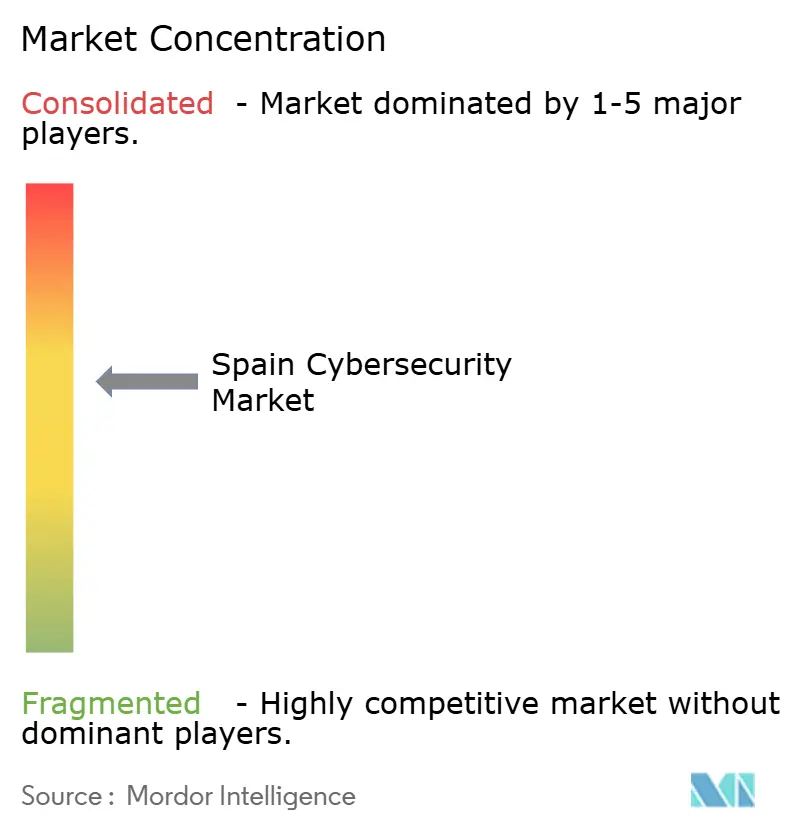
| Market Concentration | Medium |
Major Players *Disclaimer: Major Players sorted in no particular order Image © Mordor Intelligence. Reuse requires attribution under CC BY 4.0. | |
Spain Cybersecurity Market Analysis by Mordor Intelligence
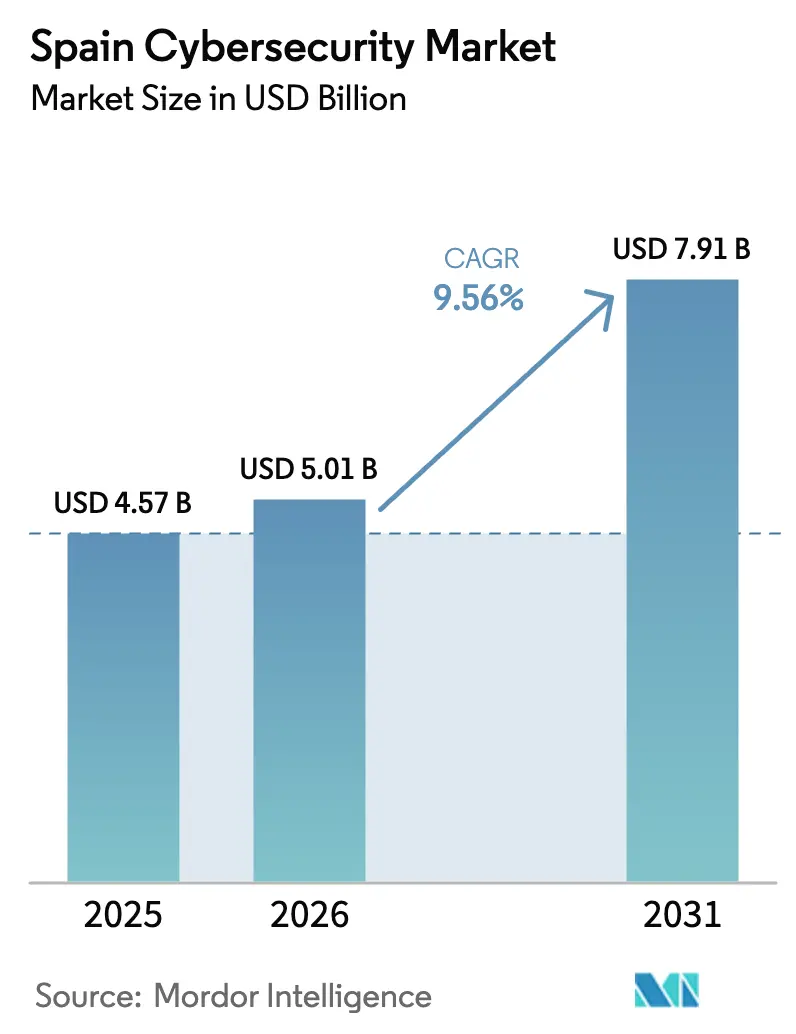
Spain cybersecurity market size was valued at USD 4.57 billion in 2025 and estimated to grow from USD 5.01 billion in 2026 to reach USD 7.91 billion by 2031, at a CAGR of 9.56% during the forecast period (2026-2031). Heightened regulatory pressure, accelerated cloud migration across all 17 autonomous communities, and an upsurge in sophisticated ransomware campaigns are simultaneously inflating security budgets and reshaping purchasing criteria. Spending momentum is reinforced by the EUR 1.157 billion (USD 1.24 billion) sovereign-resilience package approved in 2025, which earmarks fresh funds for regional security operations centers and workforce training. The operating environment also reflects Spain’s new National Cybersecurity Law, which extends 24-hour incident-reporting and third-party due diligence duties to more than 10,000 entities, prompting boards to ring-fence security outlays as a stand-alone budget line. On the supply side, vendors are pivoting from perpetual-license appliances toward outcome-based managed detection and response (MDR) contracts, enabling enterprises of all sizes to externalize operations yet still meet stringent audit requirements.
Key Report Takeaways
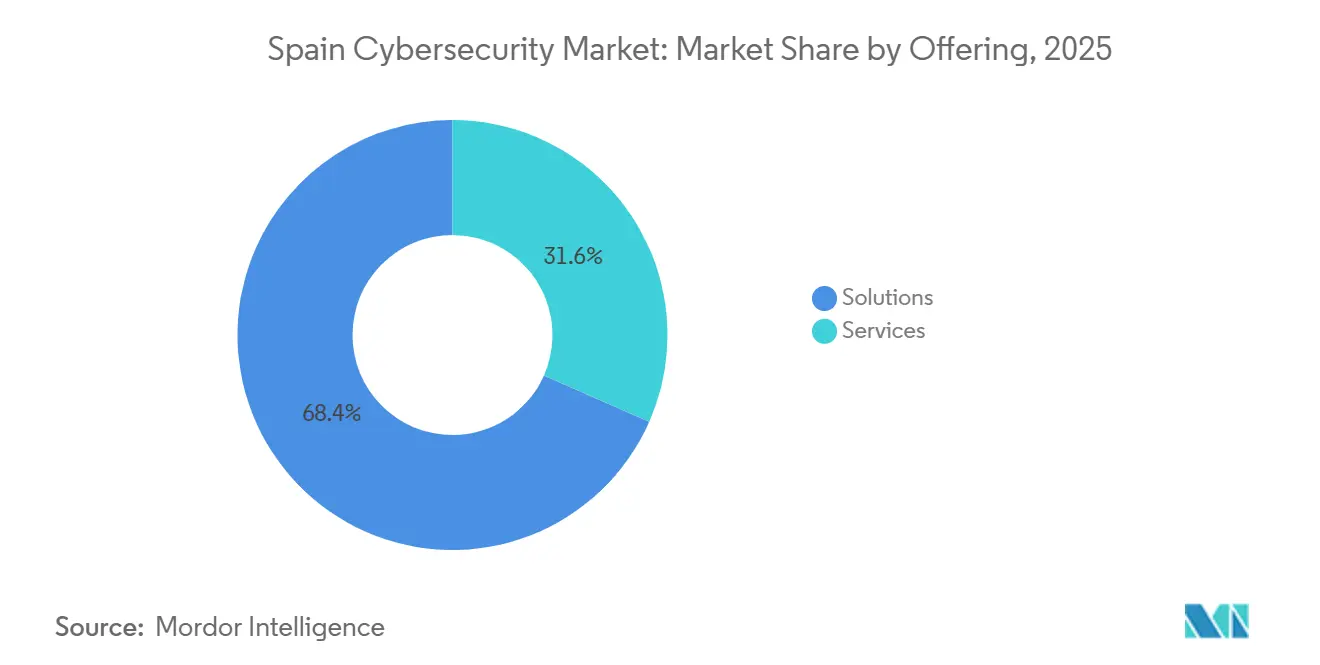
- By offering, solutions led with 68.38% revenue share in 2025, while services are projected to expand at a 10.23% CAGR through 2031.
- By deployment mode, cloud accounted for 64.37% of the Spain cybersecurity market share in 2025 and is forecast to grow at a 10.84% CAGR to 2031.
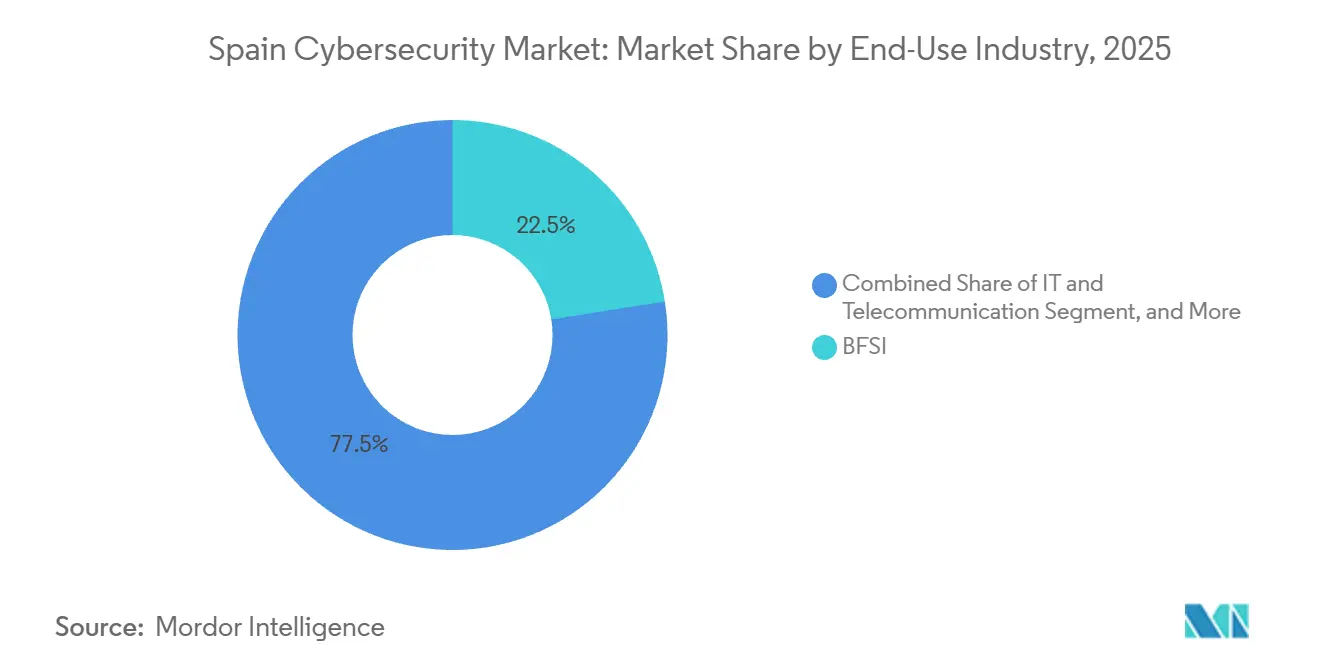
- By end-use industry, BFSI held 22.51% share of the Spain cybersecurity market size in 2025, whereas healthcare is advancing at an 11.16% CAGR through 2031.
- By enterprise size, large enterprises commanded 61.73% of 2025 spending, but small and medium enterprises are expanding at a 10.92% CAGR over 2026-2031.
Note: Market size and forecast figures in this report are generated using Mordor Intelligence’s proprietary estimation framework, updated with the latest available data and insights as of 2026.
Spain Cybersecurity Market Trends and Insights
Drivers Impact Analysis*
| Driver | (~) % Impact on CAGR Forecast | Geographic Relevance | Impact Timeline |
|---|---|---|---|
| Accelerating Digitalization Across Spanish SMEs | +2.1% | National, with concentration in Madrid, Catalonia, Valencia | Medium term (2-4 years) |
| Stringent National Cybersecurity Law 43-2022 Enforcement | +1.8% | National, affecting all 17 autonomous communities | Short term (≤ 2 years) |
| Surge in Cloud Migration by Public Administration Bodies | +1.5% | National, led by central government and regional administrations | Medium term (2-4 years) |
| Growing Adoption of Zero-Trust Architectures | +1.3% | National, early adoption in BFSI and IT/Telecom sectors | Long term (≥ 4 years) |
| Rising Cyber Insurance Uptake Re-shaping Security Budgets | +1.2% | National, with higher penetration in Madrid and Barcelona | Medium term (2-4 years) |
| Expansion of 5G Networks Driving Edge Security Demand | +1.7% | National, with early gains in industrial hubs of Basque Country, Catalonia | Long term (≥ 4 years) |
| Source: Mordor Intelligence | |||
Accelerating Digitalization Across Spanish SMEs
Spain’s 3.4 million small firms boosted basic digital-intensity penetration to 68% by Q1 2025, up seven points in two years. The Kit Digital voucher scheme subsidized endpoint protection, secure cloud storage, and multifactor authentication for 420,000 recipients, compressing the SME-to-large-enterprise maturity gap from two years to nine months. Voucher support reduced out-of-pocket endpoint detection and response costs by 60%, unleashing demand for managed MDR bundles that deliver 24/7 coverage without additional FTEs. Rapid telemetry growth is outstripping legacy SIEM capacity, steering purchasing toward AI-driven extended detection and response platforms that can ingest 10 terabytes of logs per day without manual tuning.[1]Cisco Systems, “Cybersecurity Readiness Index 2025,” cisco.com
Stringent National Cybersecurity Law 43-2022 Enforcement
Parliament’s January 2025 adoption of NIS2 obligations enlarged the regulated population to more than 10,000 organizations across 18 sectors.[2]European Commission, “NIS2 Directive Transposition – Spain,” digital-strategy.ec.europa.eu Essential entities must file incident notices within 24 hours and undergo annual third-party audits, with non-compliance fines reaching EUR 10 million (USD 10.73 million). The statute pushes security from an IT expense to a board-level risk-control category, triggering sustained budget allocations for tabletop exercises, forensic retainers, and supply-chain due diligence tooling. Early audits found 38% of newly covered operators lacked formal response plans, spurring immediate consulting demand.
Expansion of 5G Networks Driving Edge Security Demand
Standalone 5G now covers 96% of urban zones and 80% of rural zones, enabling ultra-low-latency industrial use-cases in automotive, logistics, and remote healthcare. A EUR 3.26 billion (USD 3.50 billion) telecom and cybersecurity plan funds a national 5G security operations center tasked with monitoring network slices and detecting anomalous signaling traffic. Manufacturers deploying private 5G lines need lightweight intrusion-detection software that can run machine-learning inference on ARM-based gateways without adding latency. Demand is also rising for zero-touch provisioning tools that secure thousands of edge devices scattered across smart-factory floors.
Surge in Cloud Migration by Public Administration Bodies
Madrid’s pledge to fold 43 ministerial data centers into a sovereign cloud by 2027 unlocked an initial EUR 800 million (USD 858 million) budget in 2025. Regional governments in Catalonia, Andalusia, and the Basque Country are spinning up parallel platforms, each requiring cloud security posture management that can enforce uniform policies over hybrid footprints. Because 62% of public-sector entities still run pre-2018 on-premises Active Directory services, they also need federation bridges that extend single sign-on while applying device-posture checks.
Restraints Impact Analysis*
| Restraint | (~) % Impact on CAGR Forecast | Geographic Relevance | Impact Timeline |
|---|---|---|---|
| Shortage of Certified Cybersecurity Professionals | -1.4% | National, acute in regions outside Madrid and Barcelona | Long term (≥ 4 years) |
| Budget Constraints Among Micro-Enterprises | -0.9% | National, concentrated in rural areas and hospitality sector | Short term (≤ 2 years) |
| Fragmented Procurement Across 17 Autonomous Communities | -0.7% | National, affecting multi-region vendors | Medium term (2-4 years) |
| High Dependence on Imported Security Appliances | -0.6% | National, with supply-chain exposure to Asia-Pacific | Medium term (2-4 years) |
| Source: Mordor Intelligence | |||
Shortage of Certified Cybersecurity Professionals
ICT specialists made up only 4.4% of Spain’s workforce in 2024, below the EU average of 4.8%.[3]Eurostat, “ICT Specialists in Employment – Spain,” ec.europa.eu/eurostat Median time-to-hire for CISSP-level roles exceeded six months, and 68% of credentialed staff cluster in Madrid and Barcelona, leaving Galicia, Extremadura, and other regions underserved. Universities graduated roughly 8,000 ICT students in 2024, but barely 15% majored in security. To narrow the gap, Indra Sistemas and the Catalan government launched a program to train 2,000 analysts by 2028. Until supply balances, many mid-market firms will rely on managed service providers for fractional SOC staffing.
Budget Constraints Among Micro-Enterprises
Micro-entities representing 95% of Spain’s business population budgeted a median EUR 2,400 (USD 2,575) for security in 2024. The Kit Digital grant softened costs but closed in December 2024, leaving a funding gap unlikely to be filled before 2027. Reliance on free community tools creates a false sense of safety; Orange Cyberdefense recorded a 53% higher phishing-success rate among freemium users versus commercial platform adopters. Price sensitivity channels these firms toward basic controls, sustaining systemic risk.
*Our forecasts treat driver/restraint impacts as directional, not additive. The impact forecasts reflect baseline growth, mix effects, and variable interactions.
Segment Analysis
By Offering: Services Overtake Ownership Models
Services are forecast to expand at a 10.23% CAGR between 2026 and 2031, overtaking traditional appliances even though solutions captured 68.38% of 2025 revenues. Enterprises prefer outcome-based MDR subscriptions that shift operational risk onto providers; Telefónica Tech’s NextDefense bundle slashed customers’ mean time to response by 98% while avoiding the need for new headcount. Financial audits mandated by the new law are also lifting demand for incident-response retainers and compliance consulting. The Spain cybersecurity market size for professional services is therefore scaling faster than capital purchases, though network and endpoint boxes still ship in compliance-sensitive ATMs and industrial control systems, preserving a sizeable solutions base.
Integrated risk management dashboards, identity governance suites, and cloud workload protection platforms continued to underpin steady growth in cybersecurity solutions, as enterprises prioritized broader visibility, stronger access controls, and improved protection for cloud-based workloads. However, hyperscalers continued to pressure appliance margins by embedding firewall and anti-malware capabilities directly into infrastructure-as-a-service offerings. This integration made it more difficult for attackers to bypass security controls without triggering cloud-native alerts, while also reducing the differentiation of standalone security appliances. In response to this commoditization trend, vendors strengthened their value proposition by integrating advanced AI-driven analytics, improving threat detection and response capabilities, and securing EU Common Criteria certifications. This strategy helped vendors demonstrate higher assurance, regulatory alignment, and technical credibility in an increasingly competitive market.


By Deployment Mode: Cloud Expansion Under Sovereignty Rules
Cloud captured 64.37% of 2025 spending and is on track for a 10.84% CAGR through 2031. The Spain cybersecurity market share attached to sovereign-cloud projects is set to swell as ministries migrate 43 data centers into a Federated Cloud that keeps encryption keys on Spanish soil, satisfying data-residency mandates. Enterprise uptake follows a parallel course: 58% of firms already operate on two or more cloud platforms, increasing the Spain cybersecurity market size tied to multi-cloud policy orchestration tools. Identity-and-access bridges, container runtime defense, and confidential-computing services are particularly in demand among regional governments striving for NIS2 compliance.
On-premises estates continue to play a critical role in latency-sensitive banking core systems and private 5G-enabled robotics, where cloud round trips can create unacceptable delays and regulators require dependable offline failover capabilities. Organizations operating hybrid environments must deploy secure interconnects that enforce consistent policies, controls, and governance across both on-premises and cloud environments. Financial institutions have also been conducting disaster recovery drills that isolate hyperscaler dependencies, highlighting the need to maintain operational resilience even when cloud connectivity or third-party cloud services are unavailable. This requirement continues to support sustained demand for on-premises appliances, particularly among enterprises with strict regulatory, performance, and business continuity requirements.
By End-Use Industry: Healthcare Rises, BFSI Holds Scale
Healthcare outpaces all sectors with an 11.16% CAGR, as EUR 1.69 billion (USD 1.81 billion) in Digital Health Spain grants digitize 100% of primary care centers. Interoperable electronic health records and telemedicine sessions now 40% of consultations draw previously isolated medical devices onto open networks. Hospitals, therefore, adopt asset discovery and network segmentation software that inventories legacy scanners while meeting GDPR safeguards. ENISA logged a 78% rise in EU hospital breaches during 2024, underlining the commercial urgency.
BFSI accounted for 22.51% of revenue in 2025, supported by stringent regulatory oversight, high compliance requirements, and sizable IT budgets across financial institutions. The Digital Operational Resilience Act required quarterly threat-led penetration testing and 24-hour incident reporting, which encouraged banks and other financial institutions to strengthen their operational resilience frameworks. These requirements increased the adoption of automated scenario-simulation tools, real-time third-party risk dashboards, and advanced monitoring capabilities to identify, assess, and respond to cyber and operational risks more effectively. Card-not-present fraud reached EUR 140.97 million (USD 151.24 million) in 2024, further increasing the need for behavioral biometrics, tokenization solutions, and other fraud prevention technologies across the BFSI market.

By Enterprise Size: SMEs Accelerate, Large Enterprises Sustain Growth
Small and medium enterprises are set to grow at a 10.92% CAGR to 2031, trimming their historical maturity gap. Kit Digital lowered the total cost of managed endpoint security to EUR 50-80 (USD 54-86) per device per month, catalyzing adoption even in low-margin hospitality businesses. Despite the funding hiatus, voucher alumni now budget security as an operating expense, creating recurring revenue for regional managed service providers. Still, micro-enterprises overtly rely on subsidized solutions, leaving them over-exposed once support ceases.
Large enterprises retain 61.73% of spending and pursue zero-trust architectures that span data-center, cloud, and edge domains. Cisco’s 2025 survey revealed only 4% had mature implementations, yet 86% reported AI-related incidents.[4]Cisco Systems, “Cybersecurity Readiness Index 2025,” cisco.com Boards thus approve multi-year roadmaps pairing identity-centric controls with extended detection and response analytics, bolstering absolute market value even as relative growth moderates.
Geography Analysis
Madrid and Catalonia jointly accounted for a significant share of 2025 expenditure, supported by the concentration of national ministries, global banks, and hyperscale data centers in these regions. Both regions benefited from submarine cable landings, which strengthened the role of local ISPs as European peering points and increased demand for DDoS scrubbing services and customized threat intelligence feeds. The Basque Country and Valencia also emerged as industrial technology hotspots, as automotive and aerospace manufacturers expanded the deployment of 5G-linked robotics that required sub-10 millisecond security gateways to support secure, low-latency operations. Andalusia, Galicia, and Castilla y León continued to lag behind these leading regions, largely due to the dominance of micro-enterprises in agriculture and tourism and comparatively slower procurement cycles.
Fragmented purchasing frameworks across Spain’s 17 autonomous communities created 6-to-9-month delays in vendor onboarding, increasing compliance costs and limiting the pace of national rollouts. The National Cybersecurity Law aimed to standardize audit criteria across the country. However, local authorities continued to oversee enforcement, creating the risk of inconsistent penalty interpretation across regions. As a result, vendors increasingly built partnerships with regional managed security providers that understood local regulatory requirements, supported compliance processes, and provided on-site language support for customers.
Spain’s position as a geographic bridge between Europe, Africa, and Latin America provided important external connectivity advantages. New subsea cables to Senegal and Brazil supported data center expansion in Madrid and Barcelona, strengthening Spain’s position as a security hub in Southern Europe. The national 5G security operations center, financed in 2025, also supported the monitoring of cross-border network slices and encouraged public-private sharing of anomaly telemetry with ENISA.
Competitive Landscape
The top five vendors in the Spain cybersecurity market, such as Indra Sistemas, Telefónica Tech, GMV, Orange Cyberdefense, and Palo Alto Networks, held a major share of 2025 revenues, indicating a moderately concentrated competitive landscape. Spanish incumbents strengthened their positions by leveraging long-standing relationships with government agencies and public-sector institutions. At the same time, global players such as Cisco, Fortinet, and IBM expanded their platform-based subscription offerings to serve regional banks, telecom operators, and other enterprises seeking scalable cybersecurity capabilities.
Market strategies increasingly shifted toward consumption-based contracts, as vendors aimed to reduce upfront investment barriers and improve customer retention. Telefónica Tech’s NextDefense integrated Cortex XSIAM analytics, threat intelligence, and 24/7 expert support into a per-user fee model, helping customers lower capex requirements while accessing advanced security capabilities. Indra Sistemas targeted EUR 1 billion (USD 1.07 billion) in revenue by 2030 through its IndraMind platform, which combines AI and security orchestration to improve automation, accelerate threat response, and strengthen its competitive position.
White-space opportunities remained in medical-device security, where fewer than 20% of hospitals deployed specialized platforms, and in edge-native intrusion detection for ARM gateways supporting private 5G factories. WALLIX’s 2025 acquisition of Malizen added AI-based behavior analytics to help address DORA’s continuous-monitoring requirements, showing how targeted niche acquisitions supported regulatory alignment and expanded vendor capabilities. GMV’s EUCC certification demonstrated the procurement advantages companies gained by aligning product roadmaps with EU policy and compliance requirements.
Spain Cybersecurity Industry Leaders
Indra Sistemas S.A.
Telefónica Cybersecurity and Cloud Tech, S.A. (Telefónica Tech)
GMV Innovating Solutions S.L.
Inetum Espana S.A.
NCC Group Espana S.L.
- *Disclaimer: Major Players sorted in no particular order

Recent Industry Developments
- March 2026: Cisco introduced a framework to support the secure enterprise adoption of AI agents. The framework establishes trusted identities, enforces zero trust access, hardens agents before deployment, and provides SOC teams with runtime guardrails. It aims to help enterprises deploy AI agents securely while reducing operational and cybersecurity risks.
- March 2026: Palo Alto Networks expanded Prisma Cloud with AI-powered defenses against agentic threats and enhanced Cortex XSIAM for SOC automation. The expansion focuses on securing AI workloads across hybrid cloud environments and helping security teams improve threat detection, response, and operational efficiency.
- December 2025: Indra Sistemas closed a EUR 725 million (USD 778 million) takeover of Hispasat, adding secure satellite communications to its portfolio.
- November 2025: WALLIX bought Malizen for EUR 1.6 million (USD 1.72 million), integrating AI-driven user analytics into its privileged-access suite.


Spain Cybersecurity Market Report Scope
The Cybersecurity Market encompasses global spending on solutions, software, and services designed to protect digital infrastructure, data, and operations across all industries, including cloud, network, endpoint, and application security; it includes enterprise, government, and SME segments but excludes physical security and pure consulting-only services, with the market evolving rapidly toward AI-driven automation, platform consolidation, and regulatory-driven transformation.
The Spain Cybersecurity Market Report is Segmented by Offering (Solutions [Application Security, Cloud Security, Data Security, Identity and Access Management, Infrastructure Protection, Integrated Risk Management, Network Security, and End Point Security], and Services [Professional Services, and Managed Services]), Deployment Mode (On-Premises, and Cloud), End-Use Industry (IT and Telecommunication, Banking, Financial Services, and Insurance (BFSI), Healthcare and Life Sciences, Industrial Manufacturing, Retail and E-commerce, Energy and Utilities, Aerospace, Government and Public Administration, and Other End-Use Industries), and End-User Enterprise Size (Large Enterprises, and Small and Medium Enterprises). The Market Forecasts are Provided in Terms of Value (USD).
By Offering
| Solutions | Application Security |
| Cloud Security | |
| Data Security | |
| Identity and Access Management | |
| Infrastructure Protection | |
| Integrated Risk Management | |
| Network Security | |
| End Point Security | |
| Services | Professional Services |
| Managed Services |
By Deployment Mode
| On-Premises |
| Cloud |
By End-use Industry
| IT and Telecommunication |
| Banking, Financial Services, and Insurance (BFSI) |
| Healthcare and Life Sciences |
| Industrial Manufacturing |
| Retail and E-commerce |
| Energy and Utilities |
| Government and Public Administration |
| Other End-use Industries |
By End-User Enterprise Size
| Large Enterprises |
| Small and Medium Enterprises (SMEs) |
| By Offering | Solutions | Application Security |
| Cloud Security | ||
| Data Security | ||
| Identity and Access Management | ||
| Infrastructure Protection | ||
| Integrated Risk Management | ||
| Network Security | ||
| End Point Security | ||
| Services | Professional Services | |
| Managed Services | ||
| By Deployment Mode | On-Premises | |
| Cloud | ||
| By End-use Industry | IT and Telecommunication | |
| Banking, Financial Services, and Insurance (BFSI) | ||
| Healthcare and Life Sciences | ||
| Industrial Manufacturing | ||
| Retail and E-commerce | ||
| Energy and Utilities | ||
| Government and Public Administration | ||
| Other End-use Industries | ||
| By End-User Enterprise Size | Large Enterprises | |
| Small and Medium Enterprises (SMEs) | ||


Key Questions Answered in the Report
How large is Spain’s cybersecurity spending today and how fast is it growing?
The market stands at USD 5.01 billion in 2026 and is on track to reach USD 7.91 billion by 2031, supported by a 9.56% CAGR.
Which segment is expanding quickest inside Spanish security budgets?
Managed and professional services are accelerating at a 10.23% CAGR as firms shift from appliance ownership to outcome-based MDR contracts.
Why is healthcare now a priority customer group?
EUR 1.69 billion (USD 1.93 billion) in Digital Health funds is connecting legacy medical devices to networks, raising breach exposure and lifting security procurement at an 11.16% CAGR.
How are new regulations influencing vendor selection?
National Cybersecurity Law 43-2022 mandates 24-hour incident reporting and audited response plans, so buyers favor suppliers offering turnkey compliance tooling.
What skills shortfall is slowing deployment projects?
Only 4.4% of the labor force are ICT specialists and security hiring windows exceed six months, pushing enterprises toward managed service providers.
Who holds the strongest share among local suppliers?
Indra Sistemas, Telefónica Tech, GMV, Orange Cyberdefense, and Palo Alto Networks collectively control 38% of domestic revenue.
Page last updated on:


 Your data is secure and never sold or shared.


