
Space-based C4ISR Market Size and Share
Market Overview
| Study Period | 2019 - 2031 |
|---|---|
| Market Size (2026) | USD 3.63 Billion |
| Market Size (2031) | USD 4.61 Billion |
| Growth Rate (2026 - 2031) | 4.90 % |
| Fastest Growing Market | Asia Pacific |
| Largest Market | North America |
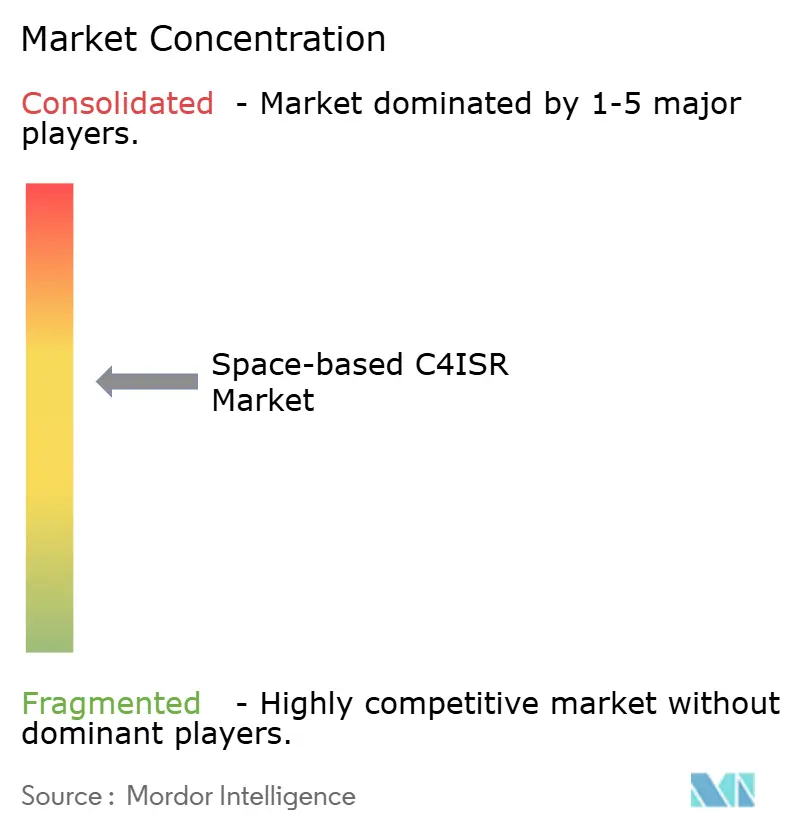
| Market Concentration | Medium |
Major Players *Disclaimer: Major Players sorted in no particular order Image © Mordor Intelligence. Reuse requires attribution under CC BY 4.0. | |
Space-based C4ISR Market Analysis by Mordor Intelligence
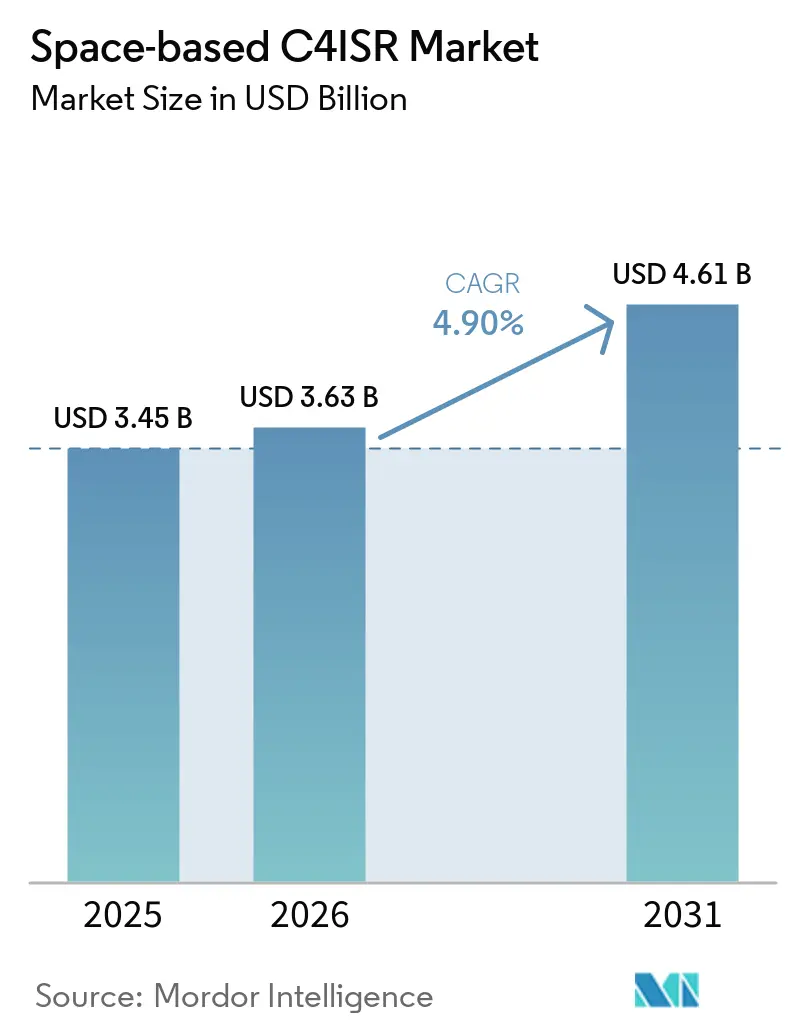
The space-based C4ISR market size was valued at USD 3.45 billion in 2025 and estimated to grow from USD 3.63 billion in 2026 to reach USD 4.61 billion by 2031, at a CAGR of 4.90% during the forecast period (2026-2031). Growth is tied to higher defense spending on satellites, sensors, secure communications, and space domain awareness. Global military space spending increased from USD 59.18 billion in 2025 to USD 63.38 billion in 2026, which strengthens funding conditions for the space-based C4ISR market. Procurement is moving toward constellations of smaller satellites that can be replaced or updated in shorter cycles. Software-defined payloads also allow operators to change missions without replacing hardware, which supports newer suppliers alongside established contractors. Demand is also broadening as countries seek sovereign access to imagery and communications rather than relying on allied tasking arrangements.
Key Report Takeaways
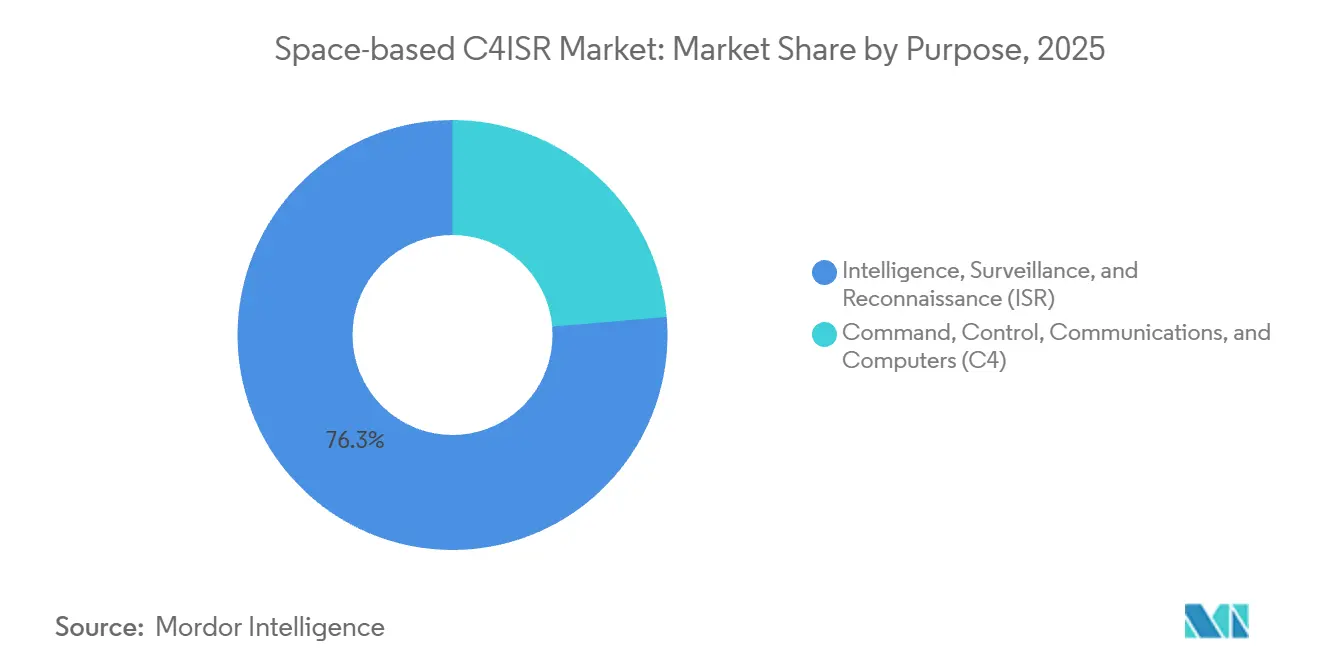
- By purpose, ISR held 76.34% of the space-based C4ISR market share in 2025, while C4 is forecast to grow at a 6.53% CAGR through 2031.
- By orbit type, LEO accounted for 71.35% of the space-based C4ISR market size in 2025 and is forecast to expand at a 6.21% CAGR through 2031.
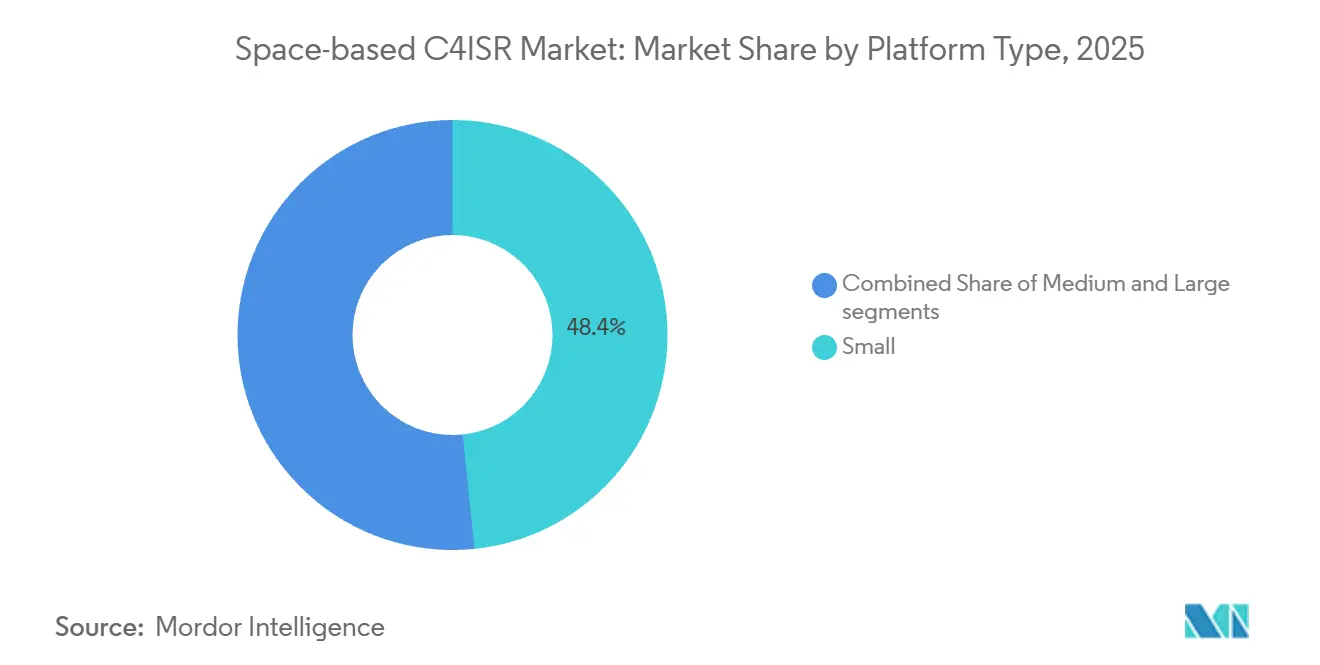
- By platform type, small satellites weighing less than 500 kg captured 48.37% of revenue in 2025 and are projected to grow at a 5.96% CAGR through 2031.
- By end user, defense forces accounted for 60.22% of revenue in 2025, while civil, government, and space agencies are forecast to grow at a 5.87% CAGR through 2031.
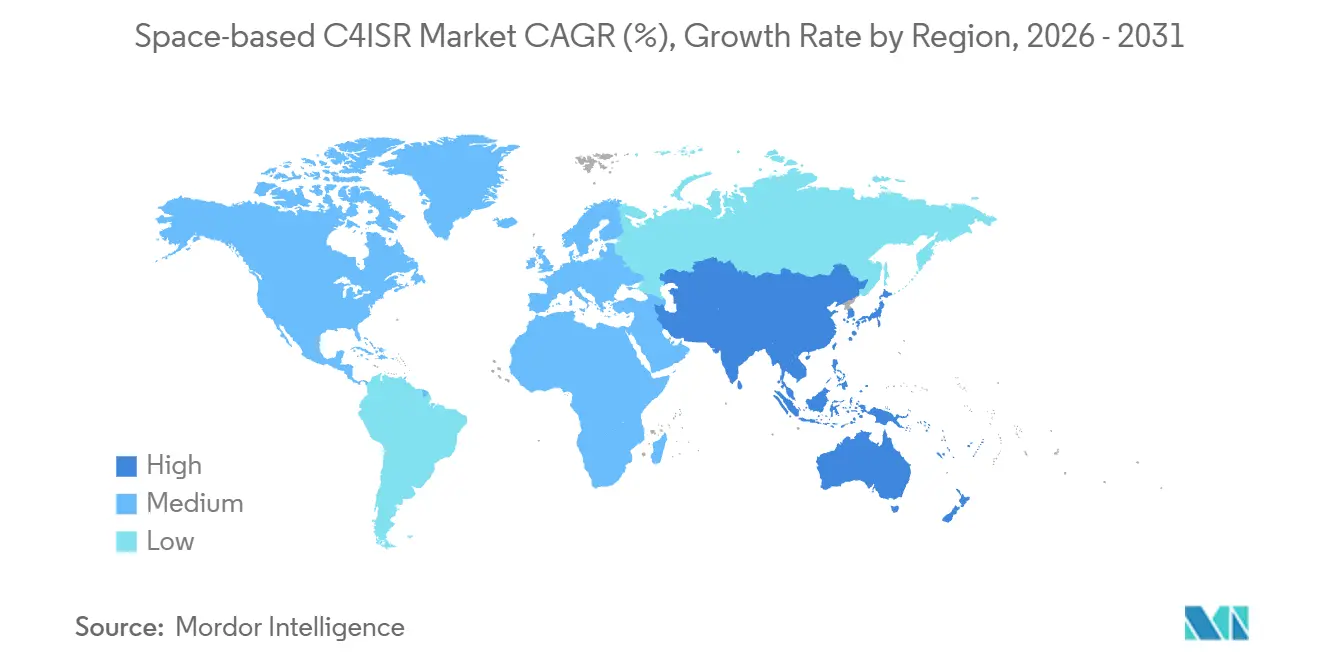
- By geography, North America retained 47.89% revenue share in 2025; Asia-Pacific is forecast to grow at a 6.05% CAGR through 2031.
Note: Market size and forecast figures in this report are generated using Mordor Intelligence’s proprietary estimation framework, updated with the latest available data and insights as of January 2026.
Market Trends and Insights
Drivers Impact Analysis of Space-based C4ISR Market*
| Driver | (~) % Impact on CAGR Forecast | Geographic Relevance | Impact Timeline |
|---|---|---|---|
| Rising demand for real-time situational awareness | +1.20% | Global | Short term (≤ 2 years) |
| Proliferation of low-cost small-sat constellations | +1.00% | Global, concentrated in North America and Asia-Pacific | Short term (≤ 2 years) |
| Higher defense spending dedicated to space domain awareness | +0.90% | North America, Europe, Asia-Pacific | Medium term (2-4 years) |
| Integration of C4ISR constellations with autonomous UAV swarms | +0.60% | North America, Europe, with growing relevance in Asia-Pacific | Medium term (2-4 years) |
| COTS software-defined payloads enabling rapid re-tasking | +0.40% | Global | Short term (≤ 2 years) |
| Multi-orbit network architectures optimizing tactical latency | +0.30% | North America and Asia-Pacific, with spillover to Middle East and Africa | Medium term (2-4 years) |
| Source: Mordor Intelligence | |||


Rising Demand for Real-Time Situational Awareness
Military users need more frequent coverage of mobile missile systems and other time-sensitive targets. The US Space Development Agency began Tranche 1 Transport Layer launches in September 2025. The program had placed 42 satellites in orbit by the end of 2025 and targets an initial warfighting capability in early 2027. Its architecture is designed to move sensor data to strike assets within 10 seconds.[1]Space Development Agency, “PWSA Tranche 1 Factsheet Update,” U.S. Space Force Space Development Agency, sda.mil This requirement shifts procurement attention from the satellite’s nominal capability to the availability and speed of the full service. Japan is developing AI-enabled satellites that process information in orbit, reducing the delay associated with sending data through ground stations. These operating requirements favor payload suppliers capable of providing reliable onboard processing for the space-based C4ISR market.
Proliferation of Low-Cost Small-Sat Constellations
Modular satellite buses and commercial production methods are allowing organizations to order larger satellite fleets. The Space Development Agency awarded USD 3.5 billion for 72 Tranche 3 Tracking Layer satellites in December 2025. The awards included USD 843 million to L3Harris Technologies, USD 1.1 billion to Lockheed Martin, USD 764 million to Northrop Grumman, and USD 805 million to Rocket Lab. The scale of these orders shows that proliferated procurement has become a standard approach in US military space programs. Dense LEO constellations can also provide persistent ISR and secure high-bandwidth links between satellites. This approach reduces reliance on individual large satellites and creates continuing manufacturing demand across the space-based C4ISR market.
Higher Defense Spending Dedicated to Space Domain Awareness
Military space spending is increasing as governments treat orbital systems as essential defense infrastructure. Global military space spending reached USD 79.9 billion in 2026, compared with USD 64.9 billion in 2025. The US allocated USD 63 billion for national security space in fiscal year 2026. Higher budgets support purchases of surveillance spacecraft, ground systems, data networks, and protected communications. NATO’s 2025 Commercial Space Strategy also establishes a framework for greater use of commercial space systems and services. This policy direction expands near-term opportunities for suppliers capable of meeting security and interoperability requirements in the space-based C4ISR market.
Integration of C4ISR Constellations with Autonomous UAV Swarms
Satellite data is becoming increasingly linked to unmanned aerial systems and ground-based weapons. Hanwha Systems unveiled its Space AI Analytics Solution at MSPO 2026 in September 2026. The product combines electro-optical (EO) and synthetic aperture radar (SAR) imagery with AI-based target analysis. It connects the resulting information to the K9 howitzer and Chunmoo rocket system fire-control interfaces. Academic research also found that satellite-assisted swarm coordination can reduce end-to-end latency and improve task completion. The link among sensors, communications, and effectors underscores the importance of integrated mission systems in the space-based C4ISR market. It also encourages replacement cycles where operators seek more responsive satellite and ground architectures.
Restraints Impact Analysis of Space-based C4ISR Market*
| Restraint | (~) % Impact on CAGR Forecast | Geographic Relevance | Impact Timeline |
|---|---|---|---|
| Orbital congestion and space-debris collision risk | -0.50% | Global, with highest risk in LEO below 600 km | Short term (≤ 2 years) |
| High upfront capex and long development cycles | -0.40% | Global | Medium term (2-4 years) |
| Spectrum clashes with emerging 5G/6G terrestrial services | -0.30% | North America, Europe, Asia-Pacific | Medium term (2-4 years) |
| Cyber-vulnerabilities in software-defined satellites | -0.30% | Global | Short term (≤ 2 years) |
| Source: Mordor Intelligence | |||
Orbital Congestion and Space-Debris Collision Risk
The increasing density of objects in orbit poses a direct operational risk to satellite fleets. ESA tracked more than 1.2 million debris objects larger than 1 cm in Earth orbit in 2025.[2]European Space Agency, “ESA Space Environment Report 2025,” ESA Space Safety Programme, esa.int Objects of that size can cause serious damage to active satellites. ISRO recorded 160,000 close-approach alerts for Indian LEO satellites during 2025 and carried out 14 collision-avoidance maneuvers. A 2026 study introduced the CRASH Clock and reported a 2.8-day interval for a catastrophic collision without avoidance maneuvers. Operators must therefore spend more on tracking, avoidance, insurance, and compliance. These requirements may slow some constellation plans in the space-based C4ISR market.
High Upfront Capex and Long Development Cycles
Space missions require early spending on spacecraft, payloads, launches, and ground infrastructure. These costs can limit procurement by smaller defense organizations. Large programs can also face supply-chain delays and extended qualification work. The US plans to spend USD 6.6 billion on 86 missile-tracking satellites and USD 8.3 billion on 336 data-transport satellites. Classified ISR systems can take 5-7 years to move from contract award to operational deployment. NIST identified high-severity vulnerabilities in NASA’s CryptoLib in 2026, including CVE-2026-22697 and CVE-2026-21898. Remediation work can add cost and time for programs using similar software frameworks.
*Our forecasts treat driver/restraint impacts as directional, not additive. The impact forecasts reflect baseline growth, mix effects, and variable interactions.
Space-based C4ISR Market Segment Analysis
By Purpose:
ISR Dominance Funds C4 AccelerationISR accounted for 76.34% of the space-based C4ISR market share in 2025. This position reflects the need for EO, SAR, and signals intelligence (SIGINT) coverage. ISR platforms are often the first orbital asset acquired by countries building sovereign defense capabilities. Belgium, South Korea, and India are pursuing or expanding national surveillance capacity. These programs reduce dependence on imagery schedules set by allied providers. The resulting demand supports satellites, payloads, data-processing systems, and secure dissemination networks. ISR, therefore, remains the main revenue base for the space-based C4ISR market.
C4 is projected to grow at a 6.53% CAGR between 2026 and 2031. Military users are connecting tactical units and command centers through satellite relay networks. The US Army has described multi-orbit SATCOM as a way to improve network resilience during large-scale combat operations. The PWSA combines the transport and tracking layers, demonstrating how communication and sensor functions can operate together. Integrated payloads may collect information while also routing data. C4’s faster expansion does not eliminate ISR’s larger installed base in the forecast period. It does, however, support a gradual shift toward combined battle-management architectures.


By Orbit Type:
LEO Proliferation Redefines ResilienceLEO accounted for 71.35% of the space-based C4ISR market size in 2025 and is forecast to grow at a 6.21% CAGR through 2031. Constellations in LEO can deliver lower latency and more frequent revisit opportunities than traditional GEO systems. This makes them useful for tracking mobile targets and supporting missile-defense missions. The PWSA deployed 42 Transport Layer satellites in September and October 2025. On-orbit test and checkout were underway in 2026, with initial warfighting capability targeted for early 2027. This implementation supports the case for shorter, repeatable acquisition cycles. Investments in satellite production, launch access, and ground networks can further reinforce LEO adoption.
MEO remains important for positioning, navigation, timing, and some missile-warning missions. The US Space Force’s Missile Warning and Tracking Epoch 2 program completed its preliminary design review in 2026. The program covers a 10-satellite MEO cluster and reached that review nine months after its May 2025 award. GEO retains a role in protected communications that require continuous regional coverage. Boeing won a contract worth up to USD 2 billion in June 2026 for 2 protected military communications satellites intended to succeed the MUOS program. Multi-orbit designs combine LEO’s responsiveness, MEO’s coverage, and GEO’s communications capacity. The space-based C4ISR market, therefore, continues to include all 3 orbit categories despite LEO’s leading position.
By Platform Type:
Small Satellites Unlock Rapid RefreshSmall satellites accounted for 48.37% of revenue in 2025 and are forecast to grow at a 5.96% CAGR through 2031. Their lower mass supports larger constellation orders and more flexible launch planning. Operators can distribute missions across multiple satellites rather than relying on a single high-value spacecraft. South Korea has planned 19 small and microsatellite reconnaissance assets in 7 launch batches through 2027. The country also planned a 40-satellite second-phase expansion. DARPA states that dense microsatellite clusters can support persistent and survivable ISR. These factors sustain demand for small platforms in the space-based C4ISR market.
Large satellites remain necessary for selected missions that require high power, large apertures, or multiple payloads. The Next Generation Overhead Persistent Infrared program illustrates the continuing role of large strategic spacecraft. BAE Systems delivered sensor hardware for Flight Unit 1 in May 2026.[3]BAE Systems, “BAE Systems Delivers Next-Generation Flight Hardware for US Space Force Missile Warning Program,” BAE Systems, baesystems.com The program remains on track for a 2028 launch. Medium platforms weighing 500-1,500 kg can serve countries seeking a more manageable initial reconnaissance program. They can balance payload requirements with launch-cost limits. Wider availability of commercial components may narrow some traditional performance differences between medium and small platforms.
By End-User:
Civil Agencies Converge with DefenseDefense forces accounted for 60.22% of revenue in 2025. Classified programs and national-security budgets create a stable base of demand for military users. The US national security space allocation reached USD 63 billion in fiscal year 2026. The NRO Starshield program reportedly involves a constellation of up to 500 LEO satellites. This indicates that classified spending is significant alongside published procurement activity. European governments are also moving toward operating their own constellations. The space-based C4ISR industry benefits as defense customers seek stronger control over tasking, data, and communications.
Civil, government, and space agencies are forecast to grow at a 5.87% CAGR through 2031. Their growth reflects programs with civil observation purposes and defense intelligence value. Brazil’s Air Force signed a multiyear agreement in February 2025 for low-latency commercial imagery services from Satellogic and Telespazio Brasil. The agreement supports border surveillance and territorial monitoring. Japan also contracted JSAT for optical satellite data and announced a 36-satellite SAR constellation for defense monitoring. These arrangements show how commercial satellite operators can provide services to government and defense customers. The line between civil observation and military ISR is becoming less distinct.
Geography Analysis
North America Space-based C4ISR Market
North America accounted for 46.72% of 2025 revenue thanks to the US Space Development Agency's (SDA's) prolific Tranche architecture and Canada's RADARSAT maritime surveillance fleet. L3Harris's USD 919 million Tranche 2 award and Northrop Grumman's USD 1.8 billion polar OPIR contract signal continued dominance. Vertically integrated suppliers control manufacturing, launch, and ground infrastructure, reinforcing regional leadership within the space-based C4ISR market.
APAC Space-based C4ISR Market
The Asia-Pacific region is projected to grow at the fastest rate, with a 5.89% CAGR. China expanded its Yaogan constellation with 12 launches across 2024-2025 for coverage of the South China Sea. India plans to launch 50 defense satellites by 2030 using indigenous PSLV vehicles. South Korea's 425 Project and Hanwha's Jeju expansion highlight the country's growing domestic production capacity. Australia hosts Transport Layer ground stations, creating an Indo-Pacific relay backbone for allied forces.
EMEA and South America Space-based C4ISR Market
Europe and the Middle East invest in sovereign capability to curb reliance on US assets. The EU committed EUR 10.60 billion (USD 12.36 billion) for IRIS², deploying 290 satellites across multiple orbits. NATO's Toulouse center sets doctrine for collective orbital defense. The UAE's USD 500 million ISR satellite plan positions Abu Dhabi as a regional hub for data. Saudi Arabia partners with Thales on radar satellites for infrastructure security. South America and Africa remain nascent, with Brazil exploring environmental partnerships and South Africa hosting foreign ground nodes, resulting in a modest near-term impact on global space-based C4ISR market growth.

Regulatory Landscape
Space-based C4ISR programs operate under a tightening set of national security and communications rules that increasingly extend to commercial suppliers. In the US, CNSSI 1200 (August 2025) establishes mandatory cybersecurity policy and minimum criteria for space-based National Security Systems used in C4ISR missions. That raises the compliance bar for software-defined satellites, ground systems, and managed services that handle mission data.
Spectrum and space operations regulation is also shifting in ways that affect proliferated LEO architectures. In May 2026, the FCC adopted a performance-based approach for GSO/NGSO spectrum sharing, replacing legacy EPFD limits. In April 2026, it advanced a proposal to expand Space Operation Service allocations to support telemetry, tracking, and command for emergent spacecraft. Separately, Executive Order 14369 (December 2025) directs development of national standards for PNT and for space traffic management and orbital debris mitigation, reinforcing debris-aware mission planning and end-of-life disposal across large constellations.
Value Chain Analysis
The space-based C4ISR value chain covers mission definition and funding (defense ministries, space agencies), satellite buses and payloads (EO/IR, SAR, SIGINT, and communications), launch and rideshare, ground segment and gateways, and data exploitation and dissemination into command-and-control (C2) networks. Proliferation of LEOs increases the importance of productized spacecraft platforms and industrialized integration. It places greater weight on high-throughput optical crosslinks and encrypted terminals to keep sensor-to-shooter timelines short while reducing dependence on vulnerable ground nodes.
On the supply side, vertical integration and prime-commercial teaming are reshaping how value is captured from payload-to-data delivery. Partnerships such as Apex and Anduril (announced October 2024) point to standardized satellite buses paired with mission software for mission sets including missile tracking and space situational awareness. On the demand and distribution side, the US Space Force contracting for government-owned, contractor-operated networks reinforces a services-and-backbone layer between constellations and tactical users. MILNET contracting began in June 2025 and evolved into the Space Data Network (SDN), supported by dedicated funding and major awards in 2026. This shift elevates network orchestration, terminals, and cross-domain integration as key nodes in the value chain alongside spacecraft manufacturing.
Competitive Landscape
The space-based C4ISR market includes established prime contractors and newer suppliers of satellite platforms, payloads, software, and ground systems. Lockheed Martin, Northrop Grumman, L3Harris Technologies, and Boeing remain prominent in US national-security awards. Their positions reflect security clearances, technical experience, and specialized manufacturing capacity. The SDA's December 2025 Tracking Layer awards went to L3Harris Technologies, Lockheed Martin, Northrop Grumman, and Rocket Lab. These awards show that government programs can include both traditional primes and commercial space companies. Established contractors retain an advantage where missions require classified access or highly specialized payloads. New entrants can compete where commercial components and software reduce entry barriers.
Hanwha Systems is expanding its role across satellite systems, data analysis, and weapons integration. The January 2026 MoU with MDA Space addressed the South Korean K-LEO constellation. It's September 2026, Space AI Analytics Solution has added a product that links orbital imagery with ground fire-control interfaces. BAE Systems is positioned as a supplier of mission-critical sensor hardware for major US programs. It delivered hardware for the Next Generation Overhead Persistent Infrared program in May 2026. Saab AB and Kratos Defense & Security Solutions have positions in ground systems and signals-intelligence architectures. These capabilities can become more valuable as multi-orbit networks require wider interoperability.
Open opportunities remain in onboard image analysis, low-cost tactical ground terminals, and spectrum coexistence. ITU-R Report S.2546-0 addresses coexistence measures between fixed-satellite services and terrestrial IMT networks. Suppliers that can meet these technical requirements may find opportunities in the space-based C4ISR market. A broader supplier base gives capable mid-tier providers paths into emerging missions. The space-based C4ISR market also rewards suppliers that can support several orbital layers and secure ground networks. These requirements can favor companies with proven integration skills. They also leave room for specialists with focused hardware or software offerings. The space-based C4ISR market requires suppliers to meet demanding security standards. The space-based C4ISR market depends on mission-ready satellite production capacity. The space-based C4ISR market gives ground-system providers an important supporting role. The space-based C4ISR market also needs secure tools for distributing operational data. The space-based C4ISR market can support specialist suppliers where their systems solve a specific mission need. The space-based C4ISR market remains open to companies that can demonstrate reliable performance.
Space-based C4ISR Industry Leaders
Northrop Grumman Corporation
Lockheed Martin Corporation
CACI International Inc.
L3Harris Technologies, Inc.
Elbit Systems Ltd.
- *Disclaimer: Major Players sorted in no particular order
Space-based C4ISR Market Companies Covered in this Report
- Elbit Systems Ltd.
- General Dynamics Corporation
- Maxar Technologies Inc.
- Lockheed Martin Corporation
- Northrop Grumman Corporation
- BAE Systems plc
- CACI International Inc.
- Kratos Defense & Security Solutions, Inc.
- The Boeing Company
- L3Harris Technologies, Inc.
- Defence Research and Development Organisation
- Hanwha Systems Co. Ltd. (Hanwha Group)
- Israel Aerospace Industries Ltd.
- Saab AB
- Sierra Nevada Company, LLC

Market Opportunities and Future Outlook
A major whitespace is forming around resilient, low-latency military data transport and sensor tasking at scale, where governments increasingly purchase capability as an integrated network rather than as isolated satellites. The US Space Force consolidation of transport efforts into the Space Data Network (SDN) and the May 2026 awards to SpaceX (USD 2.29 billion for the SDN backbone and USD 4.16 billion for space-based air moving target indicator) provide demand signals for multi-orbit data movement, networking payloads, gateways, and user terminals that can support continuous targeting and time-sensitive operations.
Opportunities are also expanding in enabling layers that reduce constellation risk and accelerate refresh, including interoperable optical communications terminals, cyber-compliant ground software aligned to CNSSI 1200, and spectrum-efficient designs aligned with the FCC's May 2026 performance-based sharing framework. The market is creating room for suppliers that can integrate commercial imagery and communications with defense mission assurance, reflecting the DoD Commercial Space Integration Strategy (2024) emphasis on aligning commercial capabilities to national security architectures without relying on bespoke, one-off regulation for every provider.
Recent Industry Developments in Space-based C4ISR Market
- June 2026: Lockheed Martin received a USD 514 million contract modification from the US Space Force to produce two additional GPS IIIF satellites. The award reinforces resilient PNT capacity and sustains demand for secure payload integration and modernized space-to-ground interfaces that feed joint C4ISR networks.
- December 2025: L3Harris won a USD 843 million Space Development Agency Tranche 3 missile-tracking satellite contract. The program extends proliferated LEO sensing and reinforces the shift toward multi-satellite architectures that combine rapid revisit with data transport into tactical C2.
- December 2024: The European Commission awarded the IRIS2 network contract to the SpaceRISE consortium (SES, Eutelsat, and Hispasat). The decision formalized a major European multi-orbit communications program with government and defense utility, widening the supplier base for secure connectivity, ground infrastructure, and managed services.


Space-based C4ISR Market Report Scope and Research Methodology
Market Definition and Coverage
This market is defined as revenues earned from space-enabled command, control, communications, computers, intelligence, surveillance, and reconnaissance capabilities, where satellites and their mission-ground links are necessary to deliver the intended operational outcome.
Scope exclusions: Purely terrestrial C4ISR systems, and stand-alone launch services that are not bundled into a space-based C4ISR program, are excluded.
Segments Covered in This Report
- By Purpose
- Command, Control, Communications, and Computers (C4)
- Intelligence, Surveillance, and Reconnaissance (ISR)
- By Orbit Type
- Low-Earth Orbit (LEO)
- Medium-Earth Orbit (MEO)
- Geostationary Orbit (GEO)
- By Platform Type
- Small (Less than 500 kg)
- Medium (500 kg to 1,500 kg)
- Large (Greater than 1,500 kg)
- By End-User
- Defense Forces
- Civil, Government, and Space Agencies
- By Geography
- North America
- United States
- Canada
- Mexico
- Europe
- United Kingdom
- France
- Germany
- Russia
- Rest of Europe
- Asia-Pacific
- China
- India
- Japan
- South Korea
- Rest of Asia-Pacific
- South America
- Brazil
- Argentina
- Rest of South America
- Middle East and Africa
- Middle East
- United Arab Emirates
- Saudi Arabia
- Rest of Middle East
- Africa
- South Africa
- Rest of Africa
- Middle East
- North America
Data Sources, Market Sizing, and Validation
Desk Research
Desk research was used to build a dependable fact base around budgets, mission plans, and procurement timing, before any sizing assumptions were finalized. We referred to public sources such as US government budget documents and contracting releases, NATO and national defense publications where available, UN registers on launched objects, ITU satellite filings, and OECD or World Bank macro series to normalize multi-year spending patterns.
To understand what is being funded and when it is likely to be delivered, we also reviewed company annual reports, investor presentations, and credible defense and space press coverage of program awards and payload roadmaps. For additional confirmation on company financial direction and program signals, we selectively used paid subscriptions covering company financials and intelligence, news and financials, patent databases, and global contracts and tenders. These desk sources are illustrative, and we also used other public references for data collection, cross-checks, and clarification.
Primary Interviews and Surveys
Primary interviews and surveys were completed with stakeholders across defense and civil space procurement, mission operations, payload and ground specialists, and integrators who support secure communications and ISR missions. Because the market is global, we tested inputs across major regions so procurement cycles, orbit preferences, and modernization pace could be captured, then we adjusted the dataset when multiple interviews described the same procurement pattern.
Distribution of primary research fieldwork respondents
| Company type | Respondent position | Region |
|---|---|---|
| Top tier: 30% | CXOs: 12% | APAC: 41% |
| Mid tier: 56% | Functional/Unit leaders: 40% | EMEA: 34% |
| Smaller Players: 14% | Managers: 48% | Americas: 25% |
Market-Sizing & Forecasting
The sizing model starts with a top-down build of the addressable demand pool. Public defense and civil space budgets, procurement schedules, and modernization plans are translated into annual spend tied to space-linked C4ISR capability delivery. Those totals are then corroborated through selective bottom-up approximations, such as sampled program values, typical payload and ground-system pricing ranges, and limited supplier roll-ups, which are used to validate and fine-tune the overall number.
Key inputs used include space and defense budget direction, satellite and payload procurement cadence, the split of missions by orbit (LEO versus GEO patterns), refresh cycles for ISR payloads, and the share of spend that sits in ground and mission operations versus space hardware. Where visibility is limited (for example, where awards are bundled or partially undisclosed), gaps are handled using conservative allocation rules that are rechecked during interviews and only scaled when independent signals support a change.
Forecasting is run using scenario analysis supported by trend smoothing on the main drivers. Contract awards and launch schedules can create uneven year-to-year steps, so assumptions for procurement pace, orbit mix, and price progression are aligned to what primary respondents see in the near-term pipeline, then stress-tested under slower and faster budget conditions.
Data Validation & Update Cycle
Outputs are triangulated against independent signals such as major contract announcements, publicly stated satellite procurement quantities, and budget totals, then variance checks are run across regions and end-use demand pools. When an outlier appears, we recheck the underlying drivers, verify currency timing, and re-contact sources if a program looks re-phased, re-scoped, or delayed.
Before sign-off, the model goes through multiple analyst reviews so unit logic, assumptions, and growth steps remain consistent across the full time series. Reports are refreshed annually, with interim updates for material events, and a final check is completed right before delivery so clients receive the latest view.
Mordor Intelligence's Space Based C4isr Market Size Versus Other Published Estimates
Published market values for space-based C4ISR often differ because different publishers define what is counted as space-based revenue, and they also time multi-year defense awards into annual market values in different ways. Differences in currency conversion timing, treatment of modernization versus new procurement, and how quickly assumptions are refreshed after major awards can also move the reported totals.
The benchmark table shows that the spread largely comes from what is counted as space-based C4ISR versus adjacent satellite services. In the Mordor Intelligence approach, the value is tied to development, procurement, and modernization of space-platform C4ISR systems, with stand-alone satellite operations and unrelated analytics kept out when they are not part of a C4ISR program.
Benchmark comparison
| Source | Market Size | Gaps in Research Methodology |
|---|---|---|
| Mordor Intelligence | USD 3.63 B (2026) | |
| Industry Publisher A | USD 3.30 B (2025) | Uses a different base year and can bundle a wider solution set, which may pull in adjacent satellite-related revenues and makes year-to-year comparison less like-for-like. |
| Global Publisher B | USD 3.40 B (2026) | Applies a broader revenue capture around space programs in some cases, which can shift value between core C4ISR program spend and surrounding support activities and equipment. |
Overall, the comparison suggests that scope choices and timing of contract recognition explain most of the gap, more than a single growth assumption. By keeping the model tied to observable budgets, procurement cadence, orbit mix, and modernization timing, the final number stays transparent and easier to update when new awards or mission changes occur.


Key Questions Answered in the Report
What is the projected growth rate for space-based C4ISR through 2031?
The space-based C4ISR market is projected to grow at a 4.90% CAGR from 2026 to 2031, reaching USD 4.61 billion by 2031.
Which application leads demand for space-based C4ISR systems?
ISR led with 76.34% of revenue in 2025, supported by demand for imagery, radar, and SIGINT.
Why are LEO satellites important for military C4ISR missions?
LEO led with 71.35% of revenue in 2025 because it supports lower latency and frequent revisit coverage for time-sensitive missions.
Which end users are expanding fastest in space-based C4ISR?
Civil, government, and space agencies are forecast to grow at a 5.87% CAGR through 2031 as dual-use programs expand.
What are the main risks facing satellite-based defense systems?
Orbital debris, high initial costs, spectrum conflicts, and software vulnerabilities can delay or increase the cost of deployments.
Which region is growing fastest for military satellite programs?
Asia-Pacific is forecast to grow at a 6.05% CAGR through 2031, supported by programs in Japan, South Korea, and India.
Page last updated on:





