
South America Stevedoring and Marine Cargo Handling Market Size and Share
Market Overview
| Study Period | 2020 - 2031 |
|---|---|
| Forecast Data Period | 2026 - 2031 |
| Base Year Market Size (2025) | USD 0.82 Billion |
| Market Size (2026) | USD 0.85 Billion |
| Market Size (2031) | USD 1.05 Billion |
| Growth Rate (2026 - 2031) | 4.20 % |
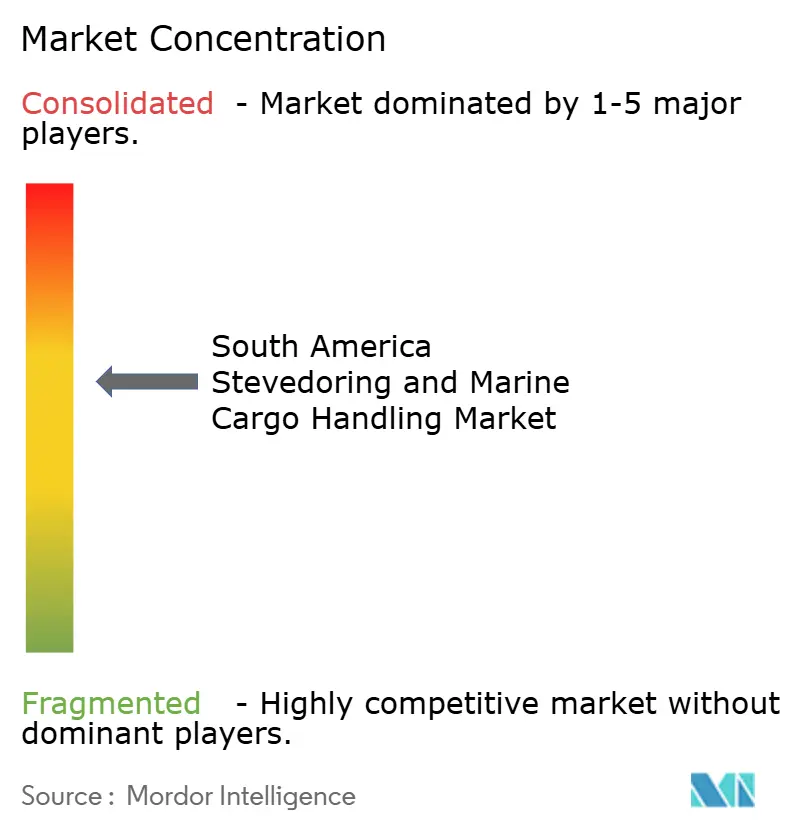
| Market Concentration | Medium |
Major Players
*Disclaimer: Major Players sorted in no particular order Image © Mordor Intelligence. Reuse requires attribution under CC BY 4.0. |
|
South America Stevedoring and Marine Cargo Handling Market Analysis by Mordor Intelligence
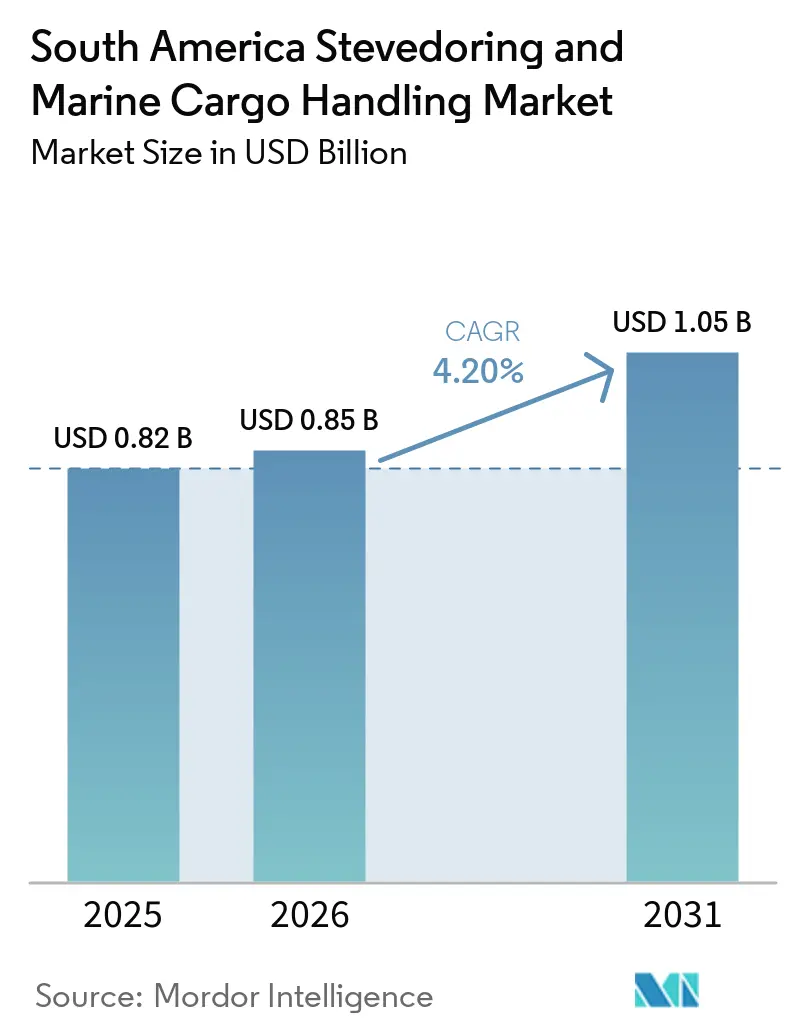
The South America Stevedoring and Marine Cargo Handling Market size was valued at USD 0.82 billion in 2025 and is estimated to grow from USD 0.85 billion in 2026 to reach USD 1.05 billion by 2031, at a CAGR of 4.20% during the forecast period (2026-2031).
Growth is tied to higher agricultural exports, deeper trade links with Asia, and investment in private port capacity across the region. Brazil remains central because its ports handle the largest volumes and attract the largest terminal investments. New concessions are increasing the need for modern equipment, deeper channels, and stronger inland freight links. Global terminal groups are expanding beyond berth operations into rail, road, and terminal services, which makes integrated logistics an important competitive area. Congestion, weak road connections, and the cost of automation remain important limits on the South America stevedoring and marine cargo handling market.
Key Report Takeaways
- By service, stevedoring held 46.24% of the South America stevedoring and marine cargo handling market share in 2025, while cargo handling and transportation recorded the highest projected CAGR at 4.54% through 2031.
- By cargo type, containerized cargo held 49.36% of the South America stevedoring and marine cargo handling market size in 2025, while dry bulk recorded the highest projected CAGR at 4.63% through 2031.
- By end use, manufacturing held 28.97% of the South America stevedoring and marine cargo handling market share in 2025 and recorded the highest projected CAGR at 4.86% through 2031.
- By geography, Brazil held 53.18% of the South America stevedoring and marine cargo handling market size in 2025, while Peru recorded the highest projected CAGR at 5.42% through 2031.
Note: Market size and forecast figures in this report are generated using Mordor Intelligence’s proprietary estimation framework, updated with the latest available data and insights as of January 2026.
South America Stevedoring and Marine Cargo Handling Market Trends and Insights
Drivers Impact Analysis*
| Driver | (~) % Impact on CAGR Forecast | Geographic Relevance | Impact Timeline |
|---|---|---|---|
| Brazil Dry Bulk and Agricultural Export Expansion | +1.2% | Brazil, Argentina, Peru, Chile | Short term (≤ 2 years) |
| Containerization of Regional and Asia Trade | +0.9% | Brazil, Chile, Peru, Colombia | Medium term (2-4 years) |
| Port Modernization and Private Concessions | +0.8% | Brazil, Chile, Peru, Colombia | Medium term (2-4 years) |
| E Commerce and Time Sensitive Cargo Requirements | +0.5% | Brazil, Colombia, Chile | Short term (≤ 2 years) |
| Nearshoring and Commodity Corridor Reconfiguration | +0.4% | Brazil, Colombia, Chile, Peru | Medium term (2-4 years) |
| Chokepoint Diversification and Pacific South Atlantic Connectivity | +0.3% | Chile, Peru, Argentina, Brazil | Long term (≥ 4 years) |
| Source: Mordor Intelligence | |||
Expansion of Brazil's Dry Bulk and Agricultural Export Flows
Brazil's export growth is changing, with stevedoring demand concentrated across South America. Brazilian ports handled 1.4 billion tonnes of waterborne cargo in 2025, and soybean volumes reached 139.7 million tonnes, up 14% from the preceding year.[1]"Port of Itaqui Handles 16.5 Million Tonnes in First Half of 2026," Port of Itaqui, portodoitaqui.ma.gov.br The Northern Arc corridor handled more than 50% of Brazil's crop shipments, which shifted grain activity away from the traditional Santos and Paranagua axis. This shift divided equipment and berth investment between northern export corridors and the established southeastern gateways, helping operators serve harvest flows without relying on a single corridor. The Port of Itaqui handled 16.5 million metric tonnes in the first half of 2026, and soybeans represented more than 51% of this volume. The Paranagua Moegao grain terminal received BRL 1.1 billion (USD 211.75 million) in investment and was designed to load 8,000 tonnes of soybeans per hour at full capacity.
Containerization of Intra South American and Asia South American Trade
Container volumes are rising faster than total cargo volumes at several South American gateways. Trade with Asia is increasing demand for dedicated container services at origin terminals. The cargo mix is broadening beyond conventional commodities to include frozen meat, reefer fruit, auto parts, and e-commerce goods. Each cargo type has different storage, handling, temperature control, and release requirements, which require closer coordination between berth planners, yard teams, truck operators, and customs processes. The South America stevedoring and marine cargo handling market benefits as terminals add services for higher-value and time-sensitive cargo. This transition makes equipment reliability, gate processing, and consistent vessel schedules more important for operators.
Port Modernization and Private Terminal Concessions
Private concessions are enabling port capacity upgrades that public funding alone could not support. DEME signed a 25-year concession with Brazil's National Secretariat of Ports and ANTAQ in March 2026 for the Paranagua access channel.[2]"DEME Concludes 25 Year Concession Contract for Port of Paranagua Access Channel," Ministry of Ports and Airports, gov.br The agreement committed to increasing the navigation draft from 13.3 meters to 15.5 meters. This change will allow larger vessels to call at Paranagua, reduce a major capacity constraint, and support a major agricultural export corridor. CAF and Empresa Portuaria San Antonio signed a USD 50 million credit facility in June 2026 for enabling works at Puerto Exterior in Chile. The USD 4.45 billion project was planned to add 2 semi-automated container terminals and lift San Antonio's capacity to 6 million TEUs.
E-Commerce and Time-Sensitive Cargo Requirements
Cross-border e-commerce is introducing more time-sensitive cargo into port operations. South America's e-commerce sector was on track to exceed USD 200 billion by the end of 2026. Faster delivery expectations increase the cost of delays at terminals and customs gates, so importers value predictable cargo release and reliable truck access. Operators are responding with optical character recognition gates, truck appointment systems, and upgraded terminal operating systems. These upgrades support faster processing but increase capital requirements for smaller concessionaires. The South America stevedoring and marine cargo handling market is placing more weight on digital systems that reduce avoidable waiting time.
Restraints Impact Analysis*
| Restraint | (~) % Impact on CAGR Forecast | Geographic Relevance | Impact Timeline |
|---|---|---|---|
| Port Congestion and Hinterland Bottlenecks | -0.8% | Brazil, Argentina | Short term (≤ 2 years) |
| High Capital Intensity and Equipment Synchronization Gaps | -0.6% | Brazil, Argentina, Colombia | Medium term (2-4 years) |
| Panama Canal and Weather Related Routing Volatility | -0.4% | Chile, Peru, Colombia | Short term (≤ 2 years) |
| Uneven Digital and Regulatory Interoperability | -0.3% | Regional, Argentina, Colombia | Long term (≥ 4 years) |
| Source: Mordor Intelligence | |||
Port Congestion and Hinterland Bottlenecks
Port congestion reduces the useful capacity of existing berths during harvest peaks. Road bottlenecks between inland production areas and transshipment points limit terminal investment benefits and affect vessel schedules, truck movements, yard availability, and export commitments. Santos also faced a delay in planned channel deepening after a court suspended a dredging contract awarded in 2025. ANTAQ turnaround frameworks increasingly place financial responsibility for congestion-related demurrage on terminal operators. That pressure encourages investment in faster operations but can increase costs for medium-sized concessionaires. These limits remain material to the South America stevedoring and marine cargo handling market because terminal upgrades cannot solve inland transport constraints by themselves.
High Capital Intensity and Equipment Synchronization Gaps
Electrification and digitalization are increasing the investment needed for modern terminal operations. Terminal upgrades require cranes, operating systems, connectivity layers, and digital tools to be commissioned in a coordinated sequence. The full productivity benefit depends on equipment, software, communications, and work processes operating together, since a delay in one component can defer wider returns. Operators at secondary ports often lack the same access to capital as global terminal groups. Environmental and operational efficiency requirements can therefore increase the immediate funding burden. The South America stevedoring and marine cargo handling market will continue to favor operators able to coordinate equipment and systems investment.
*Our forecasts treat driver/restraint impacts as directional, not additive. The impact forecasts reflect baseline growth, mix effects, and variable interactions.
Segment Analysis
By Service: Stevedoring Holds the Largest Position as Cargo Handling Expands
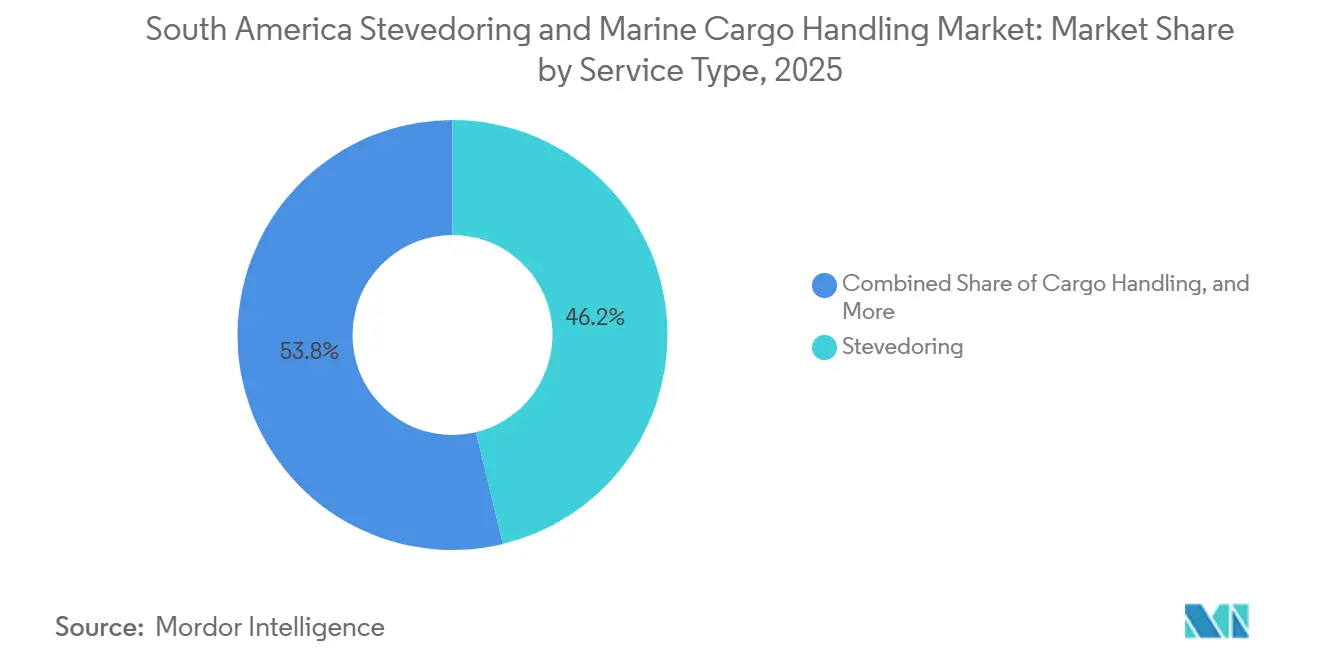
Stevedoring accounted for 46.24% of the South America stevedoring and marine cargo handling market share in 2025, making it the largest service category. The market share held by this service reflected the continued importance of vessel loading and unloading. Labor-intensive activity remained important at many ports because commercial-scale automation was limited. Other services included mooring, pilotage, and towage. These activities maintained steady demand because organized ports require certified service provision. Nearshoring-related freight, e-commerce imports, and agricultural logistics supported demand beyond the quay.
Cargo handling and transportation is the fastest-growing service, with a projected CAGR of 4.54% through 2031. CMA CGM completed its acquisition of Santos Brasil in April 2025, integrating Tecon Santos into its port and logistics operations. The acquisition showed how global carriers were bringing stevedoring and cargo handling into broader logistics offerings. The South America stevedoring and marine cargo handling market faced greater competition for major accounts and premium terminal capacity as carriers expanded their asset base.



By Cargo Type: Containerized Cargo Leads While Dry Bulk Gains Momentum
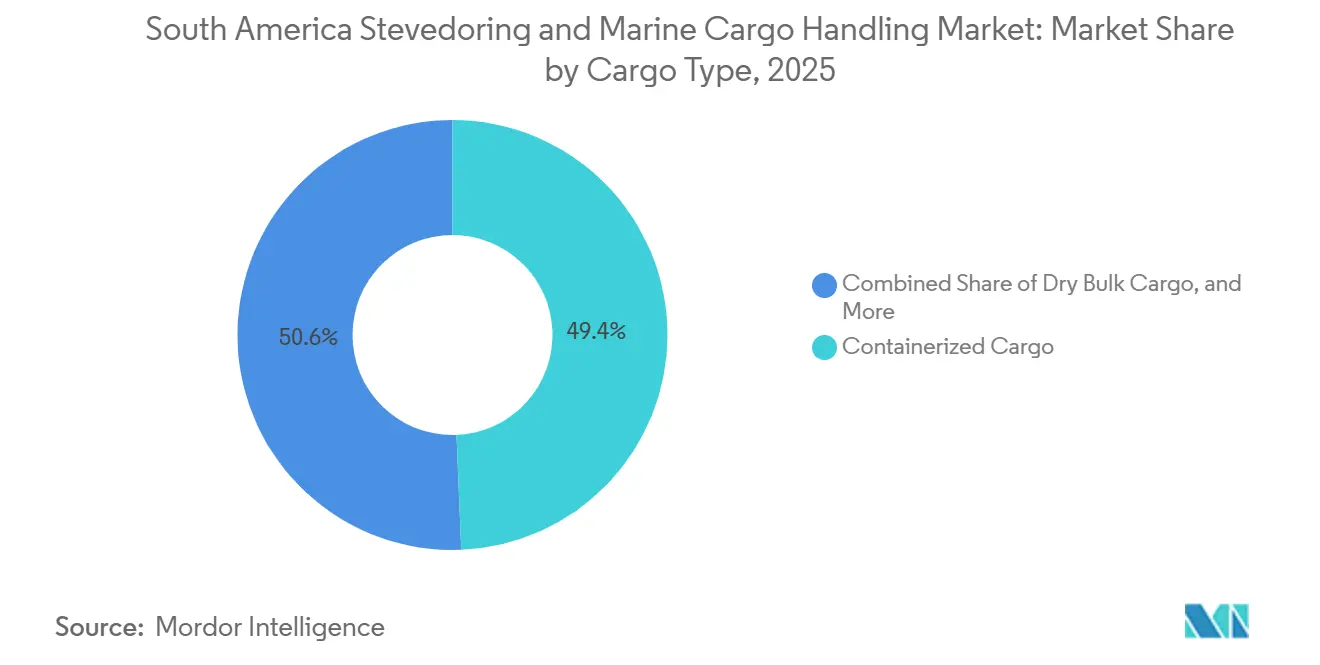
Containerized cargo held 49.36% of the South America stevedoring and marine cargo handling market size in 2025, which was the largest share among cargo types. The market size for containerized activity was supported by trade with Asia, regional container conversion, and more perishable and manufactured cargo. The segment required efficient yard management and faster cargo release than bulk operations. Reefer cargo, automotive parts, and consumer imports added to handling complexity. Container traffic also supported investment in gates, storage, and vessel planning systems.
Dry bulk is the fastest-growing cargo type, with a projected CAGR of 4.63% through 2031. Brazilian dry bulk volumes reached 839.7 million tonnes in 2025, which made it the largest cargo category by weight.[3]"Brazilian Dry Bulk and LPG Cargo Data for 2025," National Waterway Transportation Agency, gov.br Soybean exports, copper and lithium shipments, and new lithium movements at Rosario required specialized loading and storage arrangements at major export gateways. Liquid bulk maintained activity through petroleum, LPG, vegetable oil, and private use terminals. Brazil handled 5.8 million tonnes of LPG in 2025, up 10.4%, supporting a stable part of the South America stevedoring and marine cargo handling market.
By End Use: Manufacturing Leads Revenue and Growth
Manufacturing accounted for 28.97% of the South America stevedoring and marine cargo handling market share in 2025, making it the largest end-use category. Manufacturing is also the fastest-growing end use, with a projected CAGR of 4.86% through 2031. The market benefited from assembly activity linked to nearshoring. Import-dependent production was increasingly concentrated near major port clusters. This pattern increased demand for dependable container handling, storage, and inland freight connections.
Agriculture, fishing, and forestry formed the second-largest end-use block. Soybeans, corn, pulp, seafood, and fruit sustained port demand across Brazil, Argentina, Chile, and Peru. Oil, gas, and mining require specialized liquid bulk and breakbulk services. Construction remained linked to public infrastructure investment cycles. Wholesale trade remained a smaller end use, although e-commerce and consumer imports supported activity in the South America stevedoring and marine cargo handling industry and the wider South America stevedoring and marine cargo handling market.
Geography Analysis
Brazil held 53.18% of the South America stevedoring and marine cargo handling market share in 2025, the largest geographic position in the market. ANTAQ projected Brazilian port throughput of 1.44 billion tonnes in 2026, up 2.7% from the 2025 record. Brazil had the region's most active private concession pipeline. The country combined high cargo volumes with expanding capacity at its largest port clusters. This made Brazil the central source of regional handling demand.
Peru recorded the fastest forecast CAGR at 5.42% through 2031. DP World Callao surpassed 2 million TEUs in 2025, the first Pacific coast terminal in South America to reach that level. Chile also recorded a strong result, with DP World's San Antonio terminal handling 835,900 TEUs in 2025, up 18%. Peru's expansion at Callao and its Pacific connections supported the South America stevedoring and marine cargo handling market. Chile's planned capacity additions strengthened its position in Pacific trade.
Argentina scheduled more than USD 521.9 million in port investments during 2025 and 2026, including a multipurpose port at Timbues and investment from private concessionaires. Uruguay maintained transshipment demand through regional trade consolidation. Ecuador's Contecon Guayaquil and Yilport Puerto Bolivar served as gateway terminals for agricultural and commodity exports. The Capricorn Bioceanic Corridor was completed in July 2026, connected Brazil, Argentina, Paraguay, and Chile, and began to redirect inland commodity flows toward Chilean Pacific ports.[4]"The Capricorn Bioceanic Corridor Paraguay at the Center of South American Integration," Inter American Development Bank, iadb.org
Competitive Landscape
The South America stevedoring and marine cargo handling market has a moderately concentrated structure. Five global groups controlled high-throughput container berths at the primary gateways. A P Moller Maersk, through APM Terminals, DP World, ICTSI, TiL, and CMA CGM, operated major terminal assets in the region. CMA CGM strengthened its position when it acquired Santos Brasil in April 2025. Wilson Sons, SAAM Terminals, Neltume Ports, and Montecon remained important regional specialists.
Competition was strongest at flagship container terminals because concession requirements and equipment needs favor large operators. Integrated logistics created an opportunity to extend services beyond vessel loading and unloading. APM Terminals delivered the fully electrified Suape container terminal in June 2026. The terminal included remotely operated cranes, optical character recognition gates, and a truck appointment platform. These investments raised expectations for operating efficiency in the South America stevedoring and marine cargo handling market.
ANTAQ advanced the Tecon Santos 10 auction in 2026, and CADE authorized Maersk and MSC participation. The process had a floor bid of BRL 500 million (USD 96.25 million), and estimated total investment of BRL 6.45 billion (USD 1.24 billion). Higher investment requirements increased the importance of financial scale in bidding, while regional firms retained positions where local networks, specialist equipment, and customer relationships were decisive. This balance between global scale and local capability defined competition in the South America stevedoring and marine cargo handling market.
South America Stevedoring and Marine Cargo Handling Industry Leaders
-
MSC Mediterranean Shipping Company S.A.
-
A.P. Moller - Maersk
-
DP World
-
CMA CGM Group
-
International Container Terminal Services, Inc.
- *Disclaimer: Major Players sorted in no particular order

Recent Industry Developments
- June 2026: CAF Development Bank of Latin America and the Caribbean and Empresa Portuaria San Antonio signed a USD 50 million credit facility to begin enabling works for Puerto Exterior, the USD 4.45 billion project to build a 4-kilometer breakwater and 2 semi-automated container terminals of 1,730 meters each at Chile's main trade gateway.
- June 2026: APM Terminals formally delivered APM Terminals Suape, South America's first fully electrified container terminal. The facility included USD 47 million in fully electrified handling equipment and was designed to connect Pernambuco to North America, Europe, and Asia.
- March 2026: DEME signed a 25-year concession contract with Brazil's National Secretariat of Ports and ANTAQ for the Port of Paranagua access channel. The concession committed to deepening the channel draft from 13.3 meters to 15.5 meters.
- April 2025: CMA CGM completed its acquisition of Santos Brasil Participacoes S.A., integrating the operator of Tecon Santos into the carrier's port and logistics arm.


South America Stevedoring and Marine Cargo Handling Market Report Scope
| Stevedoring |
| Cargo Handling and Transportation |
| Other Services |
| Dry Bulk Cargo |
| Liquid Bulk Cargo |
| Containerized Cargo |
| Breakbulk and General Cargo |
| Ro-Ro and Project Cargo |
| Agriculture, Fishing, and Forestry |
| Construction |
| Manufacturing |
| Oil and Gas, Mining and Quarrying |
| Wholesale and Retail Trade |
| Others |
| Argentina |
| Brazil |
| Chile |
| Colombia |
| Peru |
| Rest of South America |
| By Service | Stevedoring |
| Cargo Handling and Transportation | |
| Other Services | |
| By Cargo Type | Dry Bulk Cargo |
| Liquid Bulk Cargo | |
| Containerized Cargo | |
| Breakbulk and General Cargo | |
| Ro-Ro and Project Cargo | |
| By End Use | Agriculture, Fishing, and Forestry |
| Construction | |
| Manufacturing | |
| Oil and Gas, Mining and Quarrying | |
| Wholesale and Retail Trade | |
| Others | |
| By Country | Argentina |
| Brazil | |
| Chile | |
| Colombia | |
| Peru | |
| Rest of South America |


Key Questions Answered in the Report
What is the South America stevedoring and marine cargo handling market value in 2026?
The South America stevedoring and marine cargo handling market was valued at USD 0.85 billion in 2026. It is forecast to reach USD 1.05 billion by 2031 at a CAGR of 4.20%.
Which South American country leads port handling revenue?
Brazil led with 53.18% of revenue in 2025. Its position reflected large cargo volumes, private terminal activity, and a broad concession pipeline.
Which cargo type has the largest role in South American port operations?
Containerized cargo led with 49.36% of revenue in 2025. Dry bulk had the fastest projected CAGR at 4.63% through 2031, supported by agricultural and mineral cargo.
Why is Peru growing faster than other South American countries?
Peru had the highest projected CAGR at 5.42% through 2031. Callao expansion and stronger Pacific connectivity supported the country's port handling outlook.
What service is growing fastest at South American ports?
Cargo handling and transportation had the highest projected CAGR among services at 4.54% through 2031. Growth reflected logistics requirements that extend beyond vessel loading and unloading.
What limits port handling growth in South America?
Congestion, road bottlenecks, and high equipment costs remained the main constraints. These conditions reduced efficiency and raised the funding needed for terminal upgrades.
Page last updated on:





