
South America Kitchen Furniture Market Size and Share
Market Overview
| Study Period | 2021 - 2031 |
|---|---|
| Forecast Data Period | 2026 - 2031 |
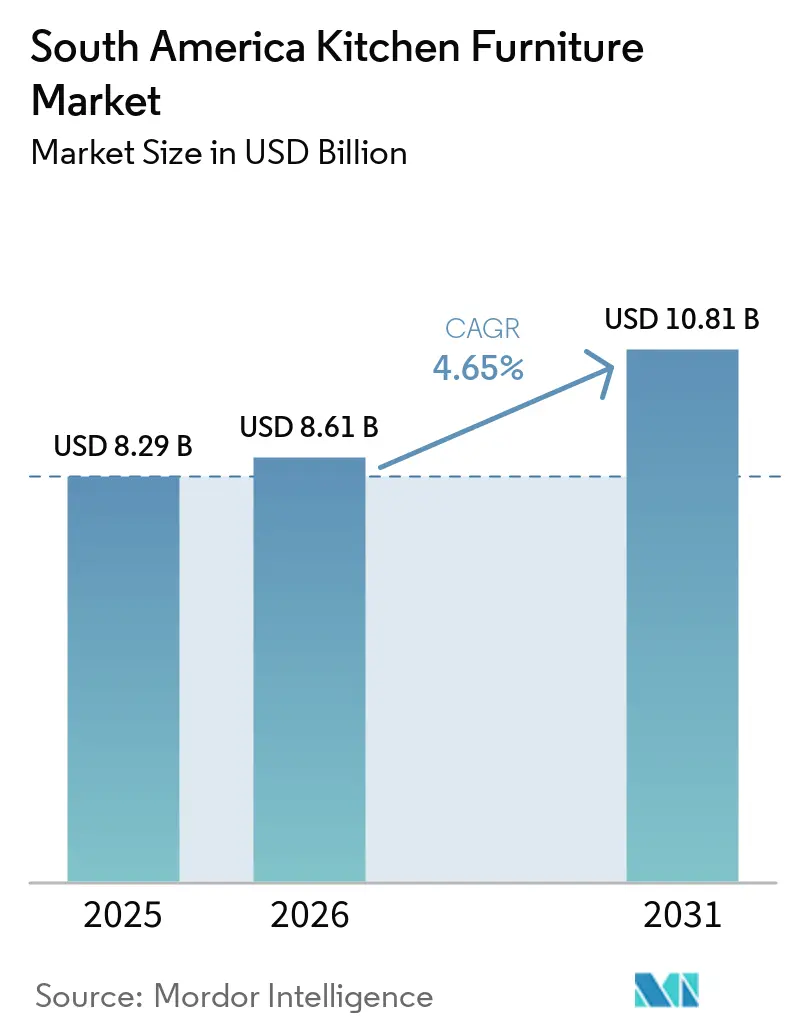
| Base Year Market Size (2025) | USD 8.29 Billion |
| Market Size (2026) | USD 8.61 Billion |
| Market Size (2031) | USD 10.81 Billion |
| Growth Rate (2026 - 2031) | 4.65 % |
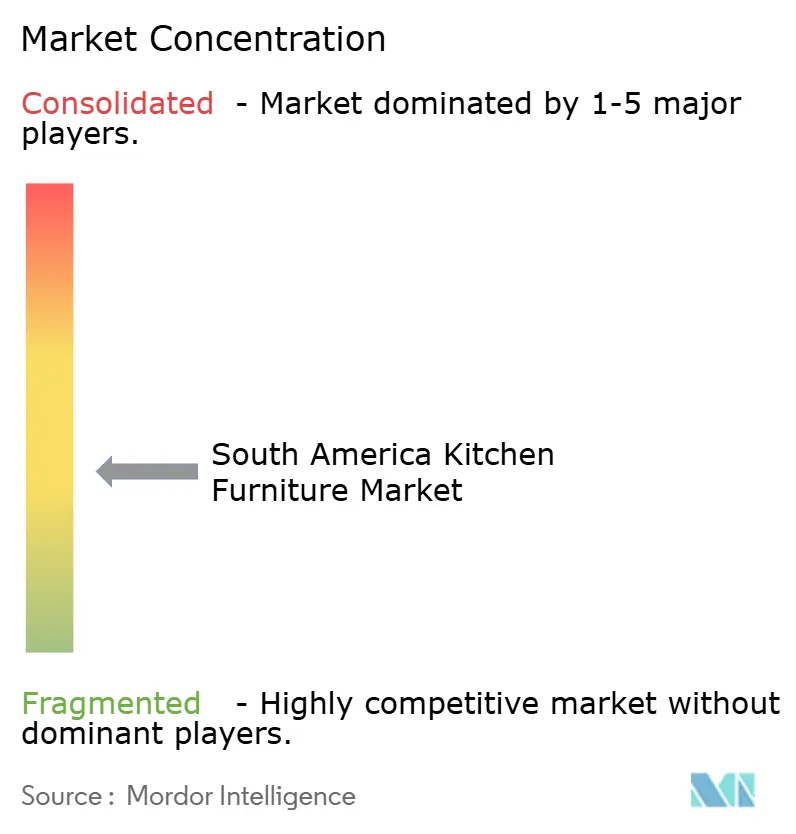
| Market Concentration | Medium |
Major Players *Disclaimer: Major Players sorted in no particular order Image © Mordor Intelligence. Reuse requires attribution under CC BY 4.0. | |
South America Kitchen Furniture Market Analysis by Mordor Intelligence
The South America kitchen furniture market size was valued at USD 8.29 billion in 2025 and is estimated to grow from USD 8.61 billion in 2026 to reach USD 10.81 billion by 2031, at a CAGR of 4.65% during the forecast period (2026-2031). Demand is supported by Brazilian renovation credit and housing programs that create repeat orders for fitted storage, cabinets, and related kitchen products. Brazil remains the region’s production center, while Peru is advancing more quickly as construction and renovation spending rise. Producers are adapting their sales models as project procurement, online discovery, and physical design consultation become more closely connected. High borrowing costs, currency movements, imported component costs, and different product rules across countries continue to limit household spending and cross-border expansion. The South America kitchen furniture market is therefore shaped by a large Brazilian base, growing renovation activity, and a gradual shift toward standardized modular systems.
Key Report Takeaways
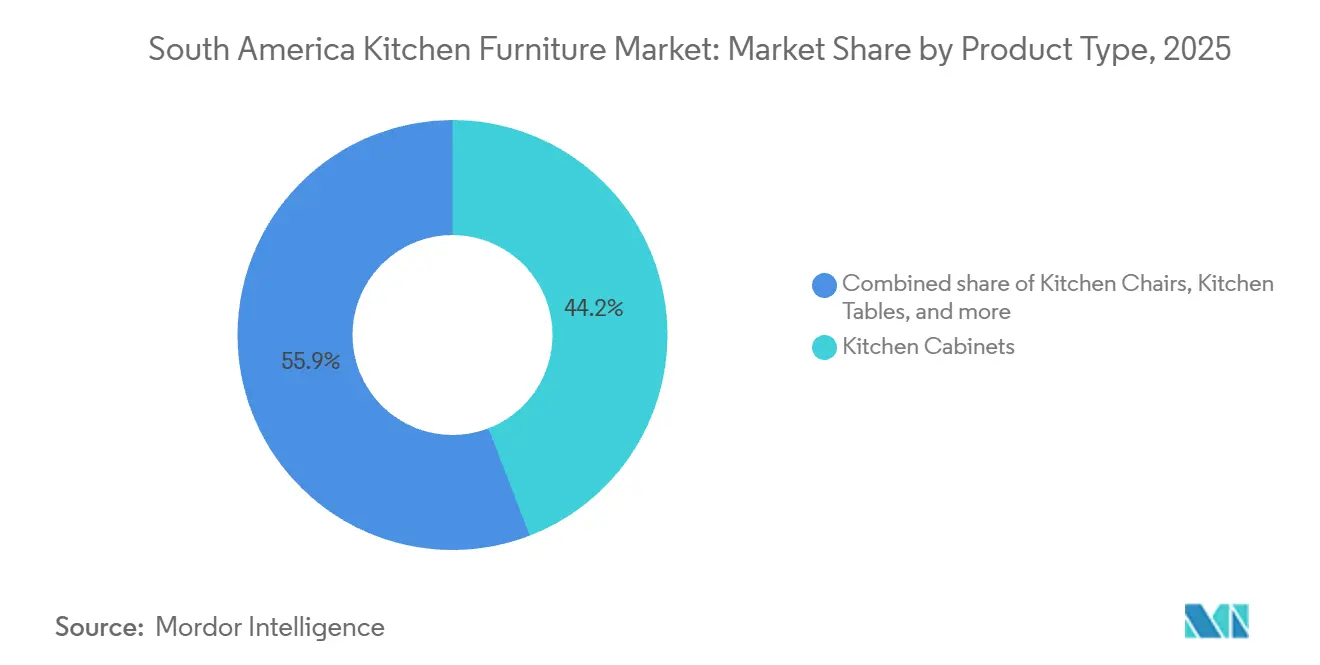
- By product type, kitchen cabinets held 44.15% of the South America kitchen furniture share in 2025, while Other Products are forecast to grow at a 5.71% CAGR through 2031.
- By material, wood accounted for 48.25% of the South America kitchen furniture market share in 2025, while metal is projected to record a 7.02% CAGR through 2031.
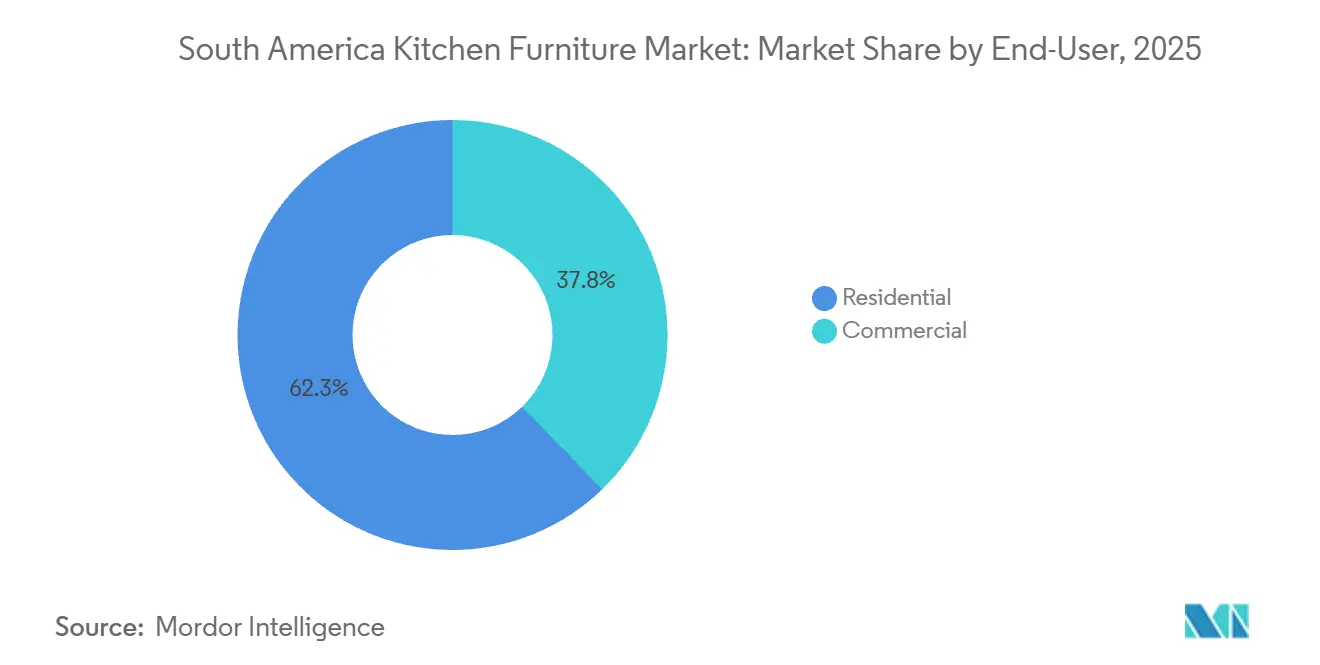
- By end-user, residential users accounted for 62.25% of the South America kitchen furniture market share in 2025, while commercial users are projected to grow at a 5.92% CAGR through 2031.
- By distribution channel, B2C and retail held 48.85% of the South America kitchen furniture market share in 2025, while B2B and project channels are forecast to expand at a 6.61% CAGR through 2031.
Note: Market size and forecast figures in this report are generated using Mordor Intelligence’s proprietary estimation framework, updated with the latest available data and insights as of January 2026.
South America Kitchen Furniture Market Trends and Insights
Drivers Impact Analysis*
| Driver | (~) % Impact on CAGR Forecast | Geographic Relevance | Impact Timeline |
|---|---|---|---|
| Urban Apartment Downsizing and Space-Efficient Kitchens | +0.4% | Brazil, Chile, Argentina, including São Paulo, Santiago, and Buenos Aires | Short term (≤ 2 years) |
| Growth of Modular and Ready-to-Assemble Kitchen Systems | +0.8% | Brazil, Peru, Rest of South America | Medium term (2-4 years) |
| Residential Renovation and Housing Development | +1% | Brazil, Argentina, Peru | Medium term (2-4 years) |
| Developer-Direct Procurement for Repeated Housing Projects | +0.6% | Brazil, Chile, Colombia | Long term (≥ 4 years) |
| Digital Kitchen Specification and Online Furniture Discovery | +0.5% | Brazil, Chile, Argentina | Short term (≤ 2 years) |
| Demand for Moisture-Resistant Engineered Wood and Low-Maintenance Finishes | +0.4% | Brazil, Peru, Chile | Medium term (2-4 years) |
| Source: Mordor Intelligence | |||
Urban Apartment Downsizing and Space-Efficient Kitchens
New residential units in major South American cities are increasingly designed with smaller internal areas. This layout places greater importance on compact kitchens that combine storage, appliances, pantry space, and work surfaces. Open-plan galley and peninsula designs have become more common in São Paulo, Santiago, and Buenos Aires. These layouts require furniture systems that use the available space efficiently without relying on separate pieces. Manufacturers with modular ranges can meet these needs more consistently than producers that only reduce traditional cabinet dimensions. The South America kitchen furniture market benefits when developers specify coordinated kitchen systems for compact apartments rather than standalone furniture. Smaller apartment layouts also change the value of each installation. A fitted kitchen can combine several household functions within one planned configuration. This can increase the value of the installed system compared with an isolated cabinet purchase. Buyers often seek pantry shelving, appliance storage, and flexible surfaces as part of the same order. The need for these functions supports demand for space-efficient cabinets and related accessories. It also favors suppliers that can offer repeatable configurations for common apartment footprints.
Growth of Modular and Ready-to-Assemble Kitchen Systems
Modular and ready-to-assemble systems shorten the time between product selection and delivery. Digital discovery, logistics networks, and visualization tools make these formats easier for households to evaluate. MadeiraMadeira invested BRL 100 million (USD 18.0 million) in a furniture technology and development center in 2025. The company connected 470 manufacturers through its platform, which increasingly serves the modular kitchen demand. The South America kitchen furniture market is seeing online channels reduce the dependence on physical showrooms for mid-priced purchases. Digital planning tools can also make it easier for consumers to compare cabinet configurations before they commit to a purchase. Brazil’s panel supply supports lower-cost and standardized ready-to-assemble products. Wood-based panels provide a consistent material base for cabinet parts, shelves, and storage units. This supply structure helps producers build repeatable products at a scale suited to retail and online channels. Moisture-resistant engineered wood and durable finishes are especially relevant in kitchens, where maintenance requirements affect product choice. These materials also help suppliers address demand in Brazil, Peru, and Chile. The result is a broader product range that can serve both entry-level buyers and renovation customers.
Residential Renovation and Housing Development
Residential renovation has become an important source of kitchen replacement demand in Brazil. Reforma Casa Brasil launched in November 2025 with BRL 40 billion (USD 7.2 billion) in renovation credit, with rates starting at 1.17% per month. The program directs credit toward existing homes, including kitchen and bathroom upgrades. This is important because renovation demand does not depend entirely on new housing finance. It gives the South America kitchen furniture market a demand base even when new development activity slows. Renovation orders can include cabinet replacement, storage additions, surfaces, and other functional updates. Peru adds another renovation-led source of demand. Its renovation and finishing segment grew by more than 20% during the first half of 2026. Kitchen and bathroom projects recorded household spending of PEN 1,500 (USD 442.7) per square meter, equivalent to USD 401 per square meter[1]El Comercio Perú, “Renovar un Ambiente Requiere una Inversión Promedio de S/1.500 por m2,” El Comercio Perú, elcomercio.pe.. This spending pattern creates opportunities for regional manufacturers that can supply practical kitchen products. It also supports exporters seeking demand beyond Brazil. The South America kitchen furniture market gains from renovation work because households can make partial improvements without replacing an entire home interior.
Developer-Direct Procurement for Repeated Housing Projects
Brazil’s Minha Casa, Minha Vida program has created a large pipeline of housing projects. The program contracted 2 million units during the first 3 years of the current administration. It targets another 1 million contracted units by the end of 2026, while more than 1 million units are under construction. These projects support repeated procurement of standard kitchen furniture. Suppliers must provide consistent products, predictable delivery schedules, installation support, and warranty coverage. The South America kitchen furniture market can benefit when developers order standardized systems in batches rather than through individual retail sales. A 2025 Niterói tender showed how this model works in practice. The tender combined kitchen furniture and appliances for 35 housing units in one contract. It also included delivery, installation, and warranty requirements[2]Municipality of Niterói, “Edital PE 90007/2025, Aquisição de Mobiliários para Unidades MCMV,” Prefeitura de Niterói, niteroi.rj.gov.br.. Such contracts differ from retail orders because volume, timing, and service requirements are set in advance. B2B suppliers can plan production around defined specifications and project schedules. This model supports the faster expansion expected for B2B and project distribution channels.
Restraints Impact Analysis*
| Restraint | (~) % Impact on CAGR Forecast | Geographic Relevance | Impact Timeline |
|---|---|---|---|
| Inflation, Currency Volatility, and Reduced Discretionary Spending | -0.9% | Argentina, Brazil, Colombia | Short term (≤ 2 years) |
| Imported Hardware and Panel-Cost Exposure | -0.5% | Brazil, Argentina, Peru | Medium term (2-4 years) |
| Non-Harmonized Mercosur Standards and Duplicate Testing | -0.2% | Brazil, Argentina, Paraguay, and Uruguay trade corridors | Long term (≥ 4 years) |
| Shortage of Skilled Installation and Custom-Cabinetry Labor | -0.3% | Brazil, Peru, Rest of South America | Medium term (2-4 years) |
| Source: Mordor Intelligence | |||
Inflation, Currency Volatility, and Reduced Discretionary Spending
Brazil’s Selic rate stands at 15%, which increases the cost of installment-financed kitchen purchases[3]Organisation for Economic Co-operation and Development, “OECD Economic Outlook, Volume 2026 Issue 1, Brazil,” OECD Publishing, oecd.org.. This pressure is most visible in the mid-priced range, where many households rely on credit. Argentina and Colombia also face conditions that can restrict purchasing power. Higher financing costs can delay a full kitchen replacement or lead consumers to choose smaller upgrades. The South America kitchen furniture market remains exposed to these decisions because cabinets and fitted systems are often discretionary purchases. Government renovation credit provides some support, but it does not remove broader affordability pressure. Brazil’s spending on furniture and household appliances moved from a 1% decline in April 2026 to 2.7% growth in May 2026. This shift indicates that household demand can react quickly to changes in financial expectations. Entry-level demand has support from government credit, while premium demand has greater protection from income concentration. The mid-price range faces the strongest pressure when payments become more expensive. Consumers may postpone a complete installation and instead buy storage units or accessories. These spending choices can shift sales toward lower-ticket products in the South America kitchen furniture market.
Imported Hardware and Panel-Cost Exposure
Hinges, drawer slides, and soft-close mechanisms are often imported and priced in USD. Currency depreciation during 2024 and 2025 increased the local-currency cost of these components. Brazil’s furniture production volume declined 1.2% in 2025, while export losses also reduced cash available for imported parts[4]Brazilian Furniture Industry Association, “Brazilian Furniture and Mattress Exports Start 2026 Lower Amid Shifting Global Trade Patterns,” DatamarNews, datamarnews.com.. Producers may pass costs on to buyers, simplify product specifications, or reduce margins. The South America kitchen furniture market is exposed because hardware quality affects the performance and perceived value of cabinets. Producers with stronger sourcing arrangements can manage this pressure more effectively. Different standards and testing requirements add to the cost of cross-border trade. Mercosur Resolution GMC/RES No. 28/08 sets a technical framework for regional trade. Argentina’s Resolution 313/2025 accepts recognized international certificates for some wood-derived panel products. This change may reduce duplication in testing and related administrative procedures. Even so, suppliers must meet country-specific product, safety, and documentation requirements. A shortage of skilled installers and custom-cabinet labor can also limit the ability to deliver complex fitted projects on time.
*Our forecasts treat driver/restraint impacts as directional, not additive. The impact forecasts reflect baseline growth, mix effects, and variable interactions.
Segment Analysis
By Product Type: Cabinets Hold the Largest Position While Other Products Expand Faster
Kitchen cabinets held 44.15% of the South America kitchen furniture market share in 2025. Cabinets form the main storage and layout structure within modular kitchen systems. Housing projects often require fitted storage as a basic part of the kitchen specification. This makes cabinets relevant to developer orders as well as retail renovation purchases. Their role in the full kitchen layout gives them a broader demand base than individual tables or chairs. Products must meet requirements for structural strength, moisture resistance, and chemical safety. These factors support domestic suppliers that can provide consistent quality. Kitchen chairs and tables remain stable categories for commercial spaces and coordinated household interiors. They serve cafeterias, restaurants, staff rooms, and residential dining areas. Their demand is less tied to the fitted-kitchen installation cycle than cabinet demand.
Other Products are forecast to grow at a 5.71% CAGR through 2031. This group includes trolleys, carts, pantry shelves, and other flexible storage pieces. These products allow households to improve kitchen organization without replacing fitted cabinets. They are suitable for smaller apartments and for renovation work with limited budgets. Online retail supports its sales because product selection and delivery are relatively simple. Buyers can add these products to an existing kitchen configuration over time. Producers can strengthen repeat sales by matching their trolleys and pantry shelves with cabinet collections. This approach creates a more coordinated purchase rather than a single commodity sale. Entry-level buyers may prefer these products when interest rates limit larger installations. The South America kitchen furniture market, therefore, has a practical route to demand through smaller storage improvements.



By Material: Wood Retains Scale While Metal Gains Commercial Demand
Wood accounted for 48.25% of the South America kitchen furniture market share in 2025. The region’s forestry and panel supply system supports wood-based cabinet production. Brazil has a large wood-based panel supply that supports the production of cabinet bodies, shelves, and doors. This supply base helps manufacturers obtain materials for standardized kitchen products. Engineered wood also supports ready-to-assemble formats. Environmental certification is becoming more relevant in developer and commercial procurement. Producers such as Arauco and Duratex are associated with regional panel supply and certified engineered-wood products. These capabilities can influence material selection when buyers seek traceable or durable products. Wood continues to fit residential renovation needs because it can be used across a wide range of designs and price points. It remains the largest material base for the South America kitchen furniture market.
Metal is projected to expand at a 7.02% CAGR through 2031. Growth is concentrated in commercial and institutional kitchens that require durable, hygienic surfaces. Metal performs well in environments exposed to intensive cleaning and regular use. It is relevant for food service, hospitality, healthcare, and education projects. Bertolini offers steel-and-wood hybrid kitchen products that address both commercial and residential needs. The group’s exclusive production arrangement with Leroy Merlin and a BRL 60 million (USD 10.8 million) digital investment shows its focus on larger-scale retail supply. Plastic and polymer products retain a smaller role in lower-priced freestanding furniture. Other materials include aluminum profiles and composite boards used in commercial kitchen applications. Material choice is increasingly shaped by maintenance, food safety, and the intended end-use setting.
By End-User: Residential Users Lead While Commercial Procurement Broadens
Residential users accounted for 62.25% of the South America kitchen furniture market share in 2025. Household formation, renovation activity, and housing completions support this large customer base. Brazilian renovation credit helps existing homeowners fund practical kitchen improvements. Demand is split between entry-level modular products and premium fitted systems. Entry-level purchases focus on affordability, storage, and simple installation. Premium orders are more often tied to architect-led projects and luxury real-estate development. Brazil’s private consumption remains resilient in 2026, supported by labor conditions and minimum wage increases. This helps retain a base level of residential kitchen spending. Ornare, Dell Anno, and Florense serve premium projects where specifications are set early in the property development process. The residential base remains central to the South America kitchen furniture market.
Commercial users are projected to record a 5.92% CAGR through 2031. Hospitality recovery and food-service expansion support new kitchen procurement in this segment. Healthcare and education facilities also require functional kitchen upgrades. Commercial buyers often require stainless steel counter integration, modular preparation stations, and compliant food-contact surfaces. These requirements can raise order values compared with residential projects. Suppliers need different design, delivery, and installation capabilities for these contracts. Procurement decisions also place greater weight on cleaning performance and structural durability. Commercial restocking may contribute to the recovery in furniture and household-appliance spending observed during May 2026. This segment offers a route to larger, planned orders that are less dependent on individual household financing. It also supports greater use of metal and other durable materials.
By Distribution Channel: B2C Retail Leads While B2B Projects Accelerate
B2C and retail channels held 48.85% of the South America kitchen furniture market share in 2025. These channels include home centers, specialty stores, online platforms, and other retail formats. Retail remains important because households often compare kitchen furniture before completing a purchase. Home centers serve buyers seeking immediate products and installation-related items. Specialty stores retain a role where consumers need design advice or premium customization. Online channels extend access to modular furniture beyond traditional showroom locations. MadeiraMadeira connects 470 manufacturers through its platform. Its model combines a broad product selection with growing interest in kitchen planning. Digital visualization can reduce uncertainty around cabinet sizing and layout. This helps online retail compete more directly with physical stores in the South America kitchen furniture market.
B2B and project channels are forecast to grow at a 6.61% CAGR through 2031. Developer orders under Minha Casa, Minha Vida create demand for planned deliveries and repeated specifications. Hotel and institutional contracts add a second source of project procurement. Bulk agreements can reduce the promotional volatility common in retail sales. They can also help manufacturers schedule output and use production capacity more efficiently. Suppliers need project-sales teams, delivery coordination, installation support, and service capabilities. This favors companies that can combine manufacturing scale with reliable project execution. Premium specialty stores remain relevant for architect-led fitted kitchens. Physical consultation still matters when buyers are selecting higher-value materials and customized layouts. The South America kitchen furniture market is moving toward a channel mix where retail and project sales serve different customer needs.
Geography Analysis
Brazil held 51.26% of the South America kitchen furniture market in 2025. Brazil has a large production base that includes forestry panel supply, hardware fabrication, retail networks, and established export links. Housing and renovation programs support demand for fitted kitchens in new homes and existing properties. Reforma Casa Brasil provides BRL 40 billion (USD 7.2 billion) in renovation credit. Minha Casa Minha Vida supports a large housing pipeline. Brazil anchors the South America kitchen furniture market due to its market scale. However, high interest rates continue to constrain some credit-financed purchases.
Peru is projected to record the fastest geographic CAGR at 6.76% through 2031. The construction sector expanded by 10.9% during the first half of 2026. Renovation and finishing activities grew by more than 20% during the same period. Kitchen and bathroom renovation spending reached PEN 1,500 (USD 442.7) per m2, which is equivalent to USD 401 per m2. Chile has a more predictable construction environment. IKEA stores operated by Falabella continue to expand the presence of organized furniture retail.
Kitchen furniture demand in Argentina is recovering unevenly. Real estate activity improved in 2025. However, reduced public works and limited investment continued to constrain construction activity. Resolution 313/2025 accepts recognized certificates for certain wood-derived panels and may reduce trade friction. Colombia, Ecuador, and smaller markets remain fragmented. Brazilian exports compete with lower-cost Asian imports in these markets.
Competitive Landscape
The South America kitchen furniture market is moderately fragmented. Brazilian manufacturers maintain a strong position in production volume. International brands have greater visibility in premium and organized retail channels. Itatiaia Florense Dell Anno Ornare Bontempo Linea Brasil Dalla Costa and Bertolini serve different price points and kitchen formats. Itatiaia directly employs 2,200 people across two industrial parks covering more than 950,000 m². The company is investing BRL 54.9 million (USD 9.9 million) in the Sooretama facility and fitted kitchen product lines. These investments support production capacity and product availability in the Brazilian market.
Premium suppliers compete through showroom networks, partnerships with architects, and relationships with property developers. Ornare operates 32 showrooms globally. The network includes 17 showrooms in Brazil and 12 in the United States. Partnerships between Ornare BTG Pactual and Next Incorporadora incorporate kitchen specifications into luxury residential projects before property sales are finalized. Dell Anno plans to open a flagship store in São Paulo during the second half of 2026. The planned investment totals BRL 45 million (USD 8.1million). Premium fitted kitchen brands have limited physical coverage in Andean markets. Renovation demand among higher-income consumers is developing in these markets and supports demand for customized kitchen furniture.
Digital retail is becoming increasingly integrated with kitchen furniture manufacturing. MadeiraMadeira opened its first modular project store format in March 2026. The format combines physical retail access with planning support for modular kitchen projects. The retail arrangement between Bertolini and Leroy Merlin highlights the importance of co-developed supply models in the mass market. IKEA operates through Falabella in Chile and Colombia. The company brings ready-to-assemble furniture expertise and access to international sourcing networks in these markets.
South America Kitchen Furniture Industry Leaders
Linea Brasil
Dalla Costa
Techni Mobili
Santos Andira
Politorno
- *Disclaimer: Major Players sorted in no particular order

Recent Industry Developments
- July 2026: Ornare participated in CASACOR SP 2026 at Parque da Água Branca, São Paulo, with 3 exclusive kitchens and interior environments designed by prominent architects, reinforcing its continued luxury co-branding strategy with Brazil's interior-design community and building institutional visibility in the developer specification channel.
- May 2026: Unicasa Indústria de Móveis S.A. (B3: UCAS3) announced the planned opening in H2 2026 of the Dell Anno flagship store on Alameda Gabriel Monteiro da Silva, São Paulo, with a total investment of BRL 45 million (USD 8.1 million) in land acquisition and store development — the first bespoke design-district flagship in the brand's 40-year history.
- May 2026: Ornare launched the Profile kitchen and closet collection at Milan Design Week 2026 and completed an immersive redesign of its Via Manzoni showroom, while planning to open 4 additional international showrooms (Washington D.C., Boston, Austin, Lisbon) by end-2026.
- March 2026: MadeiraMadeira inaugurated its first physical store format dedicated to modular kitchens and private-label brands (including Madeira Originals, which grew 25% in revenue), marking a strategic pivot from pure e-commerce to an omnichannel kitchen furniture platform targeting the growing planejados market.


South America Kitchen Furniture Market Report Scope
Kitchen furniture comprises pieces specifically designed to enhance the functionality, storage, and aesthetic appeal of culinary spaces. The South America kitchen furniture market is segmented by product type, material, end-user, distribution channel, and geography. By product type, the market is segmented into kitchen cabinets, kitchen chairs, kitchen tables, and other products (trolley, cart, pantry shelves). By material, the market is segmented into wood, metal, plastic, polymer, and other materials. By end-user, the market is segmented into residential and commercial. By distribution channel, the market is segmented into B2C and retail (home centers, specialty furniture stores, online, and other distribution channels) and B2B / project. By geography, the market is segmented into Brazil, Peru, Chile, Argentina, and the Rest of South America. The report offers the market size in value terms in USD for all the above-mentioned segments.
| Kitchen Cabinets |
| Kitchen Chairs |
| Kitchen Tables |
| Other Products (trolley, cart, pantry shelves) |
| Wood |
| Metal |
| Plastic and Polymer |
| Other Materials |
| Residential |
| Commercial |
| B2C and Retail | Home Centers |
| Specialty Furniture Stores | |
| Online | |
| Other Distribution Channels | |
| B2B / Project |
| Brazil |
| Peru |
| Chile |
| Argentina |
| Rest of South America |
| By Product Type | Kitchen Cabinets | |
| Kitchen Chairs | ||
| Kitchen Tables | ||
| Other Products (trolley, cart, pantry shelves) | ||
| By Material | Wood | |
| Metal | ||
| Plastic and Polymer | ||
| Other Materials | ||
| By End-User | Residential | |
| Commercial | ||
| By Distribution Channel | B2C and Retail | Home Centers |
| Specialty Furniture Stores | ||
| Online | ||
| Other Distribution Channels | ||
| B2B / Project | ||
| By Geography | Brazil | |
| Peru | ||
| Chile | ||
| Argentina | ||
| Rest of South America | ||


Key Questions Answered in the Report
What is the projected value of the South America kitchen furniture market by 2031?
The sector is forecast to reach USD 10.81 billion by 2031, expanding at a 4.65% CAGR from 2026.
Which product category leads kitchen furniture sales in South America?
Kitchen cabinets led sales with a 44.15% share in 2025 because they are central to fitted and modular kitchen layouts.
Which material is growing fastest for kitchen furniture in South America?
Metal is projected to grow at a 7.02% CAGR through 2031, supported by commercial and institutional kitchen requirements.
Why are B2B kitchen furniture projects expanding in South America?
Housing programs and hospitality contracts create repeat orders that require standardized products, delivery, installation, and warranty support.
Which country is expected to grow fastest in kitchen furniture demand?
Peru is expected to grow at a 6.76% CAGR through 2031 as construction, renovation, and finishing activity expand.
What factors limit demand for kitchen furniture in South America?
High financing costs, currency movements, imported hardware costs, different trade rules, and limited skilled installation capacity can restrain demand.
Page last updated on:





