
South America Domestic CEP Market Size and Share
Market Overview
| Study Period | 2020 - 2031 |
|---|---|
| Forecast Data Period | 2026 - 2031 |
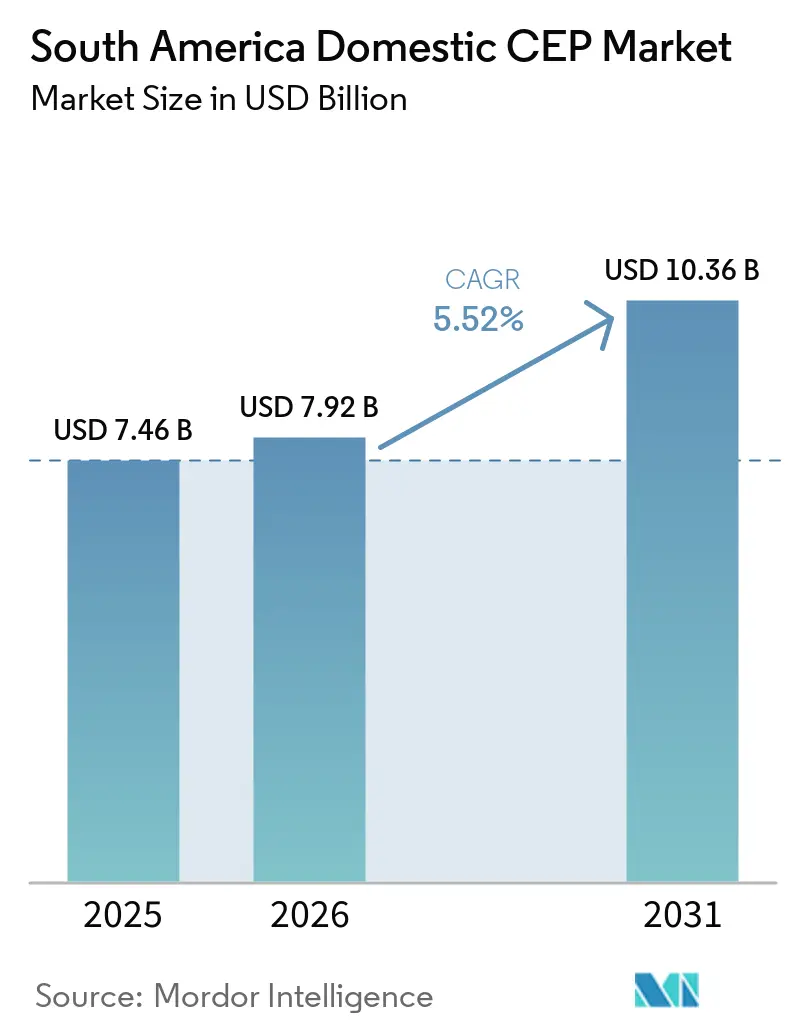
| Base Year Market Size (2025) | USD 7.46 Billion |
| Market Size (2026) | USD 7.92 Billion |
| Market Size (2031) | USD 10.36 Billion |
| Growth Rate (2026 - 2031) | 5.52 % |
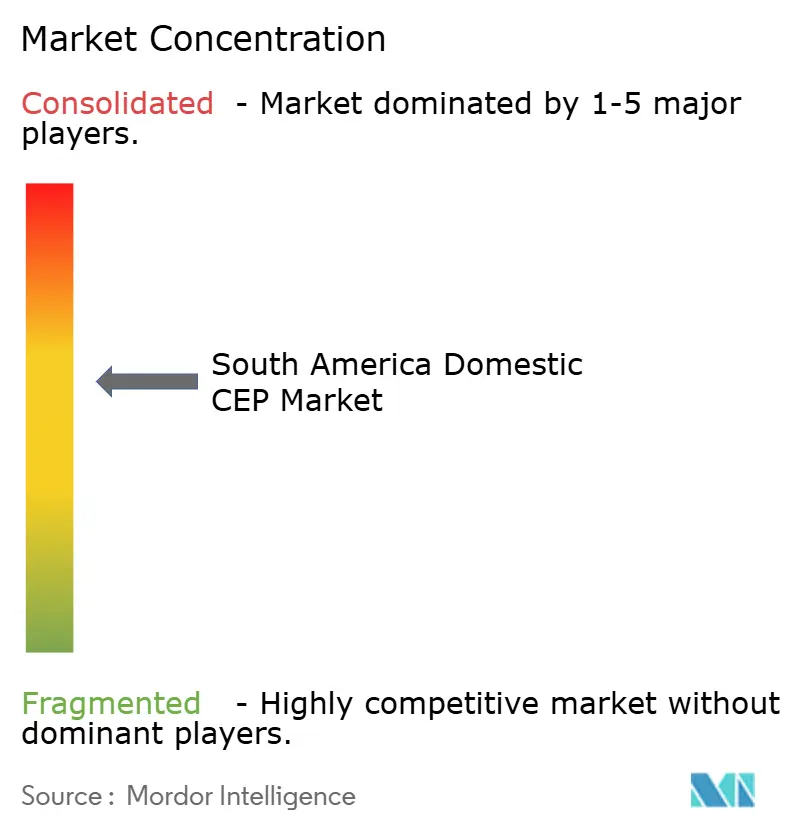
| Market Concentration | Medium |
Major Players *Disclaimer: Major Players sorted in no particular order Image © Mordor Intelligence. Reuse requires attribution under CC BY 4.0. | |
South America Domestic CEP Market Analysis by Mordor Intelligence
The South America Domestic CEP Market size was valued at USD 7.46 billion in 2025 and is estimated to grow from USD 7.92 billion in 2026 to reach USD 10.36 billion by 2031, at a CAGR of 5.52% during the forecast period (2026-2031).
E-commerce order density was increasing across large cities and smaller urban corridors, which supported parcel volumes and fulfillment investment. Instant payment systems reduced the time between checkout and shipment release, making integration with payment rails more important for carriers. Marketplace operators and global integrators were investing in sorting, fulfillment, and last-mile capacity, which changed the competitive position of conventional providers. The South America domestic CEP market offered opportunities for operators that connected effectively with marketplace systems and delivered reliable service at competitive prices. Fuel costs, security incidents, and road constraints continued to weigh on margins and network reach.
Key Report Takeaways
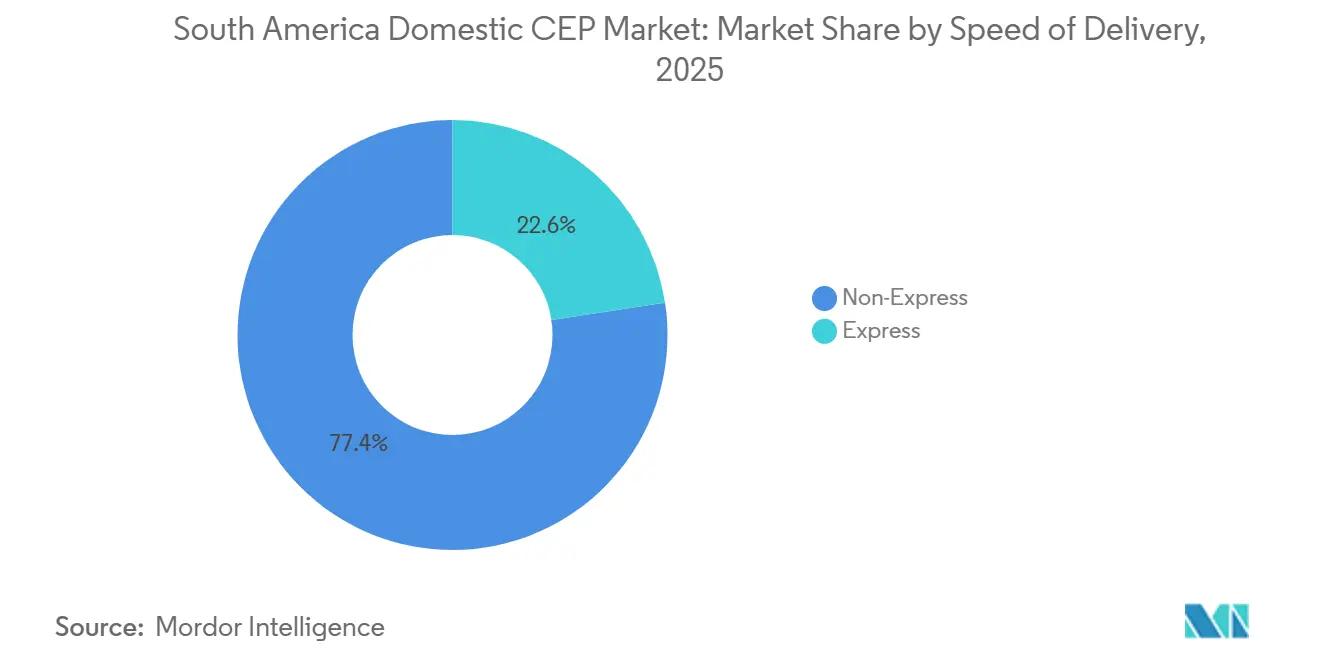
- By speed of delivery, non-express services held 77.40% of the South America domestic CEP market share in 2025, while express delivery was forecast to grow at a 6.44% CAGR through 2031.
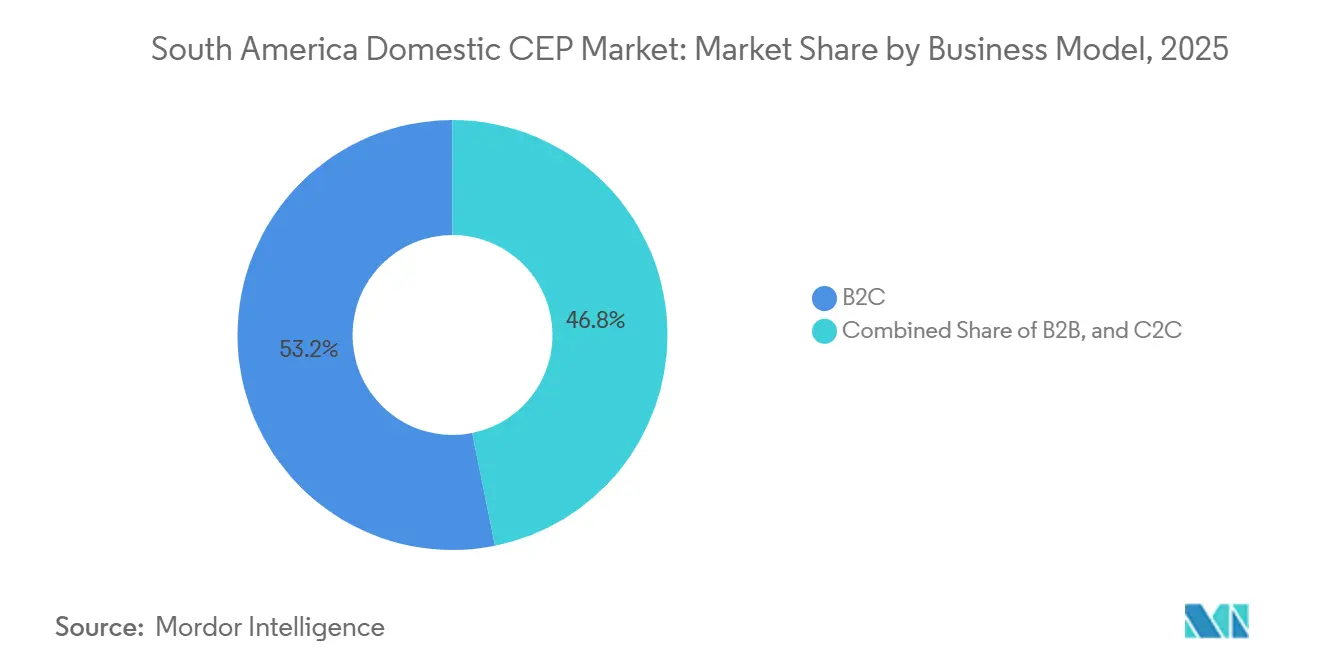
- By business model, B2C held 53.17% of the South America domestic CEP market size in 2025 and also recorded the highest projected CAGR at 6.61% through 2031.
- By shipment weight, light-weight shipments accounted for 72.54% of the South America domestic CEP market size in 2025 and were forecast to expand at a 5.69% CAGR through 2031.
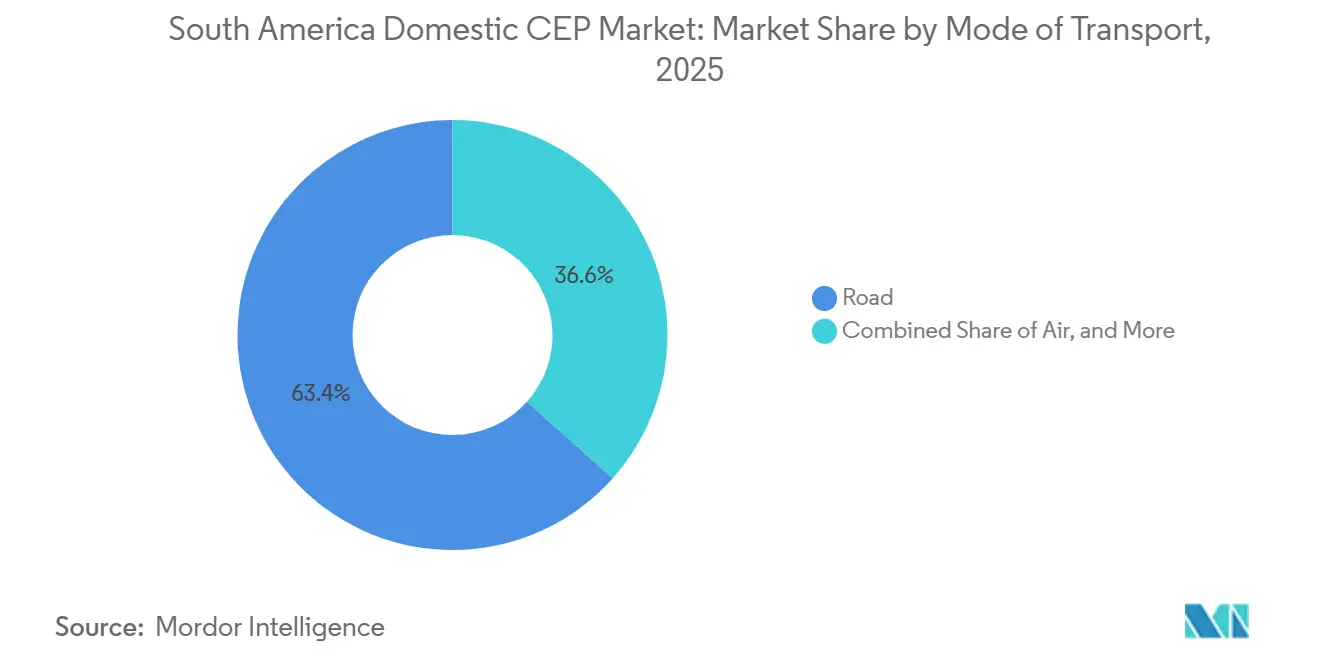
- By mode of transport, road transport held 63.39% of the South America domestic CEP market share in 2025, while air freight was forecast to grow at a 6.32% CAGR through 2031.
- By end-user industry, manufacturing held 39.24% of the South America domestic CEP market size in 2025, while e-commerce was forecast to expand at a 6.01% CAGR through 2031.
- By country, Brazil held 50.45% of the South America domestic CEP market share in 2025, while Peru was forecast to grow at a 6.60% CAGR through 2031.
Note: Market size and forecast figures in this report are generated using Mordor Intelligence’s proprietary estimation framework, updated with the latest available data and insights as of January 2026.
South America Domestic CEP Market Trends and Insights
Drivers Impact Analysis*
| Driver | (~) % Impact on CAGR Forecast | Geographic Relevance | Impact Timeline |
|---|---|---|---|
| E-Commerce Parcel Density and Marketplace Fulfillment Expansion | +1.8% | Brazil, Argentina, Chile, Colombia | Short term (≤ 2 years) |
| Same-Day and Next-Day Delivery Expectations in Major Urban Corridors | +0.9% | São Paulo, Buenos Aires, Santiago, Bogotá, Lima | Short term (≤ 2 years) |
| Instant-Payment Adoption Enabling Faster Order Release | +0.8% | Brazil primarily, Colombia and Chile follow-on | Medium term (2-4 years) |
| Dark-Store and Micro-Fulfillment Expansion | +0.6% | Brazil, with expansion to Chile and Colombia | Medium term (2-4 years) |
| Transport-Corridor and Multimodal Infrastructure Investment | +0.4% | Southern Cone, Brazil, Paraguay, Argentina, Chile | Long term (≥ 4 years) |
| Healthcare, Perishables, and Temperature-Controlled Parcel Demand | +0.4% | Brazil, Colombia, Peru | Medium term (2-4 years) |
| Source: Mordor Intelligence | |||
E-Commerce Parcel Density and Marketplace Fulfillment Expansion
E-commerce remained the primary source of domestic parcel demand across the South America domestic CEP market. MercadoLibre processed 95 orders per second in the fourth quarter of 2025 and delivered 75% of Brazilian orders within 48 hours after expanding to 27 fulfillment centers. The company announced an investment plan for 2026 targeting 42 distribution centers, and indicating continued expansion of marketplace fulfillment capacity. Shopee opened 3 fulfillment centers in 2026, and its fulfillment-network order volume increased 15 times over the preceding 12 months. Loggi reported that PUDO point use among Brazilian small and medium-sized businesses increased 53% year over year in the first half of 2026. Platform investment shifted more responsibility for network capacity from carriers to marketplaces, making carrier access to volume more dependent on digital and operational integration.
Instant-Payment Adoption Enabling Faster Order Release
Brazil's Pix system processed nearly 80 billion transactions in 2025, up 25.7% from 2024, while consumer-to-business payments represented 43% of its transactions. Immediate confirmation removed reconciliation delays that had previously held orders before dispatch. DHL Express Brazil integrated Pix processing with dLocal in February 2026, and its Pix payment volume increased 400% after the integration. DHL also reported a 31% rise in its online payment rate and shorter parcel release times. Ebanx plans Pix to account for 45% of Brazil's online sales by the end of 2026, compared with 42% in 2025. Payment systems in Colombia and Chile could support comparable improvements, although their adoption curves were expected to follow Brazil's later.
Same-Day and Next-Day Delivery Expectations in Major Urban Corridors
Delivery within 48 hours became an important service benchmark in the largest cities served by the South America domestic CEP market. Amazon Brazil introduced Amazon Now in 2026 with a 15-minute delivery promise in 8 cities through nearby micro-distribution centers. The company is opening 3 distribution centers each week in 2026, compared with 2 each week in 2025. Rappi expanded Turbo to more than 120 dark stores in 13 Brazilian cities and introduced Turbo Farma in February 2026 for 10-minute pharmaceutical delivery. The 99Compras expansion announced in July 2026 extended quick-commerce activity to Sao Paulo and more than 20 metropolitan municipalities. These models favored operators with flexible routing and close-to-customer fulfillment capacity over static route designs.
Dark-Store and Micro-Fulfillment Expansion
Dark stores were changing the location and timing of parcel flows in the South America domestic CEP market. Shopper opened its first distribution center outside Sao Paulo in Brasilia in September 2026, together with 6 dark stores in Brasília and Goiânia. The operation supported delivery within 20 minutes and showed that the model could extend to other large urban areas. Close inventory placement improved route density and reduced the distance traveled for time-sensitive orders. It also allowed platform operators to fulfill some orders internally rather than handing them to parcel carriers. This reduced the addressable pool for conventional carriers in the fastest delivery categories.
Restraints Impact Analysis*
| Restraint | (~) % Impact on CAGR Forecast | Geographic Relevance | Impact Timeline |
|---|---|---|---|
| Fuel-Price, Tax, and Currency Volatility | -1.1% | Brazil, Chile, Argentina, Peru | Short term (≤ 2 years) |
| Road Quality, Congestion, and Remote-Area Delivery Constraints | -0.7% | Brazil, Peru, Colombia, Rest of South America | Long term (≥ 4 years) |
| Parcel-Theft, Fraud, and Security Costs | -0.4% | Brazil, Peru, Argentina | Medium term (2-4 years) |
| Battery-Cell Availability and Electrification Readiness | -0.3% | Regional, with near-term concentration in Brazil and Chile | Long term (≥ 4 years) |
| Source: Mordor Intelligence | |||
Fuel-Price, Tax, and Currency Volatility
A supply disruption in early 2026 raised oil costs and lifted diesel prices in Brazil by more than 20%. Brazil's ANTT required minimum road freight rate increases of 4.8% to 7%, but diesel remained a major cost for long-haul carriers. Chile also faced sharp fuel-price increases after its fuel-stabilization scheme was wound down. Operators with net margins of 3% to 7% had limited capacity to absorb these changes. Currency movements in Argentina raised the cost of imported inputs for providers earning local-currency revenue. Smaller carriers faced greater consolidation pressure where contracts lacked fuel or inflation protection.
Road Quality, Congestion, and Remote-Area Delivery Constraints
Road networks carried more than 60% of domestic cargo movement in Brazil, but secondary and tertiary routes still limited dependable parcel coverage. Faster delivery services were concentrated around Sao Paulo, Rio de Janeiro, Curitiba, and Belo Horizonte. Peru's terrain and dispersed population centers increased last-mile costs outside Lima, where roads and addressing were less consistent. Colombia's mountain geography also constrained the economics of express services in secondary cities. The Capricorn Bioceanic Corridor was expected to open new trunk routes, although a needed 13-kilometer Brazilian road connector remained unfunded.[1]“The Capricorn Bioceanic Corridor, Paraguay at the Center of South American Integration,” Inter-American Development Bank, iadb.org These constraints kept remote-area delivery costs high across much of the forecast period.
*Our forecasts treat driver/restraint impacts as directional, not additive. The impact forecasts reflect baseline growth, mix effects, and variable interactions.
Segment Analysis
By Speed of Delivery: Non-Express Services Supported the Largest Revenue Base
Non-express services held 77.40% of the South America domestic CEP market share in 2025. Economy shipping suited cost-sensitive consumers and supply chains that placed greater weight on total freight expense than speed. This revenue base helped carriers build route density and retain broad network coverage. The scale of these flows also supported the economics of faster services on common routes. It gave providers a broad shipment base from which to develop higher-speed products.
Express delivery was forecast to grow at a 6.44% CAGR from 2026 to 2031. Demand for shorter delivery windows was spreading from the largest Brazilian cities toward secondary cities and neighboring countries. MercadoLibre's 48-hour performance in 2025 illustrated the service standard that platform operations were setting. Express adoption was likely to remain strongest in dense urban areas where delivery volumes could support the required cost base. Smaller cities were expected to retain a greater reliance on non-express services. This difference required providers to manage separate service models within the same network.


By Business Model: B2C Demand Led Revenue and Growth
B2C accounted for 53.17% of the South America domestic CEP market size in 2025. It was also the fastest-growing business model, with a forecast CAGR of 6.61% through 2031. Consumer e-commerce created steady parcel demand across a growing base of small online sellers. Pix reduced checkout friction and shortened the time needed to release paid orders to the delivery network. It also increased the importance of dependable real-time data exchange between sellers and carriers.
B2B continued to support parts replenishment, industrial distribution, and document transport. Its relative contribution was under pressure as digital procurement and marketplace fulfillment replaced some traditional wholesale flows. C2C services were supported by resale platforms and gig-delivery applications, although they remained smaller and had lower revenue per parcel. Consumer returns created an additional operating requirement under Brazil's Consumer Defense Code. Carriers needed to price return movements accurately to protect B2C profitability. These operational needs made consumer channels more demanding than simple outbound delivery volumes suggested.

By Shipment Weight: Light-Weight Shipments Maintained Their Lead
Light-weight shipments accounted for 72.54% of revenue in 2025 and were forecast to grow at a 5.69% CAGR through 2031. Apparel, accessories, beauty products, pharmaceuticals, and smaller electronics supported this mix. Medium-weight shipments served appliances and some B2B requirements, but their relative weight was declining. Heavy shipments remained concentrated in automotive parts and industrial equipment. Their specialized handling needs limited their role in high-frequency consumer delivery networks.
Amazon Brazil's local fulfillment model served 55% to 60% of demand in the Southeast and was designed for light, fast-moving product assortments. Its 15-minute promise was practical for small items held close to customers. High stop density reduced unit delivery costs, although price-sensitive customers limited revenue per shipment. This made route optimization important to profitability in the South America domestic CEP market. MercadoLibre's distribution-center program relied on placing light inventory close to dense urban postcodes.[2]“Mercado Libre Lanza su Servicio de Envíos Aéreos en la Argentina,” AAACI, aaaci.org.ar This approach increased the value of inventory placement as well as transport execution.
By Mode of Transport: Road Retained Scale, While Air Expanded Faster
Road transport retained 63.39% revenue share in 2025, which made it the core mode in the South America domestic CEP market. Road networks connected the main logistics corridors in Brazil and the Southern Cone. Their scale supported standard and economy parcel delivery across large areas. Fuel costs and road congestion created pricing and service risks. These constraints were particularly important on long routes with lower delivery density.
Air freight was forecast to grow at a 6.32% CAGR through 2031, the highest rate among transport modes. Healthcare parcels, perishable exports, and high-value electronics supported its use where time certainty mattered. MercadoLibre launched dedicated cargo flights in Argentina during 2026 using Aerolíneas Argentinas capacity to serve Ushuaia, Bariloche, Neuquen, and Trelew. LATAM Cargo reported 43% growth in pharmaceutical volumes in 2025 across 221 CEIV Pharma-certified routes. Rail, waterways, and intermodal services remained smaller but could gain relevance as corridor infrastructure improved. Their development could provide alternatives where road capacity was constrained.
By End-User Industry: Manufacturing Held Revenue Leadership While E-Commerce Grew Faster
Manufacturing generated 39.24% of domestic CEP revenue in 2025. Automotive, consumer goods, and agricultural-equipment supply chains supported regular business shipments in Brazil and Argentina. This pattern was expected to reduce manufacturing's lead in the revenue mix over time. Carrier revenue models would need to account for a changing balance between industrial and consumer consignments.
E-commerce was forecast to grow at a 6.01% CAGR through 2031. Healthcare remained a high-value activity because temperature-sensitive medicines required controlled handling. ANVISA requirements for good distribution practices supported demand for validated cold-chain processes and temperature monitoring. Peli BioThermal partnered with Polar Group in March 2026 to expand reusable and single-use cold-chain packaging in Brazil. BFSI supported document and secure-parcel movements tied to custody and regulatory needs. A higher consumer share could reduce average revenue per parcel because consumer shipments were often lighter and lower priced. Providers with specialty capabilities could offset part of this pressure through higher-value healthcare movements.
Geography Analysis
Brazil held 50.45% of the South America domestic CEP market share in 2025. The country combined marketplace investment, instant-payment use, and the region's most developed e-commerce infrastructure.[3]“Resolução RDC No. 430/2020,” Government of Brazil, gov.br Pix transactions increased 25.7% to nearly 80 billion in 2025, and consumer-to-business payments reached 43% of all Pix activity. MercadoLibre's 2026 distribution-center target showed that fulfillment expansion was moving from the Southeast toward the interior.
Peru recorded the fastest forecast growth rate at 6.60% CAGR through 2031. Courier activity grew 15% in 2025 and was expected to rise 15% to 20% in 2026. The Port of Chancay handled 336,200 TEUs during its first half-year of full operations after opening. It reduced the Shanghai to Lima ocean transit time from 42 to 23 days and reduced shipping costs by 20%. Chile had more than 70% of its road network paved and Chilexpress coverage across 346 communes.
Argentina remained an important domestic parcel economy despite currency volatility. MercadoLibre is using dedicated air service in 2026 to improve access to Patagonian and remote cities. Colombia recorded 84.1 million express-messaging shipments in the third quarter of 2025, including 61.4 million individual consumer parcels.[4]“Mercado Libre lanza su servicio de envíos aéreos en la Argentina,” La Nación, lanacion.com.ar DHL expanded its Bogota campus with a 30,000 m² building, extending its premium and healthcare logistics capability. DHL announced to acquire Uruguay's Aero Cargas S.A. in September 2026, establishing its first direct operation in Montevideo.
Competitive Landscape
The South America domestic CEP market was moderately concentrated at the national level and distributed across city clusters. Marketplace-integrated logistics became a key performance benchmark because leading platforms directed large shares of volume through their own fleets and sortation networks. MercadoLibre routed 94% of its parcels through its own infrastructure in 2025. Legacy postal operators responded with multiyear programs that combined physical delivery with digital payment and tracking functions. Technology-focused providers used dynamic route planning and wider platform connectivity to compete with established networks.
Loggi increased its e-commerce connections from 28 to 49 in 2025, covering 90% of online retail used by small and medium-sized businesses. DHL committed resources to a Sao Paulo hub intended for next-day service, and it announced plans to expand its regional reach through the Aero Cargas acquisition in September 2026. MercadoLibre strengthened its fulfillment presence through a 2026 program targeting 42 distribution centers. These moves increased the importance of network density, platform connectivity, and time-definite delivery. Global integrators focused more closely on healthcare and specialized logistics where service requirements were higher.
Healthcare logistics offered a defensible area because cold-chain infrastructure, certification, and trained personnel created barriers to entry. Secondary-city last-mile delivery also remained open as PUDO networks and small-seller volumes developed. Ride-hailing and quick-commerce providers increased price pressure in fast urban delivery categories through large driver pools. Pix integration became a competitive requirement because faster confirmation improved order release and working-capital efficiency.
South America Domestic CEP Industry Leaders
Empresa Brasileira de Correios e Telegrafos
MercadoLibre, Inc.
DHL Group
Loggi Tecnologia Ltda.
La Poste Group (Including DPD Group)
- *Disclaimer: Major Players sorted in no particular order

Recent Industry Developments
- September 2026: DHL Global Forwarding acquired Aero Cargas S.A., a Montevideo-based freight forwarder with over 58 years of South American logistics experience, establishing DHL's first direct Uruguay operation. The acquisition expands DHL's Southern Cone network into Life Sciences, healthcare, and industrial logistics, and integrates into its Peru-Ecuador-Argentina-Chile cluster as part of the group's strategic investment plan.
- September 2026: Shopper inaugurated its first distribution center outside Sao Paulo, a 7,000-m² facility in Brasilia, along with 6 dark stores across Brasilia and Goiania. The operation enabled 20-minute delivery 24 hours a day and was projected to create 840 jobs in the Center-West region by year-end.
- August 2026: Loggi launched a self-service logistics platform for Brazilian small and medium-sized businesses, enabling digital onboarding, automated shipment management, and integration with more than 40 e-commerce platforms, with same-day dispatch available from first registration.
- August 2026: DHL Supply Chain introduced the Platinum returnable thermal packaging solution in Brazil for healthcare logistics, using vacuum insulation panels and phase-change cooling materials to maintain temperature control for up to 196 hours, aligned with ANVISA good distribution practice requirements.


South America Domestic CEP Market Report Scope
| Express |
| Non-Express |
| Business-to-Business (B2B) |
| Business-to-Consumer (B2C) |
| Consumer-to-Consumer (C2C) |
| Light-Weight Shipments |
| Medium-Weight Shipments |
| Heavy-Weight Shipments |
| Air |
| Road |
| Others |
| E-Commerce |
| Financial Services (BFSI) |
| Healthcare |
| Manufacturing |
| Primary Industry |
| Wholesale and Retail Trade (Offline) |
| Others |
| Argentina |
| Brazil |
| Chile |
| Colombia |
| Peru |
| Rest of South America |
| By Speed of Delivery | Express |
| Non-Express | |
| By Business Model | Business-to-Business (B2B) |
| Business-to-Consumer (B2C) | |
| Consumer-to-Consumer (C2C) | |
| By Shipment Weight | Light-Weight Shipments |
| Medium-Weight Shipments | |
| Heavy-Weight Shipments | |
| By Mode of Transport | Air |
| Road | |
| Others | |
| By End-User Industry | E-Commerce |
| Financial Services (BFSI) | |
| Healthcare | |
| Manufacturing | |
| Primary Industry | |
| Wholesale and Retail Trade (Offline) | |
| Others | |
| By Country | Argentina |
| Brazil | |
| Chile | |
| Colombia | |
| Peru | |
| Rest of South America |


Key Questions Answered in the Report
What was the value of domestic courier, express, and parcel activity in South America?
The South America domestic CEP market size is valued at USD 7.92 billion in 2026 and forecast to reach USD 10.36 billion by 2031. E-commerce volumes and fulfillment investment supported this expansion across the South America domestic CEP market. Network investment focused on fulfillment centers, sorting capacity, and last-mile coverage.
What was the forecast growth rate through 2031?
The South America domestic CEP market was forecast to grow at a CAGR of 5.52% from 2026 to 2031. Payment integration and last-mile capacity were key operating considerations. Fuel costs and delivery constraints remained important risks for service providers.
Which delivery speed category held the largest share?
Non-express services held 77.40% revenue share in 2025, while express delivery was projected to grow faster at a 6.44% CAGR. Economy shipping continued to provide the broader shipment base. Faster services gained importance mainly where urban parcel density could support them.
Which customer channel drove growth?
B2C held 53.17% revenue share in 2025 and was projected to grow at a 6.61% CAGR through 2031. Small online sellers added to consumer parcel demand. Payment confirmation and returns management remained material elements of the service model.
Why was air transport expanding faster than other modes?
Healthcare parcels, perishable exports, and high-value electronics supported air freight's forecast 6.32% CAGR through 2031. These flows required faster and more controlled transport. Dedicated air capacity improved access to locations where road networks had longer transit times.
Which country was expected to expand fastest?
Peru was forecast to grow at a 6.60% CAGR through 2031, supported by provincial e-commerce demand and new trade flows. The opening of the Port of Chancay supported these flows. Improved trade connectivity created additional demand for domestic delivery services.
Page last updated on:





