
Market Overview
| Study Period | 2020 - 2031 |
|---|---|
| Forecast Data Period | 2026 - 2031 |
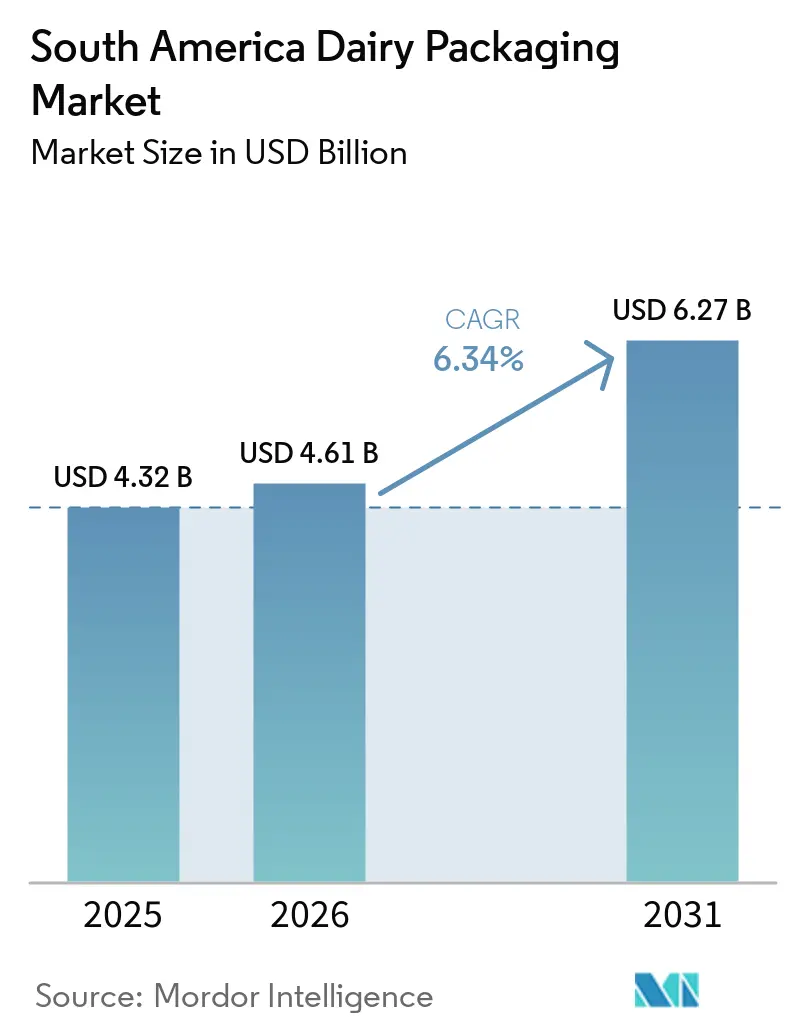
| Base Year Market Size (2025) | USD 4.32 Billion |
| Market Size (2026) | USD 4.61 Billion |
| Market Size (2031) | USD 6.27 Billion |
| Growth Rate (2026 - 2031) | 6.34 % |
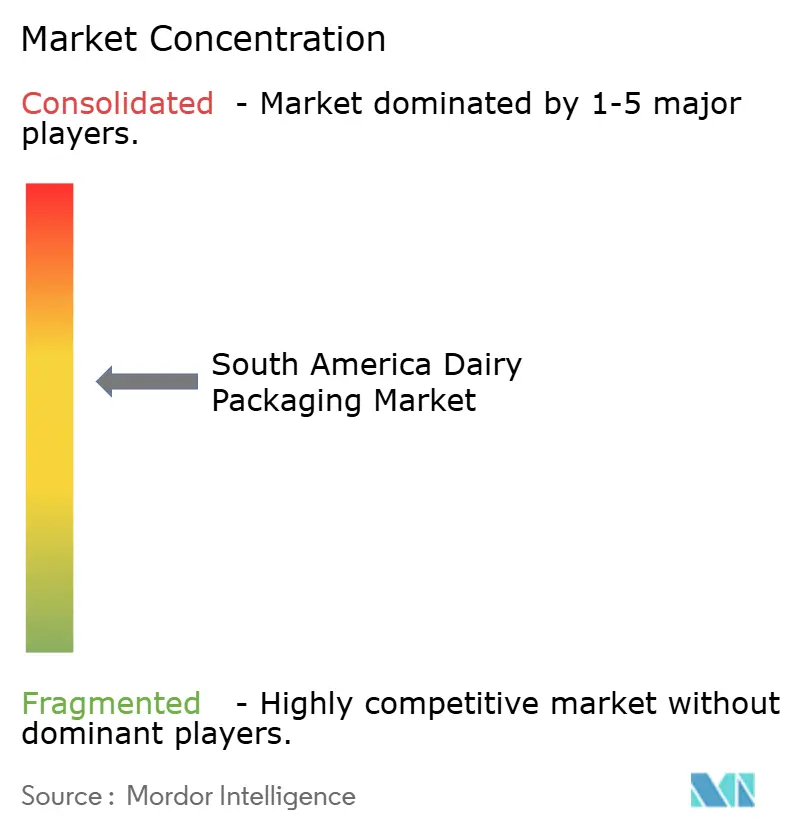
| Market Concentration | Medium |
Major Players *Disclaimer: Major Players sorted in no particular order Image © Mordor Intelligence. Reuse requires attribution under CC BY 4.0. | |
South America Dairy Packaging Market Analysis by Mordor Intelligence
The South America Dairy Packaging Market size was valued at USD 4.32 billion in 2025 and estimated to grow from USD 4.59 billion in 2026 to reach USD 6.27 billion by 2031, at a CAGR of 6.34% during the forecast period (2026-2031). Demand is moving toward ambient-stable dairy formats because they can serve areas where refrigerated distribution remains limited. Formal retail expansion is also increasing the use of branded, individually packaged dairy products. Functional and high-protein products require stronger barriers, resealable closures, and convenient formats. These requirements can raise packaging value per unit even when dairy volume grows more slowly. Suppliers are responding with aseptic filling systems, recyclable packaging, and lighter formats to address material costs.
Key Report Takeaways
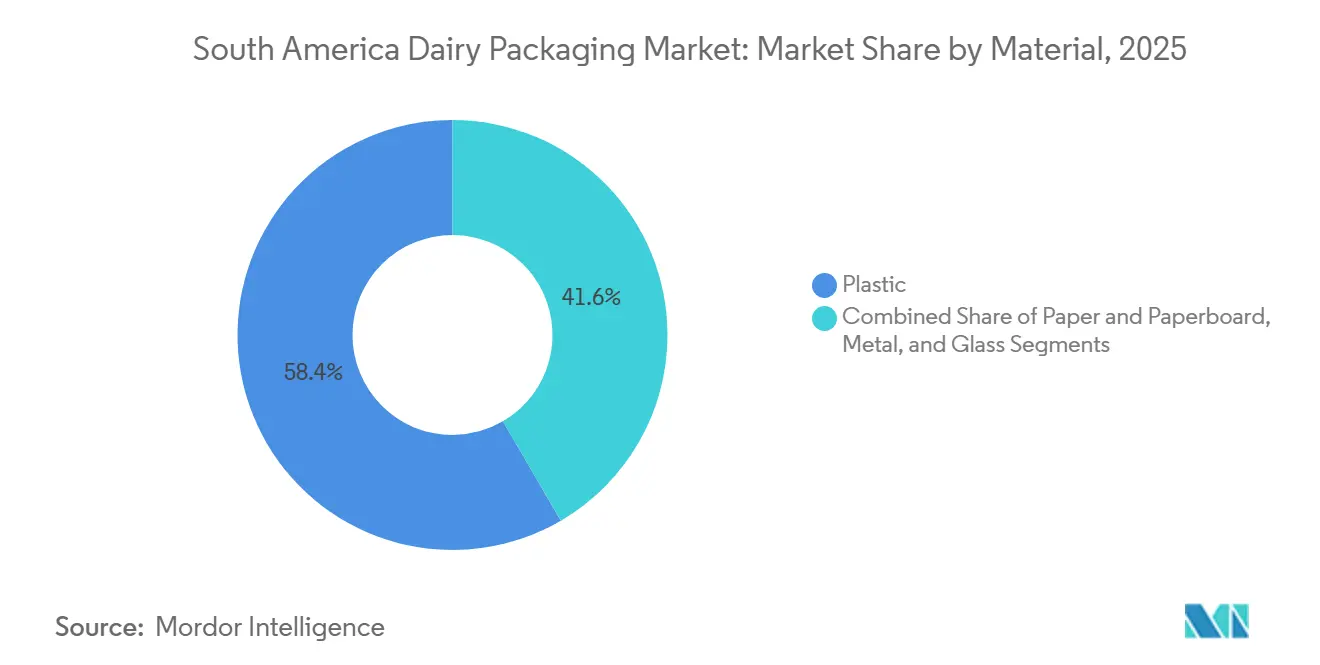
- By material, plastic held 58.41% of the South America Dairy Packaging Market share in 2025, while paper and paperboard are projected to expand at a 7.21% CAGR through 2031.
- By product, milk accounted for 46.05% of the South America dairy packaging market in 2025, while yogurt is projected to record the highest CAGR at 7.34% through 2031.
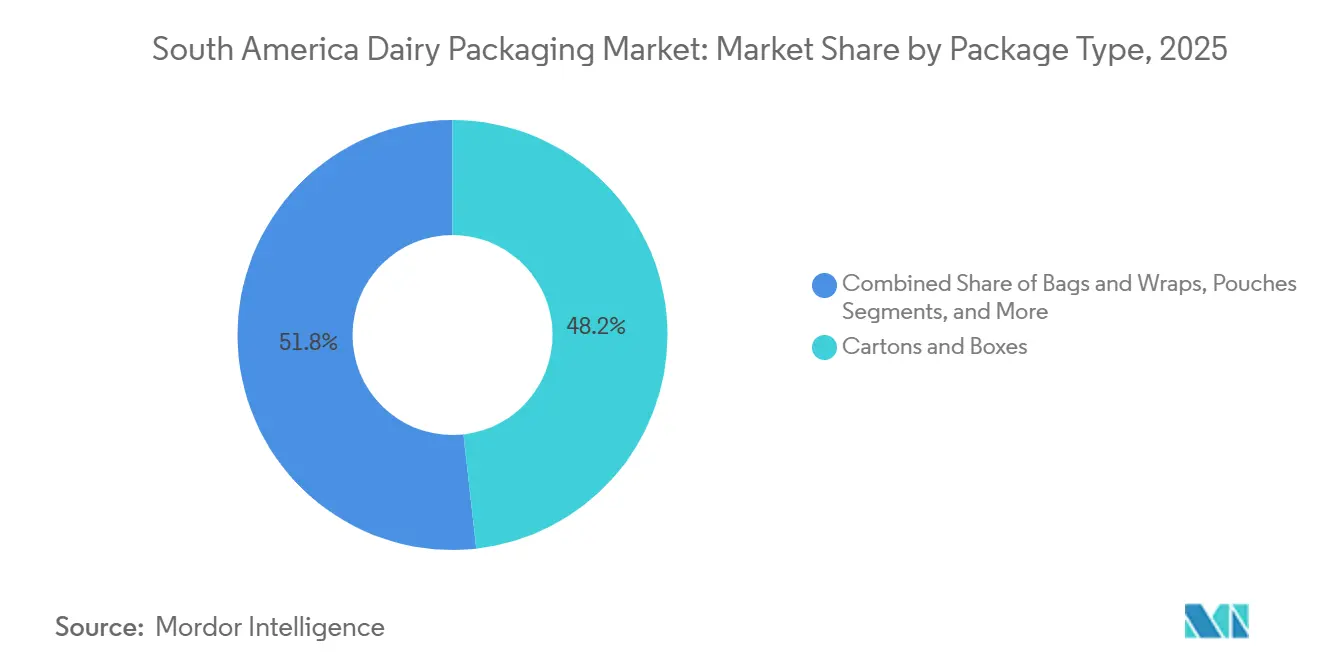
- By package type, cartons and boxes held 48.23% of revenue in 2025, while pouches are expected to expand at a 7.43% CAGR through 2031.
- By geography, Brazil accounted for 47.18% of revenue in 2025, while Colombia is projected to expand at a 7.58% CAGR through 2031.
Note: Market size and forecast figures in this report are generated using Mordor Intelligence’s proprietary estimation framework, updated with the latest available data and insights as of January 2026.
South America Dairy Packaging Market Trends and Insights
Drivers Impact Analysis*
| Driver | (~) % Impact on CAGR Forecast | Geographic Relevance | Impact Timeline |
|---|---|---|---|
| Growth of Aseptic and UHT Dairy Distribution | +1.8% | Brazil, Colombia, Argentina, Rest of South America | Medium term (2-4 years) |
| Expansion of Formal Retail and Cold-Chain Coverage | +1.4% | Brazil interior, Colombia, Rest of South America | Long term (≥ 4 years) |
| Rising Demand for Functional and High-Protein Dairy Products | +1.0% | Brazil, Chile, Colombia | Medium term (2-4 years) |
| Shift From Loose to Hygienically Packaged Dairy | +0.8% | Rest of South America, rural Brazil, inland Colombia | Long term (≥ 4 years) |
| Lightweight Flexible Formats for Cost-Constrained Distribution | +0.6% | Brazil, Argentina, Rest of South America | Short term (≤ 2 years) |
| Recyclability and Recycled-Content Commitments by Brand Owners | +0.5% | Brazil, Chile, Colombia | Medium term (2-4 years) |
| Source: Mordor Intelligence | |||
Growth of Aseptic and UHT Dairy Distribution
Aseptic and UHT distribution supports the South America dairy packaging market by expanding dairy access beyond well-developed cold chains. Brazil's long-life dairy association reported 3.9% growth in the UHT milk segment during 2024. This growth supports continued demand for multilayer cartons and related aseptic materials. School nutrition programs also provide a dependable channel for packaged dairy and carton formats. Aseptic equipment requires significant capital spending, which can keep a cooperative tied to a filling platform for 12-15 years. Early relationships with processors can therefore protect demand for the compatible package system.
Expansion of Formal Retail and Cold-Chain Coverage
Formal retail converts bulk dairy sales into branded units with dedicated packaging. In 2025, single-person households represented 19.7% of Brazilian households.[1]Instituto Brasileiro de Geografia e Estatística, “Pesquisa Nacional por Amostra de Domicílios Contínua 2025,” IBGE, ibge.gov.br This household structure supports smaller packs with greater packaging use per liter. Refrigerated distribution in inland Colombia and northeastern Brazil also supports the distribution of yogurt, fresh cheese, chilled bottles, and films. Food-contact and labeling compliance becomes necessary for supermarket placement as retail channels formalize. Converters with certified substrates can gain an advantage when chains apply consistent supplier requirements.
Rising Demand for Functional and High-Protein Dairy Products
Functional and high-protein dairy products require packaging that protects quality and supports convenient use. These products often need oxygen barriers, ultraviolet protection, and resealable closures. Cooperoeste launched protein yogurt, triple-zero yogurt, and protein-enriched dulce de leche in SIG CloverCap pouches in 2025. The launch showed how a cooperative can use aseptic pouch packaging to enter differentiated dairy categories. Research published in 2025 found that bio-based polymer coatings can provide oxygen-barrier performance comparable to that of polyethylene in dairy cartons. High-barrier laminates and specialized closures can increase the value of packaging used for each product.
Shift From Loose to Hygienically Packaged Dairy
The move from loose dairy sales to branded packaged products remains important in rural Brazil, Bolivia, Paraguay, and Peru. Many consumers in these areas still buy dairy outside formal packaging channels. Urbanization and income growth can gradually create demand for an initial layer of hygienic packaging. Regional converters can serve this stage before large suppliers expand local distribution. The region's flexible packaging demand was supported by dairy as a higher-growth food application. This opportunity develops gradually because retail access, logistics, and consumer purchasing patterns change over several years.
Restraints Impact Analysis*
| Restraint | (~) % Impact on CAGR Forecast | Geographic Relevance | Impact Timeline |
|---|---|---|---|
| Currency Volatility and Imported Resin Exposure | -1.2% | Brazil, Argentina, Rest of South America | Short term (≤ 2 years) |
| Uneven Rural Logistics and Refrigeration Infrastructure | -0.8% | Rest of South America, rural Brazil, inland Colombia | Long term (≥ 4 years) |
| Packaging Recovery and Recycling Gaps | -0.5% | Argentina, Rest of South America, global spill-over | Medium term (2-4 years) |
| Compliance Cost of EPR, Labeling, and Food-Contact Rules | -0.4% | Brazil, Chile, Colombia | Medium term (2-4 years) |
| Source: Mordor Intelligence | |||
Currency Volatility and Imported Resin Exposure
Imported resin exposure remains a near-term challenge for the South America dairy packaging market. Brazil imported 3.32 million tonnes of polyethylene in 2025. Domestic chemical capacity utilization was 64% in 2025, limiting the local output's ability to cushion the impact of supply pressure. Brazil imposed definitive duties of USD 199.04 per tonne on U.S. polyethylene and USD 238.49 per tonne on Canadian polyethylene from March 2026. Higher resin costs can compress converter margins, raise prices for dairy processors, or encourage lighter package designs. Smaller regional converters face greater exposure because they have fewer resources for foreign-exchange risk management.
Uneven Rural Logistics and Refrigeration Infrastructure
Uneven refrigeration coverage limits access to fresh dairy products in Brazil's north and northeast, the Andean highlands, and Paraguay. A cold chain is necessary for refrigerated yogurt, fresh cheese, and related packages. Where this system is incomplete, processors rely more heavily on ambient-stable dairy. Large ambient containers can also limit the adoption of single-serve packages. School programs and regional investment can improve logistics over time, but such buildout extends beyond the 2026-2031 forecast period. The same constraint supports demand for UHT cartons in places with weaker refrigerated distribution.
*Our forecasts treat driver/restraint impacts as directional, not additive. The impact forecasts reflect baseline growth, mix effects, and variable interactions.
Segment Analysis
By Material: Plastic Retains Scale, While Paper Expands
Plastic accounted for 58.41% of the 2025 South America Dairy Packaging Market share, supported by its established use in milk bottles, flexible pouches, and yogurt containers. HDPE bottles, LDPE pouches, and polypropylene containers benefit from existing converter capacity and retail familiarity. Imported resin costs and brand concerns about plastic waste are increasing pressure on these established formats. Brazil's Decree No. 12,688, issued in 2025, established reverse logistics requirements for plastic packaging and a 32% recovery target for 2026. The decree is influencing procurement discussions around traceability, recovery, and material choice. Plastic nevertheless remains central to dairy packaging because its formats address low cost, product visibility, and established filling processes. The material's broad installed base also means that package changes are usually considered alongside existing blowing, forming, sealing, and filling equipment. This favors incremental lightweighting or recycled-content approaches where food-contact and supply conditions allow them. The South America dairy packaging market, therefore, retains a substantial plastic requirement even as buyers assess alternatives.
Paper and paperboard are projected to grow at a 7.21% CAGR through 2031. The South America Dairy Packaging Market size for paper and paperboard is driven by growth in aseptic carton packaging and brand owners' interest in recyclable structures. The recovery target under Brazil's decree does not require recycled content in food-contact packaging, so adoption of fiber-based cartons depends substantially on brand strategy. Biobased coatings may replace conventional polyethylene layers while preserving shelf-life performance in dairy cartons. Glass continues to serve premium and organic dairy products in urban Chile and Brazil. Metal remains relevant for condensed and evaporated milk, particularly in shelf-stable and institutional channels. Fiber-based alternatives need to meet food safety, barrier, shelf-life, and filling-line requirements before they can replace established structures. Their adoption is strongest where aseptic distribution and brand recycling commitments overlap. Glass and metal remain specialized choices rather than broad substitutes for cartons or plastic.



By Product: Milk Supports Volume, While Yogurt Adds Value
Milk accounted for 46.05% of the South America dairy packaging market in 2025. UHT distribution, school procurement, and branded replacements for informal fresh milk sales support this position. The UHT milk segment grew by 3.9% in 2024, supporting ongoing demand for carton packaging. Brazil's rise in single-person households is boosting demand for smaller milk packages. Italac introduced 250 ml UHT A2 milk in 2025, reflecting interest in single-serve dairy formats. The category remains closely linked to access, affordability, and a format's ability to protect milk during distribution. Small cartons can increase packaging intensity per liter while maintaining the convenience sought by smaller households. Larger formats remain relevant where family purchasing and institutional distribution are more common. This mix keeps milk important to the South America dairy packaging market across both ambient and refrigerated channels.
Yogurt is projected to grow at a 7.34% CAGR through 2031, the highest rate among product categories. Functional positioning and new portion formats support the South America dairy packaging market in this category. Cooperoeste used SIG CloverCap aseptic pouches for protein yogurt and triple-zero yogurt in 2025. Resealable pouches and tubes also support children's dairy products in urban channels in Brazil and Colombia. Kefir, labneh, probiotic drinks, and other cultured products need high-barrier closures and aseptic filling capabilities. Cheese packaging is supported by vacuum and modified-atmosphere formats. Grupo Piracanjuba commissioned a 54,000 m² cheese plant in Brazil during 2025 with Tetra Pak support.[2]Tetra Pak, “Grupo Piracanjuba Counts on Tetra Pak Support to Open One of the Largest Cheese Plants,” Tetra Pak, revistamaisleite.com.br The shift toward differentiated yogurt depends on packaging that maintains product quality while allowing convenient consumption. It also gives cooperatives more options for using premium formats and closure features. Cultured products face specialized demand because their characteristics do not always align with standard mass-market packaging.
By Package Type: Cartons Lead, While Pouches Gain Ground
Cartons and boxes accounted for 48.23% of the South America dairy packaging market in 2025. Their role in UHT dairy distribution gives them broad use across Brazil, Argentina, and Colombia. School nutrition channels also provide regular demand for cartons and establish familiarity with these formats. Competing aseptic systems require substantial installation costs at comparable throughput. Proprietary filling equipment can maintain demand for compatible carton material for 12-15 years. These conditions support cartons even as processors consider alternative material structures. Cartons also support distribution where refrigeration cannot be consistently maintained. They allow long-life milk to reach locations that would otherwise have limited access to packaged fresh dairy. This functional role makes the format important to the South America dairy packaging market beyond its 2025 revenue position.
Pouches are projected to grow at a 7.43% CAGR through 2031. The format serves yogurt and dulce de leche applications that were previously concentrated in rigid cups, bottles, and cartons. Cooperoeste used SIG Prime 100 equipment to fill aseptic CloverCap pouches in Santa Catarina. This compact system can make aseptic packaging more accessible to mid-sized cooperatives. Bottles remain important for fresh milk, drinking yogurt, and cream because product visibility can support consumer choice. Bags and wraps are used in institutional dairy distribution. Trays, lidded cups, and barrier containers continue to reflect specific needs for fresh cheese and frozen dairy. Pouches can reduce material use compared with some rigid alternatives and can be easier to distribute in cost-sensitive routes. Spouts and resealable closures extend their use beyond basic flexible packaging. The format's growth reflects a combination of aseptic access, portion convenience, and application flexibility.
Geography Analysis
Brazil accounted for 47.18% of the South America dairy packaging market in 2025. The country produced 38.3 billion liters of milk in 2025, supported by a developed processing and converter base. School nutrition procurement supports carton demand across dairy cycles. SIG announced an investment in modernization at its Campo Largo and Vinhedo facilities during 2026.[3]SIG Group, “Cooperoeste Expands Portfolio with Yogurt, Dulce de Leche in SIG CloverCap Pouches at ExpoSuper 2025,” SIG Group, packagingstrategies.com Amcor, Coveris, Zaraplast, Videplast, and Santa Rosa Embalagens Flexíveis compete across films, bottles, and flexible formats. Brazil's 2025 reverse-logistics decree is directing attention toward recyclable and fiber-based packaging choices.
Colombia is projected to grow at a 7.58% CAGR through 2031. Formal retail investment in Medellín and Cali is driving demand for packaged UHT milk and yogurt. Colombia's packaging EPR system has been operational since 2021 under the Ministry of Environment and Sustainable Development. This framework influences how multinational brand owners source sustainable packaging. Greenfield aseptic filling capacity also supports higher use of ambient dairy packages. Chile's packaging requirements provide another important compliance reference point for suppliers operating in the region.
Bolivia, Paraguay, Uruguay, Peru, and Ecuador remain at earlier stages of dairy retail formalization. These markets offer long-term opportunity as loose dairy sales shift into packaged products. Uruguay differs from much of this group because its dairy sector is formalized and export-oriented. Its cheese and UHT milk exports need packaging with traceability and certification. Argentina also faces volatile material costs, but dairy suppliers continue to develop circular packaging solutions. Dow and Mastellone Hnos. developed milk-bottle shrink film containing 20% REVOLOOP recycled resin in December 2025.
Competitive Landscape
The South America dairy packaging market is moderately concentrated in aseptic cartons, while bottles, films, and specialty formats remain fragmented. Tetra Laval and SIG Group supply much of the ambient liquid dairy volume through proprietary equipment and service relationships. These installed systems can secure demand for compatible carton materials over their operating life. Amcor, Sealed Air, Coveris, Goglio, Winpak, Elopak, and Mondi compete in broader packaging categories. Videplast, Zaraplast, Santa Rosa Embalagens Flexíveis, and Canguru Embalagens serve regional requirements. Greatview Aseptic Packaging and Ecolean offer alternatives for cost-sensitive processors outside the two leading proprietary systems.
SIG announced modernization investment for Brazilian facilities in May 2026. The investment focuses on long-life carton capacity and strengthens competition for Brazilian dairy processors. SIG also worked with Cooperoeste on aseptic pouches for protein yogurt and dulce de leche. Amcor installed Moda rotary vacuum chamber sealing technology with Barra Mansa Alimentos in Brazil during June 2026.[4]Amcor, “Amcor Introduces Moda Vacuum Sealing in Brazil,” Amcor, amcor.com These moves show that suppliers are competing through filling systems, flexible formats, and integrated packaging technology.
Material innovation may broaden options for dairy processors that need stronger sustainability credentials. Research on biobased coatings supports the use of alternative barrier layers in dairy cartons. Mono-material paperboard also has potential benefits for mass optimization and damage reduction. Mid-sized cooperatives in Brazil, Colombia, and other South American markets remain an important opportunity for compact aseptic equipment. These processors may not meet the capital or volume requirements of large global systems. Modular spouted-pouch lines can provide a more accessible route into functional dairy formats. Competitive activity will therefore remain strongest where equipment access and material performance intersect. This competitive setting makes service capability as important as the package material itself. A processor that adopts an aseptic platform also needs reliable technical support, compatible materials, and access to filling equipment.
South America Dairy Packaging Industry Leaders
Tetra Laval Holdings & Finance S.A.
Amcor plc
SIG Group AG
Huhtamäki Oyj
Sonoco Products Company
- *Disclaimer: Major Players sorted in no particular order

Recent Industry Developments
- June 2026: Amcor installed the first Moda rotary vacuum chamber sealing technology in Brazil with food processor Barra Mansa Alimentos, with all 3 production lines expected to be operational by year-end 2026. The deployment extended Amcor's integrated packaging systems capability across South America's dairy and protein markets, setting a regional benchmark for vacuum-sealing efficiency.
- May 2026: SIG Group announced a BRL 170 million (USD 29 million) investment in the modernization of its Campo Largo and Vinhedo manufacturing facilities, targeting expanded long-life carton output to compete directly against Tetra Pak's dominant share in Brazil's aseptic liquid dairy packaging segment.
- March 2026: Brazil finalized definitive anti-dumping duties of USD 199.04 per tonne on U.S. polyethylene and USD 238.49 per tonne on Canadian polyethylene for a 5-year term, effective March 26, 2026. The ruling restructured import cost matrices for South America's dairy packaging converter sector, which relies heavily on foreign-sourced resin, and is expected to accelerate investment in lighter-weight and fiber-based formats.
- December 2025: Dow and Mastellone Hnos. developed a circular shrink film incorporating 20% REVOLOOP post-consumer recycled resin for milk bottle wrapping in Argentina, one of the first commercial-scale recycled-content dairy packaging innovations in the country's volatile packaging market.


South America Dairy Packaging Market Report Scope
The South America Dairy Packaging Market refers to the market for packaging materials, packaging formats, and packaging solutions used to contain, protect, preserve, transport, store, distribute, and retail dairy products across South America. The market encompasses revenue generated from the manufacture and sale of primary packaging components and containers specifically designed for dairy applications, including liquid, cultured, frozen, and cheese dairy products. The market includes both rigid and flexible packaging solutions that provide barrier protection against moisture, oxygen, light, microbial contamination, and physical damage while maintaining product freshness, quality, shelf life, safety, and regulatory compliance throughout the dairy value chain. Packaging solutions are supplied to dairy processors, milk producers, cheese manufacturers, yogurt producers, frozen dairy manufacturers, co-packers, and private-label dairy brands operating within the region.
The South America Dairy Packaging Market Report is Segmented by Material (Plastic, Paper and Paperboard, Glass, and Metal), Product (Milk, Cheese, Frozen Foods, Yogurt, and Cultured Products), Package Type (Bottles, Pouches, Cartons and Boxes, Bags and Wraps, and Other Package Types), and Geography (Brazil, Argentina, Chile, Colombia, and Rest of South America). The Market Forecasts are Provided in Terms of Value (USD).
By Material
| Plastic |
| Paper and Paperboard |
| Glass |
| Metal |
By Product
| Milk |
| Cheese |
| Frozen Foods |
| Yogurt |
| Cultured Products |
By Package Type
| Bottles |
| Pouches |
| Cartons and Boxes |
| Bags and Wraps |
| Other Package Types |
By Geography
| Brazil |
| Argentina |
| Chile |
| Colombia |
| Rest of South America |
| By Material | Plastic |
| Paper and Paperboard | |
| Glass | |
| Metal | |
| By Product | Milk |
| Cheese | |
| Frozen Foods | |
| Yogurt | |
| Cultured Products | |
| By Package Type | Bottles |
| Pouches | |
| Cartons and Boxes | |
| Bags and Wraps | |
| Other Package Types | |
| By Geography | Brazil |
| Argentina | |
| Chile | |
| Colombia | |
| Rest of South America |


Key Questions Answered in the Report
What is the size of the South America dairy packaging market?
The South America dairy packaging market is estimated at USD 4.59 billion in 2026 and is forecast to reach USD 6.27 billion by 2031.
What is driving demand for dairy packaging in South America?
Aseptic UHT distribution, formal retail growth, smaller household sizes, and functional dairy products are supporting demand.
Which material leads dairy packaging demand in South America?
Plastic led with 58.41% of 2025 revenue, supported by bottle, pouch, and yogurt-container applications.
Which dairy package format is growing fastest in South America?
Pouches are projected to grow at a 7.43% CAGR through 2031, supported by aseptic applications for yogurt and dulce de leche.
Which country is expected to grow fastest through 2031?
Colombia is projected to grow at a 7.58% CAGR, supported by formal retail, rising UHT and yogurt consumption, and aseptic investment.
How are sustainability rules affecting dairy packaging choices?
Reverse logistics and EPR requirements are increasing interest in recyclable, fiber-based, and recycled-content packaging structures.
Page last updated on:





