
Market Overview
| Study Period | 2020 - 2031 |
|---|---|
| Forecast Data Period | 2026 - 2031 |
| Base Year Market Size (2025) | USD 3.85 Billion |
| Market Size (2026) | USD 4.15 Billion |
| Market Size (2031) | USD 5.86 Billion |
| Growth Rate (2026 - 2031) | 7.14 % |
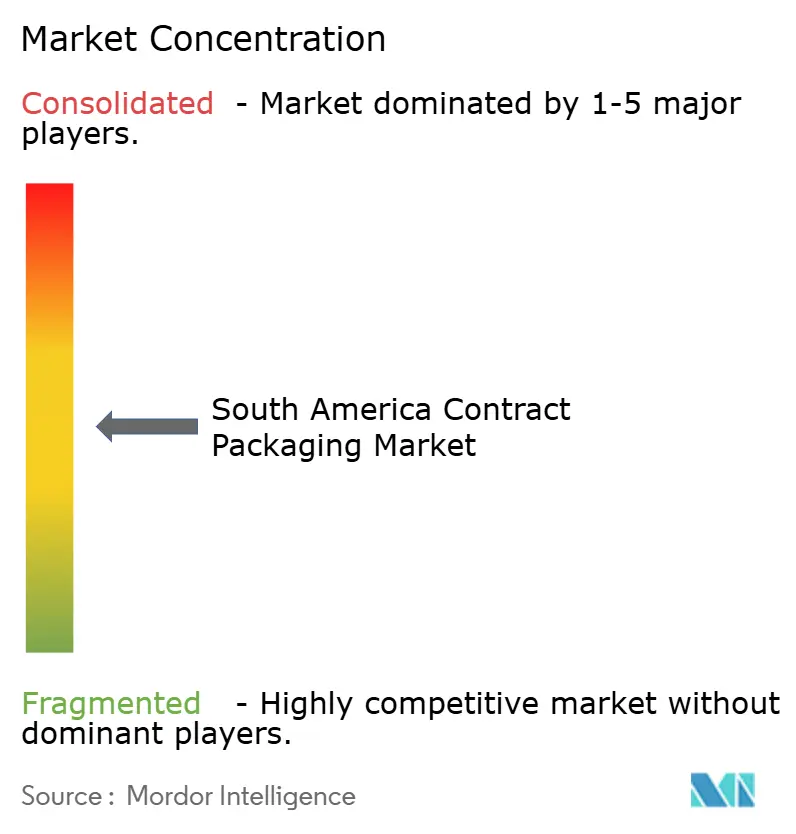
| Market Concentration | Medium |
Major Players *Disclaimer: Major Players sorted in no particular order Image © Mordor Intelligence. Reuse requires attribution under CC BY 4.0. | |
South America Contract Packaging Market Analysis by Mordor Intelligence
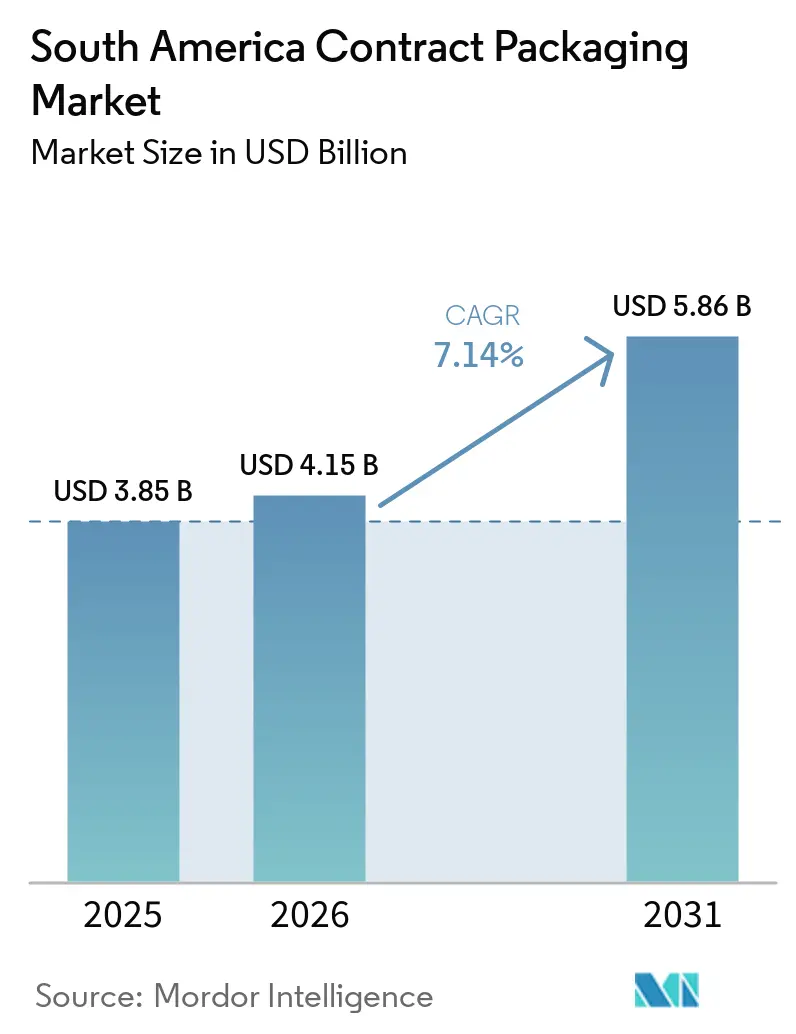
The South America contract packaging market size was valued at USD 3.85 billion in 2025 and estimated to grow from USD 4.15 billion in 2026 to reach USD 5.86 billion by 2031, at a CAGR of 7.14% during the forecast period (2026-2031). Brand owners are moving packaging work to specialist providers as product ranges expand and compliance requirements become harder to manage in-house. Food, pharmaceutical, and personal care manufacturers are using external packaging partners for filling, labeling, kitting, and fulfillment, particularly where production volumes do not support dedicated equipment. E-commerce is increasing the need for retail-ready formats and packaging locations close to urban delivery networks. Large regional operators are expanding their material, service, and country coverage, while smaller providers continue to compete by offering rapid changeovers and flexible order sizes. Input costs and supply disruptions remain constraints, although diversified operators can reduce exposure by serving multiple end-user categories and using multiple material formats.
Key Report Takeaways
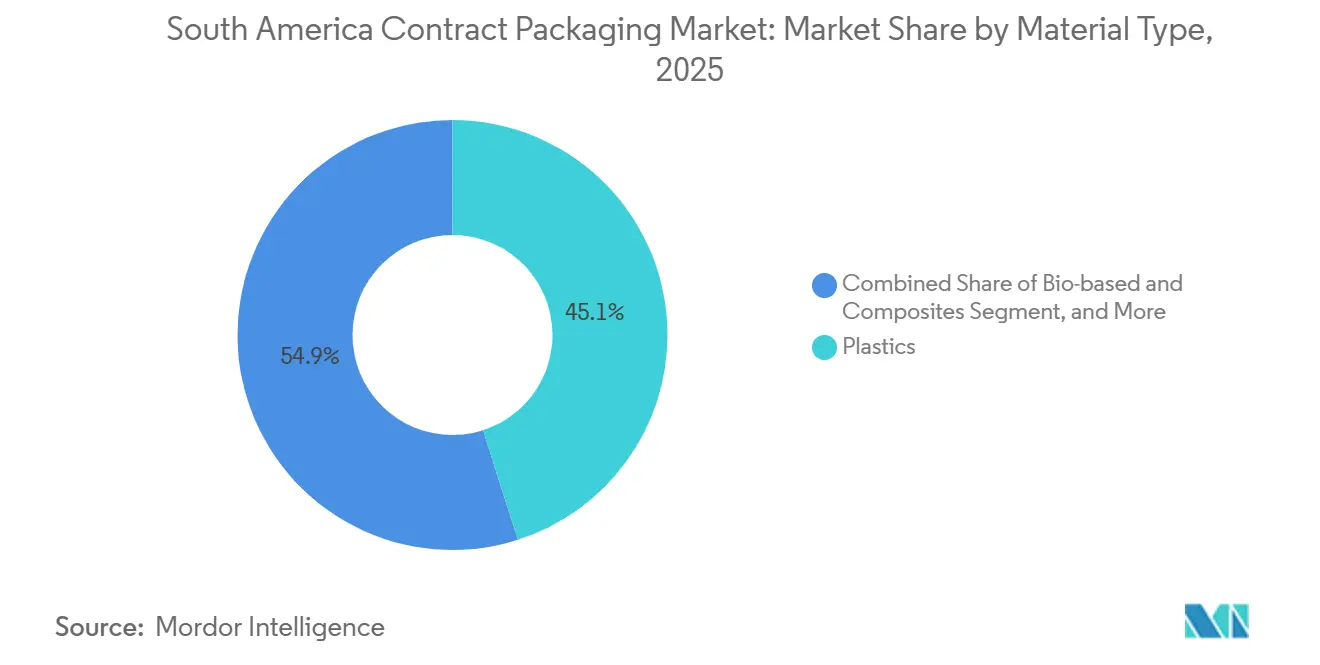
- By material type, plastics accounted for 45.08% of the South America contract packaging market share in 2025, while bio-based and composite materials are projected to expand at an 8.26% CAGR through 2031.
- By packaging type, primary packaging accounted for 64.29% of the South America contract packaging market size in 2025, while secondary packaging is projected to grow at an 8.32% CAGR through 2031.
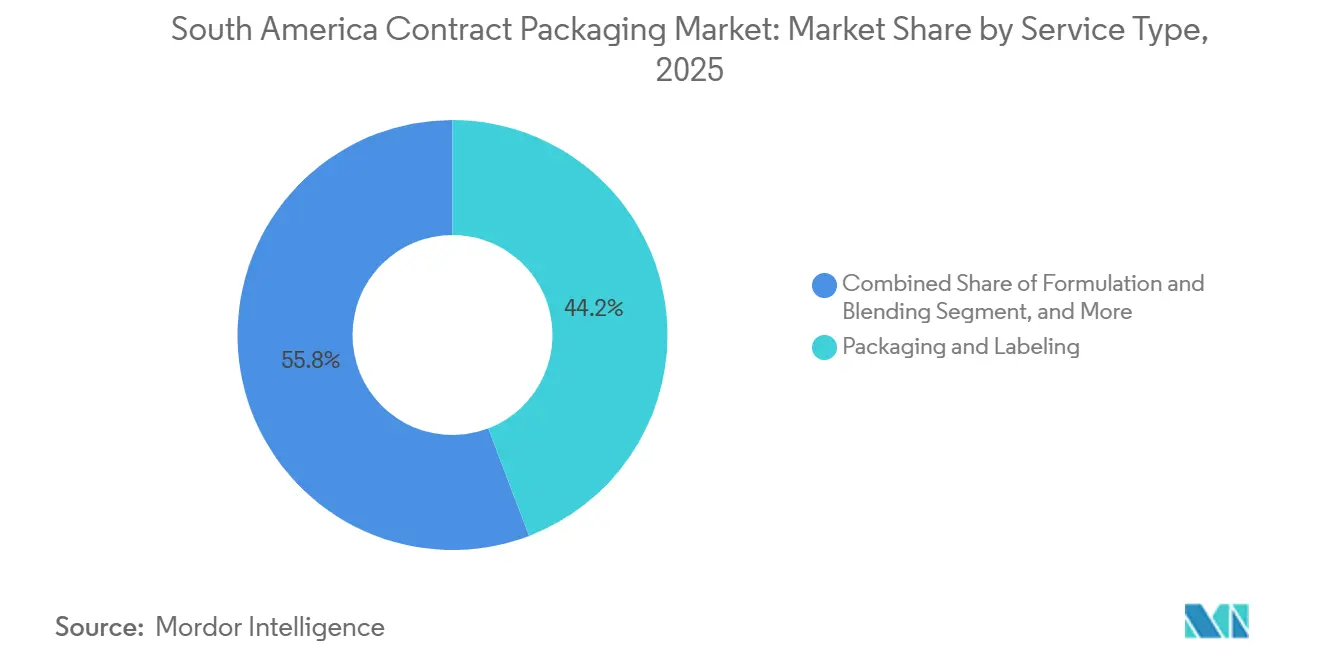
- By service type, packaging and labeling held 44.20% of the South America contract packaging market share in 2025, while fulfillment and logistics are expected to expand at an 8.57% CAGR through 2031.
- By end-user industry, food held a 38.21% share in 2025, while the pharmaceutical industry is projected to record an 8.83% CAGR through 2031.
- By geography, Brazil held 46.13% share in 2025, while Colombia is expected to grow at a 9.03% CAGR through 2031.
Note: Market size and forecast figures in this report are generated using Mordor Intelligence’s proprietary estimation framework, updated with the latest available data and insights as of January 2026.
Market Trends and Insights
Drivers Impact Analysis of South America Contract Packaging Market*
| Driver | (~) % Impact on CAGR Forecast | Geographic Relevance | Impact Timeline |
|---|---|---|---|
| Outsourcing Non-Core Packaging Activities | +1.8% | South America, concentrated in Brazil, Argentina, and Colombia | Medium term (2-4 years) |
| E-Commerce and Omnichannel Fulfillment Growth | +1.5% | Brazil, Argentina, and Colombia, with spillover to Chile | Short term (≤ 2 years) |
| Pharmaceutical Serialization and Traceability Requirements | +1.2% | Brazil, Argentina, and Colombia | Medium term (2-4 years) |
| Demand for Flexible and Sustainable Formats | +0.9% | Brazil, Chile, and Colombia, especially São Paulo, Bogotá, and Santiago | Long term (≥ 4 years) |
| Nearshoring to Reduce Cross-Border Packaging Lead Times | +0.6% | Colombia, Chile, and Peru | Long term (≥ 4 years) |
| Aseptic Co-Packing for Tropical Beverages and Nutraceuticals | +0.5% | Brazil and Colombia | Medium term (2-4 years) |
| Source: Mordor Intelligence | |||
Outsourcing Non-Core Packaging Activities
Brand owners across the South America contract packaging market are directing capital toward products, distribution, and brand development rather than maintaining all packaging activities in-house. This choice reflects more than just cost control, as mid-sized manufacturers often need access to clean rooms, validated lines, and regulated labeling systems that would be expensive to establish on their own. Pharmaceutical and personal care companies particularly value providers that can support serialization, controlled documentation, and consistent pack presentation across product variants. Integrated service bundles that include formulation, filling, labeling, and fulfillment can reduce handoffs between suppliers and make packaging programs easier to coordinate. Providers with these combined capabilities are better placed to secure longer-term contracts than businesses that offer only a single packaging task. This pattern favors regional platforms that can serve several countries while maintaining specialized quality systems for regulated products.
E-Commerce and Omnichannel Fulfillment Growth
South American online retail sales are projected to reach USD 215.31 billion in 2026, driving greater demand for packaging ready for fulfillment and delivery. Marketplace sellers increasingly need kitting, scan-ready labels, retail-ready cartons, and product formats that meet platform rules before goods enter delivery networks. Mercado Libre reported that it committed USD 13.2 billion across South America in 2025, up 36% from the prior year, to support the expansion of its distribution infrastructure. The company’s 2025 annual report also identified kitting and specialized co-packing as value-added activities in e-commerce logistics, with a reported growth rate of 12.46% CAGR. Fast delivery expectations in São Paulo, Buenos Aires, and Santiago make proximity to logistics hubs more important, as packaging must be configured for rapid picking and shipment. This creates direct demand for operations across the South America contract packaging market.
Pharmaceutical Serialization and Traceability Requirements
Brazil’s SNCM system requires serial-number relationships across secondary and tertiary packaging, which makes accurate line-level integration essential for pharmaceutical packaging programs. These requirements can lead generic drug manufacturers to use specialist co-packers that already operate validated cartoning, case-packing, and electronic batch-record systems. Argentina’s ANMAT traceability framework has been operating since 2015, while Colombia is working toward closer alignment with Brazilian standards.[1] ANVISA is also integrating its controlled-prescription traceability platform with electronic prescription systems in 2026, pursuant to RDC 1,000/2025 and RDC 1,028/2026. The added documentation demands strengthen the position of larger co-packers that have quality systems and trained regulatory teams. These requirements shape capacity needs throughout the South America contract packaging market.
Demand for Flexible and Sustainable Formats
Packaging rules in Chile and Colombia, together with recycled-content goals in Brazil, are encouraging brand owners to consider alternatives to multi-layer rigid formats. Brazil’s flexible plastic packaging sector generated BRL 40.1 billion (USD 7.0 billion) in revenue in 2025, while the agro-sector's flexible packaging volume increased by 9.7%. This scale gives co-packers access to a substantial supply base while brands seek recyclable, flexible, and lower-material packaging designs. A 2025 scientific study identified 18 bioplastic-producing companies in South America and examined a Brazilian sugarcane biorefinery pathway for the production of bio-polyethylene furanoate. The study reported that the proposed material could offer 10 times lower O₂ permeability and 45-50% lower greenhouse-gas emissions than PET. Bio-based and composites are therefore the fastest-growing material category in the South America contract packaging market, although plastics retain the largest installed base.
Restraints Impact Analysis of South America Contract Packaging Market*
| Restraint | (~) % Impact on CAGR Forecast | Geographic Relevance | Impact Timeline |
|---|---|---|---|
| In-House Packaging Capacity Expansion | -1.4% | Brazil and Argentina, especially large consumer goods and industrial operators | Medium term (2-4 years) |
| Raw Material Price Volatility and Supply Disruptions | -1.0% | South America, with strong exposure in Brazil and Argentina | Short term (≤ 2 years) |
| Fragmented Quality Systems Across Small Co-Packers | -0.6% | Brazil interior markets and the rest of South America | Long term (≥ 4 years) |
| Cross-Border Labeling and Customs Complexity | -0.4% | Mercosur corridors, Argentina-Brazil, and Colombia-Ecuador | Medium term (2-4 years) |
| Source: Mordor Intelligence | |||
In-House Packaging Capacity Expansion
Within the South America contract packaging market, large manufacturers in Brazil and Argentina expanded internal packaging lines during 2024 and 2025, which can reduce the volumes available to regional co-packers. The effect is selective because dedicated automation is most viable for businesses with consistently high throughput and stable packaging needs. Small- and mid-sized brand owners generally still face high equipment, labor, and compliance costs when they package every product internally. ABRE and FGV projected Brazilian packaging production growth of 0.2% in 2026, against a backdrop of financing conditions that can also limit large capital projects. Co-packers serving pharmaceutical, nutraceutical, and medical device customers face less displacement risk because validated operations remain difficult to develop and maintain. The South America contract packaging industry can therefore retain a clear role where compliance requirements are more demanding than simple volume-based automation.
Raw Material Price Volatility and Supply Disruptions
Petrochemical feedstock uncertainty increased input-cost risk for plastic-intensive operators in the South America contract packaging market during early 2026. ABRE and FGV indicated that Brazilian packaging production could fall within the -0.3% to +0.7% range in 2026, as supply risks affect resin and petrochemical flows. Flexible-film providers are especially exposed because LDPE and LLDPE accounted for 73% of the volume of Brazilian flexible plastic packaging in 2025. Currency depreciation in Argentina and instability across Andean markets can further raise local costs for imported specialty films. Long-term domestic resin supply agreements and recycled-content streams can help providers manage volatility and preserve service continuity. Diversification across paper, plastic, glass, and other substrates can also limit the effect of a disruption in any 1 material category.
*Our forecasts treat driver/restraint impacts as directional, not additive. The impact forecasts reflect baseline growth, mix effects, and variable interactions.
South America Contract Packaging Market Segment Analysis
By Material Type:
Bio-Based Growth Broadens the Material MixPlastics accounted for 45.08% of the regional total in 2025, supported by Brazil’s integrated petrochemical supply chain and established converting base. Their scale supports high-volume food, beverage, personal care, and household product programs that require familiar, flexible, and rigid formats. Bio-based and composites are projected to grow at an 8.26% CAGR through 2031, the fastest rate among the material categories. Within the South America contract packaging market, this growth reflects sustainability requirements and brand interest in formats that can reduce material use or increase renewable content. Paper and paperboard, metal, and glass meet the remaining material demand and offer brand owners options when product protection, presentation, and recovery systems differ.
Paper formats can benefit from e-commerce corrugated volumes and from pharmaceutical applications that need insulated cartons or other protective secondary structures. Brazil’s paper packaging sector sold 358,786 tonnes in April 2026, the highest April volume recorded since 2005, and sales were 5.5% above April 2025. Tutiplast received BRL 9.9 million (USD 2.0 million) in Finep funding during 2025 to develop bioplastic packaging from Amazonian botanical fibers.[2] CONICET and Plastimi also formalized a May 2025 research agreement for cassava-starch biodegradable bags in Argentina’s Misiones province. These projects show how regional feedstocks can support material innovation while established plastic formats continue to carry most packaging volume.

By Packaging Type:
Primary Volume and Secondary Compliance Shape DemandPrimary packaging accounted for 64.29% of the South America contract packaging market size in 2025, reflecting extensive food processing and pharmaceutical fill-finish activity. This category remains essential because it provides direct product containment and often requires careful hygiene, compatibility, and quality controls. Secondary packaging is projected to grow at an 8.32% CAGR through 2031, which is the fastest pace among packaging types. Serialization and aggregation codes are increasing the importance of secondary packs in pharmaceutical supply chains. Tertiary packaging supports pallet movement and protection across road-based distribution networks connecting production locations to large urban markets.
The secondary-pack opportunity is closely tied to regulated products where pack appearance alone is insufficient, and traceability must continue through cartons and cases. ANVISA’s traceability work underscores the need for reliable data connections between the serial-number application and related electronic systems on packaging lines. Colombia’s development as an Andean manufacturing hub supports demand across primary, secondary, and tertiary packaging formats because new consumer-goods plants require coordinated packaging and dispatch. The South America contract packaging market benefits when co-packers can provide these tiers under 1 operating plan. Integrated capabilities can reduce handling steps and help clients maintain consistent product records from filling through palletized shipment.
By Service Type:
Fulfillment Extends the Role of Co-PackersPackaging and labeling accounted for 44.20% of the service segment in 2025, making it the largest service type. This position reflects the importance of pharmaceutical labels, food-contact declarations, and country-specific content rules for products sold across the region. Fulfillment and logistics are expected to expand at an 8.57% CAGR through 2031, the fastest growth rate among service types. Online sellers require scan-ready units, marketplace labels, and retail-ready cartons before shipments are handed to delivery networks. Across the South America contract packaging market, formulation and blending remain specialized services for pharmaceutical and nutraceutical clients seeking product preparation and primary containment within a single external arrangement.
The service mix is changing because packaging activity increasingly occurs during the short period before a shipment enters an e-commerce network. This allows co-packers to capture work that previously sat with separate logistics providers, especially when products need kitting or final compliance checks. Tetra Pak supports connections between co-packers and emerging Brazilian brands in tropical beverages and functional nutraceuticals, demonstrating the role that equipment suppliers can play in linking demand with production capacity. Providers that combine labeling, packaging, and fulfillment can offer clients a more direct route from finished product to marketplace-ready inventory. The South America contract packaging industry is therefore becoming more closely connected with logistics without losing its core role in controlled packaging execution.
By End-User Industry:
Pharmaceutical Demand Outpaces Food GrowthFood held 38.21% of the regional total in 2025, supported by high processed-food volumes and a large regional consumer base. Food programs provide steady demand for filling, labeling, primary containment, and secondary retail formats. The pharmaceutical industry is projected to grow at an 8.83% CAGR through 2031, outpacing the overall rate as generic drugs, biologics, and related treatments create greater demand for controlled packaging. This category also needs cold-chain secondary packs and stronger documentation than many food applications. The South America contract packaging market also draws beverage demand through Brazil’s aseptic carton and flexible-pouch infrastructure.
Cosmetics and personal care provide an additional source of demand as local manufacturing requires compliant filling and labeling for regional distribution. SIG deployed aseptic filling technology at Cooperoeste in Brazil in 2025, extending the operator’s portfolio to yogurt and dulce de leche in pouch formats. Procaps Group completed a USD 130 million equity investment in April 2025, including USD 90 million in private-placement ordinary shares and USD 40 million in converted secured notes, alongside the restructuring of USD 209 million in debt. This capital supports manufacturing capacity and a broader CDMO footprint, aligning with the need for larger pharmaceutical co-packing platforms. Industrial and other users add baseline packaging volumes, but the strongest near-term growth remains concentrated in pharmaceutical activities.
Geography Analysis
Brazil Contract Packaging Market
Brazil accounted for 46.13% of the regional total in 2025, supported by its position as the region’s largest consumer economy and its pharmaceutical manufacturing base. The São Paulo-Campinas corridor contains the region’s deepest co-packing cluster and provides access to suppliers, customers, and logistics infrastructure. Brazil’s paper packaging sector sold 358,786 tonnes in April 2026, a record for the month since 2005, with sales 5.5% higher than in April 2025. The country’s flexible plastic packaging sector generated BRL 40.1 billion (USD 7.0 billion) in 2025, and the agro-sector's flexible packaging volume rose by 9.7%. These material bases allow the South America contract packaging market to serve food, retail, agro-industrial, e-commerce, and export-oriented clients from a large domestic supply network.
Argentina and Chile Contract Packaging Market
Argentina and Chile form a second demand tier for the South America contract packaging market, with different reasons for using specialist providers. Argentina’s online sales increased by 248% year over year in the first half of 2024, supporting new demand for fulfillment co-packing around Buenos Aires. Its pharmaceutical co-packers also have long-standing familiarity with ANMAT’s traceability framework, which has been in place since 2015. Chile’s producer-responsibility rules are encouraging packaging changes toward recyclable and barrier-coated paper substrates. KURZ Chile became a regional distribution hub during 2025 for decorative packaging films serving the Southern Cone and parts of Central America.
Colombia and Broader South America Contract Packaging Market
Colombia is projected to expand at a 9.03% CAGR through 2031, making it the fastest-growing country in the regional market. Investment into Caribbean Free Trade Zones reached USD 1.2 billion during 2024 and 2025, creating demand in industrial corridors with limited established co-packing capacity.[3] SIG’s aseptic carton-filling deployment at Celema in 2024 marked the first local use of the system and expanded access to aseptic formats for Colombian beverage and food brands. Peru, Ecuador, Uruguay, Bolivia, Paraguay, and other countries remain underserved by organized co-packing providers, while Bio DP Latam launched biodegradable and compostable packaging operations in Paraguay in June 2026.
Competitive Landscape
The South America contract packaging market is moderately fragmented, with large integrated operators holding advantages in material sourcing, regional coverage, and serialization infrastructure. Specialist pharmaceutical and aseptic co-packers retain defensible positions where validated quality systems, cold-chain expertise, and technical equipment are necessary. Large operators are pursuing geographic expansion and innovation investments, while specialist providers focus on compliance-intensive production programs. Smurfit Westrock acquired Cartomanabí packaging assets in Ecuador during 2025, extending its regional packaging presence.[4] The company also reported a 20% adjusted EBITDA margin for its South America-related regional operations in the first quarter of 2026, illustrating the value of vertical integration from paper production through converting and co-packing.
Smaller providers in craft beverages, nutraceuticals, and specialty cosmetics compete by offering rapid changeovers, lower minimum order quantities, and digital-print personalization. Those capabilities are useful for clients who need short runs or frequent product changes rather than a large standardized production program. Equipment partnerships remain important because many regional co-packers rely on technology suppliers for access to advanced aseptic and filling systems. SIG installed aseptic filling systems at Cooperoeste in Brazil in 2025 and at Celema in Colombia in 2024, supporting expanded packaging capabilities at both operators. These partnerships give operators access to formats that would otherwise require lengthy internal development work.
Procaps Group’s April 2025 recapitalization strengthened its ability to build production capacity and expand its CDMO footprint for pharmaceutical customers. Its April 2026 partnership with Genomma Lab covers the development, manufacture, and commercialization of 5 Softgel pharmaceutical products, with manufacturing managed from Barranquilla. The competitive opening remains strongest in cold-chain co-packing for biologics and injectable formats, as well as urban fulfillment for second-tier cities in Colombia, Chile, and Peru. These areas need organized capacity but do not yet have the same depth of service coverage as the major Brazilian packaging corridors.
South America Contract Packaging Industry Leaders
-
Smurfit Westrock plc
-
Atlantic Packaging Products Ltd.
-
Co-Pak Packaging Corporation
-
Stamar Packaging, Inc.
-
ActionPak, Inc.
- *Disclaimer: Major Players sorted in no particular order
South America Contract Packaging Market Companies Covered in this Report
- Aaron Thomas Company, Inc.
- AmeriPac, Inc.
- Assemblies Unlimited, Inc.
- Co-Pak Packaging Corporation
- Stamar Packaging, Inc.
- Jones Packaging Inc.
- Reed-Lane, Inc.
- Multi-Pack Solutions LLC
- Aphena Pharma Solutions, Inc.
- Unicep Packaging, Inc.
- Sharp Services, LLC
- ActionPak, Inc.
- Peoria Production Solutions
- Econo-Pak, Inc.
- Jonco Industries, Inc.
- WePack Logistics
- Smurfit Westrock plc
- Atlantic Packaging Products Ltd.
- TECPOLPA IND AND CO
- Tempos Industrial Outsourcing
- SuperFrio
- Engepack Embalagens
Recent Industry Developments in South America Contract Packaging Market
- April 2026: Procaps Group and Genomma Lab formalized a strategic agreement to develop, manufacture, and commercialize 5 Softgel pharmaceutical products across South America, with Procaps managing manufacturing from its Barranquilla facilities. The partnership advances Procaps' CDMO expansion strategy following its April 2025 recapitalization and extends Genomma's portfolio into specialized dosage forms.
- March 2026: Smurfit Westrock inaugurated an Experience Center in Brazil as the company's global reference site for sustainable packaging innovation, incorporating co-creation labs, a testing laboratory, an innovation showroom, and a simulated retail environment designed to accelerate collaborative development with South American brand partners.
- January 2026: Sharp Services invested over EUR 20 million (USD 21.6 million) in injectables packaging capacity at its European facilities in Belgium and the Netherlands, as part of a USD 100 million global investment targeting assembly, labeling, and cold storage capacity for autoinjectors, prefilled syringes, and vials, expanding capabilities accessible to South American multinational pharmaceutical clients.
- October 2025: Sharp Services announced a USD 100 million investment across its global pharmaceutical packaging and sterile manufacturing network, including expanded GMP capacity for vial labeling, syringe assembly, and injectables packaging.
South America Contract Packaging Market Report Scope
The South America Contract Packaging Market comprises the revenue generated from outsourced packaging services provided by third-party packaging companies on behalf of brand owners, manufacturers, and product companies across South America. The market includes primary, secondary, and tertiary packaging services, as well as formulation, filling, assembly, labeling, fulfillment, and logistics services delivered under contractual agreements across various end-user industries.
The South America Contract Packaging Market Report is Segmented by Material Type (Plastics, Paper and Paperboard, Metal, Glass, and Bio-Based and Composites), Packaging Type (Primary, Secondary, and Tertiary), Service Type (Formulation and Blending, Filling and Assembly, Packaging and Labeling, Fulfillment and Logistics, and Other Service Types), End-User Industry (Food, Beverage, Pharmaceutical, Cosmetics and Personal Care, Industrial, and Other End-User Industries), and Geography (Brazil, Argentina, Chile, Colombia, and Rest of South America). The Market Forecasts are Provided in Terms of Value (USD).
Segmentation Overview
By Material Type
| Plastics |
| Paper and Paperboard |
| Metal |
| Glass |
| Bio-based and Composites |
By Packaging Type
| Primary |
| Secondary |
| Tertiary |
By Service Type
| Formulation and Blending |
| Filling and Assembly |
| Packaging and Labeling |
| Fulfillment and Logistics |
| Other Service Types |
By End-User Industry
| Food |
| Beverage |
| Pharmaceutical |
| Cosmetics and Personal Care |
| Industrial |
| Other End-user Industries |
By Geography
| Brazil |
| Argentina |
| Chile |
| Colombia |
| Rest of South America |
| By Material Type | Plastics |
| Paper and Paperboard | |
| Metal | |
| Glass | |
| Bio-based and Composites | |
| By Packaging Type | Primary |
| Secondary | |
| Tertiary | |
| By Service Type | Formulation and Blending |
| Filling and Assembly | |
| Packaging and Labeling | |
| Fulfillment and Logistics | |
| Other Service Types | |
| By End-User Industry | Food |
| Beverage | |
| Pharmaceutical | |
| Cosmetics and Personal Care | |
| Industrial | |
| Other End-user Industries | |
| By Geography | Brazil |
| Argentina | |
| Chile | |
| Colombia | |
| Rest of South America |
Key Questions Answered in the Report
What is the size of the South America contract packaging market?
The South America contract packaging market size is estimated at USD 4.15 billion in 2026 and is forecast to reach USD 5.86 billion by 2031 at a 7.14% CAGR.
Which material category is growing fastest in the South America contract packaging market?
Bio-based and composites are projected to record the fastest material-category growth, with an 8.26% CAGR through 2031.
What is driving demand in the South America contract packaging market?
Outsourcing, e-commerce fulfillment, pharmaceutical traceability requirements, and demand for flexible packaging formats are the main factors supporting demand.
Which packaging service is growing fastest in the South America contract packaging market?
Fulfillment and logistics are expected to grow at an 8.57% CAGR as sellers need marketplace labeling, kitting, and retail-ready shipment preparation.
Which end-user sector offers the strongest growth opportunity in the South America contract packaging market?
Pharmaceutical is projected to grow at an 8.83% CAGR through 2031 because of generic medicines, biologics, and controlled packaging requirements.
Which South American country is expected to grow fastest in the South America contract packaging market?
Colombia is expected to expand at a 9.03% CAGR through 2031, supported by manufacturing inflows and pharmaceutical outsourcing demand.