
Smart Residential Laundry Appliances Market Size and Share
Market Overview
| Study Period | 2020 - 2031 |
|---|---|
| Market Size (2026) | USD 19.57 Billion |
| Market Size (2031) | USD 26.15 Billion |
| Growth Rate (2026 - 2031) | 5.97 % |
| Fastest Growing Market | Asia-Pacific |
| Largest Market | North America |
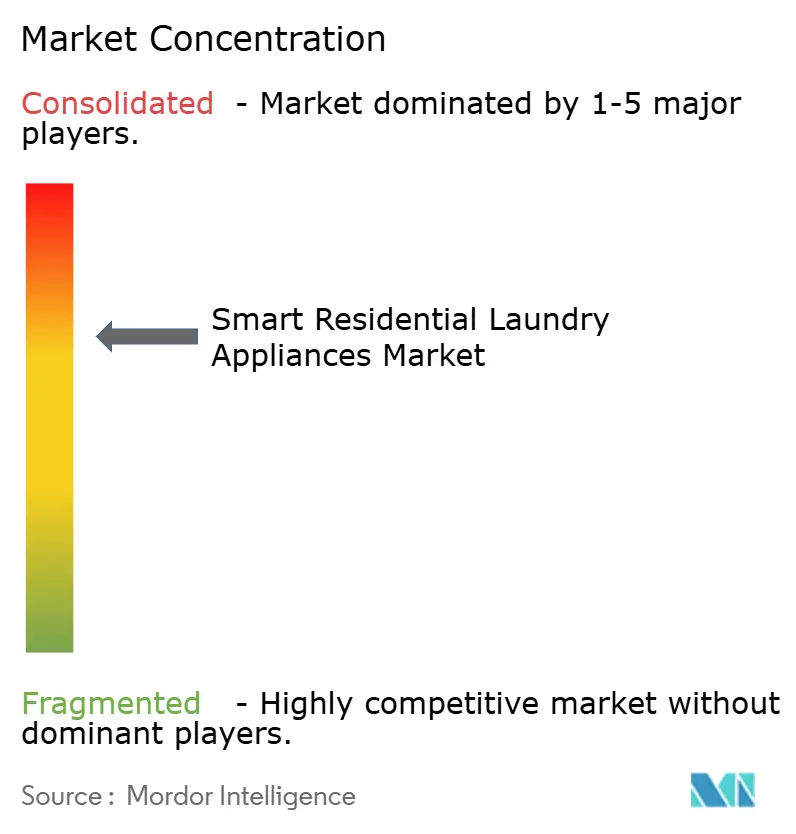
| Market Concentration | Medium |
Major Players *Disclaimer: Major Players sorted in no particular order Image © Mordor Intelligence. Reuse requires attribution under CC BY 4.0. | |
Smart Residential Laundry Appliances Market Analysis by Mordor Intelligence
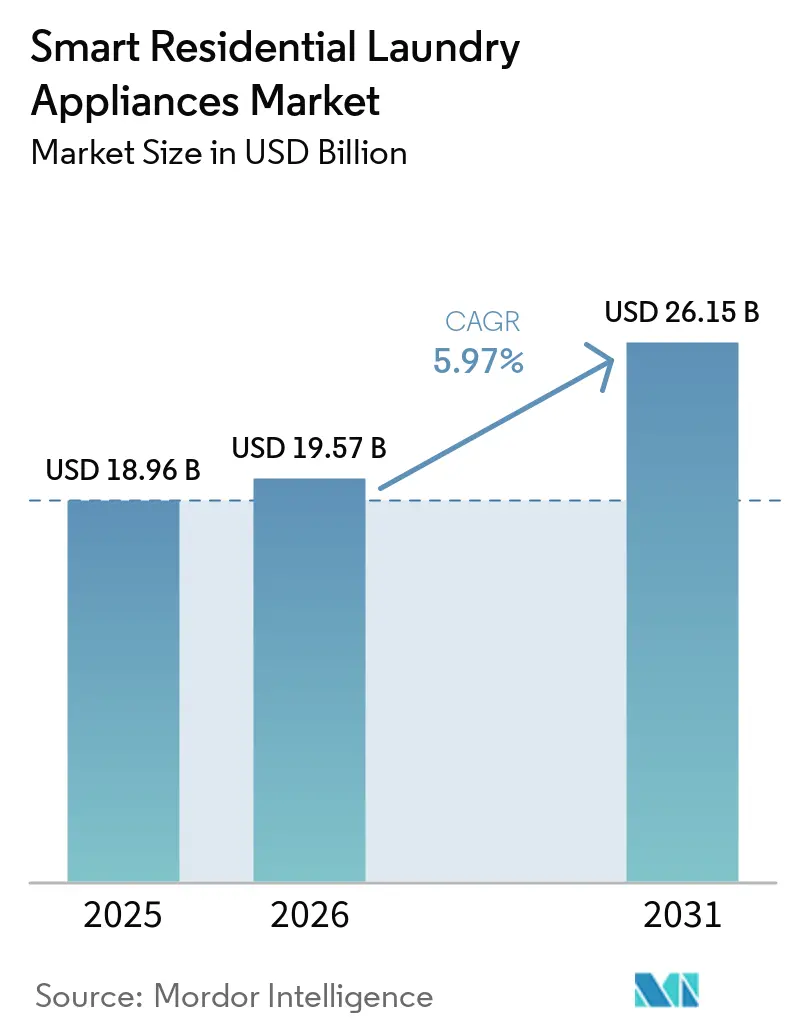
The smart residential laundry appliances market size was valued at USD 18.96 billion in 2025 and estimated to grow from USD 19.57 billion in 2026 to reach USD 26.15 billion by 2031, at a CAGR of 5.97% during the forecast period 2026-2031. Regulatory tightening in the United States and Europe is pushing product roadmaps toward connected, energy-efficient platforms, keeping replacement activity active even as consumer budgets remain mixed [1]. The smart residential laundry appliances market also benefited from stronger interest in AI-led cycle selection, remote monitoring, and heat pump integration, which together raise both convenience and operating efficiency for households. Competitive activity is centered on platform depth, manufacturing investment, and ecosystem control, as leading brands are linking appliances with security, detergent, and broader smart home services. The smart residential laundry appliances market is also seeing a clearer premium split, where larger-capacity, faster-cycle, and fabric-care-focused models are pulling demand away from conventional replacements. This direction leaves the best opportunities in replacement-led mature regions, premium urban households, and digital ecosystems that extend revenue beyond the initial appliance sale.
Key Report Takeaways
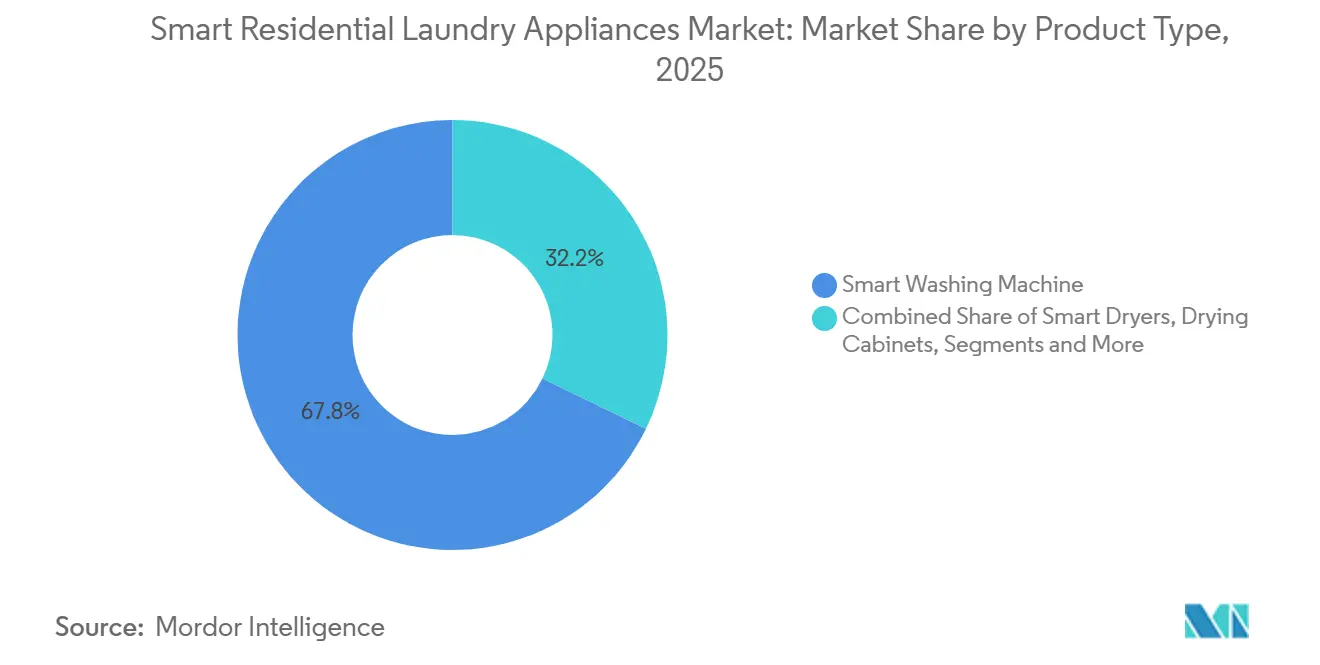
- By product type, smart washing machines accounted for 67.82% of the product mix in 2025 in the smart residential laundry appliances market, while smart dryers posted the highest projected CAGR of 6.81% through 2031.
- By capacity, the 6-8 kg segment accounted for 57.61% of revenue in 2025 in the smart residential laundry appliances market, while models above 8 kg are forecast to expand at a 6.64% CAGR through 2031.
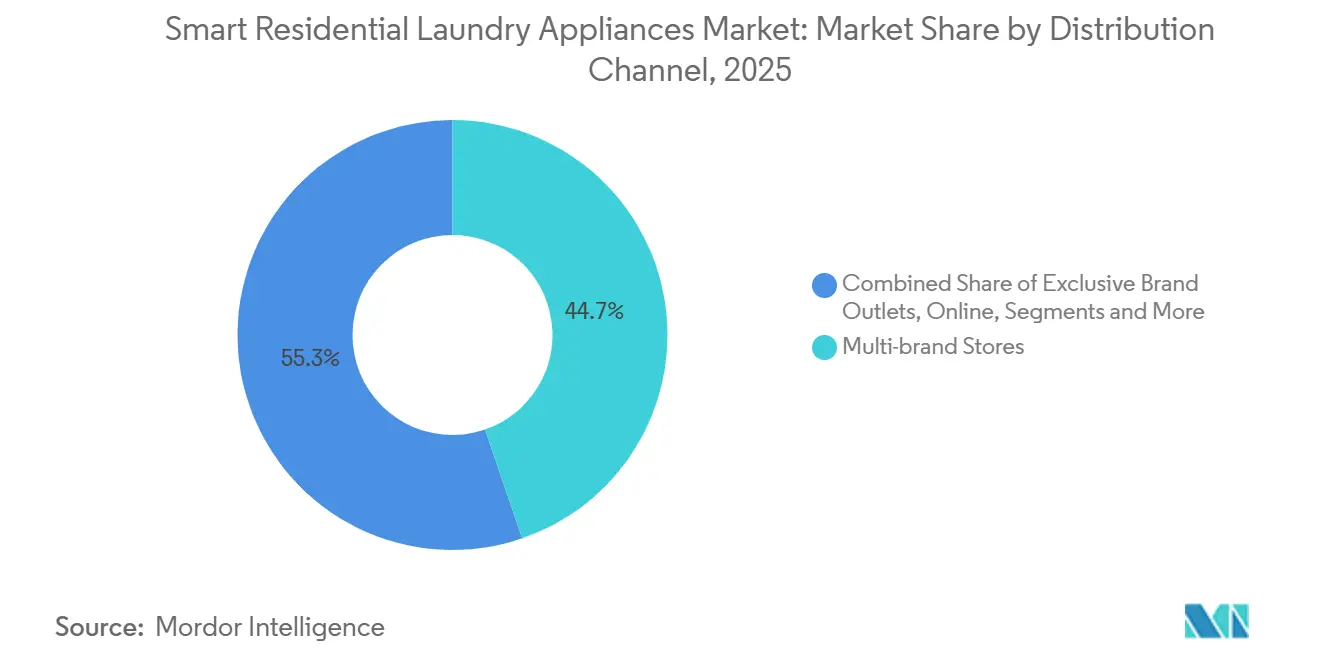
- By distribution channel, multi-brand stores captured 44.74% of revenue in 2025 in the smart residential laundry appliances market, while online channels are projected to grow at a 6.97% CAGR through 2031.
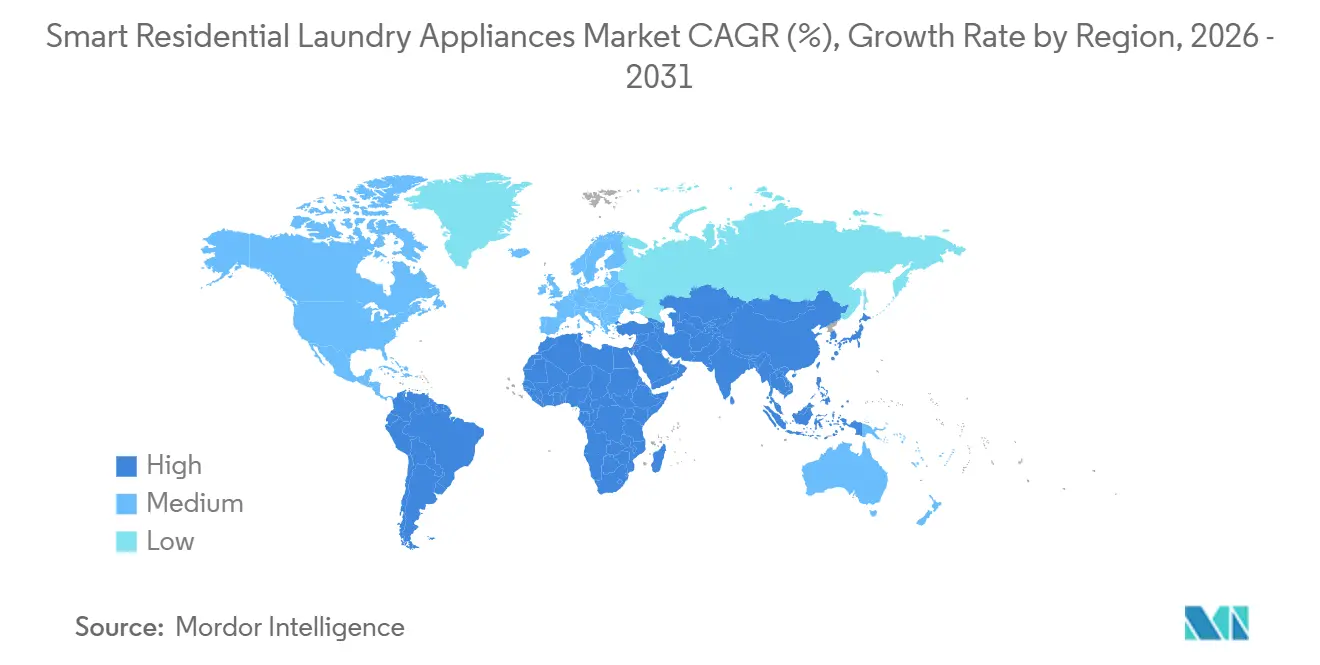
- By geography, North America held 37.23% of the smart residential laundry appliances market share in 2025, while Asia-Pacific is expected to record the highest regional CAGR at 6.19% through 2031.
Note: Market size and forecast figures in this report are generated using Mordor Intelligence’s proprietary estimation framework, updated with the latest available data and insights as of January 2026.
Market Trends and Insights
Drivers Impact Analysis of Smart Residential Laundry Appliances Market*
| Driver | (~) % Impact on CAGR Forecast | Geographic Relevance | Impact Timeline |
|---|---|---|---|
| Increasing Demand for Energy-Efficient and Water-Optimized Appliances | +1.5% | Global, with the strongest regulatory pull in the European Union and North America | Short term (≤ 2 years) |
| Expansion of IoT, AI, and App-Based Remote Monitoring Features in Laundry Appliances | +1.8% | North America, Europe, and advanced Asia-Pacific markets, South Korea, Japan, Australia | Medium term (2-4 years) |
| Technological Advancements in Sensor-Based Fabric Care and Load Optimization | +1.2% | Global, led by South Korea and Germany | Medium term (2-4 years) |
| Premiumization and Replacement Cycles in Mature Markets Favoring Connected Models | +1.0% | North America, Western Europe, GCC | Long term (≥ 4 years) |
| Growing Consumer Preference for Convenience and Time-Saving Laundry Solutions | +0.8% | Global, strongest in dual-income urban households in Asia-Pacific and North America | Medium term (2-4 years) |
| Integration of Predictive Maintenance and Automated Detergent Dispensing Technologies | +0.7% | North America, the United Kingdom, Germany, South Korea, and Australia | Long term (≥ 4 years) |
| Source: Mordor Intelligence | |||
Increasing Demand for Energy-Efficient and Water-Optimized Appliances
The smart residential laundry appliances market is being pushed forward by regulations that now shape product relevance rather than just compliance costs. Samsung presented its A-65% Bespoke AI Washer at IFA 2025, which consumed 65% less energy than the minimum required for a European Class A rating [2]. In parallel, Regulation (EU) 2019/2023 remains the core framework for washing machine efficiency standards in Europe, while the Ecodesign for Sustainable Products Regulation is guiding the next round of stricter design requirements. Each standards revision raises the risk that near-compliant conventional inventory will lose commercial value before normal replacement timing. That effect pulls demand forward in regulated regions and shifts engineering budgets toward connected and heat-pump-ready models. Energy efficiency is therefore supporting both shipment volume and selling price in the smart residential laundry appliances market.
Expansion of IoT, AI, and App-Based Remote Monitoring Features
The smart residential laundry appliances market is also gaining momentum because connectivity is no longer treated as a simple add-on. LG introduced AI DD Motor functions in its June 2026 WashTower and WashCombo lineup in South Korea, and the system selects from 6 drum motion patterns based on real-time inputs for fabric type, soil level, and load size. Haier Smart Home reported a 14.4% global share of washing machines in 2025 and said it would accelerate the rollout of AI-embedded, autonomous home management features across its 2026 lineup. As these functions become standard, connected platforms such as SmartThings, ThinQ, and hOn are turning into switching-cost systems that tie users to a broader digital household setup. That makes ecosystem breadth more important at the point of purchase. It also gives manufacturers with limited connected portfolios a weaker position in the smart residential laundry appliances market.
Technological Advancements in Sensor-Based Fabric Care and Load Optimization
The smart residential laundry appliances market is moving further into sensor-led fabric care, which broadens the value case beyond lower utility bills. Sharp launched Japan’s first drum washer with the COCORO HOME AI advisory service in September 2025, allowing users to ask for garment care guidance through a smartphone-linked experience. Hitachi Global Life Solutions also launched the BD-STX130M Big Drum series in Japan, featuring AI-based dehydration adjustment based on detected water temperature, and the company targeted monthly sales of 23,000 units across 4 models. These features matter in countries where garment protection carries strong consumer value, especially Japan, South Korea, Germany, and the United Kingdom. As component costs fall, the same logic can move into lower price tiers without losing relevance. The resulting cycle-level data also supports predictive maintenance and service-led monetization across the smart residential laundry appliances market.
Premiumization and Replacement Cycles in Mature Markets Favor Connected Models
The smart residential laundry appliances market continues to benefit from replacement buyers who are moving up the value ladder instead of replacing like-for-like. Whirlpool announced a USD 300 million investment in October 2025 across its Clyde and Marion, Ohio laundry facilities to support the next generation of washers and dryers. Haier Smart Home said its Casarte brand held 75% of China’s premium washing machine segment in 2025, while its consumer co-developed Leader three-drum model exceeded 300,000 units sold in the same year. These examples show that in saturated markets, growth is driven more by a richer product mix than by major unit expansion. Connected platforms now carry premiums that can absorb higher electronics content and still support margins. That dynamic is keeping premium tiers attractive across the smart residential laundry appliances market.
Restraints Impact Analysis of Smart Residential Laundry Appliances Market*
| Restraint | (~) % Impact on CAGR Forecast | Geographic Relevance | Impact Timeline |
|---|---|---|---|
| Smart Price Premium vs. Conventional Models Limits Mass Adoption | -0.8% | Emerging markets in Asia-Pacific, South America, Africa, and lower-income segments in Eastern Europe | Short term (≤ 2 years) |
| Data Privacy and Cybersecurity Concerns in Connected Homes Slow Uptake | -0.5% | North America, Northern Europe, with growing awareness in the Asia-Pacific | Medium term (2-4 years) |
| Repair and After-Sales Service Challenges for Digitally Integrated Appliances | -0.4% | Global, most acute in Southeast Asia, South America, Sub-Saharan Africa, and India, where authorized service networks remain sparse | Medium term (2-4 years) |
| Low Consumer Awareness About Advanced Smart Features in Emerging Regions | -0.3% | Southeast Asia, Sub-Saharan Africa, South America, Eastern Europe | Short term (≤ 2 years) |
| Source: Mordor Intelligence | |||
Smart Price Premium vs. Conventional Models Limits Mass Adoption
The smart residential laundry appliances market still faces a real adoption barrier because connected models remain expensive for many first-time buyers. Samsung’s 2026 Bespoke AI Combo in South Korea was priced from KRW 3.20 million (~USD 2,220.55) to KRW 4.30 million (~USD 2,983.86), well above mainstream replacement budgets in many emerging countries. The pressure is strongest in South Asia, Southeast Asia, Sub-Saharan Africa, and South America, where first-time appliance purchases still dominate a large share of demand. In those settings, the added benefit of connectivity is harder to explain without an in-home demonstration or strong retail support. Manufacturers, therefore, face a direct choice between defending margins in premium tiers and trimming feature stacks for broader affordability. That choice can slow penetration rates across the smart residential laundry appliances market, even when the product logic remains compelling.
Data Privacy and Cybersecurity Concerns in Connected Homes Slow Uptake
The smart residential laundry appliances market also faces caution from buyers who are increasingly aware that connected home appliances generate sensitive household-use information. The FCC’s Cyber Trust Mark program is voluntary, leaving room for uneven communication on security standards across device brands [3]. Samsung expanded its Knox-based security architecture to all Wi-Fi-enabled home appliances in 2025 and added hardware security chips to screen-equipped products, making security more visible in consumer positioning. The company also earned the TÜV Nord IoT Security Certification in August 2025, which provided an early trust signal in a category where many buyers cannot easily verify technical protection claims. Brands that cannot make security clear, visible, and credible risk losing sales to better-positioned rivals. This issue is most relevant in North America and Northern Europe, but it is increasingly affecting the smart residential laundry appliances market more broadly.
*Our forecasts treat driver/restraint impacts as directional, not additive. The impact forecasts reflect baseline growth, mix effects, and variable interactions.
Smart Residential Laundry Appliances Market Segment Analysis
By Product Type:
Washer-Dryer Integration Rewrites Category DynamicsSmart washing machines accounted for 67.82% of product revenue in 2025, and that scale keeps them at the center of the smart residential laundry appliances market by product type. Their position reflects a large installed base, a strong replacement frequency, and broad household familiarity across North America and Europe. Front-load models remain especially strong in Europe because energy labels and operating efficiency guide many purchase decisions. Top-load designs still retain structural importance in the United States, India, and parts of Southeast Asia, where usage habits and household layouts support that format. Within the smart residential laundry appliances market, this creates a split product roadmap, forcing brands to localize design priorities rather than rely on a single global washer strategy.
Smart dryers are projected to grow at a 6.81% CAGR through 2031, which makes them the fastest-growing product type in the smart residential laundry appliances market. Heat pump drying is moving from a premium niche toward mainstream specification as energy rules tighten and household electricity costs stay visible. LG’s inverter heat pump washer-dryer WHX9516TBC, available from June 2026 at USD 1,730, brought heat pump functionality into an integrated format that also included AI Direct Drive fabric care and auto-dose capability [4]. Samsung’s 2026 Bespoke AI Laundry Combo completed a full wash-to-dry cycle in 69 minutes, maintaining the same outer dimensions as a conventional washer, strengthening the appeal of integrated formats for urban households. Drying cabinets remain the smallest product category by value. Still, they are gaining traction in Scandinavia and Germany for delicate-garment care, creating a secondary premium niche within the smart residential laundry appliances industry.

By Capacity:
Large-Load Formats Gaining Structural MomentumThe 6-8 kg segment accounted for 57.61% of revenue in 2025 and remained the practical center of the smart residential laundry appliances market across much of Europe. This range fits dwelling sizes, combo-machine dimensions, and long-standing energy-label expectations, aligning with everyday household use. The below-6-kg band remains relevant in compact East Asian apartments, where small-footprint appliances remain important for urban living. Manufacturers are also finding renewed room in this bracket by adapting heat pump systems for ventless compact combinations. That keeps smaller capacities relevant even as premium large-load products receive more attention in the smart residential laundry appliances market.
Above-8-kg models are forecast to grow at a 6.64% CAGR through 2031, giving them the fastest pace among capacity tiers in the smart residential laundry appliances market. Demand is driven by households in South Korea, Australia, and the United States seeking higher single-cycle throughput for bulky items such as duvets and comforters. LG’s 2026 WashTower and WashCombo both offered 25 kg washing capacity in South Korea, while the WashCombo added 21 kg of drying capacity via a dual-inverter heat pump and a high-efficiency heat exchanger. Samsung Australia also launched the 2026 Bespoke AI Laundry Combo, featuring a 19.5 kg washer and a 10 kg heat-pump dryer, both with a 10-star energy rating. These launches show that the upper tier is splitting further into ultra-large premium formats with stronger pricing power and higher AI-feature attachment across the smart residential laundry appliances industry.
By Distribution Channel:
Omnichannel Compression Accelerates Online ShiftMulti-brand stores accounted for 44.74% of revenue in 2025. They remained the primary point of conversion in the smart residential laundry appliances market, as buyers still prefer hands-on evaluation for expensive household equipment. Drum access, control layout, door clearance, and feature explanations are easier to assess in person than on a product page. This matters even more for connected appliances, where buyers often need help comparing app features, heat pump benefits, and cycle automation. Exclusive brand outlets play a different role by showing how laundry products connect with a wider home ecosystem of screens, security, and other appliances. That gives premium brands more control over the purchase story and keeps physical retail important in the smart residential laundry appliances market.
Online channels are projected to grow at a 6.97% CAGR through 2031, which makes them the fastest-growing distribution format in the smart residential laundry appliances market. Better product visualization, downloadable cycle updates, transparent price comparison, and direct brand ecosystems are narrowing the trust gap that once favored stores. The Unilever and Samsung launch of Persil Smart Series and Comfort Smart Series in April 2026 also showed how digital channels can extend the revenue stream beyond the appliance sale into repeat detergent purchases. That matters because digital stickiness grows stronger when the household keeps buying compatible inputs and continues using the appliance app. Other channels, such as wholesale clubs and subscription-style models, remain small but are becoming more relevant, enabling retailers to use financing or membership economics to expand access. This leaves the smart residential laundry appliances market with an increasingly blended channel model rather than a simple online-versus-store shift.
Geography Analysis
North America and Europe Smart Residential Laundry Appliances Market
North America held 37.23% of the smart residential laundry appliances market share in 2025. The region leads because replacement demand is mature, household incomes are higher, and connected home infrastructure is already well established. The United States remains the largest national market, and Whirlpool reinforced that position with a USD 300 million laundry manufacturing investment in October 2025, followed by a further USD 60 million investment in Ohio components and subassemblies in April 2026. Electrolux Group and Midea also announced a 15-year partnership in April 2026 that will convert the Anderson, South Carolina, plant to laundry production and modernize 2 North American facilities with a combined USD 119 million investment. Europe is forecast to grow, and the region’s role in the smart residential laundry appliances market size is being shaped less by raw volume and more by a regulatory shift toward higher efficiency, durability, and reparability thresholds.
APAC Smart Residential Laundry Appliances Market
Asia-Pacific is forecast to grow at a 6.19% CAGR through 2031, which makes it the fastest-growing major geography in the smart residential laundry appliances market. India, Vietnam, Indonesia, and the Philippines are expanding the addressable base through urbanization, rising incomes, and wider 5G coverage that supports app-controlled devices. South Korea remains the technology benchmark, with Samsung’s 2026 Bespoke AI Combo built around fast cycle completion, 25 kg wash capacity, and strong appeal among newly married households. Japan is following a differentiated path, where Sharp and Hitachi are using AI fabric-care functions to defend premium value against lower-cost imports. Haier Smart Home also entered Southeast Asia’s washing machine segment in late 2024 with zoned washing and multi-drum coordination concepts, signaling a more direct challenge to established regional incumbents.
South America and MEA Smart Residential Laundry Appliances Market
South America is projected to grow, ranking it among the fastest regional markets in the smart residential laundry appliances market. Brazil is the central driver because financing access and digital payment adoption are reducing the purchase friction tied to premium appliances. Peru, Chile, and Argentina add smaller but meaningful volumes, while Chile shows a clearer premium orientation in major urban corridors. The Middle East and Africa remain more uneven. Still, Western Asia and Africa are expected to grow as housing construction, replacement demand, and improved power reliability support adoption. Arçelik’s April 2024 acquisition of Whirlpool’s Middle East and North Africa operations expanded its brand reach across Whirlpool, Ariston, and Indesit, which strengthened distribution scale in a region where fragmentation had limited category awareness.
Competitive Landscape
The smart residential laundry appliances market is moderately concentrated, with LG Electronics, Samsung Electronics, Haier Smart Home, BSH Hausgeräte, and Whirlpool Corporation together holding an estimated 70-75% share of global connected residential laundry in 2025. That structure reflects high entry barriers in brand trust, retail access, manufacturing scale, and proprietary connectivity architecture. Competition is centered on 3 areas: AI and sensor depth, cross-category ecosystem breadth, and factory footprint restructuring. This means leaders are trying to defend premium pricing while still protecting cost positions against expanding Chinese competitors. The smart residential laundry appliances market is, therefore, concentrated enough to reward scale, but still open enough for regional challengers to pressure pricing and feature design.
Electrolux and Midea made one of the clearest structural moves in April 2026 by setting up a long-term North American partnership that shifts an existing refrigeration plant into laundry production. That move brings lower-cost manufacturing capability into a premium brand system and could tighten the mid-market price band over time. Samsung set another benchmark when its digital appliances business earned TÜV Nord IoT Security Certification in August 2025, making security a visible part of premium positioning in the smart residential laundry appliances market. Whirlpool’s 2025 and 2026 investment sequence in Ohio also showed that domestic production scale remains a competitive lever where delivery reliability and product turnover still matter.
The smart residential laundry appliances market still has open white space in utility-linked demand response bundles, predictive maintenance service plans, and compact heat-pump washer-dryer combinations for micro-apartment households. Smaller challengers are approaching those gaps differently, with Xiaomi focusing on low-cost smart connectivity, Hisense using AI-guided washing support for North America, and IFB leaning into India-specific front-load penetration. Another notable shift is upstream integration, where the Unilever and Samsung auto-dose detergent launch begins to pull consumable economics closer to the appliance platform. As more brands connect appliance ownership with security, detergent, remote service, and software updates, the competitive fight in the smart residential laundry appliances market is moving beyond hardware alone.
Smart Residential Laundry Appliances Industry Leaders
-
LG Electronics
-
Samsung Electronics
-
Haier Smart Home Co., Ltd.
-
Whirlpool Corporation
-
BSH Hausgeräte GmbH
- *Disclaimer: Major Players sorted in no particular order
Smart Residential Laundry Appliances Market Companies Covered in this Report
- LG Electronics
- Samsung Electronics
- Whirlpool Corporation
- Haier Smart Home Co., Ltd.
- BSH Hausgeräte GmbH (Bosch, Siemens)
- Electrolux AB (Electrolux, AEG)
- Midea Group Co., Ltd. (Midea, Little Swan, Toshiba)
- Arçelik A.Ş. (Beko, Grundig)
- Hisense Group (Gorenje, ASKO)
- Miele & Cie. KG
- Panasonic Holdings Corporation
- Hitachi Global Life Solutions, Inc.
- Toshiba Lifestyle Products & Services Corporation
- GE Appliances (a Haier company)
- Vestel Elektronik Sanayi ve Ticaret A.Ş.
- Xiaomi Inc. (Mijia)
- TCL Electronics Holdings Ltd.
- IFB Industries Ltd. (IFB Appliances)
- V‑ZUG Holding AG
- Fisher & Paykel Appliances Ltd. (a Haier company)
- Sharp Corporation
- Winia Co., Ltd.
Recent Industry Developments in Smart Residential Laundry Appliances Market
- June 2026: LG Electronics launched the LG Tromm AI Objet Collection WashTower 25 kg wash and 25 kg dry and WashCombo 25 kg wash and 21 kg dry, the largest-capacity combination washer-dryers available in South Korea, integrating the AI DD Motor with 6-pattern drum motion selection and dual inverter heat pump drying. The WashCombo's Small Quick Cycle completes a 3 kg load in 64 minutes, more than 30% faster than the prior model.
- April 2026: Electrolux Group and Midea Group announced a 15-year strategic partnership, establishing 3 joint ventures for North American refrigeration and laundry manufacturing and sales. The Anderson, South Carolina, plant will be converted to laundry appliance production, with Electrolux holding 55% and Midea 45%, supported by a combined USD 119 million facility investment and plans to hire more than 1,200 workers in 2027-2028.
- April 2026: Whirlpool Corporation announced a USD 60 million investment to convert a Perrysburg, Ohio, facility into a component and subassembly manufacturing hub for washers and dryers, creating 100-150 jobs, following its October 2025 USD 300 million expansion of laundry manufacturing capacity at its Clyde and Marion, Ohio, plants.
- March 2026: Samsung launched the 2026 Bespoke AI Laundry Combo in South Korea, featuring a 25 kg wash capacity and 20 kg dry capacity, completing a full wash-to-dry cycle in 69 minutes using a hybrid heat pump and pre-heat compressor method that prevents winter drying delays.
Global Smart Residential Laundry Appliances Market Report Scope
Segmentation Overview
| Smart Washing Machines | Front-load |
| Top-load | |
| Smart Dryers | |
| Smart Washer-Dryer Combos | |
| Drying Cabinets |
| Below 6 Kg |
| 6-8 Kg |
| Above 8 Kg |
| Multi-brand Stores |
| Exclusive Brand Outlets |
| Online |
| Other Distribution Channels |
| North America | United States |
| Canada | |
| Mexico | |
| South America | Brazil |
| Peru | |
| Chile | |
| Argentina | |
| Rest of South America | |
| Europe | United Kingdom |
| Germany | |
| France | |
| Spain | |
| Italy | |
| BENELUX (Belgium, Netherlands, Luxembourg) | |
| NORDICS (Denmark, Finland, Iceland, Norway, Sweden) | |
| Rest of Europe | |
| Asia-Pacific | India |
| China | |
| Japan | |
| Australia | |
| South Korea | |
| South East Asia (Singapore, Malaysia, Thailand, Indonesia, Vietnam, Philippines) | |
| Rest of Asia-Pacific | |
| Middle East And Africa | United Arab Emirates |
| Saudi Arabia | |
| South Africa | |
| Nigeria | |
| Rest of Middle East And Africa |
| By Product Type | Smart Washing Machines | Front-load |
| Top-load | ||
| Smart Dryers | ||
| Smart Washer-Dryer Combos | ||
| Drying Cabinets | ||
| By Capacity | Below 6 Kg | |
| 6-8 Kg | ||
| Above 8 Kg | ||
| By Distribution Channel | Multi-brand Stores | |
| Exclusive Brand Outlets | ||
| Online | ||
| Other Distribution Channels | ||
| By Geography | North America | United States |
| Canada | ||
| Mexico | ||
| South America | Brazil | |
| Peru | ||
| Chile | ||
| Argentina | ||
| Rest of South America | ||
| Europe | United Kingdom | |
| Germany | ||
| France | ||
| Spain | ||
| Italy | ||
| BENELUX (Belgium, Netherlands, Luxembourg) | ||
| NORDICS (Denmark, Finland, Iceland, Norway, Sweden) | ||
| Rest of Europe | ||
| Asia-Pacific | India | |
| China | ||
| Japan | ||
| Australia | ||
| South Korea | ||
| South East Asia (Singapore, Malaysia, Thailand, Indonesia, Vietnam, Philippines) | ||
| Rest of Asia-Pacific | ||
| Middle East And Africa | United Arab Emirates | |
| Saudi Arabia | ||
| South Africa | ||
| Nigeria | ||
| Rest of Middle East And Africa | ||
Key Questions Answered in the Report
What is the 2026 value of smart residential laundry appliances worldwide?
The category stands at USD 19.57 billion in 2026 and is projected to reach USD 26.15 billion by 2031 at a 5.97% CAGR.
Which product category leads household smart laundry demand?
Smart washing machines lead the product mix with 67.82% share in 2025, supported by replacement demand and a large installed base.
Which product type is growing fastest through 2031?
Smart dryers are the fastest-growing product type, with a projected 6.81% CAGR through 2031 as heat pump adoption broadens.
Which regions are expanding the fastest?
South America is forecast to grow at 7.80% CAGR, while Asia-Pacific remains the fastest-growing major region at 6.2% CAGR through 2031.
Why are energy rules important for connected laundry products?
Tighter efficiency and design standards in Europe and the United States are pushing brands toward connected, heat-pump, and AI-enabled models, which support replacement demand.
How concentrated is competition among leading brands?
The top 5 players are estimated to control 70-75% of the global connected residential laundry market, making it moderately concentrated rather than fragmented.