
Smart Washing Machine Market Size and Share
Market Overview
| Study Period | 2020 - 2031 |
|---|---|
| Market Size (2026) | USD 13.71 Billion |
| Market Size (2031) | USD 29.97 Billion |
| Growth Rate (2026 - 2031) | 16.93 % |
| Fastest Growing Market | Asia Pacific |
| Largest Market | North America |
| Market Concentration | Medium |
Major Players *Disclaimer: Major Players sorted in no particular order Image © Mordor Intelligence. Reuse requires attribution under CC BY 4.0. | |
Smart Washing Machine Market Analysis by Mordor Intelligence
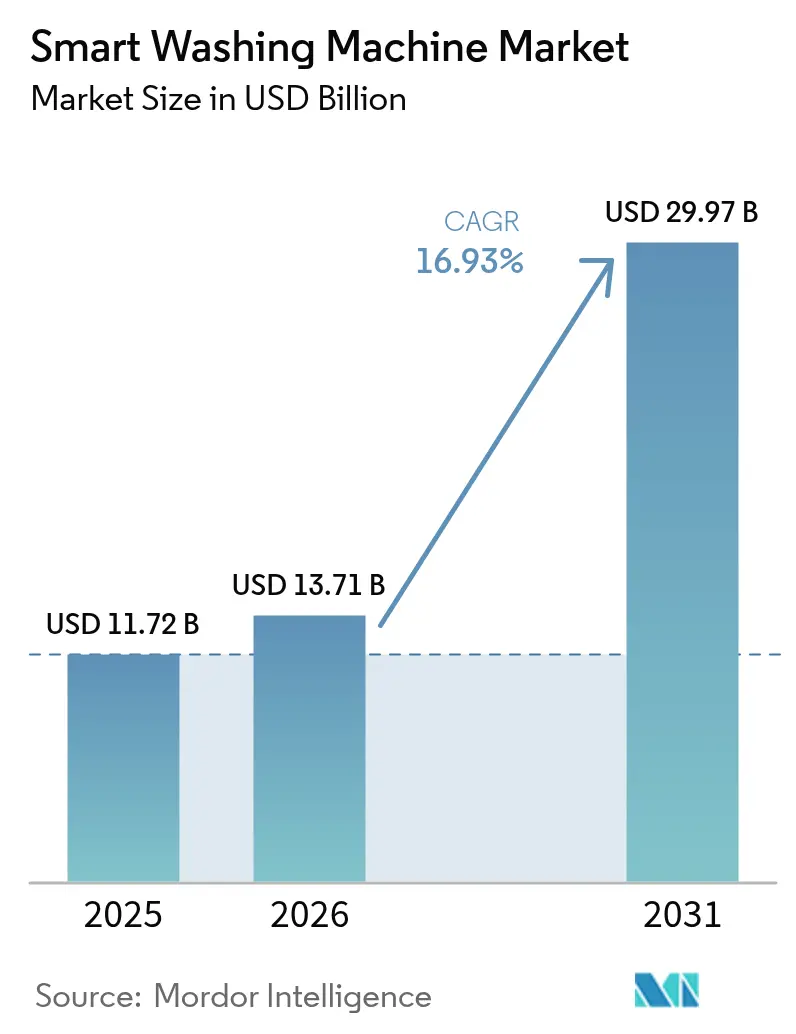
The smart washing machine market size was valued at USD 11.72 billion in 2025 and estimated to grow from USD 13.71 billion in 2026 to reach USD 29.97 billion by 2031, at a CAGR of 16.93% during the forecast period (2026-2031). Growth mirrors a shift from one-off appliance ownership toward connected-ecosystem participation, where washers operate as intelligent nodes inside broader smart homes. Adoption quickens as North American and European utilities widen demand-response incentives, on-device AI refines fabric-specific cycles, and subscription models lower the entry barrier across emerging economies. Appliance makers differentiate through firmware updates rather than simply larger drums, while property developers leverage fleet monitoring to cut service downtime. Commercial laundries and multi-family housing operators now treat connected washers as revenue-optimizing assets, reshaping replacement cycles and lifting average selling prices. Intensifying regulatory focus on water and energy efficiency also propels the smart washing machine market because connectivity enables real-time resource tracking and compliance reporting.
Key Report Takeaways
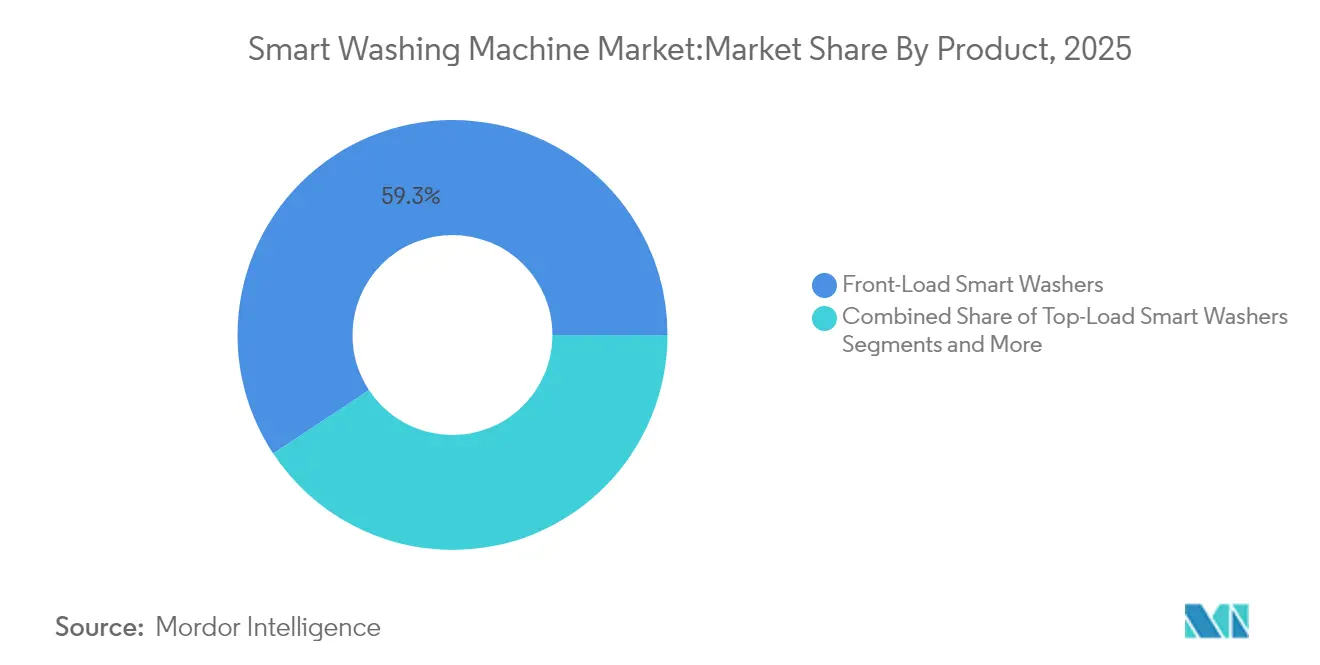
- By product type, front-load smart washers led with 59.30% revenue share of the smart washing machine market in 2025; washer-dryer combos are projected to expand at a 17.42% CAGR to 2031.
- By capacity, medium (6–8 kg) units held 54.40% of the smart washing machine market share in 2025; large (above 8 kg) units are set to grow at a 16.55% CAGR through 2031.
- By price band, mid-range (USD 501–1,000) commanded 49.20% share of the smart washing machine market size in 2025; premium (above USD 1,000) is forecast to advance at 17.08% CAGR between 2026-2031.
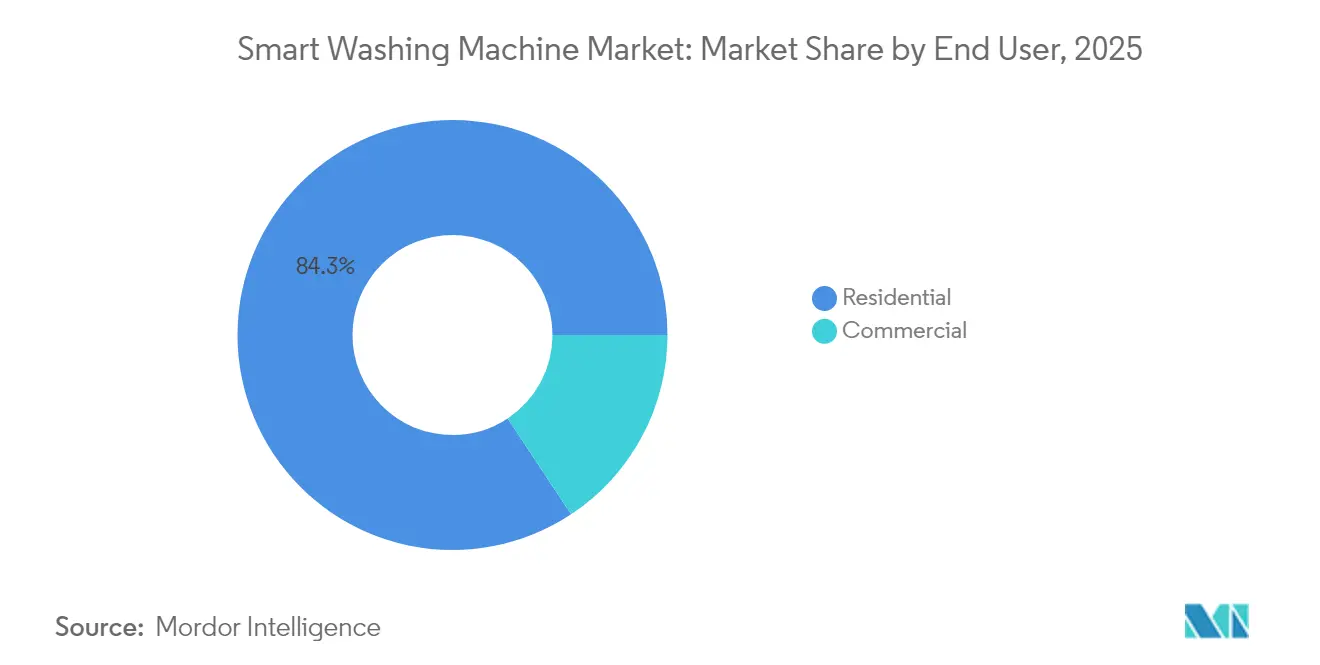
- By end user, residential applications accounted for 84.30% of the smart washing machine market size in 2025; commercial installations are rising at an 18.02% CAGR to 2031.
- By distribution channel, B2C retail held 89.10% share of the smart washing machine market in 2025; online B2C sales are climbing at an 18.33% CAGR through 2031.
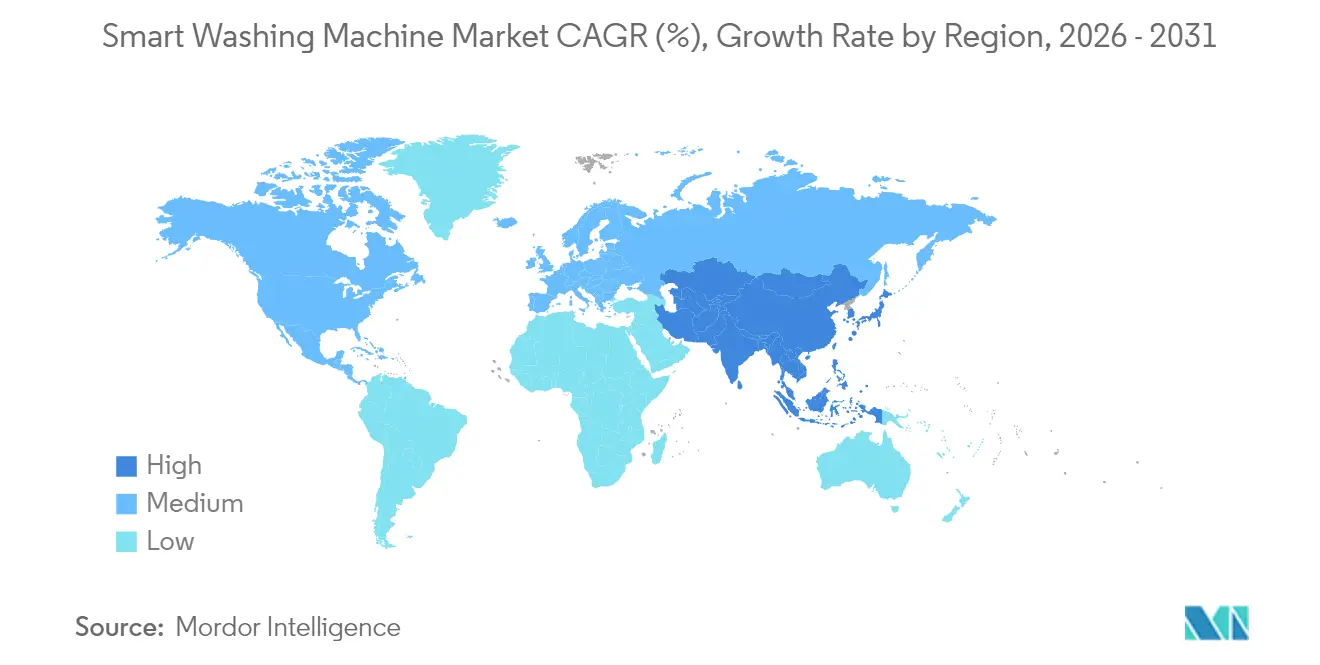
- By geography, North America secured a 31.60% share of the smart washing machine market in 2025, while Asia-Pacific is projected to record a 15.31% CAGR by 2031.
Note: Market size and forecast figures in this report are generated using Mordor Intelligence’s proprietary estimation framework, updated with the latest available data and insights as of 2026.
Market Trends and Insights
Drivers Impact Analysis of Smart Washing Machine Market*
| Driver | (~) % Impact on CAGR Forecast | Geographic Relevance | Impact Timeline |
|---|---|---|---|
| Integration with Smart-Home Ecosystems | +3.2% | Global; North America & EU lead | Medium term (2–4 years) |
| Rapid Consumer Uptake of Remote Monitoring & Predictive Maintenance | +2.8% | APAC core; spill-over to North America | Short term (≤ 2 years) |
| Proliferation of IoT-Enabled Major Appliances | +2.5% | Global, urban markets | Medium term (2–4 years) |
| Utility Incentives for Grid-Interactive, Demand-Response Washers | +2.1% | North America & EU; expanding to APAC | Long term (≥ 4 years) |
| Embedded On-Device AI for Fabric Recognition | +3.4% | Global, premium segments first | Short term (≤ 2 years) |
| Pay-Per-Wash Subscription Models | +1.8% | APAC, Latin America, MEA | Long term (≥ 4 years) |
| Source: Mordor Intelligence | |||
Integration with Smart-Home Ecosystems
Matter 1.3, released in May 2024, formally added washing-machine support, allowing a single appliance to communicate with Amazon Alexa, Google Home, and Apple HomeKit hubs[1]Connectivity Standards Alliance, “Matter 1.3 Specification Release,” csa-iotec.org. This standardization eliminates the app fragmentation that long discouraged consumers and lets manufacturers focus on differentiated features rather than basic connectivity. Major brands such as BSH confirmed that every new washer shipped to the United States in 2025 will be Matter-ready, signaling industry commitment to open protocols. Beyond remote control, open APIs enable predictive scheduling, so washers align cycles with rooftop solar output or low-tariff utility windows, maximizing household self-consumption. Samsung further deepened interoperability by partnering with Procter & Gamble to embed Tide POD-optimized programs, proving that cross-industry collaborations can unlock tailored cleaning performance.
Rapid Consumer Uptake of Remote Monitoring & Predictive Maintenance
Predictive algorithms inside modern washers parse vibration signatures, motor torque, and temperature drift to flag anomalies weeks before failure, a capability Samsung first commercialized through its HomeCare Wizard platform. Commercial operators see clear value: GE Appliances reports that laundromats using its SmartHQ dashboard reduce service calls and cut downtime penalties substantially. Embedded microcontrollers such as STMicroelectronics’ NanoEdge AI analyze edge-level sensor data without cloud latency, making in-machine diagnostics viable even where broadband is weak. Residential users benefit from maintenance alerts that pre-order parts and recommend lighter loads, thereby extending both product and clothing life. Positive user experiences continue to spread via word-of-mouth and social media, accelerating replacement demand and enlarging the smart washing machine market.
Proliferation of IoT-Enabled Major Appliances
Network effects arise when multiple appliances are connected, allowing a washer to delay its cycle until the smart water heater finishes reheating or an electric vehicle finishes fast charging. Urban residents appreciate consolidated dashboards that visualize cumulative energy and water use, nudging them toward conservation. Manufacturers harvest anonymized data to design quieter motors and refine spin algorithms, thereby improving upcoming models and locking users into branded ecosystems. As connected fleets grow, governments view them as an asset for energy-efficiency targets, further propelling the smart washing machine market.
Utility Incentives for Grid-Interactive, Demand-Response Washers
US utilities pay households yearly stipends to enroll qualifying washers in automated demand-response programs, trimming grid peaks without costly infrastructure upgrades. In Europe, similar schemes dovetail with eco-design regulations that require connectivity for verification of claimed savings[2]European Commission, “Ecodesign Requirements for Washing Machines,” ec.europa.eu. Such coupling helps offset the premium over legacy models and shifts smart washers from early-adopter status toward mass-market acceptance. Manufacturers benefit, as rebate-eligible units sell through faster, raising economies of scale. In turn, larger production runs cut bill-of-materials cost, enabling competitive pricing that further expands the smart washing machine market.
Restraints Impact Analysis of Smart Washing Machine Market*
| Restraint | (~) % Impact on CAGR Forecast | Geographic Relevance | Impact Timeline |
|---|---|---|---|
| Cross-Brand Compatibility & Interoperability Issues | -1.8% | Global; fragmented ecosystems | Medium term (2–4 years) |
| High Repair & Maintenance Costs for Connected Components | -1.2% | Global; pronounced in emerging markets | Short term (≤ 2 years) |
| Stricter Cybersecurity & Data-Privacy Compliance Costs | -1.5% | EU & North America; expanding globally | Long term (≥ 4 years) |
| Water-Scarcity Regulations Limiting Drum Capacity | -0.9% | Water-stressed regions | Long term (≥ 4 years) |
| Source: Mordor Intelligence | |||
Cross-Brand Compatibility & Interoperability Issues
Matter promises harmony, yet legacy appliances rarely receive firmware retrofits, forcing households into multiple apps when they mix brands. Small manufacturers hesitate to support diverse protocols, citing engineering costs that erode already thin margins. Property managers outfitting hundreds of units must juggle different dashboards, curbing large-scale smart deployments, and slowing smart washing machine market penetration. Cloud-to-cloud solutions such as the Home Connectivity Alliance Specification exist, but uptake remains limited to well-funded brands. Until seamless multi-brand orchestration arrives, interoperability friction will temper the market’s otherwise steep trajectory.
High Repair & Maintenance Costs for Connected Components
Touchscreens, Wi-Fi modules, and AI chipsets raise parts prices compared with mechanical timers, inflating out-of-warranty repair bills. In emerging markets, shipping a replacement board can take weeks, prompting frustrated users to revert to analog machines or low-feature models. Brands introduce modular designs—Samsung’s 2025 Bespoke series lets owners swap display panels within minutes—yet spare parts remain costlier than legacy knobs. Extended-service contracts soften the blow but still add to lifetime operating costs. Consequently, price-sensitive consumers may hesitate, capping near-term gains in the smart washing machine market.
*Our forecasts treat driver/restraint impacts as directional, not additive. The impact forecasts reflect baseline growth, mix effects, and variable interactions.
Smart Washing Machine Market Segment Analysis
By Product:
Combo Units Drive Space-Efficient InnovationFront-load washers accounted for 59.30% of 2025 revenue, reflecting their lower water use and widespread acceptance in Europe and many urban centers. Combo units, however, log a 17.42% CAGR as city dwellers value one-appliance convenience; AI programs auto-sequence wash-to-dry transfers, freeing users from manual transfer steps. LG’s WashTower integrates dual sensors that adjust drying temperature to match residual moisture, reducing fabric wear. Portable smart washers advance in co-living spaces, using Bluetooth scheduling so tenants avoid peak shower hours. Commercial heavy-duty smart washers, though niche, benefit from remote diagnostics that maximize uptime, validating premium pricing in laundromats and multi-family basements.
Market anticipation surrounds Samsung’s 27-inch Bespoke AI laundry series with 7-inch touch displays that double as smart-home hubs. Design convergence blurs residential and light-commercial boundaries as operators demand consumer-grade UX while homeowners seek commercial-grade robustness. As ecosystem applications grow, the smart washing machine market share of software-rich products increases, cementing combos as a formidable challenger to traditional twin-appliance layouts.



By Capacity:
Large Units Capitalize on Efficiency TrendsMedium units (6–8 kg) represent 54.40% of shipments because they align with typical household needs and cabinet dimensions. Yet, large models above 8 kg post a 16.55% CAGR, as families discover that one large weekly cycle uses fewer total resources than multiple smaller washes. Utility rebates often key off per-kilogram ratings, nudging buyers toward large, high-efficiency drums. Samsung’s 24-inch small-capacity set still appeals in Europe, where urban apartments limit footprint; it meets Class A requirements while consuming 55% less energy than earlier equivalents. Sub-6 kg models thrive in RVs, vacation cabins, and secondary residences, leveraging app alerts so owners can start a cycle before arriving.
The smart washing machine market size for large units will keep expanding as AI load-sensing negates water-waste fears, while smaller drums will linger for edge cases. Capacity diversification helps brands defend against regional water regulations and offers retailers bundles tailored to local living patterns.
By Price Band:
Premium Segment Leads Technology AdoptionPremium washers above USD 1,000 are projected to grow 17.08% yearly, serving as the launchpad for AI fabric recognition, automatic detergent dosing, and voice assistance. Many vendors embed cloud licenses in the purchase price and then sell optional upgrades—Samsung’s Stain-Assist library unlocks via in-app micro-payments, extending lifetime revenue. Mid-range units (USD 501–1,000) capture volume by inheriting last-year flagship capabilities, such as antimicrobial vents or limited AI presets; Whirlpool introduced the FreshFlow Vent System at a price attractive to mainstream buyers. Economy models (≤USD 500) keep costs down by pushing intelligence to the smartphone app and omitting cameras, yet still satisfy basic Energy Star requirements. As software upgradability proliferates, price segmentation increasingly hinges on bundled features and service tiers rather than core hardware, shaping consumer perceptions of value inside the smart washing machine industry.
By End User:
Commercial Segment Drives ModernizationResidential demand held 84.30% in 2025, but commercial adoption races ahead at 18.02% CAGR as property managers digitize laundry rooms. EQT Group’s WASH operates 635,000 connected machines across 82,000 sites, sustaining 98% customer retention via remote monitoring and cashless payments. Smart dashboards schedule maintenance when foot traffic is lowest, improving tenant satisfaction and raising vendor prices. Homeowners continue replacing aging top-loaders, attracted by 20% energy savings and integration with voice assistants like Amazon Alexa. Builders increasingly include connected washers in base spec sheets, branding units as part of the overall smart-home package. As lines blur, commercial-grade durability and residential-grade interfaces converge, broadening the smart washing machine market share of hybrid designs.
By Distribution Channel:
Online Sales Transform Market AccessB2C/Retail still accounts for 89.10% of 2025 revenue, yet online B2C sales accelerate at 18.33% CAGR thanks to immersive configurators and same-day delivery in urban centers. Direct-to-consumer portals empower brands to bundle detergent auto-replenishment and warranty extensions at checkout, enhancing customer stickiness. Rural shoppers benefit as e-commerce bridges gaps where physical stores stock only generic models, expanding the reachable smart washing machine market. Multi-brand showrooms now include live Wi-Fi so visitors can test app control before buying, while brand-exclusive outlets focus on premium lines with white-glove installation packages. B2B direct deals thrive in hospitality and healthcare, where bulk orders require API access for building-management integration.
Geography Analysis
North America Smart Washing Machine Market
North America retained 31.60% of the smart washing machine market share in 2025, leveraged by high broadband penetration and utility incentives such as National Grid’s ConnectedSolutions program that pays users to shift wash cycles away from peaks. GE Appliances’ USD 490 million expansion in Kentucky exemplifies domestic investment to shorten lead times for connected models. Premium-segment adoption thrives because households value both convenience and compliance with tightening energy codes.
APAC Smart Washing Machine Market
Asia-Pacific logs the fastest 15.31% CAGR driven by urban migration, rising disposable incomes, and government smart-city projects. Samsung’s April 2025 AI top-loaders cater to Asian preferences by merging traditional design with fabric-recognition algorithms, widening appeal. Subscription laundry models gain traction in Indonesia and Thailand, providing affordable access while familiarizing users with smart features.
Europe Smart Washing Machine Market
Europe frames connectivity through sustainability; ecodesign rules in force since March 2021 require Eco 40-60 cycles and reparability indices. The legislation targets 12.4 TWh electricity savings and 1,464 billion L water reductions by 2030, creating demand for washers that confirm savings through cloud telemetry. Electrolux’s 2025 smart range highlights resource efficiency and fabric longevity—attributes appealing to environmentally conscious Europeans. Utilities across Germany and Italy now tie rebates to verifiable consumption data, ensuring connected models dominate future replacements.

Regulatory Landscape
Energy and water efficiency requirements increasingly anchor market access for connected laundry appliances across major regions. In the United States, the Department of Energy progressed amended energy conservation standards for residential clothes washers through the federal rulemaking process during 2024, setting a future compliance step-change that pushes manufacturers to bake efficiency and verifiable performance into new platforms. In the European Union, Regulation (EU) 2019/2023 remains the reference point for ecodesign requirements for washing machines and washer-dryers, while the European Commission review of this regulation is underway with a support study timeline running to December 2026, keeping design-for-repair and resource-use transparency on product roadmaps.
Markets are also tightening testing, labeling, and smart-grid readiness requirements that intersect directly with connectivity features. Australia introduced new registration requirements for clothes washers that take effect by 4 October 2025, raising the bar on compliance documentation and verified performance. In parallel, the EU adopted the Ecodesign for Sustainable Products Regulation (ESPR) framework in 2024, which sets the direction toward Digital Product Passports and enhanced recyclability via future product-specific delegated acts, influencing how smart washers are designed, traced, and serviced over their lifecycle.
Value Chain Analysis
The smart washing machine value chain blends traditional white-goods manufacturing with a growing connectivity and software layer. Upstream inputs include sheet metal and plastics, along with critical electromechanical and electronic subsystems such as motors, pumps, sensors, inverters, controllers, and Wi-Fi/Bluetooth modules; chip and module suppliers increasingly shape feature cadence through edge-AI enablement and secure connectivity reference designs. OEM/ODM assembly integrates these subsystems into front-load, top-load, combo, compact, and commercial platforms, while brand owners and channel partners (multi-brand retail, brand stores, and online) manage merchandising, installation, warranty, and app onboarding, capturing a disproportionate share of consumer value through ecosystems and service bundles.
Interoperability standards and logistics conditions are key swing factors in the chain. The Matter protocol is reducing multi-ecosystem integration work by standardizing IP-based connectivity, and Matter 1.6 introduced the Joint Fabric capability so a single device network can be managed across ecosystems such as Apple Home, Amazon Alexa, and Google Home, which lowers friction for households and property managers operating mixed-brand fleets. On the physical flow side, large-appliance shipping remains sensitive to route disruptions, and manufacturers have responded with more regionalized production and nearshoring to shorten lead times and reduce exposure to freight volatility and tariff-driven cost shifts; this approach is reinforced by investments that localize subassembly and component availability for connected laundry products.
Competitive Landscape
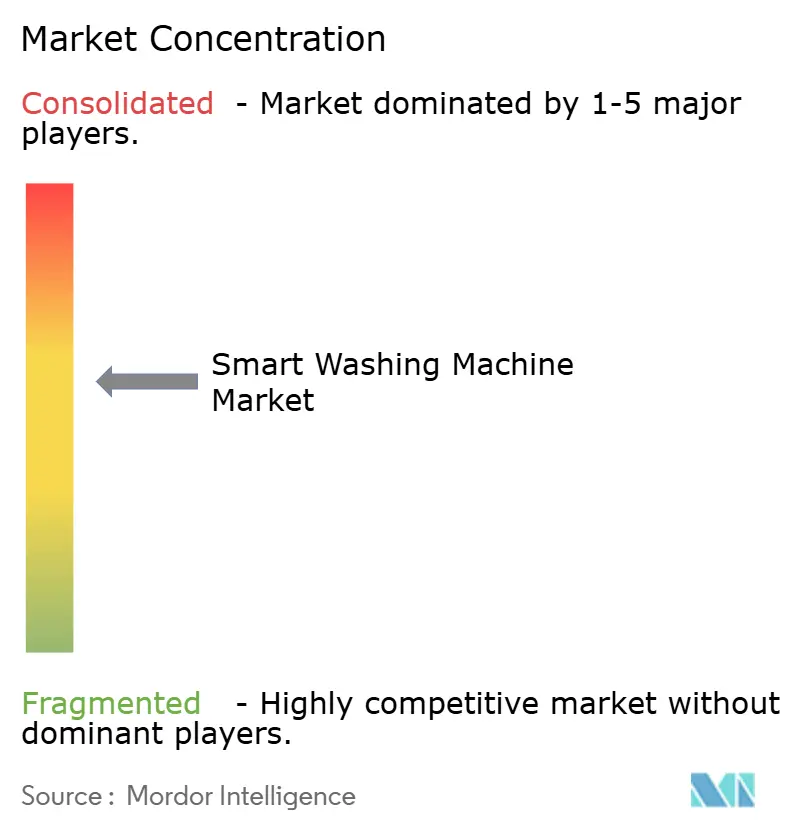
The smart washing machine market is moderately concentrated: the top five players command a major share of shipments, yet software prowess, not drum engineering, increasingly sets leaders apart. Samsung, LG, and Whirlpool wield global factories and brand recognition but channel more R&D into AI frameworks and cloud platforms each year. Smaller firms partner with chip vendors to embed turnkey AI, sidestepping heavy algorithm development. Cross-industry collaborations flourish—Unilever joined Samsung in October 2024 to refine detergent-optimized cycles, while semiconductor firms bundle vibration analytics with MCU reference designs. Bosch’s exploration of a Whirlpool bid signals consolidation pressure to secure both scale and digital talent [3]Reuters, “Bosch Considers Whirlpool Bid,” reuters.com.
Platform convergence dominates strategy. Brands now market washers as gateways to entire smart-home ecosystems, monetizing data through subscription services. Samsung’s Bespoke lineup permits firmware unlocks of advanced stain libraries, extending revenue beyond the initial sale. Whirlpool opens APIs to building-energy systems, courting property developers who demand whole-building dashboards. As cybersecurity threats mount, vendors publicize third-party audits and launch bug-bounty programs, turning security compliance from a cost center to a brand asset.
Smart Washing Machine Industry Leaders
LG Electronics Inc.
Samsung Electronics Co., Ltd.
Whirlpool Corporation
Haier Smart Home Co., Ltd.
Electrolux AB
- *Disclaimer: Major Players sorted in no particular order
Smart Washing Machine Market Companies Covered in this Report
- LG Electronics Inc.
- Samsung Electronics Co., Ltd.
- Whirlpool Corporation
- Haier Smart Home Co., Ltd. (includes GE Appliances)
- Electrolux AB
- Panasonic Corporation
- Robert Bosch GmbH
- Siemens AG
- IFB Industries Ltd.
- Midea Group Co., Ltd.
- Hisense Group
- Arçelik A.Ş. (Beko, Grundig)
- Candy Hoover Group S.r.l.
- Xiaomi Corporation
- Sharp Corporation
- Godrej & Boyce Mfg. Co. Ltd.
- Alliance Laundry Systems LLC
- Qingdao LittleSwan Co., Ltd.
- Fisher & Paykel Appliances Ltd.
- Hitachi Global Life Solutions
- Maytag (Whirlpool Corporation)
- Miele & Cie. KG

Market Opportunities and Future Outlook
Grid-interactive operation and verifiable energy management are creating a concrete product and services whitespace for smart washing machines. In March 2026, the European Commission Joint Research Centre expanded its Code of Conduct for energy smart appliances to widen coverage and support interoperability for flexible electricity systems, and PAS 1878:2026 (published in April 2026) set out system functionality and architecture for energy smart appliances, clarifying a pathway for standardized communication for demand-response and energy services. Together, these developments support the case for washers that participate in utility programs while reporting performance in a way that aligns with tightening ecodesign and sustainability scrutiny.
A second opportunity is B2B fleet management for multi-family housing, student accommodation, and professional laundry operators, where remote diagnostics, leak detection, and centralized administration reduce service overhead and downtime. In February 2026, LG Electronics launched LG ThinQ Pro for North American B2B customers, positioning connected appliance monitoring as a property-management capability rather than a consumer-only app feature. Platform-led strategies from major brands, including Samsung highlighting SmartThings Energy and remote management capabilities across its 2026 appliance portfolio, reinforce a market shift toward software-led differentiation, recurring service layers (maintenance insights, feature upgrades), and interoperability-led selling points for mixed-device environments.
Recent Industry Developments in Smart Washing Machine Market
- July 2026: Samsung Electronics announced a new Bespoke AI washer and dryer lineup in South Korea, highlighting SmartThings-based energy management and connected diagnostics across multiple capacities. The release shows how flagship laundry platforms are being used to anchor broader smart-home ecosystems and package energy monitoring as a core feature rather than an add-on.
- April 2026: Whirlpool Corporation announced a USD 60 million investment to convert its Perrysburg, Ohio facility into a component and subassembly manufacturing hub supporting laundry appliances. The investment strengthens regional supply availability for connected models and supports faster response to design changes tied to electronics, connectivity modules, and serviceability requirements.
- July 2024: Electrolux launched a sustainability-focused smart laundry range aimed at extending garment life. The product push links connected features with resource efficiency and fabric-care positioning, reinforcing the premiumization path for smart washers and washer-dryer combinations.


Smart Washing Machine Market Report Scope and Research Methodology
Market Definition and Coverage
This market covers revenue from smart washing machines that connect to a home network and support monitoring or control via an app or smart-home interface. We count value from new unit sales across the manufacturer and channel system, then convert to USD for consistent cross-region comparison.
Scope exclusions: We exclude installation services, extended warranties, detergents and consumables, and replacement spare parts sold after the original purchase.
Segments Covered in This Report
- By Product
- Front-Load Smart Washers
- Top-Load Smart Washers
- Washer-Dryer Combo Units
- Portable / Compact Smart Washers
- Commercial Heavy-Duty Smart Washers
- By Capacity
- Small (Below 6 Kg)
- Medium (6 to 8 Kg)
- Large (Above 8 Kg)
- By Price Band
- Economy (≤ USD 500)
- Mid-range (USD 501-1 000)
- Premium ( above USD 1 000)
- By End user
- Residential
- Commercial
- By Distribution Channel
- B2C/Retail
- Multi-brand Stores
- Exclusive Brand Outlets
- Online
- Other Distribution Channels
- B2B/Directly from the Manufacturers
- B2C/Retail
- By Geography
- North America
- Canada
- United States
- Mexico
- South America
- Brazil
- Peru
- Chile
- Argentina
- Rest of South America
- Asia-Pacific
- India
- China
- Japan
- Australia
- South Korea
- South East Asia (Singapore, Malaysia, Thailand, Indonesia, Vietnam, and Philippines)
- Rest of Asia Pacific
- Europe
- United Kingdom
- Germany
- France
- Spain
- Italy
- BENELUX (Belgium, Netherlands, and Luxembourg)
- NORDICS (Denmark, Finland, Iceland, Norway, and Sweden)
- Rest of Europe
- Middle East And Africa
- United Arab of Emirates
- Saudi Arabia
- South Africa
- Nigeria
- Rest of Middle East And Africa
- North America
Data Sources, Market Sizing, and Validation
Desk Research
Desk work started by aligning what qualifies as a smart washer and by mapping the demand pool for connected laundry appliances. Public sources helped us anchor the broader context, such as UN Comtrade for appliance trade flows, US DOE and ENERGY STAR materials for efficiency and test-method reference points, Eurostat for household and durable-goods indicators, and the International Energy Agency for energy-use signals that track appliance ownership and usage.
We then reviewed manufacturer annual reports, investor presentations, earnings call transcripts, and reputable news coverage to interpret feature rollouts (Wi-Fi control, remote diagnostics, auto-dosing) and pricing direction by region. When helpful, patent databases were used to understand which connectivity functions were prioritized and how quickly they were spreading across price bands. The sources listed here are illustrative, and we also drew on additional public references for data collection, validation, and research clarification.
Primary Interviews and Surveys
Primary interviews focused on validating what portion of washer shipments are truly smart-capable, how connectivity is bundled across price bands, and how channel margins differ between retail and direct sales. We spoke with a mix of product, sales, and supply-side roles, then cross-checked assumptions across APAC, EMEA, and the Americas so regional adoption and ASP differences were not averaged away.
Distribution of primary research fieldwork respondents
| Company type | Respondent position | Region |
|---|---|---|
| Top tier: 29% | CXOs: 18% | APAC: 47% |
| Mid tier: 51% | Functional/Unit leaders: 23% | EMEA: 29% |
| Smaller Players: 20% | Managers: 59% | Americas: 24% |
Market-Sizing & Forecasting
Market sizing used a top-down and bottom-up approach. We reconstructed regional appliance shipments and trade patterns, then filtered them through the smart-penetration rate for washers and washer-dryer combos. To keep totals realistic, we corroborated the result with selective bottom-up checks using sampled model lineups, observed price ladders, and unit mix by channel, then adjusted when the two views did not align.
A few inputs drove the output most, including smart-feature penetration by price band, average selling price movement for connected models, washer replacement cycles, online retail share for large appliances, and mix shifts between front-load and top-load in major countries. Forecasting leaned on scenario analysis because adoption depends on discretionary spend and on how fast connected features move into mid-priced models, which we tested through expert feedback. When a variable was not directly observable in every country, we filled the gap using regional analogs with similar income levels and appliance ownership, then re-checked those bridging assumptions during interviews.
Data Validation & Update Cycle
Outputs were validated through checks tied to observable market signals, including regional appliance demand indicators, trade direction, and pricing bands for smart-capable units. If a country-level outcome looked unusual, we reviewed the drivers, revisited penetration or ASP assumptions, and held follow-up discussions to confirm whether the variance was structural or timing-related.
Before sign-off, another analyst reviews the model so calculations, conversions, and assumptions remain consistent across regions and years. Reports are refreshed annually, and interim updates are made when material changes shift demand, pricing, or supply conditions. Right before delivery, we perform a final scan of recent updates so clients receive the latest view possible.
Mordor Intelligence's Smart Washing Machine Market Estimate Compared With Other Published Estimates
Published values for this market often differ because a smart washer is defined differently across sources, and because pricing and adoption curves are refreshed on different timelines. Differences also come from whether an estimate is shipment-led, or whether it leans on broader smart-home revenue pools that can pull in adjacent appliances.
The main gap comes from whether washer-dryer combo units and compact smart washers are counted alongside standard smart washers, and how quickly smart features are assumed to diffuse into mid-priced models, which can swing the implied ASP.
Benchmark comparison
| Source | Market Size | Gaps in Research Methodology |
|---|---|---|
| Mordor Intelligence | USD 13.71 B (2026) | |
| Trade Journal A | USD 15.10 B (2025) | Uses a different base year and appears to project forward with faster smart-adoption and ASP uplift, without clearly separating combo units and compact models from standard smart washers. |
| Industry Portal B | USD 6.14 B (2025) | Likely applies a narrower product and price definition that captures mainly premium connected washers and misses a larger share of mid-tier models, which lowers both unit counts and the blended ASP. |
The spread tightens once the same included appliance set, regional channel mix, and price-band penetration are applied, and those checks are kept current through periodic re-validation calls, a modeling habit followed by Mordor Intelligence.


Key Questions Answered in the Report
What is the current smart washing machine market size?
The smart washing machine market size is USD 13.71 billion in 2026 and is expected to reach USD 29.97 billion by 2031.
Which region is growing fastest in the smart washing machine market?
Asia-Pacific is the fastest-growing region, forecast to register a 15.31% CAGR through 2031.
Which product segment is expanding most quickly?
Washer-dryer combo units are advancing at a 17.42% CAGR because they provide space-saving all-in-one convenience.
How do utility programs influence adoption?
Initiatives like National Grid’s ConnectedSolutions pay consumers to let washers shift cycles away from peak demand, effectively subsidizing the higher upfront cost of smart models.
Why is the premium segment expanding so rapidly?
Premium models include AI-driven fabric recognition, automatic detergent dosing, and over-the-air feature updates, driving a 17.08% CAGR in the >USD 1,000 price band.
What major restraint could slow growth?
Rising cybersecurity and data-privacy compliance costs pose a significant burden, especially for mid-tier brands, and can slow global rollout.
Page last updated on:


 Your data is secure and never sold or shared.


