Smart Pulse Oximeters Market Size and Share
Market Overview
| Study Period | 2020 - 2031 |
|---|---|
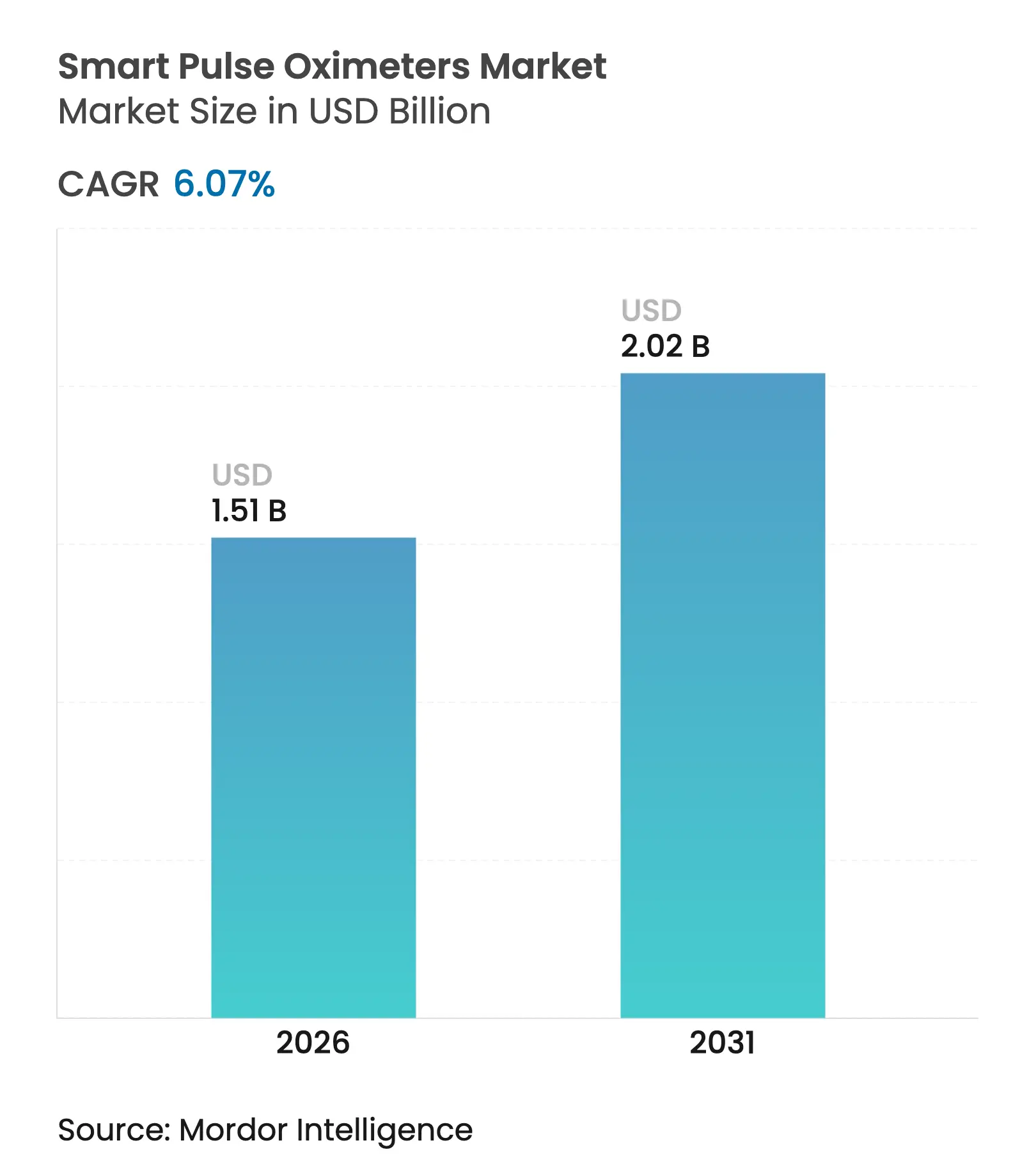
| Market Size (2026) | USD 1.51 Billion |
| Market Size (2031) | USD 2.02 Billion |
| Growth Rate (2026 - 2031) | 6.07 % CAGR |
| Fastest Growing Market | Asia Pacific |
| Largest Market | North America |
| Market Concentration | Medium |
Major Players *Disclaimer: Major Players sorted in no particular order. Image © Mordor Intelligence. Reuse requires attribution under CC BY 4.0. |

Smart Pulse Oximeters Market Analysis by Mordor Intelligence
The smart pulse oximeters market size was valued at USD 1.42 billion in 2025 and estimated to grow from USD 1.51 billion in 2026 to reach USD 2.02 billion by 2031, at a CAGR of 6.07% during the forecast period (2026-2031). Digital health integration, wider home-monitoring use, and regulatory clarity are accelerating product upgrades that blend traditional photoplethysmography with cloud-based analytics. Demand remains brisk in hospitals and clinics, yet consumer electronics brands are expanding access by embedding clinically validated sensors in smartphones and wearables. Artificial-intelligence algorithms that correct for motion artefacts and skin-tone bias strengthen clinical confidence, while reimbursement codes for remote patient monitoring encourage provider adoption. Together, these factors underpin steady value expansion and intensifying competition within the smart pulse oximeters market.
Key Report Takeaways
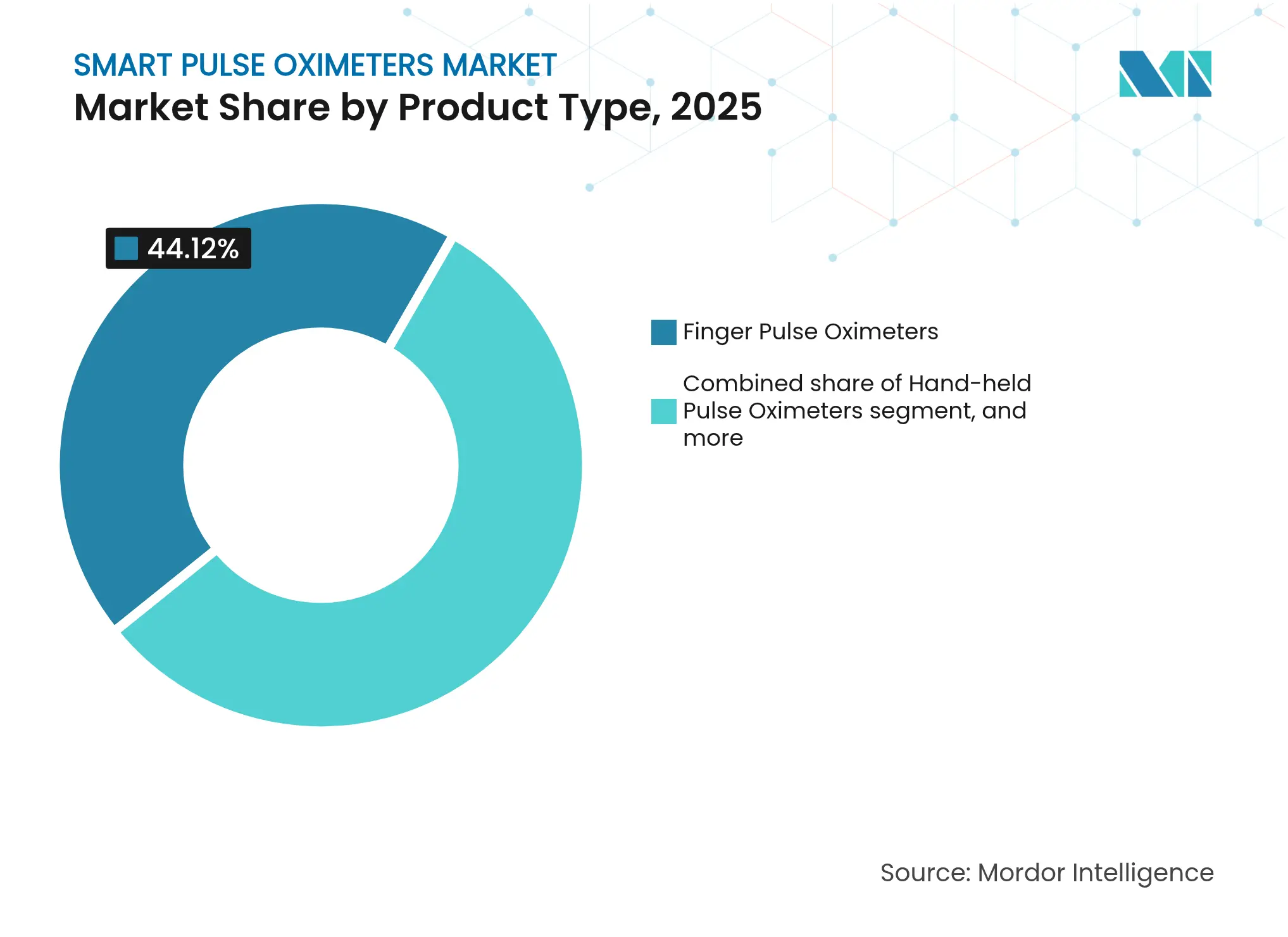
- By product type, finger pulse oximeters held 44.12% of smart pulse oximeters market share in 2025, whereas wireless/connected devices are forecast to grow at an 8.21% CAGR through 2031.
- By operating platform, stand-alone systems commanded 55.02% share of the smart pulse oximeters market size in 2025, while smartphone-integrated sensors are projected to expand at an 8.52% CAGR to 2031.
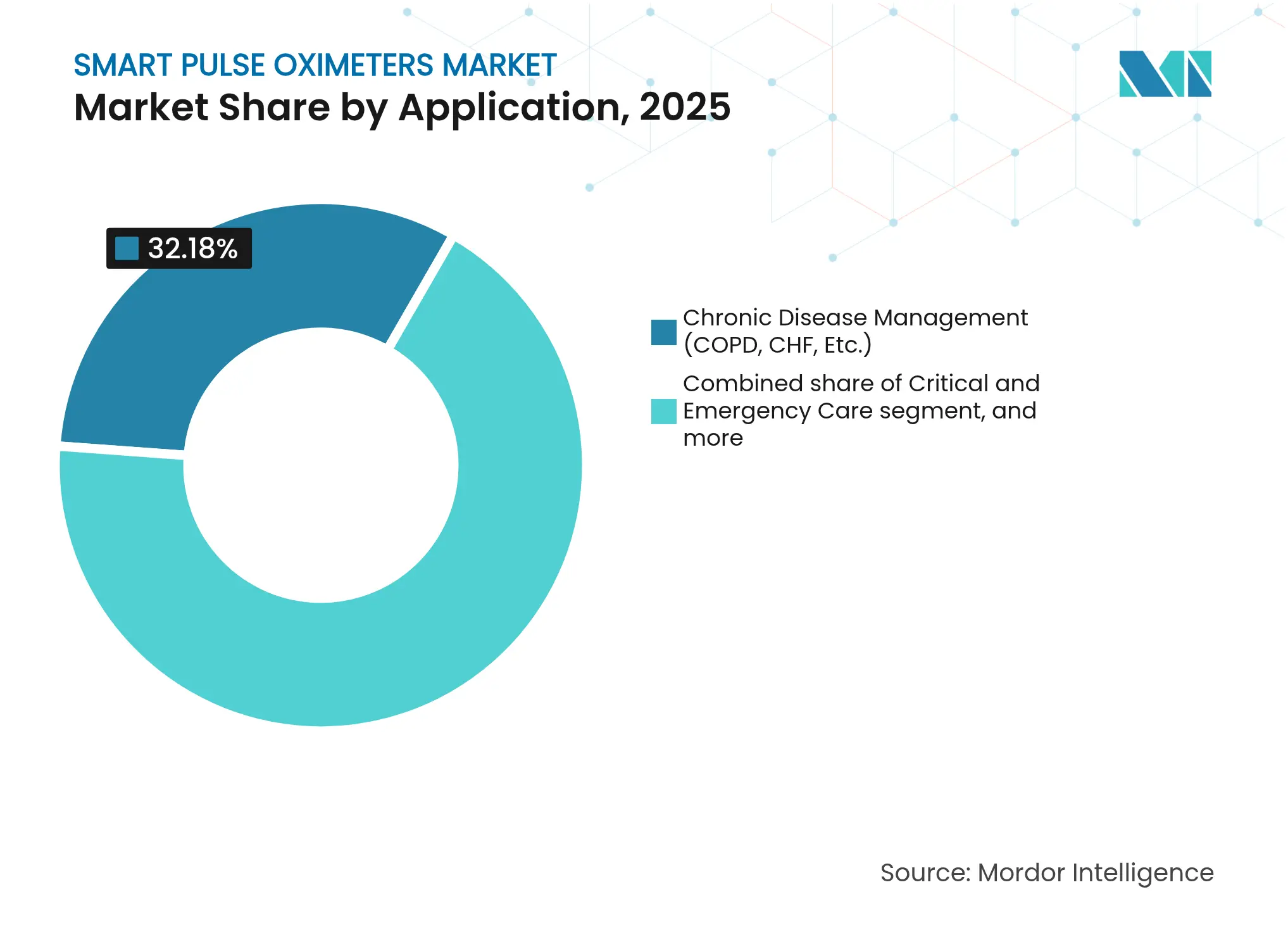
- By application, chronic disease management contributed 32.18% revenue in 2025; post-operative monitoring is advancing at a 9.31% CAGR through 2031.
- By end user, hospitals and clinics retained 48.22% share of the smart pulse oximeters market in 2025, yet home healthcare is climbing at an 8.98% CAGR through 2031.
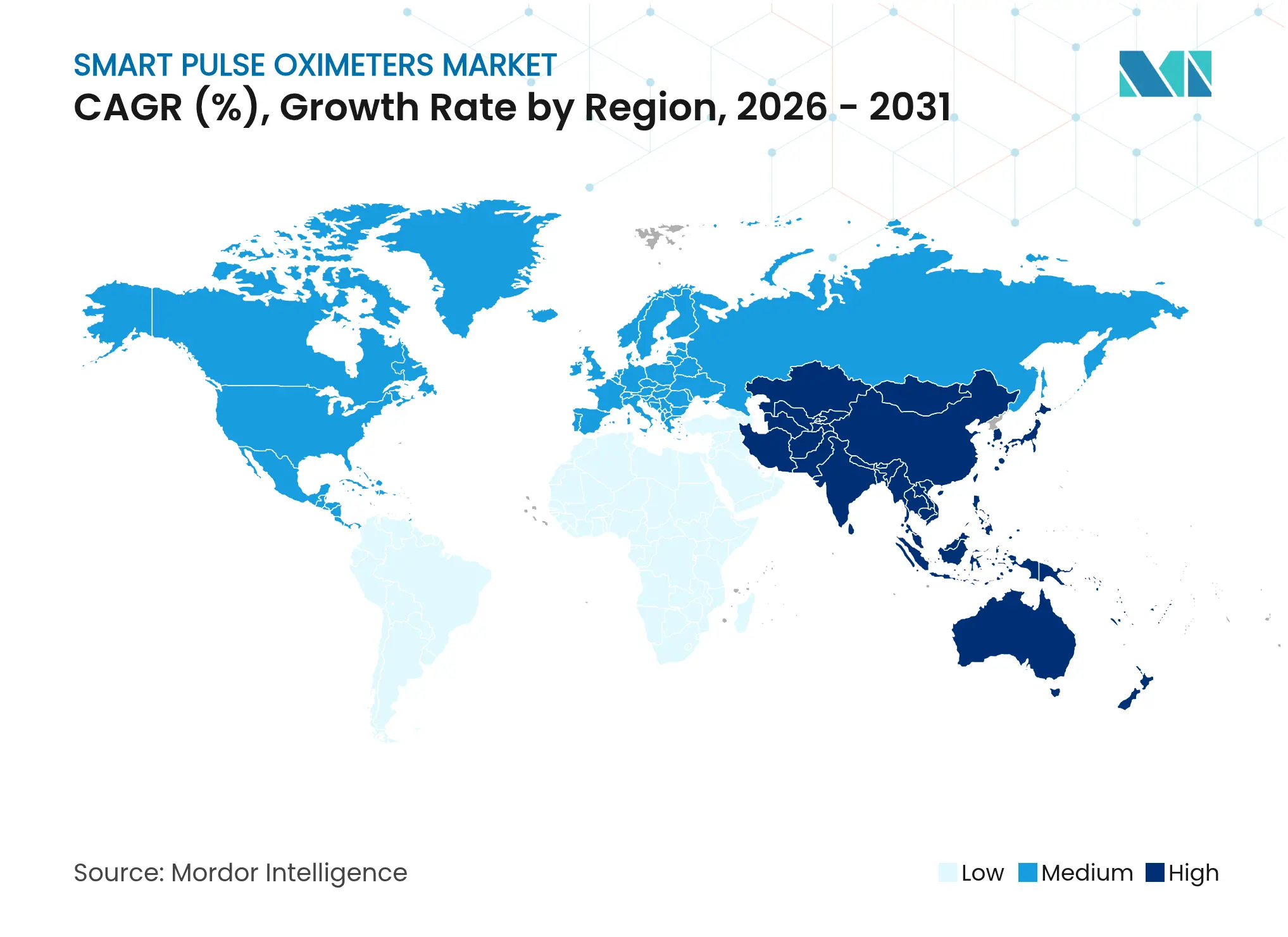
- By geography, North America led with 43.95% revenue in 2025, but Asia-Pacific is expected to record a 7.22% CAGR from 2026-2031.
Note: Market size and forecast figures in this report are generated using Mordor Intelligence's proprietary estimation framework, updated with the latest available data and insights as of 2026.
Global Smart Pulse Oximeters Market Trends and Insights
Driver Impact Analysis
| Driver | % Impact on CAGR Forecast | Geographic Relevance | Impact Timeline |
|---|---|---|---|
Rising prevalence of chronic respiratory and cardiovascular diseases | +1.8% | Global, concentrated in aging cohorts of North America, Europe, Japan | Long term (≥ 4 years) |
Increasing adoption of home healthcare and remote patient monitoring | +1.2% | North America and EU lead; rapid uptake in Asia-Pacific | Medium term (2-4 years) |
Technological advancements in wearable and connected pulse oximetry | +0.9% | Innovation hubs in United States, South Korea, China | Short term (≤ 2 years) |
Growing government support for digital health and telemedicine | +0.7% | Core focus in India and China with spill-over to emerging markets | Medium term (2-4 years) |
Expansion of e-commerce channels for consumer health devices | +0.6% | Worldwide, particularly in post-pandemic markets | Short term (≤ 2 years) |
Post-pandemic focus on hospital oxygen-saturation monitoring standards | +0.5% | Global, with regulatory emphasis in United States and European Union | Short term (≤ 2 years) |
| Source: Mordor Intelligence | |||
Rising Prevalence of Chronic Respiratory and Cardiovascular Diseases
Higher COPD and heart-failure caseloads keep clinicians focused on continuous SpO₂ surveillance. Programs that embed connected oximeters into COPD pathways cut hospitalization frequency by 65% while achieving 88.6% patient adherence, establishing compelling use-case proof. Value-based-care models reward these preventive outcomes, pushing hospitals to adopt devices with predictive analytics that spot exacerbations early. Machine-learning layers built atop longitudinal SpO₂ data enable timely interventions, reducing emergency-department visits. Consequently, chronic-disease pressure makes the smart pulse oximeters market central to disease-management ecosystems rather than a peripheral gadget.
Increasing Adoption of Home Healthcare and Remote Patient Monitoring
COVID-19 normalized at-home pulse oximetry, and payers now reimburse remote patient monitoring services. Clinical validation of Samsung’s smartphone sensor at 2.6% RMSD against arterial blood gas has placed medical-grade capability in more than 100 million phones, scaling access at negligible marginal cost[1]. Providers leverage dashboards that aggregate live SpO₂ feeds, allowing timely outreach without extra clinic appointments. Cost savings, improved patient satisfaction, and easier chronic-condition surveillance are accelerating device orders, cementing remote monitoring as a structural growth pillar for the smart pulse oximeters market.
Technological Advancements in Wearable and Connected Pulse Oximetry
AI-enhanced signal processing improves accuracy for darker skin tones while delivering multi-parameter insights such as heart-rate variability. Next-gen laser-based systems, like Zynex’s NiCO platform, promise precise readings even under low-perfusion conditions. Compliance with ISO/IEEE 11073 standards ensures frictionless data flow into electronic health records. Combined, these advances widen clinical utility and shorten response times, reinforcing smart pulse oximeters as integral nodes in connected-care frameworks.
Growing Government Support for Digital Health and Telemedicine
India’s National Medical Devices Policy 2023 and Japan’s telehealth roadmaps provide incentives, tax credits, and expedited review pathways that lower go-to-market hurdles. The FDA’s updated guidance clarifies test-protocol expectations across diverse phenotypes, giving manufacturers predictable timelines. Medicare remote-monitoring codes further de-risk provider investments. Such regulatory momentum increases confidence among established brands and opens doorways for qualified entrants, broadening the smart pulse oximeters market.
Restraints Impact Analysis
| Restraints Impact Analysis | (~) % Impact on CAGR Forecast | Geographic Relevance | Impact Timeline |
|---|---|---|---|
High device cost and inconsistent reimbursement policies | -0.8% | Global; strongest in emerging markets and uninsured populations | Medium term (2-4 years) |
Stringent regulatory and clinical validation requirements | -0.6% | North America and EU; ripple effects in Asia-Pacific | Long term (≥ 4 years) |
Data accuracy concerns in diverse patient populations | -0.4% | Global, notably in multi-ethnic regions | Short term (≤ 2 years) |
Intensifying price competition and margin compression | -0.3% | Global, heightened in online retail channels | Short term (≤ 2 years) |
| Source: Mordor Intelligence | |||
High Device Cost and Inconsistent Reimbursement Policies
Premium pricing for medical-grade sensors deters adoption among smaller facilities and self-pay consumers. Reimbursement varies widely by insurer and region, complicating ROI assessments for multi-site rollouts. Although remote-monitoring programs yield downstream savings by reducing readmissions, front-loaded hardware expenses and uncertain payor timelines prolong decision cycles. Lower-cost designs are entering the market, yet validation demands and certification fees constrain dramatic price cuts, pressuring commercial strategies across the smart pulse oximeters market.
Stringent Regulatory and Clinical Validation Requirements
Since 2023 the FDA and EU MDR require broader demographic testing to confirm accuracy across skin pigments, elevating trial size and cost. AI-enabled features must present clear audit trails and algorithm change-control documentation, adding software-as-a-medical-device overhead. Interoperability checklists under ISO/IEEE 11073 also lengthen verification steps. While these guardrails protect patients and reward incumbent expertise, they slow time-to-market for newcomers and marginally temper growth prospects for the smart pulse oximeters market.
Segment Analysis
By Product Type: Wireless Integration Drives Innovation
Finger units retained 44.12% market share in 2025 thanks to familiar form factors and low training needs. Conversely, connected variants are set to post an 8.21% CAGR through 2031, injecting cloud telemetry and big-data analytics into everyday care. Wrist-worn models appeal to athletic and sleep-health niches, and multi-parameter patches spotlight the future of ambulatory monitoring. OxiWear’s continuous-monitoring ear clip, recently FDA-cleared, illustrates the pathway to wearable medical devices with uninterrupted SpO₂ streams. Continuous data flow expands clinician insight and underpins predictive-care algorithms, securing a rising share of the smart pulse oximeters market size for wireless categories.
Their surge owes much to interoperability advances that let devices pair with smartphones and hospital dashboards in seconds. Developers now prioritize ISO-compliant Bluetooth Low Energy stacks and encrypted APIs, guaranteeing health-record compatibility. That user-centric engineering shortens onboarding, trims support costs, and accelerates institutional procurement cycles. As result, connected formats are outpacing legacy standalone models within the broader smart pulse oximeters market.
Note: Segment shares of all individual segments available upon report purchase
By Operating Platform: Smartphone Integration Accelerates
Standalone monitors still dominate with 55.02% revenue because ICU protocols require vetted hardware that meets strict alarm standards. Even so, phone-based sensors will expand at an 8.52% CAGR, as Samsung and Apple prove camera-plus-LED arrays can clear FDA thresholds. Developers supply SDKs enabling third-party telehealth apps to cache encrypted SpO₂ snapshots, multiplying software revenue prospects. When insurers reimburse remote-monitoring CPT codes, clinicians increasingly prescribe app-based oximetry, fueling adoption and diversifying the smart pulse oximeters market.
In parallel, smartwatches are edging toward medical-device clearance. Apple’s patent hurdles show IP risk, yet technical feasibility is proven. Wearable platforms support continuous background readings, informing sleep-apnea detection and exercise recovery analytics. Standardized firmware updates deliver algorithm refinements without hardware swaps, prolonging device life cycles and feeding recurring-software revenue loops inside the smart pulse oximeters industry.
By Application: Post-Operative Monitoring Emerges
Chronic-disease pathways held 32.18% revenue in 2025, anchored by COPD and heart-failure regimens that favor daily SpO₂ journaling. Hospitals are now layering continuous sensing onto surgical recovery plans, prompting post-operative monitoring to log a 9.31% CAGR through 2031. Continuous mobile probes cut undetected hypoxemia incidents and lower costly ICU transfers, strengthening value arguments. Sleep-health and athletic-performance uses are moving mainstream as consumers seek real-time oxygen feedback, widening addressable volume for the smart pulse oximeters market.
Clinical trials indicate that adding connected oximetry to standard recovery protocols detects desaturation events hours earlier than routine nurse rounds. Such evidence persuades purchasers to refresh legacy spot-check equipment for always-on networks. In consumer space, smartphones now flag potential sleep-disordered breathing episodes via overnight SpO₂ trends, prompting physician referrals. Thus applications are broadening beyond illness management to encompass preventive fitness insights, intensifying competition and innovation across the smart pulse oximeters industry.
Note: Segment shares of all individual segments available upon report purchase
By End User: Home Healthcare Transformation
Hospitals and clinics composed 48.22% of 2025 demand, purchasing enterprise-grade platforms wired into nurse stations. Yet home-care agencies, community pharmacies, and direct-to-consumer channels together will post a 8.98% CAGR, reflecting healthcare decentralization. Provider shortages and aging populations push governments to reimburse at-home management models. When paired with telehealth check-ins, connected oximeters help clinicians triage remotely, avoiding needless admissions and aligning with value-based targets. Consequently home settings will carve out a larger slice of the smart pulse oximeters market share over the decade.
Ambulatory surgical centers also join the upgrade cycle as outpatient procedures rise. These centers need portable, battery-efficient devices with Wi-Fi handoff, yet hospital-grade accuracy. Manufacturers that blend ruggedization with consumer-style interfaces stand to capture this hybrid niche. Retail sports chains and wellness programs now stock certified fingertip meters for hikers, pilots, and endurance athletes, signalling cross-over expansion channels for the smart pulse oximeters market.
Geography Analysis
North America delivered 43.95% revenue in 2025 on the back of reimbursement certainty and an innovation cluster spanning Silicon Valley to Boston. Nine of the top 10 US hospitals standardize on Masimo SET technology for ICU monitoring, anchoring corporate share in the smart pulse oximeters market. Canada’s reimbursement for virtual-ward pilots and Mexico’s cross-border trade policies support steady regional throughput.
Asia-Pacific, meanwhile, is forecast at a 7.22% CAGR through 2031 and has become the dominant volume engine. China’s medtech output has grown 28% annually since 2019, aided by generous R&D tax credits and hospital-procurement quotas favoring domestic brands. Japan’s USD 40 billion device market centres on telemonitoring to manage its super-aged demographic, with local distributors partnering US sensor specialists. India’s production-linked incentives target USD 50 billion in medical-device sales by 2030, opening greenfield capacity for oximeter assembly under revised quality norms. South Korea couples advanced semiconductor packaging with OLED expertise to produce ultra-thin reflective sensors, cementing the region as an innovation crucible for the smart pulse oximeters market.
Europe prioritizes safety and compliance under MDR, giving incumbents with robust CE portfolios a competitive moat. Germany drives R&D collaborations between university hospitals and SMEs, while France funds remote-monitoring pilots via national health insurance. Post-Brexit UK maintains MHRA alignment yet sets independent accelerated-access pathways. Regulators routinely delist non-compliant online listings, underscoring enforcement vigilance. Collectively, these policies sustain moderate yet dependable contribution to global smart pulse oximeters market growth.

Competitive Landscape
Market Concentration
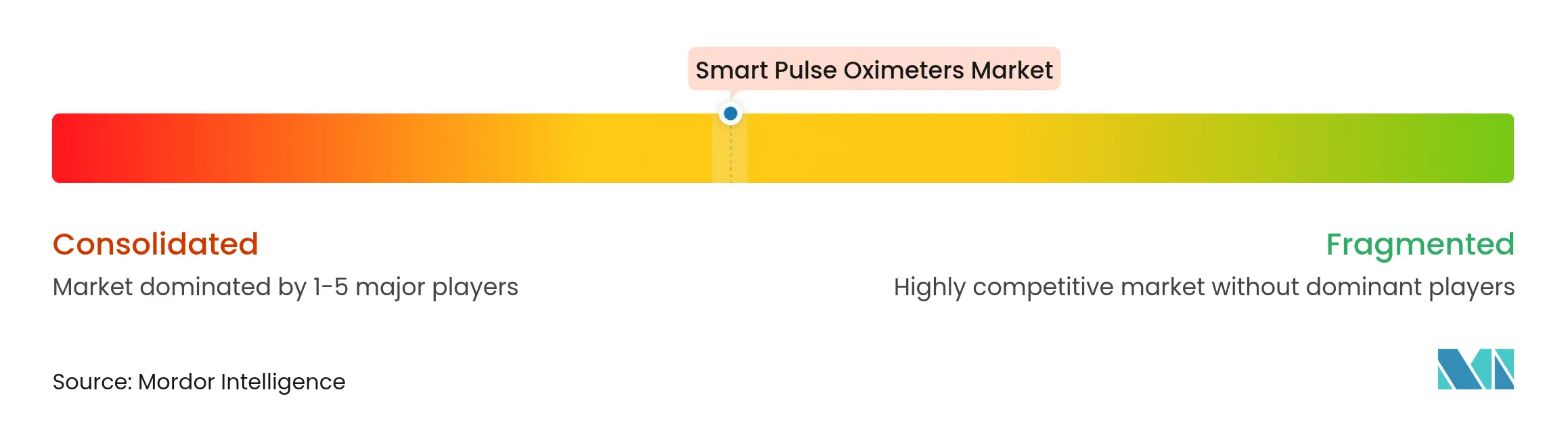
Established medical-device brands contend with consumer-electronics titans and AI-first start-ups. Masimo, Philips, and Medtronic leverage 30-plus-year clinical datasets, multichannel distribution, and deep regulatory maps to retain hospital loyalty. Apple and Samsung exploit massive installed bases to push sensor convergence, shifting battlegrounds toward ecosystems rather than single devices. Patent clashes, such as Masimo vs Apple litigation, spotlight the strategic worth of optical-sensor IP estates and may shape licensing norms going forward.
Partnership momentum is high: Medtronic and Philips agreed in 2025 to integrate Nellcor algorithms into IntelliVue monitors, stitching together complementary telemetry stacks. iRhythm licensed BioIntelliSense’s multi-parameter patches for ambulatory cardiac assessments, underscoring adjacent-market cross-pollination. M&A remains active, illustrated by BD’s USD 4.2 billion purchase of Edwards’ Critical-Care unit, signalling appetite for portfolios that unite ventilation and SpO₂ intelligence. These moves point to a trajectory where platform breadth, rather than single-metric supremacy, defines winners within the smart pulse oximeters market.
Start-ups exploit niches unserved by incumbents. OxiWear’s ear-level device targets continuous mobility use in athletes and surgical wards. Zynex’s laser oximeter aims to solve dark-skin accuracy gaps. Software firms supply analytics overlays that convert raw SpO₂ into actionable risk scores for COPD flares or sleep-apnea events. Venture funding channels into AI-enabled sensing hold steady as investors view remote-care infrastructure as a durable secular play. Overall, competitive intensity is climbing, yet regulatory and quality hurdles sustain a moderate market-concentration profile for the smart pulse oximeters industry.
Smart Pulse Oximeters Industry Leaders

*Disclaimer: Major Players sorted in no particular order
Recent Industry Developments
- July 2025: Medtronic partnered with Philips to embed Nellcor pulse-oximetry technology into Philips monitors, enhancing data continuity across peri-operative workflows.
- May 2025: Zynex filed a 510(k) for its NiCO laser oximeter, targeting improved accuracy for darker skin phenotypes.
- February 2025: Masimo posted USD 1,395 million healthcare revenue for 2024 and guided to USD 1,500-1,530 million for 2025.
- January 2025: Medable integrated Masimo MightySat Rx into decentralized clinical trials spanning 25 countries.
- December 2024: Zynex completed verification trials on its pulse-oximetry platform, paving the way for US commercialization.
- September 2024: iRhythm licensed BioIntelliSense sensor tech for ambulatory cardiac monitoring and sleep-apnea analytics.
Table of Contents for Smart Pulse Oximeters Industry Report
1. Introduction
- 1.1 Study Assumptions & Market Definition
- 1.2 Scope of the Study
2. Research Methodology
3. Executive Summary
4. Market Landscape
- 4.1 Market Overview
- 4.2 Market Drivers
- 4.2.1 Rising Prevalence of Chronic Respiratory and Cardiovascular Diseases
- 4.2.2 Increasing Adoption of Home Healthcare and Remote Patient Monitoring
- 4.2.3 Technological Advancements in Wearable and Connected Pulse Oximetry
- 4.2.4 Growing Government Support for Digital Health and Telemedicine
- 4.2.5 Expansion of E-Commerce Channels for Consumer Health Devices
- 4.2.6 Post-Pandemic Focus on Hospital Oxygen Saturation Monitoring Standards
- 4.3 Market Restraints
- 4.3.1 High Device Cost and Inconsistent Reimbursement Policies
- 4.3.2 Stringent Regulatory and Clinical Validation Requirements
- 4.3.3 Data Accuracy Concerns in Diverse Patient Populations
- 4.3.4 Intensifying Price Competition and Margin Compression
- 4.4 Regulatory Landscape
- 4.5 Porter's Five Forces Analysis
- 4.5.1 Threat of New Entrants
- 4.5.2 Bargaining Power of Buyers
- 4.5.3 Bargaining Power of Suppliers
- 4.5.4 Threat of Substitutes
- 4.5.5 Competitive Rivalry
5. Market Size & Growth Forecasts (Value, USD)
- 5.1 By Product Type
- 5.1.1 Finger Pulse Oximeters
- 5.1.2 Hand-held Pulse Oximeters
- 5.1.3 Wrist-worn Pulse Oximeters
- 5.1.4 Wireless/Connected Pulse Oximeters
- 5.1.5 Multi-parameter Smart Wearables (SpO?-enabled)
- 5.2 By Operating Platform
- 5.2.1 Stand-Alone Devices
- 5.2.2 Smartphone-Integrated Sensors
- 5.2.3 Smartwatch-Integrated Sensors
- 5.3 By Application
- 5.3.1 Chronic Disease Management (COPD, CHF, Etc.)
- 5.3.2 Critical & Emergency Care
- 5.3.3 Post-Operative Monitoring
- 5.3.4 Sleep & Respiratory Therapy
- 5.3.5 Sports & Wellness Tracking
- 5.4 By End User
- 5.4.1 Hospitals & Clinics
- 5.4.2 Ambulatory Surgical Centers
- 5.4.3 Home Healthcare
- 5.4.4 Sports & Fitness Centers
- 5.5 Geography
- 5.5.1 North America
- 5.5.1.1 United States
- 5.5.1.2 Canada
- 5.5.1.3 Mexico
- 5.5.2 Europe
- 5.5.2.1 Germany
- 5.5.2.2 United Kingdom
- 5.5.2.3 France
- 5.5.2.4 Italy
- 5.5.2.5 Spain
- 5.5.2.6 Rest of Europe
- 5.5.3 Asia-Pacific
- 5.5.3.1 China
- 5.5.3.2 Japan
- 5.5.3.3 India
- 5.5.3.4 Australia
- 5.5.3.5 South Korea
- 5.5.3.6 Rest of Asia-Pacific
- 5.5.4 Middle East & Africa
- 5.5.4.1 GCC
- 5.5.4.2 South Africa
- 5.5.4.3 Rest of Middle East & Africa
- 5.5.5 South America
- 5.5.5.1 Brazil
- 5.5.5.2 Argentina
- 5.5.5.3 Rest of South America
6. Competitive Landscape
- 6.1 Market Concentration
- 6.2 Market Share Analysis
- 6.3 Company Profiles (includes Global level Overview, Market level overview, Core Business Segments, Financials, Headcount, Key Information, Market Rank, Market Share, Products and Services, and analysis of Recent Developments)
- 6.3.1 Masimo Corporation
- 6.3.2 Medtronic plc
- 6.3.3 Koninklijke Philips N.V.
- 6.3.4 GE Healthcare
- 6.3.5 Nonin Medical, Inc.
- 6.3.6 Nihon Kohden Corporation
- 6.3.7 Halma plc (SunTech Medical)
- 6.3.8 Contec Medical Systems
- 6.3.9 Omron Corporation
- 6.3.10 ICU Medical (Smiths Group plc)
- 6.3.11 iHealth Labs
- 6.3.12 Apple Inc.
- 6.3.13 Samsung Electronics Co.
- 6.3.14 Garmin Ltd.
- 6.3.15 ResMed Inc.
7. Market Opportunities & Future Outlook
- 7.1 White-space & Unmet-Need Assessment
Global Smart Pulse Oximeters Market Report Scope
As per the scope of this report, smart pulse oximeters are the devices used to monitor the oxygen saturation level and heart rate in patients. The smart pulse oximeters market is segmented by Product type (Finger Pulse Oximeters, Handheld Pulse Oximeters, Wrist Pulse Oximeters, Wireless Pulse Oximeters, and Other), End-user (Hospitals & Clinics, Ambulatory Surgical Centers, and Home Healthcare), and Geography (North America, Europe, Asia-Pacific, Middle East and Africa, and South America). The market report also covers the estimated market sizes and trends for 17 different countries across major regions, globally. The report offers the value (in USD million) for the above segments.
| By Product Type | Finger Pulse Oximeters | |
| Hand-held Pulse Oximeters | ||
| Wrist-worn Pulse Oximeters | ||
| Wireless/Connected Pulse Oximeters | ||
| Multi-parameter Smart Wearables (SpO?-enabled) | ||
| By Operating Platform | Stand-Alone Devices | |
| Smartphone-Integrated Sensors | ||
| Smartwatch-Integrated Sensors | ||
| By Application | Chronic Disease Management (COPD, CHF, Etc.) | |
| Critical & Emergency Care | ||
| Post-Operative Monitoring | ||
| Sleep & Respiratory Therapy | ||
| Sports & Wellness Tracking | ||
| By End User | Hospitals & Clinics | |
| Ambulatory Surgical Centers | ||
| Home Healthcare | ||
| Sports & Fitness Centers | ||
| Geography | North America | United States |
| Canada | ||
| Mexico | ||
| Europe | Germany | |
| United Kingdom | ||
| France | ||
| Italy | ||
| Spain | ||
| Rest of Europe | ||
| Asia-Pacific | China | |
| Japan | ||
| India | ||
| Australia | ||
| South Korea | ||
| Rest of Asia-Pacific | ||
| Middle East & Africa | GCC | |
| South Africa | ||
| Rest of Middle East & Africa | ||
| South America | Brazil | |
| Argentina | ||
| Rest of South America | ||

