
Situational Awareness Systems Market Size and Share
Market Overview
| Study Period | 2020 - 2031 |
|---|---|
| Market Size (2026) | USD 30.31 Billion |
| Market Size (2031) | USD 42.49 Billion |
| Growth Rate (2026 - 2031) | 6.99 % |
| Fastest Growing Market | Middle East |
| Largest Market | Asia Pacific |
| Market Concentration | Medium |
Major Players *Disclaimer: Major Players sorted in no particular order Image © Mordor Intelligence. Reuse requires attribution under CC BY 4.0. | |
Situational Awareness Systems Market Analysis by Mordor Intelligence
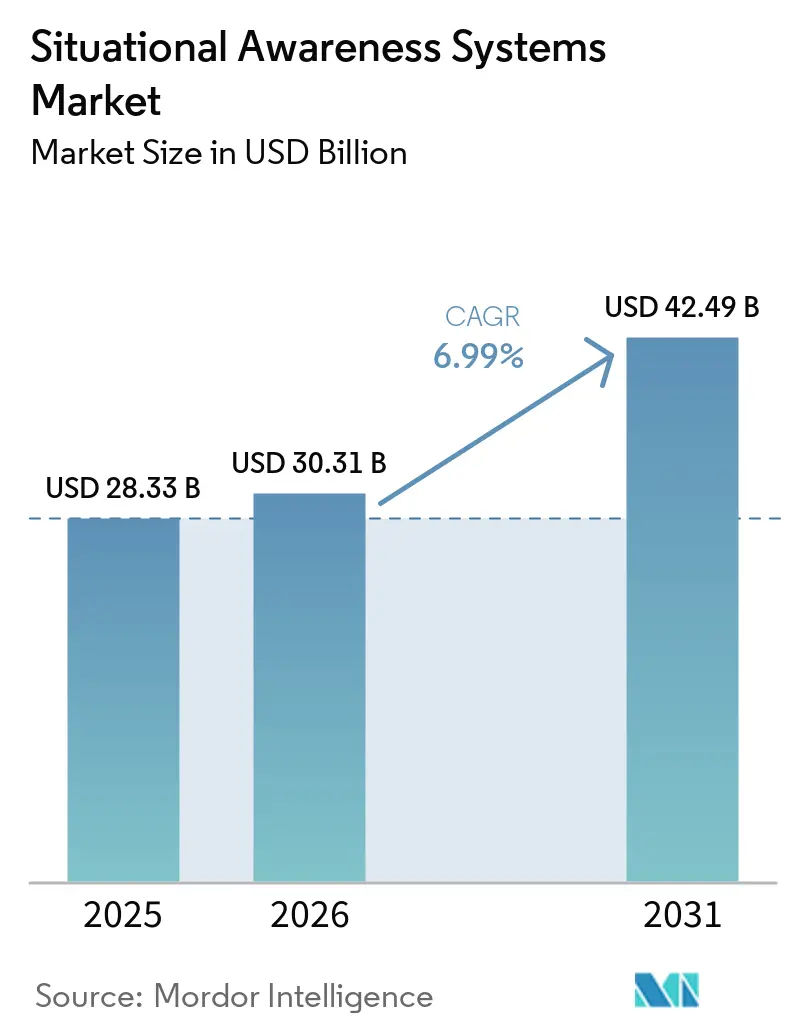
The situational awareness systems market size was valued at USD 28.33 billion in 2025 and estimated to grow from USD 30.31 billion in 2026 to reach USD 42.49 billion by 2031, at a CAGR of 6.99% during the forecast period (2026-2031). Demand is accelerating as defense ministries invest in AI-enabled sensor fusion, CubeSat constellations, and open-architecture command platforms that support multi-domain operations. NATO interoperability mandates, QUAD security cooperation, and the rise of smart-city security programs are broadening the user base beyond the military. Asia-Pacific dominates current revenues, while Gulf countries allocate record budgets to counter regional threats. At the platform level, land systems remain the largest revenue contributors, but air and space segments are where double-digit growth pipelines are forming. Component suppliers are shifting toward software-defined upgrades, allowing operators to refresh capability without expensive hardware swaps. Competitive intensity is rising as large integrators seek partnerships with AI specialists to defend their share against software-centric entrants.
Key Report Takeaways
- By platform, land systems led with a 39.02% market share of situational awareness systems in 2025; air platforms are forecasted to post the fastest growth rate of 8.05% through 2031.
- By type, command and control solutions accounted for 29.05% of 2025 revenue, while optronics and EO/IR technologies are expected to expand at an 7.86% CAGR through 2031.
- By component, processing and computing units held a 33.74% share of the situational awareness systems market size in 2025; software is projected to grow at a 7.62% CAGR over the 2026-2031 period.
- By end-user, the defense segment maintained a 46.18% share in 2025, while aviation and aerospace applications are advancing at an 7.98% CAGR.
- By application, C4ISR and battle management represented 40.66% of 2025 revenue; security and surveillance use cases are anticipated to grow at a 9.05% CAGR.
- By geography, the Asia-Pacific captured 38.12% of global revenue in 2025, and the Middle East is poised for the fastest growth, with a 10.18% CAGR through 2031.
Note: Market size and forecast figures in this report are generated using Mordor Intelligence’s proprietary estimation framework, updated with the latest available data and insights as of 2026.
Global Situational Awareness Systems Market Trends and Insights
Drivers Impact Analysis*
| Driver | % Impact on CAGR Forecast | Geographic Relevance | Impact Timeline |
|---|---|---|---|
| Escalating defense modernization budgets | +1.8% | Global (strongest in APAC and North America) | Medium term (2-4 years) |
| Surge in autonomous and remotely-piloted platforms | +1.5% | Global (led by North America and Europe) | Short term (≤ 2 years) |
| Dual-use demand from critical infrastructure and smart-city security | +1.2% | North America and EU; expanding to APAC cities | Long term (≥ 4 years) |
| NATO and QUAD interoperability mandates | +0.9% | North America, Europe, APAC allies | Medium term (2-4 years) |
| Proliferation of CubeSat space-based sensing constellations | +0.8% | Global (early deployment in North America) | Long term (≥ 4 years) |
| AI-driven sensor-fusion reducing operator cognitive load | +0.7% | Global (tech-advanced markets first) | Short term (≤ 2 years) |
| Source: Mordor Intelligence | |||
Escalating Defense Modernization Budgets
Global procurement cycles are shifting toward systems that can integrate data from air, land, sea, and space on a single platform. The US Department of Defense FY2025 request boosts funding for AI-enabled command nodes, while Asia-Pacific governments channel rising budgets into indigenous solutions that lessen foreign dependency. Lockheed Martin reported USD 18 billion in Q1 2025 sales, underpinned by integrated sensor packages embedded in missile and fire-control programs. Higher spending aligns with sovereign capability goals, creating consistent demand for modular, upgradeable situational awareness architectures.
Surge in Autonomous and Remotely-Piloted Platforms
The tri-service adoption of unmanned aircraft, ground vehicles, and maritime drones creates new requirements for onboard processing that can classify and prioritize threats without continuous human oversight. Boeing’s involvement in the Next Generation Air Dominance program underscores the development of sixth-generation fighter roadmaps, which center on AI-driven autonomy and adaptive engines.[1] RTX successfully flight-tested machine-learning radar-warning receivers that retrofit legacy fighters with cognitive threat prioritization.[2] The same logic underpins counter-UAS solutions, such as Honeywell’s modular Reveal and Intercept package, which integrates EO/IR sensors with RF detectors to neutralize drone swarms.
Dual-Use Demand from Critical Infrastructure and Smart-City Security
Critical infrastructure operators utilize defense-grade sensor fusion to monitor pipelines, ports, and power grids, while municipalities integrate command-center technology into their traffic and public safety platforms. The US Naval Information Warfare Center’s USD 125 million SeaVision deployment for India demonstrates maritime surveillance tools migrating into civilian vessel-tracking roles. Europe’s MARSUR III program enables 20 nations to share maritime data between defense and coast-guard users, underscoring a multi-mission value proposition.[3]
NATO and QUAD Interoperability Mandates
Alliance doctrines prescribe seamless data sharing across heterogeneous fleets. The Global Combat Air Programme, which links the UK, Japan, and Italy, requires common avionics standards and synchronized production workflows. Thales is coordinating the EISNET consortium of 23 partners to establish uniform Integrated Air and Missile Defence interfaces across Europe. Vendors that can certify their products against these open standards secure long-term export pathways.
Restraints Impact Analysis*
| Restraint | % Impact on CAGR Forecast | Geographic Relevance | Impact Timeline |
|---|---|---|---|
| High acquisition and lifecycle costs | –1.3% | Global (especially smaller defense budgets) | Medium term (2-4 years) |
| Cyber-security vulnerabilities in network-centric ops | –0.8% | Global (heightened concern in NATO nations) | Short term (≤ 2 years) |
| RF-spectrum congestion causing sensor interference | –0.6% | Global (acute in dense urban and contested areas) | Medium term (2-4 years) |
| Tightening export controls on advanced imaging sensors | –0.5% | Global (notably affects international trade) | Long term (≥ 4 years) |
| Source: Mordor Intelligence | |||
High Acquisition and Lifecycle Costs
The total cost of ownership extends well beyond initial procurement, encompassing operator training, sovereign crypto modules, software sustainment, and mid-life sensor refresh. Smaller defense budgets often defer or pool purchases, prompting the development of joint frameworks, such as NATO Support and Procurement Agency agreements. Software-intensive architectures incur recurring cyber-compliance expenses that can exceed hardware outlays over a 20-year lifespan.
Cyber-Security Vulnerabilities in Network-Centric Operations
The same connectivity that enables real-time domain awareness creates lucrative attack surfaces. Adversaries target unsecured data links and unpatched mission computers to disrupt decision-making processes. Governments now demand zero-trust architectures, post-quantum encryption, and secure supply-chain attestations before fielding new situational awareness suites. Integrators that pre-build cryptographic agility and cyber-resilience into their platforms gain procurement preference.
*Our forecasts treat driver/restraint impacts as directional, not additive. The impact forecasts reflect baseline growth, mix effects, and variable interactions.
Segment Analysis
By Platform: Land Dominance Drives Multi-Domain Integration
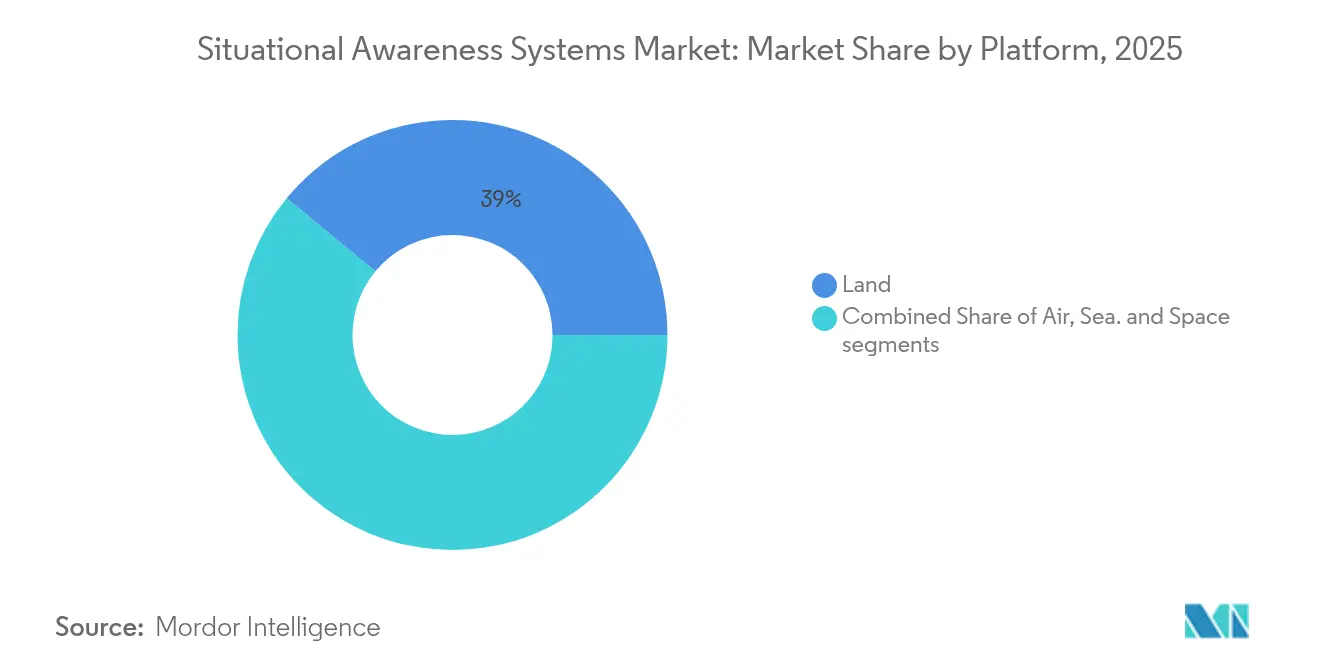
Land platforms controlled 39.02% of situational awareness systems market revenue in 2025, underpinned by mobile command centers and armored vehicle electronics.This growing demand for ground-based surveillance, detection, and threat-monitoring capabilities is also supporting the development of the land-based situational awareness systems market, particularly across military vehicles, command centers, and dismounted soldier applications. Integrated battle-management networks fuse feeds from ground radars, acoustic sensors, and dismounted soldier systems into a common operating picture. However, air platforms are pacing future growth at an 8.05% CAGR as next-generation fighters and Group 5 drones standardize panoramic sensor suites. The market size of situational awareness systems for air platforms is expected to grow rapidly, driven by the need to operate within contested airspace with degraded GPS. CubeSats increasingly extend ground forces' horizons, tying into handheld terminals that have supplanted legacy line-of-sight radios.
Space assets form the youngest but most disruptive layer. Persistent low-earth-orbit constellations beam tactical data straight to edge processors, closing observe-orient-decide loops from minutes to seconds. Sea platforms continue to invest in surface-ship air-defense sensors, while harbor security projects adopt unmanned surface vessels for autonomous patrol. Collectively, multi-domain integration favors open middleware that allows operators to reconfigure sensors across theaters without requiring the rewriting of core code. Proprietary stovepipes are losing ground to modular plug-and-play frameworks demanded by coalition planners.

By Type: Command Systems Lead While Optronics Accelerate
Command and control hubs generated 29.05% of 2025 revenue, underscoring their status as the orchestrating nerve center for every sensor node. These systems translate diverse inputs, such as radar tracks, AIS ship data, and electronic support measures, into actionable tasks. Running advanced algorithms at the edge within the next five years will lift their share of the situational awareness systems market size for C2 suites.
Optronics and EO/IR technologies, though smaller today, are expanding at an 7.86% CAGR as resolution, night-vision range, and thermal sensitivity improve. RTX’s RAIVEN family achieves five-fold detection range gains by coupling hyperspectral, lidar, and AI filtering in one gimbal. Radar remains indispensable for all-weather detection, yet the gap between radio-frequency and optical sensing narrows as software combines cues. SONAR retains its niche in submarine tracking, whereas vehicle ADAS kits borrow military heritage to assist convoy autonomy in low-visibility environments. The situational awareness systems market now favors sensor diversity over single-modality supremacy.
By Component: Processing Power Drives Software Innovation
Processing and computing units captured 33.74% of the revenue in 2025, reflecting insatiable demand for GPUs and real-time signal processors capable of processing multispectral feeds. Edge computing eliminates satellite latency and ensures commanders receive coherent tracks even when data links drop. Software, meanwhile, is the fastest riser, with a 7.62% CAGR, as containerized microservices allow users to add AI upgrades through cloud-style updates rather than depot visits.
Sensors and antennas continue to shrink, benefiting small-form-factor Group 1 drones that relay ISR data to truck-mounted fire-direction centers. Displays evolve from fixed multifunction units to helmet-mounted augmented-reality overlays. Universal Avionics’ ClearVision system, selected by Boom Supersonic, overlays symbology onto the pilot’s field of view during low-visibility departure. Networking hardware now embeds mobile ad-hoc waveforms, automatically forming secure meshes within jammed environments.
By End-User Industry: Defense Leads While Aviation Accelerates
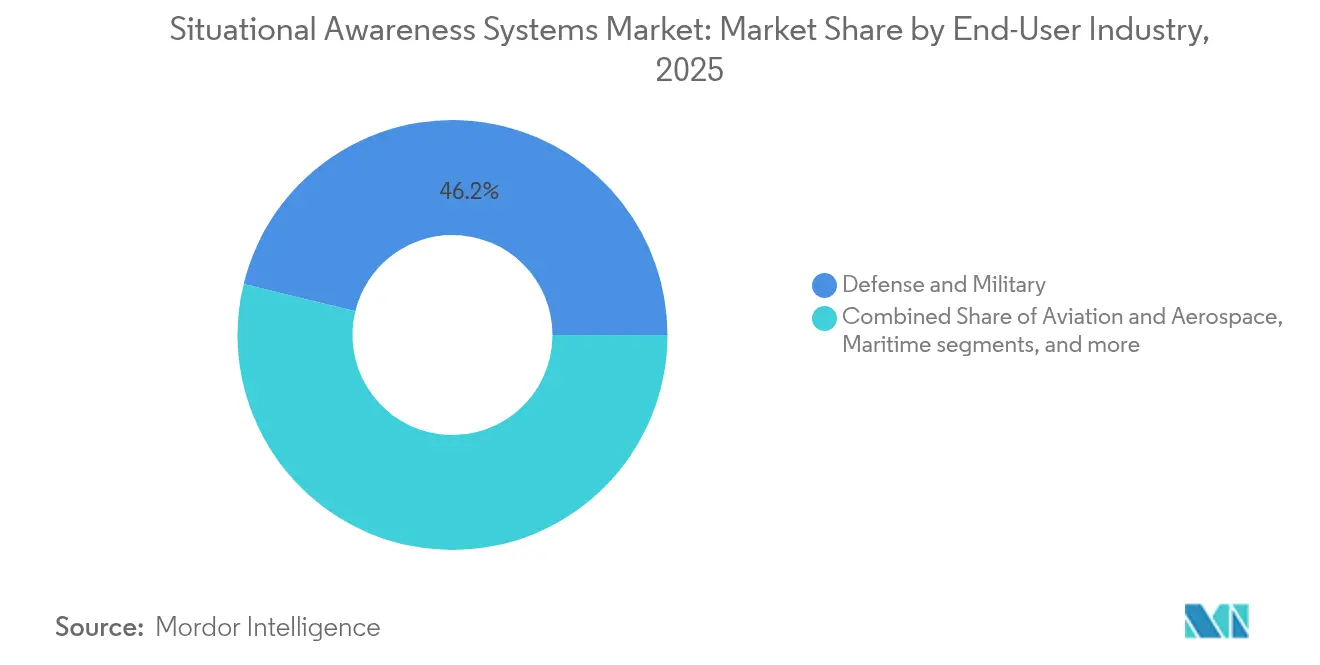
Defense ministries constituted 46.18% of 2025 spending, continuing to anchor the situational awareness systems market. Live-synthetic training and contested-space readiness ensure procurement remains robust, even amid budget scrutiny. Yet, commercial aviation and spaceflight are projected to grow at the fastest 7.98% CAGR as regulators adopt military-grade traffic-collision algorithms for crowded urban air-mobility corridors.
Homeland security agencies integrate border-surveillance towers, coastal radar, and AI-enabled video analytics to safeguard critical infrastructure. Maritime operators adopt unmanned surface vehicles equipped with ISR masts to patrol offshore energy installations. Emergency-management entities deploy ruggedized command tablets that run the same decision tools once reserved for theater commanders. The situational awareness systems industry benefits from certifications such as DO-178C, which expedite the adoption of dual-use systems.
By Application: C4ISR Dominance Meets Surveillance Growth
C4ISR and battle-management accounts for 40.66% of 2025 spending, cementing its role as the digital backbone of modern joint forces. The situational awareness systems market share for C4ISR platforms remains high as commanders prioritize fused sensor mosaics and automated course-of-action recommendations.
Security and surveillance is the breakout growth engine, with a 9.05% CAGR. City authorities in Europe and North America deploy integrated dashboards that combine traffic cameras, license-plate readers, and chemical sensor alerts. Disaster-response teams, meanwhile, leverage satellite imagery fed through AI classifiers to allocate relief assets minutes after a cyclone. Navigation and traffic-control applications incorporate GNSS-independent inertial sensors to maintain air lanes during GNSS jamming. Simulation software streamlines training cycles by replicating exact sensor behaviors, enabling crews to rehearse emerging threat scenarios before deployment.
Geography Analysis
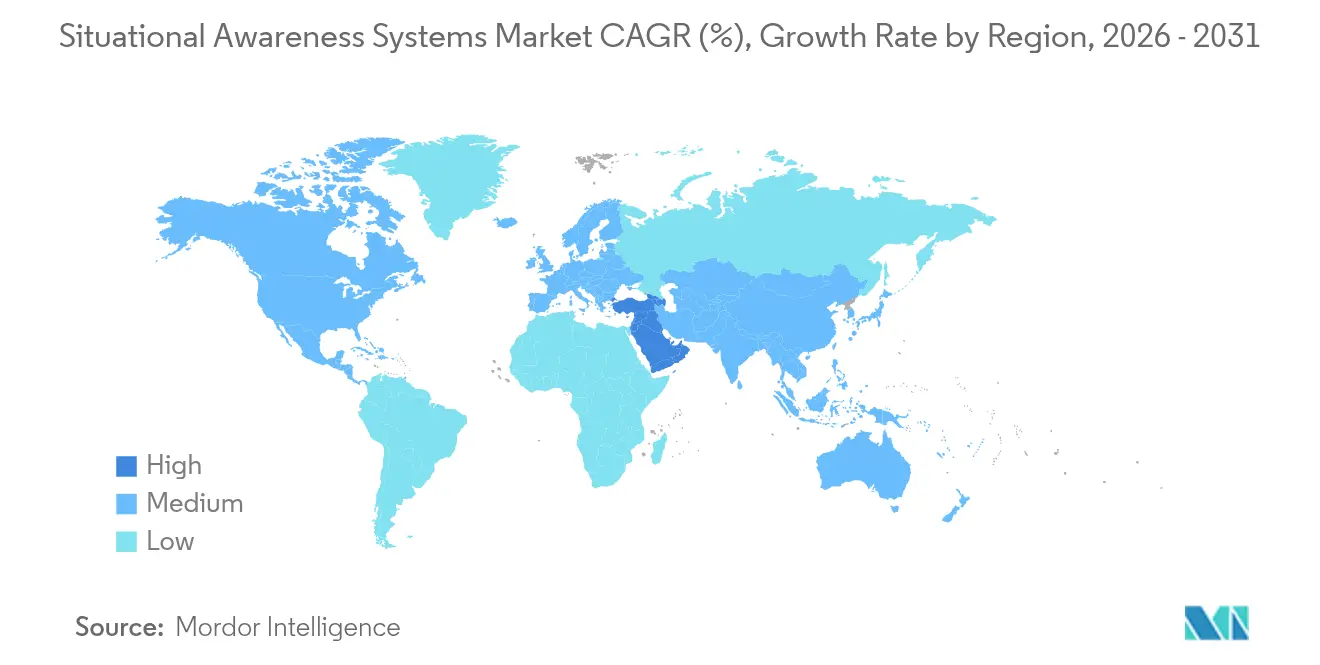
The Asia-Pacific region held 38.12% of global revenue in 2025, as China, India, Japan, South Korea, and Australia executed overlapping modernization roadmaps. Indigenous sensor fabrication programs receive preferential financing, while foreign suppliers secure contracts through offset and technology-transfer clauses. India’s Defense Acquisition Procedure streamlines approval for imported radio-frequency chips that feed into locally assembled command modules. Japanese participation in the Global Combat Air Programme aligns its next-generation fighter cockpit with European human-machine interface standards, enabling the establishment of shared supply chains.
The Middle East is forecasted to deliver a 10.18% CAGR to 2031. Saudi Arabia’s Vision 2030 requires 50% domestic content in new situational awareness suites, steering integrators such as Thales toward local joint ventures. UAE air forces embed CubeSat downlinks into pilot helmets for real-time maritime situational pictures over the Strait of Hormuz. In the maritime situational awareness systems market, PROTEUS is used to identify, query, and filter maritime vessels based on user-defined criteria and provides near-real-time global maritime situational awareness. Israel continues to export software-centric sensor fusion, often bundled with active cyber-defense layers specifically tuned for desert environments that are susceptible to thermal clutter.
North America maintains technology leadership through sustained US DoD outlays. The Pentagon’s Joint All-Domain Command and Control (JADC2) initiative finances open-standards middleware that primes the US for export wins. Canada upgrades Arctic surveillance radars to track hypersonic glide vehicles. Europe emphasizes interoperability: the EISNET consortium classifies threat libraries so that German, French, and Italian missile defense operators interpret sensor cues identically. Africa and South America remain emerging adopters; Colombia’s coastal radar overhaul and Nigeria’s pipeline-monitoring drone program illustrate how civil-security missions often precede full defense adoption.
Regulatory Landscape
Situational awareness systems procurement is increasingly shaped by open-architecture and cybersecurity compliance requirements tied to defense acquisition programs. In the United States, the Department of Defense continues to drive Modular Open Systems Approach (MOSA) adoption across major defense acquisition programs, with compliance assessed through milestone and systems engineering technical review gates that reinforce plug-and-play integration for C2, ISR, and sensor-fusion stacks. In January 2026, the DoD published its Digital Standards Strategy, signaling digital-native requirements that affect software, data models, and interoperability across multi-domain command platforms.
Policy attention also extends to adjacent mission sets that rely on situational awareness, especially counter-UAS and coalition data sharing. In July 2026, a final rule in the Federal Register implemented an interim rule under the SAFER SKIES Act framework for counter-UAS certification and mitigation, which elevates requirements for detection, identification, and command workflows used by public safety and critical infrastructure operators. In Europe, Regulation (EU) 2025/2643 (EDIP) supports strengthening the defense industrial base during 2025-2027, while EU institutions advanced proposals to simplify defense procurement processes and extend framework agreement durations, improving planning stability for long-cycle C4ISR and battle-management programs.
Value Chain Analysis
The value chain spans upstream semiconductor, RF, EO/IR, and sensing components, midstream compute and networking hardware, and downstream software-intensive command-and-control, sensor-fusion, and visualization layers delivered by prime integrators and specialist vendors. Defense procurement and certification channels dominate go-to-market for mission-critical deployments, while dual-use programs in ports, maritime domain awareness, and smart-city command centers expand commercial and government-civilian pathways. System integration and interoperability testing represent major value-add steps, because platforms must fuse heterogeneous feeds (radar, AIS, EO/IR, EW, and space-based data) into a common operating picture with mission-grade cybersecurity.
Recent partnerships show value capture shifting toward open integration, data fusion, and domain-specific software that can be retrofitted onto existing fleets. BAE Systems and Kongsberg Defence and Aerospace signed a teaming agreement in October 2024 to integrate the Integrated Combat Solution for platform situational awareness onto US combat vehicles, reflecting the importance of vehicle integration and certification. L3Harris and Palantir announced a strategic partnership in October 2024 to pair sensors and software-defined systems with Palantir AIP for joint-all-domain situational awareness, highlighting the role of AI platforms in downstream analytics. On the space-to-edge layer, ICEYE and Aechelon Technology partnered in November 2024 to combine SAR satellite data with real-time 3D sensor fusion and ML, while supply-chain resilience efforts such as the US Defense Business Board work on supply chain illumination emphasize visibility beyond Tier 1, where castings, forgings, and specialized electronics can become bottlenecks.
Competitive Landscape
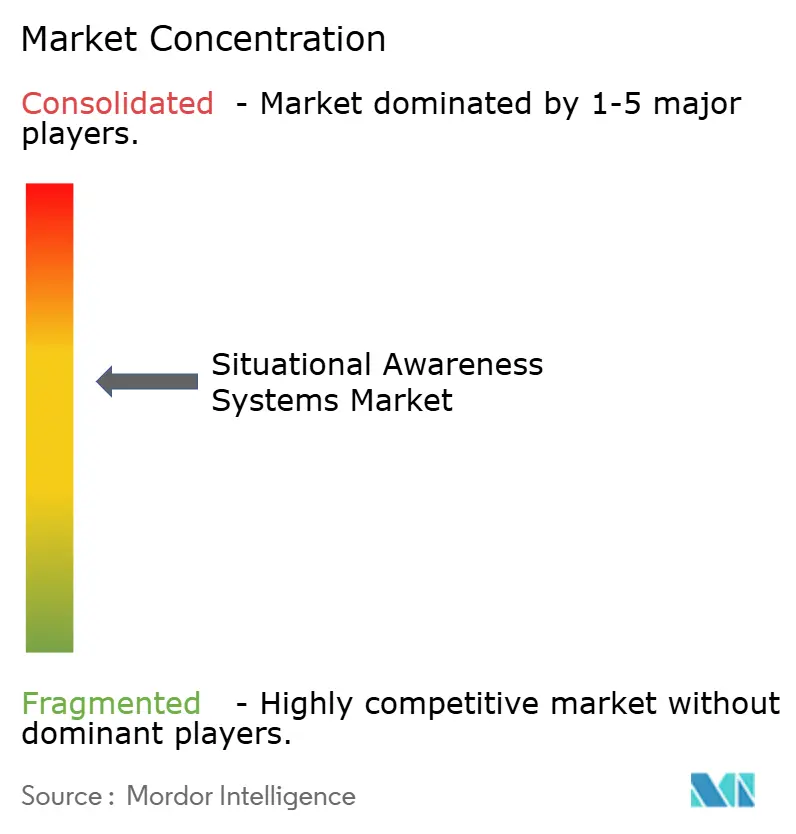
In the situational awareness systems market, a handful of major players dominate, yet niche specialists still find their footing. Companies like Lockheed Martin Corporation, RTX Corporation, and BAE Systems plc are not just selling products; they're enhancing their offerings. For instance, Lockheed Martin's F-35 Tech Refresh 3 not only upgrades processors but also paves the way for future AI capabilities. Meanwhile, RTX showcases its strategy by integrating cognitive electronic support measures into current radar pods, highlighting the lucrative potential of their established installations.
Mid-tier challengers, such as L3Harris, Saab, and Leonardo, differentiate through open-architecture kits that retrofit aging fleets. Saab's Giraffe 1X radar integrates with third-party command software via NATO-compliant data models, shortening deployment timelines for small nations. Meanwhile, technology disruptors focus on AI inference engines that combine disparate sensor feeds on handheld devices. California-based Palantir and UK-based Adarga license machine learning algorithms to defense ministries that prefer commercial refresh cycles.
Partnerships between hardware and software specialists are proliferating. Honeywell teams with Shield AI to embed autonomy in perimeter-security drones; Airbus pairs with Helsing to inject AI air-combat maneuver libraries into manned-unmanned teaming concepts. Vendors that can certify their products as cyber-hardened and export-compliant, utilizing open standards, gain bidding advantages as governments strive to avoid vendor lock-in.
Situational Awareness Systems Industry Leaders
-
Lockheed Martin Corporation
-
RTX Corporation
-
Northrop Grumman Corporation
-
Honeywell International Inc.
-
BAE Systems plc
- *Disclaimer: Major Players sorted in no particular order
Market Opportunities and Future Outlook
Large programs of record and common-data-layer initiatives are creating whitespace for vendors that can deliver MOSA-aligned, cyber-hardened software stacks that fuse multi-domain sensors into operational workflows. In the United States, the Army awarded a USD 350 million IDIQ contract in June 2026 to 3dB Labs to procure and field the Spectrum Situational Awareness System (S2AS), reinforcing demand for electromagnetic spectrum situational awareness as a standalone capability integrated into broader C2 and battle-management architectures. In parallel, the Army selected Anduril Industries in June 2026 to lead the common data layer baseline for its Next Generation Command and Control effort, expanding the addressable market for data management, edge processing, and integration tooling used to support cross-platform sensor fusion.
Budget actions and cloud-based command initiatives also broaden the opportunity set across defense and dual-use users. The Department of Defense proposed more than USD 2 billion for fiscal year 2027 to expand the Maven Smart System and included funding for initiatives such as a Virtual Joint Operations Center, indicating active procurement lanes for AI-enabled decision aids tied to situational awareness and C2. The DoD request of USD 42.7 billion for FY2026 C5ISR programs (an 11.4% increase over 2025) provides a demand backdrop for suppliers of processing/computing, software-defined networking, and secure data-sharing services. On the implementation side, programs such as the US Air Force Cloud-Based Command and Control effort, including an initial USD 24 million contract for an operational data fusion system delivered by SciTec (Firefly Aerospace), point to near-term pull for cloud-to-edge fusion solutions that unify disparate feeds into a common battlespace picture while meeting cybersecurity and interoperability constraints.
Recent Industry Developments
- July 2026: Lockheed Martin deployed its Next Generation Command and Control (NGC2) architecture at Lightning Surge 4, combining edge computing, AI decision aids, and a unified situational awareness picture for division-scale operations. The deployment reinforces the shift from platform-specific tools to software-defined C2 stacks that can fuse multi-domain sensors under contested communications conditions.
- May 2026: RTX BBN Technologies unveiled PACE4ACE, an auto-switching, self-healing communications approach demonstrated with Air Force Research Laboratory support to keep critical data flowing during network disruption. Resilient data transport and continuity directly support sensor fusion and battle-management applications where degraded links can otherwise break the common operating picture.
- April 2026: Northrop Grumman delivered its Interoperable C4i Services capability to NATO's Joint Warfare Centre in Stavanger, Norway, replacing the legacy Maritime Command and Control Information System to strengthen recognized maritime picture and domain awareness. The update highlights NATO-driven modernization demand for interoperable, upgradeable software services that align with coalition data-sharing requirements.
Research Methodology Framework and Report Scope
Market Definition and Coverage
For this report, the situational awareness systems market covers hardware and software that sense, fuse, display, and share operational picture data to support real time decisions across defense and security missions, including fixed and mobile deployments.
Scope exclusions: It excludes pure services-only contracts, basic CCTV without analytics or integration layers, and general-purpose IT infrastructure that is not sold as part of a situational awareness solution.
Segmentation Overview
- By Platform
- Air
- Land
- Sea
- Space
- By Type
- Command and Control Systems
- RADAR
- SONAR
- Optronics and EO/IR
- Vehicle SAS/ADAS
- By Component
- Sensors and Antennas
- Displays and HUDs
- Processing/Computing Units
- Communications and Networking Hardware
- Software
- By End-User Industry
- Defense and Military
- Homeland Security and Public Safety
- Aviation and Aerospace
- Maritime
- By Application
- C4ISR and Battle Management
- Security and Surveillance
- Disaster Response and Emergency Management
- Navigation and Traffic Control
- Environmental/Weather Monitoring
- Training and Simulation
- By Geography
- North America
- United States
- Canada
- Mexico
- Europe
- Germany
- United Kingdom
- France
- Rest of Europe
- Asia-Pacific
- China
- India
- Japan
- South Korea
- Australia
- Rest of Asia-Pacific
- South America
- Brazil
- Rest of South America
- Middle East and Africa
- Middle East
- Saudi Arabia
- United Arab Emirates
- Israel
- Rest of Middle East
- Africa
- South Africa
- Rest of Africa
- Middle East
- North America
Data Sources, Market Sizing, and Validation
Desk Research
Desk work started with building a fact base for demand drivers and procurement signals, then mapping those signals to system categories used in this market. Public sources reviewed included defense budget documents and program notes, national procurement portals, and annual publications from defense and security-focused agencies.
We also used the International Telecommunication Union for communications readiness context, U.S. FCC spectrum references for operating constraints, UN Comtrade for trade flows that hint at sensor and radio movements, and peer-reviewed journals for sensor fusion and command-and-control adoption patterns. Company filings, investor presentations, and reputable press were used to confirm what product families are being sold and the pace of upgrades. Paid subscriptions were used selectively for company financials and intelligence, contract and tender tracking, and patent databases to cross-check timelines and technology focus. These examples are not exhaustive, and additional sources were referenced to support data collection, validation, and clarification.
Primary Interviews and Surveys
Primary work focused on confirming what gets counted as a situational awareness system in real procurements, and how typical pricing shifts with platform mix, sensor density, and software content. We spoke with a mix of OEM-side, integrator-side, and user-side experts across the Americas, EMEA, and APAC so regional procurement patterns and upgrade cycles could be reconciled with desk signals.
Distribution of primary research fieldwork respondents
| Company type | Respondent position | Region |
|---|---|---|
| Top tier: 27% | CXOs: 17% | APAC: 44% |
| Mid tier: 51% | Functional/Unit leaders: 35% | EMEA: 35% |
| Smaller Players: 22% | Managers: 48% | Americas: 21% |
Market-Sizing & Forecasting
Sizing starts from a top-down build where defense and security spending signals are filtered into a demand pool for situational awareness, then split by platform and system type using observable procurement and modernization patterns. The results are corroborated with selective bottom-up checks, such as sampled program values, channel checks on typical system configurations, and price per unit assumptions for radar, optronics, sonar, and command-and-control layers.
Key inputs used in the model include platform fleet activity and modernization cycles, procurement intensity for sensors and C2 upgrades, mix shifts across air, land, sea, and space use cases, typical integration content per deployment, and currency timing for non-USD contract values. Where evidence was incomplete for smaller programs, gaps were handled by using comparable program analogs and conservative adoption ranges agreed in interviews, and then reviewed against the overall spend envelope.
For forecasting, scenario analysis was used around procurement tempo and upgrade timing, followed by a regression-style check that relates growth to defense outlays, platform deliveries, and technology refresh cycles. Assumptions were kept transparent so the model can be repeated using the same public indicators plus interview updates.
Data Validation & Update Cycle
Outputs are validated through multiple checks, including cross-verifying totals against independent budget and procurement signals, reviewing year-on-year jumps, and testing whether platform and type shares stay within realistic bounds. If an outlier shows up, the driver is traced back to a specific input, and experts are re-contacted when the change is tied to a program delay, a scope change, or a shift in pricing.
Before sign-off, the model and narrative go through step-by-step analyst reviews so assumptions and arithmetic are consistent across sections. The report is refreshed annually, and interim updates are triggered when material events occur, such as major contract awards, policy changes, or visible shifts in modernization priorities. Right before delivery, a final pass is completed so clients receive the most current view available.
Mordor Intelligence's Situational Awareness Systems Market Estimate Compared With Other Published Estimates
Published market sizes for situational awareness systems do not always line up because each publisher makes different choices on what to count, which base year to anchor on, and how to treat platform mix and software content. Differences also come from how currency conversion is timed and whether one-time program spikes are smoothed or left as-is.
Budget-to-award linkages and platform upgrade signals are used to keep Mordor Intelligence's 2026 estimate tied to procurements that explicitly bundle sensors with command-and-control and integration layers. When other sources appear higher or lower, it is often because adjacent categories like broader security software, services-only contracts, or partial sensor markets are being included, or because the base year is set to 2025 and then projected with a different scenario stance.
Benchmark comparison
| Source | Market Size | Gaps in Research Methodology |
|---|---|---|
| Mordor Intelligence | USD 30.31 B (2026) | |
| Industry Publisher A | USD 32.10 B (2025) | Uses a different base year and a broader situational awareness framing that can pull in additional software and end-user coverage beyond tightly defined system procurements, and its page shows internal figure inconsistencies that are hard to reconcile. |
| Regional Consultancy B | USD 44.44 B (2032) | Only a far-horizon endpoint is stated, with limited visibility on the starting value and scope filters, which makes the number sensitive to assumed CAGR and to whether services and adjacent surveillance categories are counted. |
Overall, the spread in published values is mainly explained by base-year choice, category boundaries, and how strongly the forecast assumes new procurements versus slower upgrade-driven demand. By keeping inputs traceable to procurement and upgrade indicators, and then pressure-testing totals with practical bottom-up checks, the market size stays easier to audit and reuse in planning discussions.
Key Questions Answered in the Report
What is the current value of the situational awareness systems market?
The market is valued at USD 30.31 billion in 2026 and is projected to reach USD 42.49 billion by 2031, advancing at a 6.99% CAGR. .
Which region generates the highest revenue?
Asia-Pacific contributes 38.12% of global revenue thanks to sustained modernization initiatives across China, India, Japan, and South Korea.
Which platform category is growing fastest?
Air platforms are forecasted to expand at an 8.05% CAGR as next-generation fighters and unmanned aerial systems demand advanced sensor fusion.
What is the leading application segment?
C4ISR and battle-management systems hold 40.66% of revenue, reflecting their centrality to joint operations.
How are software solutions impacting the market?
Software is the fastest-growing component at 7.62% CAGR because containerized updates let operators add AI capabilities without hardware replacement.
What is the main restraint to wider adoption?
High acquisition and lifecycle costs continue to limit uptake among smaller defense budgets, as ongoing cyber-security and software sustainment expenses elevate total ownership costs.