
Shoulder Replacement Market Size and Share
Market Overview
| Study Period | 2020 - 2031 |
|---|---|
| Market Size (2026) | USD 2.39 Billion |
| Market Size (2031) | USD 3.29 Billion |
| Growth Rate (2026 - 2031) | 6.60 % |
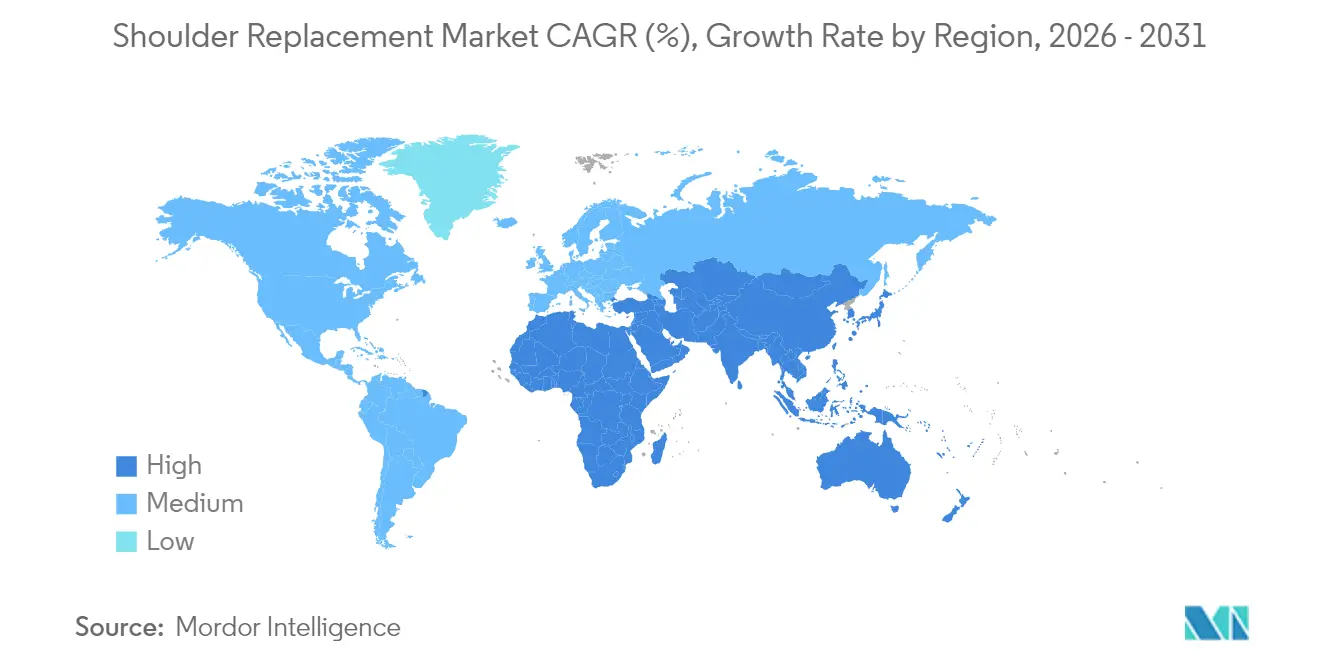
| Fastest Growing Market | Asia Pacific |
| Largest Market | North America |
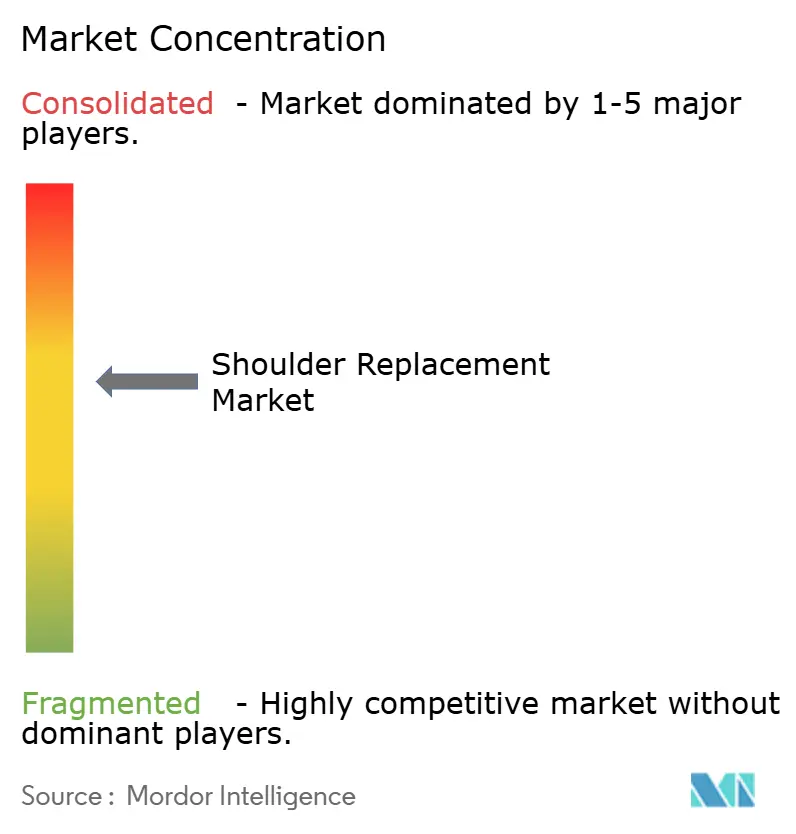
| Market Concentration | Medium |
Major Players *Disclaimer: Major Players sorted in no particular order Image © Mordor Intelligence. Reuse requires attribution under CC BY 4.0. | |
Shoulder Replacement Market Analysis by Mordor Intelligence
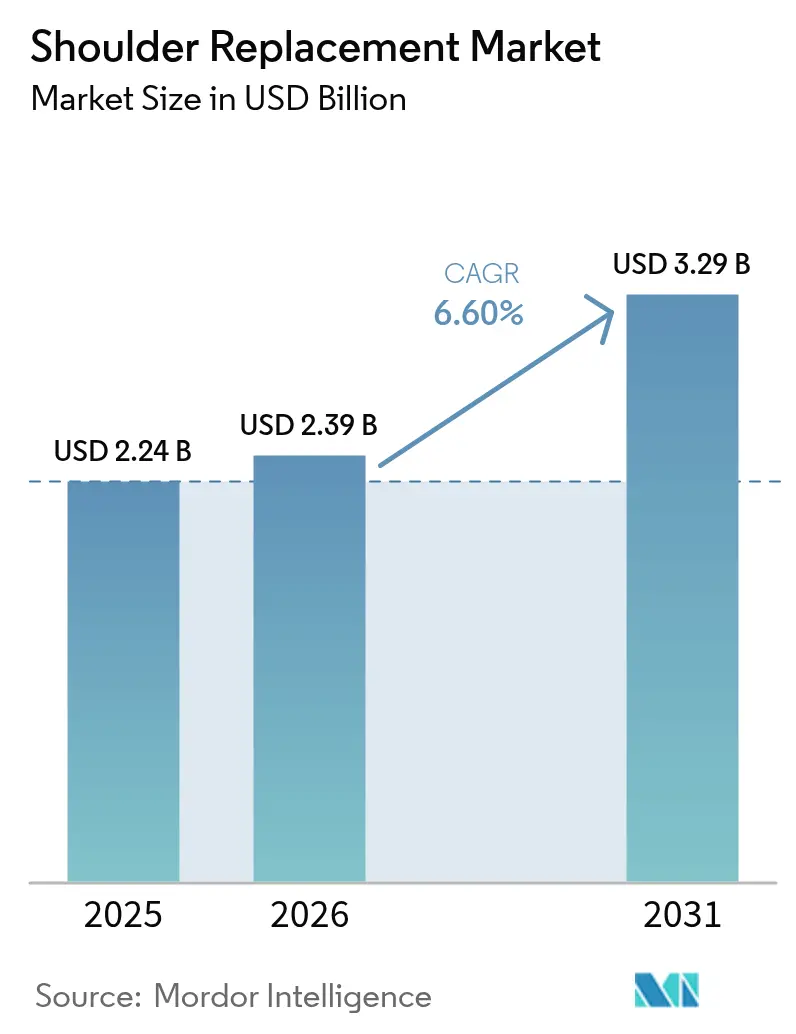
Shoulder Replacement market size in 2026 is estimated at USD 2.39 billion, growing from 2025 value of USD 2.24 billion with 2031 projections showing USD 3.29 billion, growing at 6.6% CAGR over 2026-2031.
The expansion reflects demographic shifts toward older age cohorts, rising arthritis prevalence, and continuous design innovation that enhances implant durability and surgical precision. Artificial intelligence, 3D planning software, and robotic‐assisted systems now guide surgeons in real time, shrinking operative variability and shortening recovery times. Growth also draws momentum from the migration of procedures to ambulatory surgery centers, where favorable reimbursement and lower operating costs align with payer priorities. Meanwhile, Asia-Pacific healthcare investments accelerate technology adoption, tempering North American dominance and reshaping the competitive calculus for multinational device makers.
Key Report Takeaways
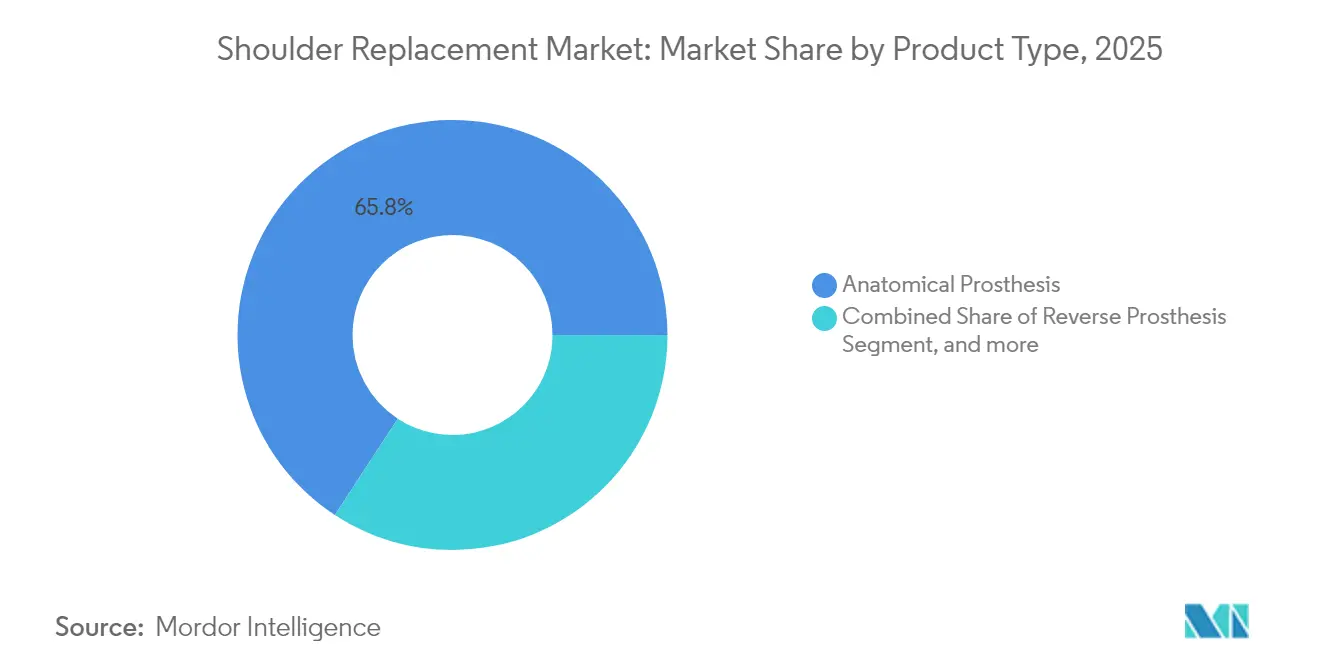
- By product type, anatomical prostheses accounted for 65.78% of the shoulder replacement market share in 2025, while reverse prostheses are forecast to expand at a 6.95% CAGR through 2031.
- By procedure, total shoulder replacement held 43.92% of the shoulder replacement market size in 2025, whereas reverse total shoulder replacement is advancing at an 7.95% CAGR to 2031.
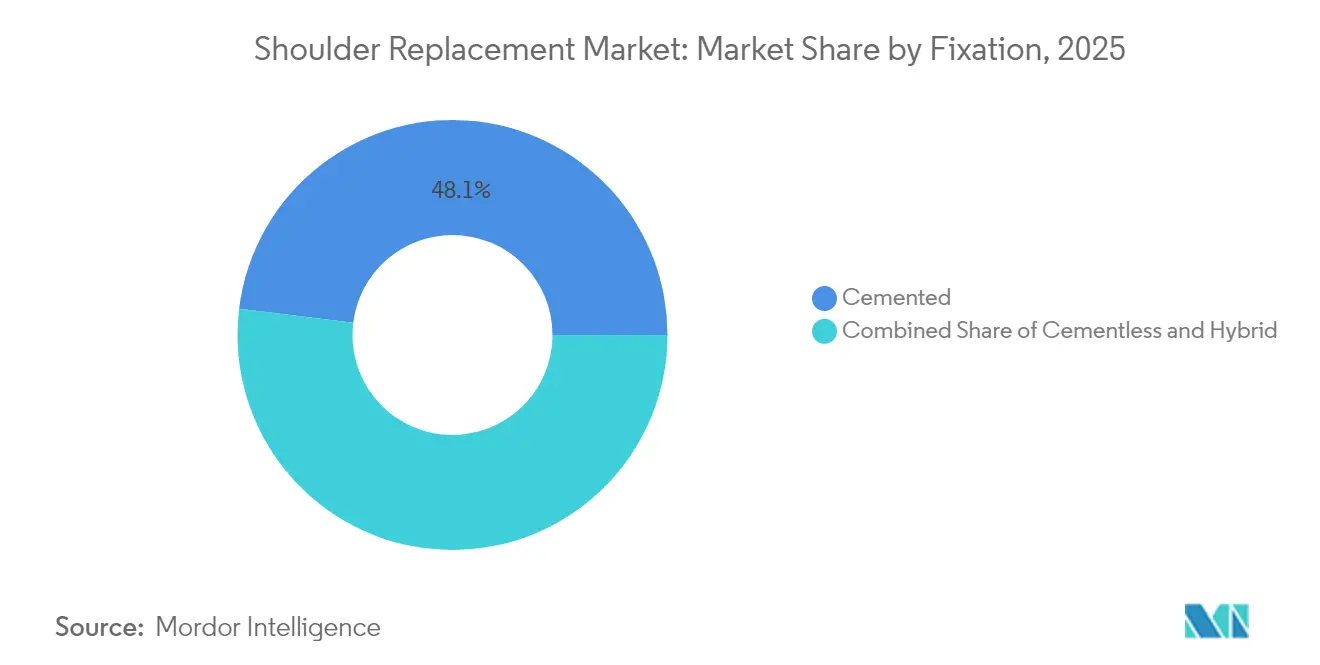
- By fixation, cemented methods captured 48.05% revenue in 2025; cementless systems are on track for a 9.28% CAGR over the same period.
- By end user, hospitals retained 62.10% revenue share in 2025, but ambulatory surgical centers are growing fastest at 9.63% CAGR.
- By geography, North America led with a 39.35% share in 2025, while Asia-Pacific is projected to expand at 8.12% CAGR through 2031.
Note: Market size and forecast figures in this report are generated using Mordor Intelligence’s proprietary estimation framework, updated with the latest available data and insights as of 2026.
Market Trends and Insights
Drivers Impact Analysis of Shoulder Replacement Market*
| Driver | (~) % Impact on CAGR Forecast | Geographic Relevance | Impact Timeline |
|---|---|---|---|
| Growing prevalence of arthritis | +1.8% | North America, Europe | Long term (≥ 4 years) |
| Technological advances in prosthesis design | +1.5% | Global, led by North America & Europe | Medium term (2-4 years) |
| Expanding geriatric population & life expectancy | +2.1% | Asia-Pacific, North America | Long term (≥ 4 years) |
| Growth of outpatient arthroplasty programs | +0.9% | North America & Europe, extending to Asia-Pacific | Short term (≤ 2 years) |
| AI-driven patient-specific instrumentation | +0.7% | North America & Europe | Medium term (2-4 years) |
| Rising sports-injury cases | +0.4% | Developed markets worldwide | Medium term (2-4 years) |
| Source: Mordor Intelligence | |||
Growing Prevalence of Arthritis
Arthritis afflicts 54 million adults in the United States alone, and glenohumeral osteoarthritis now triggers a rising share of anatomic arthroplasty referrals.[1]Aetna, “Shoulder Arthroplasty Policy and Statistics,” aetna.com Accelerated cartilage degeneration in patients with rotator-cuff pathology often progresses to complex reverse procedures, broadening the addressable base. Earlier detection through high-resolution imaging increases surgical candidacy at younger ages, while Medicare coverage expansion removes financial barriers for qualified cases. The economic burden of unmanaged arthritic pain—lost productivity, prolonged therapy, and opioid use—reinforces the value proposition of definitive joint replacement. Collectively, these factors anchor steady procedural volume growth across regions with established healthcare access.
Technological Advances in Prosthesis Design
Stemless systems from Smith + Nephew and Zimmer Biomet, cleared by the FDA in 2024, conserve bone stock and lower periprosthetic fracture risk.[2]Smith + Nephew, “AETOS Stemless Clearance,” smith-nephew.com Reverse designs now incorporate lateralization and distalization principles that restore deltoid mechanics, and pyrocarbon humeral heads approximate cortical bone modulus, reducing glenoid erosion relative to cobalt-chromium alternatives.[3]Journal of Orthopaedic Experience & Innovation, “Pyrocarbon Humeral Heads Reduce Glenoid Wear,” joei-journal.org Surgeons increasingly rely on navigation platforms that marry 3D preoperative plans with intraoperative trackers to ensure precise glenoid seating. These converging technologies deliver longer implant survival and differentiate suppliers prepared to invest in advanced R&D.
Expanding Geriatric Population & Life Expectancy
Patients aged 80 and older exhibit procedure prevalence exceeding 2%, dwarfing younger cohorts by an order of magnitude. Longer lifespans demand durable biomaterials and modular components that facilitate future revision without extensive bone loss. Reverse arthroplasty shows superior functional restoration in osteoporotic fracture cases that previously relied on internal fixation. Yet higher rates of cognitive decline introduce perioperative complexity, spurring hospitals to refine geriatric protocols that mitigate delirium, instability, and infection risks. These demographic realities amplify long-run demand while steering product design toward longevity and ease of revision.
Growth of Outpatient Arthroplasty Programs
CMS reimbursement adjustments now cover shoulder arthroplasty in freestanding centers, catalyzing a projected 25% rise in outpatient volumes over the next decade. Average ASC procedure costs register 144% lower than hospital outpatient departments, producing savings that resonate with payers and self-insured employers. Safety profiles are similar; Medicare data cites a 1.09% major adverse-event rate, matching inpatient benchmarks. Device makers respond with compact instrumentation sets that match limited ASC sterilization capacity and rapid room turnovers.
Restraints Impact Analysis of Shoulder Replacement Market*
| Restraint | (~) % Impact on CAGR Forecast | Geographic Relevance | Impact Timeline |
|---|---|---|---|
| Post-operative complications & implant loosening | -1.2% | Global, higher in emerging markets | Long term (≥ 4 years) |
| High procedure & implant costs | -0.8% | Emerging markets worldwide | Medium term (2-4 years) |
| Volatile supply of medical-grade metals & UHMWPE | -0.6% | Global, supply centered in Asia | Short term (≤ 2 years) |
| Stricter approval cycles for reverse prostheses | -0.4% | North America & Europe | Medium term (2-4 years) |
| Source: Mordor Intelligence | |||
Post-Operative Complications & Implant Loosening
Long-term data from Norway cite 14.3% complication rates for reverse arthroplasty, with instability and infection driving revisions. Glenoid loosening manifests in up to 48% of anatomic cases within two years, raising concerns about fixation strategies. Metal-backed components paired with polyethylene inserts exhibit elevated revision risk, prompting shifts toward monoblock polyethylene or hybrid designs. Five-year mortality after arthroplasty reaches 16.6% among Medicare beneficiaries, a reminder that comorbidities significantly influence outcomes. Continuous design refinement and rigorous infection-control protocols remain paramount.
High Procedure & Implant Costs
Supply disruptions and raw-material inflation now consume up to 20% of orthopedic device revenue, forcing price recalibration or margin erosion. Tariffs as high as 125% on select Chinese components accelerate reshoring initiatives but elevate near-term production expenses. Conversely, China’s national procurement program cut joint replacement hospitalization costs 50.10% without compromising outcomes, demonstrating an alternate pathway to affordability. Manufacturers must balance innovation with value-oriented offerings to penetrate cost-sensitive markets.
*Our forecasts treat driver/restraint impacts as directional, not additive. The impact forecasts reflect baseline growth, mix effects, and variable interactions.
Shoulder Replacement Market Segment Analysis
By Product Type:
Reverse Prostheses Drive InnovationAnatomical prostheses supplied 65.78% of 2025 revenue, yet reverse systems are closing the gap at a 6.95% CAGR. Surgeons favor anatomical implants for patients with intact rotator cuffs because these devices imitate normal kinematics and preserve humeral bone. Stemless variants shorten operative time by sidestepping canal preparation and simplifying future revision. Reverse implants dominate cuff-deficient cases, unstable fractures, and revisions, boasting 10-year survival above 88%.
Design evolution centers on lateralized centers of rotation and distalized glenospheres, which boost deltoid tension and extend range of motion. Inlay reverse systems simplify glenoid exposure, whereas onlay platforms provide incremental stability in cases with bone loss. Modular platforms now accommodate both anatomical and reverse configurations, permitting intraoperative decision shifts without additional inventory. These advancements broaden indications and reinforce the competitive posture of companies delivering configurable solutions across the shoulder replacement market.



By Procedure:
Complex Cases Fuel GrowthTotal shoulder replacement maintained 43.92% revenue in 2025, supported by decades of outcome data and widespread surgeon familiarity. Reverse total shoulder replacement, however, propels volume expansion at 7.95% CAGR through complex tear arthropathy, fractures, and re-revision pathways. Resurfacing hemiarthroplasty remains relevant for focal chondral lesions in young athletes who may postpone total replacement, while stemmed hemiarthroplasty has receded as reverse alternatives demonstrate higher pain relief and function.
The trajectory toward reverse total procedures reflects evidence that combined tendon transfers can regain 32° of external rotation, enhancing daily living activities. Robotic platforms support both anatomical and reverse workflows, unifying instrumentation and reducing learning curves. Outpatient migration is no longer limited to primary anatomical cases; carefully selected reverse procedures are now discharged the same day with equivalent safety profiles. This procedural diversity injects resilience into the shoulder replacement market by dispersing growth across varied clinical indications.
By Fixation:
Cementless Innovation AcceleratesCemented fixation secured 48.05% revenue in 2025, optimized for osteoporotic bone and immediate post-operative stability. The cementless cohort, advancing at 9.28% CAGR, leverages porous titanium and tantalum coatings that invite biological ingrowth. Hybrid strategies cement the glenoid while press-fitting the humerus, tailoring fixation to differential bone quality. Ceramic-coated resurfacing shoulders register a mere 0.6 mm wear over 10 years, outclassing cobalt-chromium implants in independent series.
Surface modifications such as hydroxyapatite and plasma-sprayed titanium extend the osteoconductive interface, while 3D-printed lattice structures replicate trabecular bone. Surgeons now match fixation modality to patient age, activity level, and bone biology, illustrating the nuanced segmentation of the shoulder replacement market. Continued clinical data accumulation will determine whether cementless constructs eventually surpass cemented approaches in long-term survivorship.
By End User:
ASC Migration Reshapes DeliveryHospitals held 62.10% revenue in 2025, sustained by multi-disciplinary care teams, complex revision capabilities, and intensive post-operative monitoring. Tertiary academic centers also function as innovation hubs, nurturing clinical trials that validate next-generation implants. Yet ambulatory surgical centers expand at 9.63% CAGR, propelled by payer mandates, streamlined scheduling, and rapid turnover efficiencies. Procedures in ASC settings cost 144% less than hospital outpatient pathways, compelling both payers and patients to favor the venue.
Device makers respond with single-tray instrumentation and disposables engineered for smaller sterile cores. Specialty orthopedic clinics outside metropolitan hubs rely on these offerings to deliver high-quality care without the overhead of large hospital systems. This distribution shift challenges traditional sales channels but enriches market reach, underscoring the importance of flexible commercial models within the shoulder replacement market.
Geography Analysis
North America Shoulder Replacement Market
North America retains primacy with a 39.35% revenue share in 2025, underpinned by mature reimbursement structures and roughly 53,000 annual arthroplasty procedures in the United States alone. CMS inclusion of total shoulder replacement in the ASC covered list amplifies procedural migration, while national joint registries support evidence-based device selection. Canada confronts elective surgery backlogs by increasing theater capacity, whereas Mexico leverages cost differentials to attract international patients.
APAC and Europe Shoulder Replacement Market
Asia-Pacific posts the fastest CAGR at 8.12% to 2031, fueled by hospital infrastructure expansion, rising middle-class income, and government policies that seek affordable orthopedic solutions. China’s volume-based procurement has reduced inpatient costs by half, enabling broader access to implants without sacrificing quality. Japan’s super-aged society magnifies procedure demand even as it exercises strict regulatory oversight. India’s private hospital chains pursue medical tourism, importing high-end implants while promoting indigenous manufacturing under the “Make in India” framework. Australia continues to punch above its population weight in clinical trials, offering early adoption opportunities for new technologies. Europe records steady uptake across public and private systems. Germany’s manufacturing base underwrites high domestic adoption, while the United Kingdom persists in joint replacement research despite Brexit regulatory realignment. France and Italy refine enhanced recovery protocols that trim length of stay without increasing readmissions. Nordic registries provide granular data that illuminate technique-outcome correlations, guiding global practice patterns. Although the European Medical Device Regulation has extended approval timelines, its emphasis on safety may elevate regional confidence in next-generation implants. Collectively, these regional patterns assure diversified revenue streams that insulate the shoulder replacement market from isolated policy shocks.

Competitive Landscape
The competitive field remains moderately consolidated. Zimmer Biomet, Johnson & Johnson’s DePuy Synthes, and Stryker leverage integrated portfolios covering stemless, stemmed, anatomic, and reverse implants. Zimmer Biomet’s ROSA Shoulder robot connects data analytics to intraoperative execution, reinforcing procedural consistency. Stryker continues an aggressive acquisition cadence and recorded USD 9.1 billion orthopedic revenue in 2024, up 8.9% year over year. Smith + Nephew expanded into stemless anatomic systems with the FDA-cleared AETOS platform in December 2024.
Digital differentiation is accelerating. Exactech’s partnership with Statera integrates implantable sensors that track real-time load, signaling post-operative performance to clinicians. Smaller entrants like Shoulder Innovations attract venture funding—USD 40 million in March 2025—to refine glenoid fixation approaches. These players exploit gaps left by large incumbents, particularly in niche indications or price-sensitive regions.
Suppliers face parallel pressure to localize manufacturing and streamline supply chains, especially after geopolitical tensions exposed vulnerabilities in titanium and UHMWPE sourcing. Some allocate up to 20% of revenue to logistics optimization, reinforcing resilience while containing cost inflation. Competitive emphasis is shifting toward ecosystem solutions—robots, data platforms, and patient-specific implants—that expand beyond the hardware sale to capture recurring software and services revenue. Overall, success hinges on harmonizing clinical evidence, digital augmentation, and cost competitiveness within the evolving shoulder replacement market.
Shoulder Replacement Industry Leaders
Arthrex Inc.
Zimmer Biomet Holdings Inc.
Integra LifeSciences Holdings Corporation
Johnson & Johnson
Smith & Nephew plc
- *Disclaimer: Major Players sorted in no particular order
Shoulder Replacement Market Companies Covered in this Report
- Arthrex
- Zimmer Biomet
- Integra LifeSciences
- Johnson & Johnson
- Smiths Group
- Wright Medical Group
- Stryker
- Enovis Corporation (DJO Global)
- Acumed
- Exactech
- LimaCorporate S.p.A
- Conmed
- B. Braun
- Medacta International
- Stryker
- Apex Biomedical
- Globus Medical
- FH Orthopedics
- Biotechni SAS
- Ascension Orthopedics

Market Opportunities and Future Outlook
Two near-term whitespace areas are forming around outpatient-friendly system design and digital, patient-specific workflows that reduce variability in glenoid placement. As procedures continue to migrate into ambulatory surgical centers, demand is building for lower-footprint, faster-to-sterilize instrument sets and platforms that simplify intraoperative decisions. This is most visible when surgeons want to switch between anatomic and reverse configurations without changing the underlying system.
Technology-led opportunity is also expanding around navigation, AI-enabled planning, and robotics, as suppliers increasingly frame offerings across software, instrumentation, and service rather than hardware alone. Zimmer Biomet’s ROSA Shoulder roadmap, along with multiple 2026 US FDA 510(k) clearances across reverse and total systems, points to a push toward more standardized execution of preoperative plans and broader procedural coverage within a single workflow. At the same time, cost and access pressures in parts of Asia-Pacific, including China procurement dynamics referenced in the report context, create a commercialization lane for value-oriented systems that still retain evidence-backed design features such as bone-conserving stemless options, improved glenoid fixation approaches, and modular components to address complication and revision concerns in both primary and complex indications.
Recent Industry Developments in Shoulder Replacement Market
- May 2026: Zimmer Biomet announced US FDA 510(k) clearance for expanded capabilities of its ROSA Shoulder System, adding advanced robotic support for key preparation steps across anatomic and reverse shoulder arthroplasty workflows. The update reinforces the company's digital and robotics ecosystem positioning and supports standardization efforts used by hospitals and ambulatory centers to reduce placement outliers and streamline procedure flow.
- October 2025: Johnson & Johnson MedTech launched INHANCE INTACT, a total shoulder replacement system designed for tissue-sparing surgery and early post-operative mobility. The launch increases competitive pressure in anatomic reconstruction by targeting efficiency and recovery goals aligned with the shift toward outpatient pathways.
- December 2024: Zimmer Biomet received US FDA 510(k) clearance for the OsseoFit Stemless Shoulder System for total shoulder replacement. This clearance broadened the company's bone-conserving portfolio and supports surgeon preference trends toward stemless options that can reduce canal preparation and simplify future revisions.


Shoulder Replacement Market Report Scope and Research Methodology
Market Definition and Coverage
This market covers the revenues generated from shoulder arthroplasty implants used to replace all or part of the shoulder joint, along with the related procedure-linked implant systems sold into clinical settings. It reflects demand from degenerative disease, fractures, and rotator cuff related indications that lead to surgical replacement.
Scope exclusions: It does not include trauma fixation plates and screws, non-implant biologic therapies, physical therapy services, or implants for other joints.
Segments Covered in This Report
- By Product Type
- Anatomical Prosthesis
- Stemmed Anatomical
- Stemless Anatomical
- Reverse Prosthesis
- Inlay Reverse
- Onlay Reverse
- Stemless Reverse
- Hybrid/Biological Prosthesis
- Anatomical Prosthesis
- By Procedure
- Resurfacing Hemiarthroplasty
- Stemmed Hemiarthroplasty
- Total Shoulder Replacement
- Reverse Total Shoulder Replacement
- Partial Shoulder Replacement
- By Fixation
- Cemented
- Cementless
- Hybrid
- By End User
- Hospitals
- Orthopedic Centers
- Ambulatory Surgical Centers
- Specialty Clinics
- By Geography
- North America
- United States
- Canada
- Mexico
- Europe
- Germany
- United Kingdom
- France
- Italy
- Spain
- Rest of Europe
- Asia-Pacific
- China
- Japan
- India
- Australia
- South Korea
- Rest of Asia-Pacific
- Middle East & Africa
- GCC
- South Africa
- Rest of Middle East & Africa
- South America
- Brazil
- Argentina
- Rest of South America
- North America
Data Sources, Market Sizing, and Validation
Desk Research
Desk work started with building a clean fact base on procedure volumes, demographics, and orthopedic care access, since these are the demand drivers behind shoulder arthroplasty. Public sources used included, for example, CDC and National Center for Health Statistics tables, CMS utilization and payment datasets, OECD health statistics, World Bank population and aging indicators, and peer reviewed orthopedic journals that report revision rates and outcomes.
We also reviewed company annual reports, regulatory and recall notices where relevant, clinical society guidance, and reputable press coverage to track shifts like reverse procedures moving to outpatient settings. A paid subscription for company financials and intelligence was used to sanity-check segment exposure, and a patent database was used to see where design activity was trending (such as stemless and augmented glenoid concepts). These desk sources are illustrative, and many additional public references were used to fill gaps and validate assumptions.
Primary Interviews and Surveys
Primary discussions were used to pressure-test the demand model and to confirm what gets counted as a shoulder replacement sale across settings, including hospitals and orthopedic centers. We spoke with a mix of device-side executives, distributor and channel roles, and clinicians and administrators who influence procedure adoption, with coverage across APAC, EMEA, and the Americas so regional practice patterns and pricing logic could be aligned.
Distribution of primary research fieldwork respondents
| Company type | Respondent position | Region |
|---|---|---|
| Top tier: 38% | CXOs: 15% | APAC: 46% |
| Mid tier: 46% | Functional/Unit leaders: 26% | EMEA: 33% |
| Smaller Players: 16% | Managers: 59% | Americas: 21% |
Market-Sizing & Forecasting
Sizing was built using a top-down approach where procedure demand is reconstructed from country level shoulder arthroplasty volumes, then adjusted by the share of procedures that use anatomic, reverse, and partial systems, and then translated into value using observed implant price bands. Where published procedure counts were incomplete, we filled the gap using proxy indicators such as the 60+ population pool, osteoarthritis and rotator cuff tear burden signals, surgeon density and hospital capacity, and the share of shoulder cases done in outpatient settings.
To keep the totals grounded, the outputs were checked using selective bottom-up approximations, such as rolling up supplier exposure from public financial disclosures, sampled average selling price checks from tenders and reimbursement references, and distributor feedback on mix shifts. Forecasting relied mainly on scenario analysis, since adoption can move faster or slower based on hospital capital cycles, surgeon training for reverse techniques, and reimbursement changes, and then it was cross-checked with simple time series smoothing on procedure growth where history was stable.
Data Validation & Update Cycle
Outputs were validated through multiple passes that compare the modeled value against independent signals like procedure growth, implant mix changes, and pricing direction across major regions. When large variances showed up, the assumptions were reopened, and respondents were re-contacted to confirm whether it was a real market shift or a modeling artifact.
Before sign-off, another analyst reviews the logic, unit consistency, and year-over-year movements so abnormal jumps are explained or corrected. The report is refreshed annually, and interim updates are made when material events occur, such as major reimbursement changes or regulatory actions that can impact procedure flow. Right before delivery, a final check is done to ensure the latest public data points and expert inputs are reflected.
Mordor Intelligence's Shoulder Replacement Market Size Measured Against Other Published Estimates
It is normal to see different market values for shoulder replacement because groups do not always count the same revenue line items, and they also choose different base years and pricing assumptions. The biggest swings usually come from what is treated as an implant market versus a broader procedure market, and how quickly price and mix are allowed to change in the forecast.
Some published figures lean toward procedure economics or include a wider set of orthopedic revenues, which lifts the total even when procedure volumes are similar. Mordor Intelligence counts the shoulder replacement market as implant system revenues tied to shoulder arthroplasty, and it keeps adjacent orthopedic trauma fixation and non-implant therapies out of the total, which tightens the scope and reduces double counting.
Benchmark comparison
| Source | Market Size | Gaps in Research Methodology |
|---|---|---|
| Mordor Intelligence | USD 2.39 B (2026) | |
| Industry Research Desk A | USD 1.76 B (2025) | Uses an earlier base year and tends to reflect a narrower pricing set, with less explicit separation of implant-system revenues from procedure-level economics across regions. |
| Market Intelligence Desk B | USD 1.37 B (2025) | Anchors the model on a smaller base-year value and appears to apply conservative price progression and mix shifts, especially for reverse procedures and outpatient adoption. |
Reading the table together, the spread is mainly explained by timing and what is monetized in the model, not by disagreement that procedures are rising. By linking value to procedure volumes, implant mix, and region-specific price bands, the final estimate stays traceable to inputs that can be rechecked and updated in a repeatable way.


Key Questions Answered in the Report
What is the current value of the shoulder replacement market?
The shoulder replacement market is worth USD 2.39 billion in 2026 and is projected to hit USD 3.29 billion by 2031 at a 6.6% CAGR.
Which product segment is growing fastest?
Reverse prostheses lead growth with a 6.95% CAGR through 2031, driven by broader indications and design refinements.
How fast is outpatient shoulder arthroplasty expanding?
Ambulatory surgical center procedures are increasing at 9.63% CAGR, supported by lower costs and favorable CMS reimbursement.
Which region offers the highest growth potential?
Asia-Pacific shows the fastest expansion, forecast at 8.12% CAGR due to rising incomes, hospital construction, and government procurement programs.
What technology trends are reshaping the market?
AI-driven patient-specific guides, robotic-assisted systems, and navigation platforms are boosting surgical accuracy and reducing revision risk.
Who are the leading companies in the space?
Zimmer Biomet, DePuy Synthes, and Stryker dominate, with Smith + Nephew and Exactech strengthening portfolios through stemless designs and sensor-enabled implants.
Page last updated on:


 Your data is secure and never sold or shared.


