
Semiconductor Batteries Market Size and Share
Market Overview
| Study Period | 2021 - 2031 |
|---|---|
| Market Size (2026) | USD 15.44 Billion |
| Market Size (2031) | USD 22.42 Billion |
| Growth Rate (2026 - 2031) | 7.74 % |
| Fastest Growing Market | Asia Pacific |
| Largest Market | Asia Pacific |
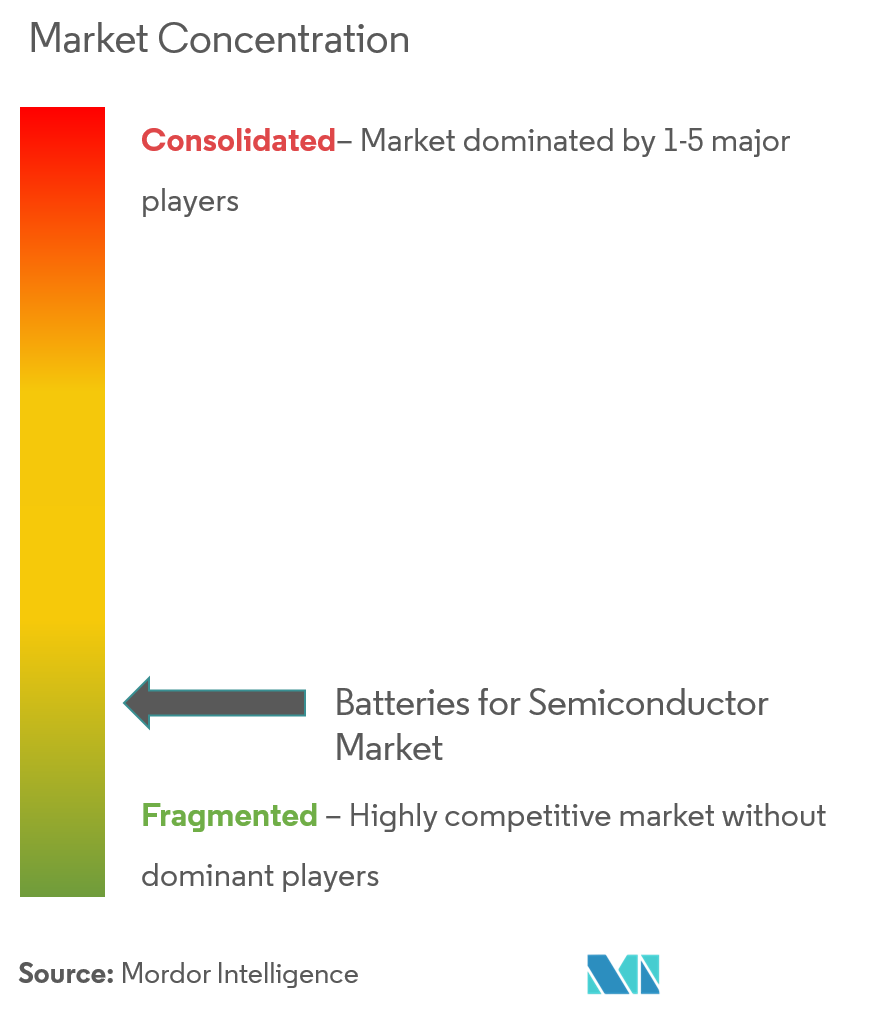
| Market Concentration | Low |
Major Players *Disclaimer: Major Players sorted in no particular order Image © Mordor Intelligence. Reuse requires attribution under CC BY 4.0. | |
Semiconductor Batteries Market Analysis by Mordor Intelligence
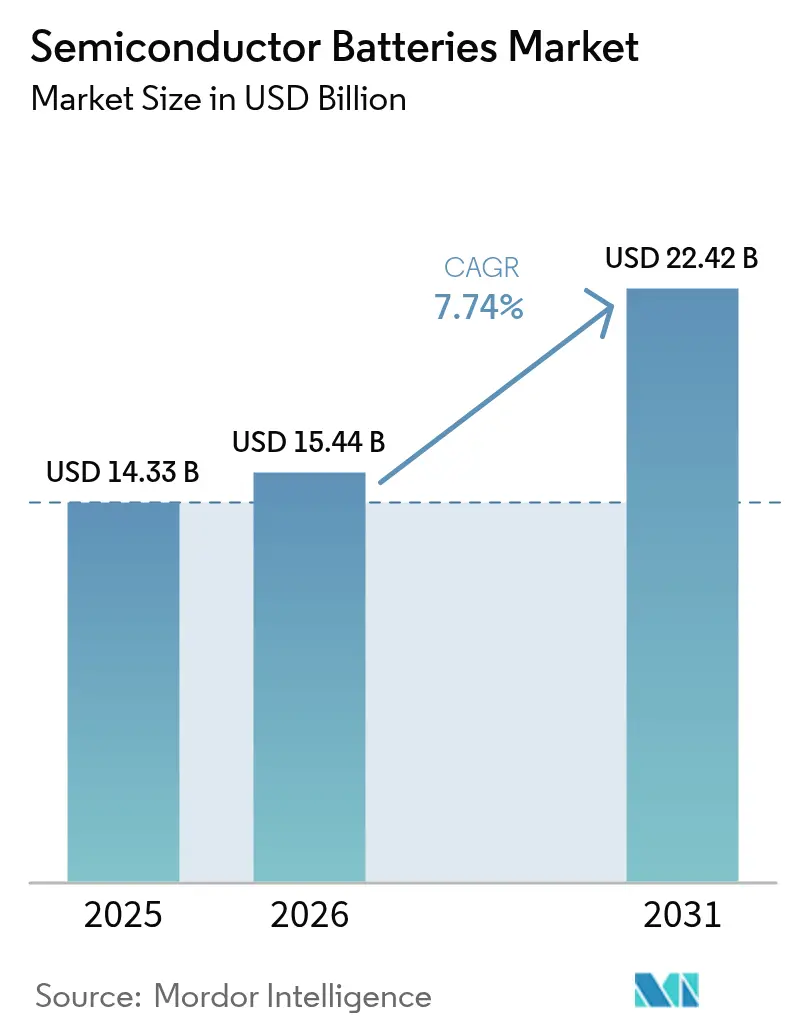
The Semiconductor Batteries Market size was valued at USD 14.33 billion in 2025 and estimated to grow from USD 15.44 billion in 2026 to reach USD 22.42 billion by 2031, at a CAGR of 7.74% during the forecast period (2026-2031).
Over the long term, the increasing adoption of electric vehicles and demand for mobile phones are expected to drive the market during the forecasted period.
On the other hand, technological challenges of batteries, like low energy density, lower lifespan, and slower charging capacity, are expected to hinder the growth of the market during the forecasted period.
Nevertheless, the increasing adoption of energy storage systems is expected to create huge opportunities for the Batteries for Semiconductor Market.
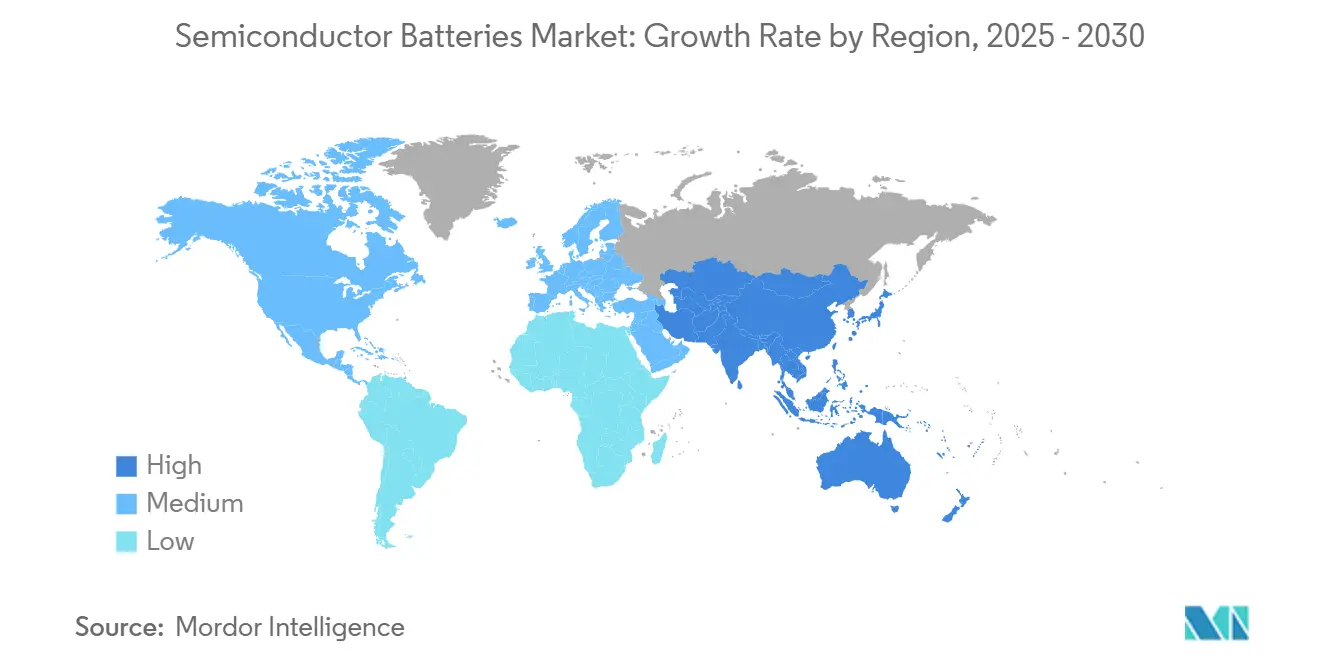
Asia-Pacific is expected to be a dominant region for the Consumer Battery Market due to the presence of a large battery manufacturing infrastructure in the region.
Note: Market size and forecast figures in this report are generated using Mordor Intelligence’s proprietary estimation framework, updated with the latest available data and insights as of 2026.
Global Semiconductor Batteries Market Trends and Insights
The Electric Vehicle Segment is Expected to Witness Significant Demand
- The electric vehicle (EV) market segment has witnessed substantial growth in recent years, and this has had a significant impact on the demand for batteries in the semiconductor market. As EVs continue to gain popularity due to their environmental benefits and technological advancements, the need for efficient and reliable batteries has become paramount. This surge in demand has generated a ripple effect throughout the semiconductor market, creating new opportunities and challenges for stakeholders in the industry.
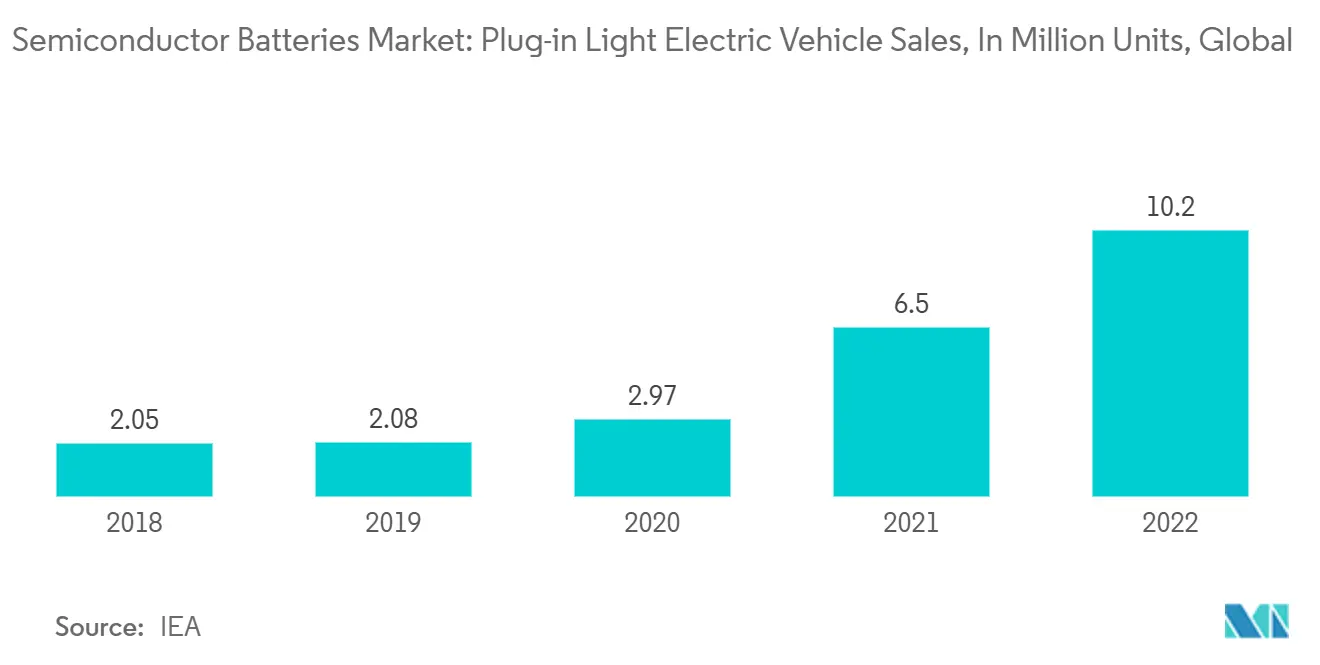
- According to the International Energy Agency, global electric vehicles are on the rise in 2022; the cumulative plug-in light electric vehicle sales globally were around 10.2 million units, recording a growth rate of 56.9% between 2021 and 2022 and a fivefold increase between 2018 and 2022.
- One of the key drivers behind the growth of the EV market segment is the increasing global awareness of environmental concerns. Governments and consumers are advocating for cleaner and more sustainable modes of transportation, and EVs have emerged as a viable solution. This has led to various incentives, tax breaks, and regulations promoting the adoption of electric vehicles. As a result, automakers are shifting their focus towards EV production, thus bolstering the demand for advanced battery technologies within the semiconductor market.
- For instance, in January 2023, the Government of Canada announced that at least 20% of the vehicles sold in the country will be electric vehicles from 2026, and it will gradually increase to 60% in 2030 and reach 100% by the end of 2035. This announcement was made to increase the adoption of electric vehicles in the country to meet the carbon emission targets set by Canada. The government has also announced offering production incentives to companies manufacturing electric vehicle batteries nationwide.
- The electric vehicle market segment's growth trajectory has a cascading effect on the semiconductor industry, creating a range of opportunities for market players. Semiconductor manufacturers have a chance to develop and supply the cutting-edge components and chips required for EV batteries, battery management systems, and power electronics. This translates to increased revenue potential and the chance to capitalize on the expanding EV market.
- With the increasing sales of electric vehicles and the supportive government policies, the segment is expected to increase further, increasing the research and development activities in the battery for semiconductor segment.


Asia-Pacific Account for Significant Market Growth
- The Asia-Pacific market segment for batteries in the semiconductor market is a pivotal and dynamic region with significant implications for the global semiconductor industry. This vast and diverse region encompasses many countries, each with its unique economic and technological landscape. The demand for batteries in the semiconductor market within the Asia Pacific region has been steadily rising, driven by factors that include rapid industrialization, increasing consumer electronics usage, and the burgeoning electric vehicle market.
- One of the critical drivers for the demand for semiconductor batteries in the Asia-Pacific region is the exponential growth in consumer electronics. This growth is driven by rising disposable incomes and a surging middle-class population, especially in countries like China and India. These consumers are increasingly adopting smartphones, laptops, and other personal electronic devices, which, in turn, fuels the need for advanced semiconductor batteries to power these gadgets. As consumer electronics become an integral part of everyday life, semiconductor manufacturers in the Asia-Pacific region are poised to benefit from this growing market segment.
- Additionally, the Asia-Pacific region has witnessed a substantial uptick in electric vehicle adoption. With an increasing focus on environmental sustainability and government incentives to promote electric vehicles, countries like China have become significant players in the electric vehicle market.
- For instance, according to the China Association of Automobile Manufacturers (AMMA), as of May 2023, China is the largest market for electric vehicles (EV), with an estimated 0.793 million plug-in hybrid Electric vehicles (PHEVs) and 2.146 million battery electric vehicles (BEVs) being sold. In 2022, the country recorded the highest sales of battery electric vehicles, with 5.45 million. It is expected to remain the world's largest electric car market during the forecast period.
- This, in turn, has led to soaring demand for advanced batteries in the semiconductor market, as EVs require efficient and reliable semiconductor components to manage power and battery performance. The growth of the electric vehicle market, therefore, offers substantial opportunities for semiconductor battery manufacturers in the Asia-Pacific region.
- In conclusion, the Asia-Pacific market segment for batteries in the semiconductor market is a dynamic and rapidly evolving landscape. The region's growing demand for semiconductor batteries, driven by consumer electronics and electric vehicles, offers significant opportunities for manufacturers. Therefore, per the above points, the Asia-Pacific region will dominate the battery for semiconductor market during the forecasted period.

Regulatory Landscape
Regulation affecting batteries used across semiconductor-enabled applications is tightening on sustainability, safety, and traceability. The EU Batteries Regulation (Regulation (EU) 2023/1542) sets a major compliance reference point for EV and industrial batteries, with obligations phasing in during 2025-2027. The timeline includes carbon footprint rules and the digital battery passport requirement for EV and industrial batteries by February 2027, which increases documentation and audit needs for suppliers of cells, materials, and pack-level electronics used in battery systems.
Safety and operational requirements for battery energy storage systems (BESS) are also being formalized through dedicated fire-risk guidance and design methodologies released in December 2024 by fire-safety authorities. This is raising the bar for permitting, engineering validation, and insurer requirements. In parallel, China is progressing technical standardization for solid-state batteries for EVs through national automotive standardization bodies, shaping how manufacturers label and position solid-state versus semi-solid chemistries and affecting qualification pathways for battery platforms used in electrified mobility and electronics supply chains.
Value Chain Analysis
The value chain starts with upstream raw materials and specialty chemicals, including lithium, nickel, cobalt, manganese, graphite, separators, and solid electrolytes such as sulfides. It also includes semiconductor-adjacent materials used for precision coatings and embedded electronics. Midstream participants comprise cathode and anode material producers, electrolyte and separator suppliers, and equipment providers enabling semiconductor-like processes such as Atomic Layer Deposition (ALD) for interface engineering in micro solid-state and advanced lithium-ion systems. Downstream, cell makers and module or pack integrators combine batteries with battery management systems and power electronics for consumer electronics, EVs, and energy storage systems, followed by OEM channels, EPCs or integrators for ESS, and aftermarket or service networks.
Recent supply-chain behavior underscores localization and long-term sourcing as core themes for scale-up and risk reduction. Samsung SDI signed a mid-to-long-term LFP cathode material supply agreement with L&F in March 2026 to support ESS production tied to its US manufacturing footprint. In October 2025, Samsung SDI joined BMW Group and Solid Power to advance automotive all-solid-state battery validation. The chain is also tightening around domestic capacity and material availability, as shown by Forge Nano partnering with Samsung SDI in June 2026 on a planned 3 GWh per year US battery facility in North Carolina, reinforcing the shift toward regionally anchored manufacturing and qualified input supply.
Competitive Landscape
The batteries for semiconductor market are highly fragmented and consolidated. The major companies (in no particular order) include Samsung SDI Co Ltd, Sony Corporation, Panasonic Corporation, Varta AG, and Toshiba Corporation, among others.
Semiconductor Batteries Industry Leaders
Samsung SDI Co Ltd
Sony Corporation
Panasonic Corporation
Varta AG
Toshiba Corporation
- *Disclaimer: Major Players sorted in no particular order

Market Opportunities and Future Outlook
Compliance-led product differentiation is a near-term opportunity for suppliers that can operationalize carbon-footprint accounting, labeling, and traceability for EV and industrial batteries under the EU Batteries Regulation (EU) 2023/1542, including readiness for the battery passport timeline in February 2027. This creates openings for semiconductor-enabled sensing, embedded identification, and data capture across cell and pack manufacturing, particularly where supply-chain mapping and substance disclosure are required and where lead times for audits and documentation affect customer qualification cycles.
Technology-defined segmentation is also emerging as governments formalize definitions for solid-state systems. In July 2026, China released a GB/T solid-state battery terminology and classification document for EVs that introduces a threshold to distinguish true solid-state designs from semi-solid or hybrid approaches. That helps clarify commercialization pathways for premium EVs and adjacent high-value applications, such as robotics, that can absorb higher BOM and validation costs. Separately, peer-reviewed results published in 2026, including work reported by MIT and the Technical University of Munich on grain-boundary-driven failure mechanisms, point to targeted processing and interface control as levers to raise performance limits, supporting semiconductor-grade process discipline and advanced coatings in next-generation cells for EVs, consumer electronics, and ESS.
Recent Industry Developments
- June 2026: Japan's Ministry of Economy, Trade and Industry (METI) reported progress under its Battery Stable Supply Assurance Plan, with five all-solid-state battery supply-chain projects approved as of Q1 2026 and total subsidies cited at about USD 660 million (105.7 billion yen). The program supports pilot lines and domestic supply-chain buildout, reinforcing Japan's push to commercialize all-solid-state technologies alongside established players active in batteries and materials.
- October 2025: BMW Group and Solid Power advanced their all-solid-state battery (ASSB) development path by adding Samsung SDI to the collaboration to support automotive validation work. Bringing a major cell manufacturer into the program strengthened the route from lab-scale cell designs to scalable manufacturing and qualification requirements for EV deployment.
- February 2024: The European Union continued implementing its Batteries Regulation (Regulation (EU) 2023/1542), accelerating industry preparation for phased-in requirements spanning 2025-2027, including carbon footprint reporting and the digital battery passport for EV and industrial batteries. This timeline pushed battery producers and upstream suppliers to invest earlier in traceability systems, documentation, and verified data pipelines that can be integrated into battery electronics and manufacturing workflows.


Research Methodology Framework and Report Scope
Market Definition and Coverage
This market covers revenue earned from semiconductor batteries that supply power to semiconductor-based devices and systems, where the battery is sold as a defined product and counted at the point of sale into end uses.
Scope exclusions: We exclude chargers, external power banks, and broader battery management electronics that are typically sold as separate components.
Segmentation Overview
- Type
- Lithium-Ion
- Nickel-Metal Hydride
- Lithium-Ion Polymer
- Sodium-Ion Battery
- End-User Application
- Consumer Electronics
- Electric Vehicles
- Energy Storage System
- Other End-User Applications
- Geography (Regional Market Analysis {Market Size and Demand Forecast till 2028 (for regions only)})
- North America
- United States
- Canada
- Rest of North America
- Asia-Pacific
- China
- India
- Japan
- South Korea
- Rest of Asia-Pacific
- Europe
- Germany
- United Kingdom
- France
- Italy
- Rest of Europe
- South America
- Chile
- Brazil
- Argentina
- Rest of South America
- Middle-East and Africa
- Saudi Arabia
- United Arab Emirates
- South Africa
- Egypt
- Rest of Middle-East and Africa
- North America
Data Sources, Market Sizing, and Validation
Desk Research
Desk research is used to set the base structure of the market and to anchor the model with observable indicators that can be checked over time. We use public sources such as US Energy Information Administration battery and energy storage releases, International Energy Agency EV and battery supply chain statistics, UN Comtrade trade flows for cells and related materials, and USGS mineral supply summaries (lithium, nickel, cobalt) to understand demand direction and supply tightness.
In parallel, we review company filings, investor presentations, and product documentation to map where semiconductor batteries are being adopted and how pricing tends to move with scale and chemistry mix. Patent databases are also scanned to see where new solid-state and sodium-ion activity is concentrated, and an import/export shipment-level database is used selectively to sanity-check trade intensity by region. These sources are illustrative, and we also used other public references for collection, cross-checking, and clarification.
Primary Interviews and Surveys
Primary work is used to validate what desk research cannot show clearly, especially adoption pace by application and the realistic pricing path by chemistry and form factor. We speak with a mix of battery suppliers, component ecosystem participants, and downstream users across APAC, EMEA, and the Americas to confirm assumptions on volumes, qualification timelines, and channel margins, then adjust the model where needed.
Distribution of primary research fieldwork respondents
| Company type | Respondent position | Region |
|---|---|---|
| Top tier: 32% | CXOs: 16% | APAC: 47% |
| Mid tier: 51% | Functional/Unit leaders: 28% | EMEA: 31% |
| Smaller Players: 17% | Managers: 56% | Americas: 22% |
Market-Sizing & Forecasting
The market is sized using a top-down build where battery demand pools are reconstructed from application-level unit activity and then converted to value using typical capacity and pricing ranges. For example, consumer electronics and wearables are translated using device shipments, average battery capacity per device (mAh or Wh), and expected replacement rates, which are then aligned with the mix of lithium-ion, lithium polymer, NiMH, and sodium-ion batteries.
To keep totals realistic, we corroborate the output with selective bottom-up approximations such as sampled ASP times estimated volume for key application clusters, plus channel checks on margin layers. Inputs that matter in this market include device shipment trends, EV and hybrid penetration, energy storage deployments, chemistry mix shifts, average battery capacity progression, and raw material price direction that impacts cell pricing. Forecasting is done using scenario analysis supported by multivariate regression where the main drivers are shipments, EV adoption, and energy storage additions, with expert feedback used to set conservative and aggressive bands. When gaps show up in smaller applications, proxy ratios are applied from similar end uses and then re-checked with interviews before finalizing.
Data Validation & Update Cycle
Validation is handled through several checks so the model does not drift away from real-world signals. We compare calculated market totals with independent indicators like trade intensity, chemistry share commentary in public disclosures, and broad battery price movements, and then investigate any variance that looks too large for a given region or year.
Before sign-off, the model and assumptions go through multi-step internal review, and re-contacts are triggered when a major input changes, such as a shift in EV demand or a clear pricing break. The report is refreshed annually, with interim updates when material events occur, and a fresh analyst pass is completed right before delivery so clients receive the latest updated view.
Mordor Intelligence's Semiconductor Batteries Market Size Compared Against Other Published Estimates
Published market values for semiconductor batteries can differ because companies do not always count the same battery types and end uses, and they anchor their models to different base years. Differences in how pricing is treated over time and how fast adoption is assumed to move across electronics, EVs, and energy storage can also create visible gaps.
Chargers and standalone power accessories are not counted, and that item sits outside Mordor Intelligence's scope, which is one reason our 2026 value does not automatically scale up to match broader battery-style totals. Other estimates may also lean heavily on a single base year, apply higher average battery values per device without checking capacity ranges, or keep currency conversion timing static even when exchange rates move across the forecast window.
Benchmark comparison
| Source | Market Size | Gaps in Research Methodology |
|---|---|---|
| Mordor Intelligence | USD 15.44 B (2026) | |
| Trade Journal A | USD 14.70 B (2024) | Uses an earlier base year and may carry forward a single growth rate without fully re-basing chemistry mix and capacity-per-device changes, which can shift the starting value versus a 2026 anchored model. |
| Global Consultancy B | USD 26.97 B (2024) | Likely includes a broader battery definition that can pull in adjacent categories and wide end-use coverage, which inflates the addressable revenue compared with a tighter semiconductor-battery product view. |
The spread mainly comes from what gets counted as a semiconductor battery product and how base year and pricing are handled. By tying totals to observable demand signals like device shipments, EV adoption, and energy storage additions, our estimate stays traceable to inputs that can be repeated and re-checked.


Key Questions Answered in the Report
How big is the Batteries For Semiconductor Market?
The Batteries For Semiconductor Market size is expected to reach USD 15.44 billion in 2026 and grow at a CAGR of 7.74% to reach USD 22.42 billion by 2031.
What is the current Batteries For Semiconductor Market size?
In 2026, the Batteries For Semiconductor Market size is expected to reach USD 15.44 billion.
Who are the key players in Batteries For Semiconductor Market?
Samsung SDI Co Ltd, Sony Corporation, Panasonic Corporation, Varta AG and Toshiba Corporation are the major companies operating in the Batteries For Semiconductor Market.
Which is the fastest growing region in Batteries For Semiconductor Market?
Asia Pacific is estimated to grow at the highest CAGR over the forecast period (2026-2031).
Which region has the biggest share in Batteries For Semiconductor Market?
In 2025, the Asia Pacific accounts for the largest market share in Batteries For Semiconductor Market.
What years does this Batteries For Semiconductor Market cover, and what was the market size in 2025?
In 2025, the Batteries For Semiconductor Market size was estimated at USD 15.44 billion. The report covers the Batteries For Semiconductor Market historical market size for years: 2019, 2020, 2021, 2022, 2023 and 2024. The report also forecasts the Batteries For Semiconductor Market size for years: 2026, 2027, 2028, 2029, 2030 and 2031.
Page last updated on:





