
Market Overview
| Study Period | 2021 - 2031 |
|---|---|
| Forecast Data Period | 2026 - 2031 |
| Base Year Market Size (2025) | USD 150 Million |
| Market Size (2026) | USD 160.67 Million |
| Market Size (2031) | USD 226.49 Million |
| Growth Rate (2026 - 2031) | 7.11 % |
| Market Concentration | Medium |
Major Players *Disclaimer: Major Players sorted in no particular order Image © Mordor Intelligence. Reuse requires attribution under CC BY 4.0. | |
Nepal Seed Market Analysis by Mordor Intelligence
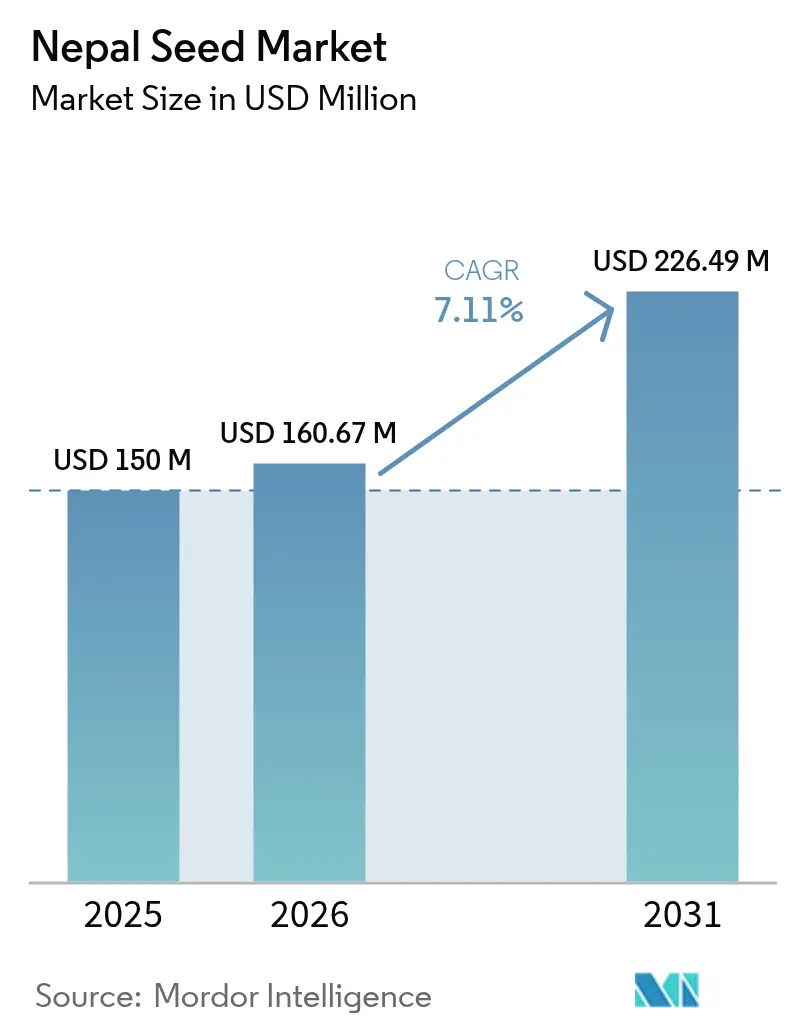
The Nepal seed market size is expected to grow from USD 150 million in 2025 to USD 160.67 million in 2026 and is forecast to reach USD 226.49 million by 2031 at 7.11% CAGR over 2026-2031. Rising commercialization, supportive subsidies, and rapid hybrid penetration are driving the demand for certified seeds, while domestic multiplication capacity lags behind the growth in imports. Private firms now dominate the release of varieties, community seed networks fill the gaps in hill districts, and protected cultivation in the Terai is increasing vegetable seed turnover. Import dependence exposes the Nepal seed market to currency swings and phytosanitary delays, yet it also signals white-space potential for local processing hubs. Competitive intensity is moderate as the top five suppliers control a significant portion of revenue, leaving room for niche players that can deliver climate-smart genetics and reliable cold-chain logistics.
Key Report Takeaways
- By crop type, grains and cereals accounted for 43.60% of the Nepal seed market size in 2025, while vegetables led with a 9.45% CAGR through 2031.
- By breeding technology, open-pollinated varieties and hybrid derivatives commanded a 56.30% share of the 2025 Nepal seed market revenue, while hybrids expanded at a 10.35% CAGR through 2031.
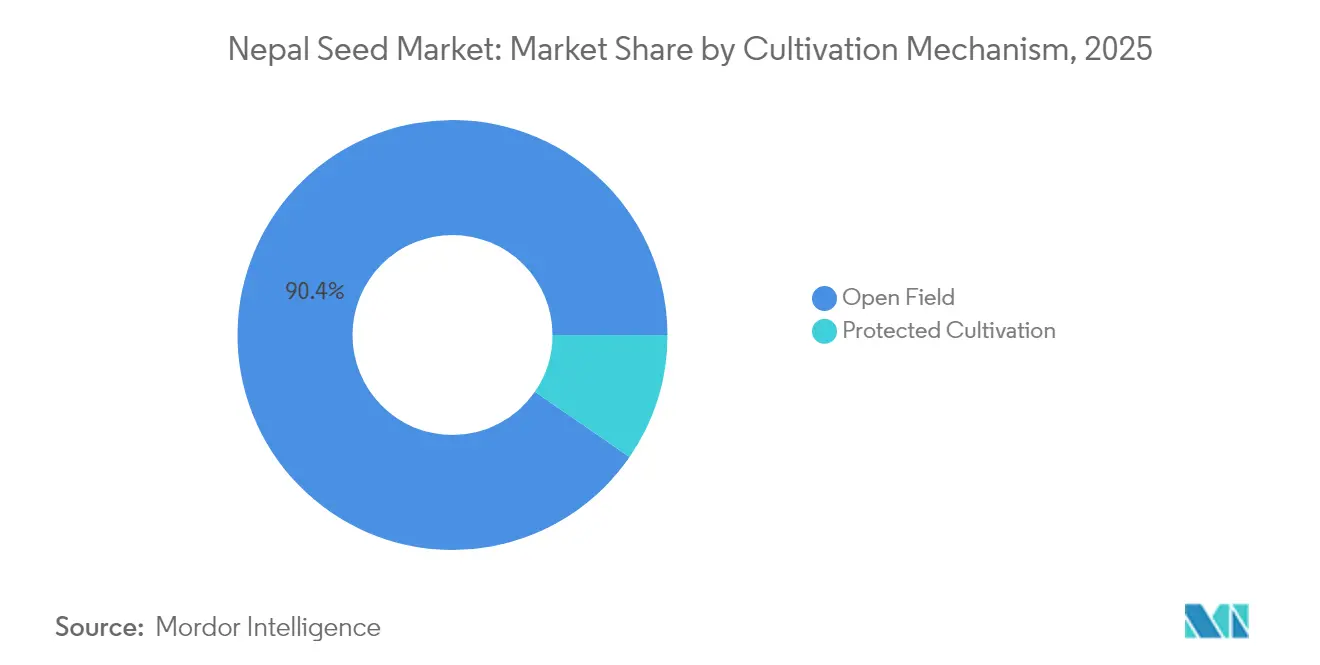
- By cultivation mechanism, open-field systems held 90.40% of the 2025 Nepal seed markets, while protected cultivation produced the fastest 10.82% CAGR through 2031.
Note: Market size and forecast figures in this report are generated using Mordor Intelligence’s proprietary estimation framework, updated with the latest available data and insights as of 2026.
Nepal Seed Market Trends and Insights
Drivers Impact Analysis*
| Driver | (~) % Impact on CAGR Forecast | Geographic Relevance | Impact Timeline |
|---|---|---|---|
| Growing agricultural commercialization | +1.8% | National, early gains in Terai | Medium term (2-4 years) |
| Rising adoption of hybrid and open-pollinated variety seeds | +1.5% | Irrigated Terai and mid-hill valleys | Medium term (2-4 years) |
| Government input-subsidy schemes | +1.2% | Prime Minister Agricultural Modernization Project (PMAMP) districts | Short term (≤ 2 years) |
| Expansion of community-based seed banks | +0.9% | Hill and mountain areas | Long term (≥ 4 years) |
| Climate-smart seed research and development incentives | +0.7% | Drought-prone western Terai and heat-stressed plains | Long term (≥ 4 years) |
| Cross-border seed trade liberalization | +0.6% | National via South Asian Association for Regional Cooperation (SAARC) corridor | Medium term (2-4 years) |
| Source: Mordor Intelligence | |||
Growing Agricultural Commercialization
The shift from subsistence to market-oriented farming is rewriting seed demand across Nepal's 750,000-hectare wheat belt and 1.4 million-hectare rice area. Contract farming for export processors nowadays requires documented seed sources, which has led to a significant increase in certified-seed penetration in vegetable clusters. Lumbini Province, which contributes 14.2% of the national GDP and employs 67% of its households in agriculture, has seen commercial maize acreage double since 2022, as Kalash Dairy in Parsa District began purchasing grain for cattle feed, offering farmers income roughly three times their previous crop returns. The Nepal Trade Integration Strategy 2023-2028 mandates that banks allocate 15% of their lending to agriculture by July 2026, a policy lever likely to channel capital into cold storage, grading lines, and contract farming networks that will further tighten quality specifications and pull certified seed deeper into the value chain.
Rising Adoption of Hybrid and Open-Pollinated Variety Seeds
Demonstrated yield advantages are eroding farmer reluctance to pay premium prices for improved genetics. The International Rice Research Institute's (IRRI) drought-tolerant Sookha Dhan rice varieties deliver gains of 0.8 to 1.2 metric tons per hectare under water stress, a margin that translates into USD 150 to USD 225 of additional revenue per hectare at prevailing paddy prices. The Nepal Agricultural Research Council released Hardinath Hybrid-1 in 2018, the country's first hybrid rice. Initially, it captured small acreage in Chitwan and Nawalparasi, but suffered a setback in 2022 when a neck-blast epidemic destroyed 5,000 hectares, underscoring the need for disease-resistant breeding pipelines[1]Source: Food and Agriculture Organization, “Neck-Blast Epidemic Report,” fao.org. . The February 2022 cabinet policy, which granted variety-release authority to Lumbini Seed Company, Gorkha Seed, and Sean Seed Service Center, is likely to shorten the time-to-market for private-sector hybrids from 8 years to 4 years, thereby accelerating the pipeline of locally adapted genetics.
Government Input-Subsidy Schemes
Subsidy programs are the single most effective lever for overcoming smallholder price sensitivity. In 2022, the Prime Minister's Agriculture Modernization Project offered 50% cost-share grants for hybrid seeds, biofertilizers, and drip irrigation to farmers in designated value-chain zones, resulting in a 26% increase in rice seed-replacement rates in project districts compared to a national average of 8.7% for improved varieties. Subsidy leakage remains a concern, with anecdotal reports of dealers diverting mini-kits to non-target farmers or inflating invoices. The shift toward digital vouchers and biometric verification under the Agriculture Management Information System is tightening accountability and ensuring that subsidies reach their intended beneficiaries.
Expansion of Community-Based Seed Banks
Localized multiplication through community seed banks is proving to be a cost-effective complement to formal supply chains, particularly for landraces and open-pollinated varieties that multinational firms often overlook. In 2022, the Community Seed Banks Association of Nepal, legally registered as the world's first national Community Seed Bank (CSB) federation, operates 25 community seed banks that curate over 200 local varieties. The association has developed a five-star classification system to benchmark storage, documentation, and distribution practices. The Nepal Agricultural Research Council has incorporated the Community Seed Banks Association of Nepal (CSBAN) into its annual program of work, marking a policy milestone that channels public-sector breeder seed to community networks for multiplication and ensures that new releases reach remote districts within two seasons, rather than the previous five-year lag. This hybrid approach is particularly relevant for pulses and oilseeds, where certified-seed production remains minimal, with lentils recording only 0.8 metric tons in 2023/24, leaving farmer-saved seed as the default option for 95% of growers.
Restraints Impact Analysis*
| Restraint | (~) % Impact on CAGR Forecast | Geographic Relevance | Impact Timeline |
|---|---|---|---|
| Limited rural cold chain storage | -1.1% | Hill and mountain districts | Short term (≤ 2 years) |
| Under developed domestic seed testing labs | -0.8% | National bottlenecks | Medium term (2-4 years) |
| Small holder price sensitivity | -0.9% | Marginal rain-fed zones | Medium term (2-4 years) |
| Prevalence of informal seed exchanges | -1.0% | Cereal systems nationwide | Long term (≥ 4 years) |
| Source: Mordor Intelligence | |||
Limited Rural Cold Chain Storage
Seed viability losses during the hot pre-monsoon months are eroding farmer confidence in certified seed and forcing dealers to over-order, inflating working-capital costs. Only six mini cold storages operate in Sindhuli district, each with a capacity of 16 metric tons, while the Investment Board of Nepal's USD 34.45 million provincial warehouse program remains in the early rollout stage, leaving most rural points of sale without temperature-controlled storage[2]Source: Investment Board Nepal, “Provincial Warehouse and Cold Storage Program,” ibn.gov.np. The absence of a cold chain is particularly damaging for vegetable hybrids, where germination rates drop from 90% to 60% after 90 days at ambient temperatures above 30 degrees Celsius. This quality deterioration is often masked by dealers offering informal replacement guarantees, which cut into margins and discourage inventory depth.
Under Developed Domestic Seed Testing Labs
Capacity constraints at the Seed Quality Control Centre and provincial labs are delaying variety registration, import clearances, and quality certifications, creating bottlenecks that favor incumbents and deter new entrants. The Nepal Trade Integration Strategy 2023-2028 allocates USD 3,750 to upgrade the Central Phytosanitary and Diagnostics Lab and USD 112,500 to accredit four labs to international standards. These budgets fall short of the equipment and staffing needs to process the 2,500 annual seed-lot submissions that current import volumes imply. The lack of accredited labs also undermines enforcement against counterfeit seed, with anecdotal reports of repackaged grain sold as certified seed in remote districts, a practice that damages the reputation of legitimate suppliers and perpetuates farmer reliance on informal channels.
*Our forecasts treat driver/restraint impacts as directional, not additive. The impact forecasts reflect baseline growth, mix effects, and variable interactions.
Segment Analysis
By Crop Type: Vegetables Outpace Cereal Mainstay
Grains and cereals accounted for a 43.60% share of the Nepal seed market in 2025, led by rice, maize, and wheat. Rice seed-replacement rates have climbed to 26% in Prime Minister Agriculture Modernization Project (PMAMP) districts, driven by Hardinath Hybrid-1 and IRRI's Sookha Dhan drought-tolerant lines, while maize replacement stands at 15% and wheat at 15%, constrained by farmer preference for saved seed and the lower seed rates of open-pollinated varieties. The Southern Agricultural Science and Technology Park, launched in August 2024 at Agriculture and Forestry University in Chitwan, is piloting precision phenotyping for vegetable hybrids and CRISPR-edited rice, a research infrastructure that could accelerate variety release timelines and tilt investment toward higher-value crops.
Vegetables led with 9.45% of CAGR through 2031, tomato production reached 422,703 metric tons across 22,911 hectares in 2021/22, with hybrids requiring only 125 to 175 grams per hectare versus 400 to 500 grams for open-pollinated lines, a seed-rate advantage that offsets higher per-kilogram prices and delivers the uniformity demanded by wholesale buyers in Kathmandu, Pokhara, and cross-border markets. Chilli cultivation spanned 7,945 hectares in 2021/22, yielding 75,664 metric tons, with Akabare chilli alone accounting for 1,728 hectares and 11,224 metric tons, while sweet pepper occupied 1,931 hectares and produced 20,002 metric tons, both crops benefiting from protected cultivation that extends the growing season and reduces pest pressure.




By Breeding Technology: Hybrids Gain Share as Open-Pollinated Variety Seeds Dominance Erodes
Open-pollinated varieties and hybrid derivatives accounted for 56.30% of the 2025 revenue in the Nepal seed market, reflecting their entrenched position in cereal systems where farmers save seeds and multiplication costs are low. The Nepal Agricultural Research Council released six drought-adapted "Sukkha" varieties and two flood-tolerant lines, expanding the genetic toolkit for climate resilience. Meanwhile, Bangor University collaborated with the Nepal Agricultural Research Council (NARC) on the Clustered Regularly Interspaced Short Palindromic Repeats (CRISPR) editing of Jumli Marshi rice, utilizing KASP markers to accelerate trait introgression and reduce breeding cycles from eight years to four years.
Hybrids expanded at a 10.35% CAGR through 2031, driven by vegetable demand and government subsidies that cover up to 50% of seed costs under the Prime Minister's Agriculture Modernization Project (PMAMP), thereby narrowing the affordability gap that had historically deterred adoption. The February 2022 cabinet policy, which granted variety-release authority to Lumbini Seed Company, Gorkha Seed, and Sean Seed Service Center, is projected to accelerate hybrid pipelines. As a result, private firms can now bypass the lengthy National Seed Board evaluation process and register varieties based on multi-location trials conducted under their own research and development licenses.
By Cultivation Mechanism: Protected Systems Unlock Year-Round Production
Open-field systems accounted for 90.40% of the 2025 Nepal seed market size, reflecting Nepal's smallholder structure and the dominance of rain-fed cereals. Open-field systems will remain the backbone of cereal production, with 98% of paddy transplantation projected to be completed by August 2024 across Nepal's 1.4 million hectares of rice area. Yield stagnation at 2.5 metric tons per hectare for wheat and 3.5 tonnes for rice is prompting policymakers to explore fertigation and drip irrigation as complements to improved seed.
Protected cultivation is projected to grow at the fastest rate, with a 10.82% CAGR through 2031. IZ's GRAPE program trained 20 farmers in Dadeldhura district on plastic-house construction and low-tunnel techniques in 2024, and immediate adoption by participants demonstrated that even low-cost structures costing USD 500 to USD 1,000 per unit can extend the vegetable growing season by 60 days and reduce pest pressure by 40%, lifting yields from 18.45 metric ton per hectare to over 25 metric tons for tomatoes.
Geography Analysis
The Nepal seed market is shaped by agro-climatic gradients that range from the Terai plains at an elevation of 100 meters to the high Himalayas above 4,000 meters, creating distinct demand profiles for heat-tolerant, drought-adapted, and cold-hardy genetics. The Terai belt, spanning Morang, Rupandehi, Bara, and Sarlahi districts, accounts for a significant portion of commercial seed sales, driven by irrigated rice and maize systems, intensive vegetable production, and proximity to Indian supply chains that deliver hybrid seed within 48 hours of order.
Lumbini province contributes a significant portion of the national GDP, with households in agriculture spanning 426,000 hectares, 56.7% of which are under irrigation. This resource endowment supports double cropping and raises seed-replacement rates above the national average. Chitwan District, home to the Southern Agricultural Science and Technology Park, which was launched in August 2024 at the Agriculture and Forestry University, is emerging as a research hub for precision phenotyping and CRISPR-edited rice. This concentration of breeding capacity could attract multinational investment and reduce the time required for variety release.
Hill and mountain districts face acute seed-access challenges, with distribution costs 40 to 60% higher than in the Terai due to poor road connectivity and the absence of cold-chain infrastructure, yet these zones are also the custodians of landraces that offer climate resilience and niche market premiums. The Community Seed Banks Association of Nepal operates 25 community seed banks that curate over 200 local varieties, utilizing a five-star classification system to benchmark storage, documentation, and distribution practices. CSBAN's "Our Seed" mobile app enables farmers to request seeds via SMS, reducing search costs in fragmented geographies.
Regulatory Landscape
Nepal seed-sector governance is anchored in the Seeds Act 2045 (1988), amended in 2022. The National Seed Board sets policy and quality standards, while the Seed Quality Control Centre (SQCC) functions as the main implementing body for licensing, inspections, and enforcement. Operational requirements for varietal release, registration, and the licensing of seed inspectors, samplers, and analysts are set out in the Seed Regulation 2069 (2013), shaping legal market entry for imported and domestically multiplied seeds.
Federalization has added a tiered framework through provincial seed legislation (for example, the Seed Act 2076 (2019)), increasing the need for province-level coordination alongside the federal Ministry of Agriculture and Livestock Development. In parallel, the 2022 amendment has been positioned to align domestic rules more closely with international obligations referenced in policy discussions, such as WTO, CBD, and ITPGRFA. This affects how companies structure variety registration, labeling, and cross-border germplasm and seed movement compliance.
Competitive Landscape
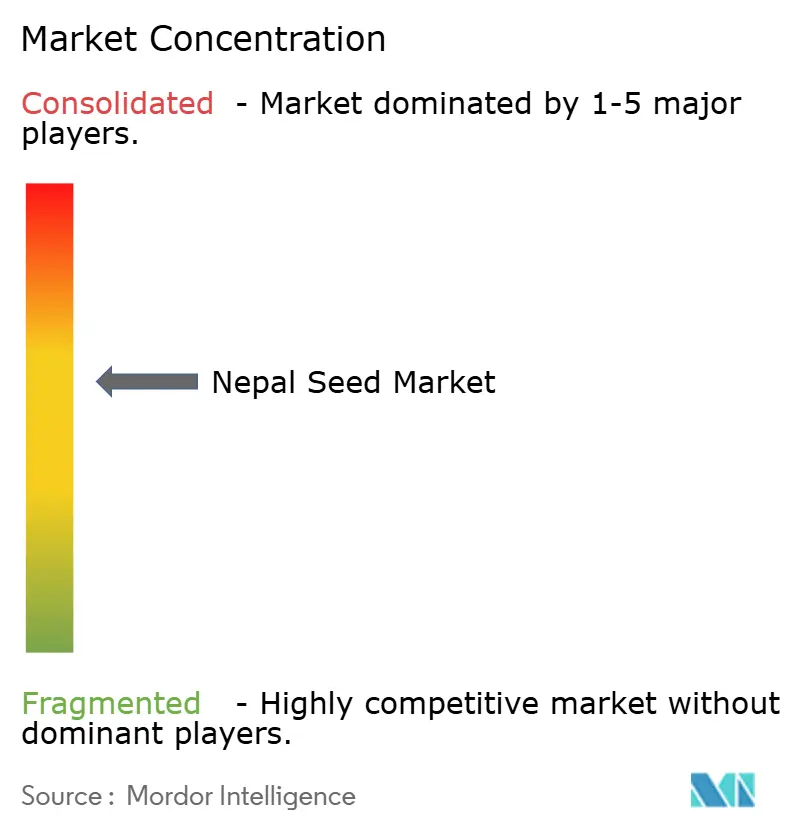
The Nepal seed market exhibits moderate concentration, with the top players including Anamolbiu Private Limited, UPL Limited, East-West Seed International B.V., Syngenta Group, and Bayer AG commanding a significant portion of 2024 revenue, yet competitive intensity is rising as the February 2022 cabinet policy that granted variety-release authority to Lumbini Seed Company, Gorkha Seed, and Sean Seed Service Center dismantles the public-sector monopoly on variety registration and opens pathways for private research and development investment.
Opportunities are concentrated in pulses and oilseeds, where lentil seed production totaled only 0.8 metric tons in 2023/24 and certified chickpea seed is virtually absent, leaving 95% of growers reliant on farmer-saved material that carries disease inoculum and genetic drift. Merging disruptors include community seed banks, which operate outside formal regulatory frameworks but have achieved legal recognition through the Community Seed Banks Association of Nepal, the world's first nationally registered CSB federation, and have developed a mobile app that catalogues over 200 local varieties and enables SMS-based seed requests, a distribution innovation that incumbents have yet to match.
Technology is becoming a competitive lever, with the Southern Agricultural Science and Technology Park, launched in August 2024 at Agriculture and Forestry University in Chitwan, piloting precision phenotyping and CRISPR-edited rice. This research infrastructure could accelerate variety release timelines and tilt investment toward higher-value crops.
Nepal Seed Industry Leaders
Anamolbiu Private Limited
UPL Limited
East-West Seed International B.V.
Syngenta Group
Bayer AG
- *Disclaimer: Major Players sorted in no particular order

Market Opportunities and Future Outlook
Digitization and traceability are expanding operating space within Nepal's formal seed system, particularly where quality control and early generation seed (EGS) coordination limit private scaling. The government's launch of DESIS 2.0 in December 2024 introduced an integrated digital mechanism for seed tracking and for coordinating EGS demands across federal, provincial, and local tiers. This improves the practical addressability of services such as planning tools, seed inventory visibility, and compliance-ready distribution workflows for companies and cooperatives.
Policy-led import substitution and export-oriented production targets also create space for local multiplication and processing capacity. This is most visible in vegetables, where hybrid penetration and protected cultivation are increasing seed turnover. The National Seed Vision 2013-2025 frames goals to reduce vegetable seed imports and scale vegetable seed exports (including a stated target of 750 Mt per year), supporting opportunities for contract production, seed conditioning, and cold-chain capable handling in the Terai and in emerging research and testing clusters. Sector evaluations also point to execution gaps, including shortages of trained plant breeders and seed technologists, and limited public-private partnership depth, which in turn supports demand for private technical services, training, and accredited testing capacity that can compress release-to-commercialization cycles.
Recent Industry Developments
- June 2026: CIMMYT convened a two-day Partners Forum and field visit in Banke on 5-6 June 2026 focused on maize commercialization, innovation, and pathways to private-sector investment in Nepal. The engagement reinforced partner alignment around scaling formal seed and grain value chains in the Terai, where commercial demand links more directly to certified seed use.
- July 2025: The UK-backed CASA program reported mobilizing NPR 830 million for Nepal's agribusiness ecosystem, supporting finance flows into priority value chains. Greater capital availability for agribusiness operations supports the enabling environment for seed distribution, storage, and contract-farming models that rely on documented seed sourcing.
- December 2024: Nepal's Ministry of Agriculture and Livestock Development officially launched DESIS 2.0, attended by more than 150 seed stakeholders. The Digital Seed Information System uses digital tools (including blockchain-linked tracking and mobile/online interfaces) to improve seed traceability and coordination from breeders to farmers, increasing the practical utility of compliance and quality assurance across the seed supply chain.


Research Methodology Framework and Report Scope
Market Definition and Coverage
For this methodology, the Nepal seed sector market is defined as the value of seeds sold for sowing within Nepal, across formal and organized sales, for open-field and protected cultivation uses.
Scope exclusions: We exclude grains or produce used for food or feed, and any seed volumes that are not sold for farm-level sowing.
Segmentation Overview
- By Crop Type
- Grains and Cereals
- Pulses and Oilseeds
- Cotton
- Vegetables
- Other Crops
- By Breeding Technology
- Hybrids
- Open-Pollinated Varieties and Hybrid Derivatives
- By Cultivation Mechanism
- Open-field
- Protected Cultivation
Data Sources, Market Sizing, and Validation
Desk Research
Desk research was used to build the initial structure for demand and supply indicators, before assumptions were stress-tested using field inputs. We relied on public agriculture statistics and policy documents, including Ministry of Agriculture and Livestock Development releases, Nepal Rastra Bank macro and FX series, Customs trade statistics, and FAOSTAT crop area and yield references where helpful for cross-checking.
For pricing and movement of seed lots, we also reviewed seed certification and inspection notes from national quality control bodies, plus trade association updates and reputed press coverage on input availability and subsidy programs. Company annual reports, investor updates, and product catalogs were used to understand seed portfolios and price bands, then those were sanity-checked using a paid subscription that supports company financials and a separate subscription that supports shipment-level import or export checks. These desk sources are illustrative, and many other public and proprietary references were also used to collect data, validate ranges, and clarify open questions.
Primary Interviews and Surveys
We use interviews and surveys with Nepal-based seed producers, importers, distributors, agro-dealers, public researchers, and growers. Their feedback checks replacement demand, hybrid adoption, channel markups, availability gaps, and price movement, helping us adjust desk findings and reconcile the final estimate.
Distribution of primary research fieldwork respondents
| Company type | Respondent position |
|---|---|
| Top tier: 30% | CXOs: 15% |
| Mid tier: 45% | Functional/Unit leaders: 30% |
| Smaller Players: 25% | Managers: 55% |
Market-Sizing & Forecasting
Sizing starts from a top-down demand pool build, where crop-wise planted area and typical seeding rates are translated into an addressable seed requirement, which is then adjusted using realistic replacement and purchase shares for commercial seed. Once that backbone is in place, we corroborate it with selective bottom-up approximations, such as sampled price per kilogram by crop and channel, and a roll-up of reported sales ranges from a set of suppliers and distributors.
A few inputs matter a lot in Nepal, so they were treated carefully and rechecked during interviews. These include hybrid penetration by crop (especially in vegetables), protected cultivation expansion and its seed intensity, import dependence for specific crop seeds, seasonal price swings linked to FX movement, and the spread between certified and non-certified seed offerings in trade. For forecasting, scenario analysis was used with a base case that reflects expected policy continuity, import availability, and gradual adoption, then cross-checked against expert expectations on how fast protected cultivation and hybrid use can expand. Where bottom-up details were missing for smaller channels, gaps were filled using conservative range-based pricing and volume shares anchored to the demand pool math, then reviewed again for outliers.
Data Validation & Update Cycle
Validation is done through multiple checks so the model stays tied to observable signals rather than a single assumption. We compare outputs with independent indicators such as seed import trends, reported certified seed availability, and crop area movements, then large variances are traced back to the specific crop, price, or adoption input causing the change.
Before sign-off, the dataset and calculations go through step-by-step analyst reviews, followed by a final variance scan against prior editions and recent developments. If a material change is identified, like a sharp FX shift or a policy move that impacts seed subsidies or import clearance, experts are re-contacted to confirm direction and magnitude. Reports are refreshed annually, and a final pre-delivery check is done so clients receive the latest updated view.
Mordor Intelligence's Seed Sector Analysis Nepal Market Size Compared Against Other Published Estimates
Published market values for Nepal seeds can look far apart, even when they appear to cover the same product set, because the counted products and the pricing basis are not always aligned. Differences also come from whether the estimate is anchored on sowing-seed demand signals or whether it is closer to a broader agriculture input spend view.
The table below shows that part of the spread is explained by scope boundaries around what qualifies as seed sold for sowing, and whether protected cultivation seed demand is explicitly modeled or treated as a small add-on. Another common gap driver is the way prices are converted to USD, since using one-time FX assumptions versus period averages can move a Nepal estimate noticeably in a given year.
Benchmark comparison
| Source | Market Size | Gaps in Research Methodology |
|---|---|---|
| Mordor Intelligence | USD 150 M (2025) | |
| Industry Publisher A | USD 135 M (2025) | Uses a narrower commercial-only view that tends to undercount farm-level sowing seed sold through mixed channels, and it applies conservative hybrid adoption shares for vegetables and other high-value crops. |
| Trade Journal B | USD 190 M (2025) | Likely folds in adjacent planting material and broad input spending proxies, and it appears to apply a single high price assumption without checking crop-wise pack sizes, certification mix, and import-led price dispersion. |
The table points to a scope and pricing mix difference, and in Mordor Intelligence's model the number is built only around seeds sold for farm-level sowing, with crop-wise seeding demand, hybrid share, and protected cultivation intensity used as the main guardrails. By keeping these inputs traceable to field checks and public signals like imports and crop area, the estimate stays repeatable and easier to defend when buyers compare year-on-year changes.


Key Questions Answered in the Report
What is the size of the Nepal seed market in 2026?
The Nepal seed market size is USD 160.67 million in 2026 and is projected to grow to USD 226.49 million by 2031.
Which segment is expanding fastest?
Vegetable seeds are projected to grow at a 9.45% CAGR through 2031, driven by protected cultivation and urban demand.
What limits certified seed use in hill districts?
Limited cold-chain storage and the dominance of informal seed exchanges keep certified penetration low in remote areas.
Which policy helps smallholders adopt hybrids the most?
The Prime Minister Agriculture Modernization Project covers up to 50% of hybrid seed costs, lifting rice replacement rates to 26% in its districts.
Page last updated on:





