
Market Overview
| Study Period | 2021 - 2031 |
|---|---|
| Forecast Data Period | 2026 - 2031 |
| Base Year Market Size (2025) | USD 480.0 Million |
| Market Size (2026) | USD 518.54 Million |
| Market Size (2031) | USD 762.83 Million |
| Growth Rate (2026 - 2031) | 8.03 % |
| Market Concentration | Medium |
Major Players *Disclaimer: Major Players sorted in no particular order Image © Mordor Intelligence. Reuse requires attribution under CC BY 4.0. | |
India Forage Seed Market Analysis by Mordor Intelligence
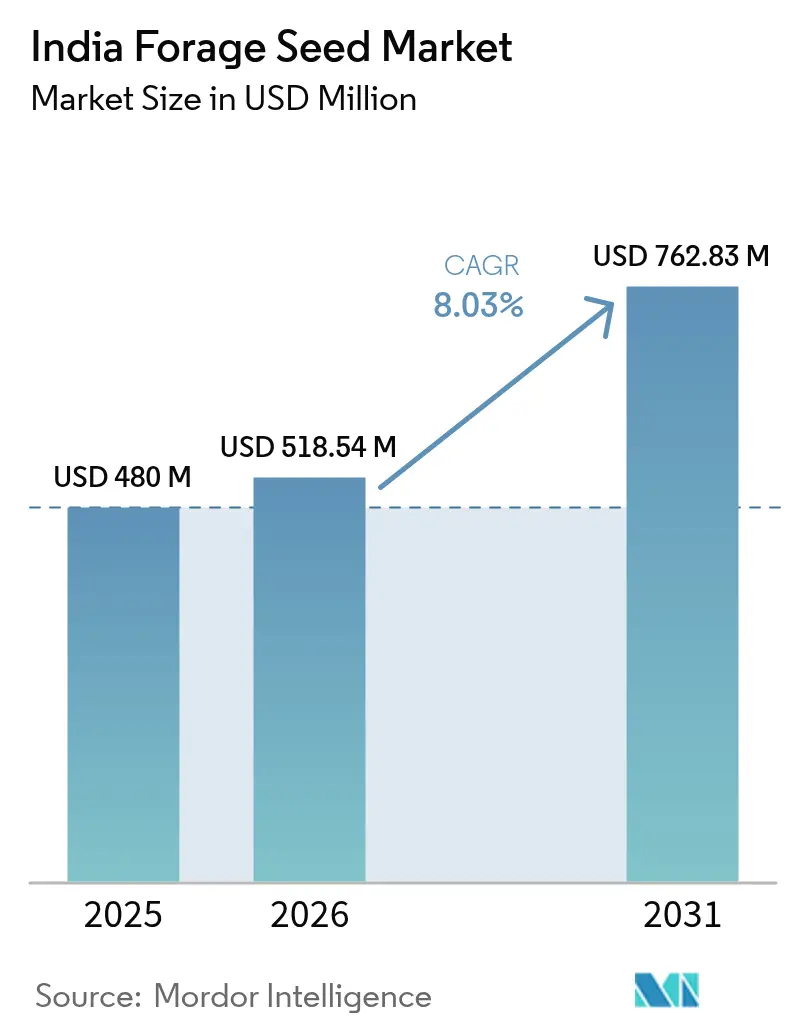
The India forage seed market size is expected to grow from USD 480.0 million in 2025 to USD 518.54 million in 2026 and is forecast to reach USD 762.83 million by 2031 at 8.03% CAGR over 2026-2031. Robust livestock intensification, policy-led fodder security programs, and steady improvement in breeding technologies collectively push demand beyond cyclical feed trends. Rising disposable income sustains higher dairy and meat consumption, while digital seed distribution platforms compress transaction costs, improve varietal authenticity, and deepen reach into underserved rural districts. Technology-enabled hybrids dominate planting decisions, yet open-pollinated varieties expand quickly among price-sensitive smallholders seeking cost relief without sacrificing productivity. Government intervention through the National Livestock Mission and Animal Husbandry Infrastructure Development Fund creates market conditions that favor technology adoption over traditional practices. The allocation of USD 1.8 billion (INR 15,000 crore) for livestock infrastructure development through 2025-26 specifically targets fodder production and seed distribution systems. Regional growth corridors emerge in Punjab, Haryana, and Uttar Pradesh because of cooperative dairy infrastructure. Maharashtra and Gujarat post the fastest acreage gains as commercial forage cultivation aligns with progressive irrigation practices.
Key Report Takeaways
- By breeding technology, hybrids led with 68.40% of the India forage seed market share in 2025, while open-pollinated varieties and hybrid derivatives are forecast to expand at a 10.35% CAGR through 2031.
- By crop, forage corn accounted for a 47.10% share of the India forage seed market size in 2025, and forage sorghum posted the fastest segment growth, advancing at an 11.02% CAGR between 2026 and 2031.
- The forage seed market in India is moderately fragmented, with key players including Advanta Seeds International, Corteva Agriscience, Nuziveedu Seeds Limited, Mangalam Seeds Ltd, and Foragen Seeds Pvt Ltd.
Note: Market size and forecast figures in this report are generated using Mordor Intelligence’s proprietary estimation framework, updated with the latest available data and insights as of 2026.
India Forage Seed Market Trends and Insights
Drivers Impact Analysis*
| Driver | (~) % Impact on CAGR Forecast | Geographic Relevance | Impact Timeline |
|---|---|---|---|
| Growing livestock population | 2.1% | National, concentrated in Punjab, Haryana, Uttar Pradesh, and Rajasthan | Medium term (2-4 years) |
| Rising demand for dairy and meat products | 1.8% | National, with early gains in Gujarat, Maharashtra, and Karnataka | Medium term (2-4 years) |
| Advancements in forage-crop genetics | 1.5% | National, spill-over to marginal farming regions | Long term (≥ 4 years) |
| Government fodder-security schemes | 1.4% | National, targeted support in drought-prone regions | Short term (≤ 2 years) |
| Digitization of seed distribution networks | 0.9% | National, accelerated adoption in tech-forward states | Short term (≤ 2 years) |
| Climate-resilient forage varieties uptake | 1.2% | National, concentrated in water-stressed regions | Long term (≥ 4 years) |
| Source: Mordor Intelligence | |||
Growing Livestock Population
India’s cattle herd climbs to 307.5 million head in 2025 as sustained animal health programs improve calving rates, lifting daily dry-matter requirements and enlarging the Indian forage seed market [1]Source: U.S. Department of Agriculture, “India: Livestock and Products Semi-annual,” usda.gov. Each additional dairy animal requires approximately 15 kg of dry matter daily, creating an immediate demand for multi-cut sorghum and legume mixes that balance energy and protein needs. Uttar Pradesh alone contributes 16.21% of national milk output, forming a concentrated demand hub for certified forage seed [2]Source: Ministry of Fisheries, Animal Husbandry and Dairying, “National Livestock Mission,” pib.gov.in. Breed-improvement grants within the National Livestock Mission stimulate on-farm fodder plots, further embedding quality seed use. The National Livestock Mission's focus on breed development and feed availability directly supports this expansion through certified fodder seed production initiatives.
Rising Demand for Dairy and Meat Products
Per-capita milk intake is projected to reach 550 g per day by 2030, underpinned by income growth and health awareness. Fluid milk alone is forecast to reach 91 million metric tons in 2025, forcing dairies to intensify their feeding programs, which hinge on high-digestibility forages. The shift toward processed dairy products, including cheese and yogurt, requires higher milk quality standards that depend on superior forage nutrition. Meanwhile, factory-use milk climbs toward 125.5 million metric tons as cheese and yogurt lines expand, spurring uptake of legume-rich silage blends for superior butterfat levels[3]Source: OECD-FAO, “OECD-FAO Agricultural Outlook 2020-2029,” oecd-ilibrary.org. Urban meat consumption also rises, particularly broiler demand, encouraging growers to incorporate fresh forage to enhance carcass quality. This trajectory necessitates systematic improvements in forage quality and availability to support the sustainable productivity of grains.
Advancements in Forage-Crop Genetics
The Indian Council of Agricultural Research released 69 new forage cultivars in 2024, including multi-cut sorghum capable of 22 metric tons/ha green matter, sharply above legacy varieties. Genome-edited rice approvals set a precedent that could hasten Clustered regularly interspaced short palindromic repeats (CRISPR) based forage sorghum and pearl millet pipelines, targeting traits such as drought resilience and higher crude protein. Hybrid breeding programs focus on heterosis exploitation to achieve 25-40% yield advantages over open-pollinated varieties, with companies like Advanta and Mahyco investing in proprietary germplasm development. Molecular marker-assisted selection accelerates variety development timelines from 10-12 years to 6-8 years, enabling faster response to emerging market needs and climate challenges.
Government Fodder-Security Schemes
The National Livestock Mission earmarks USD 204 million (INR 1,702 crore) for sustainable feed and animal husbandry, including 50% capital grants for fodder-seed units. Entrepreneur subsidies have already approved 145 projects in Uttar Pradesh, adding 28,000 MT annual fodder capacity. Budget 2025-26 established a National Mission on High-Yielding Seeds, specifically aimed at enhancing seed research and availability. This initiative also increased Kisan Credit Card limits from USD 3,410 to USD 5,680 (INR 3 lakh to Rs 5 lakh), thereby benefiting dairy farmers' access to quality inputs. The Digital Agriculture Mission further invests USD 339 million (INR 2,817 crore) in farmer registries, enabling the precise allocation of subsidized seed packets.
Digitization of Seed Distribution Networks
Indian Farmers Fertilizer Cooperative Limited (IFFCO) e-Bazar processed approximately USD 282 million (INR 2,350 crore) in agri-input sales during the 2024-2025 fiscal year, shipping orders to 27,000 postal codes and proving the viability of rural e-commerce. Blockchain pilots trace seed lots from breeder plots to farm gates, reducing adulteration and cutting middle-layer costs that once dampened smallholder buying power. Common Services Centre (CSC) and IFFCO (Indian Farmers Fertilizer Cooperative Limited) signed a Memorandum of Understanding (MOU) to supply fertilizers and certified seeds to 10,000 Farmer-Producer Organizations, thereby widening the last-mile reach and reducing procurement costs for smallholders.
Restraints Impact Analysis*
| Restraint | (~ ) % Impact on CAGR Forecast | Geographic Relevance | Impact Timeline |
|---|---|---|---|
| Competition with food crops for acreage | -1.8% | National, acute in Punjab, Haryana, and western Uttar Pradesh | Medium term (2-4 years) |
| High input costs of hybrid seeds | -1.2% | National, pronounced impact on smallholder farmers | Short term (≤ 2 years) |
| Fragmented last-mile cold-chain for seeds | -0.9% | National, severe in eastern and northeastern states | Medium term (2-4 years) |
| Low seed-replacement rate among smallholders | -1.1% | National, concentrated in rain-fed farming regions | Long term (≥ 4 years) |
| Source: Mordor Intelligence | |||
Competition with Food Crops for Acreage
Minimum Support Price (MSP) incentives keep farmers centered on rice and wheat together, they captured more than 60% of field acreage in 2024, crowding out dedicated fodder plots. Summer maize for silage shows attractive margins in Punjab, yet groundwater extraction surpasses recharge by 10.66 MAF (Million Acre Feet), jeopardizing long-term viability. Ethanol blending targets create additional competition as sugarcane, rice, and maize are diverted for fuel production, with government restrictions on sugar and rice exports due to lower yields affecting land allocation decisions. The estimated cost of guaranteeing MSP (Minimum Support Price) across all crops at USD 2.38 billion (INR 21,000 crore ) suggests limited fiscal space for expanding support to forage crops in the near term.
High Input Costs of Hybrid Seeds
Hybrid corn seed averages USD 5.8 per kg against USD 2.1 per kg for open-pollinated types, a steep premium for marginal growers. The fertilizer subsidy structure's imbalance, with excessive nitrogen application and under-application of phosphorus and potassium, increases overall input costs while reducing soil health and crop productivity. Post-harvest losses of USD 18.5 billion (INR 1.53 trillion) annually indicate systemic inefficiencies that compound input cost pressures. The blockchain-based seed supply chain analysis reveals that intermediaries' involvement increases costs and reduces transparency, particularly affecting small farmers' access to quality seeds. Regional variations show that lease rates in Punjab have risen significantly, with farmers cultivating leased land facing additional cost pressures that limit their ability to invest in premium forage seed varieties.
*Our forecasts treat driver/restraint impacts as directional, not additive. The impact forecasts reflect baseline growth, mix effects, and variable interactions.
Segment Analysis
By Breeding Technology: Hybrids Drive Premium Market Expansion
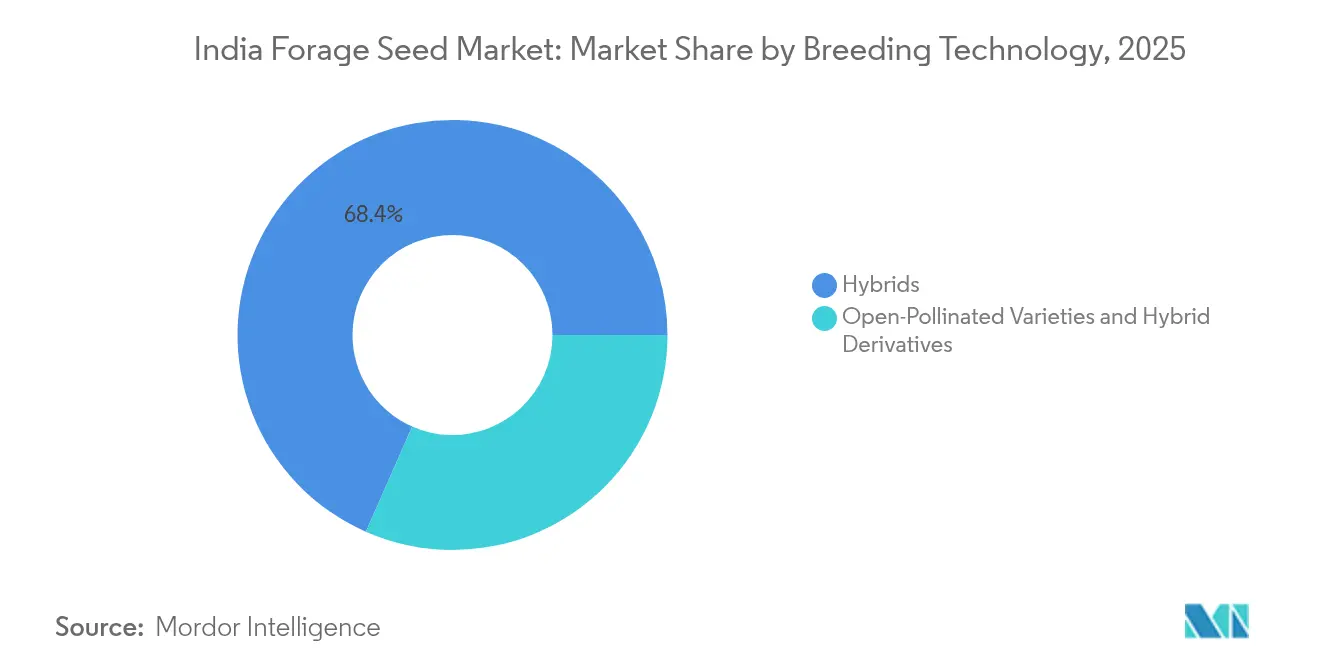
Hybrid varieties contributed 68.40% of the India forage seed market share in 2025. Robust heterosis yields an additional 25-40% biomass, providing a decisive edge for professional dairies optimizing feed conversion. Strong performance secures repeated annual purchases, ensuring the India forage seed market size for hybrids climbs at the fastest-growing segment. Most demand concentrates in Punjab, Haryana, and Gujarat, where irrigation lets farmers exploit multi-cut cycles for hybrid Napier and forage corn. Firms such as Bayer and Syngenta complement seed with herbicide packages that simplify weed management, embedding hybrid loyalty.
Open-pollinated varieties and hybrid derivatives captured the remainder and are now exhibiting the swiftest expansion at a 10.35% CAGR through 2031. Seed-saving potential resonates with resource-constrained farmers in rain-fed areas, extending utility across seasons and reducing cash expenditures. The Indian Council of Agricultural Research (ICAR) pipeline supplies affordable, open-pollinated lines with protein gains of 1-2 percentage points, helping to close nutrition gaps in backyard dairies. Coupled with community seed banks, these varieties expand formal market penetration and balance access to technology across farm segments.



By Crop: Forage Corn Maintains Leadership Through Versatility
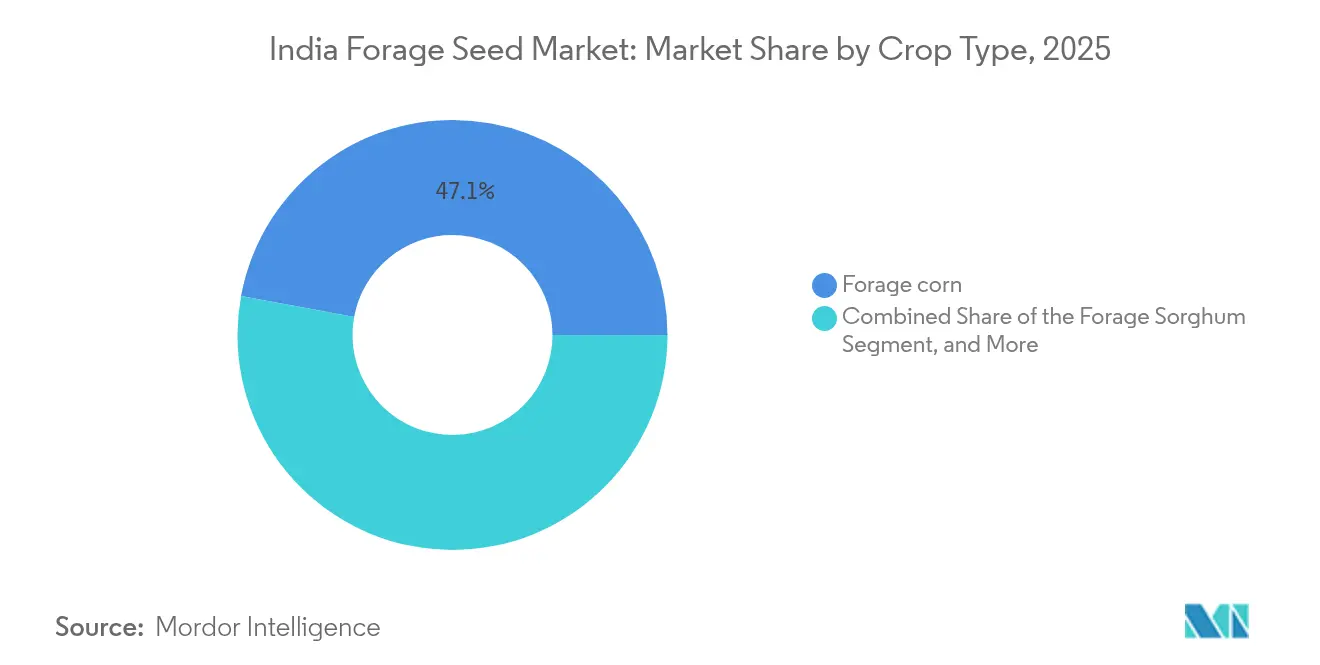
Forage corn held 47.10% of the India forage seed market share in 2025, reflecting its dual role in silage and green chop systems. The segment grows at an 7.68% CAGR, ensuring it remains the anchor crop for the India forage seed market size to 2031. High starch levels translate into higher milk output, drawing strong adoption among cooperatives that pay on fat content. Processing firms subsidize silage bunkers, which lock in corn’s advantage by safeguarding feed quality year-round.
Forage sorghum advances fastest at 11.02% CAGR as climate stress elevates water-efficient choices. Multi-cut and brown-midrib traits improve digestibility, inviting farmers in Maharashtra and Rajasthan to shift acreage. Alfalfa keeps modest expansion because of its protein boost and nitrogen fixation, embedded within organic and mixed-farming systems. Pearl millet and oats cater to niche windows such as arid summer feed gaps and winter fodder in temperate hill zones, collectively representing a flexible supplement that diversifies the India forage seeds market.
Geography Analysis
Northern India dominates demand with Punjab and Haryana supplying organized dairies that require consistent green fodder for high-yield cattle. Irrigated fields, mechanized harvesters, and cooperative milk collection underpin hybrid acceptance rates near 80% of acreage. Uttar Pradesh hosts the largest livestock headcount and, despite variable irrigation, is propelled by district-level fodder depots that bundle seed with agronomic advice.
Western growth corridors in Maharashtra and Gujarat expand acreage at double-digit rates. Gujarat’s cooperative model offers bonus payments for high-protein milk, which motivates farmers to adopt improved forage corn and sorghum. Micro-irrigation and reclaimed groundwater sustain year-round production. Maharashtra’s sugarcane belt incorporates forage crops in rotation, leveraging residual soil fertility to temper production cost. Strong local seed multipliers keep supply reliable and bolster the India forage seed market.
Eastern and northeastern states remain nascent yet promising. High rainfall supports tropical grasses, but cold-chain gaps limit hybrid seed viability. Government logistical grants target 500 village seed stores by 2027, anticipated to lift viability and accelerate adoption. Demonstrations in Assam show 35% milk yield gains from hybrid maize silage, signaling potential once infrastructure matures. The region’s transformation could add a fresh USD 75 million to the India forage seed market over the next five years.
Regulatory Landscape
India forage seed production and marketing are primarily governed by the Seeds Act, 1966 and the Seed Rules, 1968. These rules empower state governments to notify seed certification agencies and appoint Seed Inspectors to draw samples, inspect premises, and take enforcement actions against sub-standard or misbranded seed lots. Quality parameters for major fodder species used in India (for example, berseem, lucerne, oats, and forage grasses) are anchored in the Indian Minimum Seed Certification Standards (IMSCS) issued under the seed certification system, supporting formal trade through foundation, registered, and certified seed classes.
Regulatory oversight is also being strengthened through digitization and plant variety governance. The Ministry of Agriculture and Farmers Welfare operates the SATHI portal (Seed Authentication, Traceability and Holistic Inventory) to strengthen seed traceability and reduce spurious seed circulation across the supply chain, while the Protection of Plant Varieties and Farmers Rights Authority (PPV and FRA) provides the framework for plant variety protection and related compliance. In February 2026, the Ministry reiterated strict enforcement of the Seeds Act, 1966 and the Seeds (Control) Order, 1983 through state governments, reinforcing compliance expectations for labeling, certification documentation, and inventory integrity in the seed trade.
Competitive Landscape
The India forage seed market remains moderately fragmented, with the top five players, including Advanta Seeds International, Corteva Agriscience, Nuziveedu Seeds Limited, Mangalam Seeds Ltd, and Foragen Seeds Pvt Ltd. Market positions hinge on genetic pipelines, regionalized extension teams, and value-added treatments such as biodegradable micronutrient coatings.
Strategic thrusts reflect a pivot toward collaborative R&D and digital outreach. Corteva’s non-GMO (Genetically Modified Organism) hybrid wheat platform, although not applicable to forage, showcases breeder innovation that can be applied to feed cereals, underscoring competitive differentiation. Royal Barenbrug Group and its domestic peers are racing to commercialize climate-ready cultivars, seeking a first-mover advantage in water-stressed zones. Seed firms also partner with fintech companies to integrate credit solutions, thereby lowering the entry barriers for small farmers.
Mid-tier and regional companies exploit localized knowledge, tailoring varietal mixes to micro-climates and cultivating dealer loyalty through agronomic training. Import competition is minimal due to phytosanitary hurdles, yet multinational know-how permeates through joint ventures. Overall, price competition yields ground to performance-based marketing as farmers weigh total feed economics against upfront seed costs.
India Forage Seed Industry Leaders
Corteva Agriscience
Nuziveedu Seeds Limited
Mangalam Seeds Ltd
Foragen Seeds Pvt Ltd
Advanta Seeds International (UPL Limited)
- *Disclaimer: Major Players sorted in no particular order


Market Opportunities and Future Outlook
Import substitution and domestic capacity building in high-demand fodder species remain a key opportunity, particularly where supply constraints persist. The sector has been linked to a recurring domestic deficit in berseem seed, with imports cited at around 9,000 tonnes annually (about INR 109.2 crore), which creates room for organized multiplication, quality assurance, and distribution of certified seed through domestic channels. Public programs and institutions also support scaling infrastructure: the National Dairy Development Board (NDDB) coordinates breeder seed indents with the Department of Agriculture and Farmers Welfare and has supported 17 seed processing plants across agro-climatic zones. This focus on cleaning, grading, and storage is directly relevant for forage seed viability and purity maintenance.
Opportunities also build around product and pipeline choices in protein and climate-resilience traits, along with institutional models that connect seed systems to dairy procurement. In April 2025, ICAR and Birsa Agricultural University recommended release of Birsa Lathyrus-1, reporting 20.7% crude protein and a 15% higher seed yield than the national check, which illustrates near-term scope for premiumization in fodder legumes. Parallel R&D programs at IGFRI and the All India Coordinated Research Project (AICRP) on Forage Crops (2020-2029) cover multi-cut and dual-purpose genotypes across maize, pearl millet, cowpea, and berseem, and adoption can be accelerated through milk federation and State Seeds Corporation channels that bundle certified seed with advisory and buy-back or assured market linkages.
Recent Industry Developments
- February 2026: Corteva Agriscience and BASF India launched the Clearfield Production System for mustard in India, combining non-GM herbicide-tolerant technology with a packaged production approach. While mustard is outside core forage crops, the rollout indicates a stronger push into trait-led systems and stewardship models, which can extend into feed and forage-oriented seed portfolios and dealer networks.
- September 2025: Rasi Seeds, ICAR, and the Indian Grassland and Fodder Research Institute (IGFRI) signed an MoU to enhance production and availability of high-quality forage seeds for the dairy sector. The tie-up reinforces varietal development and multiplication linkages between public research and commercial distribution, supporting wider access to certified fodder seed.
- August 2024: ICAR developed 109 seed varieties, including seven forage varieties, which were introduced by Prime Minister Narendra Modi. The release broadened the pipeline of high-yielding and climate-resilient options available to state seed systems and private multipliers, expanding the addressable portfolio for formal forage seed marketing.


Research Methodology Framework and Report Scope
Market Definition and Coverage
For this study, the India forage seed market is defined as the value of seeds sold for raising fodder crops that are cultivated mainly to feed livestock, covering certified and commercial seed supplied through organized and local channels across India.
Scope exclusions: We exclude fodder output value, hay and silage trade, crop residues used as feed, and on-farm saved seed that is not sold through the market.
Segmentation Overview
- By Breeding Technology
- Hybrids
- Non-Transgenic Hybrids
- Transgenic Hybrids
- Herbicide-Tolerant Hybrids
- Other Traits
- Open-Pollinated Varieties and Hybrid Derivatives
- Hybrids
- By Crop
- Alfalfa
- Forage Corn
- Forage Sorghum
- Other Forage Crops
Data Sources, Market Sizing, and Validation
Desk Research
Desk research was used to build the fact base around forage crop area, livestock population, and seed supply conditions, which helped us set realistic demand pools before modeling value. We relied on public sources such as the Ministry of Agriculture and Farmers Welfare (area and production releases), the Department of Animal Husbandry and Dairying (livestock counts and schemes), and ICAR publications for agronomy and recommended seed rates for key fodder crops.
To cross-check market direction, we also reviewed sources such as FAOSTAT for comparable crop and livestock indicators, DGFT and customs trade statistics for seed import and export signals, and peer reviewed papers on forage crop performance and adoption in Indian conditions. Alongside these, company annual reports, investor presentations, and reputed agriculture press were used to understand distribution reach, pricing behavior, and product focus. A paid subscription for company financials and a patent database were then used selectively to validate scale and pipeline activity. These desk sources are illustrative, and many additional public references were used during data collection, validation, and clarification.
Primary Interviews and Surveys
Primary work focused on checking what drives seed purchases at the farm level, and how demand differs by dairy intensity, irrigation access, and crop preference across Indian states. We spoke with seed producers and distributors, forage agronomists, cooperative-linked field staff, and large dairy and feed stakeholders, and then used their inputs to confirm seed-rate assumptions, price ranges, replacement cycles, and the split between hybrids and open pollinated offerings.
Distribution of primary research fieldwork respondents
| Company type | Respondent position |
|---|---|
| Top tier: 33% | CXOs: 12% |
| Mid tier: 45% | Functional/Unit leaders: 36% |
| Smaller Players: 22% | Managers: 52% |
Market-Sizing & Forecasting
Sizing started with a top down build where forage seed value was reconstructed from the demand pool, using state-level fodder crop area, typical seed replacement rates, and recommended seed rates for major forage crops, which were then adjusted for commercial seed adoption. After this base was formed, we checked it with selective bottom-up approximations such as sampled price bands from channel discussions, supplier and distributor sense checks on annual movement, and crop-wise splits that match field realities.
A few inputs carried most of the weight in the model, including estimated acreage under key fodder crops, hybrid versus open pollinated penetration, seasonal sowing patterns that impact purchase timing, and average selling price progression by crop and breeding type. We also used signals like dairy herd expansion, fodder deficit discussions, and the spread of organized fodder programs in high dairy states to ensure the growth path is practical. Forecasts were built using scenario analysis supported by a simple multivariate regression layer, where drivers like livestock growth, fodder cultivation expansion, and price inflation were varied and then reconciled with what primary respondents considered achievable.
Where bottom-up visibility was weak in smaller states or informal channels, gaps were handled through conservative adoption proxies tied to fodder crop presence and distribution reach, and then rechecked through follow-up calls before finalizing totals.
Data Validation & Update Cycle
Model outputs were validated through multiple checks, starting with consistency tests against independent indicators such as fodder crop area signals, seed trade movement, and the implied price per kg across major crops. Large variances were flagged, and assumptions were revisited until the result matched what most respondents described as plausible for both organized and local routes to market.
Before sign-off, the work goes through stepwise analyst review where calculations, unit conversions, and year alignment are rechecked, followed by targeted re-contact if any input looks out of range. Reports are refreshed annually, and interim updates are made when material events occur, such as policy shifts that affect seed programs or major pricing changes. Right before delivery, a final data pass is completed so clients receive the most current view available.
Mordor Intelligence's India Forage Seed Market Sizing Compared With Other Published Estimates
Published market sizes for forage seed in India can vary widely because each study draws the line differently on what counts as a seed sale, which crops are included, and what year and pricing basis are used. Differences also show up when one estimate uses higher growth assumptions, while another applies more cautious views of adoption and replacement rates.
Key gaps usually come from whether the estimate counts only commercial seed sold into fodder cultivation, or whether it blends in adjacent pasture and turf seed categories, saved seed, or even fodder output value by mistake. Some figures also rely on a single average price without separating hybrids from open pollinated varieties, which can push totals up or down depending on the assumed mix. When the model is anchored on crop area, seed-rate norms, and adoption checks from state-level channels, and then only counts seeds that are purchased through the market, the spread becomes easier to explain, a choice applied by Mordor Intelligence.
Benchmark comparison
| Source | Market Size | Gaps in Research Methodology |
|---|---|---|
| Mordor Intelligence | USD 480.00 M (2025) | |
| Market Research Publisher A | USD 128.81 M (2024) | Uses an earlier base year and appears to apply narrower inclusion and conservative adoption, which can understate commercial seed demand in high dairy corridors and may treat crop coverage differently. |
| Industry Publisher B | USD 187.40 M (2026) | Starts from a later year and may build growth from a smaller starting pool, while using broader end-use framing that can mix non-fodder applications and simplify price and replacement assumptions. |
Across the three figures, most of the difference is explained by year alignment, what is counted as a paid seed sale, and how crop coverage and hybrid mix are handled. By keeping the steps tied to observable crop area and realistic seed-rate and adoption inputs, the estimate stays traceable and can be repeated when assumptions change.


Key Questions Answered in the Report
What is the current value of the India forage seeds market?
The India forage seeds market is valued at USD 518.54 million in 2026.
How fast is the market projected to grow?
It is projected to post an 8.03% CAGR and reach USD 762.83 million by 2031.
Which crop segment leads demand?
Forage corn holds 47.10% of 2025 sales because of its silage versatility.
How do hybrids compare with open-pollinated varieties?
Hybrids deliver 25-40% higher biomass but cost more, open-pollinated varieties grow faster among price-sensitive farmers.
Page last updated on:


 Your data is secure and never sold or shared.


